Basic Life Support
                 & Anaphylaxis
NECA Training


                     Training
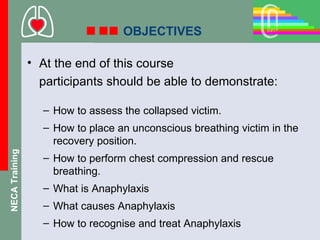
OBJECTIVES

                • At the end of this course
                  participants should be able to demonstrate:

                  – How to assess the collapsed victim.
                  – How to place an unconscious breathing victim in the
                    recovery position.
NECA Training


                  – How to perform chest compression and rescue
                    breathing.
                  – What is Anaphylaxis
                  – What causes Anaphylaxis
                  – How to recognise and treat Anaphylaxis
BACKGROUND

                • Approximately 700,000 cardiac arrests per year
                  in Europe
                • Survival to hospital discharge presently
                  approximately 5-10%

                • Bystander CPR vital intervention before arrival of
                  emergency services
NECA Training


                • Early resuscitation and prompt defibrillation
                  (within 1-2 minutes) can result in >60% survival
CHAIN OF SURVIVAL
NECA Training
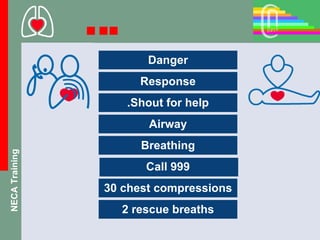
Danger
                     Response
                   .Shout for help
                       Airway
                      Breathing
NECA Training


                      Call 999
                30 chest compressions
                  2 rescue breaths
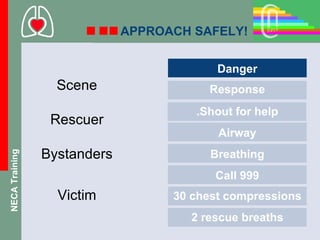
APPROACH SAFELY!

                                          Danger
                  Scene                 Response
                                      .Shout for help
                 Rescuer
                                          Airway
                Bystanders               Breathing
NECA Training


                                         Call 999
                  Victim           30 chest compressions
                                     2 rescue breaths
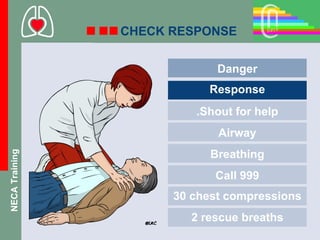
CHECK RESPONSE

                             Danger
                           Response
                         .Shout for help
                             Airway
                            Breathing
NECA Training


                            Call 999
                      30 chest compressions
                        2 rescue breaths
CHECK RESPONSE


                      Shake shoulders gently
                      Ask “Are you all right?”
                      If they responds
                      • Leave as you find.
NECA Training


                      • Find out what is wrong.
                      • Reassess regularly.
SHOUT FOR HELP

                             Danger
                            Response
                         .Shout for help
                             Airway
                            Breathing
NECA Training


                             Call 999
                      30 chest compressions
                         2 rescue breaths
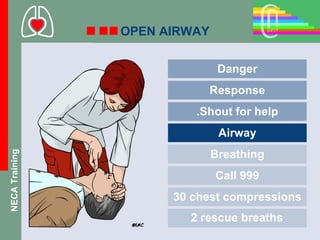
OPEN AIRWAY

                               Danger
                              Response
                         .Shout for help
                               Airway
                              Breathing
NECA Training


                              Call 999
                      30 chest compressions
                        2 rescue breaths
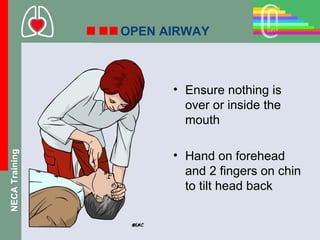
OPEN AIRWAY


                      • Ensure nothing is
                        over or inside the
                        mouth

                      • Hand on forehead
NECA Training


                        and 2 fingers on chin
                        to tilt head back
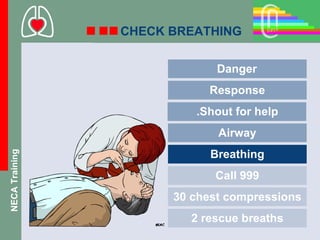
CHECK BREATHING

                             Danger
                           Response
                         .Shout for help
                             Airway
                            Breathing
NECA Training


                            Call 999
                      30 chest compressions
                        2 rescue breaths
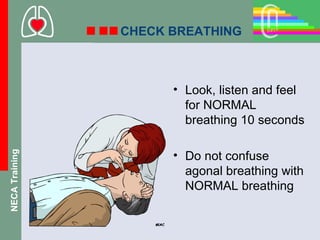
CHECK BREATHING


                      • Look, listen and feel
                        for NORMAL
                        breathing 10 seconds

                      • Do not confuse
NECA Training


                        agonal breathing with
                        NORMAL breathing
YES -BREATHING
                IF BREATHE NORMALLY PLACE
                IN RECOVERY POSITION
NECA Training
NECA Training
NOT BREATHING

                If NOT Breathing or Agonal Breathing

                • Occurs shortly after the heart stops
                  in up to 40% of cardiac arrests

                • Described as barely, heavy, noisy or
NECA Training


                  gasping breathing

                • Recognise as a sign of cardiac arrest
Danger
                     Response
                   .Shout for help
                       Airway
                      Breathing
NECA Training


                      Call 999
                30 chest compressions
                  2 rescue breaths
30 CHEST COMPRESSIONS

                             Danger
                            Response
                         .Shout for help
                             Airway
                            Breathing
NECA Training


                             Call 999
                      30 chest compressions
                         2 rescue breaths
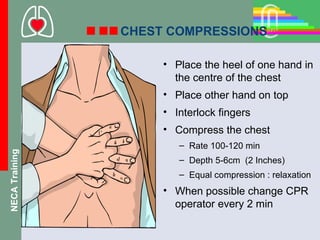
CHEST COMPRESSIONS

                     • Place the heel of one hand in
                       the centre of the chest
                     • Place other hand on top
                     • Interlock fingers
                     • Compress the chest
                        – Rate 100-120 min
NECA Training


                        – Depth 5-6cm (2 Inches)
                        – Equal compression : relaxation
                     • When possible change CPR
                       operator every 2 min
RESCUE BREATHS

                             Danger
                           Response
                         .Shout for help
                             Airway
                            Breathing
NECA Training


                            Call 999
                      30 chest compressions
                        2 rescue breaths
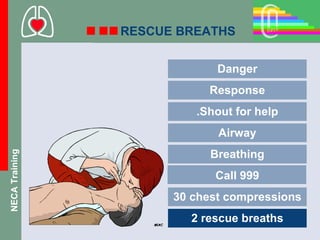
RESCUE BREATHS


                      •   Pinch the nose
                      •   Tilt casualties head back
                      •   Take a normal breath
                      •   Place lips over mouth
                      •   Blow until the chest rises
NECA Training


                      •   Take about 1 second
                      •   Allow chest to fall
                      •   Repeat
CONTINUE CPR
NECA Training


                30              2
CONTINUE CPR
NECA Training


                • Till Ambulance Arrives
                • You Pass Out
                • Signs of Movement and Breathing
Danger
                     Response
                   .Shout for help
                       Airway
                      Breathing
NECA Training


                      Call 999
                30 chest compressions
                  2 rescue breaths
What is Anaphylaxis?


                Anaphylaxis is:
                  - A severe, life-threatening, generalized or
                  systemic hypersensitivity reaction


                        Anaphylaxis is characterised by:
                  -Rapidly developing, life threatening, Airway
NECA Training


                  and/or Breathing and or Circulation
                  problems
                  - Usually with skin and/or mucosal changes.
What Causes Anaphylaxis?

                Stings                     47
                                                  29 wasp, 4 bee, ? 14


                Nuts                             10 peanut, 6 walnut, 2 almond, 2 brazil, 1 hazel, 11 mixed or ?
                                           32
                Food                             5 milk, 2 fish, 2 chickpea, 2 crustacean, 1 banana, 1 snail
                                           13
                ? Food                     18
                                                 5 during meal, 3 milk, 3 nut, 1 each - fish, yeast, sherbet, nectarine,
                                                 grape, strawberry

                Antibiotics                27    11 penicillin, 12 cephalosporin, 2 amphotericin, 1 ciprofloxacin,
                                                 1 vancomycin

                Anaesthetic                35    19 suxamethonium, 7 vecuronium, 6 atracurium, 7 at induction
                drugs
NECA Training


                                                 6 NSAID, 3 ACEI, 5 gelatins, 2 protamine, 2 vitamin K,
                Other drugs                15    1 each - etoposide, diamox, pethidine, local anaesthetic,
                                                 diamorphine, streptokinase

                Contrast media             11    9 iodinated, 1 technetium, 1 fluorescine


                Other                       4    1 latex, 1 hair dye, 1 hydatid,1 idiopathic

                   Suspected triggers for fatal anaphylactic reactions in the UK between 1992‐2001
Anaphylactic reaction is highly likely
                 when following 3 criteria are fulfilled:

                • Sudden onset and rapid progression of
                  symptoms
                • Life-threatening Airway and/or Breathing
NECA Training


                  and/or Circulation problems
                • Skin and/or mucosal changes (flushing,
                  hives, blotches).
RECOGNITION
                                  A B C D E-

                Airway problems

                •Airway swelling e.g. throat and tongue swelling

                •Difficulty in breathing and swallowing

                •Sensation that throat is ‘closing up’
NECA Training


                •Hoarse voice

                •Stridor
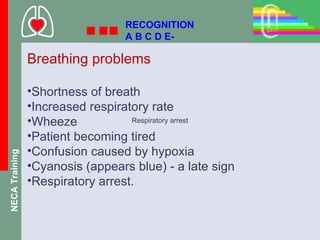
RECOGNITION
                                 A B C D E-

                Breathing problems

                •Shortness of breath
                •Increased respiratory rate
                •Wheeze            Respiratory arrest

                •Patient becoming tired
                •Confusion caused by hypoxia
NECA Training


                •Cyanosis (appears blue) - a late sign
                •Respiratory arrest.
RECOGNITION
                                    A B C D E-

                Circulation problems

                •Signs of shock - pale, clammy

                •Increased pulse rate (tachycardia)

                •Low blood pressure (hypotension)
NECA Training


                •Decreased level of consciousness

                •Cardiac arrest.
RECOGNITION
                                     A B C D E-

                Disability

                •Sense of “impending doom

                •Anxiety, panic

                •Decreased conscious level caused by
                airway, breathing or circulation problem.
NECA Training
RECOGNITION
                                    A B C D E-

                Exposure

                •Skin changes- swelling / Flushing

                •Present in over 80% of anaphylactic reactions

                •Skin, mucosal, or both skin and mucosal
                changes.
NECA Training
NECA Training
                TREATMENT
EPI PEN- Auto-Injector


                •For those with severe reactions
                and difficult to avoid trigger


                •Nursing staff only to prescribe
NECA Training


                •Practice regularly with training
                device

Cpr and anaphylaxis neca

  • 1.
    Basic Life Support & Anaphylaxis NECA Training Training
  • 2.
    OBJECTIVES • At the end of this course participants should be able to demonstrate: – How to assess the collapsed victim. – How to place an unconscious breathing victim in the recovery position. NECA Training – How to perform chest compression and rescue breathing. – What is Anaphylaxis – What causes Anaphylaxis – How to recognise and treat Anaphylaxis
  • 3.
    BACKGROUND • Approximately 700,000 cardiac arrests per year in Europe • Survival to hospital discharge presently approximately 5-10% • Bystander CPR vital intervention before arrival of emergency services NECA Training • Early resuscitation and prompt defibrillation (within 1-2 minutes) can result in >60% survival
  • 4.
  • 5.
    Danger Response .Shout for help Airway Breathing NECA Training Call 999 30 chest compressions 2 rescue breaths
  • 6.
    APPROACH SAFELY! Danger Scene Response .Shout for help Rescuer Airway Bystanders Breathing NECA Training Call 999 Victim 30 chest compressions 2 rescue breaths
  • 7.
    CHECK RESPONSE Danger Response .Shout for help Airway Breathing NECA Training Call 999 30 chest compressions 2 rescue breaths
  • 8.
    CHECK RESPONSE Shake shoulders gently Ask “Are you all right?” If they responds • Leave as you find. NECA Training • Find out what is wrong. • Reassess regularly.
  • 9.
    SHOUT FOR HELP Danger Response .Shout for help Airway Breathing NECA Training Call 999 30 chest compressions 2 rescue breaths
  • 10.
    OPEN AIRWAY Danger Response .Shout for help Airway Breathing NECA Training Call 999 30 chest compressions 2 rescue breaths
  • 11.
    OPEN AIRWAY • Ensure nothing is over or inside the mouth • Hand on forehead NECA Training and 2 fingers on chin to tilt head back
  • 12.
    CHECK BREATHING Danger Response .Shout for help Airway Breathing NECA Training Call 999 30 chest compressions 2 rescue breaths
  • 13.
    CHECK BREATHING • Look, listen and feel for NORMAL breathing 10 seconds • Do not confuse NECA Training agonal breathing with NORMAL breathing
  • 14.
    YES -BREATHING IF BREATHE NORMALLY PLACE IN RECOVERY POSITION NECA Training
  • 15.
  • 16.
    NOT BREATHING If NOT Breathing or Agonal Breathing • Occurs shortly after the heart stops in up to 40% of cardiac arrests • Described as barely, heavy, noisy or NECA Training gasping breathing • Recognise as a sign of cardiac arrest
  • 17.
    Danger Response .Shout for help Airway Breathing NECA Training Call 999 30 chest compressions 2 rescue breaths
  • 18.
    30 CHEST COMPRESSIONS Danger Response .Shout for help Airway Breathing NECA Training Call 999 30 chest compressions 2 rescue breaths
  • 19.
    CHEST COMPRESSIONS • Place the heel of one hand in the centre of the chest • Place other hand on top • Interlock fingers • Compress the chest – Rate 100-120 min NECA Training – Depth 5-6cm (2 Inches) – Equal compression : relaxation • When possible change CPR operator every 2 min
  • 20.
    RESCUE BREATHS Danger Response .Shout for help Airway Breathing NECA Training Call 999 30 chest compressions 2 rescue breaths
  • 21.
    RESCUE BREATHS • Pinch the nose • Tilt casualties head back • Take a normal breath • Place lips over mouth • Blow until the chest rises NECA Training • Take about 1 second • Allow chest to fall • Repeat
  • 22.
  • 23.
    CONTINUE CPR NECA Training • Till Ambulance Arrives • You Pass Out • Signs of Movement and Breathing
  • 24.
    Danger Response .Shout for help Airway Breathing NECA Training Call 999 30 chest compressions 2 rescue breaths
  • 25.
    What is Anaphylaxis? Anaphylaxis is: - A severe, life-threatening, generalized or systemic hypersensitivity reaction Anaphylaxis is characterised by: -Rapidly developing, life threatening, Airway NECA Training and/or Breathing and or Circulation problems - Usually with skin and/or mucosal changes.
  • 26.
    What Causes Anaphylaxis? Stings 47 29 wasp, 4 bee, ? 14 Nuts 10 peanut, 6 walnut, 2 almond, 2 brazil, 1 hazel, 11 mixed or ? 32 Food 5 milk, 2 fish, 2 chickpea, 2 crustacean, 1 banana, 1 snail 13 ? Food 18 5 during meal, 3 milk, 3 nut, 1 each - fish, yeast, sherbet, nectarine, grape, strawberry Antibiotics 27 11 penicillin, 12 cephalosporin, 2 amphotericin, 1 ciprofloxacin, 1 vancomycin Anaesthetic 35 19 suxamethonium, 7 vecuronium, 6 atracurium, 7 at induction drugs NECA Training 6 NSAID, 3 ACEI, 5 gelatins, 2 protamine, 2 vitamin K, Other drugs 15 1 each - etoposide, diamox, pethidine, local anaesthetic, diamorphine, streptokinase Contrast media 11 9 iodinated, 1 technetium, 1 fluorescine Other 4 1 latex, 1 hair dye, 1 hydatid,1 idiopathic Suspected triggers for fatal anaphylactic reactions in the UK between 1992‐2001
  • 27.
    Anaphylactic reaction ishighly likely when following 3 criteria are fulfilled: • Sudden onset and rapid progression of symptoms • Life-threatening Airway and/or Breathing NECA Training and/or Circulation problems • Skin and/or mucosal changes (flushing, hives, blotches).
  • 28.
    RECOGNITION A B C D E- Airway problems •Airway swelling e.g. throat and tongue swelling •Difficulty in breathing and swallowing •Sensation that throat is ‘closing up’ NECA Training •Hoarse voice •Stridor
  • 29.
    RECOGNITION A B C D E- Breathing problems •Shortness of breath •Increased respiratory rate •Wheeze Respiratory arrest •Patient becoming tired •Confusion caused by hypoxia NECA Training •Cyanosis (appears blue) - a late sign •Respiratory arrest.
  • 30.
    RECOGNITION A B C D E- Circulation problems •Signs of shock - pale, clammy •Increased pulse rate (tachycardia) •Low blood pressure (hypotension) NECA Training •Decreased level of consciousness •Cardiac arrest.
  • 31.
    RECOGNITION A B C D E- Disability •Sense of “impending doom •Anxiety, panic •Decreased conscious level caused by airway, breathing or circulation problem. NECA Training
  • 32.
    RECOGNITION A B C D E- Exposure •Skin changes- swelling / Flushing •Present in over 80% of anaphylactic reactions •Skin, mucosal, or both skin and mucosal changes. NECA Training
  • 33.
    NECA Training TREATMENT
  • 34.
    EPI PEN- Auto-Injector •For those with severe reactions and difficult to avoid trigger •Nursing staff only to prescribe NECA Training •Practice regularly with training device