By dr.Kailash nagar
INTRODUCTION
Submersion injury is also known as the
“SILENT EVENT”. It is the second leading cause of
accidental death in children (National SAFE KIDS
Campaign 2005.b)
One of the most important nursing
responsibilities is related to drowning is
prevention of injury, including water safety
education and training, drowning prevention
measures and teaching CPR.
DEFINITION
Drowning is submersion that results in asphyxia
and death within 24 hours. If the child survives
longer than 24 hour after submersion, the event is
referred to as near drowning.
INCIDENCE
 Drowning is the 3rd leading cause of unintentional
injury death worldwide, accounting for 7% of all injury-
related deaths.
 There are an estimated 372 000 annual drowning deaths
worldwide.
 Global estimates may significantly underestimate the
actual public health problem related to drowning.
ETIOLOGY
Most drownings happen in residential swimmimg
pools.
 BATH TUBS
 TOILETS
 Buckets
 Open water sites, such as lakes, rivers and oceans are
more likely to be the site of accident among teenagers.
EPIDEMIOLOGY
Children between 1-4 years are mostly affected.
In teenagers males are mostly affected than females.
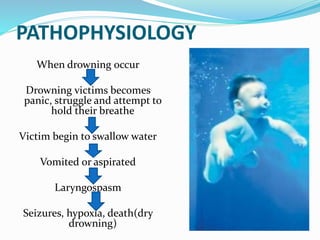
PATHOPHYSIOLOGY
When drowning occur
Drowning victims becomes
panic, struggle and attempt to
hold their breathe
Victim begin to swallow water
Vomited or aspirated
Laryngospasm
Seizures, hypoxia, death(dry
drowning)
If the child becomes unconscious before
Laryngospasm
hypoxia causes loss of airway reflexes and
aspiration of large amounts of water
Wet drowning
As hypoxia increases and acidosis increases
Cardiopulmonary arrest occurs
MANIFESTATIONS
The child’s condition after near drowning
varies with the extent of injury.
Five factors contribute to the child’s eventual prognosis:
i. Age
ii. Submersion time and
iii. water temperature.
iv. Elapsed time before resuscitation efforts are
instituted
v. Neurologic status
vi. Arterial blood gas measurements(especially pH)
 The child with the
poorest prognosis is
younger than 3 years,
has been submerged
longer than 5 minutes
is comatose and has an
arterial ph less than
7.10 and has not
resuscitate within the
first 10 minutes.
 The child who is conscious with adequate respirations
might have mild hypothermia, show slight pulmonary
changes on radiography.
 Children who are
unconscious demonstrate
the consequences related
to whether respiration
are present or absent. If
the respirations are
adequate, the child may
have mild to moderate
hypothermia, respiratory
distress abnormal chest
radiography and arterial
blood gas results
 The child who has
resuscitative efforts is in
markedly poor conditions
with altered mental
status, metabolic acidosis
and altered blood gas
abnormalities,
electrolytes imbalances,
shock,disseminated
intravascular coagulation
leads to death.
THERAPEUTIC MANAGEMENT
I. Pre-hospital management
II. Hospital management
Pre-hospital Management
ii) Rescue the victim and
removed from the water
iii) Prompt initiation of CPR and
activation of emergency medical system
conti…
iv)The goal of pre-hospital care is to
maintained adequate oxygenation and
circulation, minimize secondary organ
damage and take proper
precautions to stabilize cervical spine injuries.
V) The child’s airway is opened,
the nurse begins to suction
to remove mucus and fluid and
delivers oxygen by mask or
by bag valve mask
conti…
VI) Over-inflation of the lungs must be avoided to prevent
pneumothorax
VII) Elevating the head of the bed to 30 degree may help
lower intracranial pressure but should not be done in
spinal injury
conti….
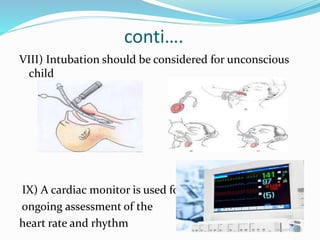
VIII) Intubation should be considered for unconscious
child
IX) A cardiac monitor is used for
ongoing assessment of the
heart rate and rhythm
conti….
X) Warm the child and
removed the wet clothes
XI) I/V lines should be started immediately in critically
ill children.
Hospital management
Continue the pre-hospital goals of maintaining
adequate oxygenation and circulation and initiates
other treatment on the basis of laboratory and
radiologic findings.
Arterial blood gases may indicate the need to correct
acidosis with sodium bicarbonate.
Hypothermia is initiated of warm blankets, oxygen
Fluid and electrolyte correction can be instituted
The child is admitted to the hospital for the
observation even if in stable condition after initial
rescue and emergency treatment
Prevention
Prevention: Pool Fencing
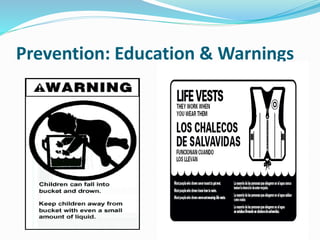
Prevention: Education & Warnings
Prevention: Targeted Education
Prevention: Do not swim alone
Prevention
Prevention
PREVENTION Infants
Parental vigilance
Toddler
 Pool fencing
 Adolescent/Young
Adult
 Control Alcohol/Drug
Use
 Swimming lessons
drowning

drowning

  • 1.
  • 2.
    INTRODUCTION Submersion injury isalso known as the “SILENT EVENT”. It is the second leading cause of accidental death in children (National SAFE KIDS Campaign 2005.b) One of the most important nursing responsibilities is related to drowning is prevention of injury, including water safety education and training, drowning prevention measures and teaching CPR.
  • 3.
    DEFINITION Drowning is submersionthat results in asphyxia and death within 24 hours. If the child survives longer than 24 hour after submersion, the event is referred to as near drowning.
  • 4.
    INCIDENCE  Drowning isthe 3rd leading cause of unintentional injury death worldwide, accounting for 7% of all injury- related deaths.  There are an estimated 372 000 annual drowning deaths worldwide.  Global estimates may significantly underestimate the actual public health problem related to drowning.
  • 5.
    ETIOLOGY Most drownings happenin residential swimmimg pools.
  • 6.
  • 7.
  • 8.
  • 9.
     Open watersites, such as lakes, rivers and oceans are more likely to be the site of accident among teenagers.
  • 10.
    EPIDEMIOLOGY Children between 1-4years are mostly affected. In teenagers males are mostly affected than females.
  • 11.
    PATHOPHYSIOLOGY When drowning occur Drowningvictims becomes panic, struggle and attempt to hold their breathe Victim begin to swallow water Vomited or aspirated Laryngospasm Seizures, hypoxia, death(dry drowning)
  • 12.
    If the childbecomes unconscious before Laryngospasm hypoxia causes loss of airway reflexes and aspiration of large amounts of water Wet drowning As hypoxia increases and acidosis increases Cardiopulmonary arrest occurs
  • 13.
    MANIFESTATIONS The child’s conditionafter near drowning varies with the extent of injury. Five factors contribute to the child’s eventual prognosis: i. Age ii. Submersion time and iii. water temperature. iv. Elapsed time before resuscitation efforts are instituted v. Neurologic status vi. Arterial blood gas measurements(especially pH)
  • 14.
     The childwith the poorest prognosis is younger than 3 years, has been submerged longer than 5 minutes is comatose and has an arterial ph less than 7.10 and has not resuscitate within the first 10 minutes.
  • 15.
     The childwho is conscious with adequate respirations might have mild hypothermia, show slight pulmonary changes on radiography.
  • 16.
     Children whoare unconscious demonstrate the consequences related to whether respiration are present or absent. If the respirations are adequate, the child may have mild to moderate hypothermia, respiratory distress abnormal chest radiography and arterial blood gas results
  • 17.
     The childwho has resuscitative efforts is in markedly poor conditions with altered mental status, metabolic acidosis and altered blood gas abnormalities, electrolytes imbalances, shock,disseminated intravascular coagulation leads to death.
  • 19.
    THERAPEUTIC MANAGEMENT I. Pre-hospitalmanagement II. Hospital management
  • 20.
    Pre-hospital Management ii) Rescuethe victim and removed from the water iii) Prompt initiation of CPR and activation of emergency medical system
  • 21.
    conti… iv)The goal ofpre-hospital care is to maintained adequate oxygenation and circulation, minimize secondary organ damage and take proper precautions to stabilize cervical spine injuries. V) The child’s airway is opened, the nurse begins to suction to remove mucus and fluid and delivers oxygen by mask or by bag valve mask
  • 22.
    conti… VI) Over-inflation ofthe lungs must be avoided to prevent pneumothorax VII) Elevating the head of the bed to 30 degree may help lower intracranial pressure but should not be done in spinal injury
  • 23.
    conti…. VIII) Intubation shouldbe considered for unconscious child IX) A cardiac monitor is used for ongoing assessment of the heart rate and rhythm
  • 24.
    conti…. X) Warm thechild and removed the wet clothes XI) I/V lines should be started immediately in critically ill children.
  • 25.
    Hospital management Continue thepre-hospital goals of maintaining adequate oxygenation and circulation and initiates other treatment on the basis of laboratory and radiologic findings. Arterial blood gases may indicate the need to correct acidosis with sodium bicarbonate. Hypothermia is initiated of warm blankets, oxygen Fluid and electrolyte correction can be instituted The child is admitted to the hospital for the observation even if in stable condition after initial rescue and emergency treatment
  • 27.
  • 28.
  • 29.
  • 30.
  • 31.
  • 32.
  • 33.
  • 35.
    PREVENTION Infants Parental vigilance Toddler Pool fencing  Adolescent/Young Adult  Control Alcohol/Drug Use  Swimming lessons