WEST
SYNDROME
Dr. Liza Bulsara
introduction
 West syndrome is a severe epilepsy
syndrome composed of the triad of
infantile spasms, an interictal
electroencephalogram (EEG) pattern
termed hypsarrhythmia, and mental
retardation, although the diagnosis
can be made even if 1 of the 3
elements is missing (according to
international classification)
 The syndrome's namesake, Dr W J West,
gave the first detailed description of infantile
spasms, which occurred in his own child.In a
letter to the editor of The Lancet in 1841,
West described the events as "bobbings" that
"cause a complete heaving of the head
forward towards his knees, and then
immediately relaxing into the upright
position.These bowings and relaxings would
be repeated alternately at intervals of a few
seconds, and repeated from 10 to 20 or more
times at each attack, which would not
continue more than 2 or 3 minutes; he
sometimes has 2, 3 or more attacks in the
day."
Classification based on etiology:
 Symptomatic:Patients are diagnosed with
symptomatic infantile spasms if an
identifiable factor is responsible for the
syndrome. Virtually any disorder that can
produce brain damage can be associated
with infantile spasms.
◦ Hydrocephalus
◦ Microcephaly
◦ Sturge weber syndrome
◦ Tuberous sclerosis
◦ HIE
◦ Congenital infections
◦ Meningitis
◦ Encephalitis
◦ Pyridoxine deficiency
◦ Maple syrup urine disease
◦ Phenylketonuria
◦ Biotinidase deficiency
◦ Trauma
 Cryptogenic:Patients have cryptogenic
infantile spasms if no cause is identified
but a cause is suspected and the epilepsy
is presumed to be symptomatic.
 Idiopathic:Patients may be considered to
have idiopathic infantile spasms if normal
psychomotor development occurs prior to
the onset of symptoms, no underlying
disorders or presumptive causes are
present, and no neurologic or
neuroradiologic abnormalities exist. Some
investigators use the terms idiopathic and
cryptogenic interchangeably.
A case study:
 A 5 month old baby presented with
generalized convulsion since 20 days.
 Frequency: 4-5/day each lasting for 2-4 min.
 h/o cough-10days
 No H/O LOC ,vomiting, fever, trauma.
 No autonomic involvement
 Perinatal history-uneventful.
 Immunization up to date.
 No similar history in the family.
 No history of drug intake.
On examination:
 Conscious,feeding well.
 No bulging of fontanel.
 No evidence of meningeal irritation.
 No pallor, cyanosis, icterus,
lymphadenopathy,hepatosplenomegaly or
abdominal mass.
 No evidence of any dermatologic lesion.
 Developmental milestones normal.
Ictal manifestations:
 Spasms begin with a sudden, rapid, tonic
contraction of trunk and limb musculature
that gradually relaxes over 0.5-2 seconds.
Spasms last for 3-4 sec. The intensity of
spasms may vary from a subtle head nodding
to a powerful contraction of the body.
 The spasms are of mixed variety consisting
of flexion of the neck and trunk with
extension and abduction of limbs. They are
associated with a cry. The patient then
relaxes, and the jerk repeats. These attacks
occur in clusters throughout the day and last
for 2-4 min.
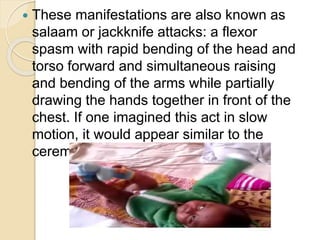
 These manifestations are also known as
salaam or jackknife attacks: a flexor
spasm with rapid bending of the head and
torso forward and simultaneous raising
and bending of the arms while partially
drawing the hands together in front of the
chest. If one imagined this act in slow
motion, it would appear similar to the
ceremonial greeting (Salaam).
Investigations:
 Hb 11.0 gm%
 TLC 9,400/cumm
 DLC 52/45/01/02/00
 ESR 18mm/1st hr
 Sr. Ca 8.9 mg/dl
 NCCT brain- within normal limit.
 ECG- within normal limit.
 EEG- hypsarrhythmia.
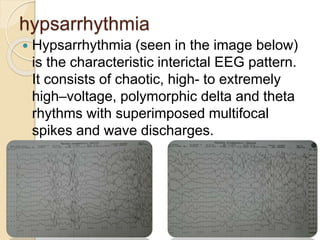
hypsarrhythmia
 Hypsarrhythmia (seen in the image below)
is the characteristic interictal EEG pattern.
It consists of chaotic, high- to extremely
high–voltage, polymorphic delta and theta
rhythms with superimposed multifocal
spikes and wave discharges.
Treatment:
 Compared with other forms of
epilepsy, West syndrome is difficult to
treat. To raise the chance of
successful treatment and keep down
the risk of longer-lasting effects, it is
very important that the condition is
diagnosed as early as possible and
that treatment begins straight away.
However, there is no guarantee that
therapy will work even in this case.
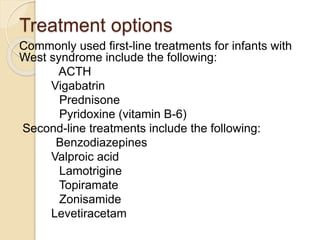
Treatment options
Commonly used first-line treatments for infants with
West syndrome include the following:
ACTH
Vigabatrin
Prednisone
Pyridoxine (vitamin B-6)
Second-line treatments include the following:
Benzodiazepines
Valproic acid
Lamotrigine
Topiramate
Zonisamide
Levetiracetam
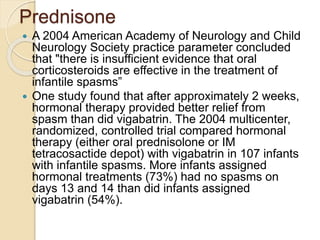
Prednisone
 A 2004 American Academy of Neurology and Child
Neurology Society practice parameter concluded
that "there is insufficient evidence that oral
corticosteroids are effective in the treatment of
infantile spasms”
 One study found that after approximately 2 weeks,
hormonal therapy provided better relief from
spasm than did vigabatrin. The 2004 multicenter,
randomized, controlled trial compared hormonal
therapy (either oral prednisolone or IM
tetracosactide depot) with vigabatrin in 107 infants
with infantile spasms. More infants assigned
hormonal treatments (73%) had no spasms on
days 13 and 14 than did infants assigned
vigabatrin (54%).
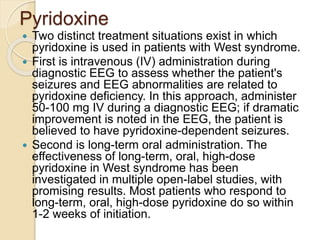
Pyridoxine
 Two distinct treatment situations exist in which
pyridoxine is used in patients with West syndrome.
 First is intravenous (IV) administration during
diagnostic EEG to assess whether the patient's
seizures and EEG abnormalities are related to
pyridoxine deficiency. In this approach, administer
50-100 mg IV during a diagnostic EEG; if dramatic
improvement is noted in the EEG, the patient is
believed to have pyridoxine-dependent seizures.
 Second is long-term oral administration. The
effectiveness of long-term, oral, high-dose
pyridoxine in West syndrome has been
investigated in multiple open-label studies, with
promising results. Most patients who respond to
long-term, oral, high-dose pyridoxine do so within
1-2 weeks of initiation.
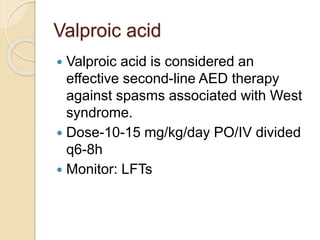
Valproic acid
 Valproic acid is considered an
effective second-line AED therapy
against spasms associated with West
syndrome.
 Dose-10-15 mg/kg/day PO/IV divided
q6-8h
 Monitor: LFTs
ACTH
 A 2004 American Academy of Neurology
and Child Neurology Society practice
parameter concluded that "ACTH is
probably effective for the short-term
treatment of infantile spasms and in
resolution of hypsarrhythmia” and "here
is insufficient evidence to recommend
the optimum dosage and duration of
treatment with ACTH for the treatment of
infantile spasms."
 Corticotropin is associated with serious,
potentially life-threatening adverse effects. It
must be administered intramuscularly, and
such injections are painful for the infant to
receive and are unpleasant for the parent to
perform.
 A prospective, single-blind study
demonstrated no difference in effectiveness
between high-dose, long-duration
corticotropin (150 U/m2/day for 3 wk,
tapering over 9 wk) and low-dose, short-
duration corticotropin (20-30 U/day for 2-6
wk, tapering over 1 wk with respect to spasm
cessation and improvement in the patient's
EEG. Hypertension was more common with
larger doses
Vigabatrin
 Vigabatrin is indicated as monotherapy for
children aged 1 month to 2 year with infantile
spasms. Its precise mechanism of action is
unknown. The drug is a selective, irreversible
inhibitor of gamma-aminobutyric acid
transaminase (GABA-T). GABA-T
metabolizes GABA, an inhibitory
neurotransmitter, thereby increasing CNS
GABA levels. Vigabatrin use must be
weighed against the risk of permanent vision
loss.Vigabatrin was approved by the US
Food and Drug Administration (FDA) in
August 2009. It is available only from a
restricted access program.
Topiramate
 Topiramate is a sulfamate-substituted
monosaccharide with a broad spectrum of
antiepileptic activity that may have state-
dependent sodium channel blocking action,
may potentiate the inhibitory activity of the
neurotransmitter GABA, and may block
glutamate activity.
 A 2004 American Academy of Neurology and
Child Neurology Society practice parameter
concluded that "there is insufficient evidence
to recommend topiramate for the treatment of
infantile spasms."
Levetiracetam
 Levetiracetam's mechanism of action is
the inhibition of N-type calcium channels,
the modulation of GABA and glycine
receptors, and binding to SVA2 protein.
 An open-label trial of 5 infants with new-
onset, cryptogenic infantile spasms
showed levetiracetam to be clinically
effective. Two children became seizure
free, while 2 others showed a minimum of
50% reduction in seizures. The dose
ranged from 30-60 mg/kg/day.
clonazepam
 Clonazepam is considered a second-line
AED therapy against spasms associated
with West syndrome. However, adverse
effects and the development of tolerance
limit the drug's usefulness over time.
Nitrazepam and clobazam are not
approved by the FDA but are available in
many countries worldwide.
Treatment given
 Methyl prednisone 1mg/kg/day
 Pyridoxine hydrochloride 10mg/day
 Sodium valproate 10-15mg/kg/day
There was only a single episode of
seizure after the commencement of the
steroid therapy.
Prognosis
 It is not possible to make a generalised
prognosis for development due to the
variability of causes, the differing types of
symptoms and etiology. Each case must
be considered individually.
 The prognosis for children with idiopathic
West syndrome are mostly more positive
than for those with the cryptogenic or
symptomatic forms.
 A large proportion (up to 90%) of children suffer
severe physical and cognitive impairments, even
when treatment for the attacks is successful.
This is not usually because of the epileptic fits,
but rather because of the causes behind them
(cerebral anomalies or their location or degree of
severity).
 Permanent damage often associated with West
syndrome in the literature include cognitive
disabilities, learning difficulties and behavioural
problems, cerebral palsy (up to 5 out of 10
children), psychological disorders and often
autism (in around 3 out of 10 children). Once
more, the etiology of each individual case of
West syndrome must be considered when
debating cause and effect.
 Statistically, 5 out of every 100 children with West syndrome do not
survive beyond five years of age, in some cases due to the cause of the
syndrome, in others for reasons related to their medication. Only less
than half of all children can become entirely free from attacks with the
help of medication. Statistics show that treatment produces a
satisfactory result in around three out of ten cases, with only one in
every 25 children's cognitive and motoric development developing more
or less normally.
 Sometimes West syndrome turns into a focal or other generalised
epilepsy. Around half of all children develop Lennox-Gastaut syndrome.
Thank you

West syndrome

  • 1.
  • 2.
    introduction  West syndromeis a severe epilepsy syndrome composed of the triad of infantile spasms, an interictal electroencephalogram (EEG) pattern termed hypsarrhythmia, and mental retardation, although the diagnosis can be made even if 1 of the 3 elements is missing (according to international classification)
  • 3.
     The syndrome'snamesake, Dr W J West, gave the first detailed description of infantile spasms, which occurred in his own child.In a letter to the editor of The Lancet in 1841, West described the events as "bobbings" that "cause a complete heaving of the head forward towards his knees, and then immediately relaxing into the upright position.These bowings and relaxings would be repeated alternately at intervals of a few seconds, and repeated from 10 to 20 or more times at each attack, which would not continue more than 2 or 3 minutes; he sometimes has 2, 3 or more attacks in the day."
  • 4.
    Classification based onetiology:  Symptomatic:Patients are diagnosed with symptomatic infantile spasms if an identifiable factor is responsible for the syndrome. Virtually any disorder that can produce brain damage can be associated with infantile spasms. ◦ Hydrocephalus ◦ Microcephaly ◦ Sturge weber syndrome
  • 5.
    ◦ Tuberous sclerosis ◦HIE ◦ Congenital infections ◦ Meningitis ◦ Encephalitis ◦ Pyridoxine deficiency ◦ Maple syrup urine disease ◦ Phenylketonuria ◦ Biotinidase deficiency ◦ Trauma
  • 6.
     Cryptogenic:Patients havecryptogenic infantile spasms if no cause is identified but a cause is suspected and the epilepsy is presumed to be symptomatic.  Idiopathic:Patients may be considered to have idiopathic infantile spasms if normal psychomotor development occurs prior to the onset of symptoms, no underlying disorders or presumptive causes are present, and no neurologic or neuroradiologic abnormalities exist. Some investigators use the terms idiopathic and cryptogenic interchangeably.
  • 7.
    A case study: A 5 month old baby presented with generalized convulsion since 20 days.  Frequency: 4-5/day each lasting for 2-4 min.  h/o cough-10days  No H/O LOC ,vomiting, fever, trauma.  No autonomic involvement  Perinatal history-uneventful.  Immunization up to date.  No similar history in the family.  No history of drug intake.
  • 8.
    On examination:  Conscious,feedingwell.  No bulging of fontanel.  No evidence of meningeal irritation.  No pallor, cyanosis, icterus, lymphadenopathy,hepatosplenomegaly or abdominal mass.  No evidence of any dermatologic lesion.  Developmental milestones normal.
  • 9.
    Ictal manifestations:  Spasmsbegin with a sudden, rapid, tonic contraction of trunk and limb musculature that gradually relaxes over 0.5-2 seconds. Spasms last for 3-4 sec. The intensity of spasms may vary from a subtle head nodding to a powerful contraction of the body.  The spasms are of mixed variety consisting of flexion of the neck and trunk with extension and abduction of limbs. They are associated with a cry. The patient then relaxes, and the jerk repeats. These attacks occur in clusters throughout the day and last for 2-4 min.
  • 10.
     These manifestationsare also known as salaam or jackknife attacks: a flexor spasm with rapid bending of the head and torso forward and simultaneous raising and bending of the arms while partially drawing the hands together in front of the chest. If one imagined this act in slow motion, it would appear similar to the ceremonial greeting (Salaam).
  • 11.
    Investigations:  Hb 11.0gm%  TLC 9,400/cumm  DLC 52/45/01/02/00  ESR 18mm/1st hr  Sr. Ca 8.9 mg/dl  NCCT brain- within normal limit.  ECG- within normal limit.  EEG- hypsarrhythmia.
  • 12.
    hypsarrhythmia  Hypsarrhythmia (seenin the image below) is the characteristic interictal EEG pattern. It consists of chaotic, high- to extremely high–voltage, polymorphic delta and theta rhythms with superimposed multifocal spikes and wave discharges.
  • 13.
    Treatment:  Compared withother forms of epilepsy, West syndrome is difficult to treat. To raise the chance of successful treatment and keep down the risk of longer-lasting effects, it is very important that the condition is diagnosed as early as possible and that treatment begins straight away. However, there is no guarantee that therapy will work even in this case.
  • 14.
    Treatment options Commonly usedfirst-line treatments for infants with West syndrome include the following: ACTH Vigabatrin Prednisone Pyridoxine (vitamin B-6) Second-line treatments include the following: Benzodiazepines Valproic acid Lamotrigine Topiramate Zonisamide Levetiracetam
  • 15.
    Prednisone  A 2004American Academy of Neurology and Child Neurology Society practice parameter concluded that "there is insufficient evidence that oral corticosteroids are effective in the treatment of infantile spasms”  One study found that after approximately 2 weeks, hormonal therapy provided better relief from spasm than did vigabatrin. The 2004 multicenter, randomized, controlled trial compared hormonal therapy (either oral prednisolone or IM tetracosactide depot) with vigabatrin in 107 infants with infantile spasms. More infants assigned hormonal treatments (73%) had no spasms on days 13 and 14 than did infants assigned vigabatrin (54%).
  • 16.
    Pyridoxine  Two distincttreatment situations exist in which pyridoxine is used in patients with West syndrome.  First is intravenous (IV) administration during diagnostic EEG to assess whether the patient's seizures and EEG abnormalities are related to pyridoxine deficiency. In this approach, administer 50-100 mg IV during a diagnostic EEG; if dramatic improvement is noted in the EEG, the patient is believed to have pyridoxine-dependent seizures.  Second is long-term oral administration. The effectiveness of long-term, oral, high-dose pyridoxine in West syndrome has been investigated in multiple open-label studies, with promising results. Most patients who respond to long-term, oral, high-dose pyridoxine do so within 1-2 weeks of initiation.
  • 17.
    Valproic acid  Valproicacid is considered an effective second-line AED therapy against spasms associated with West syndrome.  Dose-10-15 mg/kg/day PO/IV divided q6-8h  Monitor: LFTs
  • 18.
    ACTH  A 2004American Academy of Neurology and Child Neurology Society practice parameter concluded that "ACTH is probably effective for the short-term treatment of infantile spasms and in resolution of hypsarrhythmia” and "here is insufficient evidence to recommend the optimum dosage and duration of treatment with ACTH for the treatment of infantile spasms."
  • 19.
     Corticotropin isassociated with serious, potentially life-threatening adverse effects. It must be administered intramuscularly, and such injections are painful for the infant to receive and are unpleasant for the parent to perform.  A prospective, single-blind study demonstrated no difference in effectiveness between high-dose, long-duration corticotropin (150 U/m2/day for 3 wk, tapering over 9 wk) and low-dose, short- duration corticotropin (20-30 U/day for 2-6 wk, tapering over 1 wk with respect to spasm cessation and improvement in the patient's EEG. Hypertension was more common with larger doses
  • 20.
    Vigabatrin  Vigabatrin isindicated as monotherapy for children aged 1 month to 2 year with infantile spasms. Its precise mechanism of action is unknown. The drug is a selective, irreversible inhibitor of gamma-aminobutyric acid transaminase (GABA-T). GABA-T metabolizes GABA, an inhibitory neurotransmitter, thereby increasing CNS GABA levels. Vigabatrin use must be weighed against the risk of permanent vision loss.Vigabatrin was approved by the US Food and Drug Administration (FDA) in August 2009. It is available only from a restricted access program.
  • 21.
    Topiramate  Topiramate isa sulfamate-substituted monosaccharide with a broad spectrum of antiepileptic activity that may have state- dependent sodium channel blocking action, may potentiate the inhibitory activity of the neurotransmitter GABA, and may block glutamate activity.  A 2004 American Academy of Neurology and Child Neurology Society practice parameter concluded that "there is insufficient evidence to recommend topiramate for the treatment of infantile spasms."
  • 22.
    Levetiracetam  Levetiracetam's mechanismof action is the inhibition of N-type calcium channels, the modulation of GABA and glycine receptors, and binding to SVA2 protein.  An open-label trial of 5 infants with new- onset, cryptogenic infantile spasms showed levetiracetam to be clinically effective. Two children became seizure free, while 2 others showed a minimum of 50% reduction in seizures. The dose ranged from 30-60 mg/kg/day.
  • 23.
    clonazepam  Clonazepam isconsidered a second-line AED therapy against spasms associated with West syndrome. However, adverse effects and the development of tolerance limit the drug's usefulness over time. Nitrazepam and clobazam are not approved by the FDA but are available in many countries worldwide.
  • 24.
    Treatment given  Methylprednisone 1mg/kg/day  Pyridoxine hydrochloride 10mg/day  Sodium valproate 10-15mg/kg/day There was only a single episode of seizure after the commencement of the steroid therapy.
  • 25.
    Prognosis  It isnot possible to make a generalised prognosis for development due to the variability of causes, the differing types of symptoms and etiology. Each case must be considered individually.  The prognosis for children with idiopathic West syndrome are mostly more positive than for those with the cryptogenic or symptomatic forms.
  • 26.
     A largeproportion (up to 90%) of children suffer severe physical and cognitive impairments, even when treatment for the attacks is successful. This is not usually because of the epileptic fits, but rather because of the causes behind them (cerebral anomalies or their location or degree of severity).  Permanent damage often associated with West syndrome in the literature include cognitive disabilities, learning difficulties and behavioural problems, cerebral palsy (up to 5 out of 10 children), psychological disorders and often autism (in around 3 out of 10 children). Once more, the etiology of each individual case of West syndrome must be considered when debating cause and effect.
  • 27.
     Statistically, 5out of every 100 children with West syndrome do not survive beyond five years of age, in some cases due to the cause of the syndrome, in others for reasons related to their medication. Only less than half of all children can become entirely free from attacks with the help of medication. Statistics show that treatment produces a satisfactory result in around three out of ten cases, with only one in every 25 children's cognitive and motoric development developing more or less normally.  Sometimes West syndrome turns into a focal or other generalised epilepsy. Around half of all children develop Lennox-Gastaut syndrome.
  • 28.