PAEDIATRIC NURSING
(SNS0112)
“Cerebral Palsy”
P R E P A R E D B Y : E N D A N G L I S N A N I
I D : 0 1 2 0 1 3 0 3 0 8 7 2
L E C T U R E N A M E : M D M . R O S M A N I Z A
LEARNING OUTCOME
1. Define of cerebral palsy (CP)
2. List the etiology of cerebral palsy (CP)
3. State the type of cerebral palsy (CP)
4. List the clinical manifestation of cerebral palsy (CP)
5. Identify the Diagnostic test for cerebral palsy (CP)
6. Explain the management related to cerebral palsy (CP)
7. Describe the nursing responsibility for child with cerebral
palsy (CP)
8. Create nursing diagnosis child with cerebral palsy (CP)
9. Appreciate the knowledge of nursing management of
cerebral palsy (CP) in order to give quality and client care
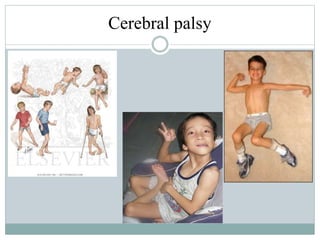
Cerebral palsy
Definition
 Cerebral Palsy (CP) is a group of permanent disorder of
the development of movement and posture, causing activity
limitation.
(Hockenberry & wilson)
 Cerebral palsy (CP) is a motor disorder, the condition
involves disturbances of sensation, perception,
communication, cognition and behavior, secondary
musculoskeletal problems and epilepsy.
(Hockenberry & wilson)
Cont….
 CP is term used for a group of non progressive disorder of
movement and posture caused by abnormal development
of damage to motor control centers of the brain.
(medical dictionary.com)
 CP is a disorder of the movement, muscle tone,/ posture
that is caused by an insult to the immature, developing
brain, most often before birth.
(mayoclinic.com)
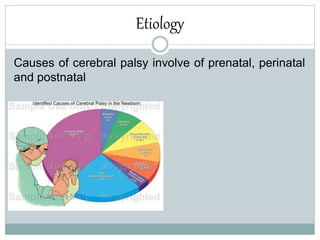
Etiology
Causes of cerebral palsy involve of prenatal, perinatal
and postnatal
Cont….
Maternal
 Diabetes/hyperthyroidism
 Exposure to radiation/toxins
 Malnutrition
 Cognitive impairment/seizures
 Infections
 Incompetent cervix
 Bleeding
 Polyhydramnios
 Genetic abnormalities
 Previous child with development disabilities
 Previous premature birth
 Medication use(e.g, thyroid, estrogen,progesterone)
 Severe proteinuria
Prenatal
Gestational
 Chromosomes abnormalities
 Genetic syndrome
 Teratogen
 Rh incompatibility infections
 Congenital malformations
 Fetal development
abnormalities
 Problems in placenta
functioning
 Inflammatory response
Cont….
Labor and delivery
 Premature delivery
 Prolonged rupture of membranes
 Fetal heart rate depression
 Abnormal presentation
 Long labor
 Preeclampsia
 Asphyxia
Cont….
Perinatal
 prematurity and associated problems
 Sepsis and/ or central nervous system infections
 Seizure
 Intraventricular hemorrrhage
 Periventicular hemorrhage
 Meconium aspiration
 Number of days on mechanical ventilation
 Persistent pulmonary hypertension
 Intrauterine growth restriction
 Low birth weight
Cont….
postnatal/childhood
 Brain injury
 Meningitis or encephalitis
 Toxins
 Traumatic brain injury
 Infections
 stroke
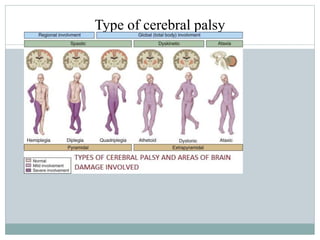
Type of cerebral palsy
1) Spastic (pyramidal)
characterized by persistent primitive reflexes, positive babinski reflex, ankle
clonus, exaggerated stretch reflex, eventual development of contractures.
Type of spastic cerebral palsy:
 Hemiplegia :motor dysfunction on one side of the body , upper extremity
more affected than lower.
 Diplegia :all extremities affected, but lower extremities more effected than
upper.
 Tetraplegia(quadriplegia) :all four extremities involved.
 Triplegia :involving three extremities
 Monoplegia :involving only one extremities
 Paraplegia :pure cerebral paraplegia of lower extremities.
Cont….
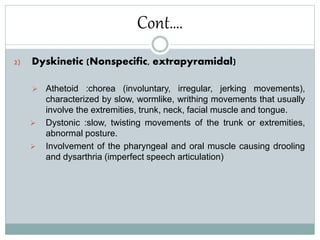
2) Dyskinetic (Nonspecific, extrapyramidal)
 Athetoid :chorea (involuntary, irregular, jerking movements),
characterized by slow, wormlike, writhing movements that usually
involve the extremities, trunk, neck, facial muscle and tongue.
 Dystonic :slow, twisting movements of the trunk or extremities,
abnormal posture.
 Involvement of the pharyngeal and oral muscle causing drooling
and dysarthria (imperfect speech articulation)
Cont….
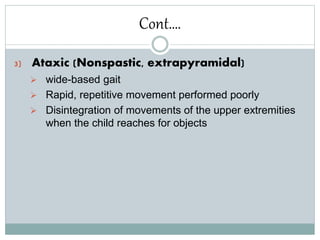
3) Ataxic (Nonspastic, extrapyramidal)
 wide-based gait
 Rapid, repetitive movement performed poorly
 Disintegration of movements of the upper extremities
when the child reaches for objects
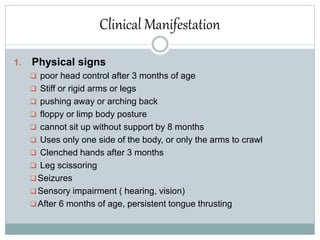
Clinical Manifestation
1. Physical signs
 poor head control after 3 months of age
 Stiff or rigid arms or legs
 pushing away or arching back
 floppy or limp body posture
 cannot sit up without support by 8 months
 Uses only one side of the body, or only the arms to crawl
 Clenched hands after 3 months
 Leg scissoring
Seizures
Sensory impairment ( hearing, vision)
After 6 months of age, persistent tongue thrusting
Cont….
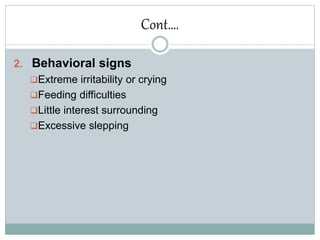
2. Behavioral signs
Extreme irritability or crying
Feeding difficulties
Little interest surrounding
Excessive slepping
Diagnostic test
 Physical examination.
 History taking.
 Neurologic assessment .
 Magnetic resonance imaging (MRI) which uses radio and magnetic
waves to study the brain in more detail.
 Ultrasound :uses sound waves to detect certain type of structural and
anatomic abnormalities.
 Computerised tomography (CT) scan, uses a series of X-rays that are
then assembled by a computer to create a detailed 3-D model of your
child's brain.
Cont….
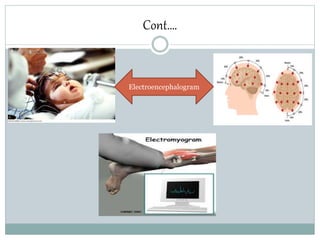
 Electroencephalogram (EEG), where small electrodes are
placed on the scalp to monitor brain activity.
 Electromyogram (EMG) and nerve conduction studies
(NCS) to testing the electrical activity of muscles and to
measures the conducting function of nerves.
 Laboratory studies, to detect any blood clotting and screen
for genetic or metabolic problems.
 Additional tests: Vision impairment, Hearing impairment,
Speech delays or impairments, Intellectual disabilities,
Other developmental delays, Movement disorders
Cont….
Electroencephalogram
Treatment
Medical treatment
Therapy can help a person with cerebral palsy to enhance
functional abilities and therapy is chiefly symptomatic and
preventive.
The broad aims of therapy are :
o To establish locomotion, communication and self help.
o To gain optimum appearance and integration of motor
functions.
o To correct associated defects as early and effectively .
o To provide educational opportunities adapted to the individual
child’s needs and capabilities
o To promote socialization experiences with other affected
unaffected children
Cont….
The therapy treatment include:
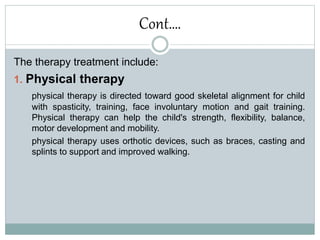
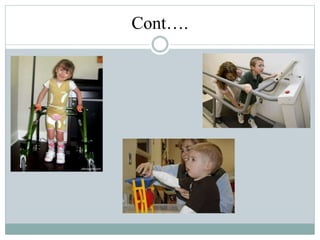
1. Physical therapy
physical therapy is directed toward good skeletal alignment for child
with spasticity, training, face involuntary motion and gait training.
Physical therapy can help the child's strength, flexibility, balance,
motor development and mobility.
physical therapy uses orthotic devices, such as braces, casting and
splints to support and improved walking.
Cont….
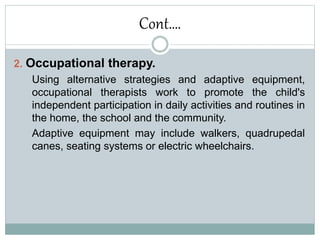
2. Occupational therapy.
Using alternative strategies and adaptive equipment,
occupational therapists work to promote the child's
independent participation in daily activities and routines in
the home, the school and the community.
Adaptive equipment may include walkers, quadrupedal
canes, seating systems or electric wheelchairs.
Cont….
3. Speech and language therapy
Speech-language pathologists can help improve the
child's ability to speak clearly or to communicate using
sign language.
4. Recreation therapy
this therapy can help improve your child's motor skills,
speech and emotional well-being.
Cont….
Cont….
Pharmacological treatment
The goal of drug therapy is to reduce the effects of cerebral palsy and
prevent complications.
 Analgesic drug, to reduce intense pain or muscle spasm.
 Botulinum toxin type A, used to reduce spasticity in targeted muscle of
the upper and lower extremities.
 Inhaled nitrous / oral midazolam used for sedation duringbotulinum
toxin A injection.
 Dantrolene sodium, baclofen, and diazepam to improving muscle
coordination and to muscle relaxation.
 Anticonvulsants drug, to relieve or stop seizures
Cont….
Surgical treatment
Surgery used to correct problems with bones and joints,
by lengthening any muscles and tendons that are too short and
causing problems.
1. Orthopedic surgery
Orthopedic surgery may be required to correct contracture or
spastic deformities, to provide stability for an uncontrolled joint, to
address bone malalignment, and to provide balanced muscle
power.
Example for orthopedic surgery :tendon transfer, muscle lengthening,
and spinal deformities.
Cont…
2. Selective dorsal rhizotomy (SDR)
Selective dorsal rhizotomy (SDR) is a surgical procedure that can
help children with particularly severe muscle stiffness in their legs to
improve their walking. The operation involves cutting some of the
nerves in the lower spinal column, which can help relieve leg
stiffness.
3. Gastrostomy
surgery may performed to improve feedings, correct
gastroesophageal reflux disease and correct associated dental
problems.
Nursing responsibility
 Assessment of infants for abnormal muscle tones, inability to achieve
milestones, and persistence of neonatal reflexes .
 Reinforce the therapeutic plan and assist the family devising and
modifying equipment and activities to continue the therapy program the
home.
 Encourage parents to define their concerns, acknowledge the concerns
as genuine, and ask the parents what approach.
 Ensure as adequate nutritional and caloric intake.
 Monitor the body weight
 Assistance and Advice parents to administration medication through
gastrostomy tube to prevent clotting.
Cont….
 Flush the feeding tube with more water after administration
medication.
 Immunization should be administered to prevent childhood
illness and protect against respiratory tract infections such
as influenza.
 Educate families in the principle of family centered care
and parents professional collaboration.
Nursing diagnosis
1. Impaired physical mobility related to decreased muscle
strength and control as evidence the child limited ability to
perform gross motor skills.
Objective: the child will have adequate mobility to perform
activities of daily living to maximum potential.
Cont…
Nursing intervention :
 Assess the child general condition, such as level of mobility.
rationale : to known the child level of mobility and to plan the next
intervention for child.
 Plan activities to use gross and fine motor skills (e.g. holding pen or
eating utensils, toy positioned to encourage reaching and rolling over)
rationale: many activities of daily living and play activities promote
physical development.
 Teach family to perform stretching exercises on affected muscles.
Rationale: to prevent muscle contractures.
 Allow time for the child to complete activities.
rationale: the child may perform tasks more slowly than most children.
Cont….
 Perform range of motion exercises every 4 hours for the
child unable to move body parts.
rationale : to promotes mobility and increased circulation,
and decreased the risk of contractures.
 Arrange for and encourage parents to keep appointments
with a rehabilitation therapist.
rationale : a regular and frequently rehabilitation program
assists in promoting development.
Cont….
2. Altered nutrition :less than body requirements related to
difficulty in chewing and swallowing
3. Sensory /perceptual :visual or auditory related to cerebral
damage.
References
Book
1. Honkenberry,marilyn j & wilson, david (2011) Wongs – Nursing
care of infants and children. (9th ed).Elseiver Mosby:canada.
2. Kliegam,Robert m &Berbman,Richard E. (2009).Nelson text
book of paediatrics. (18th ed). Sauder Elseiver:United state.
3. Watson, C (2000) Nurses dictionary, edt waller F.B. (23rd
ed).united kigdom.
Website
1. websitehttp://www.nlm.nih.gov/medlineplus/cerebralpalsy.html
2. http://www.ninds.nih.gov/disorders/cerebral_palsy/cerebral_pal
sy.htm
Cerebral Palsy

Cerebral Palsy

  • 1.
    PAEDIATRIC NURSING (SNS0112) “Cerebral Palsy” PR E P A R E D B Y : E N D A N G L I S N A N I I D : 0 1 2 0 1 3 0 3 0 8 7 2 L E C T U R E N A M E : M D M . R O S M A N I Z A
  • 2.
    LEARNING OUTCOME 1. Defineof cerebral palsy (CP) 2. List the etiology of cerebral palsy (CP) 3. State the type of cerebral palsy (CP) 4. List the clinical manifestation of cerebral palsy (CP) 5. Identify the Diagnostic test for cerebral palsy (CP) 6. Explain the management related to cerebral palsy (CP) 7. Describe the nursing responsibility for child with cerebral palsy (CP) 8. Create nursing diagnosis child with cerebral palsy (CP) 9. Appreciate the knowledge of nursing management of cerebral palsy (CP) in order to give quality and client care
  • 3.
  • 4.
    Definition  Cerebral Palsy(CP) is a group of permanent disorder of the development of movement and posture, causing activity limitation. (Hockenberry & wilson)  Cerebral palsy (CP) is a motor disorder, the condition involves disturbances of sensation, perception, communication, cognition and behavior, secondary musculoskeletal problems and epilepsy. (Hockenberry & wilson)
  • 5.
    Cont….  CP isterm used for a group of non progressive disorder of movement and posture caused by abnormal development of damage to motor control centers of the brain. (medical dictionary.com)  CP is a disorder of the movement, muscle tone,/ posture that is caused by an insult to the immature, developing brain, most often before birth. (mayoclinic.com)
  • 6.
    Etiology Causes of cerebralpalsy involve of prenatal, perinatal and postnatal
  • 7.
    Cont…. Maternal  Diabetes/hyperthyroidism  Exposureto radiation/toxins  Malnutrition  Cognitive impairment/seizures  Infections  Incompetent cervix  Bleeding  Polyhydramnios  Genetic abnormalities  Previous child with development disabilities  Previous premature birth  Medication use(e.g, thyroid, estrogen,progesterone)  Severe proteinuria Prenatal Gestational  Chromosomes abnormalities  Genetic syndrome  Teratogen  Rh incompatibility infections  Congenital malformations  Fetal development abnormalities  Problems in placenta functioning  Inflammatory response
  • 8.
    Cont…. Labor and delivery Premature delivery  Prolonged rupture of membranes  Fetal heart rate depression  Abnormal presentation  Long labor  Preeclampsia  Asphyxia
  • 9.
    Cont…. Perinatal  prematurity andassociated problems  Sepsis and/ or central nervous system infections  Seizure  Intraventricular hemorrrhage  Periventicular hemorrhage  Meconium aspiration  Number of days on mechanical ventilation  Persistent pulmonary hypertension  Intrauterine growth restriction  Low birth weight
  • 10.
    Cont…. postnatal/childhood  Brain injury Meningitis or encephalitis  Toxins  Traumatic brain injury  Infections  stroke
  • 11.
  • 12.
    Type of cerebralpalsy 1) Spastic (pyramidal) characterized by persistent primitive reflexes, positive babinski reflex, ankle clonus, exaggerated stretch reflex, eventual development of contractures. Type of spastic cerebral palsy:  Hemiplegia :motor dysfunction on one side of the body , upper extremity more affected than lower.  Diplegia :all extremities affected, but lower extremities more effected than upper.  Tetraplegia(quadriplegia) :all four extremities involved.  Triplegia :involving three extremities  Monoplegia :involving only one extremities  Paraplegia :pure cerebral paraplegia of lower extremities.
  • 13.
    Cont…. 2) Dyskinetic (Nonspecific,extrapyramidal)  Athetoid :chorea (involuntary, irregular, jerking movements), characterized by slow, wormlike, writhing movements that usually involve the extremities, trunk, neck, facial muscle and tongue.  Dystonic :slow, twisting movements of the trunk or extremities, abnormal posture.  Involvement of the pharyngeal and oral muscle causing drooling and dysarthria (imperfect speech articulation)
  • 14.
    Cont…. 3) Ataxic (Nonspastic,extrapyramidal)  wide-based gait  Rapid, repetitive movement performed poorly  Disintegration of movements of the upper extremities when the child reaches for objects
  • 15.
    Clinical Manifestation 1. Physicalsigns  poor head control after 3 months of age  Stiff or rigid arms or legs  pushing away or arching back  floppy or limp body posture  cannot sit up without support by 8 months  Uses only one side of the body, or only the arms to crawl  Clenched hands after 3 months  Leg scissoring Seizures Sensory impairment ( hearing, vision) After 6 months of age, persistent tongue thrusting
  • 16.
    Cont…. 2. Behavioral signs Extremeirritability or crying Feeding difficulties Little interest surrounding Excessive slepping
  • 17.
    Diagnostic test  Physicalexamination.  History taking.  Neurologic assessment .  Magnetic resonance imaging (MRI) which uses radio and magnetic waves to study the brain in more detail.  Ultrasound :uses sound waves to detect certain type of structural and anatomic abnormalities.  Computerised tomography (CT) scan, uses a series of X-rays that are then assembled by a computer to create a detailed 3-D model of your child's brain.
  • 18.
    Cont….  Electroencephalogram (EEG),where small electrodes are placed on the scalp to monitor brain activity.  Electromyogram (EMG) and nerve conduction studies (NCS) to testing the electrical activity of muscles and to measures the conducting function of nerves.  Laboratory studies, to detect any blood clotting and screen for genetic or metabolic problems.  Additional tests: Vision impairment, Hearing impairment, Speech delays or impairments, Intellectual disabilities, Other developmental delays, Movement disorders
  • 19.
  • 20.
    Treatment Medical treatment Therapy canhelp a person with cerebral palsy to enhance functional abilities and therapy is chiefly symptomatic and preventive. The broad aims of therapy are : o To establish locomotion, communication and self help. o To gain optimum appearance and integration of motor functions. o To correct associated defects as early and effectively . o To provide educational opportunities adapted to the individual child’s needs and capabilities o To promote socialization experiences with other affected unaffected children
  • 21.
    Cont…. The therapy treatmentinclude: 1. Physical therapy physical therapy is directed toward good skeletal alignment for child with spasticity, training, face involuntary motion and gait training. Physical therapy can help the child's strength, flexibility, balance, motor development and mobility. physical therapy uses orthotic devices, such as braces, casting and splints to support and improved walking.
  • 22.
    Cont…. 2. Occupational therapy. Usingalternative strategies and adaptive equipment, occupational therapists work to promote the child's independent participation in daily activities and routines in the home, the school and the community. Adaptive equipment may include walkers, quadrupedal canes, seating systems or electric wheelchairs.
  • 23.
    Cont…. 3. Speech andlanguage therapy Speech-language pathologists can help improve the child's ability to speak clearly or to communicate using sign language. 4. Recreation therapy this therapy can help improve your child's motor skills, speech and emotional well-being.
  • 24.
  • 25.
    Cont…. Pharmacological treatment The goalof drug therapy is to reduce the effects of cerebral palsy and prevent complications.  Analgesic drug, to reduce intense pain or muscle spasm.  Botulinum toxin type A, used to reduce spasticity in targeted muscle of the upper and lower extremities.  Inhaled nitrous / oral midazolam used for sedation duringbotulinum toxin A injection.  Dantrolene sodium, baclofen, and diazepam to improving muscle coordination and to muscle relaxation.  Anticonvulsants drug, to relieve or stop seizures
  • 26.
    Cont…. Surgical treatment Surgery usedto correct problems with bones and joints, by lengthening any muscles and tendons that are too short and causing problems. 1. Orthopedic surgery Orthopedic surgery may be required to correct contracture or spastic deformities, to provide stability for an uncontrolled joint, to address bone malalignment, and to provide balanced muscle power. Example for orthopedic surgery :tendon transfer, muscle lengthening, and spinal deformities.
  • 27.
    Cont… 2. Selective dorsalrhizotomy (SDR) Selective dorsal rhizotomy (SDR) is a surgical procedure that can help children with particularly severe muscle stiffness in their legs to improve their walking. The operation involves cutting some of the nerves in the lower spinal column, which can help relieve leg stiffness. 3. Gastrostomy surgery may performed to improve feedings, correct gastroesophageal reflux disease and correct associated dental problems.
  • 28.
    Nursing responsibility  Assessmentof infants for abnormal muscle tones, inability to achieve milestones, and persistence of neonatal reflexes .  Reinforce the therapeutic plan and assist the family devising and modifying equipment and activities to continue the therapy program the home.  Encourage parents to define their concerns, acknowledge the concerns as genuine, and ask the parents what approach.  Ensure as adequate nutritional and caloric intake.  Monitor the body weight  Assistance and Advice parents to administration medication through gastrostomy tube to prevent clotting.
  • 29.
    Cont….  Flush thefeeding tube with more water after administration medication.  Immunization should be administered to prevent childhood illness and protect against respiratory tract infections such as influenza.  Educate families in the principle of family centered care and parents professional collaboration.
  • 30.
    Nursing diagnosis 1. Impairedphysical mobility related to decreased muscle strength and control as evidence the child limited ability to perform gross motor skills. Objective: the child will have adequate mobility to perform activities of daily living to maximum potential.
  • 31.
    Cont… Nursing intervention : Assess the child general condition, such as level of mobility. rationale : to known the child level of mobility and to plan the next intervention for child.  Plan activities to use gross and fine motor skills (e.g. holding pen or eating utensils, toy positioned to encourage reaching and rolling over) rationale: many activities of daily living and play activities promote physical development.  Teach family to perform stretching exercises on affected muscles. Rationale: to prevent muscle contractures.  Allow time for the child to complete activities. rationale: the child may perform tasks more slowly than most children.
  • 32.
    Cont….  Perform rangeof motion exercises every 4 hours for the child unable to move body parts. rationale : to promotes mobility and increased circulation, and decreased the risk of contractures.  Arrange for and encourage parents to keep appointments with a rehabilitation therapist. rationale : a regular and frequently rehabilitation program assists in promoting development.
  • 33.
    Cont…. 2. Altered nutrition:less than body requirements related to difficulty in chewing and swallowing 3. Sensory /perceptual :visual or auditory related to cerebral damage.
  • 34.
    References Book 1. Honkenberry,marilyn j& wilson, david (2011) Wongs – Nursing care of infants and children. (9th ed).Elseiver Mosby:canada. 2. Kliegam,Robert m &Berbman,Richard E. (2009).Nelson text book of paediatrics. (18th ed). Sauder Elseiver:United state. 3. Watson, C (2000) Nurses dictionary, edt waller F.B. (23rd ed).united kigdom. Website 1. websitehttp://www.nlm.nih.gov/medlineplus/cerebralpalsy.html 2. http://www.ninds.nih.gov/disorders/cerebral_palsy/cerebral_pal sy.htm