Composite regional center for skill Development, Rehabilitation & empowerment of
persons with disabilities (CRC) Gorakhpur
Evidence based recent research on play and children with CP
Dr. Jagroop Singh
Research Associate
Govt. Medical College Amritsar
Evidence Based Recent Research on Play and children with CP
CEREBRAL PALSY (CP)
In 1860, known as Cerebral Paralysis or Little s Disease
After an English surgeon wrote the 1st medical descriptions
William john little
CEREBRAL PALSY (CP)
Cerebral; latin Cerebrum
Affected part of brain
Palsy; Gr. Para – beyond,
lysis – loosening
Lack of muscle control
CEREBRAL PALSY (CP)
A motor function disorder
- Caused by permanent, non – progressive brain lesion
- Present at birth or shortly thereafter
Non – curable , life long condition
Damage doesn’t worsen
May be congenital or acquired
CEREBRAL PALSY (CP)
A Heterogenous group of movement disorder.
-An umbrella term
-Not a single diagnosis
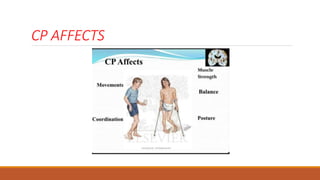
CP AFFECTS
IN CP
Muscles are unaffected
Brain is unable to send the appropriate signals necessary to instruct muscles when to contract
and relax.
CAUSES
An insult or injury to the brain
- fixed, static lesions
- In single or multiple areas of the motor centers of the brain
- early in CNS deviation
Development malformations
-The brain fails to develop correctly
Neurological damage
Neurological damage
- Can occur before, during or after delivery
- Rh incompatibility, illness, severe lack of oxygen
-Unknown in many instances
Severe deprivation of oxygen or blood flow to the brain
- Hypoxic ischemic encephalopathy or intraportal asphyxia
RISK FACTORS
Prenatal factor
- Before birth
- Maternal characteristics
Perinatal factors
-At the time of birth to 1 month
Postnatal factors
- In the first 5 mos of life
Prenatal factors
Hemorrhage/bleeding
- Abruptic placenta
Infections
- Rubella, cytomegalovirus, toxoplasmosis
Environment factors
Maternal characteristics
- Age
- Difficulty in conceiving or holding a baby to term
Multiple births
History of fetal deaths/miscarriages
Cigrarette smoking more than 30 sticks per day
Alcoholism and drug addiction
Social status; mother with MR
Mother s medical condition
Perinatal factors
High or low BP
Umbilical cord coil
Breech delivary
Over sedation of drugs
Trauma ie. Forcepts or vaccum delivary
Complication of birth
Postnatal causes
Trauma, head injury
Infections
Lack of oxygen
Stroke in the young
Tumor, cyst
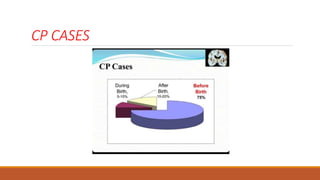
CP CASES
TYPES OF CP
According to;
Neurologic deficits
Type of movements involved
Area of affected limbs
Acc. To neurologic deficits;
Based on the
- Extent of the damage
- Area of brain damage
Each type involves the way a person moves
3 main types;
PYRAMIDAL
- Originates from the motor areas of the cerebral cortex
EXTRAPYRAMIDAL
- Basal ganglia and cerebellum
MIXED
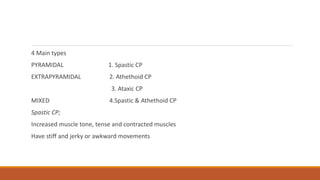
4 Main types
PYRAMIDAL 1. Spastic CP
EXTRAPYRAMIDAL 2. Athethoid CP
3. Ataxic CP
MIXED 4.Spastic & Athethoid CP
Spastic CP;
Increased muscle tone, tense and contracted muscles
Have stiff and jerky or awkward movements
-Limbs are usually underdeveloped
-Increased deep tendon reflexes
-Most common form 70 – 80% of all affected
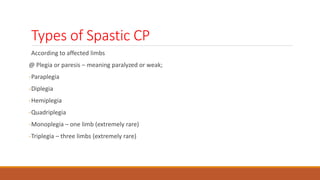
Types of Spastic CP
According to affected limbs
@ Plegia or paresis – meaning paralyzed or weak;
-Paraplegia
-Diplegia
-Hemiplegia
-Quadriplegia
-Monoplegia – one limb (extremely rare)
-Triplegia – three limbs (extremely rare)
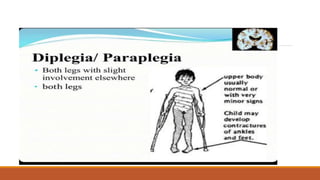
Diplegia/paraplegia
Both legs with slight involvement else where
Both legs
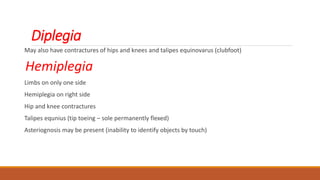
Diplegia
May also have contractures of hips and knees and talipes equinovarus (clubfoot)
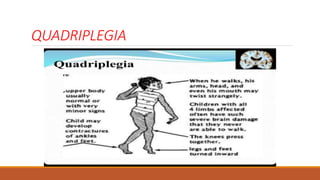
Hemiplegia
Limbs on only one side
Hemiplegia on right side
Hip and knee contractures
Talipes equnius (tip toeing – sole permanently flexed)
Asteriognosis may be present (inability to identify objects by touch)
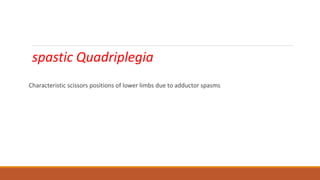
QUADRIPLEGIA
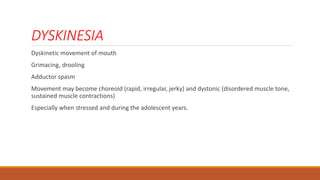
spastic Quadriplegia
Characteristic scissors positions of lower limbs due to adductor spasms
DYSKINESIA
Dyskinetic movement of mouth
Grimacing, drooling
Adductor spasm
Movement may become choreoid (rapid, irregular, jerky) and dystonic (disordered muscle tone,
sustained muscle contractions)
Especially when stressed and during the adolescent years.
ATAXIC CP
Poor balance and lack of coordination
Wide based gait
Depth perception usually affected
Tendency to fall and stumble
Inability to walk straight line
Least common 5 – 10% of cases
MIXED CP
A common combination is spastic
Spastic muscle tone and involuntary movements
25% of CP cases, fairly common
DEGREE OF SEVERITY
Mild CP 20% of cases
- Not require self help for assisting their impaired ambulation capacity
Moderate CP 50%
- Reqiure self help for assisting their impaired ambulation capacity
Severe CP 30%
- Totally incapacited and bedridden and they always need care from others
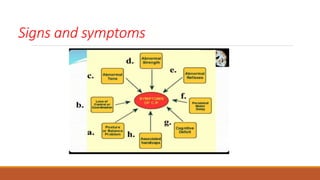
Signs and symptoms
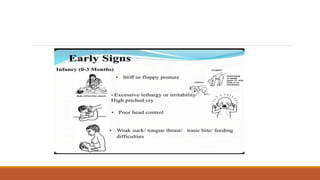
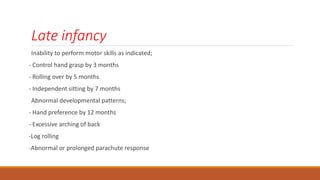
Late infancy
Inability to perform motor skills as indicated;
- Control hand grasp by 3 months
- Rolling over by 5 months
- Independent sitting by 7 months
Abnormal developmental patterns;
- Hand preference by 12 months
- Excessive arching of back
-Log rolling
-Abnormal or prolonged parachute response
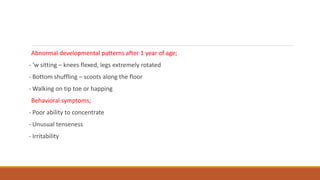
Abnormal developmental patterns after 1 year of age;
- ‘w sitting – knees flexed, legs extremely rotated
- Bottom shuffling – scoots along the floor
- Walking on tip toe or happing
Behavioral symptoms;
- Poor ability to concentrate
- Unusual tenseness
- Irritability
CEREBRAL PALSY
Main problems;
Mentation and thought processes are not always affected
Trapped in their bodies with their disabilities
Ability to express their intelligence may be limited by difficulties in communicating
ASSOCIATED PROBLEMS
Hearing and visual problems
Sensory integration problems
Failure to thrive, feeding problem
Behavioral/ emotional difficulties
Communication disorders
Bladder and bowel control problem, digestive problem
Skeletal deformities, dental problem
Mental retardation and learning disabilibities in some
DIAGNOSIS
A useful diagnosis is when the specific type, affected limb, severity and cause, if known are
identified.
Physical evalution, interview
MRI, CT scan EEG
Laboratory and radiologic work up
Assessment tools
i.e. Peabody development motor skills, Denver test II
DENVER TEST II
Developmental screening test
Cover 4 general functions;
- Personal social i.e. smiling
- Fine motor adaptive i.e. grasping & drawing
- Language i.e. combining words
- Gross motor i.e. walking
- Ages covered; from birth to 6 years
ASSESSMENT
Subjective – interview
a. history taking
Include all that may predispose an infant to brain damage or CP
Risk factors
Psychosocial factors
Family adaptation
b, child s health history
Often admitted to hospitals for corrective surgeries and other complications.
Respiratory status
Motor function
Presence of fever
Feeding and weight loss
Any changes in physical state
2. OBJECTIVE – Physical examination
CRITERIA
P osturing/poor muscle control and strength
O ropharyngeal problems
S trabismus/squint
T one
E volutional maldevelopment
R eflexes
Posturing/poor muscle control and
strength
Test hand strength by lifting the child off the ground while the child holds the nurses hands
Observe for presence of limb deformity, as decreased use of extremity leads to shortening
Upon extension of extremities on vertical suspension of the infant,
If infant backbend backwards like and arch may indicate CP is severe
Oropharyngeal problems
Speech,
Swallowing breathing
Drooling,
Feeding poorly
EVOLUTIONAL MAL DEVELOPMENT
Delay in motor skills
Such as rolling over, sitting, crawling, and walking
Size for age
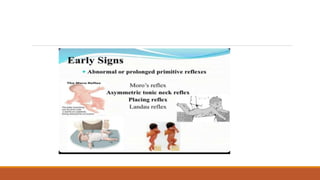
Persistence of primitive reflexes or parachute reflex fail to develop
Treatment
No treatment to cure cerebral palsy
Brain damage cannot be corrected
Crucial for children with CP;
Early identification
Multidisciplinary care ; and
Support
Nonphysical therapy
The earlier we start, the more improvement can be made
A. General management
Proper nutrition and personal care
B.Pharmacologic
Intrathecal, baclofen
Control muscle spasms and seizures
Delivered directly to the spinal fluid
Using a pump to avoid brain effects
GLYCOPYRROLATE – Control drooling
Pamidronate – may help with osteoporosis
C. surgery
To loosen joints
Relieve muscle tightness
Straightening of different of leg muscles
Improve the ability to sit, stand and walk
Selective posterior rhizotomy
Is used to improve spasticity ( muscle stiffness) in cerebral palsy. In some cases nerves need to be
severed to decrease muscle tension of inappropriate contractions.
Procedure
A major operation, takes approximately four hours to complete
The sensory nerve fibers in the spinal cord, usually between the bottom of the rib cage and the
top of the hips are divided
The nerve fibers are then stimulated and the responses of the leg muscles are observed
Those that have an abnormal or excessive response are severed
Those with a normal response are left intact
Intensive rehabilitation is required after the surgery, usually up to six weeks, followed by
physical therapy on an ongoing basis
D. Physical aids
Orthosis, braces and splints
- Keep limbs in correct alignment
- Prevent deformities
Positioning devices
Enable better posture
Walkers, special scooters, wheelchairs
- Make it easier to move about
E. Special education
To meet the child s special needs
Improve learning
Vocational training can help prepare young adults for jobs
F. Rehabilitation Services
Speech and occupational therapies may improve the ability to speak, and perform activities of
daily living and to do some suitable works to have their own income.
G. Family Services
Professional support helps a patient and family cope with cerebral palsy
Counselors help parents learn how to modify behaviors
Caring for a child with cerebral palsy can be very stressful
Some families find support groups helpful
Other treatment
Therapeutic electrical stimulation,
Acupuncture
Hyperbaric therapy
Massage therapy might help
II. Physical therapy
The ultimate long term goal is realistic independence
To get there we have to have some short term goals
Those being a working communication skills and above all friends
A. sitting
- Vertical head control and control of head and trunk
B. standing and walking
- Establish an equal distribution of weight on each foot, train to use steps or inclines
C. prone development
D. supine development
- Head control on supine and positions
PLAY
Range of voluntary intrinsically motivated activities normally associated with pleasure and
enjoyment
Also known as work of the children/daily work of a child
Act as a tool assessing stress
CRITERIA
Voluntary
Internally motivated
Unique to each child
Active with motion and cognition
CONTENT OF PLAY
This involves physical, mental, emotional and spiritual aspects of the play along with the social
relationships
It follows a directional trend of simple to complex
THE CHARACTERISTICS OF PLAY
Play is child chosen
Play is child invented
Play is pretend but done as if the activites were real
Play focuses on the doing (process, not product
Play requires active involvement
Play is pleasurable
Play is marked by flexibility
VALUES OF PLAY
Physical value
Intellectual value
Moral value
Creative value
Therapeutic value
Socialization
TYPES OF PLAY
Social affective play
Play with objects
Play with language
Skill play
Play with motion and interaction
Play with nature
Play with social material explore, relation between objects, actions, and people
Play with child s interest and skills
Play with rules
Play with animals
Play with technology
Cooperative play
Medical play
TOY
Definition;
The word toy comes from an old English term that means tool
Toys are tools for a child
Toys are valuable teaching tools
TYPES OF TOYS
Soft and cuddling toys
Manipulation/small motor skill toys
Large motor skill toys
Dramtic play
The most important things that parents
can provide are;
Time
Space
Materials
Caring adults
THANK YOU

conference feb.pptx

  • 1.
    Composite regional centerfor skill Development, Rehabilitation & empowerment of persons with disabilities (CRC) Gorakhpur Evidence based recent research on play and children with CP Dr. Jagroop Singh Research Associate Govt. Medical College Amritsar
  • 2.
    Evidence Based RecentResearch on Play and children with CP CEREBRAL PALSY (CP) In 1860, known as Cerebral Paralysis or Little s Disease After an English surgeon wrote the 1st medical descriptions William john little
  • 3.
    CEREBRAL PALSY (CP) Cerebral;latin Cerebrum Affected part of brain Palsy; Gr. Para – beyond, lysis – loosening Lack of muscle control
  • 4.
    CEREBRAL PALSY (CP) Amotor function disorder - Caused by permanent, non – progressive brain lesion - Present at birth or shortly thereafter Non – curable , life long condition Damage doesn’t worsen May be congenital or acquired
  • 5.
    CEREBRAL PALSY (CP) AHeterogenous group of movement disorder. -An umbrella term -Not a single diagnosis
  • 6.
  • 7.
    IN CP Muscles areunaffected Brain is unable to send the appropriate signals necessary to instruct muscles when to contract and relax.
  • 8.
    CAUSES An insult orinjury to the brain - fixed, static lesions - In single or multiple areas of the motor centers of the brain - early in CNS deviation Development malformations -The brain fails to develop correctly Neurological damage
  • 9.
    Neurological damage - Canoccur before, during or after delivery - Rh incompatibility, illness, severe lack of oxygen -Unknown in many instances Severe deprivation of oxygen or blood flow to the brain - Hypoxic ischemic encephalopathy or intraportal asphyxia
  • 10.
    RISK FACTORS Prenatal factor -Before birth - Maternal characteristics Perinatal factors -At the time of birth to 1 month Postnatal factors - In the first 5 mos of life
  • 11.
    Prenatal factors Hemorrhage/bleeding - Abrupticplacenta Infections - Rubella, cytomegalovirus, toxoplasmosis Environment factors Maternal characteristics - Age - Difficulty in conceiving or holding a baby to term
  • 12.
    Multiple births History offetal deaths/miscarriages Cigrarette smoking more than 30 sticks per day Alcoholism and drug addiction Social status; mother with MR Mother s medical condition
  • 13.
    Perinatal factors High orlow BP Umbilical cord coil Breech delivary Over sedation of drugs Trauma ie. Forcepts or vaccum delivary Complication of birth
  • 14.
    Postnatal causes Trauma, headinjury Infections Lack of oxygen Stroke in the young Tumor, cyst
  • 15.
  • 16.
    TYPES OF CP Accordingto; Neurologic deficits Type of movements involved Area of affected limbs Acc. To neurologic deficits; Based on the - Extent of the damage - Area of brain damage
  • 17.
    Each type involvesthe way a person moves 3 main types; PYRAMIDAL - Originates from the motor areas of the cerebral cortex EXTRAPYRAMIDAL - Basal ganglia and cerebellum MIXED
  • 18.
    4 Main types PYRAMIDAL1. Spastic CP EXTRAPYRAMIDAL 2. Athethoid CP 3. Ataxic CP MIXED 4.Spastic & Athethoid CP Spastic CP; Increased muscle tone, tense and contracted muscles Have stiff and jerky or awkward movements
  • 19.
    -Limbs are usuallyunderdeveloped -Increased deep tendon reflexes -Most common form 70 – 80% of all affected
  • 20.
    Types of SpasticCP According to affected limbs @ Plegia or paresis – meaning paralyzed or weak; -Paraplegia -Diplegia -Hemiplegia -Quadriplegia -Monoplegia – one limb (extremely rare) -Triplegia – three limbs (extremely rare)
  • 21.
    Diplegia/paraplegia Both legs withslight involvement else where Both legs
  • 22.
    Diplegia May also havecontractures of hips and knees and talipes equinovarus (clubfoot) Hemiplegia Limbs on only one side Hemiplegia on right side Hip and knee contractures Talipes equnius (tip toeing – sole permanently flexed) Asteriognosis may be present (inability to identify objects by touch)
  • 23.
  • 24.
    spastic Quadriplegia Characteristic scissorspositions of lower limbs due to adductor spasms
  • 25.
    DYSKINESIA Dyskinetic movement ofmouth Grimacing, drooling Adductor spasm Movement may become choreoid (rapid, irregular, jerky) and dystonic (disordered muscle tone, sustained muscle contractions) Especially when stressed and during the adolescent years.
  • 26.
    ATAXIC CP Poor balanceand lack of coordination Wide based gait Depth perception usually affected Tendency to fall and stumble Inability to walk straight line Least common 5 – 10% of cases
  • 27.
    MIXED CP A commoncombination is spastic Spastic muscle tone and involuntary movements 25% of CP cases, fairly common
  • 28.
    DEGREE OF SEVERITY MildCP 20% of cases - Not require self help for assisting their impaired ambulation capacity Moderate CP 50% - Reqiure self help for assisting their impaired ambulation capacity Severe CP 30% - Totally incapacited and bedridden and they always need care from others
  • 29.
  • 32.
    Late infancy Inability toperform motor skills as indicated; - Control hand grasp by 3 months - Rolling over by 5 months - Independent sitting by 7 months Abnormal developmental patterns; - Hand preference by 12 months - Excessive arching of back -Log rolling -Abnormal or prolonged parachute response
  • 33.
    Abnormal developmental patternsafter 1 year of age; - ‘w sitting – knees flexed, legs extremely rotated - Bottom shuffling – scoots along the floor - Walking on tip toe or happing Behavioral symptoms; - Poor ability to concentrate - Unusual tenseness - Irritability
  • 34.
    CEREBRAL PALSY Main problems; Mentationand thought processes are not always affected Trapped in their bodies with their disabilities Ability to express their intelligence may be limited by difficulties in communicating
  • 35.
    ASSOCIATED PROBLEMS Hearing andvisual problems Sensory integration problems Failure to thrive, feeding problem Behavioral/ emotional difficulties Communication disorders Bladder and bowel control problem, digestive problem Skeletal deformities, dental problem Mental retardation and learning disabilibities in some
  • 36.
    DIAGNOSIS A useful diagnosisis when the specific type, affected limb, severity and cause, if known are identified. Physical evalution, interview MRI, CT scan EEG Laboratory and radiologic work up Assessment tools i.e. Peabody development motor skills, Denver test II
  • 37.
    DENVER TEST II Developmentalscreening test Cover 4 general functions; - Personal social i.e. smiling - Fine motor adaptive i.e. grasping & drawing - Language i.e. combining words - Gross motor i.e. walking - Ages covered; from birth to 6 years
  • 38.
    ASSESSMENT Subjective – interview a.history taking Include all that may predispose an infant to brain damage or CP Risk factors Psychosocial factors Family adaptation
  • 39.
    b, child shealth history Often admitted to hospitals for corrective surgeries and other complications. Respiratory status Motor function Presence of fever Feeding and weight loss Any changes in physical state
  • 40.
    2. OBJECTIVE –Physical examination CRITERIA P osturing/poor muscle control and strength O ropharyngeal problems S trabismus/squint T one E volutional maldevelopment R eflexes
  • 41.
    Posturing/poor muscle controland strength Test hand strength by lifting the child off the ground while the child holds the nurses hands Observe for presence of limb deformity, as decreased use of extremity leads to shortening Upon extension of extremities on vertical suspension of the infant, If infant backbend backwards like and arch may indicate CP is severe
  • 42.
  • 43.
    EVOLUTIONAL MAL DEVELOPMENT Delayin motor skills Such as rolling over, sitting, crawling, and walking Size for age Persistence of primitive reflexes or parachute reflex fail to develop
  • 44.
    Treatment No treatment tocure cerebral palsy Brain damage cannot be corrected Crucial for children with CP; Early identification Multidisciplinary care ; and Support
  • 45.
    Nonphysical therapy The earlierwe start, the more improvement can be made
  • 46.
    A. General management Propernutrition and personal care B.Pharmacologic Intrathecal, baclofen Control muscle spasms and seizures Delivered directly to the spinal fluid Using a pump to avoid brain effects GLYCOPYRROLATE – Control drooling
  • 47.
    Pamidronate – mayhelp with osteoporosis C. surgery To loosen joints Relieve muscle tightness Straightening of different of leg muscles Improve the ability to sit, stand and walk
  • 48.
    Selective posterior rhizotomy Isused to improve spasticity ( muscle stiffness) in cerebral palsy. In some cases nerves need to be severed to decrease muscle tension of inappropriate contractions.
  • 49.
    Procedure A major operation,takes approximately four hours to complete The sensory nerve fibers in the spinal cord, usually between the bottom of the rib cage and the top of the hips are divided The nerve fibers are then stimulated and the responses of the leg muscles are observed Those that have an abnormal or excessive response are severed Those with a normal response are left intact Intensive rehabilitation is required after the surgery, usually up to six weeks, followed by physical therapy on an ongoing basis
  • 50.
    D. Physical aids Orthosis,braces and splints - Keep limbs in correct alignment - Prevent deformities Positioning devices Enable better posture Walkers, special scooters, wheelchairs - Make it easier to move about
  • 51.
    E. Special education Tomeet the child s special needs Improve learning Vocational training can help prepare young adults for jobs
  • 52.
    F. Rehabilitation Services Speechand occupational therapies may improve the ability to speak, and perform activities of daily living and to do some suitable works to have their own income.
  • 53.
    G. Family Services Professionalsupport helps a patient and family cope with cerebral palsy Counselors help parents learn how to modify behaviors Caring for a child with cerebral palsy can be very stressful Some families find support groups helpful
  • 54.
    Other treatment Therapeutic electricalstimulation, Acupuncture Hyperbaric therapy Massage therapy might help
  • 55.
    II. Physical therapy Theultimate long term goal is realistic independence To get there we have to have some short term goals Those being a working communication skills and above all friends
  • 56.
    A. sitting - Verticalhead control and control of head and trunk B. standing and walking - Establish an equal distribution of weight on each foot, train to use steps or inclines C. prone development D. supine development - Head control on supine and positions
  • 57.
    PLAY Range of voluntaryintrinsically motivated activities normally associated with pleasure and enjoyment Also known as work of the children/daily work of a child Act as a tool assessing stress
  • 58.
    CRITERIA Voluntary Internally motivated Unique toeach child Active with motion and cognition
  • 59.
    CONTENT OF PLAY Thisinvolves physical, mental, emotional and spiritual aspects of the play along with the social relationships It follows a directional trend of simple to complex
  • 60.
    THE CHARACTERISTICS OFPLAY Play is child chosen Play is child invented Play is pretend but done as if the activites were real Play focuses on the doing (process, not product Play requires active involvement Play is pleasurable Play is marked by flexibility
  • 61.
    VALUES OF PLAY Physicalvalue Intellectual value Moral value Creative value Therapeutic value Socialization
  • 62.
    TYPES OF PLAY Socialaffective play Play with objects Play with language Skill play Play with motion and interaction Play with nature Play with social material explore, relation between objects, actions, and people Play with child s interest and skills
  • 63.
    Play with rules Playwith animals Play with technology Cooperative play Medical play
  • 64.
    TOY Definition; The word toycomes from an old English term that means tool Toys are tools for a child Toys are valuable teaching tools
  • 65.
    TYPES OF TOYS Softand cuddling toys Manipulation/small motor skill toys Large motor skill toys Dramtic play
  • 66.
    The most importantthings that parents can provide are; Time Space Materials Caring adults
  • 67.