CEREBRAL
PALSY
By: DR HARDEV SINGH
MODERATOR: DR SAMIR GROVER
Snr CONSULTANT
ORTHOPAEDIC
CEREBRAL
PALSY
• A motor function disorder
– caused by permanent, non-progressive brain lesion
– present at birth or shortly thereafter.
• Non-curable, life-long condition
• Damage doesn’t worsen
• May be congenital or acquired
A Heterogenous Group of Movement Disorders
CEREBRAL PALSY
Three distinctive features common to all patients with cerebral palsy
:
(1) Some degree of motor impairment is present,
(2) An insult to the developing brain has occurred,.
(3) A neurological deficit is present that is nonprogressive,
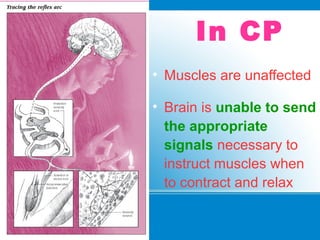
In CP
• Muscles are unaffected
• Brain is unable to send
the appropriate
signals necessary to
instruct muscles when
to contract and relax
CAUSES
OF CEREBRAL PALSY
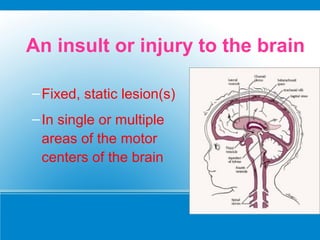
An insult or injury to the brain
–Fixed, static lesion(s)
–In single or multiple
areas of the motor
centers of the brain
• Development Malformations
– The brain fails to develop correctly.
• Neurological damage
– Can occur before, during or after delivery
* Unknown in many instances
CAUSES
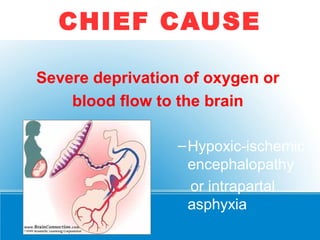
Severe deprivation of oxygen or
blood flow to the brain
–Hypoxic-ischemic
encephalopathy
or intrapartal
asphyxia
CHIEF CAUSE
RISK FACTORS
• Prenatal factors
– Before birth
– Maternal characteristics
• Perinatal factors
– at the time of birth to 1mo
• Postnatal factors
– In the first 5 mos of life
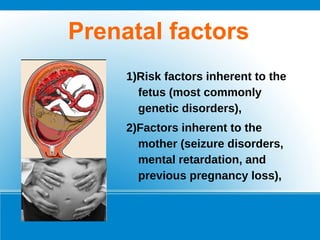
Prenatal factors
1)Risk factors inherent to the
fetus (most commonly
genetic disorders),
2)Factors inherent to the
mother (seizure disorders,
mental retardation, and
previous pregnancy loss),
3)Factors inherent to the pregnancy itself (Rh
incompatibility, polyhydramnios, placental rupture,
and drug or alcohol exposure).
4)External factors, such as TORCH (toxoplasmosis,
other agents, rubella, cytomegalovirus, herpes
simplex),
Perinatal Factors
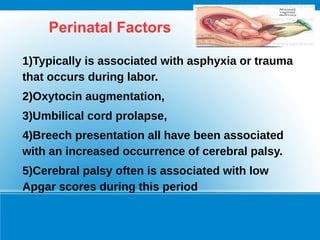
1)Typically is associated with asphyxia or trauma
that occurs during labor.
2)Oxytocin augmentation,
3)Umbilical cord prolapse,
4)Breech presentation all have been associated
with an increased occurrence of cerebral palsy.
5)Cerebral palsy often is associated with low
Apgar scores during this period
Low-birth-weight infants (<1500 g) are at dramatically
increased risk of cerebral palsy.
This increased incidence is believed to be due to the
fragility of the periventricular blood vessels, which are
highly susceptible to physiological fluctuations during
pregnancy.
These fluctuations, which include hypoxic episodes,
placental pathology, maternal diabetes, and infection, can
injure these vessels and lead to subsequent intraventricular
hemorrhages.
Grading of Periventricular Lesions
I Bleeding confined to germinal matrix
II Bleeding extends into ventricles
III Bleeding into ventricles with dilation
IV Bleeding into brain substance
Postnatal Causes
Trauma, head injury
Infections
Lack of oxygen
Stroke in the young
Tumor, cyst
TYPES
OF CEREBRAL PALSY
Classification of CP
1.Geographical Classification1.Geographical Classification
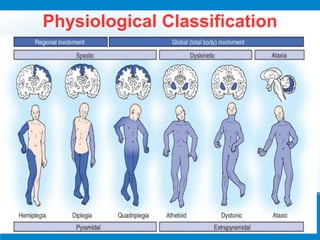
2. Physiological Classification2. Physiological Classification
One extremity involved, usually lower
Monoplegia
Geographical Classification
Hemiplegia
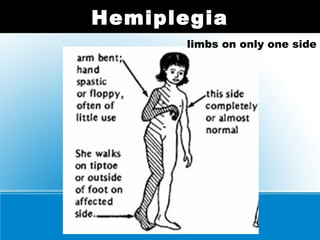
In hemiplegia, one side of the body is involved, with
the upper extremity usually more affected than the
lower extremity.
Patients with hemiplegia, approximately 30% of
patients with cerebral palsy, typically have sensory
changes in the affected extremities as well.
Hemiplegia
limbs on only one side
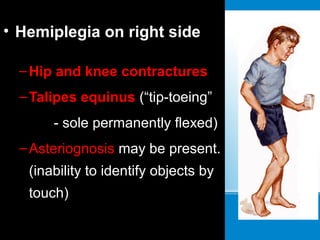
• Hemiplegia on right side
–Hip and knee contractures
–Talipes equinus (“tip-toeing”
- sole permanently flexed)
–Asteriognosis may be present.
(inability to identify objects by
touch)
Diplegia
Diplegia is the most common anatomical type of
cerebral palsy, constituting approximately 50% of all
cases.
Patients with diplegia have motor abnormalities in
all four extremities, with the lower extremities more
affected than the upper.
The close proximity of the lower extremity tracts to
the ventricles most likely explains the more frequent
involvement of the lower extremities with
periventricular lesions .
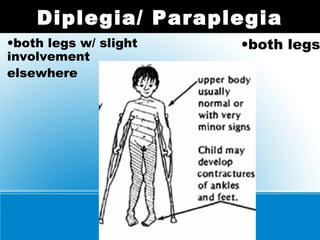
Diplegia/ Paraplegia
•both legs•both legs w/ slight
involvement
elsewhere
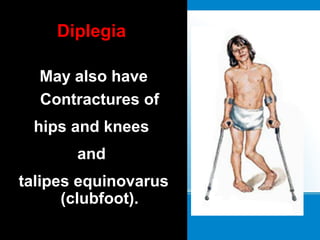
Diplegia
May also have
Contractures of
hips and knees
and
talipes equinovarus
(clubfoot).
This type of cerebral palsy is most common in
premature infants
Intelligence usually is normal.
Most children with diplegia walk eventually,
although walking is delayed usually until around
age 4 years.
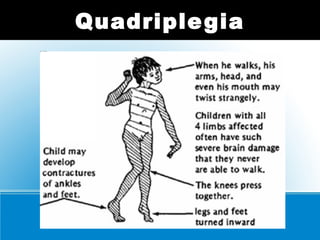
Quadriplegia
In quadriplegia, all four extremities are equally
involved, and many patients have significant
cognitive deficiencies that make care more difficult
Head and neck control usually are present, which
helps with communication, education, and seating.
Quadriplegia
Physiological Classification
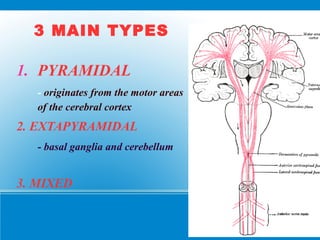
3 MAIN TYPES
1. PYRAMIDAL
- originates from the motor areas
of the cerebral cortex
2. EXTAPYRAMIDAL
- basal ganglia and cerebellum
3. MIXED
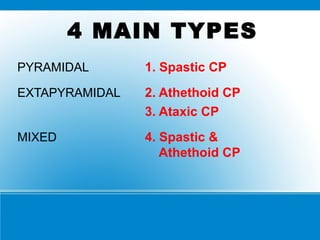
4 MAIN TYPES
PYRAMIDAL 1. Spastic CP
EXTAPYRAMIDAL 2. Athethoid CP
3. Ataxic CP
MIXED 4. Spastic &
Athethoid CP
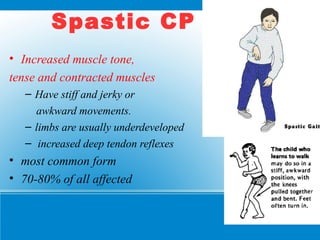
Spastic CP
• Increased muscle tone,
tense and contracted muscles
– Have stiff and jerky or
awkward movements.
– limbs are usually underdeveloped
– increased deep tendon reflexes
• most common form
• 70-80% of all affected
Spastic is the most common form of cerebral palsy,
constituting approximately 80% of cases, and usually is
associated with injury to the pyramidal tracts in the
immature brain.
Booth showed histologically that this altered muscle
function leads to the deposition of type I collagen in the
endomysium of the affected muscle, leading to thickening
and fibrosis, the degree of which correlated to the severity
of the spasticity.
Joint contractures, subluxation, and degeneration are
common in patients with spastic cerebral palsy.
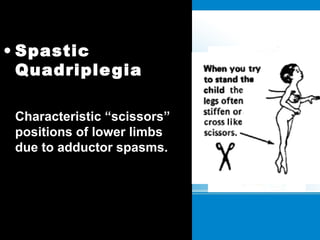
• Spastic
Quadriplegia
Characteristic “scissors”
positions of lower limbs
due to adductor spasms.
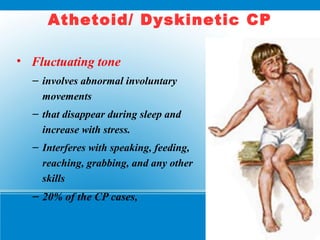
Athetoid/ Dyskinetic CP
• Fluctuating tone
– involves abnormal involuntary
movements
– that disappear during sleep and
increase with stress.
– Interferes with speaking, feeding,
reaching, grabbing, and any other
skills
– 20% of the CP cases,
Athetoid cerebral palsy is caused by an injury to the
extrapyramidal tracts and is characterized by
dyskinetic, purposeless movements that may be
exacerbated by environmental stimulation.
Choreiform
Choreiform cerebral palsy is characterized by
continual purposeless movements of the
patient's wrists, fingers, toes, and ankles. This
continuous movement can make bracing and
sitting difficult.
Rigid
Patients with rigid cerebral palsy are the most hypertonic
of all cerebral palsy patients.
These patients have a “cogwheel” or “lead pipe” muscle
stiffness that often requires surgical release.
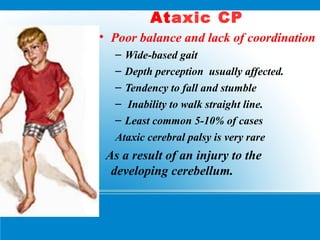
Ataxic CP
• Poor balance and lack of coordination
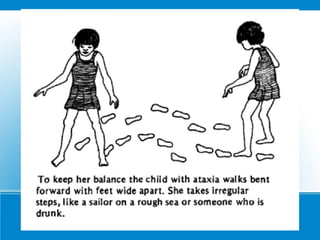
– Wide-based gait
– Depth perception usually affected.
– Tendency to fall and stumble
– Inability to walk straight line.
– Least common 5-10% of cases
Ataxic cerebral palsy is very rare
As a result of an injury to the
developing cerebellum.
It is important to distinguish true ataxia from
spasticity because with treatment many children
with ataxia are able to improve their gait function
without surgery.
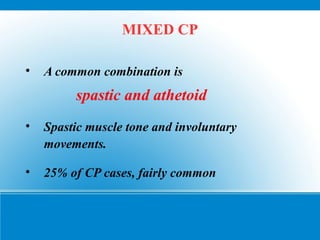
MIXED CP
• A common combination is
spastic and athetoid
• Spastic muscle tone and involuntary
movements.
• 25% of CP cases, fairly common
Signs and
Symptoms
OF CEREBRAL PALSY
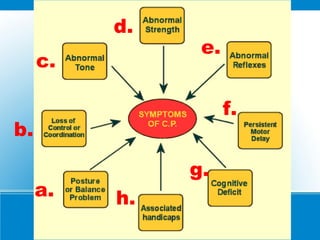
a.
b.
c.
d.
e.
f.
g.
h.
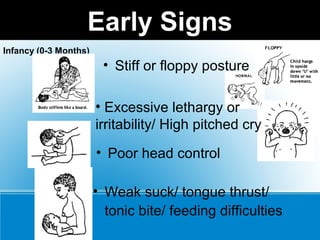
Early Signs
• Stiff or floppy posture
• Weak suck/ tongue thrust/
tonic bite/ feeding difficulties
• Poor head control
• Excessive lethargy or
irritability/ High pitched cry
Infancy (0-3 Months)
• Abnormal or prolonged
primitive reflexes
Moro’s reflex
Asymmetric tonic neck reflex
Placing reflex
Landau reflex
Early Signs
Late infancy
• Inability to perform motor skills as indicated:
– Control hand grasp by 3 months
– Rolling over by 5 months
– Independent sitting by 7 months
• Abnormal Developmental Patterns:
– Hand preference by 12 months
– Excessive arching of back
– Log rolling
– Abnormal or prolonged parachute response
Abnormal Developmental Patterns after 1
year of age:
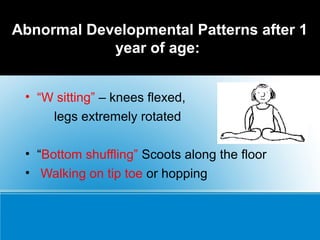
• “W sitting” – knees flexed,
legs extremely rotated
• “Bottom shuffling” Scoots along the floor
• Walking on tip toe or hopping
Behavioral Symptoms
• Poor ability to concentrate,
• unusual tenseness,
• Irritability
ASSOCIATED
PROBLEMS
OF CEREBRAL PALSY
• Hearing and visual
problems
• Sensory integration
problems
• Failure-to-thrive, Feeding
problems
• Behavioral/emotional
difficulties,
• Communication disorders
• Bladder and bowel
control problems,
digestive problems
(gastroesophageal reflux)
• Skeletal deformities,
dental problems
• Mental retardation and
learning disabilities in
some
• Seizures/ epilepsy
Diagnosis
OF CEREBRAL PALSY
History and physical examination are the primary tools in
making the diagnosis of cerebral palsy.
The history should include a thorough investigation of the
pregnancy and delivery.
Ancillary studies, such as radiographs, hematological studies,
chromosomal analysis, CT, MRI, and positron emission
tomography, rarely are needed to make the diagnosis, but may
be helpful in determining the type and extent of cerebral palsy
present.
Diagnosis of cerebral palsy before age 2 years can be
very difficult.
Nelson and Ellenberg found that 55% of children
diagnosed with cerebral palsy by 1 year of age did not
meet the criteria by age 7 years.
Transient dystonia of prematurity is a condition
characterized by increased tone in the lower
extremities between 4 and 14 months old and often is
confused with cerebral palsy.
ASSESSMENT
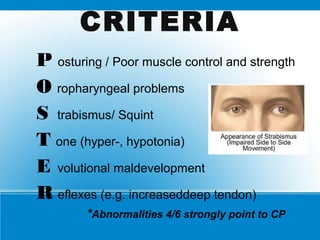
CRITERIA
P osturing / Poor muscle control and strength
O ropharyngeal problems
S trabismus/ Squint
T one (hyper-, hypotonia)
E volutional maldevelopment
R eflexes (e.g. increaseddeep tendon)
*Abnormalities 4/6 strongly point to CP
Treatment
OF CEREBRAL PALSY
- No treatment to cure cerebral palsy.
- Brain damage cannot be corrected.
• Crucial for children with CP:
–Early Identification;
–Multidisciplinary Care; and
–Support
NON OPERATIVE TREATMENT
•
Commonly used as primary treatment or in
conjuction with surgery

Medication

Splinting

bracing

Physical therapy
MEDICAL MANAGEMENT
•
Common agents - diazepam
- baclofen
- dantrolene
- botulinum toxin
Oral agents:
Dantrolene-acts at the level of skeletal muscle and
decreases muscle calcium ion release. It has an
affinity for fast twitch muscle fibers and selectively
decreases abnormal muscle stretch reflexes and
tone.
Diazepam- increases inhibitory neurotransmitter
activity (GABA)
Baclofen -inhibit abnormal monosynaptic extensor
activity and poly synaptic flexor activity and
decrease substance P levels
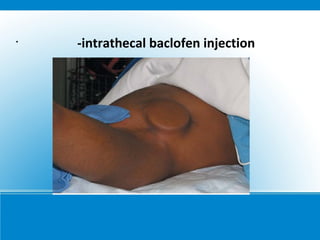
Intrathecal injection of baclofen requires 1/30 the dose of
oral baclofen to achieve a similar or better response.
An implantable programmable pump dramatically decreases
the dose required to affect spasticity and decreases some of
the side effects such as sedation. This pump typically is
implanted subcutaneously in the abdominal wall and requires
refilling approximately every 2 to 3 months.
•
-intrathecal baclofen injection

Botulinum toxin type A (BTX-A) (Botox, Dysport) has
been used to weaken muscles selectively in patients with
cerebral palsy.

BTX-A injected directly into the muscle acts at the level
of the motor end plate, blocking the release of the
neurotransmitter acetylcholine and inhibiting muscle
contraction

This effect begins approximately 24 hours after
injection and lasts 2 to 6 monthsCare
– Intra muscular botulinum toxin for 2-6 months
– Safe maximal dose 36-50 U/kg
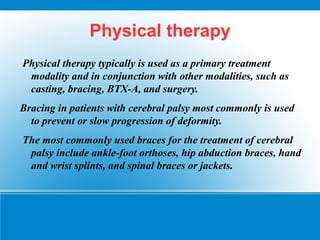
Physical therapy
Physical therapy typically is used as a primary treatment
modality and in conjunction with other modalities, such as
casting, bracing, BTX-A, and surgery.
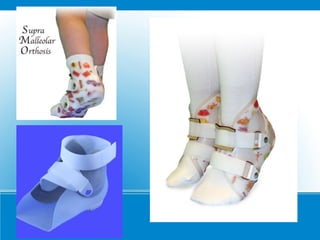
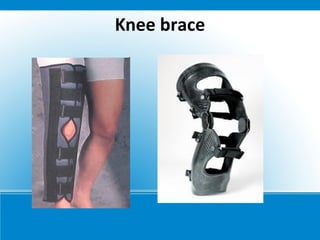
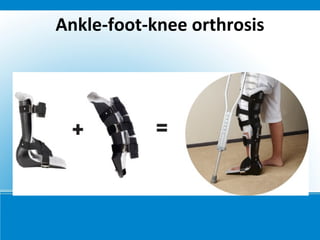
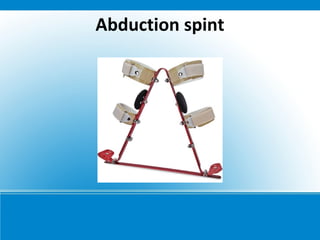
Bracing in patients with cerebral palsy most commonly is used
to prevent or slow progression of deformity.
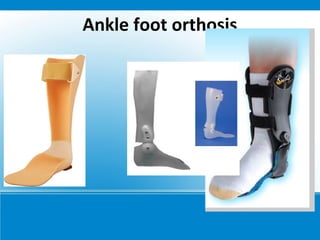
The most commonly used braces for the treatment of cerebral
palsy include ankle-foot orthoses, hip abduction braces, hand
and wrist splints, and spinal braces or jackets.
Ankle foot orthosis
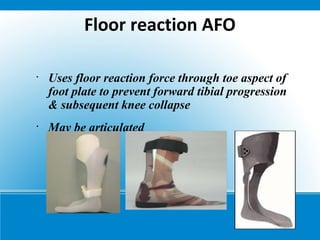
Floor reaction AFO
•
Uses floor reaction force through toe aspect of
foot plate to prevent forward tibial progression
& subsequent knee collapse
•
May be articulated
Knee brace
Ankle-foot-knee orthrosis
Abduction spint
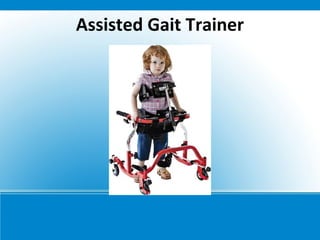
Assisted Gait Trainer
Walking aids
•
Axillary crutches
•
Elbow crutches
•
Walking sticks
SURGICAL
MANAGEMENT
Operative Treatment
Operative treatment typically is indicated when
contractures or deformities decrease function,
cause pain, or interfere with activities of daily
living. It is the only effective treatment when
significant fixed contractures exist.
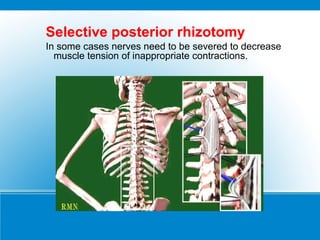
Selective posterior rhizotomy
In some cases nerves need to be severed to decrease
muscle tension of inappropriate contractions.
How it Works
• The sensory nerve fibers in the spinal cord, usually
between the bottom of the rib cage and the top of the
hips are divided
• The nerve fibers are then stimulated and the
responses of the leg muscles are observed.
• Those that have an abnormal or excessive response
are severed.
• Those with a normal response are left intact.
• Intensive rehabilitation is required after the surgery,
usually up to six weeks, followed by physical therapy
on an ongoing basis
OPERATIVE MENAGEMENT HIP
•
Indications
•
contracture or deformities causing
pain
Decrease function
Interfere with ADL
PREREQUISITES FOR EFFECTIVE
SURGERY
•
hemiplegics / diplegics : good results
quadriplegics : minimal improvement
•
Age : 3- 12 years
•
IQ : good
•
Good upper limb function : for walking
•
Underlying muscle power should be good
•
surgery hardly changes status in
walkers/nonwalker, but improves gait
PROCEDURE
•
Neurosurgical procedures
•
Tendon release
•
Muscle tendon lengthening
•
Capsulotomies
•
Osteotomies
•
Resection and replacement procedures
DEFORMITIES
•
DEFORMITIES OF HIP:
•
Flexion deformities
•
adduction
•
Subluxation and dislocation
SECODARY DEFORMITIES:
•
Knee Flexion
•
Equinus foot
•
Pelvic tilt
•
Scoliosis and lordosis
•
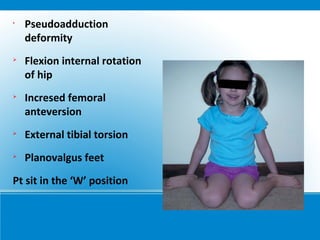
Pseudoadduction
deformity

Flexion internal rotation
of hip

Incresed femoral
anteversion

External tibial torsion

Planovalgus feet
Pt sit in the ‘W’ position
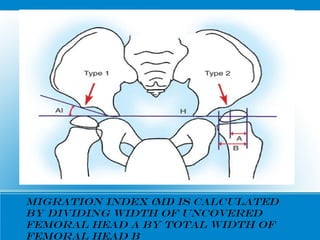
Migration index (MI) is calculated
by dividing width of uncovered
femoral head A by total width of
femoral head B
Hip flexion
deformity
Indication for surgery
•
Hip flexion deformity never decrease by
physiotherapy.
•
Hip flexion deformity > 20 needs surgery
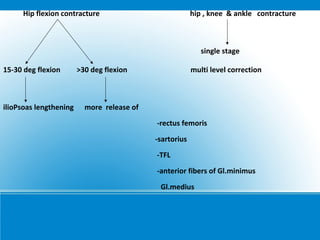
Hip flexion contracture hip , knee & ankle contracture
single stage
15-30 deg flexion >30 deg flexion multi level correction
ilioPsoas lengthening more release of
-rectus femoris
-sartorius
-TFL
-anterior fibers of Gl.minimus
Gl.medius
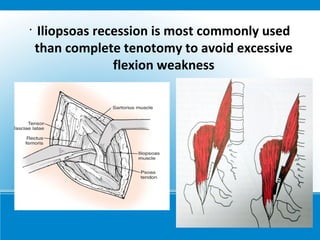
•
Iliopsoas recession is most commonly used
than complete tenotomy to avoid excessive
flexion weakness
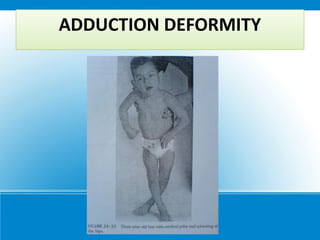
ADDUCTION DEFORMITY
•
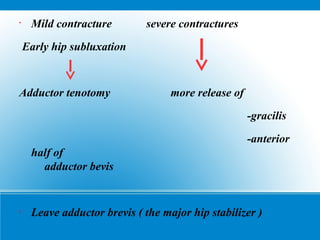
Mild contracture severe contractures
Early hip subluxation
Adductor tenotomy more release of
-gracilis
-anterior
half of
adductor bevis
•
Leave adductor brevis ( the major hip stabilizer )
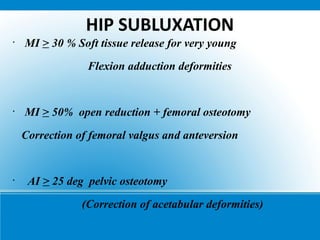
HIP SUBLUXATION
•
MI > 30 % Soft tissue release for very young
Flexion adduction deformities
•
MI > 50% open reduction + femoral osteotomy
Correction of femoral valgus and anteversion
•
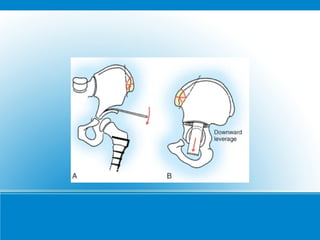
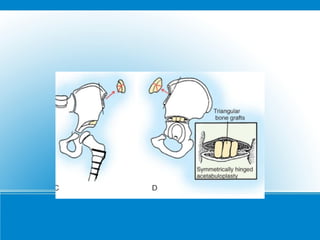
AI > 25 deg pelvic osteotomy
(Correction of acetabular deformities)
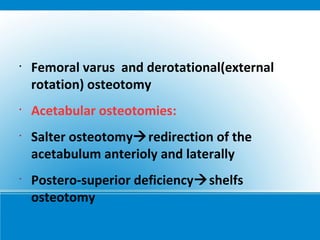
•
Femoral varus and derotational(external
rotation) osteotomy
•
Acetabular osteotomies:
•
Salter osteotomyredirection of the
acetabulum anterioly and laterally
•
Postero-superior deficiencyshelfs
osteotomy
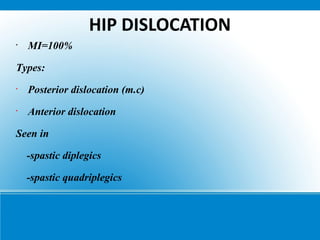
HIP DISLOCATION
•
MI=100%
Types:
•
Posterior dislocation (m.c)
•
Anterior dislocation
Seen in
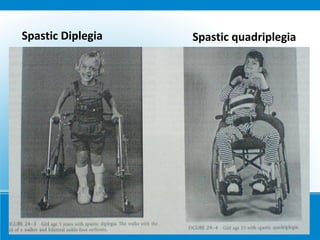
-spastic diplegics
-spastic quadriplegics
TRETMENT OPTIONS IN HIP
DISLOCATION
•
Observation
•
Relocation procedure on femur and
acetabulum
•
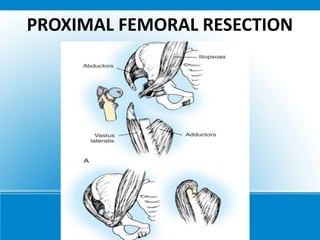
Proximal femoral resection
•
Hip arthrodesis
•
Total hip arthroplasty
Spastic Diplegia Spastic quadriplegia
hip dislocation :
if detected early: surgery
if detected late : no pain – leave
pain – proximal resection
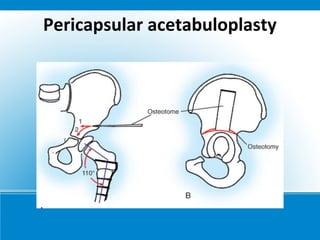
Combined one stage correction of
spastic dislocated hip
1. Soft tissue release
2. Open reduction
3. femoral osteotomy
4. Pericapsular pelvic osteotomy
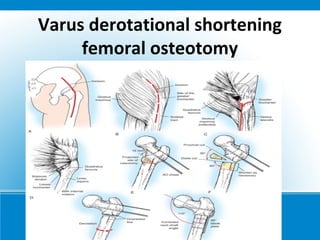
Varus derotational shortening
femoral osteotomy
Pericapsular acetabuloplasty
PROXIMAL FEMORAL RESECTION
FOOT
The most common deformity is ankle
equinus, with equinovarus and
equinovalgus deformities being equally
common.
Equinus Deformity
Equinus deformity is the most common foot deformity in
patients with cerebral palsy, affecting 70% of children.
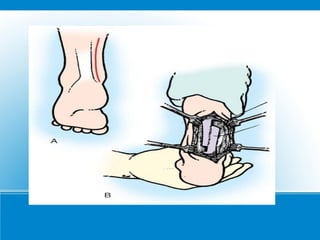
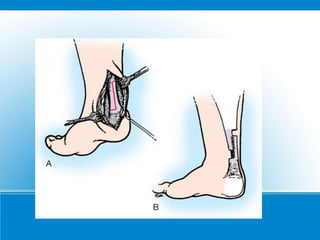
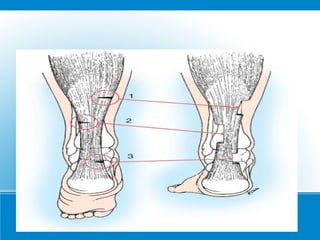
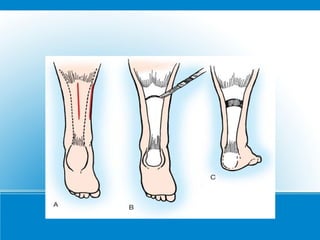
Surgical Correction of Equinus Deformity
Open Lengthening of the Achilles Tendon
Z-Plasty Lengthening of the Achilles Tendon
Percutaneous Lengthening of the Achilles Tendon
Lengthening of the Gastrocnemius-Soleus Muscle
Equinovarus Deformity
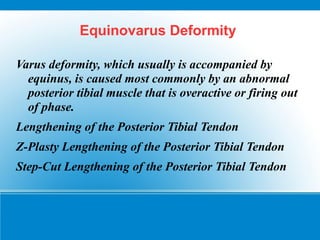
Varus deformity, which usually is accompanied by
equinus, is caused most commonly by an abnormal
posterior tibial muscle that is overactive or firing out
of phase.
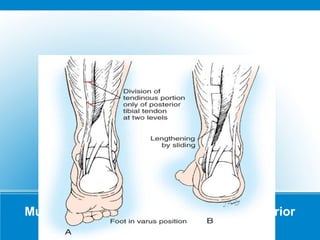
Lengthening of the Posterior Tibial Tendon
Z-Plasty Lengthening of the Posterior Tibial Tendon
Step-Cut Lengthening of the Posterior Tibial Tendon
Musculotendinous Recession of the Posterior
Tibial Tendon
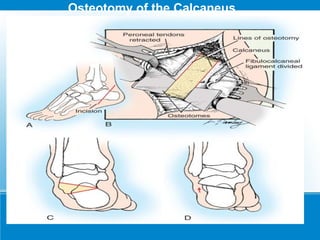
Osteotomy of the Calcaneus
Equinovalgus Deformity
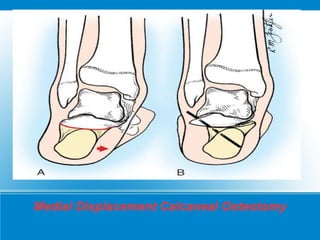
Medial Displacement Calcaneal Osteotomy
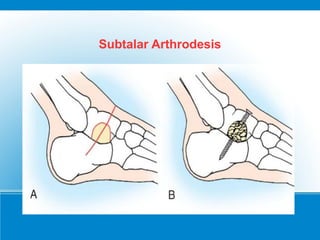
Subtalar Arthrodesis
KNEE
Flexion Deformity
Flexion is the most common knee deformity in patients with
cerebral palsy and frequently occurs in ambulatory children
Spastic hamstrings, weak quadriceps, or a combination of both
can cause isolated knee flexion.
Fractional Lengthening of Hamstring Tendons
Combined Hamstring Lengthening, Posterior Capsular Release,
and Quadriceps Shortening
Distal Transfer of Rectus Femoris
Than
k you

cerebral palsy

  • 1.
    CEREBRAL PALSY By: DR HARDEVSINGH MODERATOR: DR SAMIR GROVER Snr CONSULTANT ORTHOPAEDIC
  • 2.
    CEREBRAL PALSY • A motorfunction disorder – caused by permanent, non-progressive brain lesion – present at birth or shortly thereafter. • Non-curable, life-long condition • Damage doesn’t worsen • May be congenital or acquired
  • 3.
    A Heterogenous Groupof Movement Disorders CEREBRAL PALSY Three distinctive features common to all patients with cerebral palsy : (1) Some degree of motor impairment is present, (2) An insult to the developing brain has occurred,. (3) A neurological deficit is present that is nonprogressive,
  • 4.
    In CP • Musclesare unaffected • Brain is unable to send the appropriate signals necessary to instruct muscles when to contract and relax
  • 5.
  • 6.
    An insult orinjury to the brain –Fixed, static lesion(s) –In single or multiple areas of the motor centers of the brain
  • 7.
    • Development Malformations –The brain fails to develop correctly. • Neurological damage – Can occur before, during or after delivery * Unknown in many instances CAUSES
  • 8.
    Severe deprivation ofoxygen or blood flow to the brain –Hypoxic-ischemic encephalopathy or intrapartal asphyxia CHIEF CAUSE
  • 9.
    RISK FACTORS • Prenatalfactors – Before birth – Maternal characteristics • Perinatal factors – at the time of birth to 1mo • Postnatal factors – In the first 5 mos of life
  • 10.
    Prenatal factors 1)Risk factorsinherent to the fetus (most commonly genetic disorders), 2)Factors inherent to the mother (seizure disorders, mental retardation, and previous pregnancy loss),
  • 11.
    3)Factors inherent tothe pregnancy itself (Rh incompatibility, polyhydramnios, placental rupture, and drug or alcohol exposure). 4)External factors, such as TORCH (toxoplasmosis, other agents, rubella, cytomegalovirus, herpes simplex),
  • 12.
    Perinatal Factors 1)Typically isassociated with asphyxia or trauma that occurs during labor. 2)Oxytocin augmentation, 3)Umbilical cord prolapse, 4)Breech presentation all have been associated with an increased occurrence of cerebral palsy. 5)Cerebral palsy often is associated with low Apgar scores during this period
  • 13.
    Low-birth-weight infants (<1500g) are at dramatically increased risk of cerebral palsy. This increased incidence is believed to be due to the fragility of the periventricular blood vessels, which are highly susceptible to physiological fluctuations during pregnancy.
  • 14.
    These fluctuations, whichinclude hypoxic episodes, placental pathology, maternal diabetes, and infection, can injure these vessels and lead to subsequent intraventricular hemorrhages. Grading of Periventricular Lesions I Bleeding confined to germinal matrix II Bleeding extends into ventricles III Bleeding into ventricles with dilation IV Bleeding into brain substance
  • 15.
    Postnatal Causes Trauma, headinjury Infections Lack of oxygen Stroke in the young Tumor, cyst
  • 16.
  • 17.
    Classification of CP 1.GeographicalClassification1.Geographical Classification 2. Physiological Classification2. Physiological Classification
  • 18.
    One extremity involved,usually lower Monoplegia Geographical Classification
  • 19.
    Hemiplegia In hemiplegia, oneside of the body is involved, with the upper extremity usually more affected than the lower extremity. Patients with hemiplegia, approximately 30% of patients with cerebral palsy, typically have sensory changes in the affected extremities as well.
  • 20.
  • 21.
    • Hemiplegia onright side –Hip and knee contractures –Talipes equinus (“tip-toeing” - sole permanently flexed) –Asteriognosis may be present. (inability to identify objects by touch)
  • 22.
    Diplegia Diplegia is themost common anatomical type of cerebral palsy, constituting approximately 50% of all cases. Patients with diplegia have motor abnormalities in all four extremities, with the lower extremities more affected than the upper.
  • 23.
    The close proximityof the lower extremity tracts to the ventricles most likely explains the more frequent involvement of the lower extremities with periventricular lesions .
  • 24.
    Diplegia/ Paraplegia •both legs•bothlegs w/ slight involvement elsewhere
  • 25.
    Diplegia May also have Contracturesof hips and knees and talipes equinovarus (clubfoot).
  • 26.
    This type ofcerebral palsy is most common in premature infants Intelligence usually is normal. Most children with diplegia walk eventually, although walking is delayed usually until around age 4 years.
  • 27.
    Quadriplegia In quadriplegia, allfour extremities are equally involved, and many patients have significant cognitive deficiencies that make care more difficult Head and neck control usually are present, which helps with communication, education, and seating.
  • 28.
  • 29.
  • 30.
    3 MAIN TYPES 1.PYRAMIDAL - originates from the motor areas of the cerebral cortex 2. EXTAPYRAMIDAL - basal ganglia and cerebellum 3. MIXED
  • 31.
    4 MAIN TYPES PYRAMIDAL1. Spastic CP EXTAPYRAMIDAL 2. Athethoid CP 3. Ataxic CP MIXED 4. Spastic & Athethoid CP
  • 32.
    Spastic CP • Increasedmuscle tone, tense and contracted muscles – Have stiff and jerky or awkward movements. – limbs are usually underdeveloped – increased deep tendon reflexes • most common form • 70-80% of all affected
  • 33.
    Spastic is themost common form of cerebral palsy, constituting approximately 80% of cases, and usually is associated with injury to the pyramidal tracts in the immature brain.
  • 34.
    Booth showed histologicallythat this altered muscle function leads to the deposition of type I collagen in the endomysium of the affected muscle, leading to thickening and fibrosis, the degree of which correlated to the severity of the spasticity. Joint contractures, subluxation, and degeneration are common in patients with spastic cerebral palsy.
  • 35.
  • 36.
    Athetoid/ Dyskinetic CP •Fluctuating tone – involves abnormal involuntary movements – that disappear during sleep and increase with stress. – Interferes with speaking, feeding, reaching, grabbing, and any other skills – 20% of the CP cases,
  • 37.
    Athetoid cerebral palsyis caused by an injury to the extrapyramidal tracts and is characterized by dyskinetic, purposeless movements that may be exacerbated by environmental stimulation.
  • 38.
    Choreiform Choreiform cerebral palsyis characterized by continual purposeless movements of the patient's wrists, fingers, toes, and ankles. This continuous movement can make bracing and sitting difficult.
  • 39.
    Rigid Patients with rigidcerebral palsy are the most hypertonic of all cerebral palsy patients. These patients have a “cogwheel” or “lead pipe” muscle stiffness that often requires surgical release.
  • 40.
    Ataxic CP • Poorbalance and lack of coordination – Wide-based gait – Depth perception usually affected. – Tendency to fall and stumble – Inability to walk straight line. – Least common 5-10% of cases Ataxic cerebral palsy is very rare As a result of an injury to the developing cerebellum.
  • 41.
    It is importantto distinguish true ataxia from spasticity because with treatment many children with ataxia are able to improve their gait function without surgery.
  • 43.
    MIXED CP • Acommon combination is spastic and athetoid • Spastic muscle tone and involuntary movements. • 25% of CP cases, fairly common
  • 44.
  • 45.
  • 46.
    Early Signs • Stiffor floppy posture • Weak suck/ tongue thrust/ tonic bite/ feeding difficulties • Poor head control • Excessive lethargy or irritability/ High pitched cry Infancy (0-3 Months)
  • 47.
    • Abnormal orprolonged primitive reflexes Moro’s reflex Asymmetric tonic neck reflex Placing reflex Landau reflex Early Signs
  • 48.
    Late infancy • Inabilityto perform motor skills as indicated: – Control hand grasp by 3 months – Rolling over by 5 months – Independent sitting by 7 months • Abnormal Developmental Patterns: – Hand preference by 12 months – Excessive arching of back – Log rolling – Abnormal or prolonged parachute response
  • 49.
    Abnormal Developmental Patternsafter 1 year of age: • “W sitting” – knees flexed, legs extremely rotated • “Bottom shuffling” Scoots along the floor • Walking on tip toe or hopping
  • 50.
    Behavioral Symptoms • Poorability to concentrate, • unusual tenseness, • Irritability
  • 51.
  • 52.
    • Hearing andvisual problems • Sensory integration problems • Failure-to-thrive, Feeding problems • Behavioral/emotional difficulties, • Communication disorders • Bladder and bowel control problems, digestive problems (gastroesophageal reflux) • Skeletal deformities, dental problems • Mental retardation and learning disabilities in some • Seizures/ epilepsy
  • 53.
  • 54.
    History and physicalexamination are the primary tools in making the diagnosis of cerebral palsy. The history should include a thorough investigation of the pregnancy and delivery. Ancillary studies, such as radiographs, hematological studies, chromosomal analysis, CT, MRI, and positron emission tomography, rarely are needed to make the diagnosis, but may be helpful in determining the type and extent of cerebral palsy present.
  • 55.
    Diagnosis of cerebralpalsy before age 2 years can be very difficult. Nelson and Ellenberg found that 55% of children diagnosed with cerebral palsy by 1 year of age did not meet the criteria by age 7 years. Transient dystonia of prematurity is a condition characterized by increased tone in the lower extremities between 4 and 14 months old and often is confused with cerebral palsy.
  • 56.
  • 57.
    CRITERIA P osturing /Poor muscle control and strength O ropharyngeal problems S trabismus/ Squint T one (hyper-, hypotonia) E volutional maldevelopment R eflexes (e.g. increaseddeep tendon) *Abnormalities 4/6 strongly point to CP
  • 58.
  • 59.
    - No treatmentto cure cerebral palsy. - Brain damage cannot be corrected. • Crucial for children with CP: –Early Identification; –Multidisciplinary Care; and –Support
  • 60.
    NON OPERATIVE TREATMENT • Commonlyused as primary treatment or in conjuction with surgery  Medication  Splinting  bracing  Physical therapy
  • 61.
    MEDICAL MANAGEMENT • Common agents- diazepam - baclofen - dantrolene - botulinum toxin
  • 62.
    Oral agents: Dantrolene-acts atthe level of skeletal muscle and decreases muscle calcium ion release. It has an affinity for fast twitch muscle fibers and selectively decreases abnormal muscle stretch reflexes and tone. Diazepam- increases inhibitory neurotransmitter activity (GABA) Baclofen -inhibit abnormal monosynaptic extensor activity and poly synaptic flexor activity and decrease substance P levels
  • 63.
    Intrathecal injection ofbaclofen requires 1/30 the dose of oral baclofen to achieve a similar or better response. An implantable programmable pump dramatically decreases the dose required to affect spasticity and decreases some of the side effects such as sedation. This pump typically is implanted subcutaneously in the abdominal wall and requires refilling approximately every 2 to 3 months.
  • 64.
  • 65.
     Botulinum toxin typeA (BTX-A) (Botox, Dysport) has been used to weaken muscles selectively in patients with cerebral palsy.  BTX-A injected directly into the muscle acts at the level of the motor end plate, blocking the release of the neurotransmitter acetylcholine and inhibiting muscle contraction  This effect begins approximately 24 hours after injection and lasts 2 to 6 monthsCare – Intra muscular botulinum toxin for 2-6 months – Safe maximal dose 36-50 U/kg
  • 66.
    Physical therapy Physical therapytypically is used as a primary treatment modality and in conjunction with other modalities, such as casting, bracing, BTX-A, and surgery. Bracing in patients with cerebral palsy most commonly is used to prevent or slow progression of deformity. The most commonly used braces for the treatment of cerebral palsy include ankle-foot orthoses, hip abduction braces, hand and wrist splints, and spinal braces or jackets.
  • 68.
  • 69.
    Floor reaction AFO • Usesfloor reaction force through toe aspect of foot plate to prevent forward tibial progression & subsequent knee collapse • May be articulated
  • 70.
  • 71.
  • 72.
  • 73.
  • 74.
  • 75.
  • 76.
    Operative Treatment Operative treatmenttypically is indicated when contractures or deformities decrease function, cause pain, or interfere with activities of daily living. It is the only effective treatment when significant fixed contractures exist.
  • 77.
    Selective posterior rhizotomy Insome cases nerves need to be severed to decrease muscle tension of inappropriate contractions.
  • 78.
    How it Works •The sensory nerve fibers in the spinal cord, usually between the bottom of the rib cage and the top of the hips are divided • The nerve fibers are then stimulated and the responses of the leg muscles are observed. • Those that have an abnormal or excessive response are severed. • Those with a normal response are left intact. • Intensive rehabilitation is required after the surgery, usually up to six weeks, followed by physical therapy on an ongoing basis
  • 79.
    OPERATIVE MENAGEMENT HIP • Indications • contractureor deformities causing pain Decrease function Interfere with ADL
  • 80.
    PREREQUISITES FOR EFFECTIVE SURGERY • hemiplegics/ diplegics : good results quadriplegics : minimal improvement • Age : 3- 12 years • IQ : good • Good upper limb function : for walking • Underlying muscle power should be good • surgery hardly changes status in walkers/nonwalker, but improves gait
  • 81.
    PROCEDURE • Neurosurgical procedures • Tendon release • Muscletendon lengthening • Capsulotomies • Osteotomies • Resection and replacement procedures
  • 82.
    DEFORMITIES • DEFORMITIES OF HIP: • Flexiondeformities • adduction • Subluxation and dislocation SECODARY DEFORMITIES: • Knee Flexion • Equinus foot • Pelvic tilt • Scoliosis and lordosis
  • 83.
    • Pseudoadduction deformity  Flexion internal rotation ofhip  Incresed femoral anteversion  External tibial torsion  Planovalgus feet Pt sit in the ‘W’ position
  • 84.
    Migration index (MI)is calculated by dividing width of uncovered femoral head A by total width of femoral head B
  • 85.
  • 86.
    Indication for surgery • Hipflexion deformity never decrease by physiotherapy. • Hip flexion deformity > 20 needs surgery
  • 87.
    Hip flexion contracturehip , knee & ankle contracture single stage 15-30 deg flexion >30 deg flexion multi level correction ilioPsoas lengthening more release of -rectus femoris -sartorius -TFL -anterior fibers of Gl.minimus Gl.medius
  • 88.
    • Iliopsoas recession ismost commonly used than complete tenotomy to avoid excessive flexion weakness
  • 89.
  • 90.
    • Mild contracture severecontractures Early hip subluxation Adductor tenotomy more release of -gracilis -anterior half of adductor bevis • Leave adductor brevis ( the major hip stabilizer )
  • 91.
    HIP SUBLUXATION • MI >30 % Soft tissue release for very young Flexion adduction deformities • MI > 50% open reduction + femoral osteotomy Correction of femoral valgus and anteversion • AI > 25 deg pelvic osteotomy (Correction of acetabular deformities)
  • 92.
    • Femoral varus andderotational(external rotation) osteotomy • Acetabular osteotomies: • Salter osteotomyredirection of the acetabulum anterioly and laterally • Postero-superior deficiencyshelfs osteotomy
  • 93.
    HIP DISLOCATION • MI=100% Types: • Posterior dislocation(m.c) • Anterior dislocation Seen in -spastic diplegics -spastic quadriplegics
  • 94.
    TRETMENT OPTIONS INHIP DISLOCATION • Observation • Relocation procedure on femur and acetabulum • Proximal femoral resection • Hip arthrodesis • Total hip arthroplasty
  • 95.
  • 96.
    hip dislocation : ifdetected early: surgery if detected late : no pain – leave pain – proximal resection
  • 97.
    Combined one stagecorrection of spastic dislocated hip 1. Soft tissue release 2. Open reduction 3. femoral osteotomy 4. Pericapsular pelvic osteotomy
  • 98.
  • 99.
  • 102.
  • 103.
    FOOT The most commondeformity is ankle equinus, with equinovarus and equinovalgus deformities being equally common.
  • 104.
    Equinus Deformity Equinus deformityis the most common foot deformity in patients with cerebral palsy, affecting 70% of children. Surgical Correction of Equinus Deformity Open Lengthening of the Achilles Tendon Z-Plasty Lengthening of the Achilles Tendon Percutaneous Lengthening of the Achilles Tendon Lengthening of the Gastrocnemius-Soleus Muscle
  • 109.
    Equinovarus Deformity Varus deformity,which usually is accompanied by equinus, is caused most commonly by an abnormal posterior tibial muscle that is overactive or firing out of phase. Lengthening of the Posterior Tibial Tendon Z-Plasty Lengthening of the Posterior Tibial Tendon Step-Cut Lengthening of the Posterior Tibial Tendon
  • 110.
    Musculotendinous Recession ofthe Posterior Tibial Tendon
  • 111.
  • 112.
  • 113.
  • 114.
  • 115.
    KNEE Flexion Deformity Flexion isthe most common knee deformity in patients with cerebral palsy and frequently occurs in ambulatory children Spastic hamstrings, weak quadriceps, or a combination of both can cause isolated knee flexion. Fractional Lengthening of Hamstring Tendons Combined Hamstring Lengthening, Posterior Capsular Release, and Quadriceps Shortening Distal Transfer of Rectus Femoris
  • 116.

Editor's Notes

  • #60 to establish locomotion, communication and self-help, gain optimal appearance and integration of motor functions; correct associated defects as effectively as possible and provide educational opportunities based on the individual’s needs and capabilities