CEREBRAL
PALSY
(CP)
By- M. Binanda Singh
RINPS
INTRODUCTION
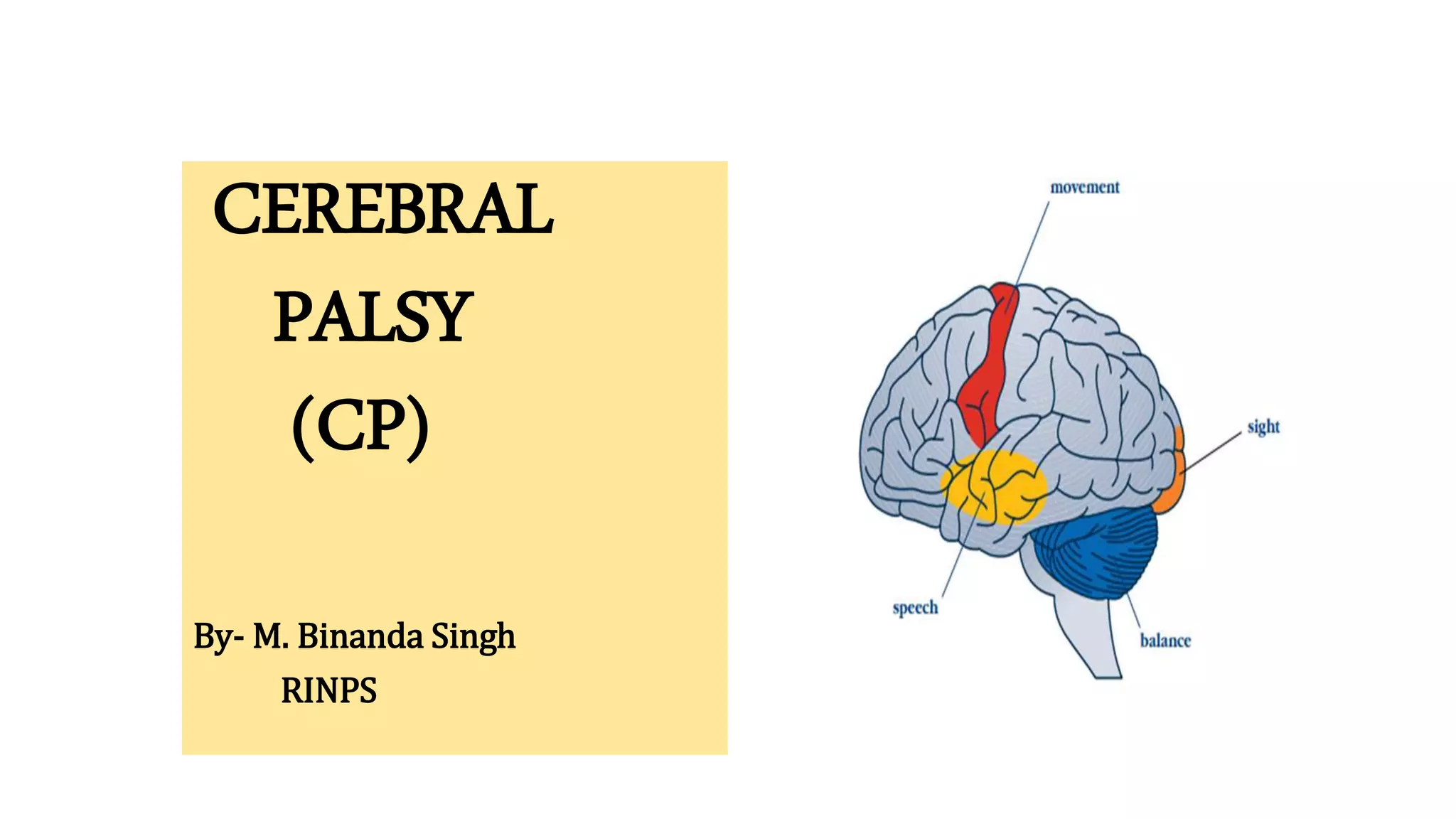
• The brain controls all that we do.
• Different parts of the brain control the
movement of every muscle of the body.
• In cerebral palsy, there is damage or
lack of development in/one of these
areas of the brain.
CEREBRAL PALSY
• 'Cerebral' – refers to the brain.
• 'Palsy' – can mean weakness or paralysis or lack of muscle control.
• Therefore cerebral palsy is a disorder of muscle control which results
from some damage to part of the brain.
• The term cerebral palsy is used when the problem has occurred early
in life, to the developing brain.
CONTD…..
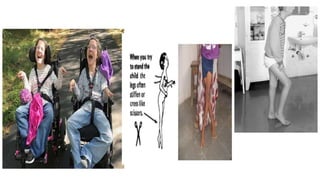
• Children with cerebral palsy can have problems such as muscle
weakness, stiffness, slowness, shakiness, and difficulty with balance.
• These problems can range from mild to severe.
DEFINITION
• Cerebral palsy is a chronic non-progressive motor
dysfunction caused by damage to the motor areas of brain.
(Blosser and Burns, 2004).
INCIDENCE
• In 2007, the incidence of cerebral palsy was estimated to be
2.12-2.45 per 1000 live births.
CAUSES
• There is rarely one single cause of cerebral palsy.
• For most babies born with cerebral palsy, the cause remains unknown.
• For a long time, it was believed that cerebral palsy was due to
complications at birth, including asphyxia (lack of oxygen).
• Researchers now understand that this contributes to only a very small
percentage of cases of cerebral palsy.
The Indian Cerebral Palsy Register Report 2009
identified four groups that, statistically-
1. Males - Males are at greater risk of having cerebral palsy.
2. Premature babies - Prematurity is associated with higher rates of
cerebral palsy. 42% of children with cerebral palsy are born
prematurely, compared to 8% of the Indian population.
The Indian Cerebral Palsy Register Report 2009
identified four groups that, statistically-
3. Small babies - Low birth weight is associated with higher rates of cerebral
palsy. This may be a result of prematurity or slow intrauterine growth. 43%
of children with cerebral palsy had low birth weight, compared to just over
6% of the Indian population.
4. Twins, triplets and higher multiple births - Multiple births are associated
with higher rates of cerebral palsy. 11% of children with cerebral palsy were
from a multiple birth.
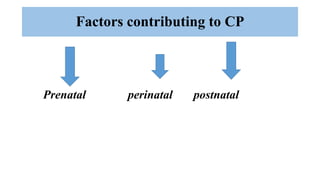
Factors contributing to CP
Prenatal perinatal postnatal
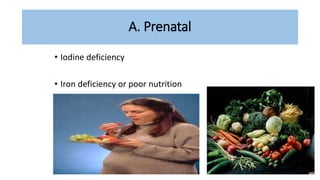
A. Prenatal
• Iodine deficiency
• Iron deficiency or poor nutrition
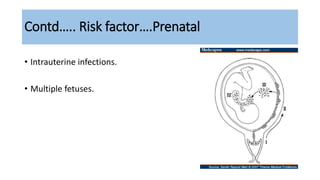
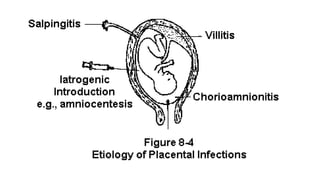
Contd….. Risk factor….Prenatal
• Intrauterine infections.
• Multiple fetuses.
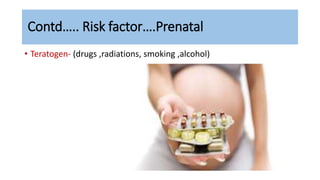
Contd….. Risk factor….Prenatal
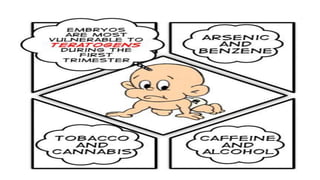
• Teratogen- (drugs ,radiations, smoking ,alcohol)
Contd….. Risk factor….Prenatal
• Advanced age pregnancy
B. Perinatal/Birth factors
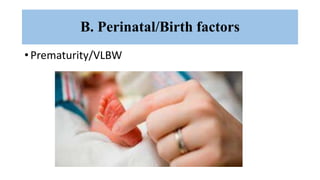
• Prematurity/VLBW
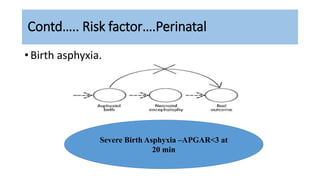
Contd….. Risk factor….Perinatal
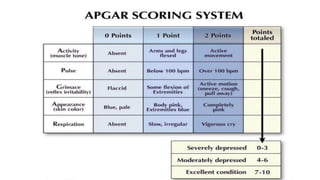
• Birth asphyxia.
Severe Birth Asphyxia –APGAR<3 at
20 min
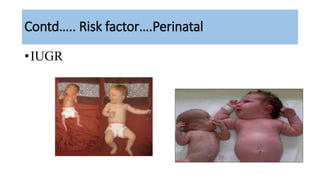
Contd….. Risk factor….Perinatal
•IUGR
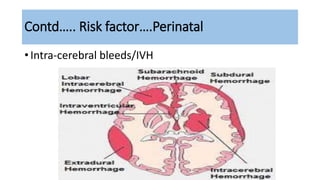
Contd….. Risk factor….Perinatal
• Intra-cerebral bleeds/IVH
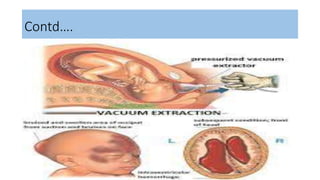
Contd….
• Jaundice shortly after birth.
Contd….. Risk factor….Perinatal
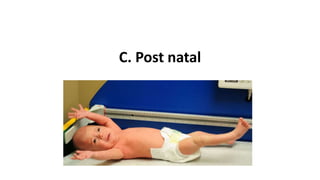
C. Post natal
C. Post natal
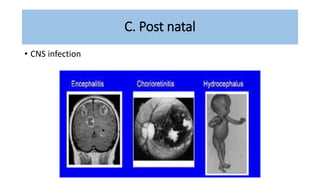
• CNS infection
Risk factor….Post-natal
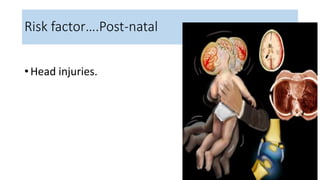
• Head injuries.
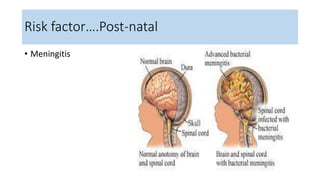
• Meningitis
Risk factor….Post-natal
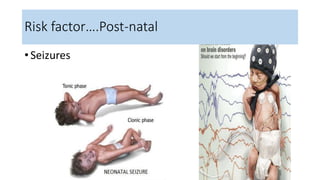
• Seizures
Risk factor….Post-natal
Contd….
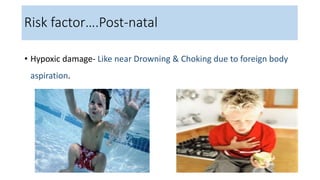
• Hypoxic damage- Like near Drowning & Choking due to foreign body
aspiration.
Risk factor….Post-natal
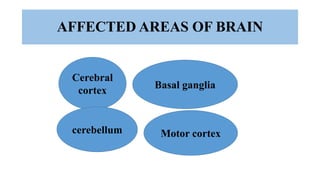
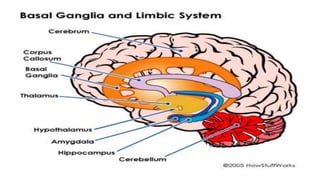
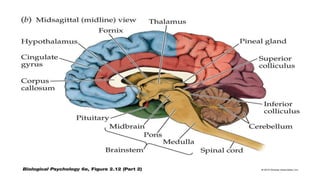
AFFECTED AREAS OF BRAIN
Cerebral
cortex
Basal ganglia
cerebellum Motor cortex
Cerebral cortex
• Produce persons desire to move.
• Injury cause spasticity (muscle stiffness).
• Tone abnormality.
Basal ganglia
• Controls the brain’s ability to recall previously learned movement
patterns.
• Injury cause tone disorder.
• Hypotonia, Hypertonia, Dystonia ,Chorea.
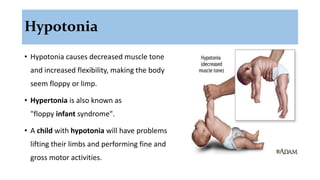
Hypotonia
• Hypotonia causes decreased muscle tone
and increased flexibility, making the body
seem floppy or limp.
• Hypertonia is also known as
"floppy infant syndrome".
• A child with hypotonia will have problems
lifting their limbs and performing fine and
gross motor activities.
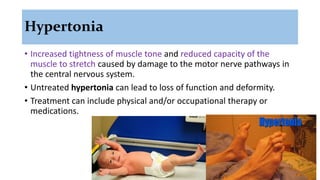
Hypertonia
• Increased tightness of muscle tone and reduced capacity of the
muscle to stretch caused by damage to the motor nerve pathways in
the central nervous system.
• Untreated hypertonia can lead to loss of function and deformity.
• Treatment can include physical and/or occupational therapy or
medications.
Dystonia & Chorea
• Dystonia- is characterized by sustained or intermittent muscle contractions
causing twisting or repetitive movement.
• Chorea is a movement disorder that causes involuntary, irregular, unpredictable
muscle movements.
• The disorder can make you look like you're dancing (the word chorea comes from
the Greek word for “dance”) or look restless or fidgety.
• Chorea is a movement problem that occurs in many different diseases and
conditions.
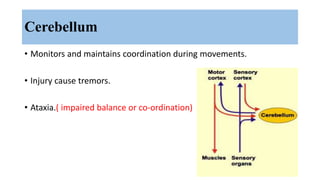
Cerebellum
• Monitors and maintains coordination during movements.
• Injury cause tremors.
• Ataxia.( impaired balance or co-ordination)
Motor cortex
• Control muscle movements in specific parts of the body.
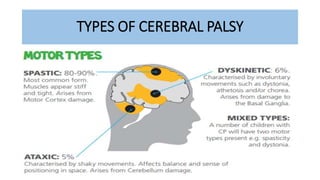
TYPES OF CEREBRAL PALSY
A. SPASTIC CEREBRAL PALSY
• This is the most common type of cerebral palsy occurring 80% of all
cases.
• Arises from motor cortex damage.
• Spasticity means stiffness or tightness of muscles.
• The muscles are stiff because the message to the muscles is sent
incorrectly through the damaged part of the brain.
TYPES OF SPASTIC CP
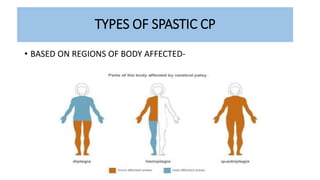
• BASED ON REGIONS OF BODY AFFECTED-
TYPES OF SPASTIC CP
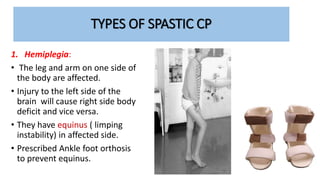
1. Hemiplegia:
• The leg and arm on one side of
the body are affected.
• Injury to the left side of the
brain will cause right side body
deficit and vice versa.
• They have equinus ( limping
instability) in affected side.
• Prescribed Ankle foot orthosis
to prevent equinus.
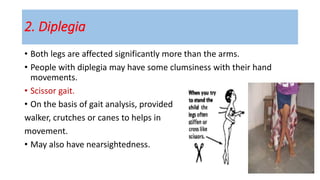
2. Diplegia
• Both legs are affected significantly more than the arms.
• People with diplegia may have some clumsiness with their hand
movements.
• Scissor gait.
• On the basis of gait analysis, provided
walker, crutches or canes to helps in
movement.
• May also have nearsightedness.
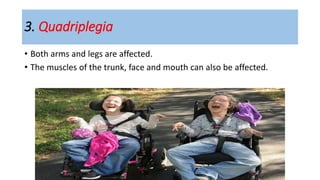
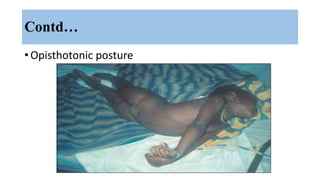
3. Quadriplegia
• Both arms and legs are affected.
• The muscles of the trunk, face and mouth can also be affected.
Contd…
• Opisthotonic posture
B. DYSKINETIC/ATHETOID CEREBRAL PALSY
• This type affects about 2-15% of people with cerebral palsy.
There are two forms:
• Athetoid- is characterized by mixed muscle tone both hypotonia and
hypertonia present with constant involuntary writhing motions.
• Dystonia- is characterized by sustained or intermittent muscle
contractions causing twisting or repetitive movement.
C. ATAXIC CEREBRAL PALSY
• This is the least common type of cerebral palsy (2-8%).
• Cause by damage to cerebellum.
• Characterized by shaky movements.
• It affects a persons balance and coordination.
• Hypotonia and tremors may present.
• Motor skills like writing, typing, using scissors might be affected.
D. MIXED FORMS
• Many people have signs of more than one of the three types.
• The most common mixed form includes spasticity and dystonic
movements, but other combinations are also possible.
DIAGNOSTIC EVALUATION
• Details history related to the condition is most important for
diagnosis.
• These should include history of prenatal and perinatal period
including APGAR score, resuscitation, birth injury, etc.
• History of neonatal period with physical, neurological and
developmental assessment are significant diagnostic evidence.
• Special diagnostic approach should includes CT scan, psychometric
test, examination of blood and urine.
• MRI, EEG.
PREVENTION OF CEREBRAL PALSY
• Adequate antenatal care with prevention of maternal infections, fetal
problems and perinatal hazards.
• Prevention of birth injury, perinatal asphyxia, neonatal jaundice are
important measures for prevention of CP.
• Early diagnosis and prompt initiation of appropriate management of
etiological factors along with the condition.
MANAGEMENT
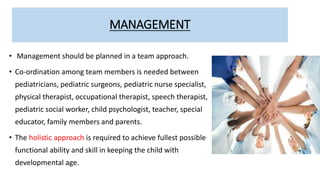
• Management should be planned in a team approach.
• Co-ordination among team members is needed between
pediatricians, pediatric surgeons, pediatric nurse specialist,
physical therapist, occupational therapist, speech therapist,
pediatric social worker, child psychologist, teacher, special
educator, family members and parents.
• The holistic approach is required to achieve fullest possible
functional ability and skill in keeping the child with
developmental age.
MANAGEMENT INCLUDES:
1. Drug therapy.
2. Physiotherapy.
3. Surgical corrections of deformities.
4. Occupational therapy.
5. Rehabilitation.
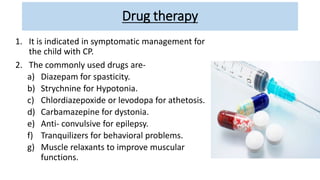
Drug therapy
1. It is indicated in symptomatic management for
the child with CP.
2. The commonly used drugs are-
a) Diazepam for spasticity.
b) Strychnine for Hypotonia.
c) Chlordiazepoxide or levodopa for athetosis.
d) Carbamazepine for dystonia.
e) Anti- convulsive for epilepsy.
f) Tranquilizers for behavioral problems.
g) Muscle relaxants to improve muscular
functions.
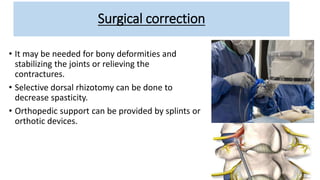
Surgical correction
• It may be needed for bony deformities and
stabilizing the joints or relieving the
contractures.
• Selective dorsal rhizotomy can be done to
decrease spasticity.
• Orthopedic support can be provided by splints or
orthotic devices.
CONCLUSION
• Children with cerebral palsy can have problems such as muscle
weakness, stiffness, awkwardness, slowness, shakiness, and difficulty
with balance.
• These problems can range from mild to severe. In mild cerebral palsy,
the child may be slightly clumsy in one arm or leg, and the problem
may be barely noticeable.
• In severe cerebral palsy, the child may have a lot of difficulties in
performing everyday tasks and movements.
REFERENCE
• Marlow Dorothy, “Text book of pediatric nursing”, 6th ed., W.B.
Saunders Company, 1988
• Marilyn J. Hockenberry “Wong’s essentials of pediatric nursing”,
7thEd., Mosby Publication 2005
• Pediatric nursing as per INC syllabus 4th edition by Parul dutta.
• Nelson essential of pediatrics First south asian ediation, Elsevier By
Karen Marcdante, Robert m kiegman
• Essential pediatric nursing book by rimple Sharma jaypee publishers.

Cerebral palsy

  • 1.
  • 2.
    INTRODUCTION • The braincontrols all that we do. • Different parts of the brain control the movement of every muscle of the body. • In cerebral palsy, there is damage or lack of development in/one of these areas of the brain.
  • 3.
    CEREBRAL PALSY • 'Cerebral'– refers to the brain. • 'Palsy' – can mean weakness or paralysis or lack of muscle control. • Therefore cerebral palsy is a disorder of muscle control which results from some damage to part of the brain. • The term cerebral palsy is used when the problem has occurred early in life, to the developing brain.
  • 4.
    CONTD….. • Children withcerebral palsy can have problems such as muscle weakness, stiffness, slowness, shakiness, and difficulty with balance. • These problems can range from mild to severe.
  • 6.
    DEFINITION • Cerebral palsyis a chronic non-progressive motor dysfunction caused by damage to the motor areas of brain. (Blosser and Burns, 2004).
  • 7.
    INCIDENCE • In 2007,the incidence of cerebral palsy was estimated to be 2.12-2.45 per 1000 live births.
  • 8.
    CAUSES • There israrely one single cause of cerebral palsy. • For most babies born with cerebral palsy, the cause remains unknown. • For a long time, it was believed that cerebral palsy was due to complications at birth, including asphyxia (lack of oxygen). • Researchers now understand that this contributes to only a very small percentage of cases of cerebral palsy.
  • 9.
    The Indian CerebralPalsy Register Report 2009 identified four groups that, statistically- 1. Males - Males are at greater risk of having cerebral palsy. 2. Premature babies - Prematurity is associated with higher rates of cerebral palsy. 42% of children with cerebral palsy are born prematurely, compared to 8% of the Indian population.
  • 10.
    The Indian CerebralPalsy Register Report 2009 identified four groups that, statistically- 3. Small babies - Low birth weight is associated with higher rates of cerebral palsy. This may be a result of prematurity or slow intrauterine growth. 43% of children with cerebral palsy had low birth weight, compared to just over 6% of the Indian population. 4. Twins, triplets and higher multiple births - Multiple births are associated with higher rates of cerebral palsy. 11% of children with cerebral palsy were from a multiple birth.
  • 11.
    Factors contributing toCP Prenatal perinatal postnatal
  • 12.
    A. Prenatal • Iodinedeficiency • Iron deficiency or poor nutrition
  • 13.
    Contd….. Risk factor….Prenatal •Intrauterine infections. • Multiple fetuses.
  • 15.
    Contd….. Risk factor….Prenatal •Teratogen- (drugs ,radiations, smoking ,alcohol)
  • 16.
  • 18.
  • 19.
  • 20.
    Contd….. Risk factor….Perinatal •Birth asphyxia. Severe Birth Asphyxia –APGAR<3 at 20 min
  • 21.
  • 22.
    Contd….. Risk factor….Perinatal •Intra-cerebral bleeds/IVH
  • 23.
  • 24.
    • Jaundice shortlyafter birth. Contd….. Risk factor….Perinatal
  • 25.
  • 26.
    C. Post natal •CNS infection
  • 27.
  • 28.
  • 29.
  • 30.
    Contd…. • Hypoxic damage-Like near Drowning & Choking due to foreign body aspiration. Risk factor….Post-natal
  • 31.
    AFFECTED AREAS OFBRAIN Cerebral cortex Basal ganglia cerebellum Motor cortex
  • 34.
    Cerebral cortex • Producepersons desire to move. • Injury cause spasticity (muscle stiffness). • Tone abnormality.
  • 35.
    Basal ganglia • Controlsthe brain’s ability to recall previously learned movement patterns. • Injury cause tone disorder. • Hypotonia, Hypertonia, Dystonia ,Chorea.
  • 36.
    Hypotonia • Hypotonia causesdecreased muscle tone and increased flexibility, making the body seem floppy or limp. • Hypertonia is also known as "floppy infant syndrome". • A child with hypotonia will have problems lifting their limbs and performing fine and gross motor activities.
  • 37.
    Hypertonia • Increased tightnessof muscle tone and reduced capacity of the muscle to stretch caused by damage to the motor nerve pathways in the central nervous system. • Untreated hypertonia can lead to loss of function and deformity. • Treatment can include physical and/or occupational therapy or medications.
  • 38.
    Dystonia & Chorea •Dystonia- is characterized by sustained or intermittent muscle contractions causing twisting or repetitive movement. • Chorea is a movement disorder that causes involuntary, irregular, unpredictable muscle movements. • The disorder can make you look like you're dancing (the word chorea comes from the Greek word for “dance”) or look restless or fidgety. • Chorea is a movement problem that occurs in many different diseases and conditions.
  • 39.
    Cerebellum • Monitors andmaintains coordination during movements. • Injury cause tremors. • Ataxia.( impaired balance or co-ordination)
  • 40.
    Motor cortex • Controlmuscle movements in specific parts of the body.
  • 42.
  • 43.
    A. SPASTIC CEREBRALPALSY • This is the most common type of cerebral palsy occurring 80% of all cases. • Arises from motor cortex damage. • Spasticity means stiffness or tightness of muscles. • The muscles are stiff because the message to the muscles is sent incorrectly through the damaged part of the brain.
  • 44.
    TYPES OF SPASTICCP • BASED ON REGIONS OF BODY AFFECTED-
  • 45.
    TYPES OF SPASTICCP 1. Hemiplegia: • The leg and arm on one side of the body are affected. • Injury to the left side of the brain will cause right side body deficit and vice versa. • They have equinus ( limping instability) in affected side. • Prescribed Ankle foot orthosis to prevent equinus.
  • 46.
    2. Diplegia • Bothlegs are affected significantly more than the arms. • People with diplegia may have some clumsiness with their hand movements. • Scissor gait. • On the basis of gait analysis, provided walker, crutches or canes to helps in movement. • May also have nearsightedness.
  • 47.
    3. Quadriplegia • Botharms and legs are affected. • The muscles of the trunk, face and mouth can also be affected.
  • 48.
  • 49.
    B. DYSKINETIC/ATHETOID CEREBRALPALSY • This type affects about 2-15% of people with cerebral palsy. There are two forms: • Athetoid- is characterized by mixed muscle tone both hypotonia and hypertonia present with constant involuntary writhing motions. • Dystonia- is characterized by sustained or intermittent muscle contractions causing twisting or repetitive movement.
  • 50.
    C. ATAXIC CEREBRALPALSY • This is the least common type of cerebral palsy (2-8%). • Cause by damage to cerebellum. • Characterized by shaky movements. • It affects a persons balance and coordination. • Hypotonia and tremors may present. • Motor skills like writing, typing, using scissors might be affected.
  • 51.
    D. MIXED FORMS •Many people have signs of more than one of the three types. • The most common mixed form includes spasticity and dystonic movements, but other combinations are also possible.
  • 52.
    DIAGNOSTIC EVALUATION • Detailshistory related to the condition is most important for diagnosis. • These should include history of prenatal and perinatal period including APGAR score, resuscitation, birth injury, etc. • History of neonatal period with physical, neurological and developmental assessment are significant diagnostic evidence. • Special diagnostic approach should includes CT scan, psychometric test, examination of blood and urine. • MRI, EEG.
  • 54.
    PREVENTION OF CEREBRALPALSY • Adequate antenatal care with prevention of maternal infections, fetal problems and perinatal hazards. • Prevention of birth injury, perinatal asphyxia, neonatal jaundice are important measures for prevention of CP. • Early diagnosis and prompt initiation of appropriate management of etiological factors along with the condition.
  • 55.
    MANAGEMENT • Management shouldbe planned in a team approach. • Co-ordination among team members is needed between pediatricians, pediatric surgeons, pediatric nurse specialist, physical therapist, occupational therapist, speech therapist, pediatric social worker, child psychologist, teacher, special educator, family members and parents. • The holistic approach is required to achieve fullest possible functional ability and skill in keeping the child with developmental age.
  • 56.
    MANAGEMENT INCLUDES: 1. Drugtherapy. 2. Physiotherapy. 3. Surgical corrections of deformities. 4. Occupational therapy. 5. Rehabilitation.
  • 57.
    Drug therapy 1. Itis indicated in symptomatic management for the child with CP. 2. The commonly used drugs are- a) Diazepam for spasticity. b) Strychnine for Hypotonia. c) Chlordiazepoxide or levodopa for athetosis. d) Carbamazepine for dystonia. e) Anti- convulsive for epilepsy. f) Tranquilizers for behavioral problems. g) Muscle relaxants to improve muscular functions.
  • 58.
    Surgical correction • Itmay be needed for bony deformities and stabilizing the joints or relieving the contractures. • Selective dorsal rhizotomy can be done to decrease spasticity. • Orthopedic support can be provided by splints or orthotic devices.
  • 59.
    CONCLUSION • Children withcerebral palsy can have problems such as muscle weakness, stiffness, awkwardness, slowness, shakiness, and difficulty with balance. • These problems can range from mild to severe. In mild cerebral palsy, the child may be slightly clumsy in one arm or leg, and the problem may be barely noticeable. • In severe cerebral palsy, the child may have a lot of difficulties in performing everyday tasks and movements.
  • 60.
    REFERENCE • Marlow Dorothy,“Text book of pediatric nursing”, 6th ed., W.B. Saunders Company, 1988 • Marilyn J. Hockenberry “Wong’s essentials of pediatric nursing”, 7thEd., Mosby Publication 2005 • Pediatric nursing as per INC syllabus 4th edition by Parul dutta. • Nelson essential of pediatrics First south asian ediation, Elsevier By Karen Marcdante, Robert m kiegman • Essential pediatric nursing book by rimple Sharma jaypee publishers.