1.1 Linear Equations
Chapter 1 Equations and Inequalities
Concepts and Objectives
⚫ Identify basic properties of equations
⚫ Solve linear equations
⚫ Identify equations as identities, conditional equations,
and contradictions
⚫ Solve for a specific variable (literal equations)
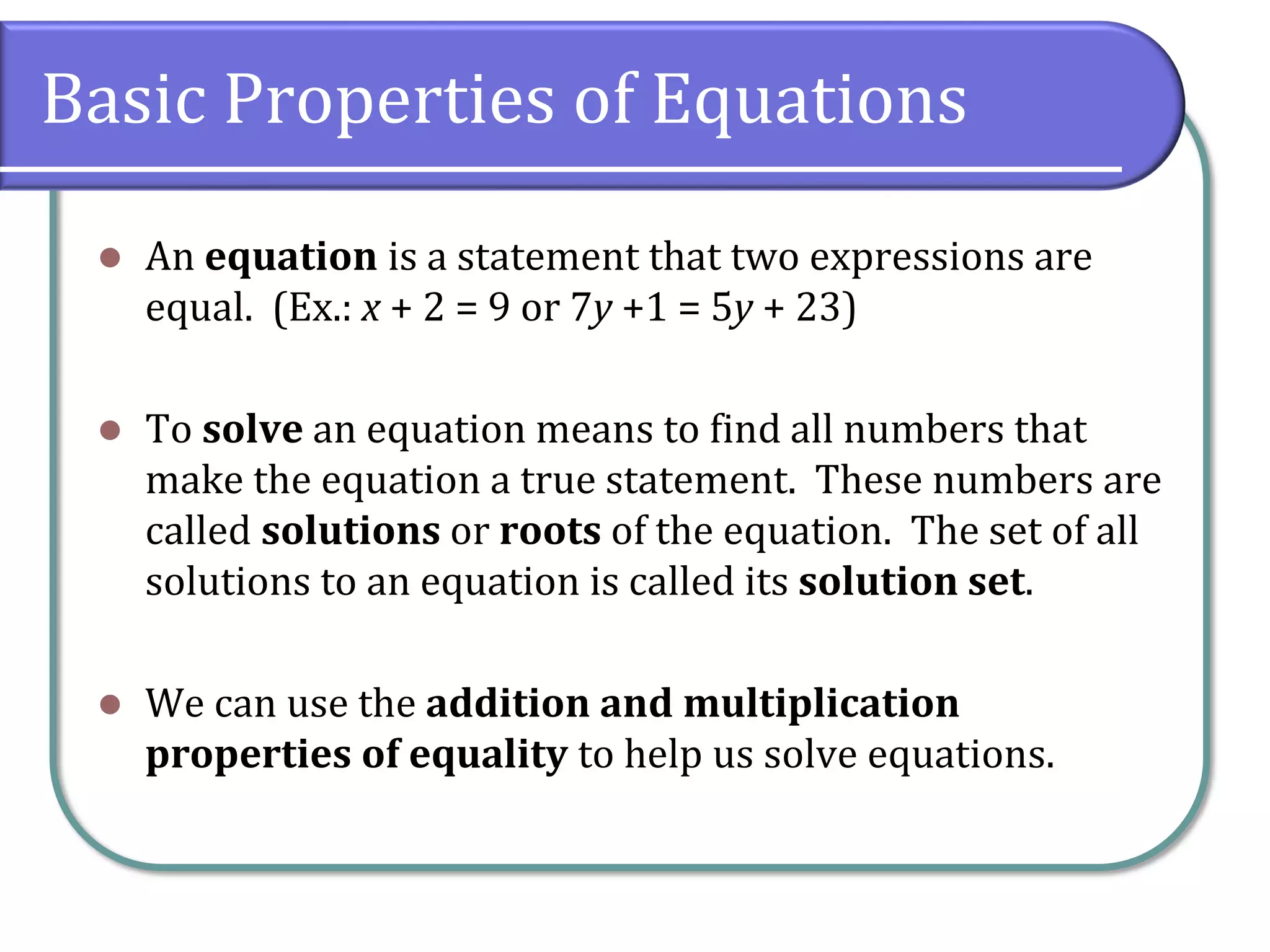
Basic Properties of Equations
⚫ An equation is a statement that two expressions are
equal. (Ex.: x + 2 = 9 or 7y +1 = 5y + 23)
⚫ To solve an equation means to find all numbers that
make the equation a true statement. These numbers are
called solutions or roots of the equation. The set of all
solutions to an equation is called its solution set.
⚫ We can use the addition and multiplication
properties of equality to help us solve equations.
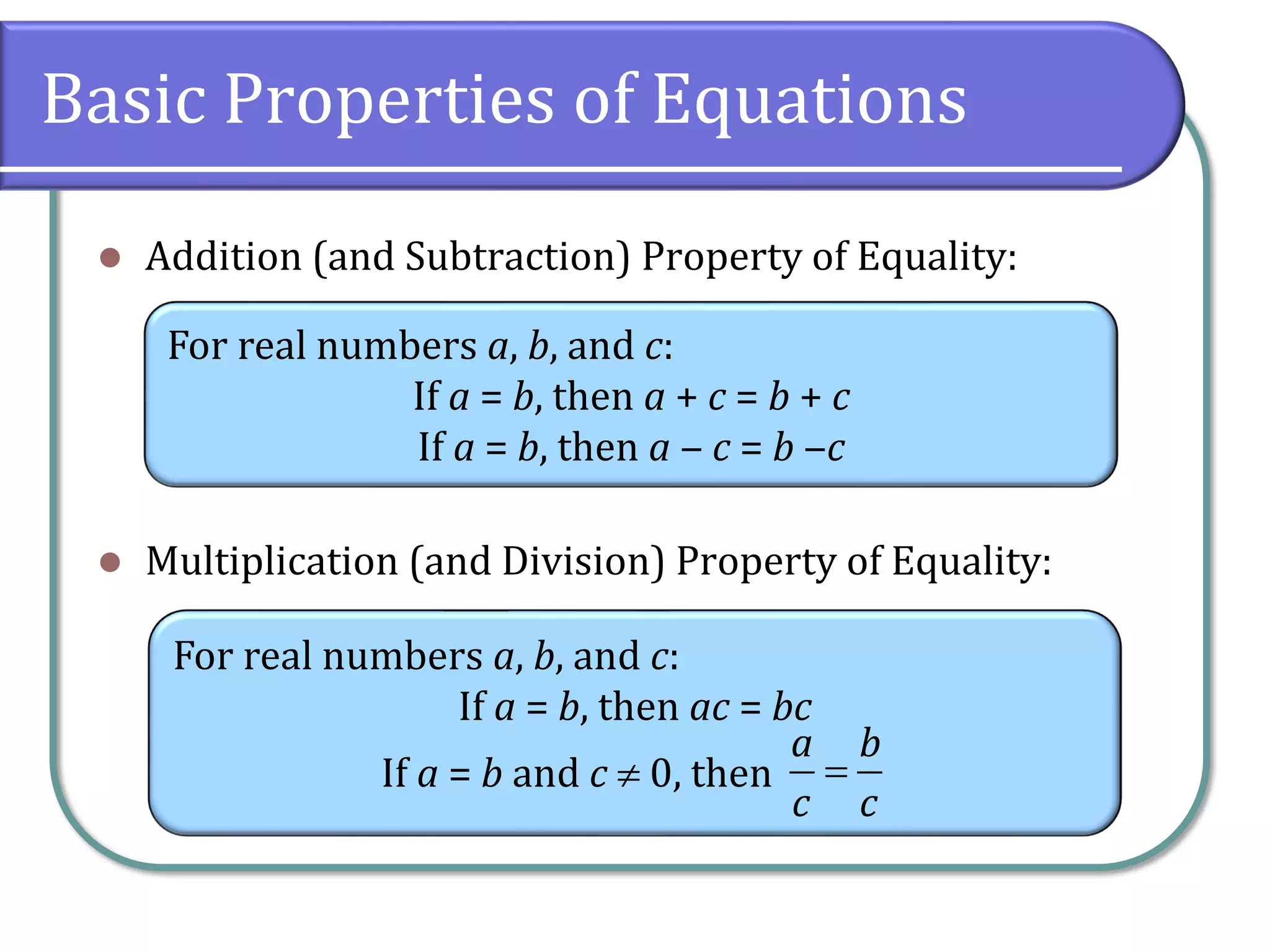
Basic Properties of Equations
⚫ Addition (and Subtraction) Property of Equality:
⚫ Multiplication (and Division) Property of Equality:
For real numbers a, b, and c:
If a = b, then ac = bc
If a = b and c  0, then
a b
c c
=
For real numbers a, b, and c:
If a = b, then a + c = b + c
If a = b, then a ‒ c = b ‒c
Linear Equations
⚫ A linear equation in one variable is an equation that
can be written in the form
ax + b = 0,
where a and b are real numbers and a  0.
⚫ A linear equation is also called a first-degree equation
since the degree of the variable is either one or zero.
⚫ To solve a linear equation, use the properties of equality
to isolate the variable on one side and the solution on
the other.
Linear Equations (cont.)
⚫ If solving a linear equation leads to
⚫ a true statement such as 0 = 0, the equation is an
identity. Its solution set is  or {all real numbers}.
⚫ a single solution such as x = 3, the equation is
conditional. Its solution set consists of a single
element.
⚫ a false statement such as 0 = 7, the equation is a
contradiction. Its solution set is  or { }.
Linear Equations (cont.)
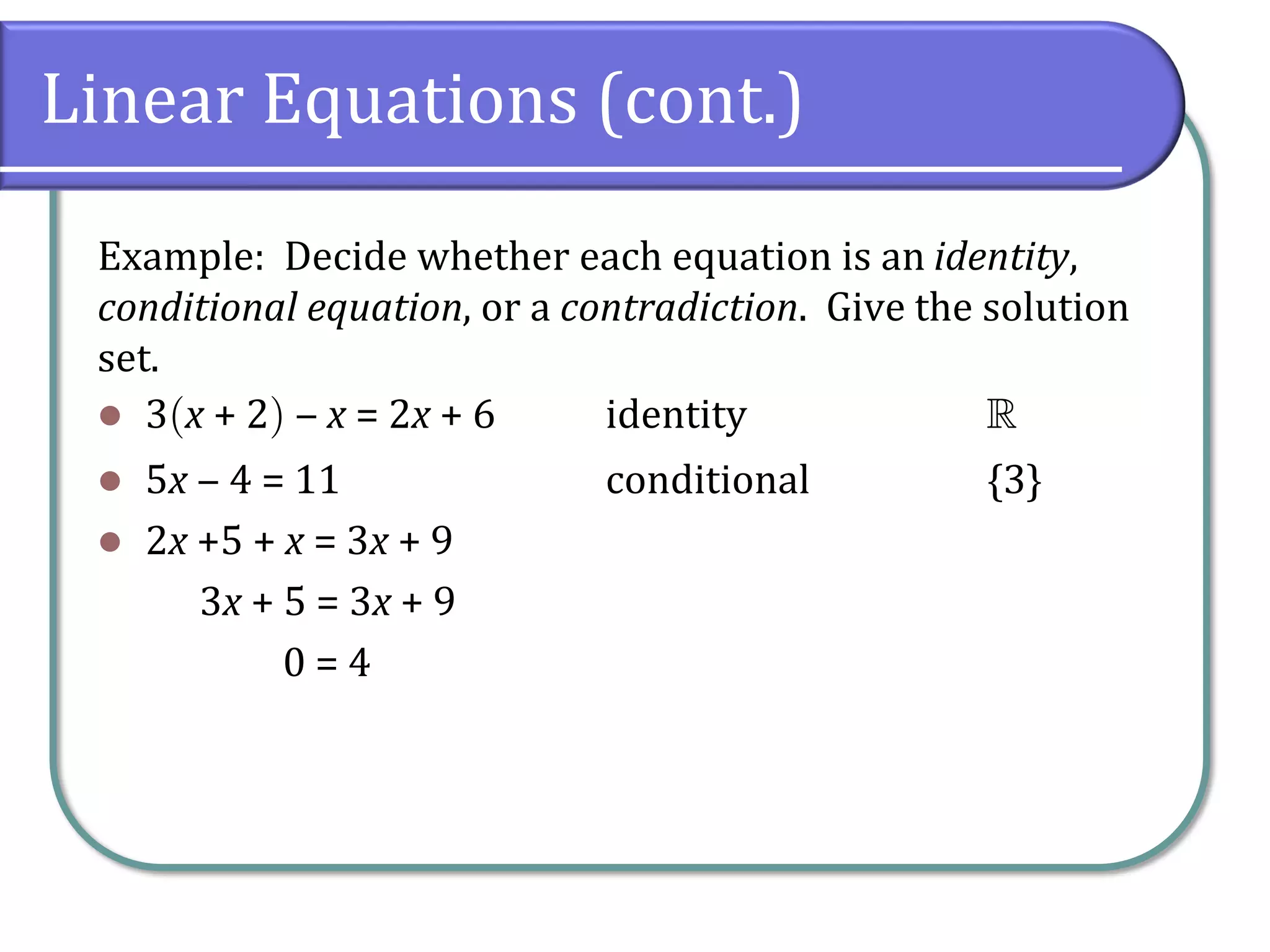
Example: Decide whether each equation is an identity,
conditional equation, or a contradiction. Give the solution
set.
⚫ 3x + 2 ‒ x = 2x + 6
⚫ 5x ‒ 4 = 11
⚫ 2x +5 + x = 3x + 9
Linear Equations (cont.)
Example: Decide whether each equation is an identity,
conditional equation, or a contradiction. Give the solution
set.
⚫ 3x + 2 ‒ x = 2x + 6
3x + 6 ‒ x = 2x + 6
2x + 6 = 2x + 6
0 = 0
⚫ 5x ‒ 4 = 11
⚫ 2x +5 + x = 3x + 9
Linear Equations (cont.)
Example: Decide whether each equation is an identity,
conditional equation, or a contradiction. Give the solution
set.
⚫ 3x + 2 ‒ x = 2x + 6 identity 
3x + 6 ‒ x = 2x + 6
2x + 6 = 2x + 6
0 = 0
⚫ 5x ‒ 4 = 11
⚫ 2x +5 + x = 3x + 9
Linear Equations (cont.)
Example: Decide whether each equation is an identity,
conditional equation, or a contradiction. Give the solution
set.
⚫ 3x + 2 ‒ x = 2x + 6 identity 
⚫ 5x ‒ 4 = 11
5x = 15
x = 3
⚫ 2x +5 + x = 3x + 9
Linear Equations (cont.)
Example: Decide whether each equation is an identity,
conditional equation, or a contradiction. Give the solution
set.
⚫ 3x + 2 ‒ x = 2x + 6 identity 
⚫ 5x ‒ 4 = 11 conditional {3}
5x = 15
x = 3
⚫ 2x +5 + x = 3x + 9
Linear Equations (cont.)
Example: Decide whether each equation is an identity,
conditional equation, or a contradiction. Give the solution
set.
⚫ 3x + 2 ‒ x = 2x + 6 identity 
⚫ 5x ‒ 4 = 11 conditional {3}
⚫ 2x +5 + x = 3x + 9
3x + 5 = 3x + 9
0 = 4
Linear Equations (cont.)
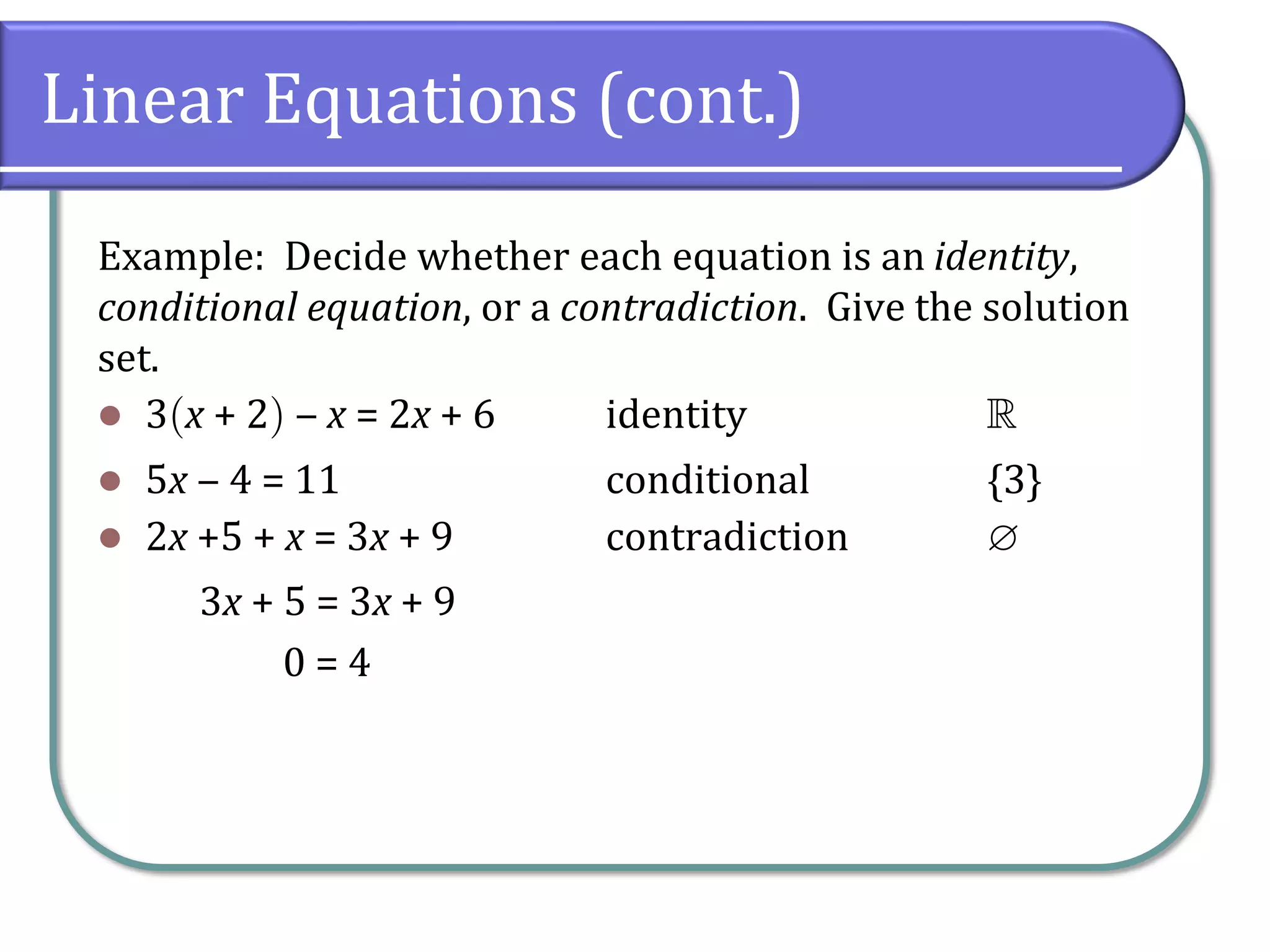
Example: Decide whether each equation is an identity,
conditional equation, or a contradiction. Give the solution
set.
⚫ 3x + 2 ‒ x = 2x + 6 identity 
⚫ 5x ‒ 4 = 11 conditional {3}
⚫ 2x +5 + x = 3x + 9 contradiction 
3x + 5 = 3x + 9
0 = 4
Literal Equations
⚫ A literal equation is an equation that relates two or
more variables. Formulas are examples of literal
equations.
⚫ When using literal equations, sometimes the variable is
not the one that is isolated, and so we have to solve for a
different variable.
⚫ In this case we use some of the same methods used to
solve other equations – we treat the specified
variable as if it were the only variable, and the other
variables we treat as constants (although we
generally can’t combine them).
Literal Equations (cont.)
Examples: Solve for the specified variable.
(1) , for t (2) , for kI Prt= 2
S kr krm= +
Literal Equations (cont.)
Examples: Solve for the specified variable.
(1) , for t (2) , for k
I Pr
Pr P
t
r
I
t
Pr
=
=
I Prt= 2
S kr krm= +
Literal Equations (cont.)
Examples: Solve for the specified variable.
(1) , for t (2) , for k
I Pr
Pr P
t
r
I
t
Pr
=
=
I Prt= 2
S kr krm= +
( )
( )
2
2
2 2
2
S r rm
k r rmS
r rm r rm
S
k
r rm
k= +
+
=
+ +
=
+
Classwork
⚫ 1.1 Assignment (College Algebra)
⚫ Page 88: 10-28 (even); page 71: 64-92 (×4);
page 61: 76-96 (×4)
⚫ 1.1 Classwork Check
⚫ Quiz 0.7

1.1 Linear Equations

  • 1.
    1.1 Linear Equations Chapter1 Equations and Inequalities
  • 2.
    Concepts and Objectives ⚫Identify basic properties of equations ⚫ Solve linear equations ⚫ Identify equations as identities, conditional equations, and contradictions ⚫ Solve for a specific variable (literal equations)
  • 3.
    Basic Properties ofEquations ⚫ An equation is a statement that two expressions are equal. (Ex.: x + 2 = 9 or 7y +1 = 5y + 23) ⚫ To solve an equation means to find all numbers that make the equation a true statement. These numbers are called solutions or roots of the equation. The set of all solutions to an equation is called its solution set. ⚫ We can use the addition and multiplication properties of equality to help us solve equations.
  • 4.
    Basic Properties ofEquations ⚫ Addition (and Subtraction) Property of Equality: ⚫ Multiplication (and Division) Property of Equality: For real numbers a, b, and c: If a = b, then ac = bc If a = b and c  0, then a b c c = For real numbers a, b, and c: If a = b, then a + c = b + c If a = b, then a ‒ c = b ‒c
  • 5.
    Linear Equations ⚫ Alinear equation in one variable is an equation that can be written in the form ax + b = 0, where a and b are real numbers and a  0. ⚫ A linear equation is also called a first-degree equation since the degree of the variable is either one or zero. ⚫ To solve a linear equation, use the properties of equality to isolate the variable on one side and the solution on the other.
  • 6.
    Linear Equations (cont.) ⚫If solving a linear equation leads to ⚫ a true statement such as 0 = 0, the equation is an identity. Its solution set is  or {all real numbers}. ⚫ a single solution such as x = 3, the equation is conditional. Its solution set consists of a single element. ⚫ a false statement such as 0 = 7, the equation is a contradiction. Its solution set is  or { }.
  • 7.
    Linear Equations (cont.) Example:Decide whether each equation is an identity, conditional equation, or a contradiction. Give the solution set. ⚫ 3x + 2 ‒ x = 2x + 6 ⚫ 5x ‒ 4 = 11 ⚫ 2x +5 + x = 3x + 9
  • 8.
    Linear Equations (cont.) Example:Decide whether each equation is an identity, conditional equation, or a contradiction. Give the solution set. ⚫ 3x + 2 ‒ x = 2x + 6 3x + 6 ‒ x = 2x + 6 2x + 6 = 2x + 6 0 = 0 ⚫ 5x ‒ 4 = 11 ⚫ 2x +5 + x = 3x + 9
  • 9.
    Linear Equations (cont.) Example:Decide whether each equation is an identity, conditional equation, or a contradiction. Give the solution set. ⚫ 3x + 2 ‒ x = 2x + 6 identity  3x + 6 ‒ x = 2x + 6 2x + 6 = 2x + 6 0 = 0 ⚫ 5x ‒ 4 = 11 ⚫ 2x +5 + x = 3x + 9
  • 10.
    Linear Equations (cont.) Example:Decide whether each equation is an identity, conditional equation, or a contradiction. Give the solution set. ⚫ 3x + 2 ‒ x = 2x + 6 identity  ⚫ 5x ‒ 4 = 11 5x = 15 x = 3 ⚫ 2x +5 + x = 3x + 9
  • 11.
    Linear Equations (cont.) Example:Decide whether each equation is an identity, conditional equation, or a contradiction. Give the solution set. ⚫ 3x + 2 ‒ x = 2x + 6 identity  ⚫ 5x ‒ 4 = 11 conditional {3} 5x = 15 x = 3 ⚫ 2x +5 + x = 3x + 9
  • 12.
    Linear Equations (cont.) Example:Decide whether each equation is an identity, conditional equation, or a contradiction. Give the solution set. ⚫ 3x + 2 ‒ x = 2x + 6 identity  ⚫ 5x ‒ 4 = 11 conditional {3} ⚫ 2x +5 + x = 3x + 9 3x + 5 = 3x + 9 0 = 4
  • 13.
    Linear Equations (cont.) Example:Decide whether each equation is an identity, conditional equation, or a contradiction. Give the solution set. ⚫ 3x + 2 ‒ x = 2x + 6 identity  ⚫ 5x ‒ 4 = 11 conditional {3} ⚫ 2x +5 + x = 3x + 9 contradiction  3x + 5 = 3x + 9 0 = 4
  • 14.
    Literal Equations ⚫ Aliteral equation is an equation that relates two or more variables. Formulas are examples of literal equations. ⚫ When using literal equations, sometimes the variable is not the one that is isolated, and so we have to solve for a different variable. ⚫ In this case we use some of the same methods used to solve other equations – we treat the specified variable as if it were the only variable, and the other variables we treat as constants (although we generally can’t combine them).
  • 15.
    Literal Equations (cont.) Examples:Solve for the specified variable. (1) , for t (2) , for kI Prt= 2 S kr krm= +
  • 16.
    Literal Equations (cont.) Examples:Solve for the specified variable. (1) , for t (2) , for k I Pr Pr P t r I t Pr = = I Prt= 2 S kr krm= +
  • 17.
    Literal Equations (cont.) Examples:Solve for the specified variable. (1) , for t (2) , for k I Pr Pr P t r I t Pr = = I Prt= 2 S kr krm= + ( ) ( ) 2 2 2 2 2 S r rm k r rmS r rm r rm S k r rm k= + + = + + = +
  • 18.
    Classwork ⚫ 1.1 Assignment(College Algebra) ⚫ Page 88: 10-28 (even); page 71: 64-92 (×4); page 61: 76-96 (×4) ⚫ 1.1 Classwork Check ⚫ Quiz 0.7