1
Lecture 1
Matrices and Determinants
By Kisor Mukhopadhyay, Prabhu Jagatbandhu College,
Module I
2
1.1 Matrices
1.2 Operations of matrices
1.3 Types of matrices
1.4 Properties of matrices
1.5 Determinants
1.6 Inverse of a 33 matrix
3
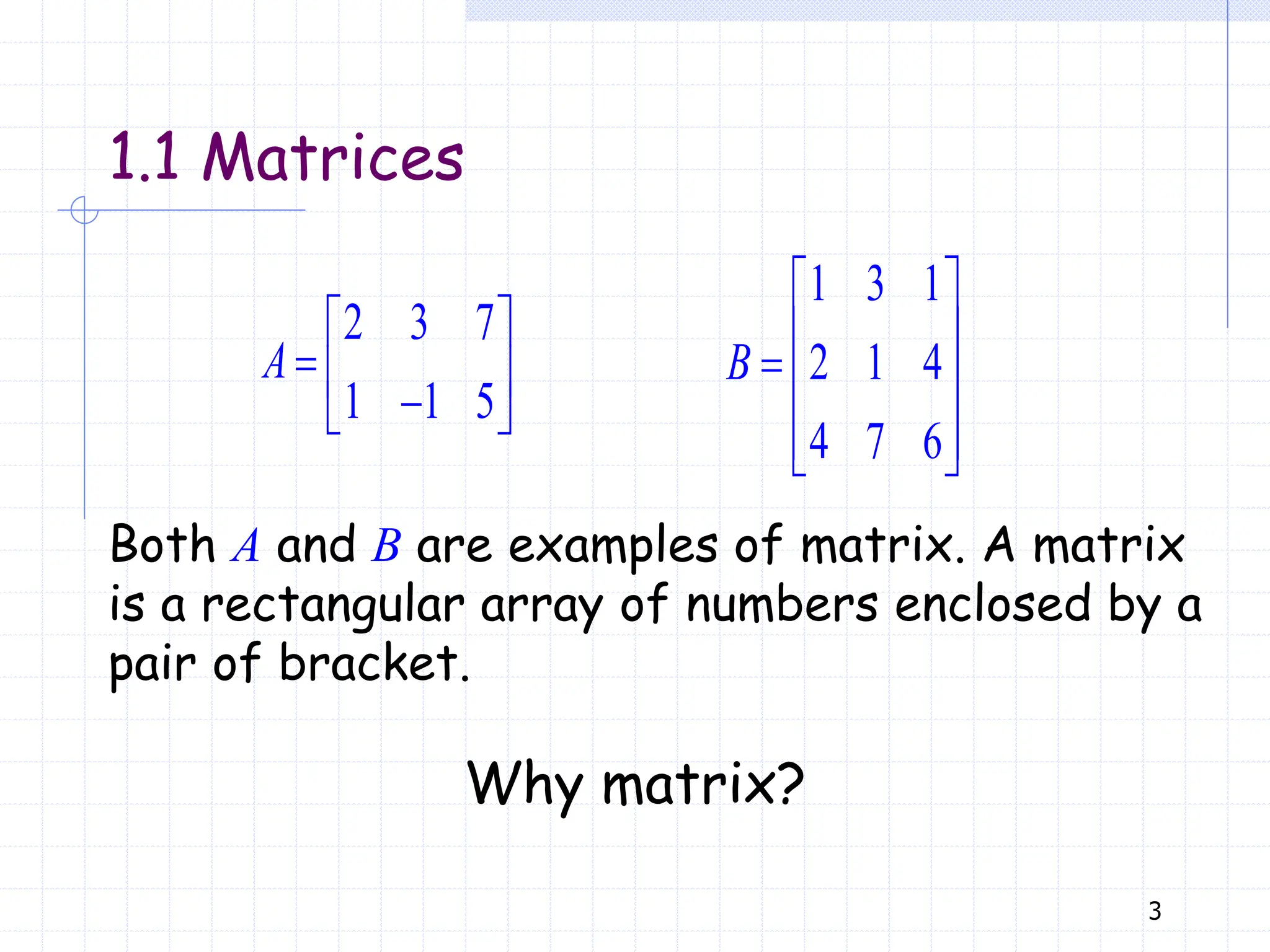
2 3 7
1 1 5
A
 
  

 
1.1 Matrices
1 3 1
2 1 4
4 7 6
B
 
 
  
 
 
Both A and B are examples of matrix. A matrix
is a rectangular array of numbers enclosed by a
pair of bracket.
Why matrix?
4
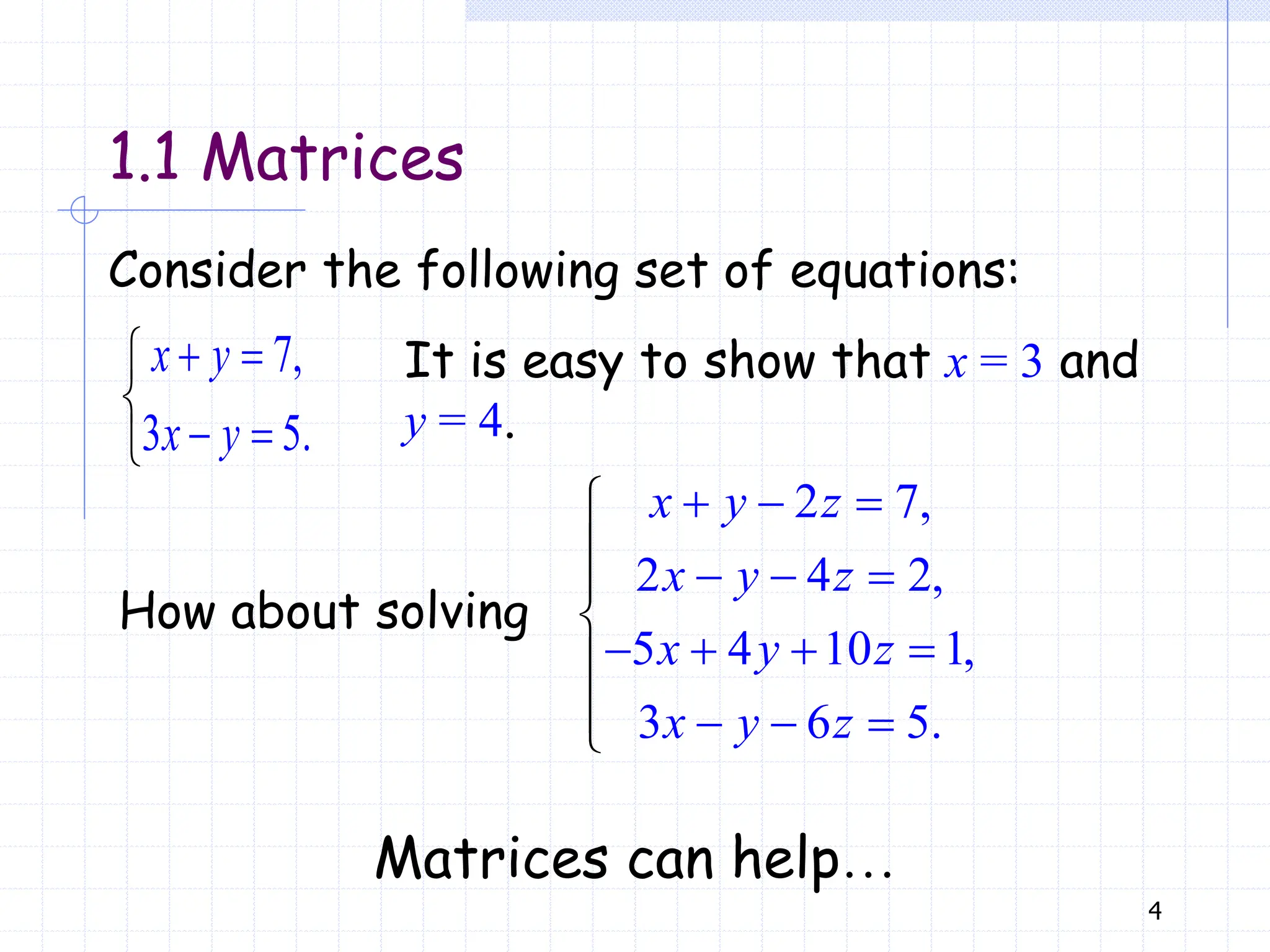
How about solving
7,
3 5.
 


 

x y
x y
2 7,
2 4 2,
5 4 10 1,
3 6 5.
  
  
   
 





 

x y z
x y z
x y z
x y z
Consider the following set of equations:
It is easy to show that x = 3 and
y = 4.
Matrices can help…
1.1 Matrices
5
11 12 1
21 22 2
1 2
 
 
 

 
 
 
n
n
m m mn
a a a
a a a
A
a a a
In the matrix
▪numbers aij are called elements. First subscript
indicates the row; second subscript indicates
the column. The matrix consists of mn elements
▪It is called “the m  n matrix A = [aij]” or simply
“the matrix A ” if number of rows and columns
are understood.
1.1 Matrices
6
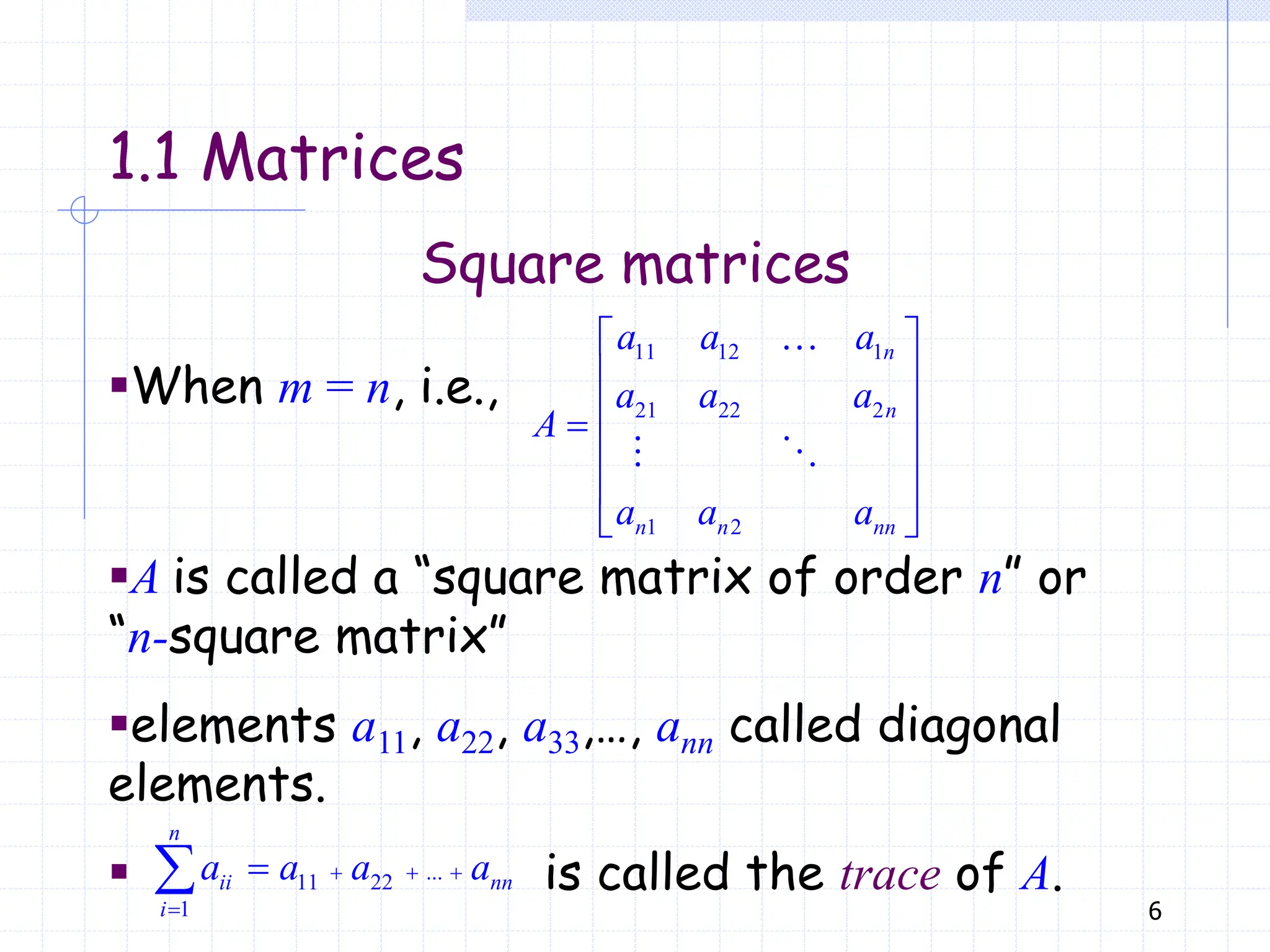
Square matrices
▪When m = n, i.e.,
▪A is called a “square matrix of order n” or
“n-square matrix”
▪elements a11, a22, a33,…, ann called diagonal
elements.
▪ is called the trace of A.
11 12 1
21 22 2
1 2
 
 
 

 
 
 
n
n
n n nn
a a a
a a a
A
a a a
...
11 22
1
  



n
ii nn
i
a a a a
1.1 Matrices
7
Equal matrices
▪Two matrices A = [aij] and B = [bij] are said to
be equal (A = B) iff each element of A is equal
to the corresponding element of B, i.e., aij = bij
for 1  i  m, 1  j  n.
▪iff pronouns “if and only if”
if A = B, it implies aij = bij for 1  i  m, 1  j  n;
if aij = bij for 1  i  m, 1  j  n, it implies A = B.
1.1 Matrices
8
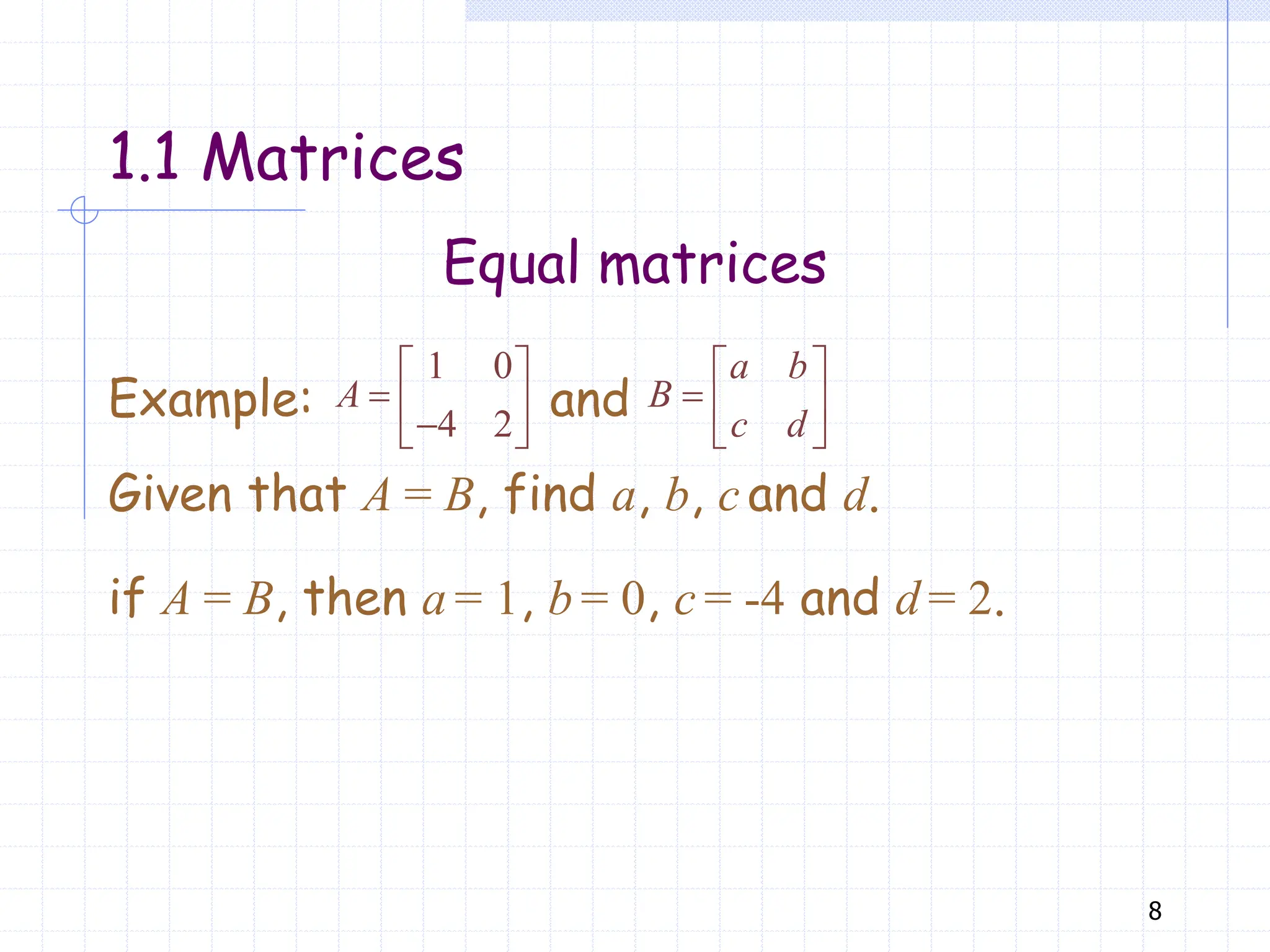
Equal matrices
Given that A = B, find a, b, c and d.
1.1 Matrices
1 0
4 2
A
 
  

 
a b
B
c d
 
  
 
Example: and
if A = B, then a = 1, b = 0, c = -4 and d = 2.
9
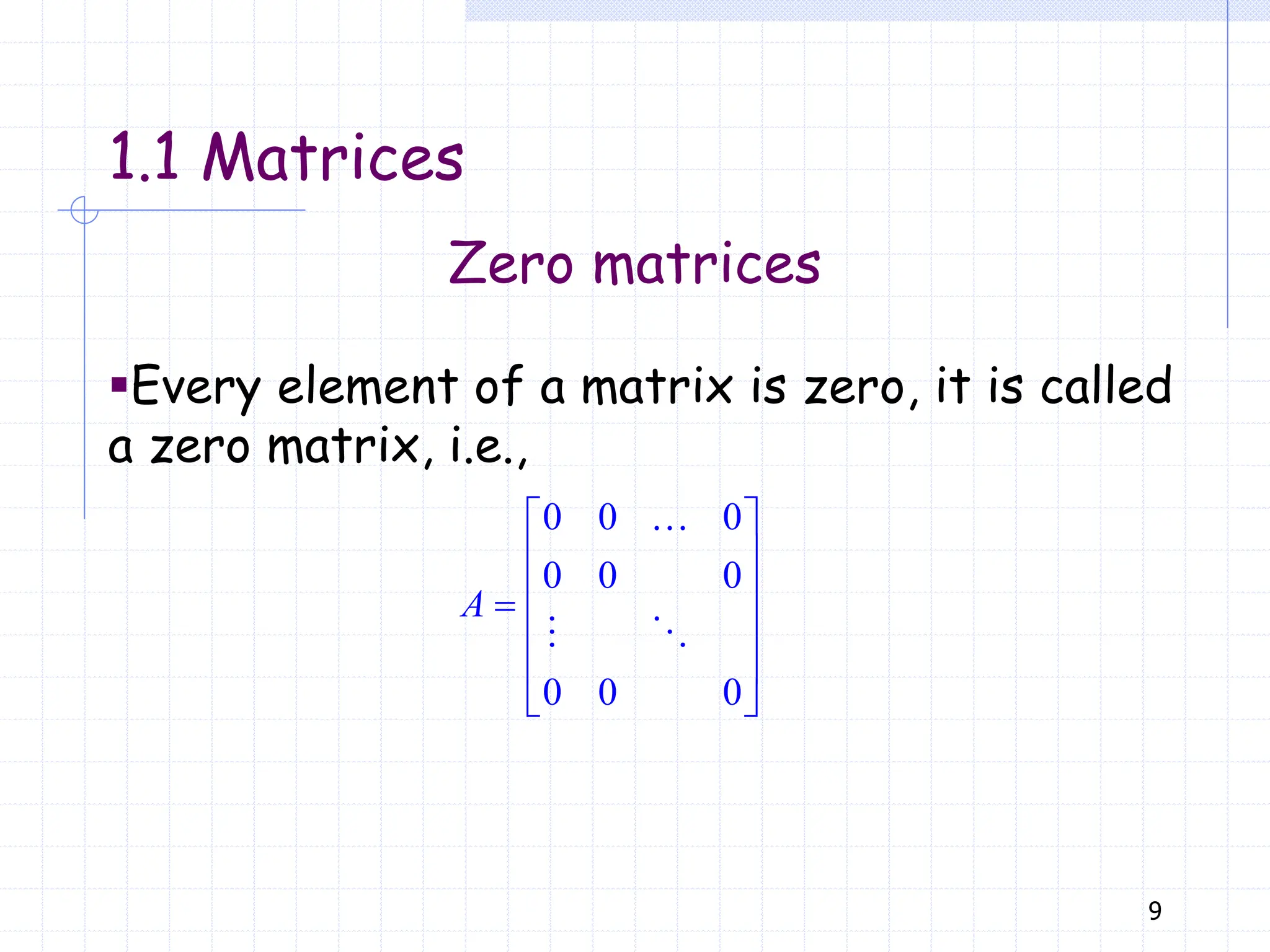
Zero matrices
▪Every element of a matrix is zero, it is called
a zero matrix, i.e.,
0 0 0
0 0 0
0 0 0
 
 
 

 
 
 
A
1.1 Matrices
10
Sums of matrices
1.2 Operations of matrices
▪If A = [aij] and B = [bij] are m  n matrices,
then A + B is defined as a matrix C = A + B,
where C= [cij], cij = aij + bij for 1  i  m, 1  j  n.
1 2 3
0 1 4
 
  
 
A
2 3 0
1 2 5
 
  

 
B
Example: if and
Evaluate A + B and A – B.
1 2 2 3 3 0 3 5 3
0 ( 1) 1 2 4 5 1 3 9
  
   
  
   
    
   
A B
1 2 2 3 3 0 1 1 3
0 ( 1) 1 2 4 5 1 1 1
    
   
  
   
     
   
A B
11
Sums of matrices
1.2 Operations of matrices
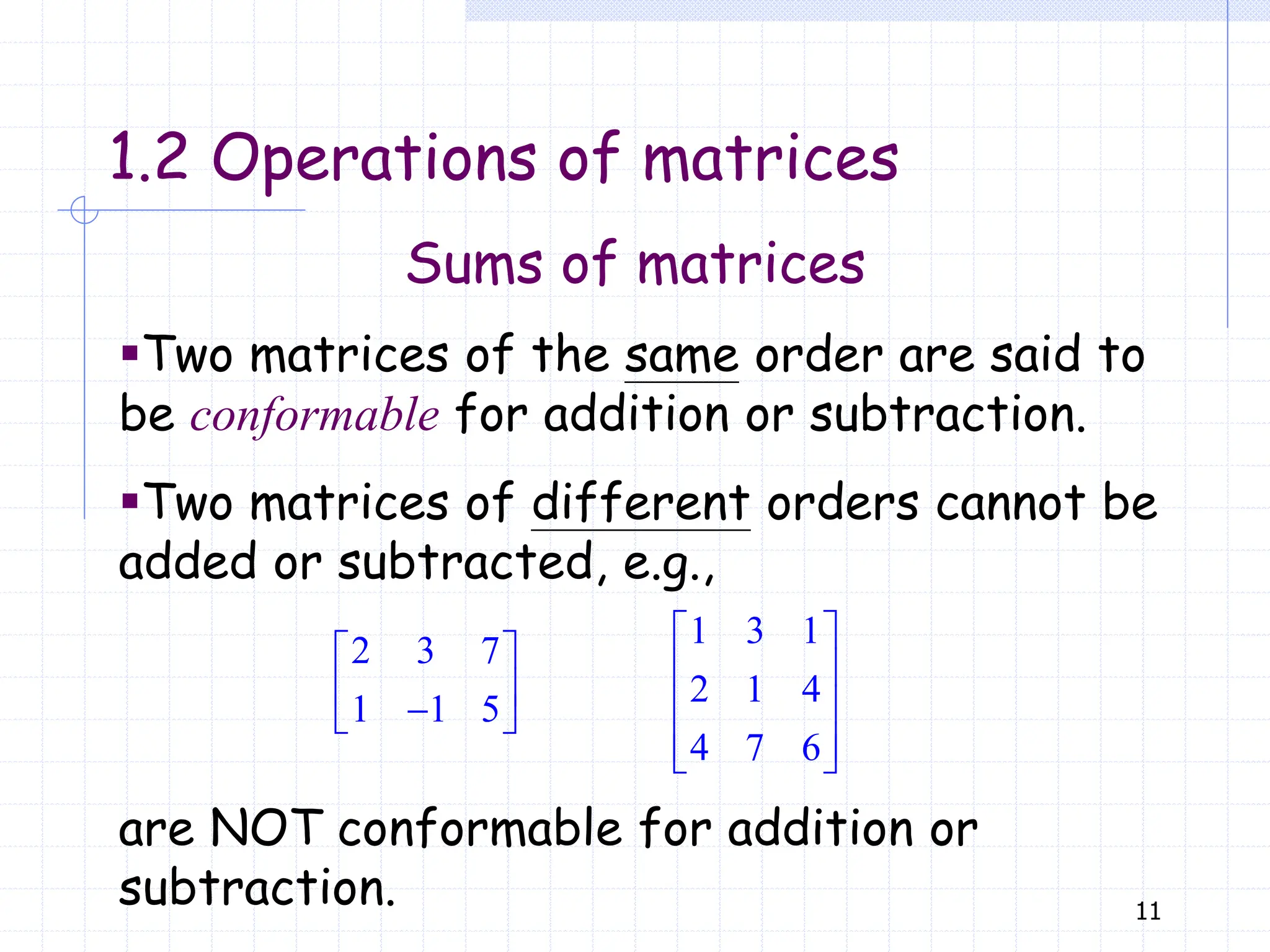
▪Two matrices of the same order are said to
be conformable for addition or subtraction.
▪Two matrices of different orders cannot be
added or subtracted, e.g.,
are NOT conformable for addition or
subtraction.
2 3 7
1 1 5
 
 

 
1 3 1
2 1 4
4 7 6
 
 
 
 
 
12
Scalar multiplication
1.2 Operations of matrices
▪Let l be any scalar and A = [aij] is an m  n
matrix. Then lA = [laij] for 1  i  m, 1  j  n,
i.e., each element in A is multiplied by l.
1 2 3
0 1 4
 
  
 
A
Example: . Evaluate 3A.
3 1 3 2 3 3 3 6 9
3
3 0 3 1 3 4 0 3 12
  
   
 
   
  
   
A
▪In particular, l  1, i.e., A = [aij]. It’s called
the negative of A. Note: A  A = 0 is a zero matrix
13
Properties
1.2 Operations of matrices
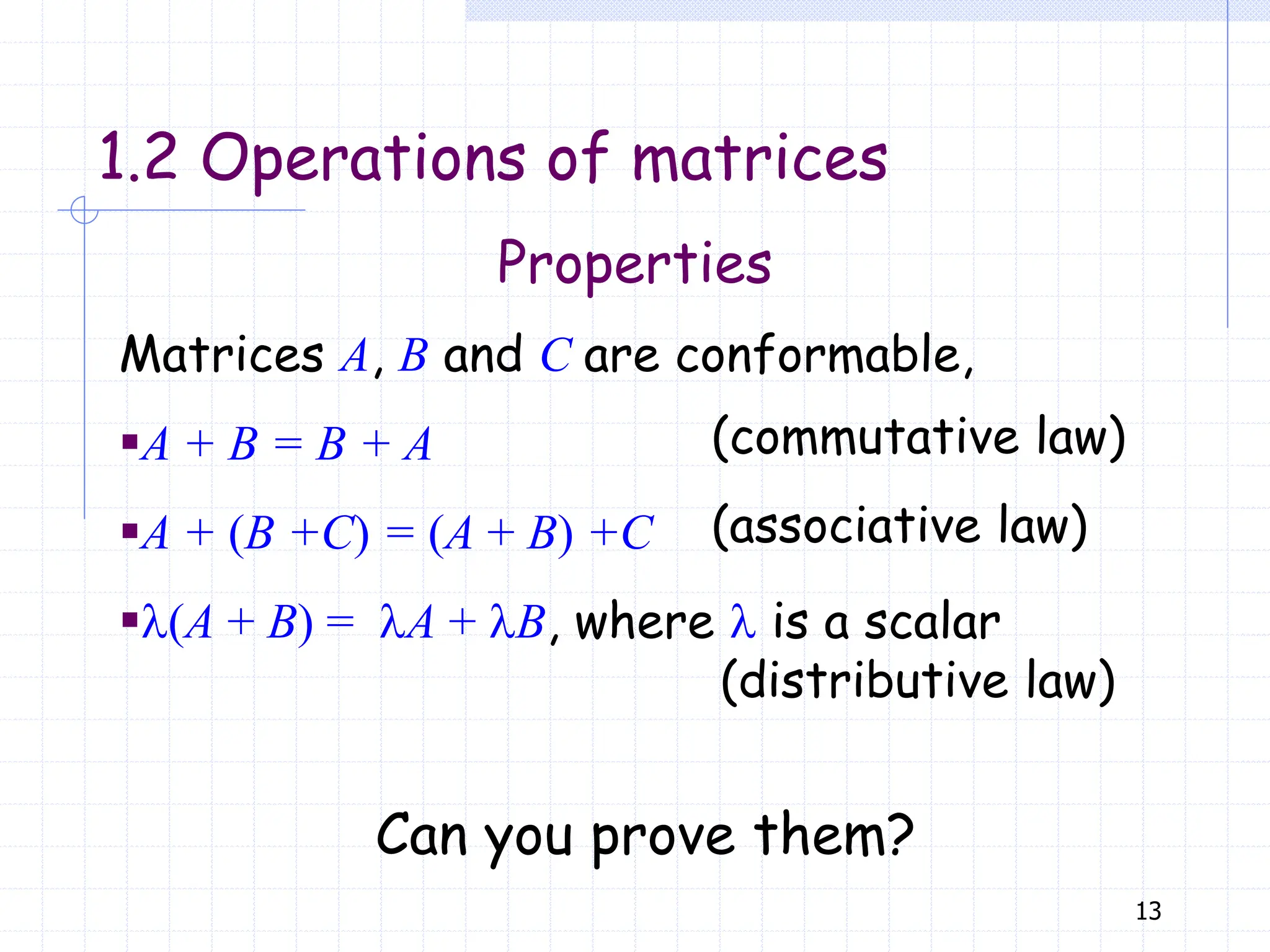
Matrices A, B and C are conformable,
▪A + B = B + A
▪A + (B +C) = (A + B) +C
▪l(A + B) = lA + lB, where l is a scalar
(commutative law)
(associative law)
Can you prove them?
(distributive law)
14
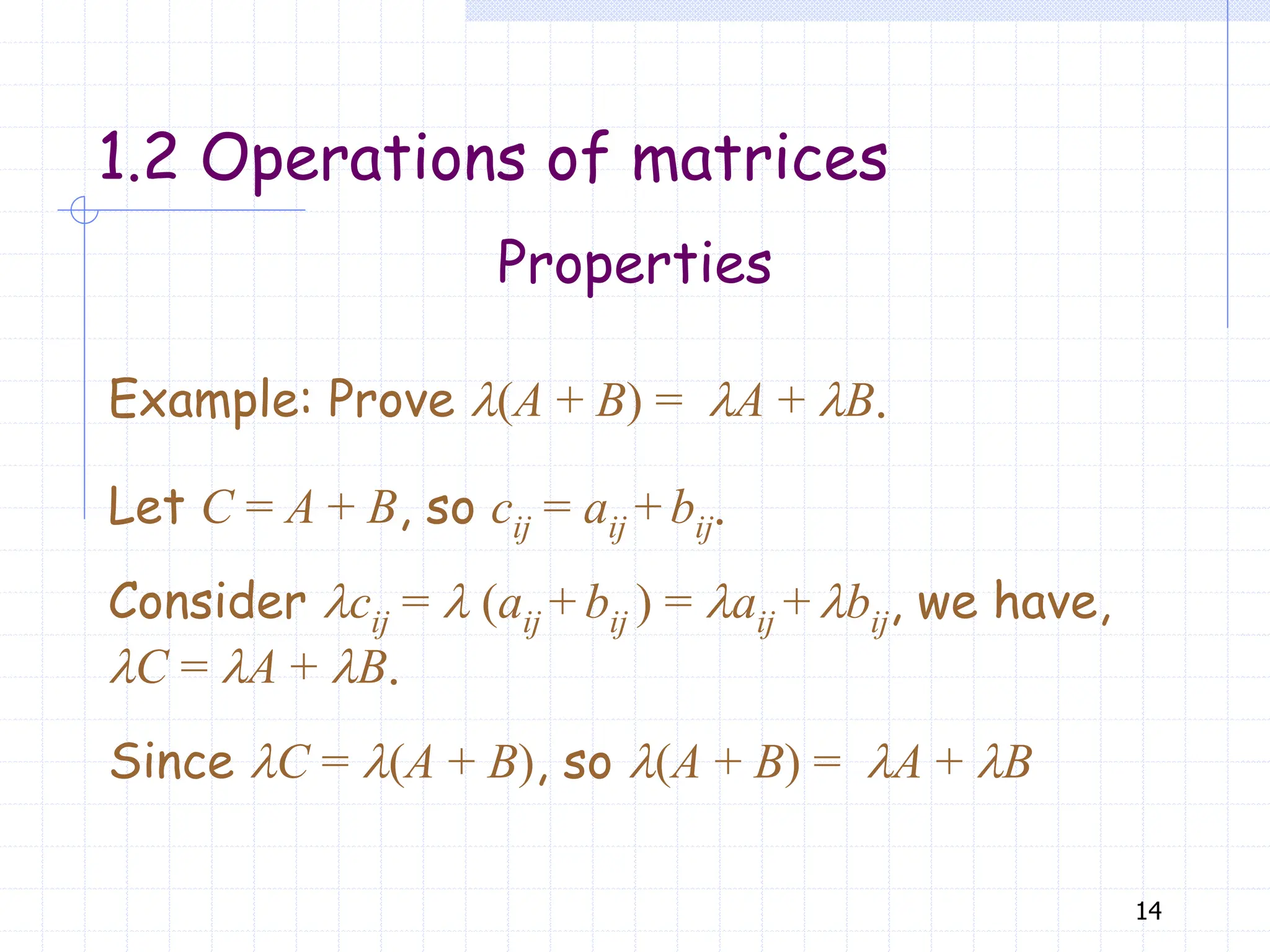
Let C = A + B, so cij = aij + bij.
Consider lcij = l (aij + bij ) = laij + lbij, we have,
lC = lA + lB.
Since lC = l(A + B), so l(A + B) = lA + lB
Example: Prove l(A + B) = lA + lB.
Properties
1.2 Operations of matrices
15
Matrix multiplication
1.2 Operations of matrices
▪If A = [aij] is a m  p matrix and B = [bij] is a
p  n matrix, then AB is defined as a m  n
matrix C = AB, where C= [cij] with
1 1 2 2
1
...

    

p
ij ik kj i j i j ip pj
k
c a b a b a b a b
1 2 3
0 1 4
 
  
 
A
1 2
2 3
5 0

 
 
  
 
 
B
Example: , and C = AB.
Evaluate c21.
1 2
1 2 3
2 3
0 1 4
5 0

 
   
   
   
 
21 0 ( 1) 1 2 4 5 22
       
c
for 1  i  m, 1  j  n.
16
Matrix multiplication
1.2 Operations of matrices
1 2 3
0 1 4
 
  
 
A
1 2
2 3
5 0

 
 
  
 
 
B
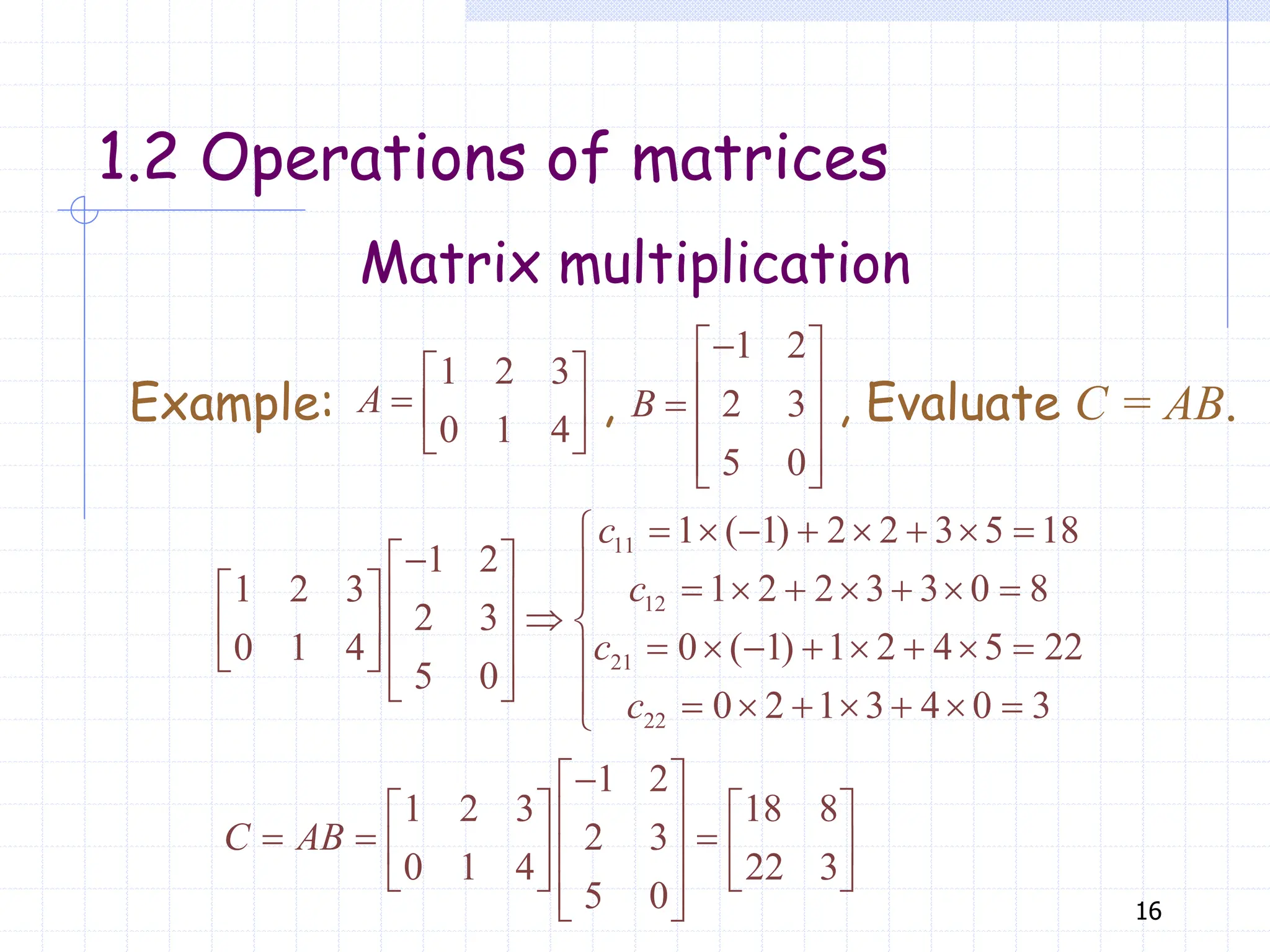
Example: , , Evaluate C = AB.
11
12
21
22
1 ( 1) 2 2 3 5 18
1 2
1 2 2 3 3 0 8
1 2 3
2 3
0 ( 1) 1 2 4 5 22
0 1 4
5 0
0 2 1 3 4 0 3
c
c
c
c
       


         
  
   
           
  
 
         

1 2
1 2 3 18 8
2 3
0 1 4 22 3
5 0
C AB

 
   
 
  
   
 
   
 
 
17
Matrix multiplication
1.2 Operations of matrices
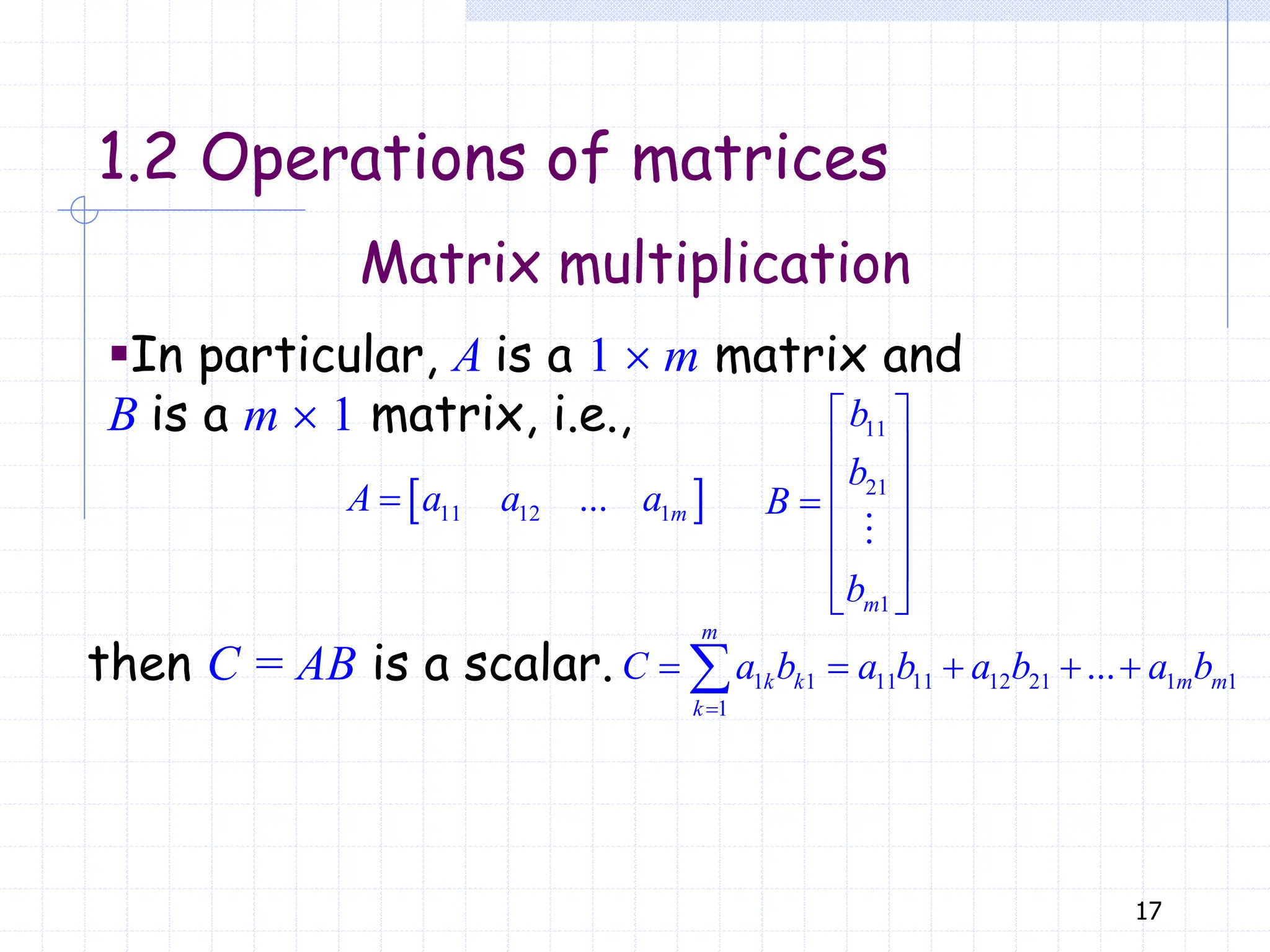
▪In particular, A is a 1  m matrix and
B is a m  1 matrix, i.e.,
1 1 11 11 12 21 1 1
1
...

    

m
k k m m
k
C a b a b a b a b
 
11 12 1
...
 m
A a a a
11
21
1
 
 
 

 
 
 
m
b
b
B
b
then C = AB is a scalar.
18
Matrix multiplication
1.2 Operations of matrices
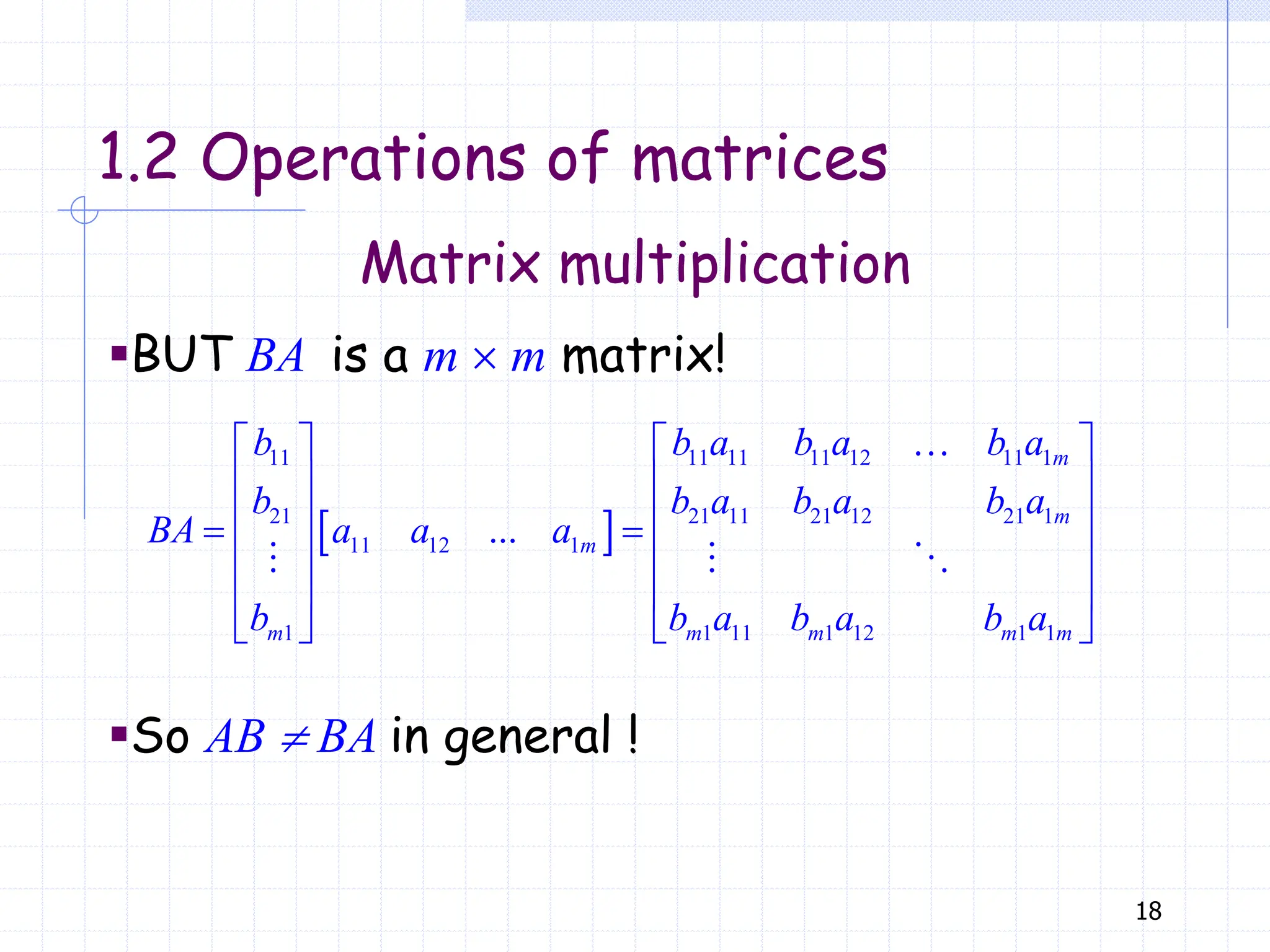
▪BUT BA is a m  m matrix!
 
11 11 11 11 12 11 1
21 21 11 21 12 21 1
11 12 1
1 1 11 1 12 1 1
...
   
   
   
 
   
   
   
m
m
m
m m m m m
b b a b a b a
b b a b a b a
BA a a a
b b a b a b a
▪So AB  BA in general !
19
Properties
1.2 Operations of matrices
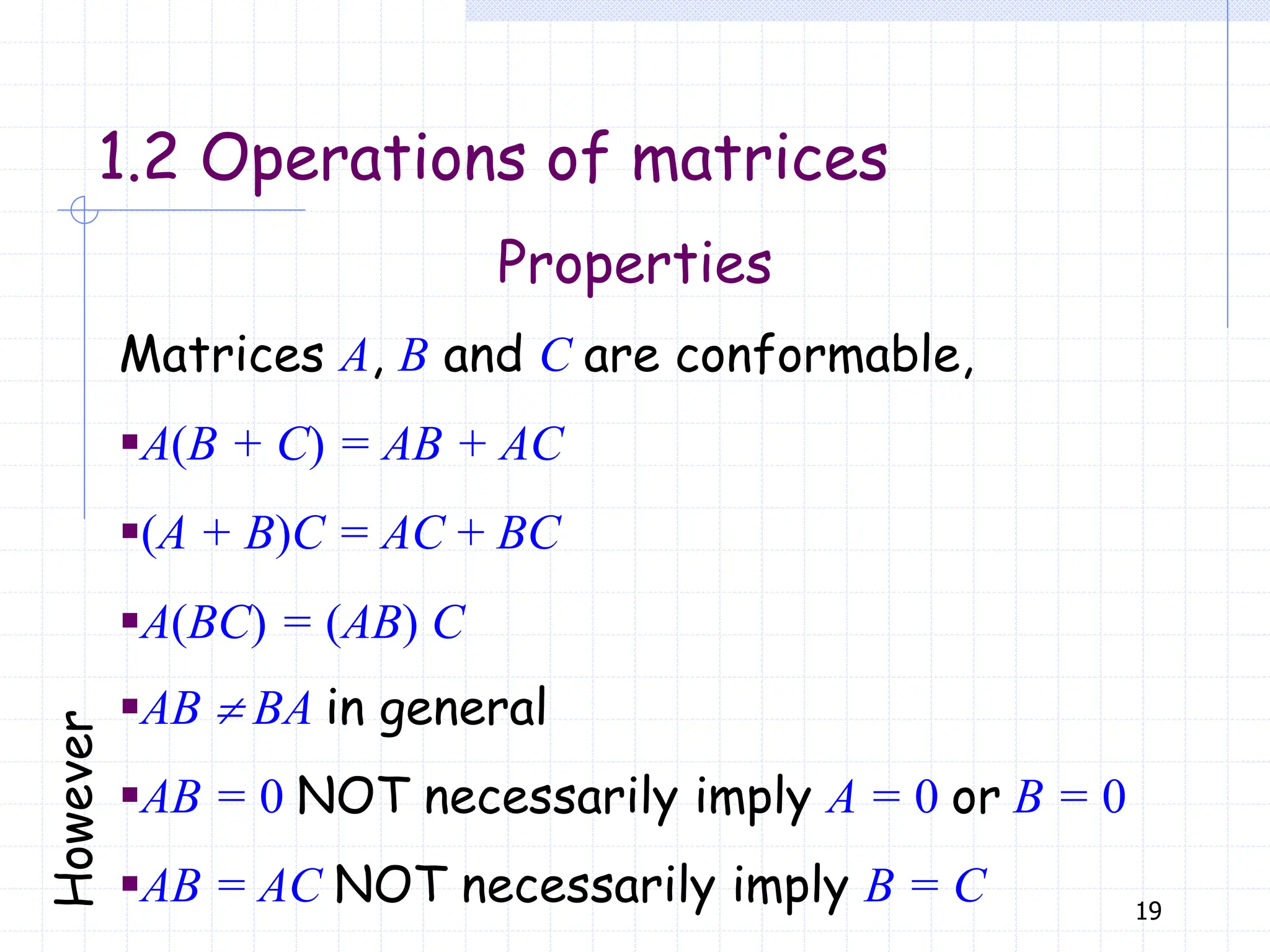
Matrices A, B and C are conformable,
▪A(B + C) = AB + AC
▪(A + B)C = AC + BC
▪A(BC) = (AB) C
▪AB  BA in general
▪AB = 0 NOT necessarily imply A = 0 or B = 0
▪AB = AC NOT necessarily imply B = C
20
Properties
Let X = B + C, so xij = bij + cij. Let Y = AX, then
1 1
1 1 1
( )
( )
n n
ij ik kj ik kj kj
k k
n n n
ik kj ik kj ik kj ik kj
k k k
y a x a b c
a b a c a b a c
 
  
  
   
 
  
Example: Prove A(B + C) = AB + AC where A, B
and C are n-square matrices
So Y = AB + AC; therefore, A(B + C) = AB + AC
1.2 Operations of matrices
21
1.3 Types of matrices
▪Identity matrix
▪The inverse of a matrix
▪The transpose of a matrix
▪Symmetric matrix
▪Orthogonal matrix
22
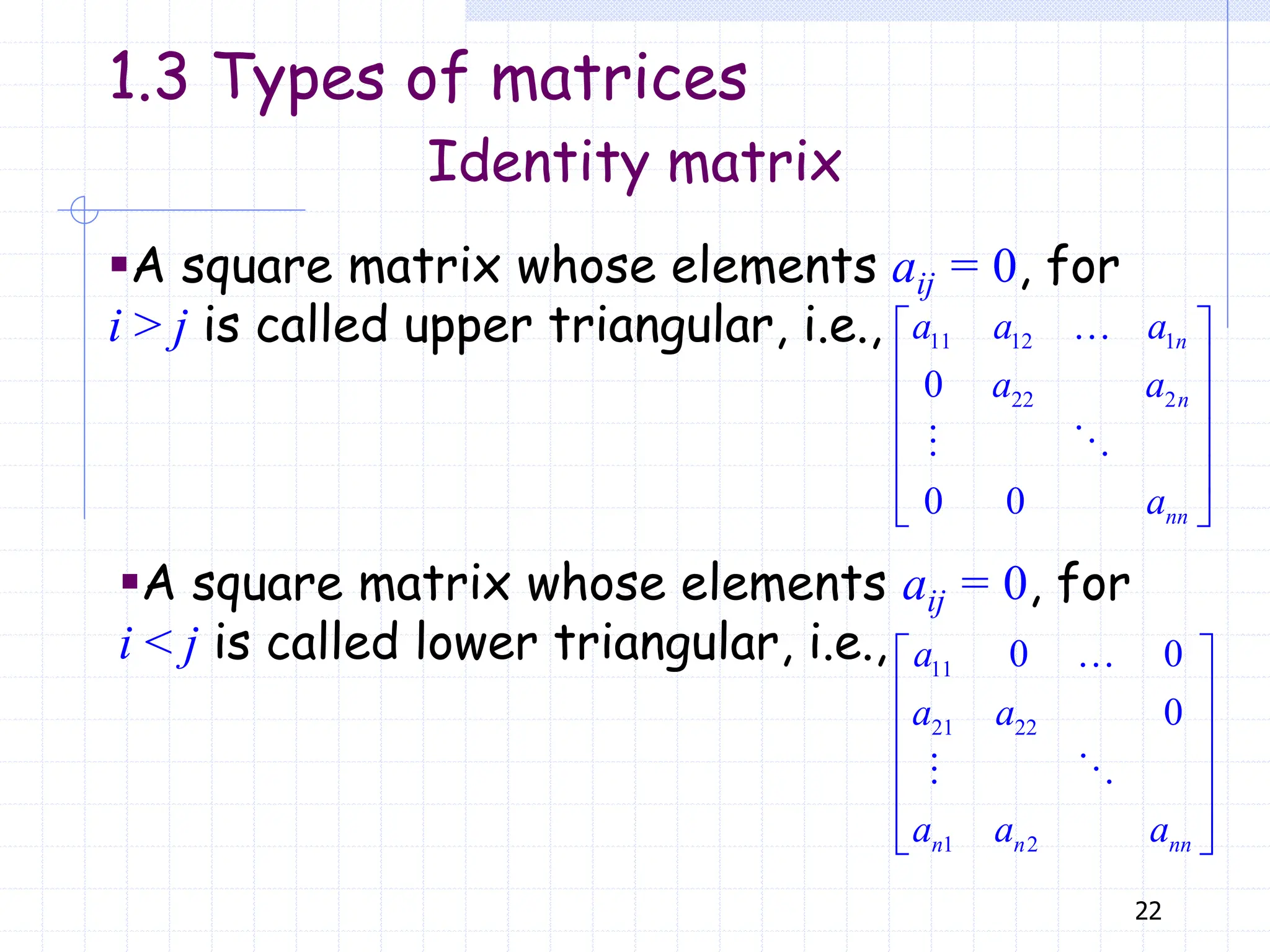
▪A square matrix whose elements aij = 0, for
i > j is called upper triangular, i.e., 11 12 1
22 2
0
0 0
 
 
 
 
 
 
n
n
nn
a a a
a a
a
▪A square matrix whose elements aij = 0, for
i < j is called lower triangular, i.e., 11
21 22
1 2
0 0
0
 
 
 
 
 
 
n n nn
a
a a
a a a
Identity matrix
1.3 Types of matrices
23
▪Both upper and lower triangular, i.e., aij = 0, for
i  j , i.e., 11
22
0 0
0 0
0 0
 
 
 

 
 
 
nn
a
a
D
a
11 22
diag[ , ,..., ]
 nn
D a a a
Identity matrix
1.3 Types of matrices
is called a diagonal matrix, simply
24
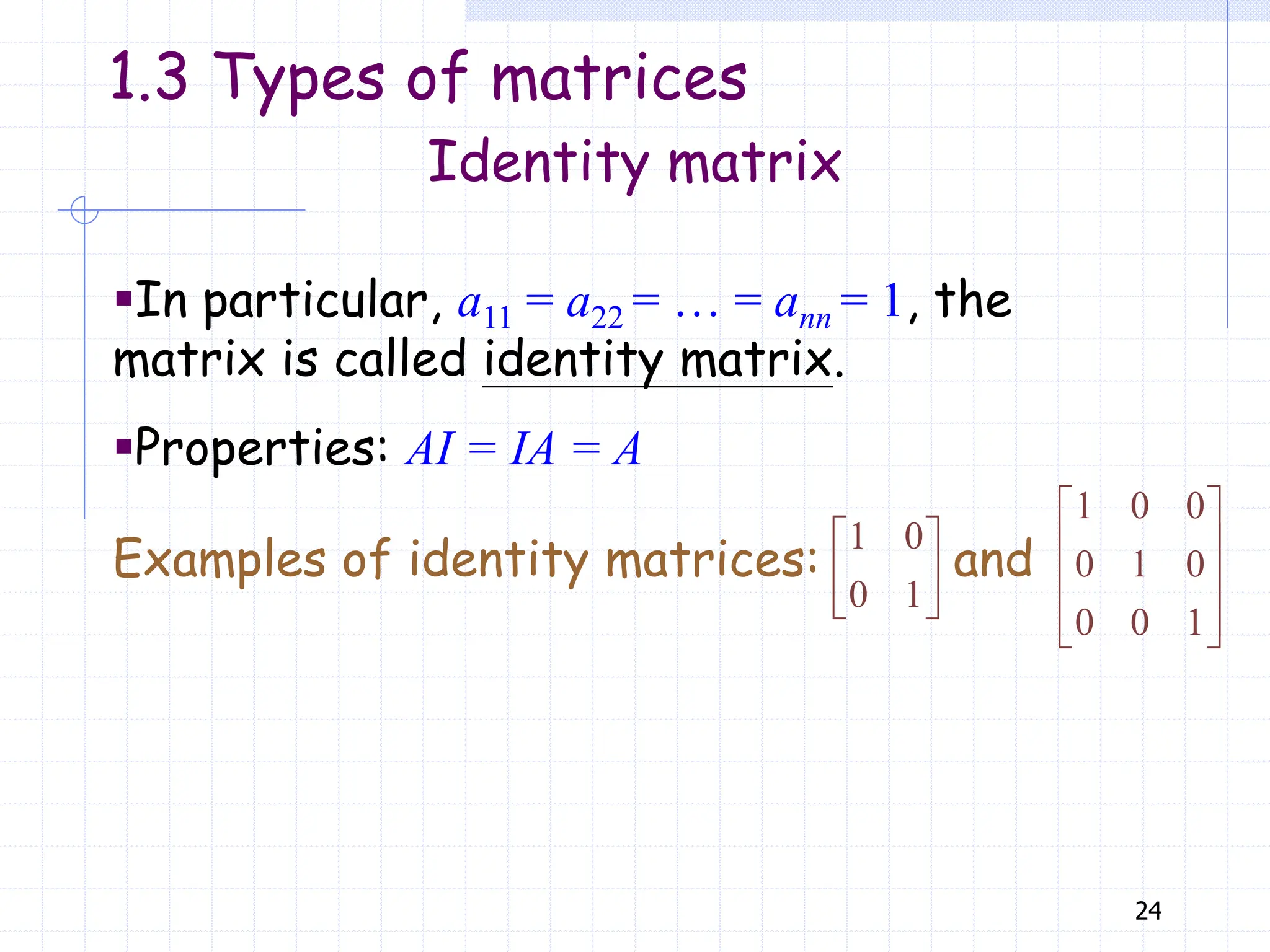
▪In particular, a11 = a22 = … = ann = 1, the
matrix is called identity matrix.
▪Properties: AI = IA = A
Examples of identity matrices: and
1 0
0 1
 
 
 
1 0 0
0 1 0
0 0 1
 
 
 
 
 
Identity matrix
1.3 Types of matrices
25
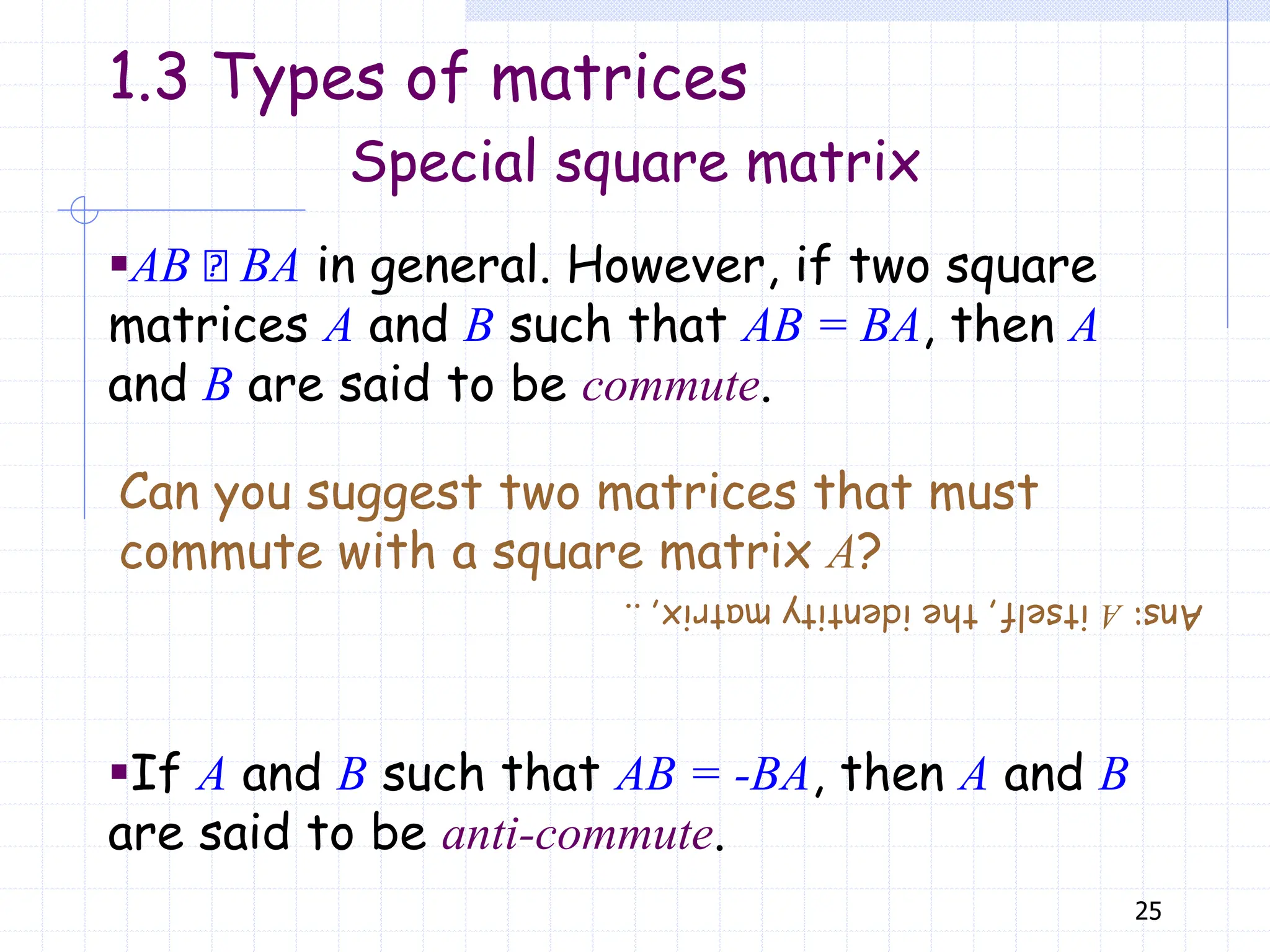
▪AB BA in general. However, if two square
matrices A and B such that AB = BA, then A
and B are said to be commute.
Can you suggest two matrices that must
commute with a square matrix A?
▪If A and B such that AB = -BA, then A and B
are said to be anti-commute.
Special square matrix
1.3 Types of matrices
Ans:
A
itself,
the
identity
matrix,
..
26
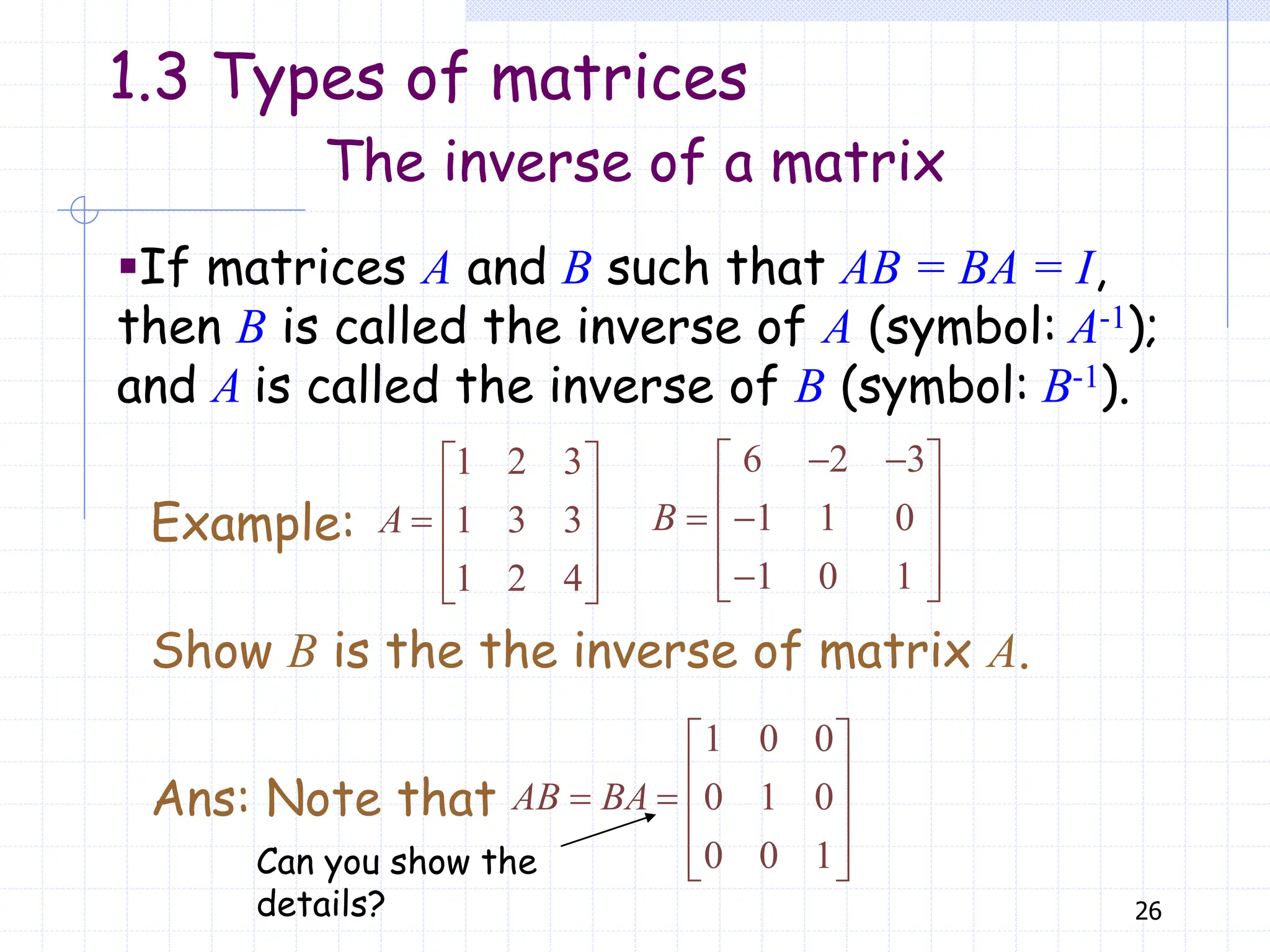
▪If matrices A and B such that AB = BA = I,
then B is called the inverse of A (symbol: A-1);
and A is called the inverse of B (symbol: B-1).
The inverse of a matrix
6 2 3
1 1 0
1 0 1
B
 
 
 
 
 
 

 
Show B is the the inverse of matrix A.
1 2 3
1 3 3
1 2 4
A
 
 
  
 
 
Example:
1 0 0
0 1 0
0 0 1
AB BA
 
 
   
 
 
Ans: Note that
Can you show the
details?
1.3 Types of matrices
27
The transpose of a matrix
▪The matrix obtained by interchanging the
rows and columns of a matrix A is called the
transpose of A (write AT).
Example:
The transpose of A is
1 2 3
4 5 6
 
  
 
A
1 4
2 5
3 6
 
 
  
 
 
T
A
▪For a matrix A = [aij], its transpose AT = [bij],
where bij = aji.
1.3 Types of matrices
28
Symmetric matrix
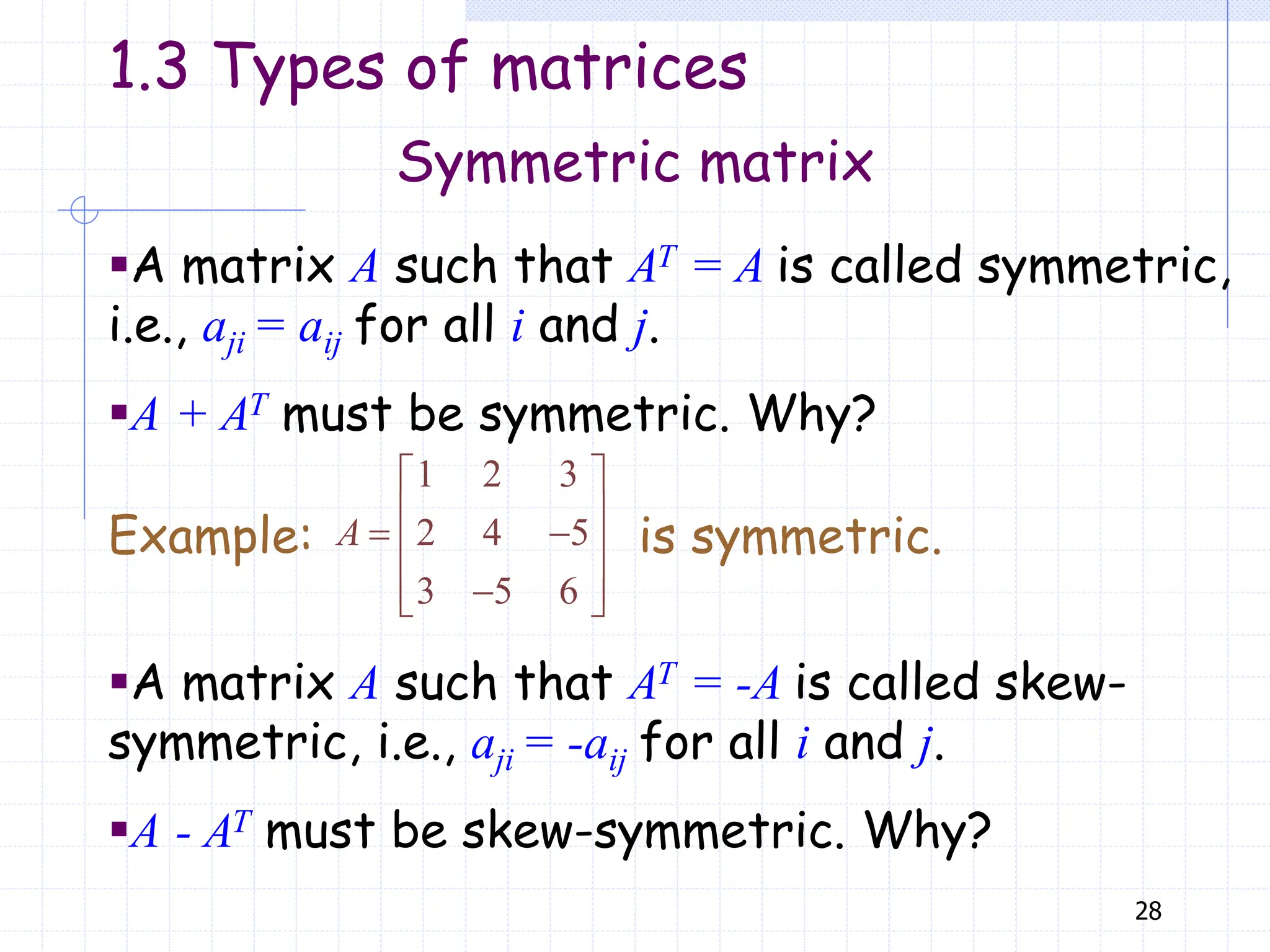
▪A matrix A such that AT = A is called symmetric,
i.e., aji = aij for all i and j.
▪A + AT must be symmetric. Why?
Example: is symmetric.
1 2 3
2 4 5
3 5 6
 
 
 
 
 

 
A
▪A matrix A such that AT = -A is called skew-
symmetric, i.e., aji = -aij for all i and j.
▪A - AT must be skew-symmetric. Why?
1.3 Types of matrices
29
Orthogonal matrix
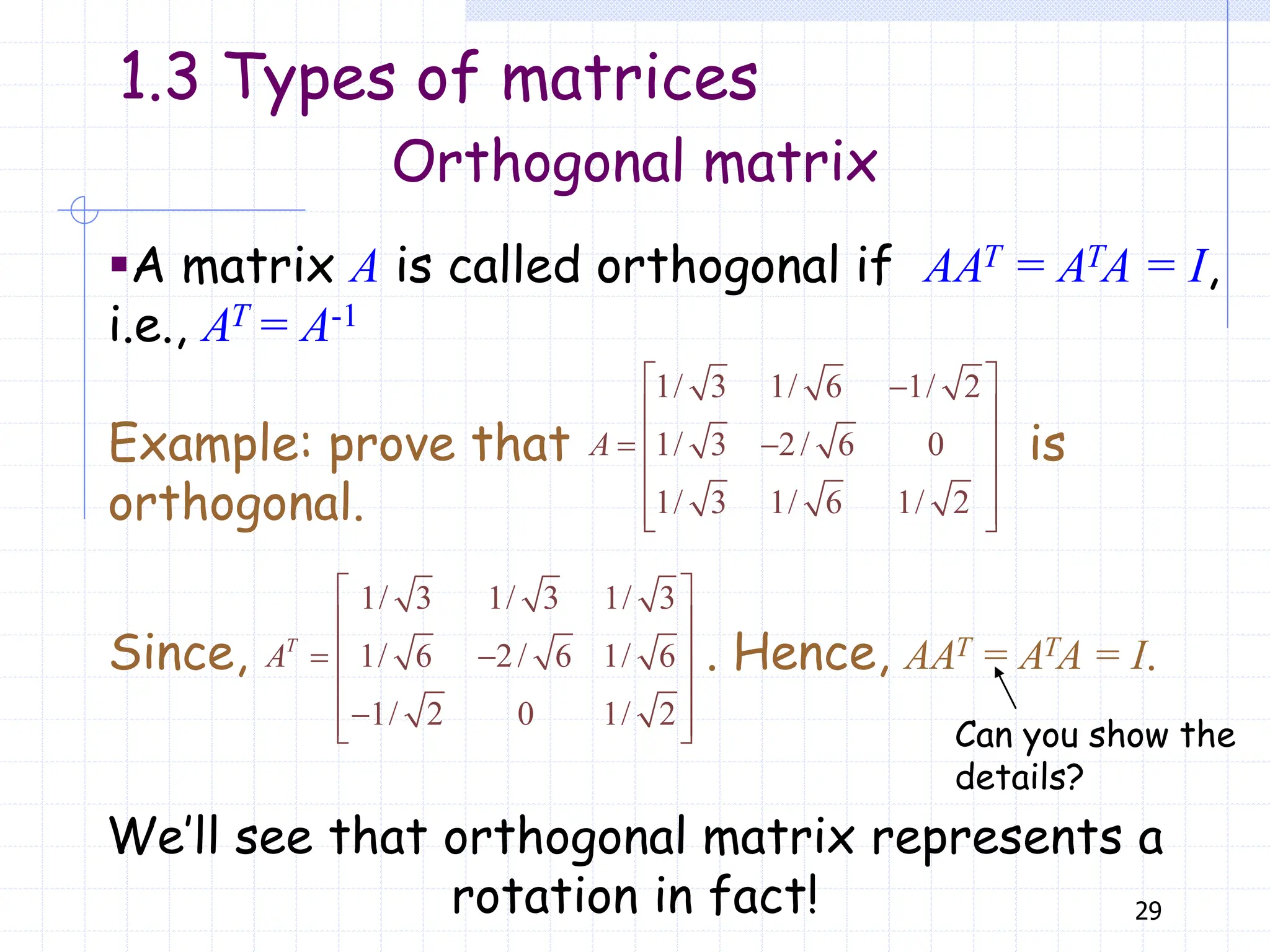
▪A matrix A is called orthogonal if AAT = ATA = I,
i.e., AT = A-1
Example: prove that is
orthogonal.
1/ 3 1/ 6 1/ 2
1/ 3 2/ 6 0
1/ 3 1/ 6 1/ 2
 

 
 
 
 
 
 
A
We’ll see that orthogonal matrix represents a
rotation in fact!
1.3 Types of matrices
Since, . Hence, AAT = ATA = I.
1/ 3 1/ 3 1/ 3
1/ 6 2/ 6 1/ 6
1/ 2 0 1/ 2
T
A
 
 
 
 
 

 
  Can you show the
details?
30
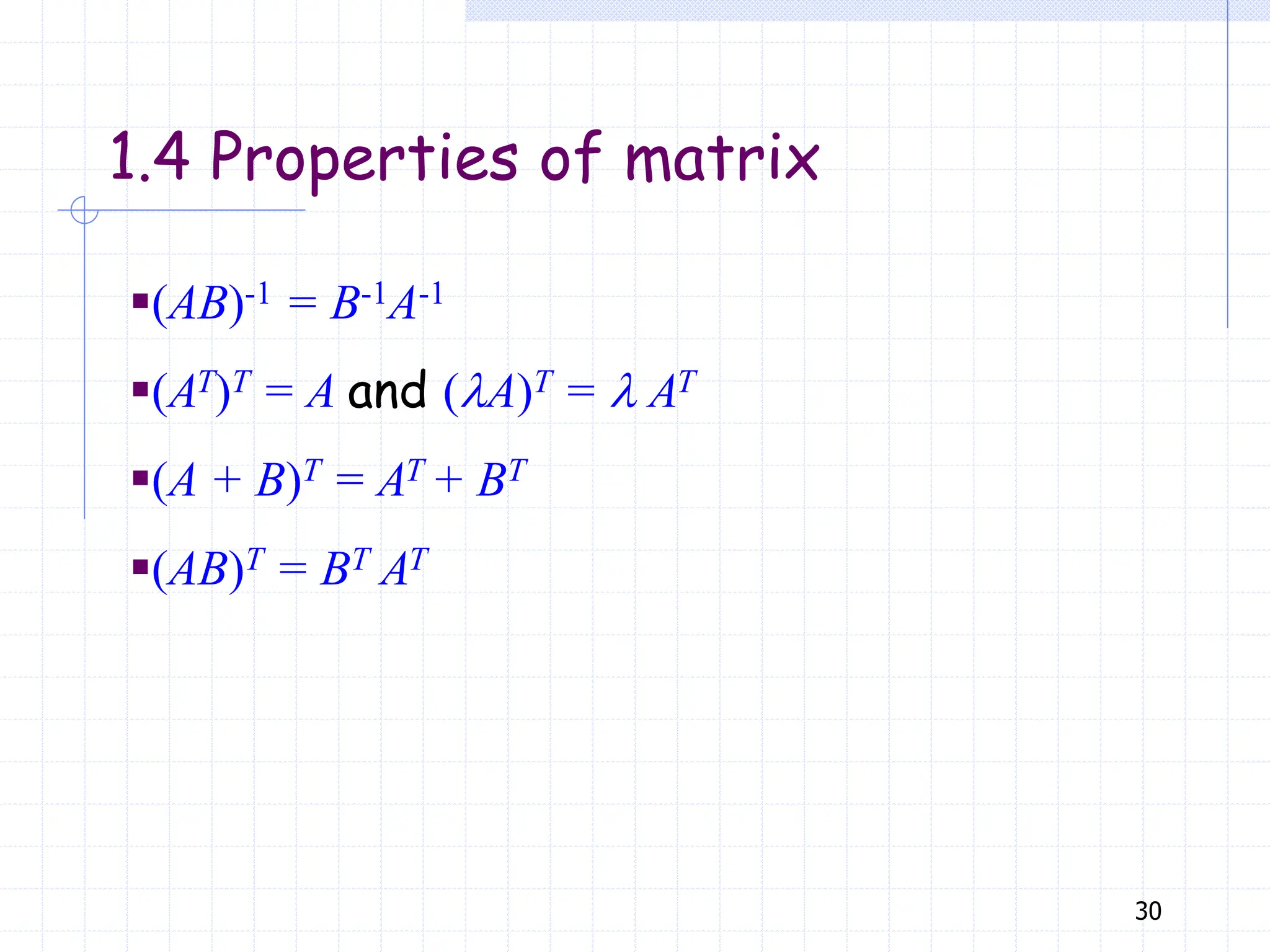
▪(AB)-1 = B-1A-1
▪(AT)T = A and (lA)T = l AT
▪(A + B)T = AT + BT
▪(AB)T = BT AT
1.4 Properties of matrix
31
1.4 Properties of matrix
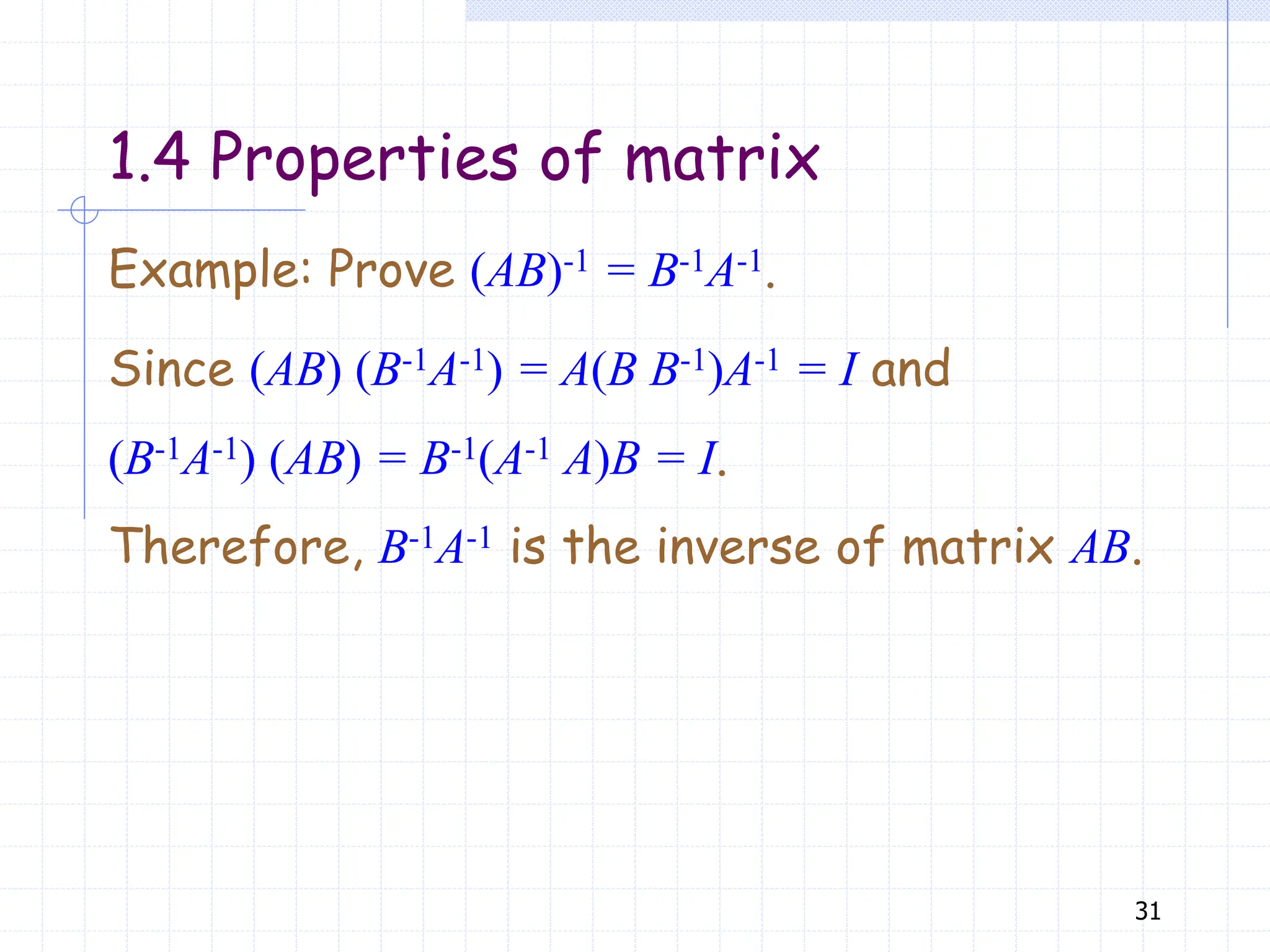
Example: Prove (AB)-1 = B-1A-1.
Since (AB) (B-1A-1) = A(B B-1)A-1 = I and
(B-1A-1) (AB) = B-1(A-1 A)B = I.
Therefore, B-1A-1 is the inverse of matrix AB.
32
1.5 Determinants
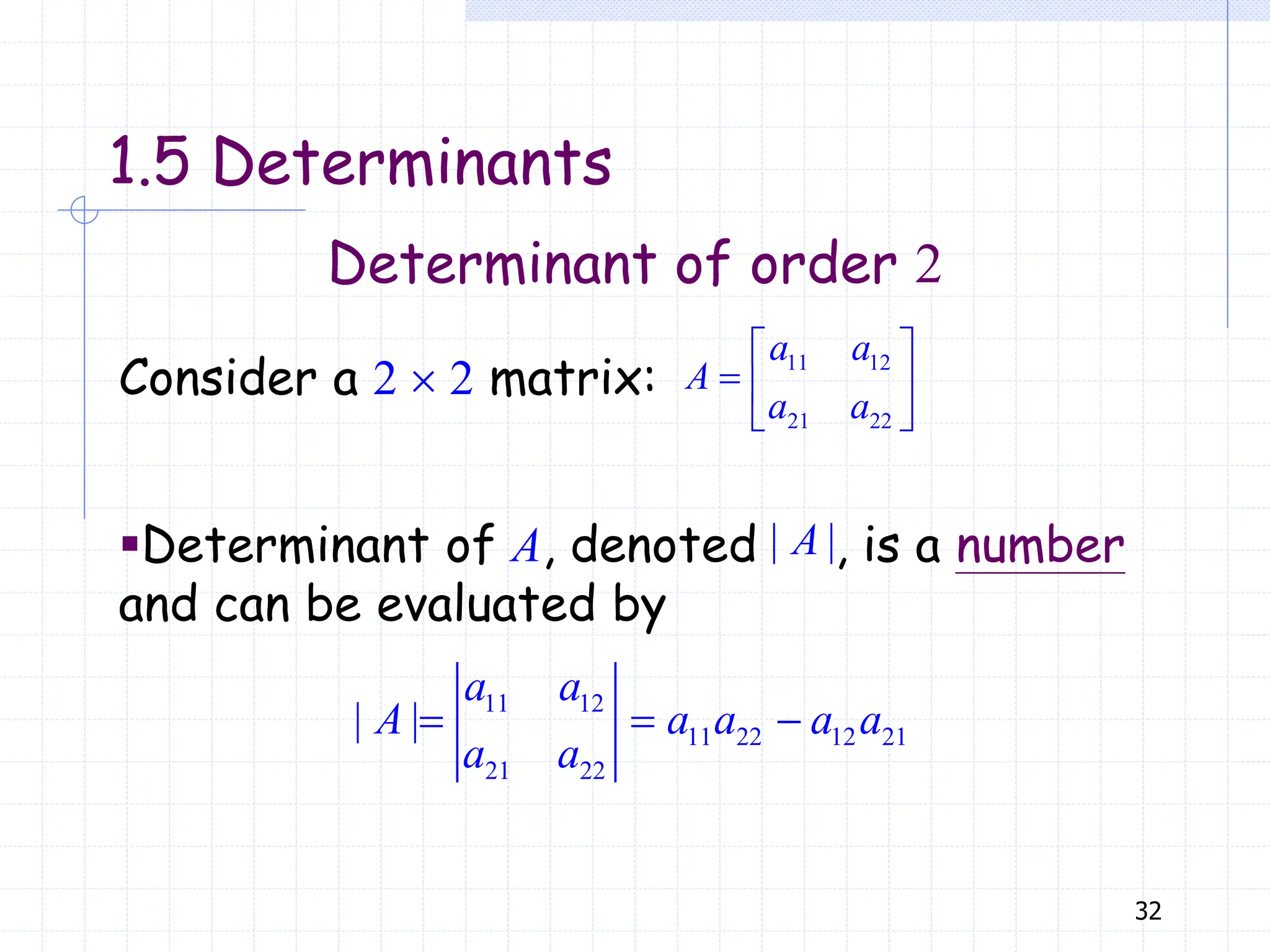
Consider a 2  2 matrix: 11 12
21 22
a a
A
a a
 
  
 
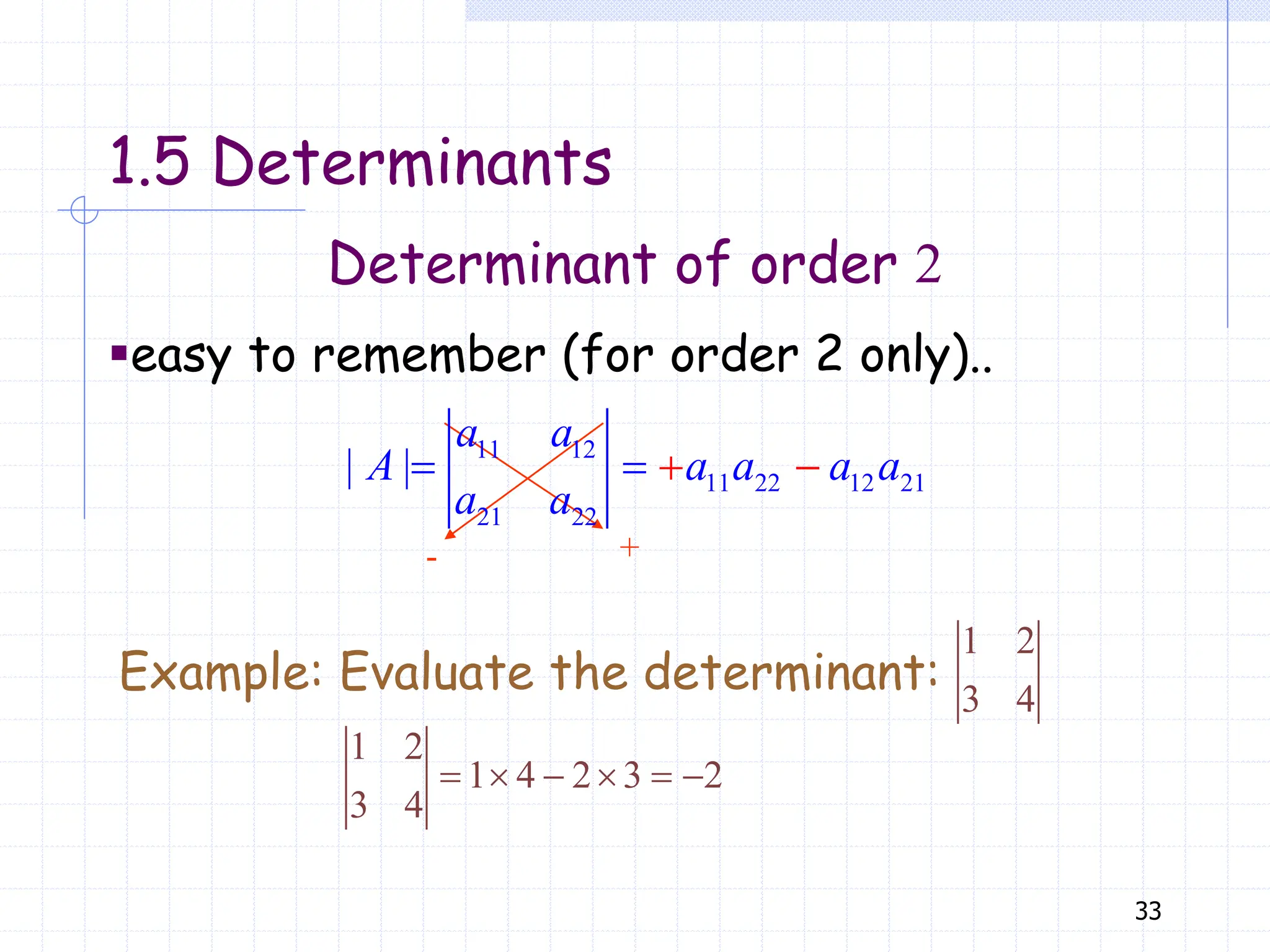
Determinant of order 2
▪Determinant of A, denoted , is a number
and can be evaluated by
11 12
11 22 12 21
21 22
| |
a a
A a a a a
a a
  
| |
A
33
11 12
11 22 12 21
21 22
| |
a a
A a a a a
a a

  
Determinant of order 2
▪easy to remember (for order 2 only)..
1 2
3 4
Example: Evaluate the determinant:
1 2
1 4 2 3 2
3 4
     
1.5 Determinants
+
-
34
1.5 Determinants
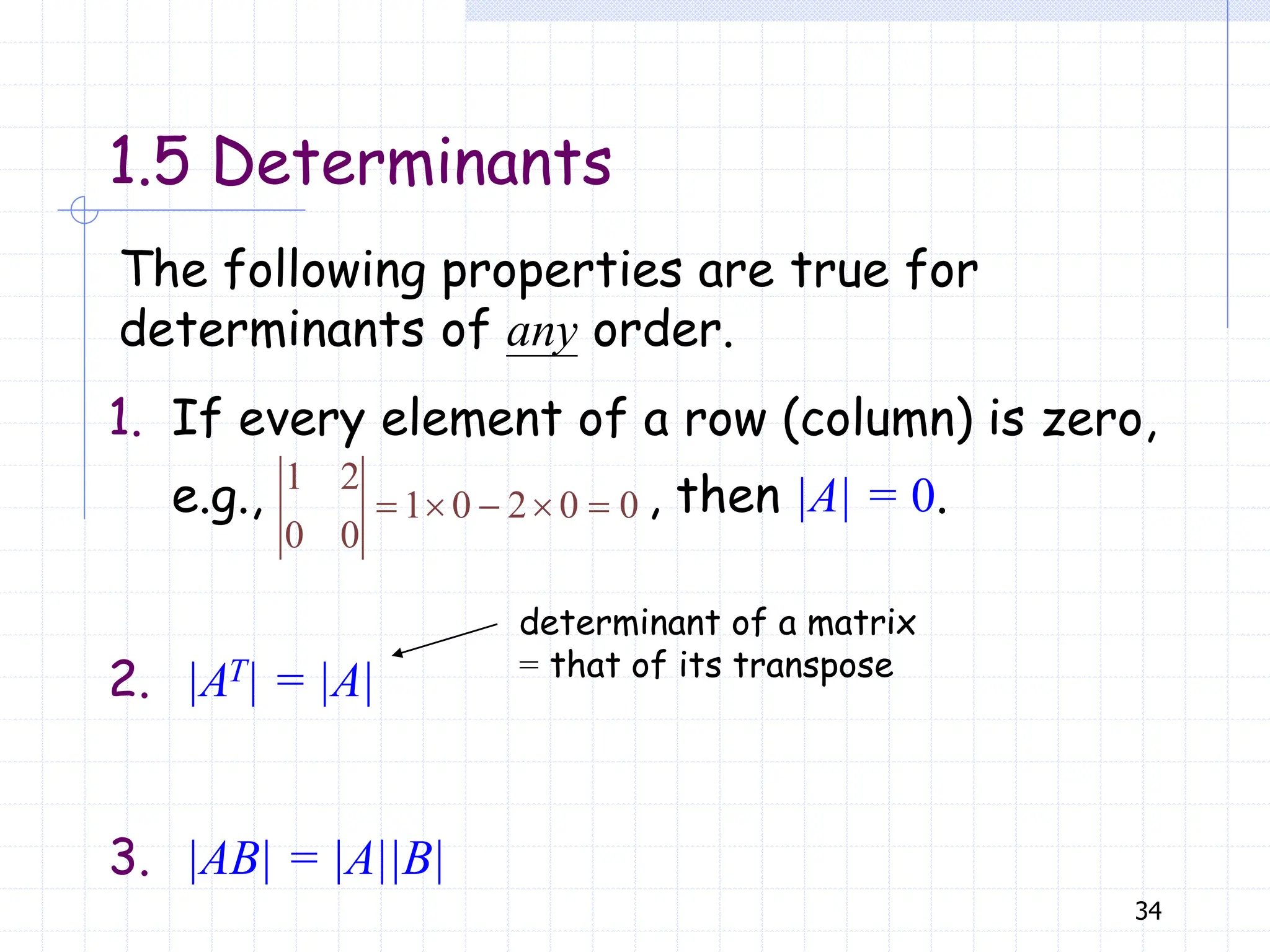
1. If every element of a row (column) is zero,
e.g., , then |A| = 0.
2. |AT| = |A|
3. |AB| = |A||B|
determinant of a matrix
= that of its transpose
The following properties are true for
determinants of any order.
1 2
1 0 2 0 0
0 0
    
35
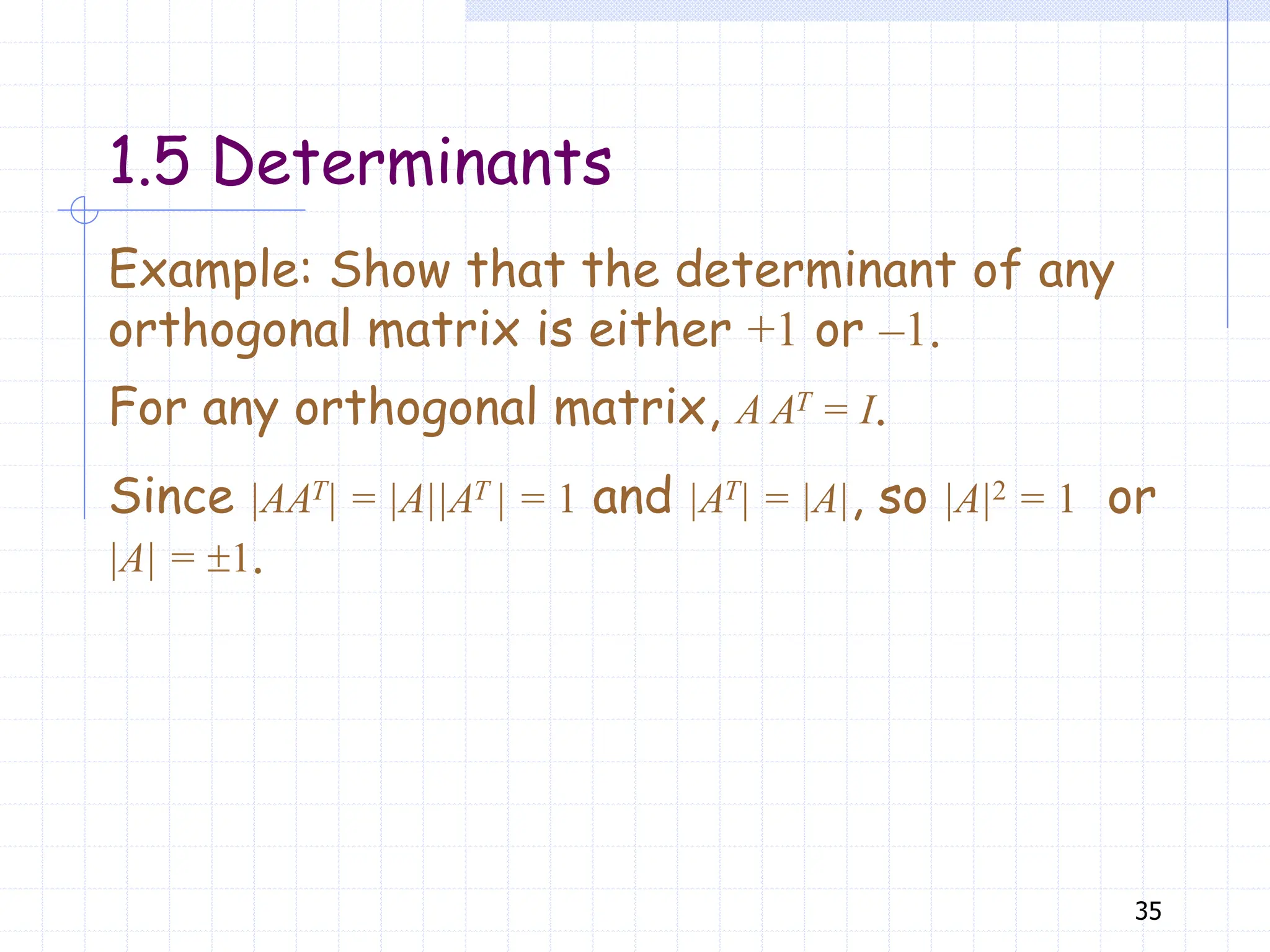
Example: Show that the determinant of any
orthogonal matrix is either +1 or –1.
For any orthogonal matrix, A AT = I.
Since |AAT| = |A||AT | = 1 and |AT| = |A|, so |A|2 = 1 or
|A| = 1.
1.5 Determinants
36
1.5 Determinants
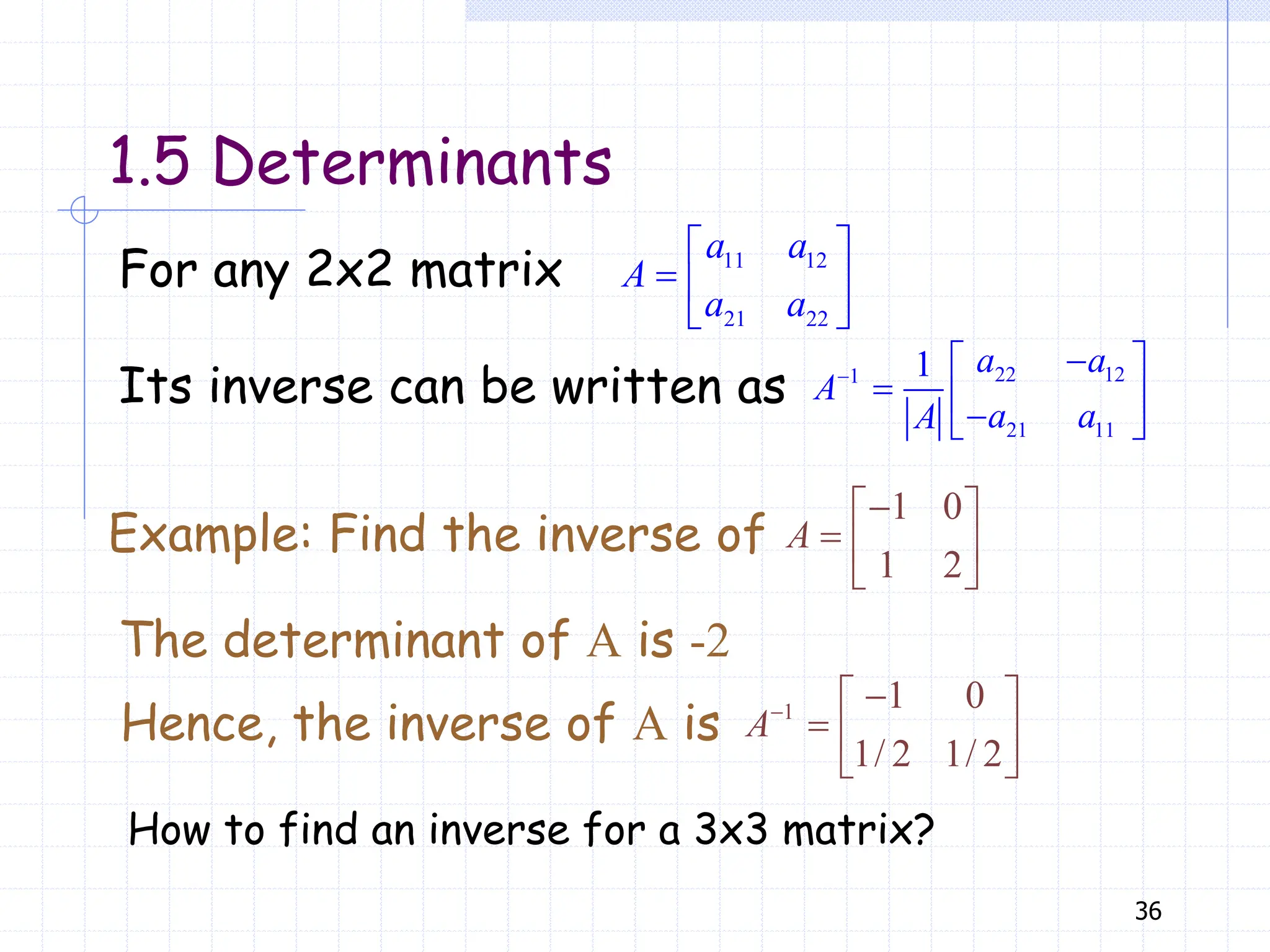
For any 2x2 matrix 11 12
21 22
a a
A
a a
 
  
 
Its inverse can be written as 22 12
1
21 11
1 a a
A
a a
A


 
  

 
Example: Find the inverse of
1 0
1 2
A

 
  
 
The determinant of A is -2
Hence, the inverse of A is 1 1 0
1/ 2 1/ 2
A 
 
  
 
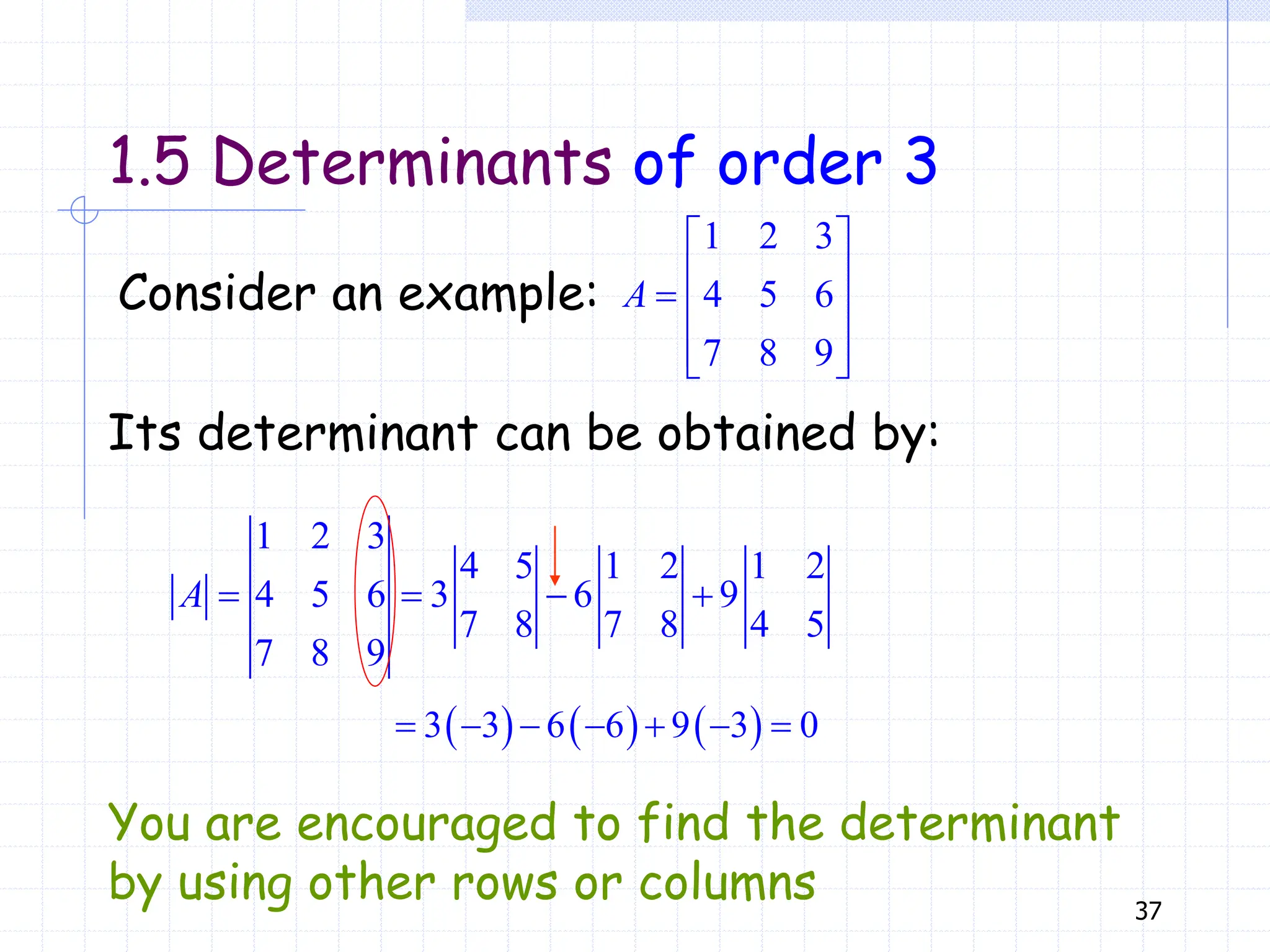
How to find an inverse for a 3x3 matrix?
37
1.5 Determinants of order 3
Consider an example:
1 2 3
4 5 6
7 8 9
A
 
 
  
 
 
Its determinant can be obtained by:
1 2 3
4 5 1 2 1 2
4 5 6 3 6 9
7 8 7 8 4 5
7 8 9
A    
     
3 3 6 6 9 3 0
      
You are encouraged to find the determinant
by using other rows or columns
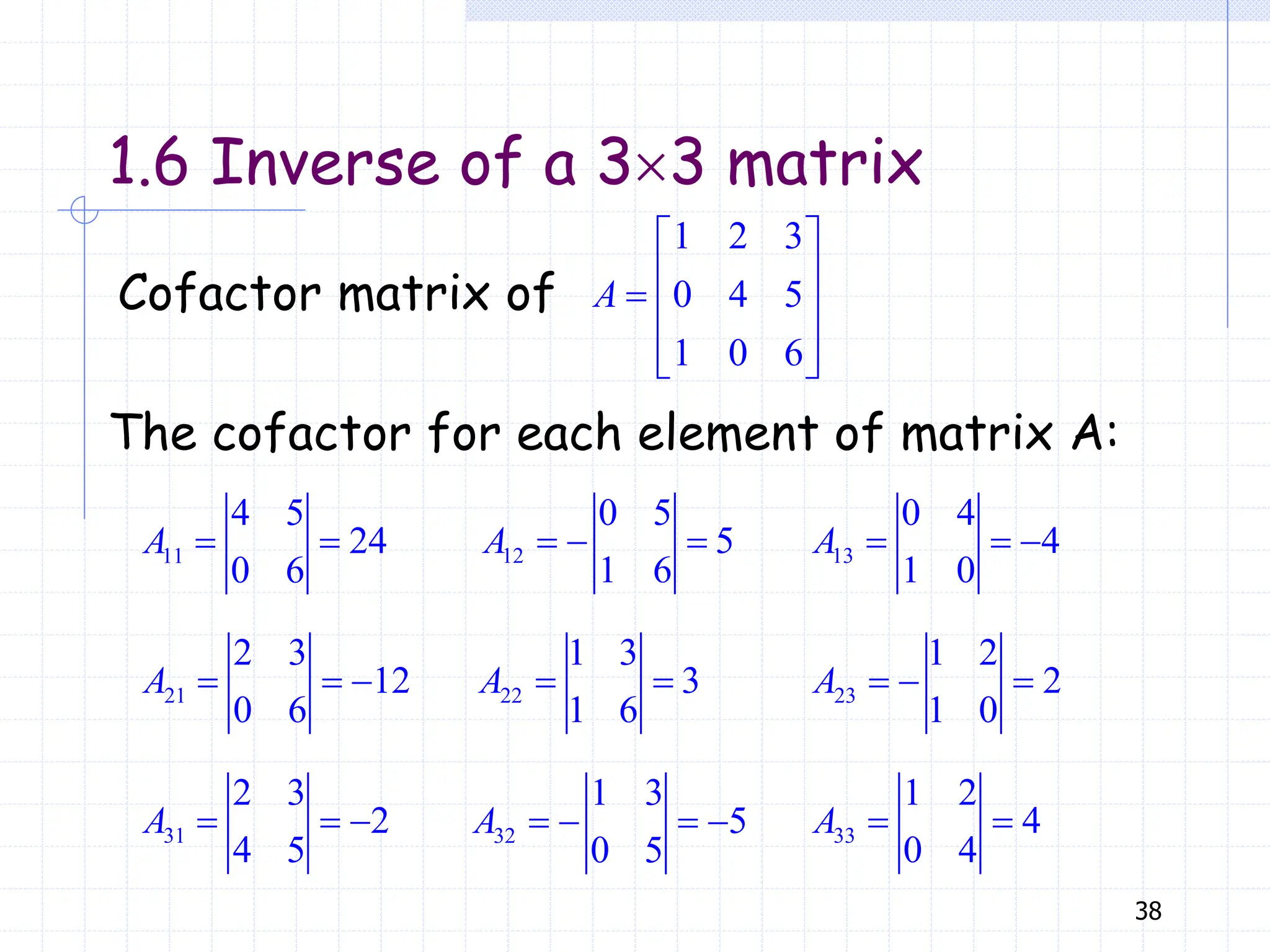
38
1.6 Inverse of a 33 matrix
Cofactor matrix of
1 2 3
0 4 5
1 0 6
A
 
 
  
 
 
The cofactor for each element of matrix A:
11
4 5
24
0 6
A   12
0 5
5
1 6
A    13
0 4
4
1 0
A   
21
2 3
12
0 6
A    22
1 3
3
1 6
A   23
1 2
2
1 0
A   
31
2 3
2
4 5
A    32
1 3
5
0 5
A     33
1 2
4
0 4
A  
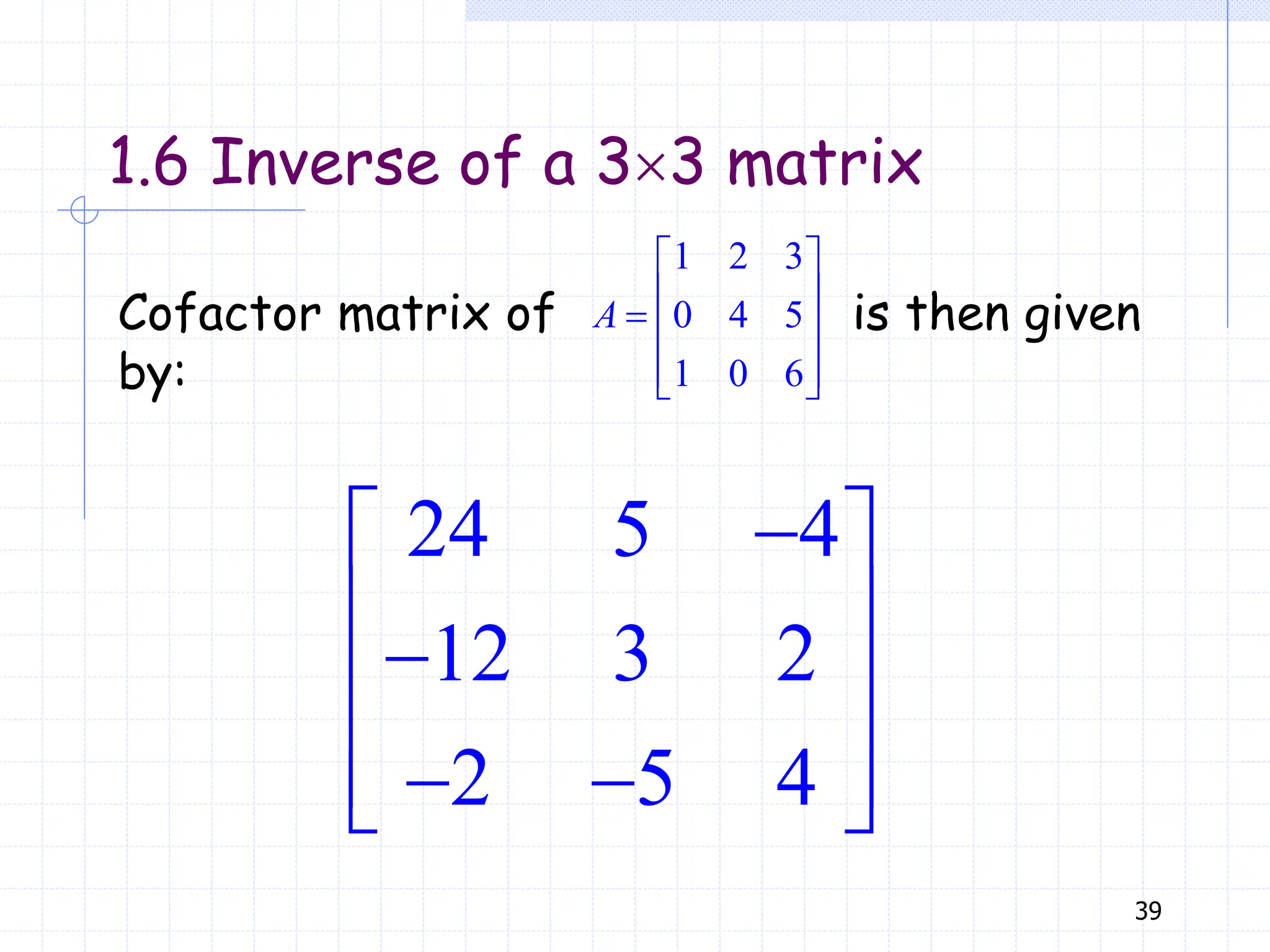
39
Cofactor matrix of is then given
by:
1 2 3
0 4 5
1 0 6
A
 
 
  
 
 
24 5 4
12 3 2
2 5 4

 
 

 
 
 
 
1.6 Inverse of a 33 matrix
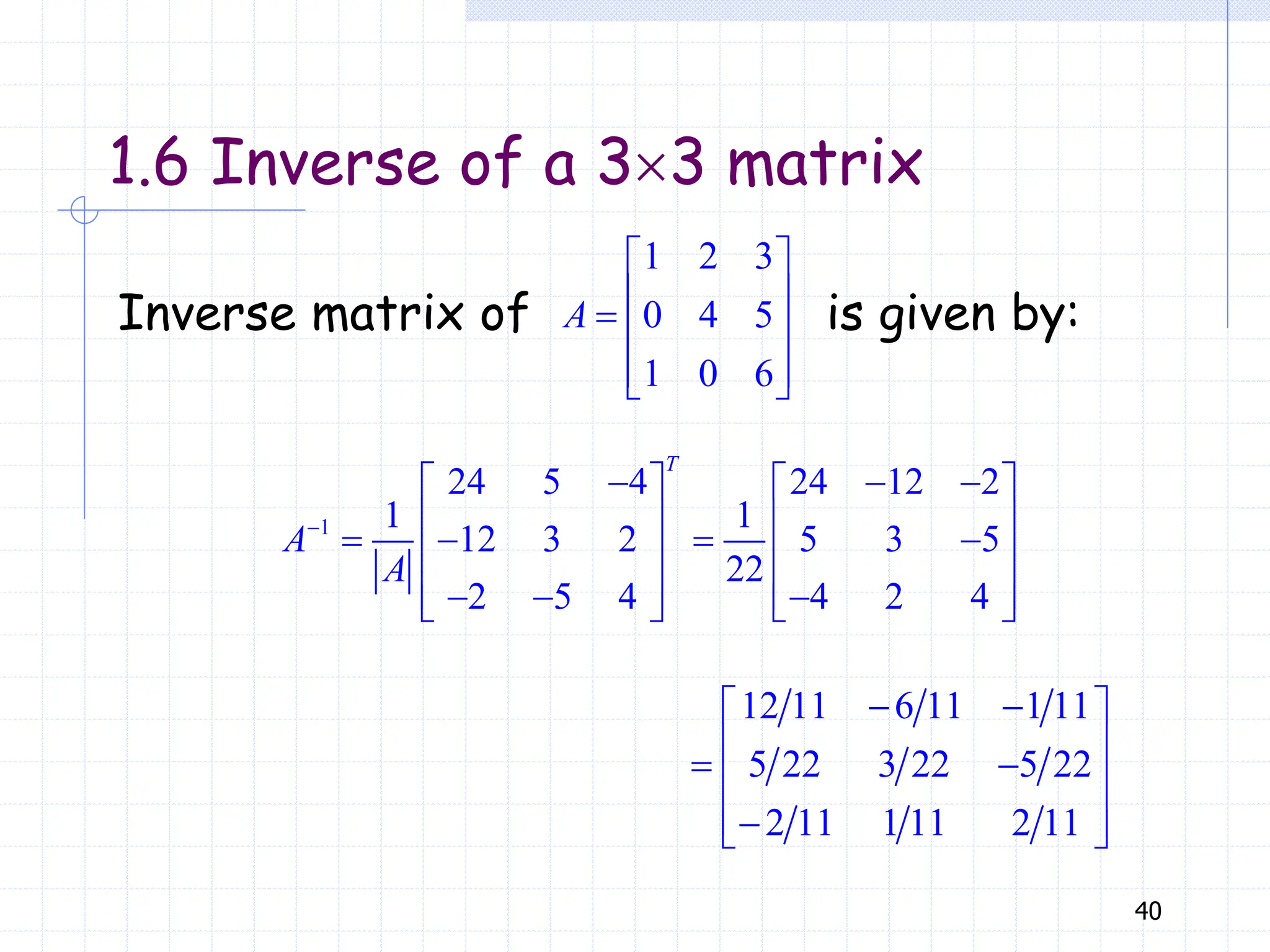
40
1.6 Inverse of a 33 matrix
Inverse matrix of is given by:
1 2 3
0 4 5
1 0 6
A
 
 
  
 
 
1
24 5 4 24 12 2
1 1
12 3 2 5 3 5
22
2 5 4 4 2 4
T
A
A

  
   
   
   
   
   
  
   
12 11 6 11 1 11
5 22 3 22 5 22
2 11 1 11 2 11
 
 
 
 
 
 

 

ppt power point presentation physics.pdf

  • 1.
    1 Lecture 1 Matrices andDeterminants By Kisor Mukhopadhyay, Prabhu Jagatbandhu College, Module I
  • 2.
    2 1.1 Matrices 1.2 Operationsof matrices 1.3 Types of matrices 1.4 Properties of matrices 1.5 Determinants 1.6 Inverse of a 33 matrix
  • 3.
    3 2 3 7 11 5 A         1.1 Matrices 1 3 1 2 1 4 4 7 6 B            Both A and B are examples of matrix. A matrix is a rectangular array of numbers enclosed by a pair of bracket. Why matrix?
  • 4.
    4 How about solving 7, 35.        x y x y 2 7, 2 4 2, 5 4 10 1, 3 6 5.                     x y z x y z x y z x y z Consider the following set of equations: It is easy to show that x = 3 and y = 4. Matrices can help… 1.1 Matrices
  • 5.
    5 11 12 1 2122 2 1 2              n n m m mn a a a a a a A a a a In the matrix ▪numbers aij are called elements. First subscript indicates the row; second subscript indicates the column. The matrix consists of mn elements ▪It is called “the m  n matrix A = [aij]” or simply “the matrix A ” if number of rows and columns are understood. 1.1 Matrices
  • 6.
    6 Square matrices ▪When m= n, i.e., ▪A is called a “square matrix of order n” or “n-square matrix” ▪elements a11, a22, a33,…, ann called diagonal elements. ▪ is called the trace of A. 11 12 1 21 22 2 1 2              n n n n nn a a a a a a A a a a ... 11 22 1       n ii nn i a a a a 1.1 Matrices
  • 7.
    7 Equal matrices ▪Two matricesA = [aij] and B = [bij] are said to be equal (A = B) iff each element of A is equal to the corresponding element of B, i.e., aij = bij for 1  i  m, 1  j  n. ▪iff pronouns “if and only if” if A = B, it implies aij = bij for 1  i  m, 1  j  n; if aij = bij for 1  i  m, 1  j  n, it implies A = B. 1.1 Matrices
  • 8.
    8 Equal matrices Given thatA = B, find a, b, c and d. 1.1 Matrices 1 0 4 2 A         a b B c d        Example: and if A = B, then a = 1, b = 0, c = -4 and d = 2.
  • 9.
    9 Zero matrices ▪Every elementof a matrix is zero, it is called a zero matrix, i.e., 0 0 0 0 0 0 0 0 0              A 1.1 Matrices
  • 10.
    10 Sums of matrices 1.2Operations of matrices ▪If A = [aij] and B = [bij] are m  n matrices, then A + B is defined as a matrix C = A + B, where C= [cij], cij = aij + bij for 1  i  m, 1  j  n. 1 2 3 0 1 4        A 2 3 0 1 2 5         B Example: if and Evaluate A + B and A – B. 1 2 2 3 3 0 3 5 3 0 ( 1) 1 2 4 5 1 3 9                        A B 1 2 2 3 3 0 1 1 3 0 ( 1) 1 2 4 5 1 1 1                           A B
  • 11.
    11 Sums of matrices 1.2Operations of matrices ▪Two matrices of the same order are said to be conformable for addition or subtraction. ▪Two matrices of different orders cannot be added or subtracted, e.g., are NOT conformable for addition or subtraction. 2 3 7 1 1 5        1 3 1 2 1 4 4 7 6          
  • 12.
    12 Scalar multiplication 1.2 Operationsof matrices ▪Let l be any scalar and A = [aij] is an m  n matrix. Then lA = [laij] for 1  i  m, 1  j  n, i.e., each element in A is multiplied by l. 1 2 3 0 1 4        A Example: . Evaluate 3A. 3 1 3 2 3 3 3 6 9 3 3 0 3 1 3 4 0 3 12                     A ▪In particular, l  1, i.e., A = [aij]. It’s called the negative of A. Note: A  A = 0 is a zero matrix
  • 13.
    13 Properties 1.2 Operations ofmatrices Matrices A, B and C are conformable, ▪A + B = B + A ▪A + (B +C) = (A + B) +C ▪l(A + B) = lA + lB, where l is a scalar (commutative law) (associative law) Can you prove them? (distributive law)
  • 14.
    14 Let C =A + B, so cij = aij + bij. Consider lcij = l (aij + bij ) = laij + lbij, we have, lC = lA + lB. Since lC = l(A + B), so l(A + B) = lA + lB Example: Prove l(A + B) = lA + lB. Properties 1.2 Operations of matrices
  • 15.
    15 Matrix multiplication 1.2 Operationsof matrices ▪If A = [aij] is a m  p matrix and B = [bij] is a p  n matrix, then AB is defined as a m  n matrix C = AB, where C= [cij] with 1 1 2 2 1 ...        p ij ik kj i j i j ip pj k c a b a b a b a b 1 2 3 0 1 4        A 1 2 2 3 5 0             B Example: , and C = AB. Evaluate c21. 1 2 1 2 3 2 3 0 1 4 5 0                  21 0 ( 1) 1 2 4 5 22         c for 1  i  m, 1  j  n.
  • 16.
    16 Matrix multiplication 1.2 Operationsof matrices 1 2 3 0 1 4        A 1 2 2 3 5 0             B Example: , , Evaluate C = AB. 11 12 21 22 1 ( 1) 2 2 3 5 18 1 2 1 2 2 3 3 0 8 1 2 3 2 3 0 ( 1) 1 2 4 5 22 0 1 4 5 0 0 2 1 3 4 0 3 c c c c                                                        1 2 1 2 3 18 8 2 3 0 1 4 22 3 5 0 C AB                          
  • 17.
    17 Matrix multiplication 1.2 Operationsof matrices ▪In particular, A is a 1  m matrix and B is a m  1 matrix, i.e., 1 1 11 11 12 21 1 1 1 ...        m k k m m k C a b a b a b a b   11 12 1 ...  m A a a a 11 21 1              m b b B b then C = AB is a scalar.
  • 18.
    18 Matrix multiplication 1.2 Operationsof matrices ▪BUT BA is a m  m matrix!   11 11 11 11 12 11 1 21 21 11 21 12 21 1 11 12 1 1 1 11 1 12 1 1 ...                           m m m m m m m m b b a b a b a b b a b a b a BA a a a b b a b a b a ▪So AB  BA in general !
  • 19.
    19 Properties 1.2 Operations ofmatrices Matrices A, B and C are conformable, ▪A(B + C) = AB + AC ▪(A + B)C = AC + BC ▪A(BC) = (AB) C ▪AB  BA in general ▪AB = 0 NOT necessarily imply A = 0 or B = 0 ▪AB = AC NOT necessarily imply B = C
  • 20.
    20 Properties Let X =B + C, so xij = bij + cij. Let Y = AX, then 1 1 1 1 1 ( ) ( ) n n ij ik kj ik kj kj k k n n n ik kj ik kj ik kj ik kj k k k y a x a b c a b a c a b a c                  Example: Prove A(B + C) = AB + AC where A, B and C are n-square matrices So Y = AB + AC; therefore, A(B + C) = AB + AC 1.2 Operations of matrices
  • 21.
    21 1.3 Types ofmatrices ▪Identity matrix ▪The inverse of a matrix ▪The transpose of a matrix ▪Symmetric matrix ▪Orthogonal matrix
  • 22.
    22 ▪A square matrixwhose elements aij = 0, for i > j is called upper triangular, i.e., 11 12 1 22 2 0 0 0             n n nn a a a a a a ▪A square matrix whose elements aij = 0, for i < j is called lower triangular, i.e., 11 21 22 1 2 0 0 0             n n nn a a a a a a Identity matrix 1.3 Types of matrices
  • 23.
    23 ▪Both upper andlower triangular, i.e., aij = 0, for i  j , i.e., 11 22 0 0 0 0 0 0              nn a a D a 11 22 diag[ , ,..., ]  nn D a a a Identity matrix 1.3 Types of matrices is called a diagonal matrix, simply
  • 24.
    24 ▪In particular, a11= a22 = … = ann = 1, the matrix is called identity matrix. ▪Properties: AI = IA = A Examples of identity matrices: and 1 0 0 1       1 0 0 0 1 0 0 0 1           Identity matrix 1.3 Types of matrices
  • 25.
    25 ▪AB BA ingeneral. However, if two square matrices A and B such that AB = BA, then A and B are said to be commute. Can you suggest two matrices that must commute with a square matrix A? ▪If A and B such that AB = -BA, then A and B are said to be anti-commute. Special square matrix 1.3 Types of matrices Ans: A itself, the identity matrix, ..
  • 26.
    26 ▪If matrices Aand B such that AB = BA = I, then B is called the inverse of A (symbol: A-1); and A is called the inverse of B (symbol: B-1). The inverse of a matrix 6 2 3 1 1 0 1 0 1 B                Show B is the the inverse of matrix A. 1 2 3 1 3 3 1 2 4 A            Example: 1 0 0 0 1 0 0 0 1 AB BA             Ans: Note that Can you show the details? 1.3 Types of matrices
  • 27.
    27 The transpose ofa matrix ▪The matrix obtained by interchanging the rows and columns of a matrix A is called the transpose of A (write AT). Example: The transpose of A is 1 2 3 4 5 6        A 1 4 2 5 3 6            T A ▪For a matrix A = [aij], its transpose AT = [bij], where bij = aji. 1.3 Types of matrices
  • 28.
    28 Symmetric matrix ▪A matrixA such that AT = A is called symmetric, i.e., aji = aij for all i and j. ▪A + AT must be symmetric. Why? Example: is symmetric. 1 2 3 2 4 5 3 5 6              A ▪A matrix A such that AT = -A is called skew- symmetric, i.e., aji = -aij for all i and j. ▪A - AT must be skew-symmetric. Why? 1.3 Types of matrices
  • 29.
    29 Orthogonal matrix ▪A matrixA is called orthogonal if AAT = ATA = I, i.e., AT = A-1 Example: prove that is orthogonal. 1/ 3 1/ 6 1/ 2 1/ 3 2/ 6 0 1/ 3 1/ 6 1/ 2                A We’ll see that orthogonal matrix represents a rotation in fact! 1.3 Types of matrices Since, . Hence, AAT = ATA = I. 1/ 3 1/ 3 1/ 3 1/ 6 2/ 6 1/ 6 1/ 2 0 1/ 2 T A                Can you show the details?
  • 30.
    30 ▪(AB)-1 = B-1A-1 ▪(AT)T= A and (lA)T = l AT ▪(A + B)T = AT + BT ▪(AB)T = BT AT 1.4 Properties of matrix
  • 31.
    31 1.4 Properties ofmatrix Example: Prove (AB)-1 = B-1A-1. Since (AB) (B-1A-1) = A(B B-1)A-1 = I and (B-1A-1) (AB) = B-1(A-1 A)B = I. Therefore, B-1A-1 is the inverse of matrix AB.
  • 32.
    32 1.5 Determinants Consider a2  2 matrix: 11 12 21 22 a a A a a        Determinant of order 2 ▪Determinant of A, denoted , is a number and can be evaluated by 11 12 11 22 12 21 21 22 | | a a A a a a a a a    | | A
  • 33.
    33 11 12 11 2212 21 21 22 | | a a A a a a a a a     Determinant of order 2 ▪easy to remember (for order 2 only).. 1 2 3 4 Example: Evaluate the determinant: 1 2 1 4 2 3 2 3 4       1.5 Determinants + -
  • 34.
    34 1.5 Determinants 1. Ifevery element of a row (column) is zero, e.g., , then |A| = 0. 2. |AT| = |A| 3. |AB| = |A||B| determinant of a matrix = that of its transpose The following properties are true for determinants of any order. 1 2 1 0 2 0 0 0 0     
  • 35.
    35 Example: Show thatthe determinant of any orthogonal matrix is either +1 or –1. For any orthogonal matrix, A AT = I. Since |AAT| = |A||AT | = 1 and |AT| = |A|, so |A|2 = 1 or |A| = 1. 1.5 Determinants
  • 36.
    36 1.5 Determinants For any2x2 matrix 11 12 21 22 a a A a a        Its inverse can be written as 22 12 1 21 11 1 a a A a a A           Example: Find the inverse of 1 0 1 2 A         The determinant of A is -2 Hence, the inverse of A is 1 1 0 1/ 2 1/ 2 A         How to find an inverse for a 3x3 matrix?
  • 37.
    37 1.5 Determinants oforder 3 Consider an example: 1 2 3 4 5 6 7 8 9 A            Its determinant can be obtained by: 1 2 3 4 5 1 2 1 2 4 5 6 3 6 9 7 8 7 8 4 5 7 8 9 A           3 3 6 6 9 3 0        You are encouraged to find the determinant by using other rows or columns
  • 38.
    38 1.6 Inverse ofa 33 matrix Cofactor matrix of 1 2 3 0 4 5 1 0 6 A            The cofactor for each element of matrix A: 11 4 5 24 0 6 A   12 0 5 5 1 6 A    13 0 4 4 1 0 A    21 2 3 12 0 6 A    22 1 3 3 1 6 A   23 1 2 2 1 0 A    31 2 3 2 4 5 A    32 1 3 5 0 5 A     33 1 2 4 0 4 A  
  • 39.
    39 Cofactor matrix ofis then given by: 1 2 3 0 4 5 1 0 6 A            24 5 4 12 3 2 2 5 4               1.6 Inverse of a 33 matrix
  • 40.
    40 1.6 Inverse ofa 33 matrix Inverse matrix of is given by: 1 2 3 0 4 5 1 0 6 A            1 24 5 4 24 12 2 1 1 12 3 2 5 3 5 22 2 5 4 4 2 4 T A A                                12 11 6 11 1 11 5 22 3 22 5 22 2 11 1 11 2 11               