1.6 Other Types of Equations
Chapter 1 Equations and Inequalities
Concepts and Objectives
⚫ Solve equations consisting of rational expressions
⚫ Solve work-rate problems
⚫ Solve equations with radicals and check the solutions
⚫ Solve equations that are quadratic in form
Rational Equations
⚫ A rational equation is an equation that has a rational
expression for one or more terms.
⚫ To solve a rational equation, multiply both sides by the
lowest common denominator of the terms of the
equation. Be sure to check your solution against the
undefined values!
Because a rational expression is not defined when its
denominator is 0, any value of the variable which makes
the denominator’s value 0 cannot be a solution.
Rational Equations (cont.)
⚫ Example: Solve
−
+ =
+
2 3 5
2 1
x x
x
x
Rational Equations (cont.)
⚫ Example: Solve
The lowest common denominator is , which is
equal to 0 if x = ‒1. Write this as .
−
+ =
+
2 3 5
2 1
x x
x
x
( )+2 1x
 −1x
( ) ( ) ( )( )+ +
−   
+ =   + 
+
 
2 1 2 1
2 3
2
5
1
2 1
x x
x
x x x x
Rational Equations (cont.)
⚫ Example: Solve
The lowest common denominator is , which is
equal to 0 if x = ‒1. Write this as .
−
+ =
+
2 3 5
2 1
x x
x
x
( )+2 1x
 −1x
( ) ( ) ( )( )+ +
−   
+ =   + 
+
 
2 1 2 1
2 3
2
5
1
2 1
x x
x
x x x x
( )( ) ( ) ( )( )+ − + = +1 2 3 2 5 2 1x x x x x
− − + = +2 2
2 3 10 2 2x x x x x
=7 3x
=
3
7
x
Since this is not ‒1, this is a
valid solution.
 
 
 
3
7
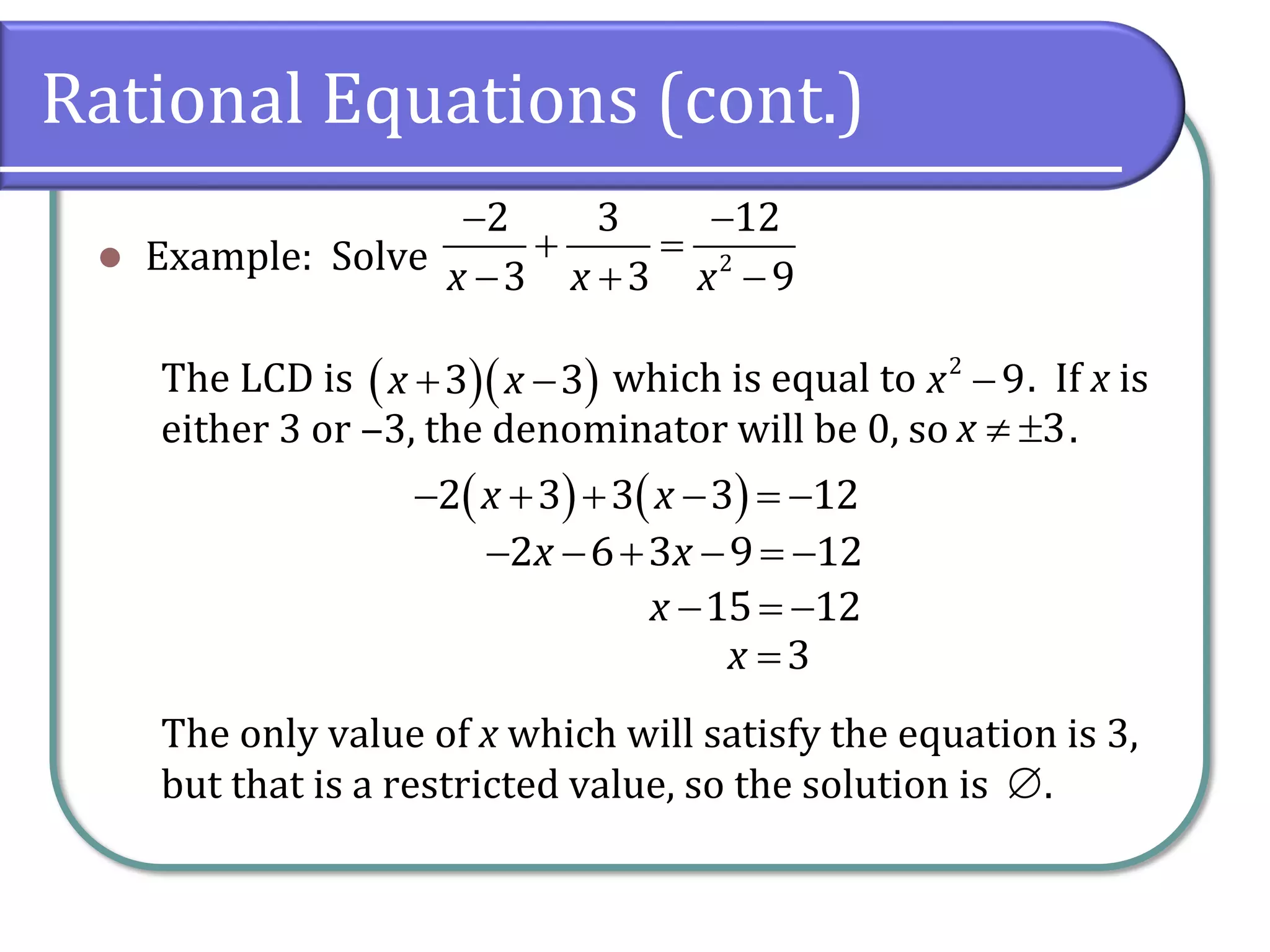
Rational Equations (cont.)
⚫ Example: Solve
− −
+ =
− + −2
2 3 12
3 3 9x x x
Rational Equations (cont.)
⚫ Example: Solve
The LCD is which is equal to . If x is
either 3 or ‒3, the denominator will be 0, so .
The only value of x which will satisfy the equation is 3,
but that is a restricted value, so the solution is .
− −
+ =
− + −2
2 3 12
3 3 9x x x
( )( )+ −3 3x x −2
9x
 3x
( ) ( )− + + − = −2 3 3 3 12x x
− − + − = −2 6 3 9 12x x
− = −15 12x
=3x

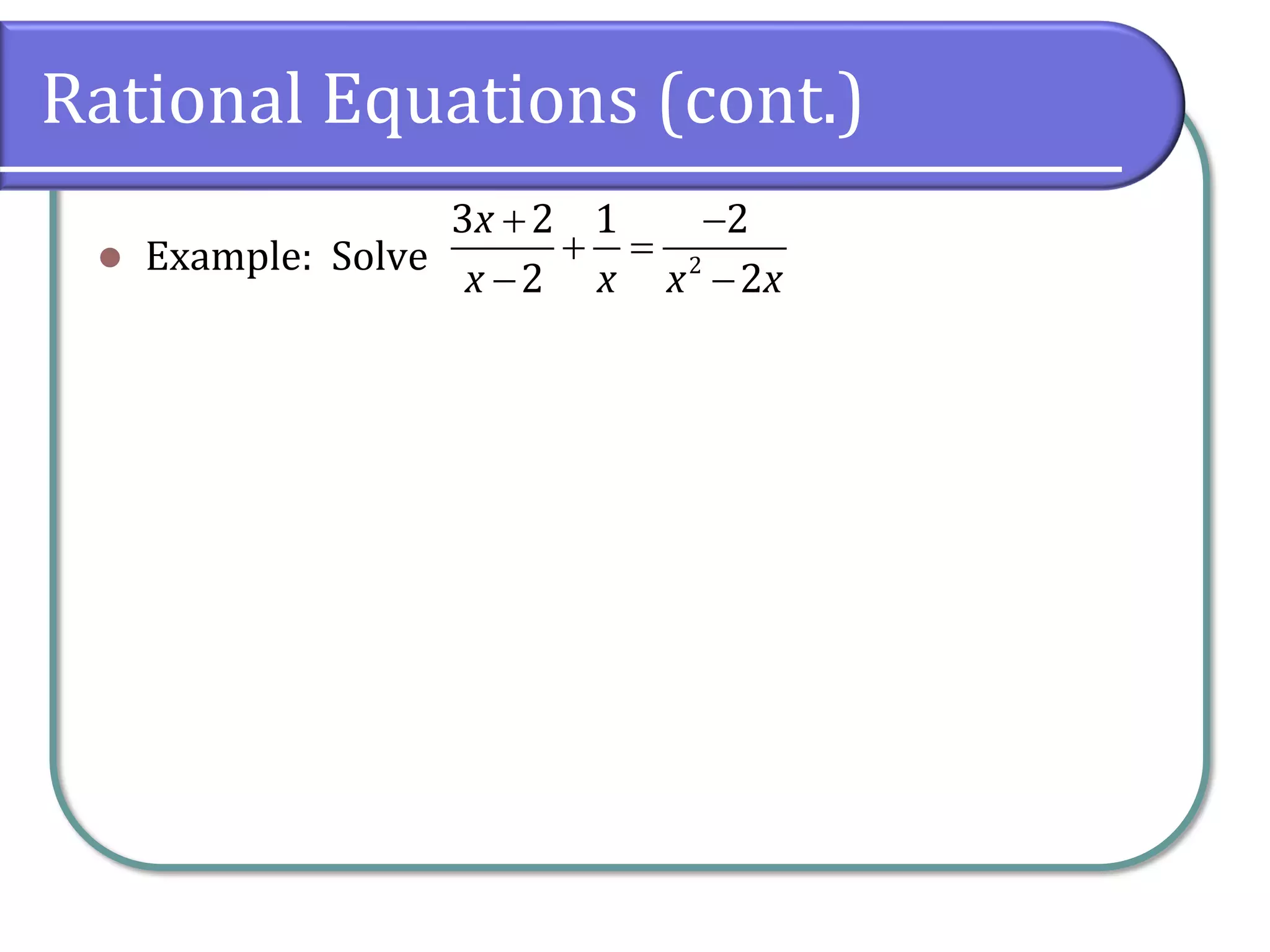
Rational Equations (cont.)
⚫ Example: Solve 2
3 2 1 2
2 2
x
x x x x
+ −
+ =
− −
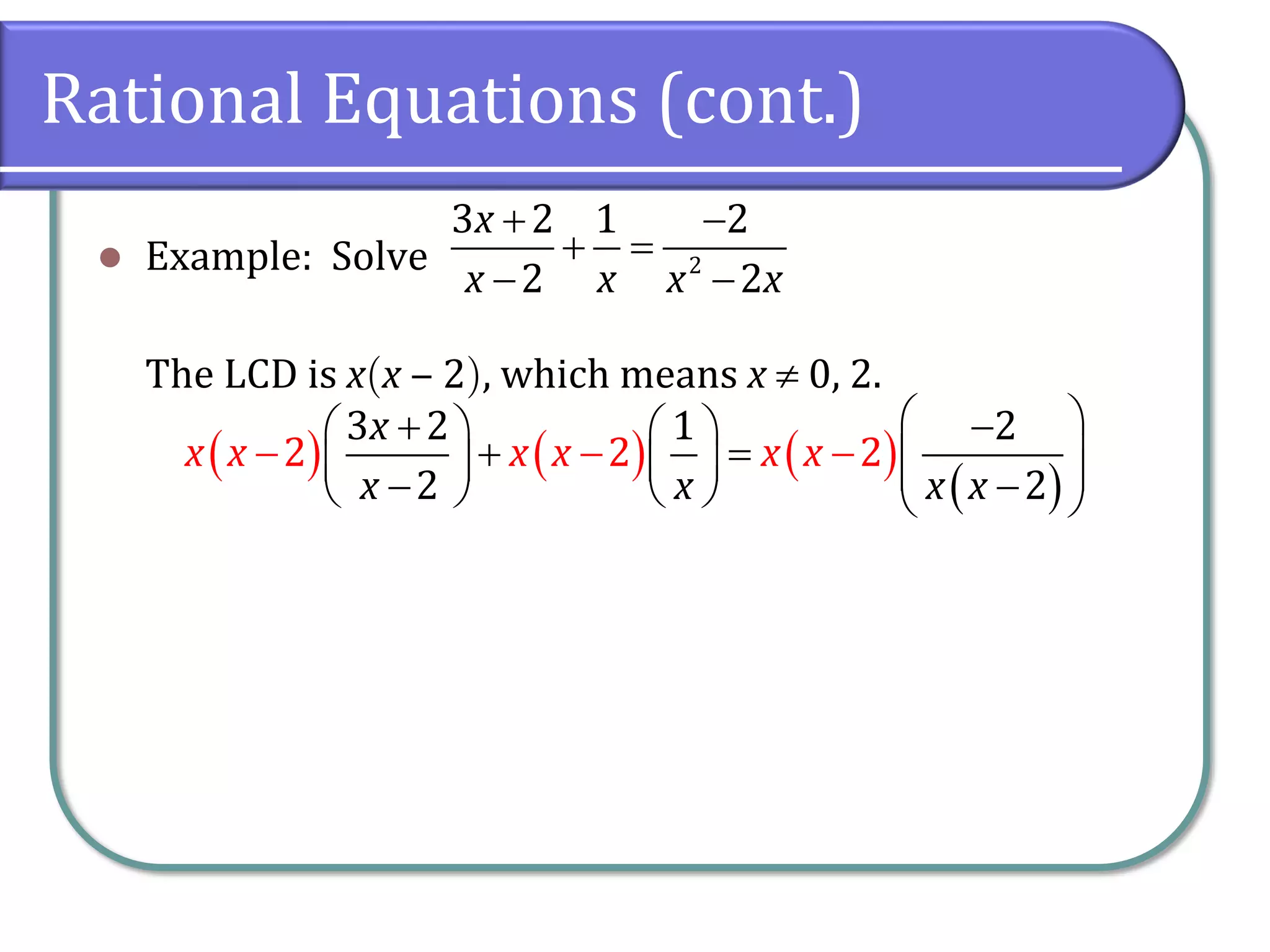
Rational Equations (cont.)
⚫ Example: Solve
The LCD is xx ‒ 2, which means x  0, 2.
2
3 2 1 2
2 2
x
x x x x
+ −
+ =
− −
( ) ( ) ( )
( )2
2 2
3 2 1 2
2
2
x
x x x x
xx x x x x
 + −   
+ =       −
− − −
−     
Rational Equations (cont.)
⚫ Example: Solve
The LCD is xx ‒ 2, which means x  0, 2.
2
3 2 1 2
2 2
x
x x x x
+ −
+ =
− −
( ) ( ) ( )
( )
( ) ( )
( )
2
2
3 2 1 2
2 2
3 2 2 2
3 2 2 2
2
3 3 0
3 1 0
2 2
0, 1
x
x
x x x x
x x x
x
xx x x x
x x
x x
x x
x
 + −   
+ =       − −     
+ + − = −
+ + − = −
+ =
+ =
=
− −
−
−
 1−
Work Rate Problems
⚫ If a job can be done in t units of time, then the rate of
work is of the job per time unit. Therefore,
⚫ If the letters r, t, and A represent the rate at which work
is done, the time, and the amount of work accomplished,
respectively, then
1
t
portion of the job completed = rate time
A rt=
Work Rate Problems (cont.)
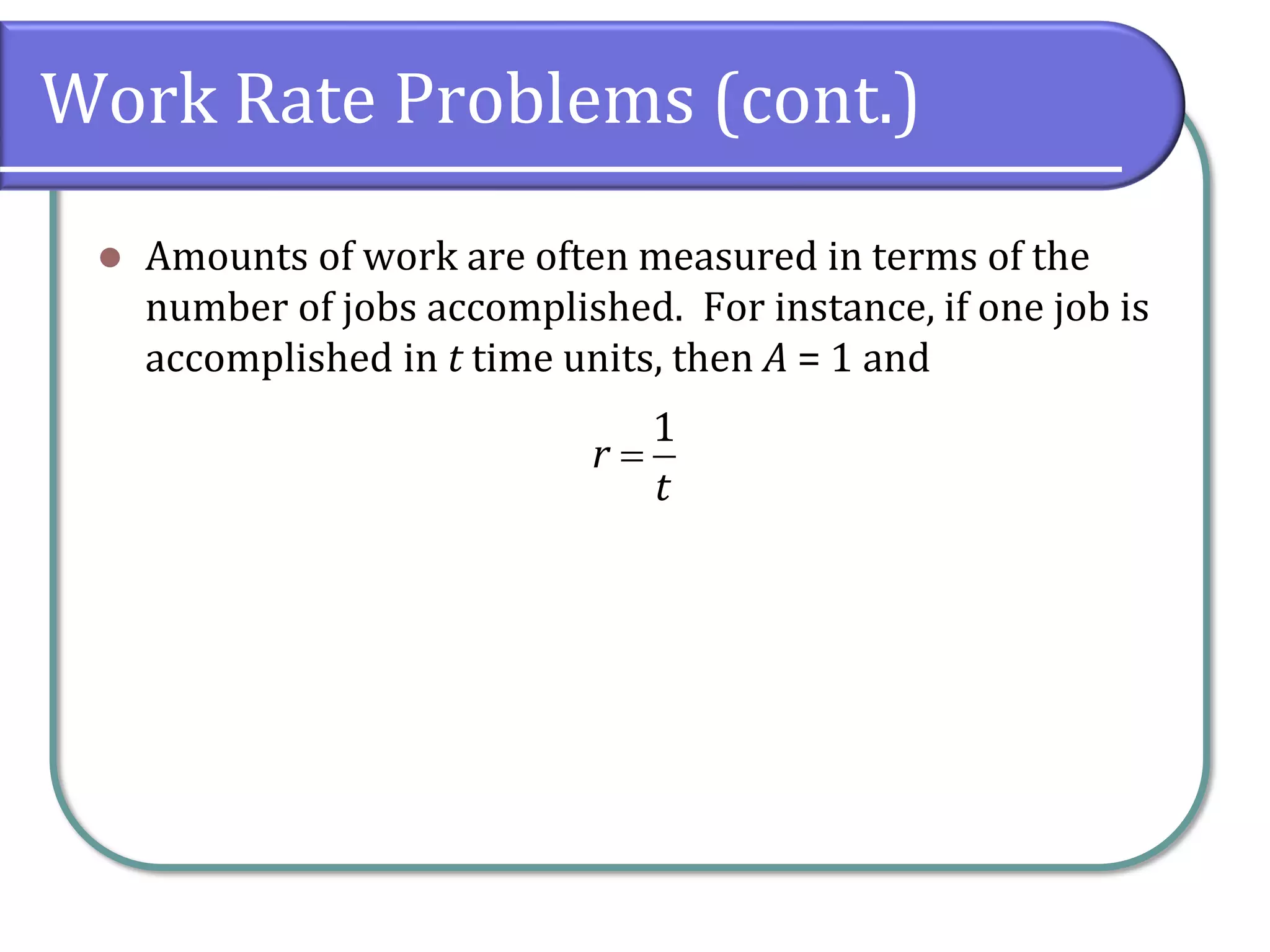
⚫ Amounts of work are often measured in terms of the
number of jobs accomplished. For instance, if one job is
accomplished in t time units, then A = 1 and
1
r
t
=
Work Rate Problems (cont.)
⚫ Example: Lisa and Keith are raking the leaves in their
backyard. Working alone, Lisa can rake the leaves in
5 hr, while Keith can rake them in 4 hr. How long would
it take them to rake the leaves working together?
Work Rate Problems (cont.)
⚫ Example: Lisa and Keith are raking the leaves in their
backyard. Working alone, Lisa can rake the leaves in
5 hr, while Keith can rake them in 4 hr. How long would
it take them to rake the leaves working together?
Lisa’s rate: Keith’s rate:
x is the time it takes for both of them to rake the leaves
1 yard
5 hr
1 yard
4 hr
1 1
1
5 4
x x+ =
Work Rate Problems
⚫ Example, cont.
1 1
1
5 4
x x+ =
Lisa’s
rate
Keith’s
rate
( )
1 1
20 20 20 1
5 4
x x
   
+ =   
   
4 5 20x x+ =
9 20x =
20
hr
9
x =
common
denominator
Power Property
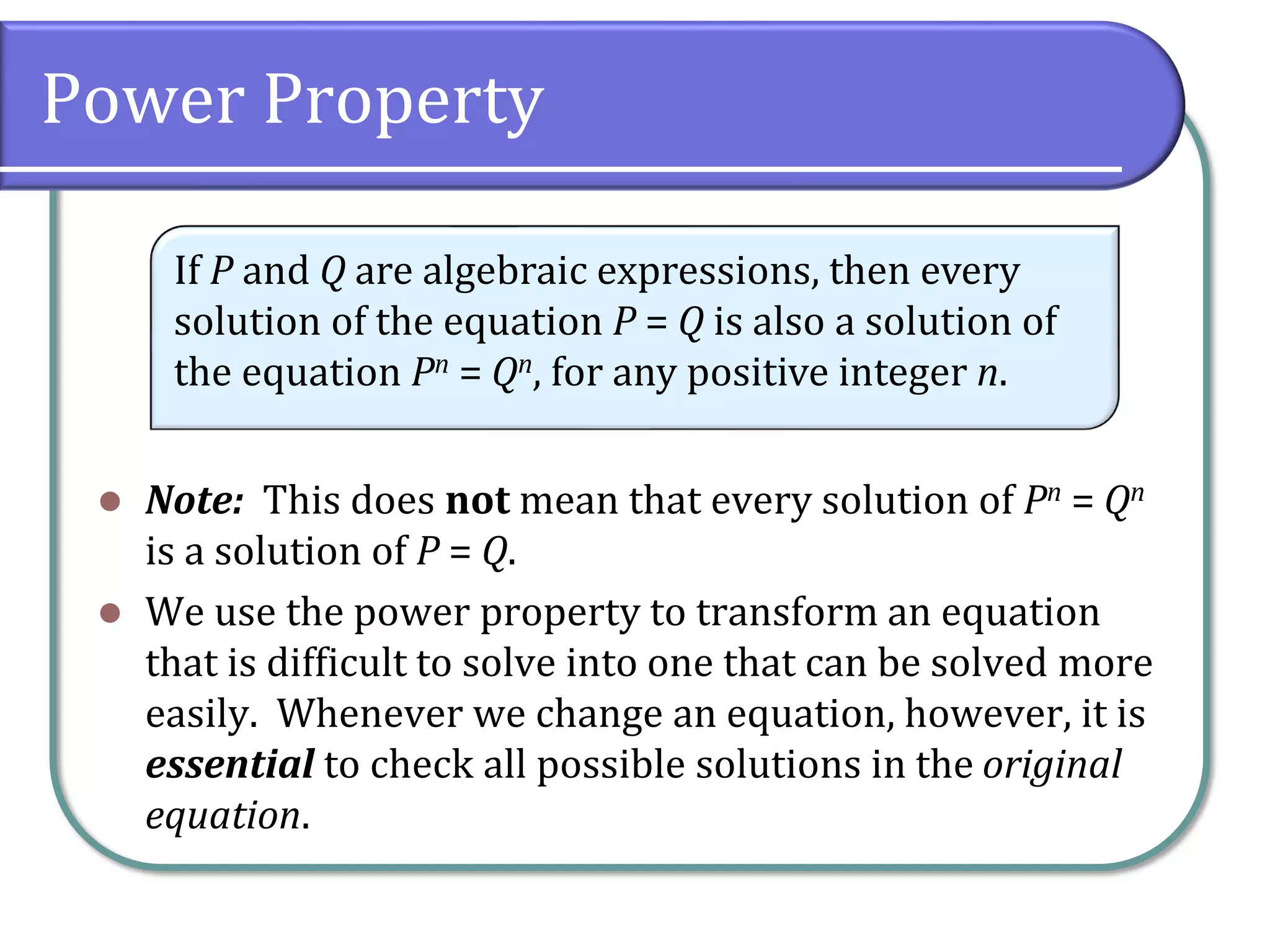
⚫ Note: This does not mean that every solution of Pn = Qn
is a solution of P = Q.
⚫ We use the power property to transform an equation
that is difficult to solve into one that can be solved more
easily. Whenever we change an equation, however, it is
essential to check all possible solutions in the original
equation.
If P and Q are algebraic expressions, then every
solution of the equation P = Q is also a solution of
the equation Pn = Qn, for any positive integer n.
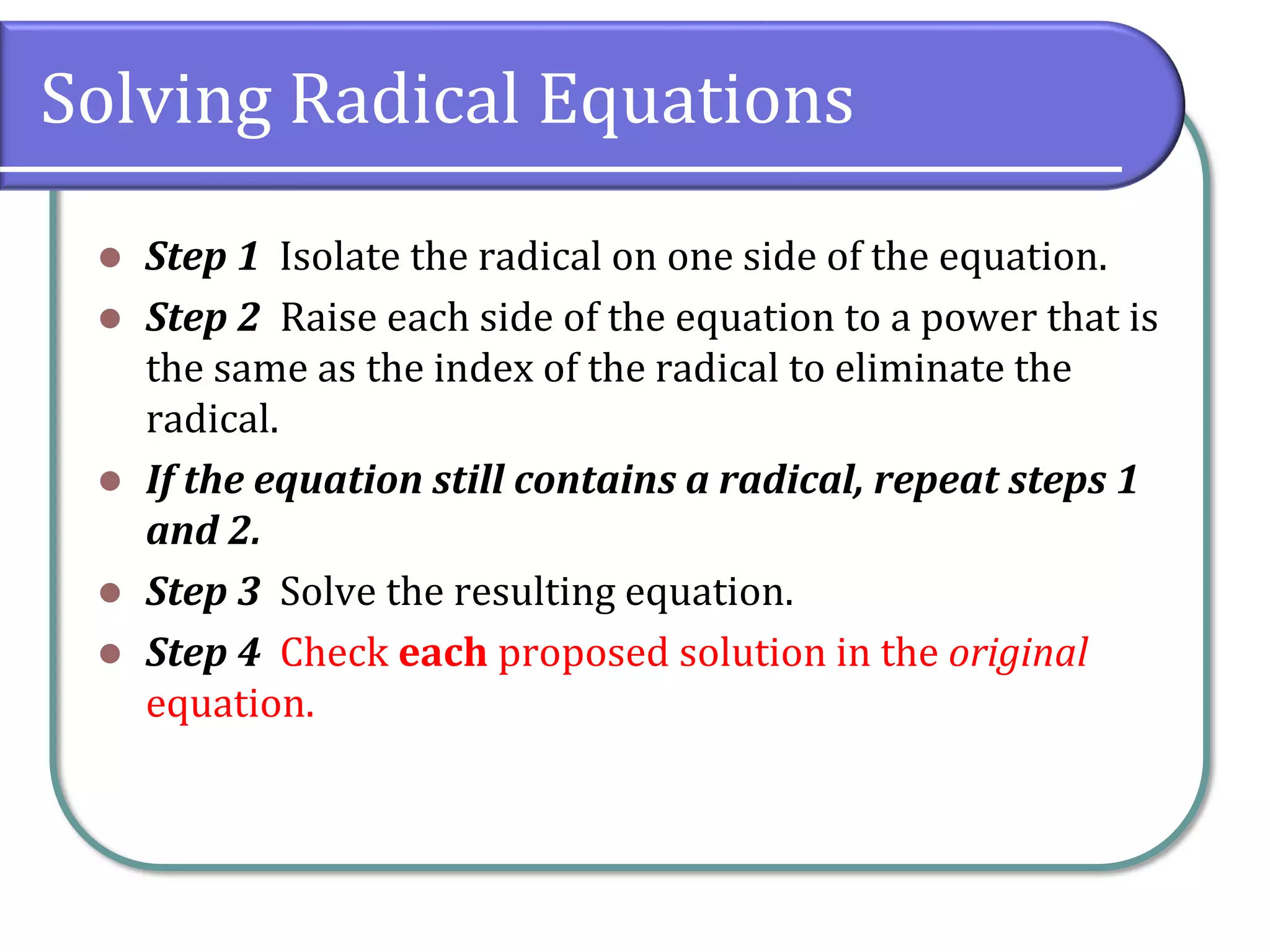
Solving Radical Equations
⚫ Step 1 Isolate the radical on one side of the equation.
⚫ Step 2 Raise each side of the equation to a power that is
the same as the index of the radical to eliminate the
radical.
⚫ If the equation still contains a radical, repeat steps 1
and 2.
⚫ Step 3 Solve the resulting equation.
⚫ Step 4 Check each proposed solution in the original
equation.
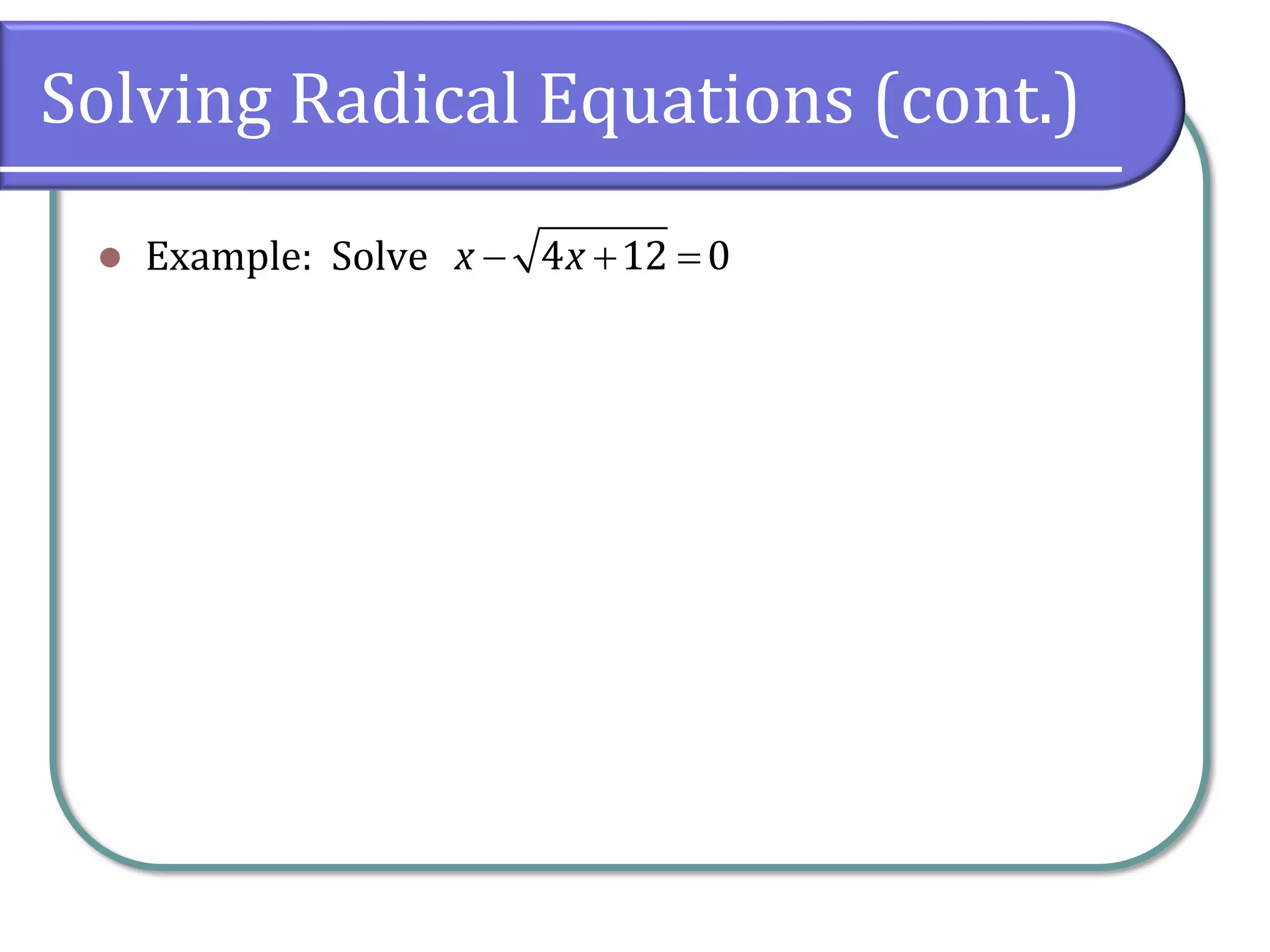
Solving Radical Equations (cont.)
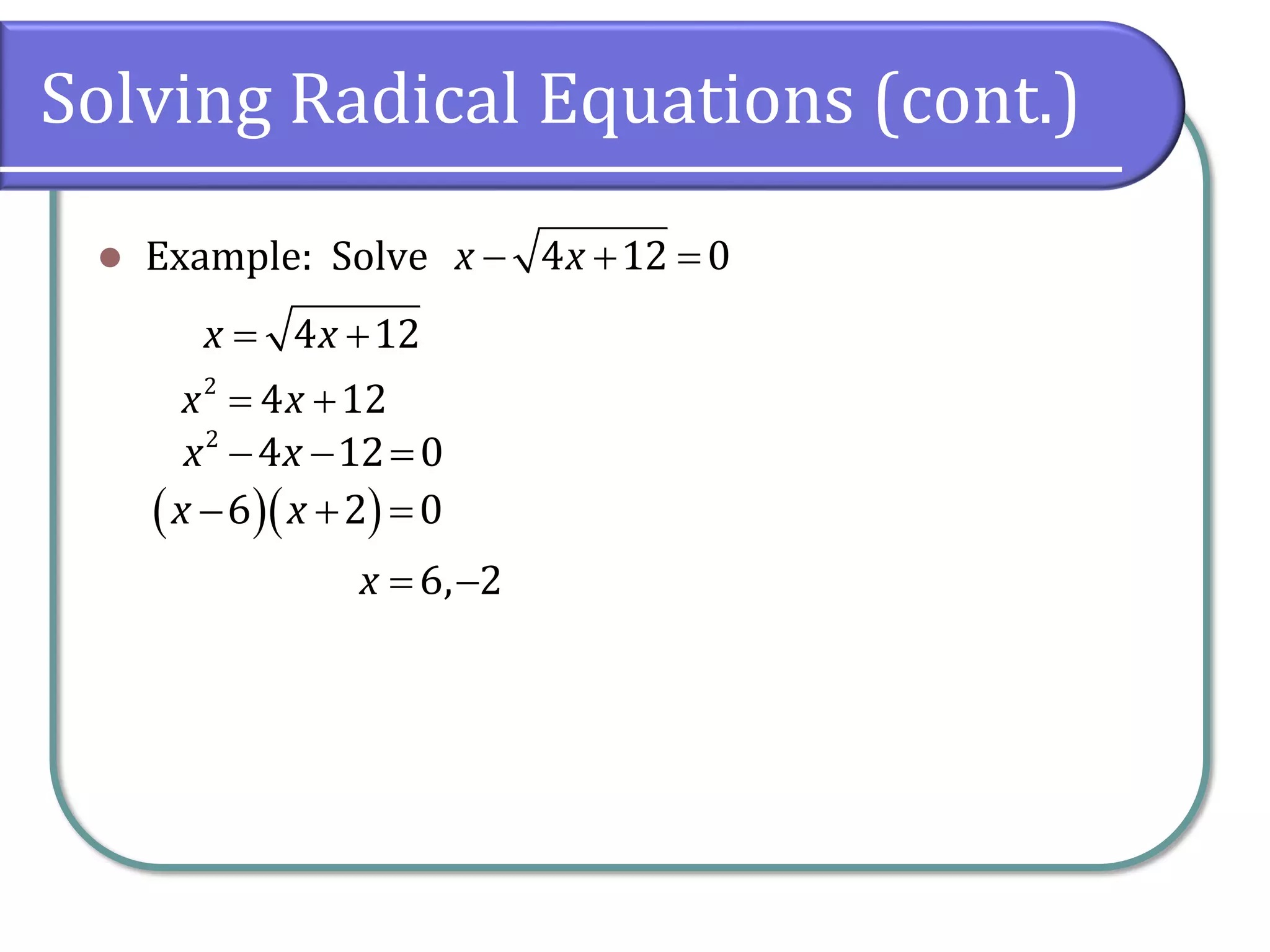
⚫ Example: Solve − + =4 12 0x x
Solving Radical Equations (cont.)
⚫ Example: Solve − + =4 12 0x x
= +4 12x x
= +2
4 12x x
− − =2
4 12 0x x
( )( )− + =6 2 0x x
= −6, 2x
Solving Radical Equations (cont.)
⚫ Example: Solve
Check:
Solution: {6}
− + =4 12 0x x
4 12x x= +
2
4 12x x= +
2
4 12 0x x− − =
( )( )6 2 0x x− + =
6, 2x = −
( )− + =6 4 6 12 0
− =6 36 0
− =6 6 0
=0 0
( )− − − + =2 4 2 12 0
− − =2 4 0
− − =2 2 0
− 4 0
Solving Radical Equations (cont.)
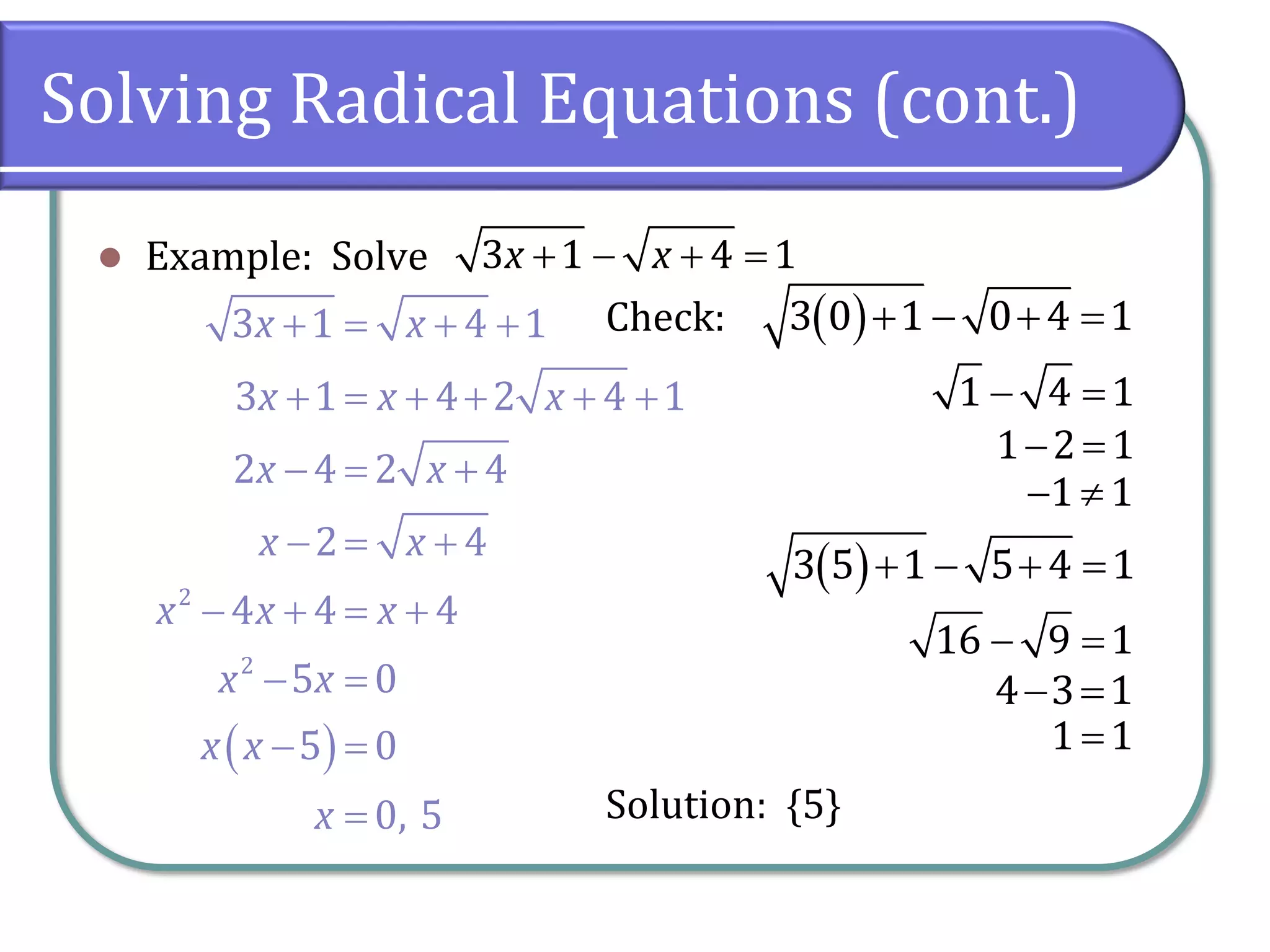
⚫ Example: Solve + − + =3 1 4 1x x
Solving Radical Equations (cont.)
⚫ Example: Solve + − + =3 1 4 1x x
( )
2
4 1x + +
( )
2
2
3 1 4 1
3 1 4 2 4 1
2 4 2 4
2 4
4 4 4
5 0
5 0
0, 5
x x
x x x
x x
x x
x x x
x x
x x
x
+ = + +
+ = + + + +
− = +
− = +
− + = +
− =
− =
=
Solving Radical Equations (cont.)
⚫ Example: Solve
Check:
Solution: {5}
+ − + =3 1 4 1x x
( )
2
2
3 1 4 1
3 1 4 2 4 1
2 4 2 4
2 4
4 4 4
5 0
5 0
0, 5
x x
x x x
x x
x x
x x x
x x
x x
x
+ = + +
+ = + + + +
− = +
− = +
− + = +
− =
− =
=
( )+ − + =3 0 1 0 4 1
− =1 4 1
− =1 2 1
− 1 1
( )+ − + =3 5 1 5 4 1
− =16 9 1
− =4 3 1
=1 1
Quadratic in Form
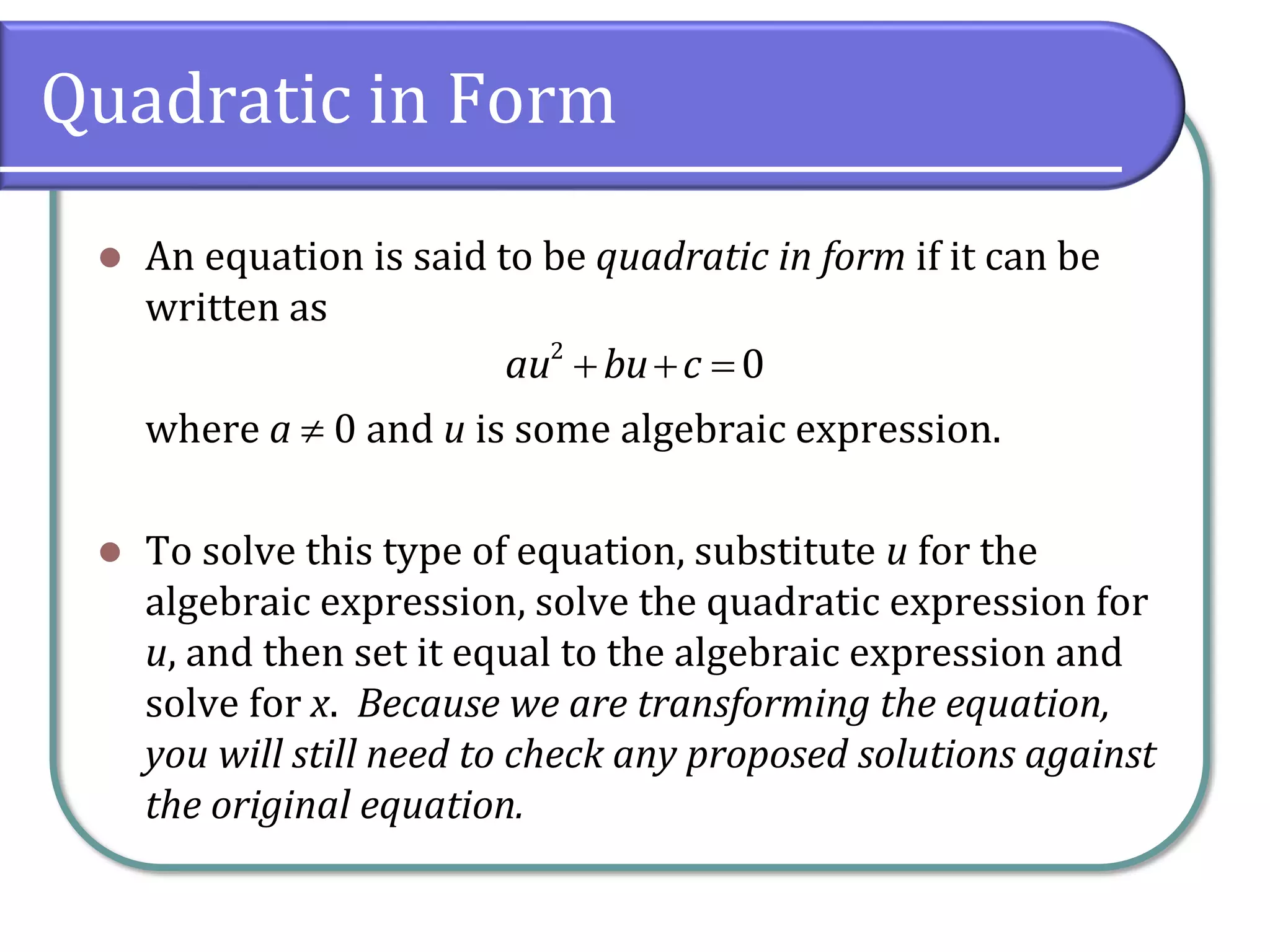
⚫ An equation is said to be quadratic in form if it can be
written as
where a  0 and u is some algebraic expression.
⚫ To solve this type of equation, substitute u for the
algebraic expression, solve the quadratic expression for
u, and then set it equal to the algebraic expression and
solve for x. Because we are transforming the equation,
you will still need to check any proposed solutions against
the original equation.
+ + =2
0au bu c
Quadratic in Form (cont.)
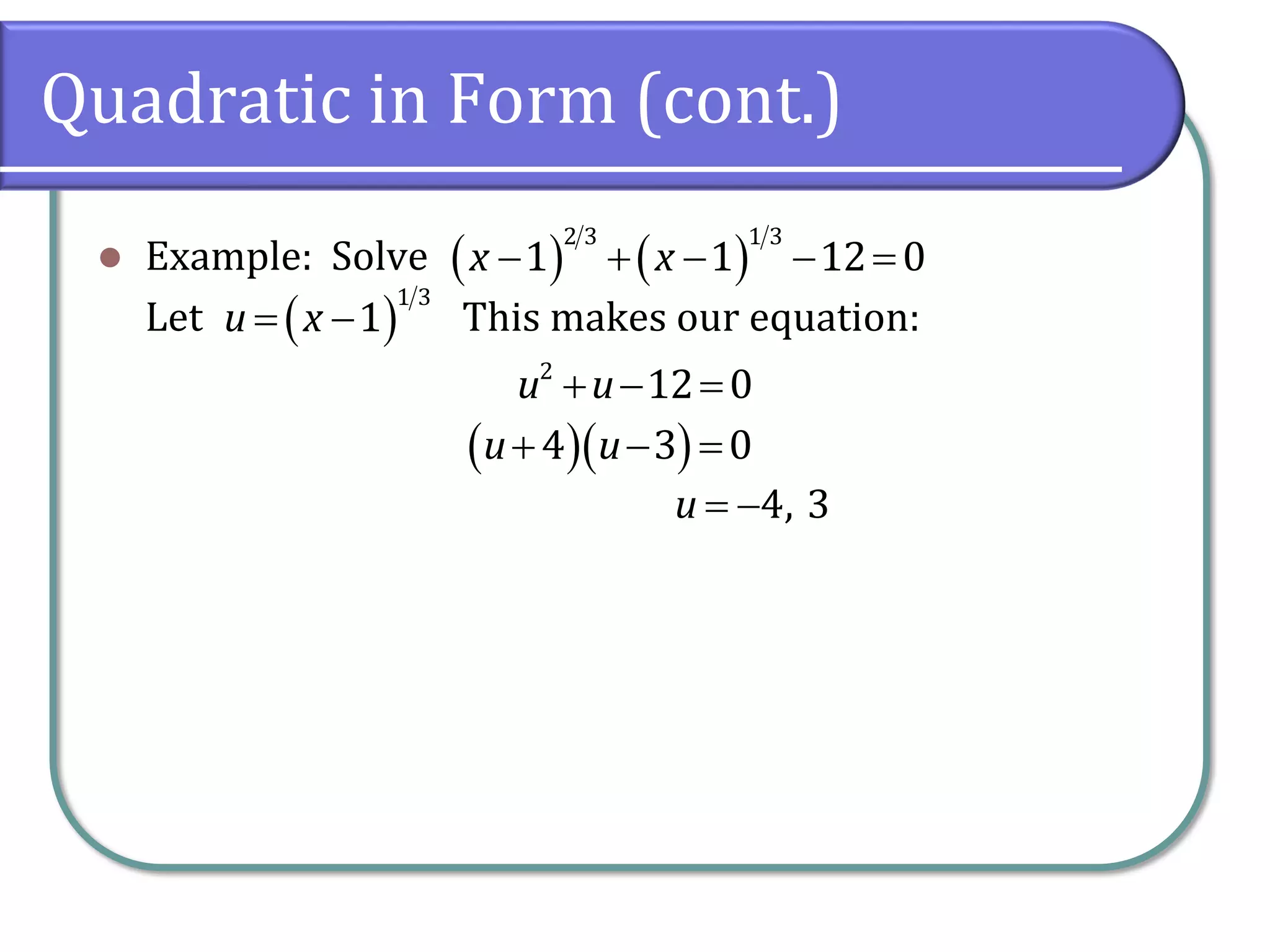
⚫ Example: Solve ( ) ( )− + − − =
2 3 1 3
1 1 12 0x x
Quadratic in Form (cont.)
⚫ Example: Solve
Let This makes our equation:
( ) ( )− + − − =
2 3 1 3
1 1 12 0x x
( )= −
1 3
1u x
+ − =2
12 0u u
( )( )+ − =4 3 0u u
= −4, 3u
Quadratic in Form (cont.)
⚫ Example: Solve
Let . This makes our equation:
So, and
( ) ( )− + − − =
2 3 1 3
1 1 12 0x x
( )= −
1 3
1u x
+ − =2
12 0u u
( )( )+ − =4 3 0u u
= −4, 3u
( )
( ) ( )
1 3
31/3 3
1 4
1 4
1 64
63
x
x
x
x
− = −
 − = −
 
− = −
= −
( )
( ) ( )
1 3
31/3 3
1 3
1 3
1 27
28
x
x
x
x
− =
 − =
 
− =
=
Quadratic in Form (cont.)
⚫ Example: Solve (cont.)
Now, we have to check our proposed solutions:
( ) ( )− + − − =
2 3 1 3
1 1 12 0x x
( ) ( )− − + − − − =
2 3 1 3
63 1 63 1 12 0
( ) ( )− + − − =
2 3 1 3
64 64 12 0
( ) ( )− + − − =
2 1
4 4 12 0
− − =16 4 12 0
=0 0
Quadratic in Form (cont.)
⚫ Example: Solve (cont.)
Solution: {–63, 28}
( ) ( )− + − − =
2 3 1 3
1 1 12 0x x
( ) ( )− + − − =
2 3 1 3
28 1 28 1 12 0
( ) ( )+ − =
2 3 1 3
27 27 12 0
( ) ( )+ − =
2 1
3 3 12 0
+ − =9 3 12 0
=0 0
Classwork
⚫ 1.6 Assignment (College Algebra)
⚫ Page 142: 8-32 (4); page 128: 20-36 (4), 38;
page 120: 62-80 (even)
⚫ 1.6 Classwork Check
⚫ Quiz 1.5

1.6 Other Types of Equations

  • 1.
    1.6 Other Typesof Equations Chapter 1 Equations and Inequalities
  • 2.
    Concepts and Objectives ⚫Solve equations consisting of rational expressions ⚫ Solve work-rate problems ⚫ Solve equations with radicals and check the solutions ⚫ Solve equations that are quadratic in form
  • 3.
    Rational Equations ⚫ Arational equation is an equation that has a rational expression for one or more terms. ⚫ To solve a rational equation, multiply both sides by the lowest common denominator of the terms of the equation. Be sure to check your solution against the undefined values! Because a rational expression is not defined when its denominator is 0, any value of the variable which makes the denominator’s value 0 cannot be a solution.
  • 4.
    Rational Equations (cont.) ⚫Example: Solve − + = + 2 3 5 2 1 x x x x
  • 5.
    Rational Equations (cont.) ⚫Example: Solve The lowest common denominator is , which is equal to 0 if x = ‒1. Write this as . − + = + 2 3 5 2 1 x x x x ( )+2 1x  −1x ( ) ( ) ( )( )+ + −    + =   +  +   2 1 2 1 2 3 2 5 1 2 1 x x x x x x x
  • 6.
    Rational Equations (cont.) ⚫Example: Solve The lowest common denominator is , which is equal to 0 if x = ‒1. Write this as . − + = + 2 3 5 2 1 x x x x ( )+2 1x  −1x ( ) ( ) ( )( )+ + −    + =   +  +   2 1 2 1 2 3 2 5 1 2 1 x x x x x x x ( )( ) ( ) ( )( )+ − + = +1 2 3 2 5 2 1x x x x x − − + = +2 2 2 3 10 2 2x x x x x =7 3x = 3 7 x Since this is not ‒1, this is a valid solution.       3 7
  • 7.
    Rational Equations (cont.) ⚫Example: Solve − − + = − + −2 2 3 12 3 3 9x x x
  • 8.
    Rational Equations (cont.) ⚫Example: Solve The LCD is which is equal to . If x is either 3 or ‒3, the denominator will be 0, so . The only value of x which will satisfy the equation is 3, but that is a restricted value, so the solution is . − − + = − + −2 2 3 12 3 3 9x x x ( )( )+ −3 3x x −2 9x  3x ( ) ( )− + + − = −2 3 3 3 12x x − − + − = −2 6 3 9 12x x − = −15 12x =3x 
  • 9.
    Rational Equations (cont.) ⚫Example: Solve 2 3 2 1 2 2 2 x x x x x + − + = − −
  • 10.
    Rational Equations (cont.) ⚫Example: Solve The LCD is xx ‒ 2, which means x  0, 2. 2 3 2 1 2 2 2 x x x x x + − + = − − ( ) ( ) ( ) ( )2 2 2 3 2 1 2 2 2 x x x x x xx x x x x  + −    + =       − − − − −     
  • 11.
    Rational Equations (cont.) ⚫Example: Solve The LCD is xx ‒ 2, which means x  0, 2. 2 3 2 1 2 2 2 x x x x x + − + = − − ( ) ( ) ( ) ( ) ( ) ( ) ( ) 2 2 3 2 1 2 2 2 3 2 2 2 3 2 2 2 2 3 3 0 3 1 0 2 2 0, 1 x x x x x x x x x x xx x x x x x x x x x x  + −    + =       − −      + + − = − + + − = − + = + = = − − − −  1−
  • 12.
    Work Rate Problems ⚫If a job can be done in t units of time, then the rate of work is of the job per time unit. Therefore, ⚫ If the letters r, t, and A represent the rate at which work is done, the time, and the amount of work accomplished, respectively, then 1 t portion of the job completed = rate time A rt=
  • 13.
    Work Rate Problems(cont.) ⚫ Amounts of work are often measured in terms of the number of jobs accomplished. For instance, if one job is accomplished in t time units, then A = 1 and 1 r t =
  • 14.
    Work Rate Problems(cont.) ⚫ Example: Lisa and Keith are raking the leaves in their backyard. Working alone, Lisa can rake the leaves in 5 hr, while Keith can rake them in 4 hr. How long would it take them to rake the leaves working together?
  • 15.
    Work Rate Problems(cont.) ⚫ Example: Lisa and Keith are raking the leaves in their backyard. Working alone, Lisa can rake the leaves in 5 hr, while Keith can rake them in 4 hr. How long would it take them to rake the leaves working together? Lisa’s rate: Keith’s rate: x is the time it takes for both of them to rake the leaves 1 yard 5 hr 1 yard 4 hr 1 1 1 5 4 x x+ =
  • 16.
    Work Rate Problems ⚫Example, cont. 1 1 1 5 4 x x+ = Lisa’s rate Keith’s rate ( ) 1 1 20 20 20 1 5 4 x x     + =        4 5 20x x+ = 9 20x = 20 hr 9 x = common denominator
  • 17.
    Power Property ⚫ Note:This does not mean that every solution of Pn = Qn is a solution of P = Q. ⚫ We use the power property to transform an equation that is difficult to solve into one that can be solved more easily. Whenever we change an equation, however, it is essential to check all possible solutions in the original equation. If P and Q are algebraic expressions, then every solution of the equation P = Q is also a solution of the equation Pn = Qn, for any positive integer n.
  • 18.
    Solving Radical Equations ⚫Step 1 Isolate the radical on one side of the equation. ⚫ Step 2 Raise each side of the equation to a power that is the same as the index of the radical to eliminate the radical. ⚫ If the equation still contains a radical, repeat steps 1 and 2. ⚫ Step 3 Solve the resulting equation. ⚫ Step 4 Check each proposed solution in the original equation.
  • 19.
    Solving Radical Equations(cont.) ⚫ Example: Solve − + =4 12 0x x
  • 20.
    Solving Radical Equations(cont.) ⚫ Example: Solve − + =4 12 0x x = +4 12x x = +2 4 12x x − − =2 4 12 0x x ( )( )− + =6 2 0x x = −6, 2x
  • 21.
    Solving Radical Equations(cont.) ⚫ Example: Solve Check: Solution: {6} − + =4 12 0x x 4 12x x= + 2 4 12x x= + 2 4 12 0x x− − = ( )( )6 2 0x x− + = 6, 2x = − ( )− + =6 4 6 12 0 − =6 36 0 − =6 6 0 =0 0 ( )− − − + =2 4 2 12 0 − − =2 4 0 − − =2 2 0 − 4 0
  • 22.
    Solving Radical Equations(cont.) ⚫ Example: Solve + − + =3 1 4 1x x
  • 23.
    Solving Radical Equations(cont.) ⚫ Example: Solve + − + =3 1 4 1x x ( ) 2 4 1x + + ( ) 2 2 3 1 4 1 3 1 4 2 4 1 2 4 2 4 2 4 4 4 4 5 0 5 0 0, 5 x x x x x x x x x x x x x x x x x + = + + + = + + + + − = + − = + − + = + − = − = =
  • 24.
    Solving Radical Equations(cont.) ⚫ Example: Solve Check: Solution: {5} + − + =3 1 4 1x x ( ) 2 2 3 1 4 1 3 1 4 2 4 1 2 4 2 4 2 4 4 4 4 5 0 5 0 0, 5 x x x x x x x x x x x x x x x x x + = + + + = + + + + − = + − = + − + = + − = − = = ( )+ − + =3 0 1 0 4 1 − =1 4 1 − =1 2 1 − 1 1 ( )+ − + =3 5 1 5 4 1 − =16 9 1 − =4 3 1 =1 1
  • 25.
    Quadratic in Form ⚫An equation is said to be quadratic in form if it can be written as where a  0 and u is some algebraic expression. ⚫ To solve this type of equation, substitute u for the algebraic expression, solve the quadratic expression for u, and then set it equal to the algebraic expression and solve for x. Because we are transforming the equation, you will still need to check any proposed solutions against the original equation. + + =2 0au bu c
  • 26.
    Quadratic in Form(cont.) ⚫ Example: Solve ( ) ( )− + − − = 2 3 1 3 1 1 12 0x x
  • 27.
    Quadratic in Form(cont.) ⚫ Example: Solve Let This makes our equation: ( ) ( )− + − − = 2 3 1 3 1 1 12 0x x ( )= − 1 3 1u x + − =2 12 0u u ( )( )+ − =4 3 0u u = −4, 3u
  • 28.
    Quadratic in Form(cont.) ⚫ Example: Solve Let . This makes our equation: So, and ( ) ( )− + − − = 2 3 1 3 1 1 12 0x x ( )= − 1 3 1u x + − =2 12 0u u ( )( )+ − =4 3 0u u = −4, 3u ( ) ( ) ( ) 1 3 31/3 3 1 4 1 4 1 64 63 x x x x − = −  − = −   − = − = − ( ) ( ) ( ) 1 3 31/3 3 1 3 1 3 1 27 28 x x x x − =  − =   − = =
  • 29.
    Quadratic in Form(cont.) ⚫ Example: Solve (cont.) Now, we have to check our proposed solutions: ( ) ( )− + − − = 2 3 1 3 1 1 12 0x x ( ) ( )− − + − − − = 2 3 1 3 63 1 63 1 12 0 ( ) ( )− + − − = 2 3 1 3 64 64 12 0 ( ) ( )− + − − = 2 1 4 4 12 0 − − =16 4 12 0 =0 0
  • 30.
    Quadratic in Form(cont.) ⚫ Example: Solve (cont.) Solution: {–63, 28} ( ) ( )− + − − = 2 3 1 3 1 1 12 0x x ( ) ( )− + − − = 2 3 1 3 28 1 28 1 12 0 ( ) ( )+ − = 2 3 1 3 27 27 12 0 ( ) ( )+ − = 2 1 3 3 12 0 + − =9 3 12 0 =0 0
  • 31.
    Classwork ⚫ 1.6 Assignment(College Algebra) ⚫ Page 142: 8-32 (4); page 128: 20-36 (4), 38; page 120: 62-80 (even) ⚫ 1.6 Classwork Check ⚫ Quiz 1.5