Math 182
Permutation
• An arrangement where order is important
is called a permutation.
• An arrangement where order is not
important is called combination.
Seating Arrangement
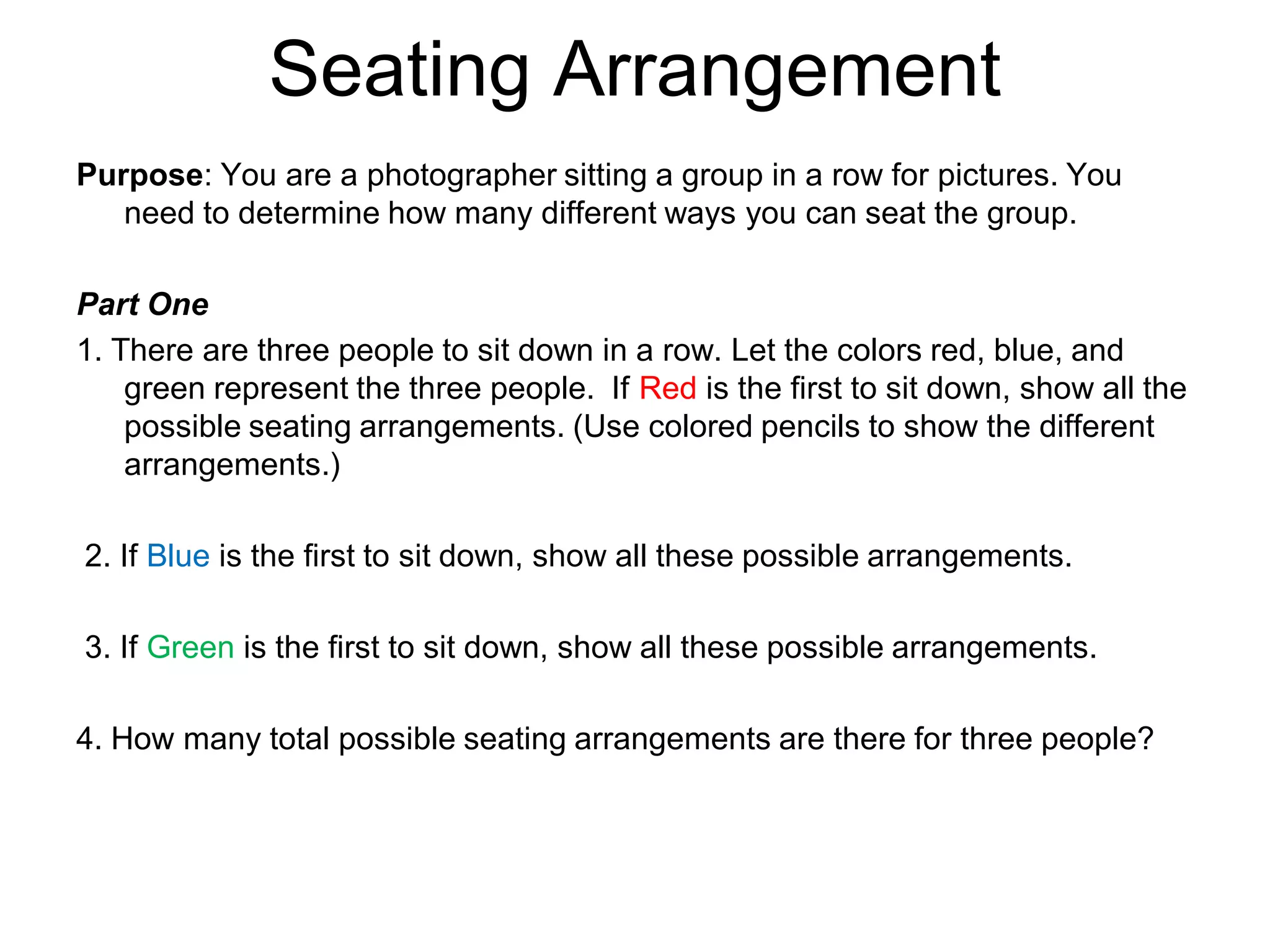
Purpose: You are a photographer sitting a group in a row for pictures. You
need to determine how many different ways you can seat the group.
Part One
1. There are three people to sit down in a row. Let the colors red, blue, and
green represent the three people. If Red is the first to sit down, show all the
possible seating arrangements. (Use colored pencils to show the different
arrangements.)
2. If Blue is the first to sit down, show all these possible arrangements.
3. If Green is the first to sit down, show all these possible arrangements.
4. How many total possible seating arrangements are there for three people?
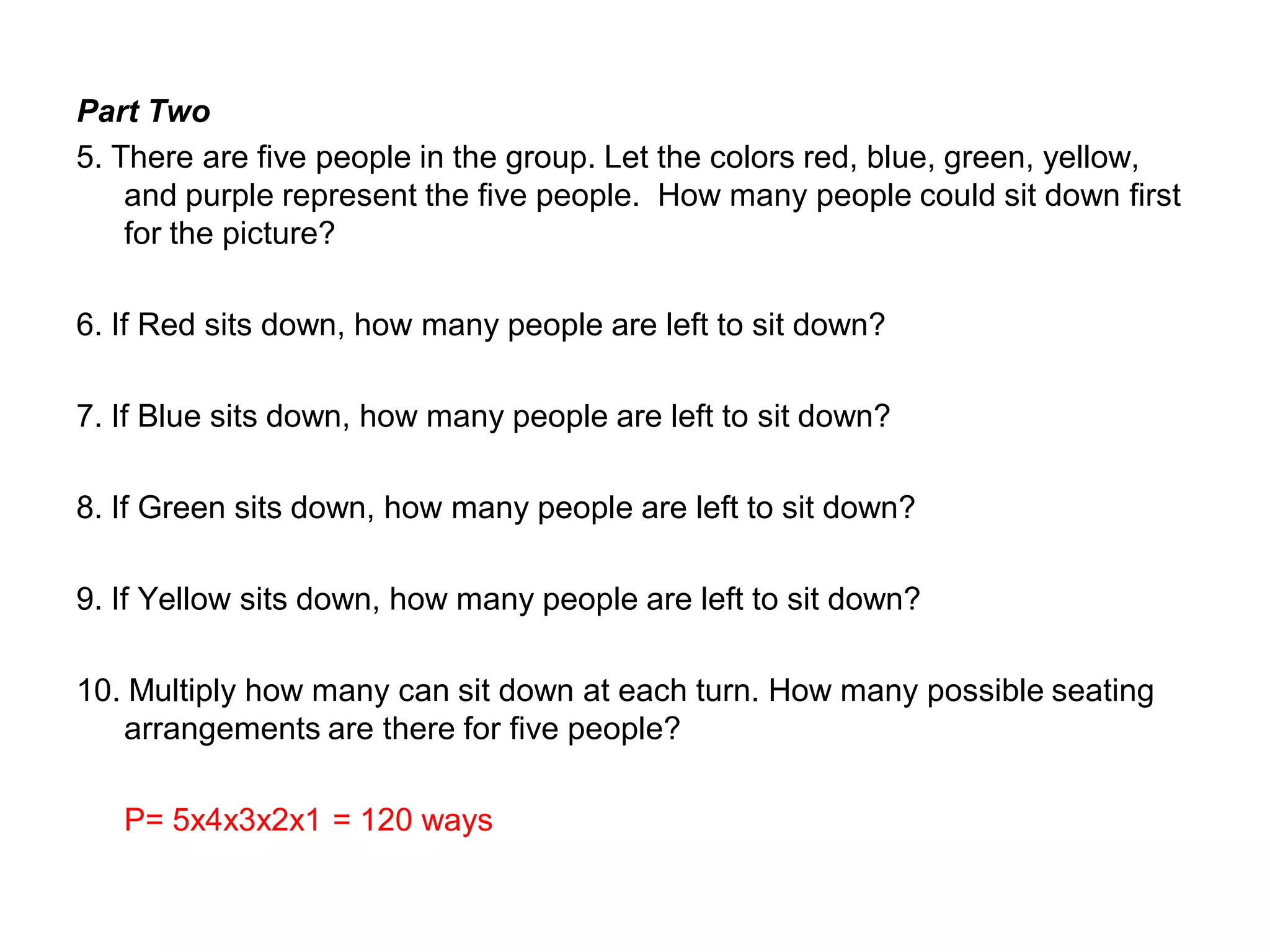
Part Two
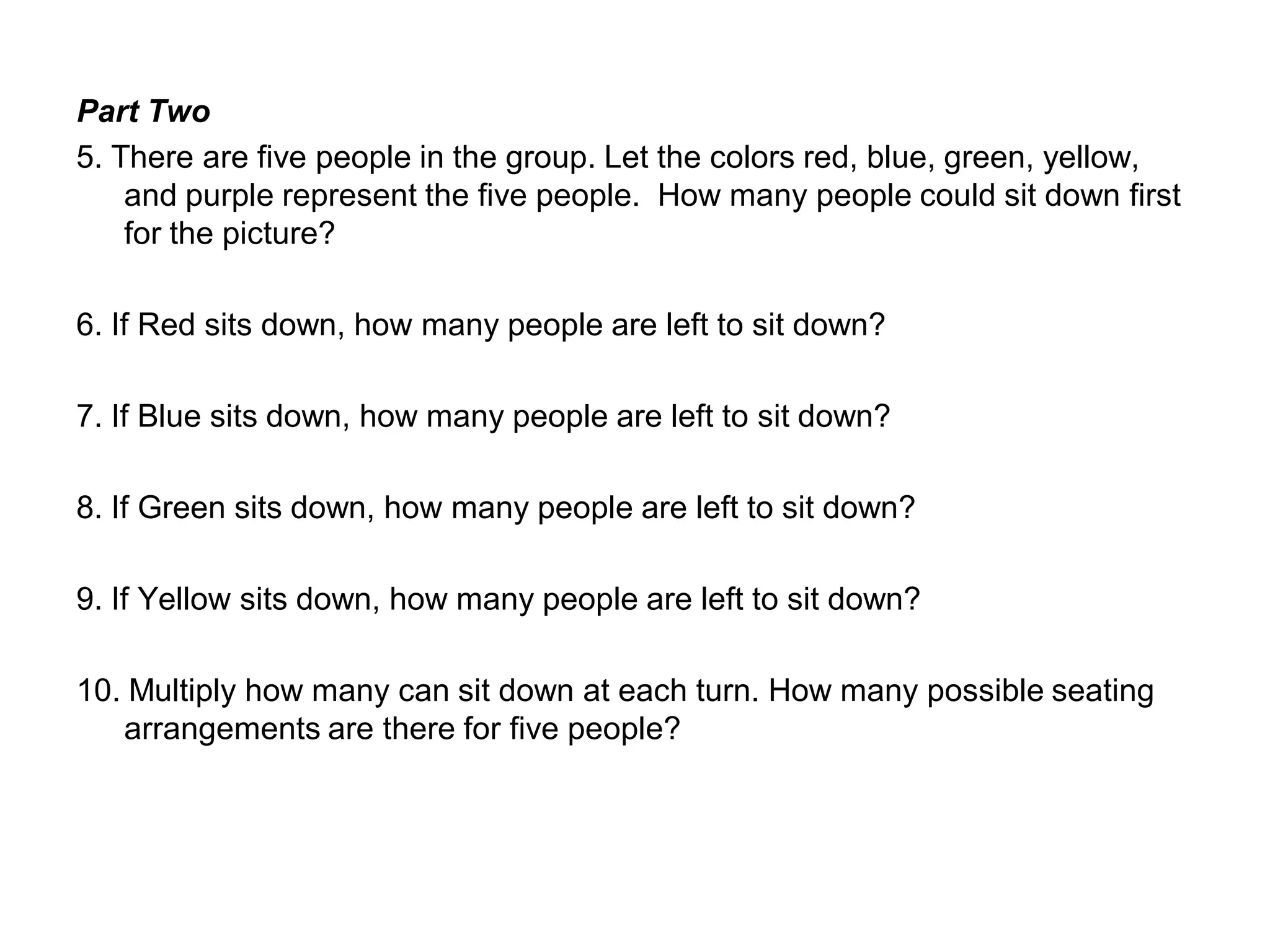
5. There are five people in the group. Let the colors red, blue, green, yellow,
and purple represent the five people. How many people could sit down first
for the picture?
6. If Red sits down, how many people are left to sit down?
7. If Blue sits down, how many people are left to sit down?
8. If Green sits down, how many people are left to sit down?
9. If Yellow sits down, how many people are left to sit down?
10. Multiply how many can sit down at each turn. How many possible seating
arrangements are there for five people?
Part Two
5. There are five people in the group. Let the colors red, blue, green, yellow,
and purple represent the five people. How many people could sit down first
for the picture?
6. If Red sits down, how many people are left to sit down?
7. If Blue sits down, how many people are left to sit down?
8. If Green sits down, how many people are left to sit down?
9. If Yellow sits down, how many people are left to sit down?
10. Multiply how many can sit down at each turn. How many possible seating
arrangements are there for five people?
P= 5x4x3x2x1 = 120 ways
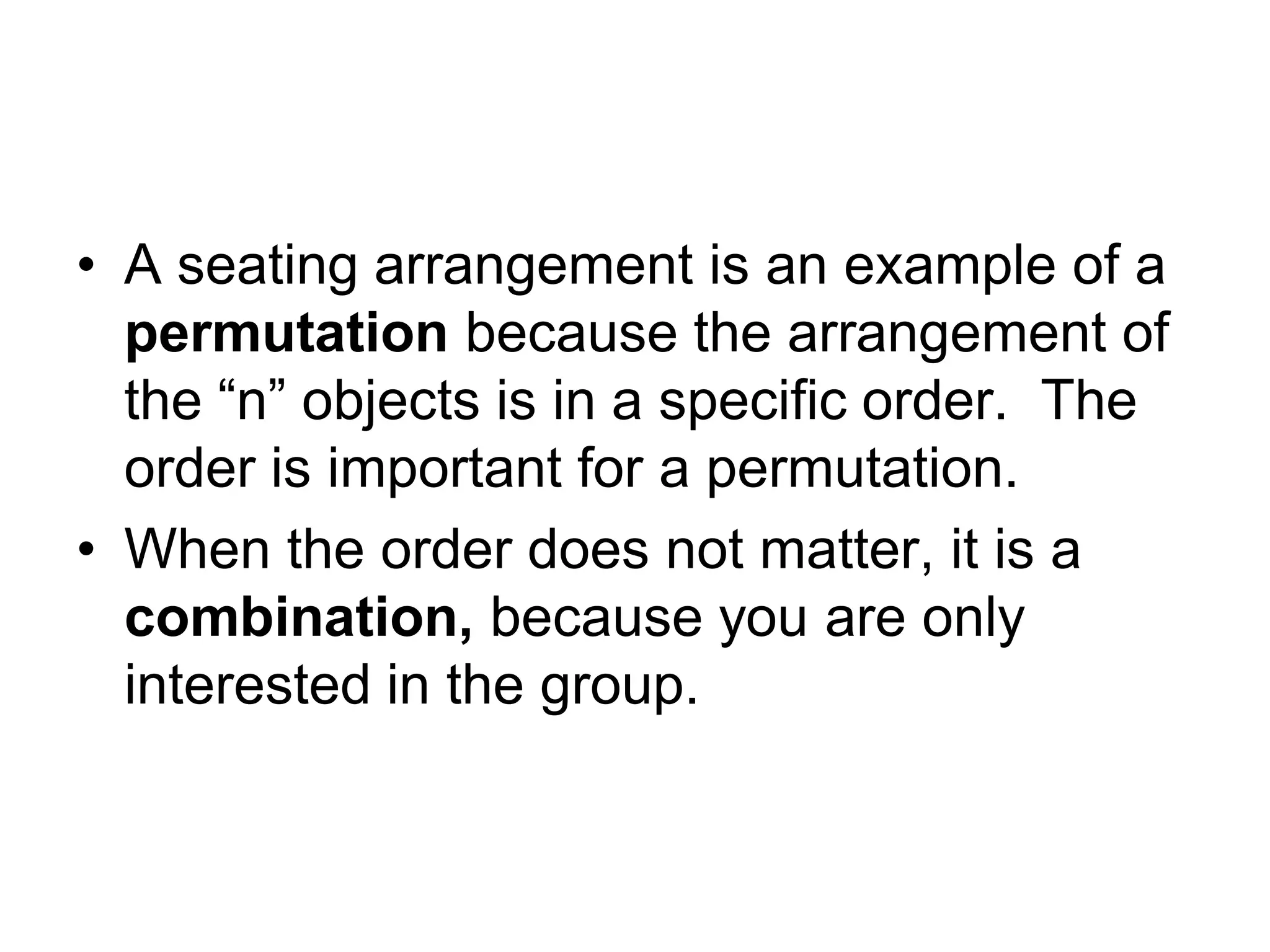
• A seating arrangement is an example of a
permutation because the arrangement of
the “n” objects is in a specific order. The
order is important for a permutation.
• When the order does not matter, it is a
combination, because you are only
interested in the group.
Extend:
. Twelve people need to be photographed,
but there are only five chairs. (The rest of
the people will be standing behind and
their order does not matter.) How many
ways can you sit the twelve people on the
five chairs?
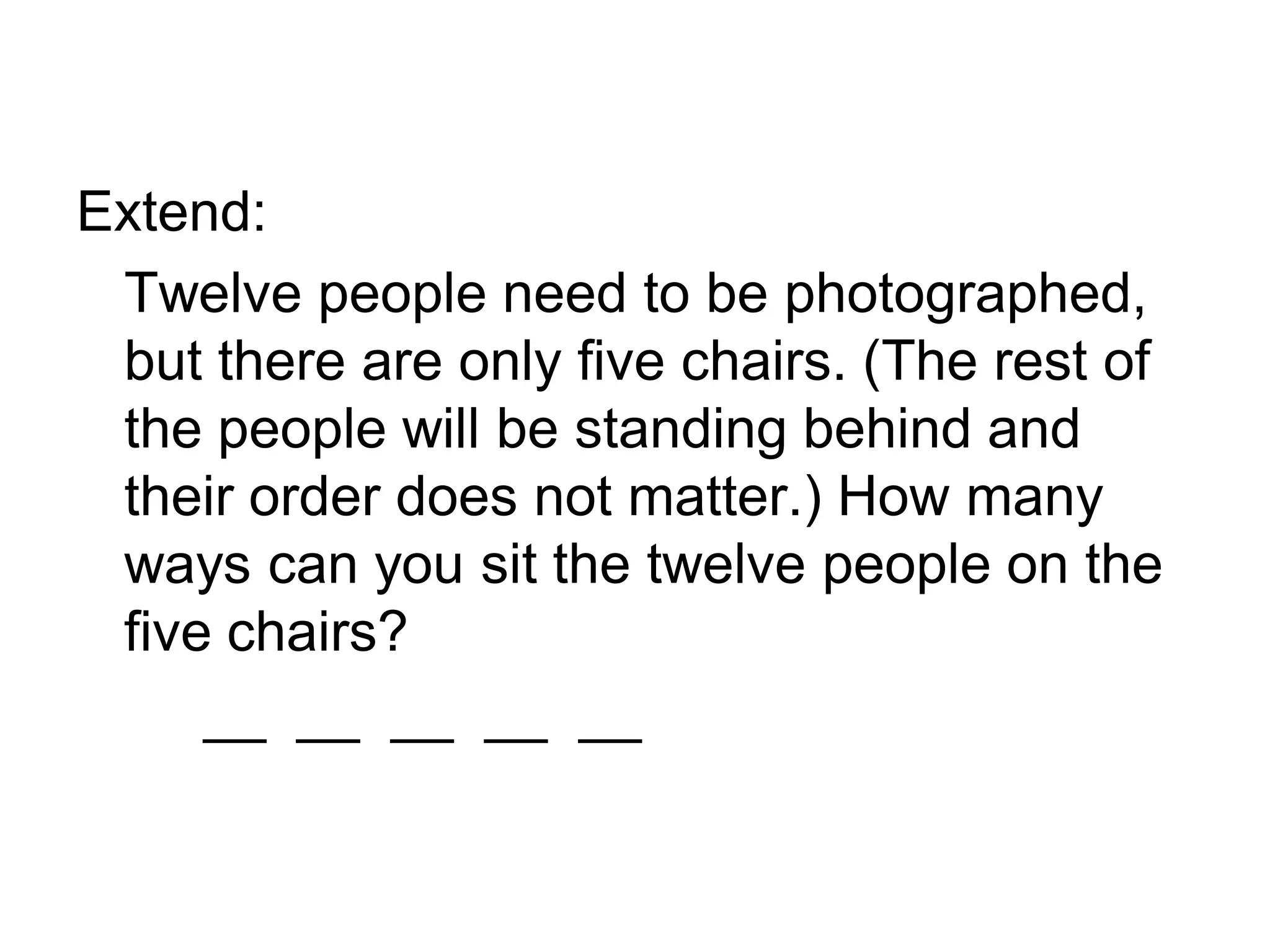
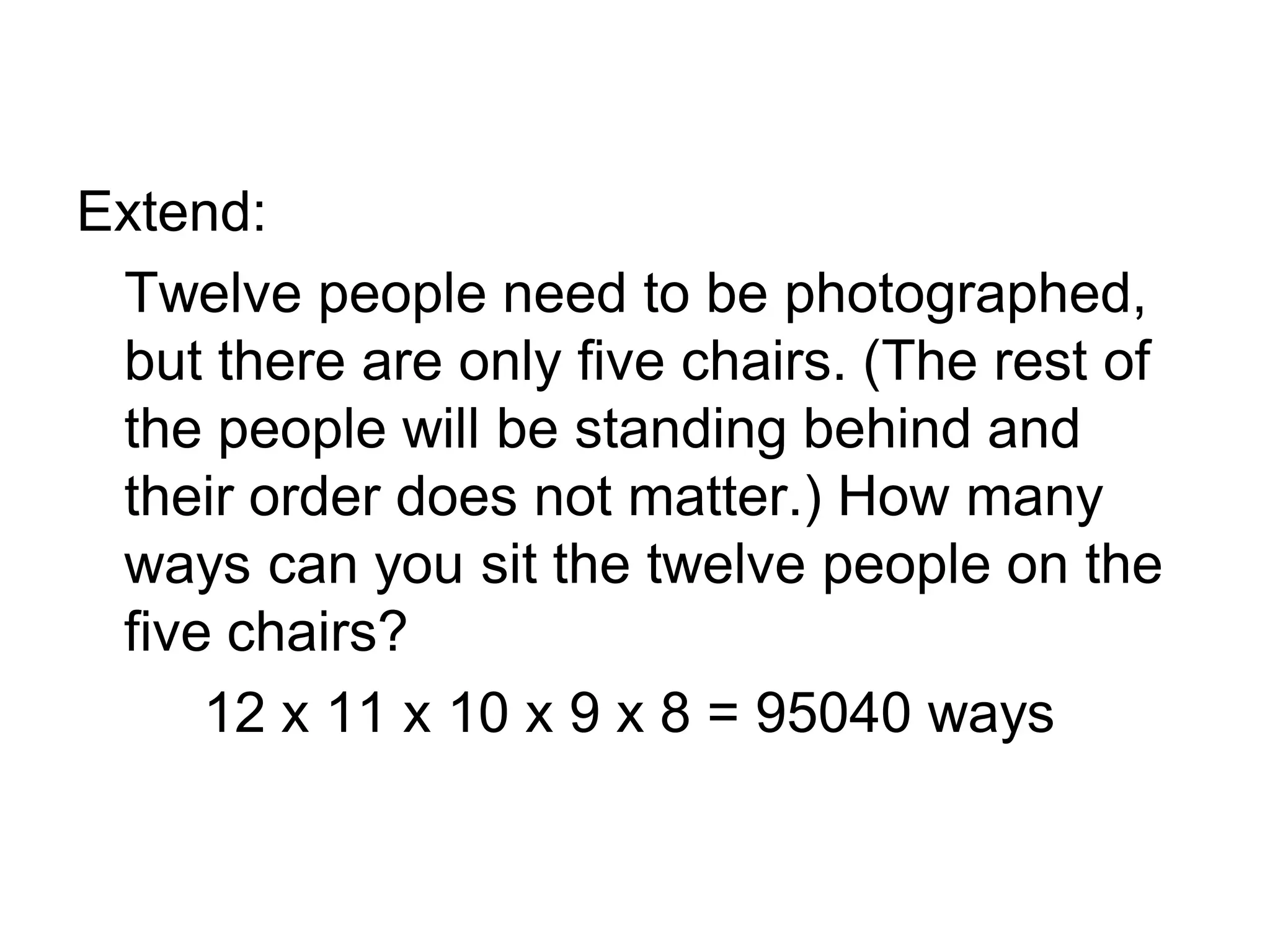
Extend:
Twelve people need to be photographed,
but there are only five chairs. (The rest of
the people will be standing behind and
their order does not matter.) How many
ways can you sit the twelve people on the
five chairs?
__ __ __ __ __
Extend:
Twelve people need to be photographed,
but there are only five chairs. (The rest of
the people will be standing behind and
their order does not matter.) How many
ways can you sit the twelve people on the
five chairs?
12 x 11 x 10 x 9 x 8 = 95040 ways
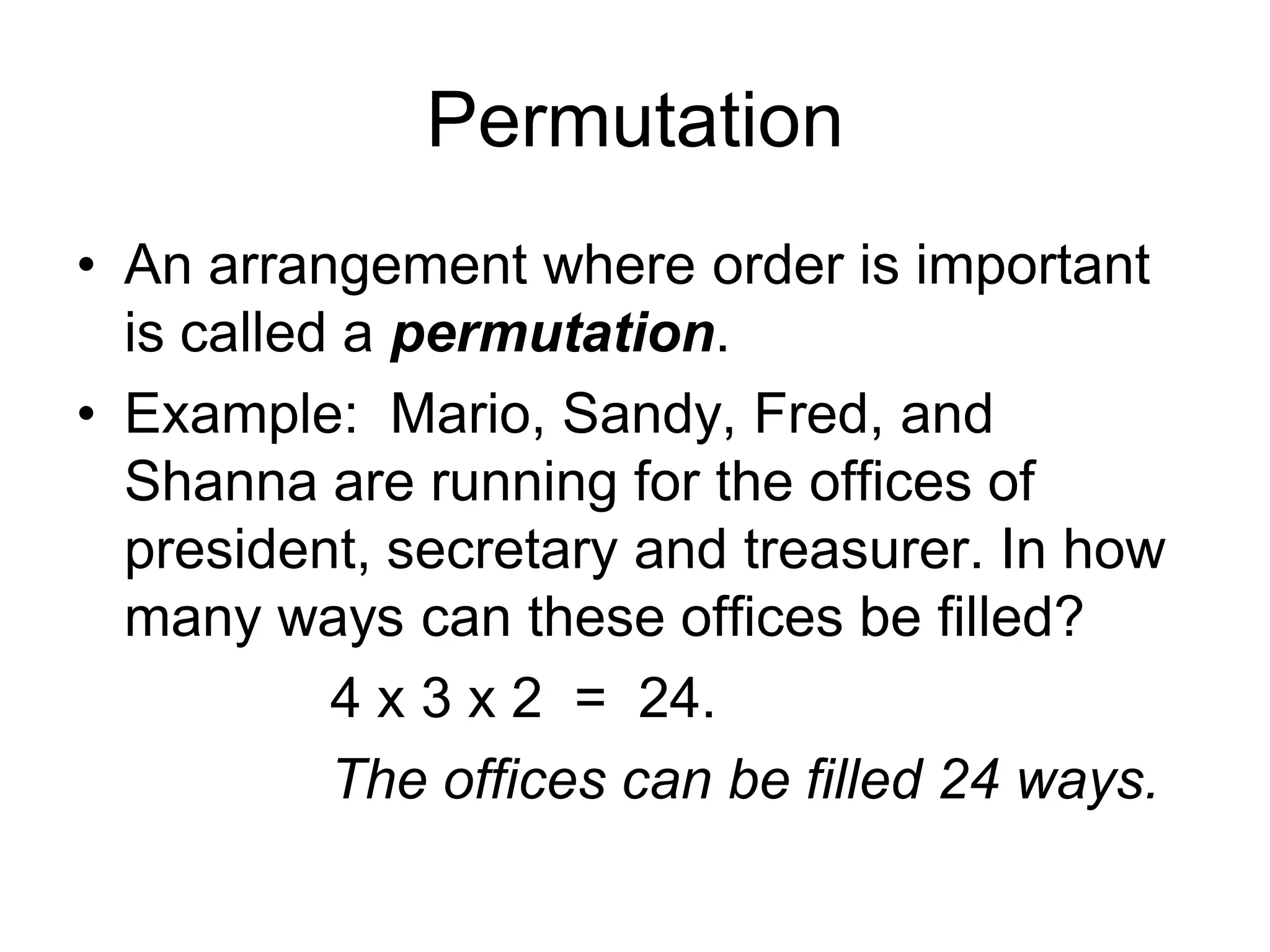
Permutation
• An arrangement where order is important
is called a permutation.
• Example: Mario, Sandy, Fred, and
Shanna are running for the offices of
president, secretary and treasurer. In how
many ways can these offices be filled?
4 x 3 x 2 = 24.
The offices can be filled 24 ways.
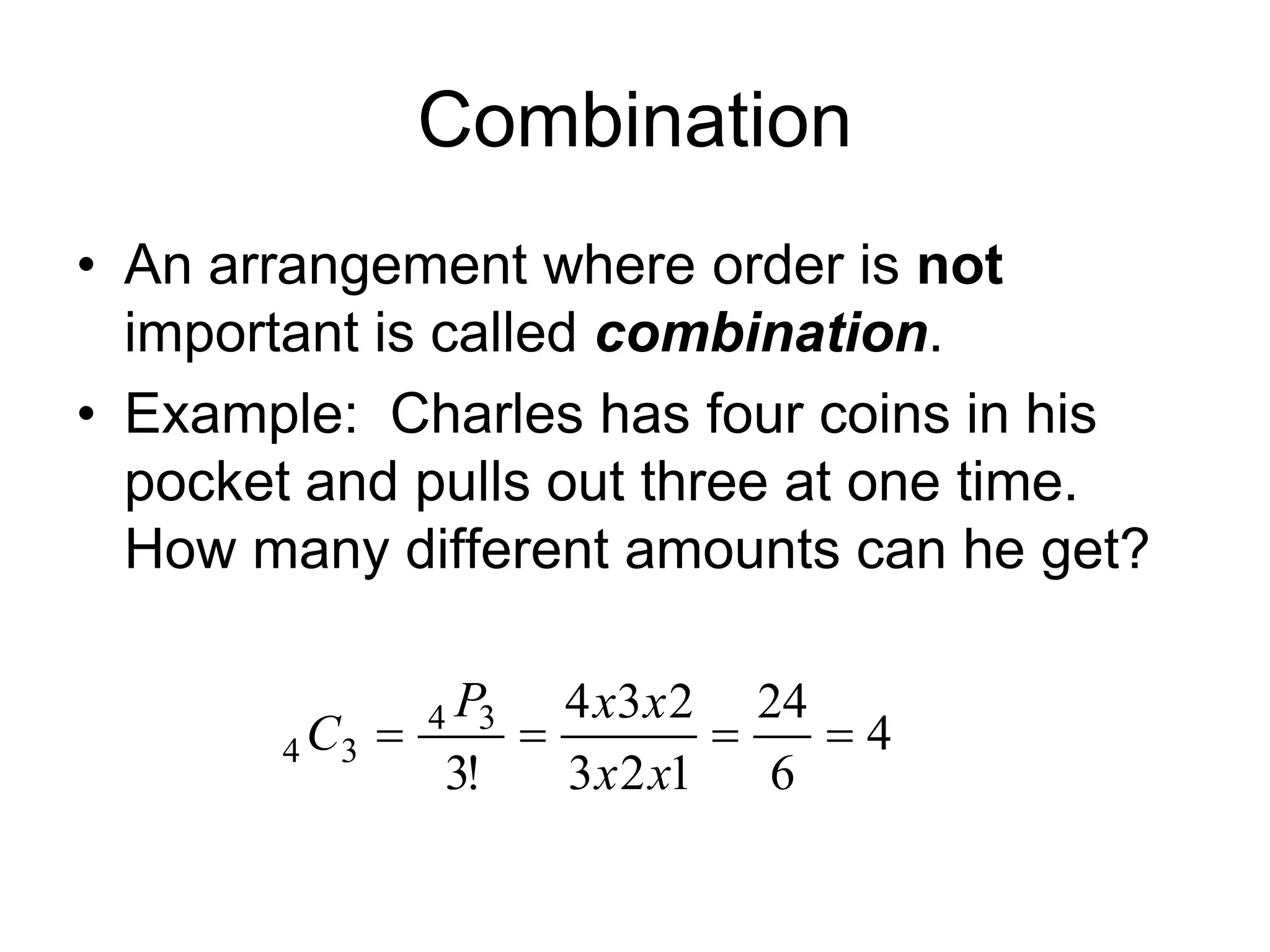
Combination
• An arrangement where order is not
important is called combination.
• Example: Charles has four coins in his
pocket and pulls out three at one time.
How many different amounts can he get?
4
6
24
123
234
!3
34
34
xx
xxP
C
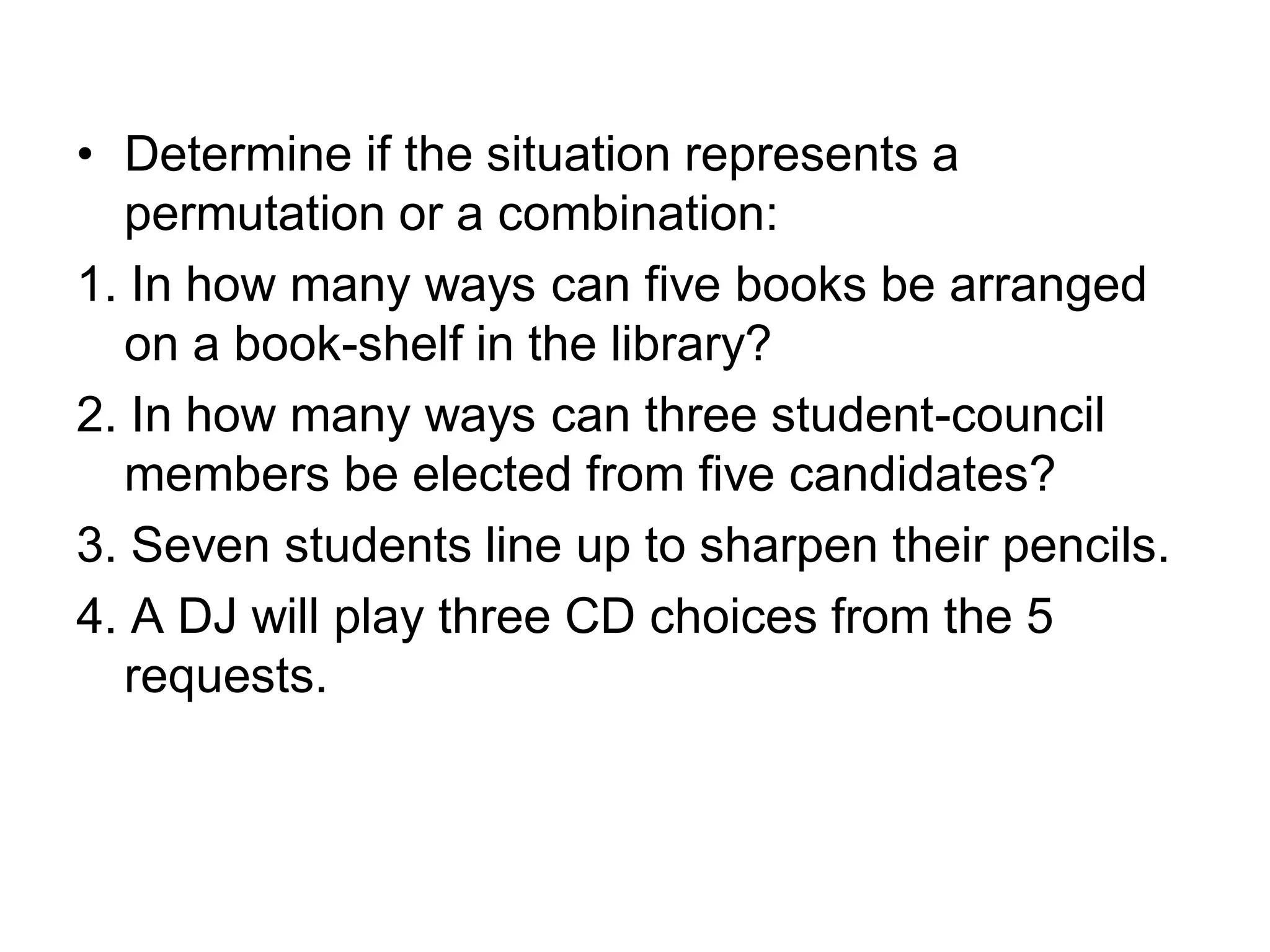
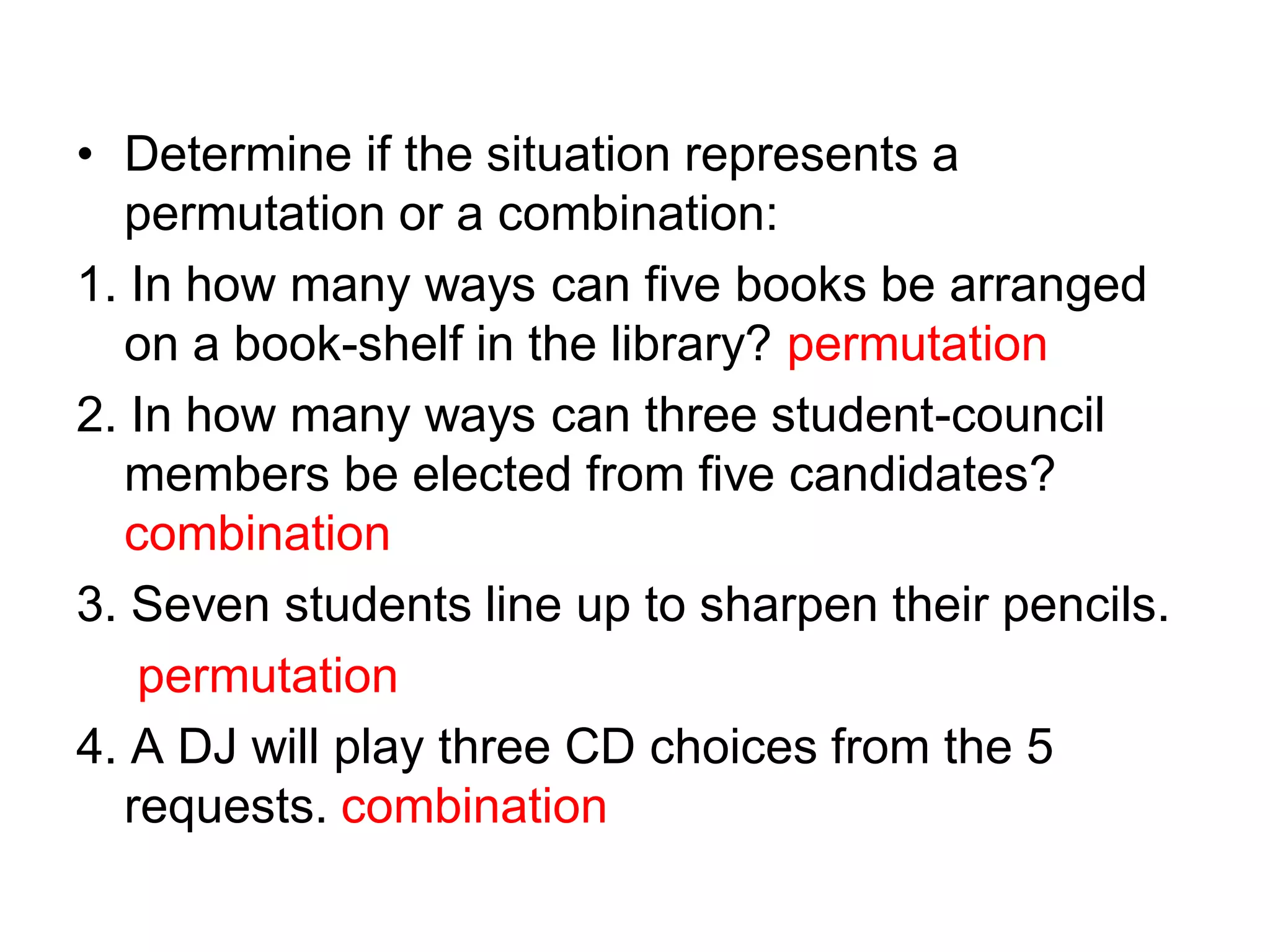
• Determine if the situation represents a
permutation or a combination:
1. In how many ways can five books be arranged
on a book-shelf in the library?
2. In how many ways can three student-council
members be elected from five candidates?
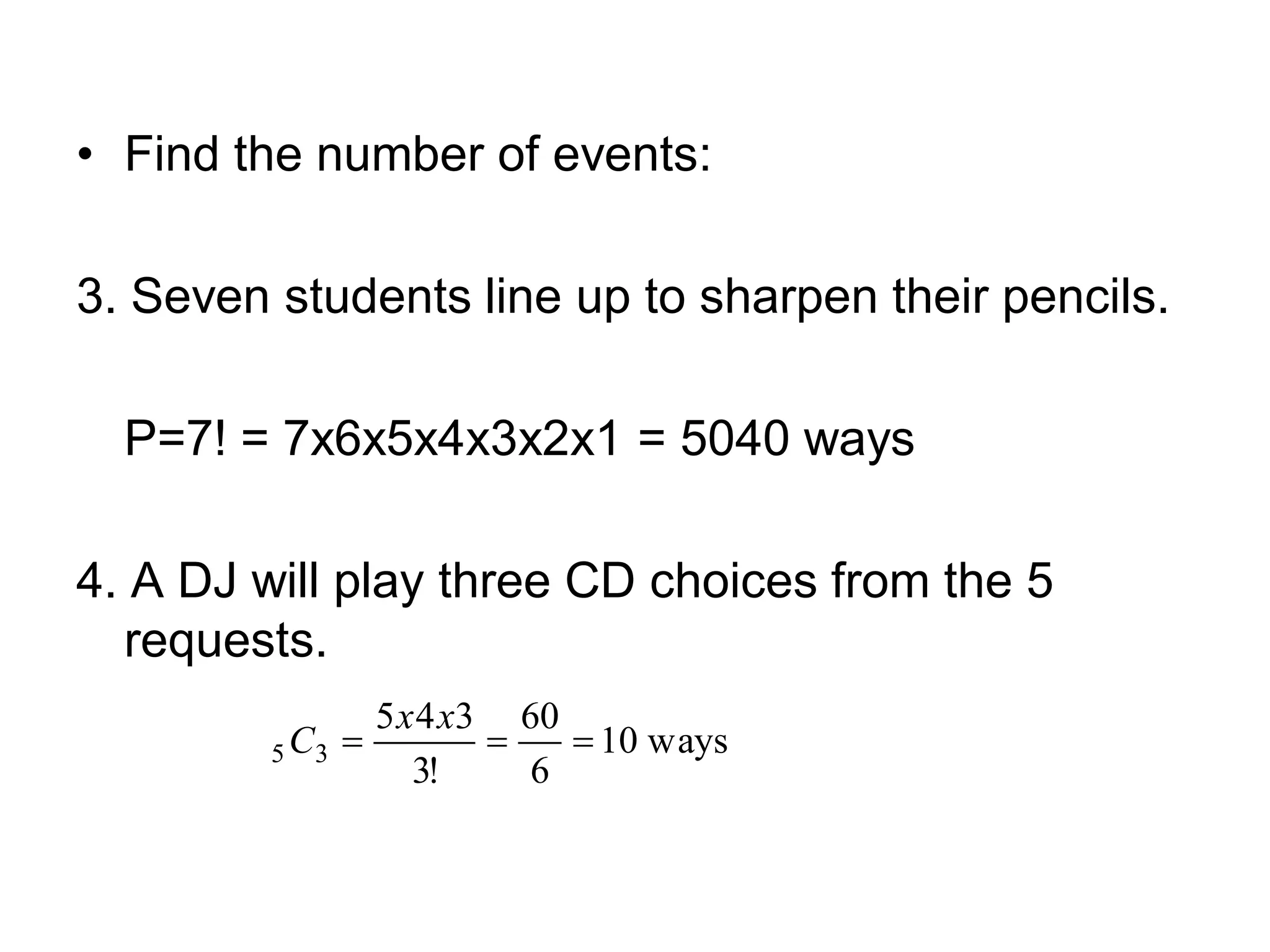
3. Seven students line up to sharpen their pencils.
4. A DJ will play three CD choices from the 5
requests.
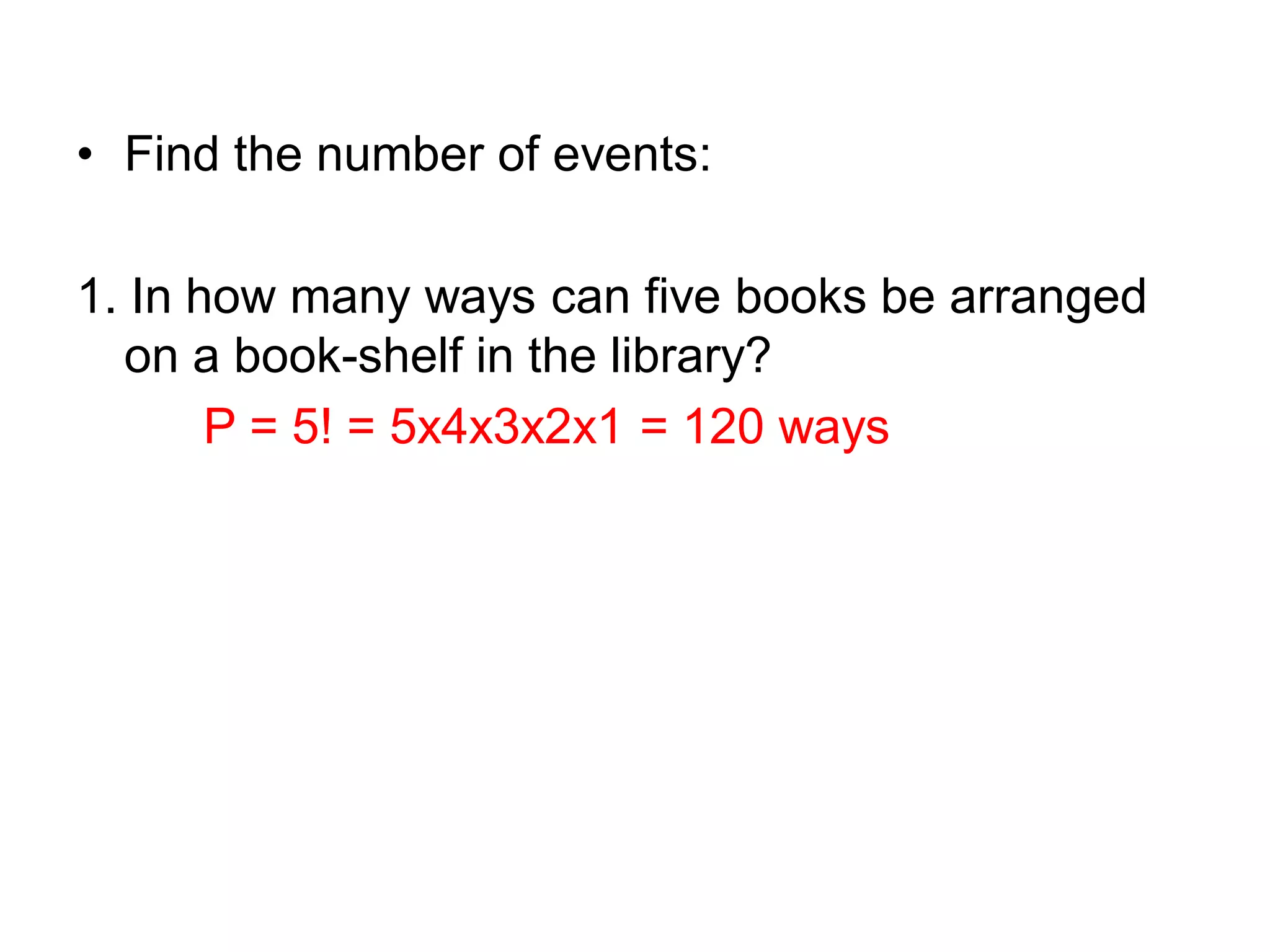
• Determine if the situation represents a
permutation or a combination:
1. In how many ways can five books be arranged
on a book-shelf in the library? permutation
2. In how many ways can three student-council
members be elected from five candidates?
combination
3. Seven students line up to sharpen their pencils.
permutation
4. A DJ will play three CD choices from the 5
requests. combination
• Find the number of events:
1. In how many ways can five books be arranged
on a book-shelf in the library?
P = 5! = 5x4x3x2x1 = 120 ways
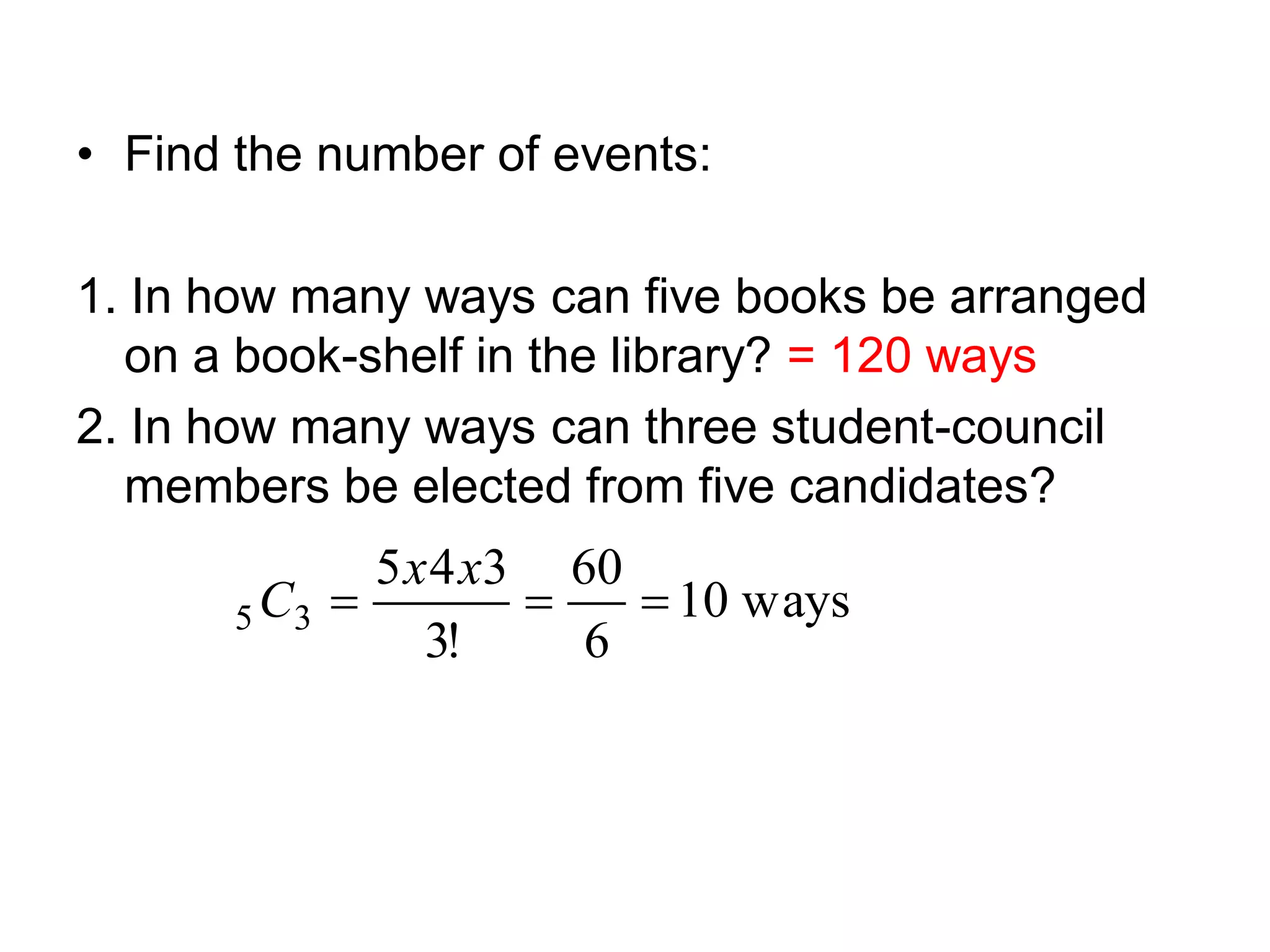
• Find the number of events:
1. In how many ways can five books be arranged
on a book-shelf in the library? = 120 ways
2. In how many ways can three student-council
members be elected from five candidates?
ways10
6
60
!3
345
35
xx
C
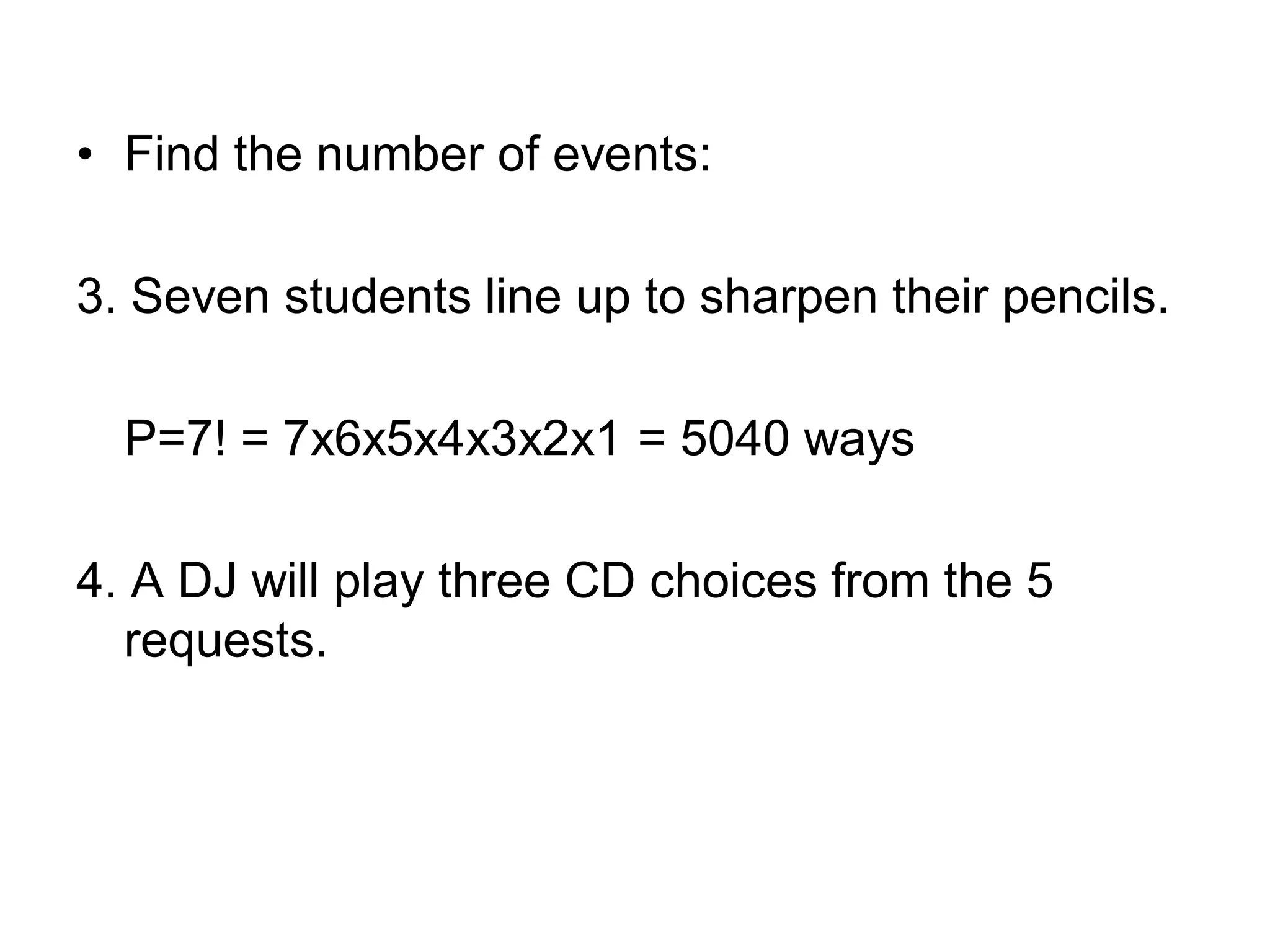
• Find the number of events:
3. Seven students line up to sharpen their pencils.
P=7! = 7x6x5x4x3x2x1 = 5040 ways
4. A DJ will play three CD choices from the 5
requests.
• Find the number of events:
3. Seven students line up to sharpen their pencils.
P=7! = 7x6x5x4x3x2x1 = 5040 ways
4. A DJ will play three CD choices from the 5
requests.
ways10
6
60
!3
345
35
xx
C
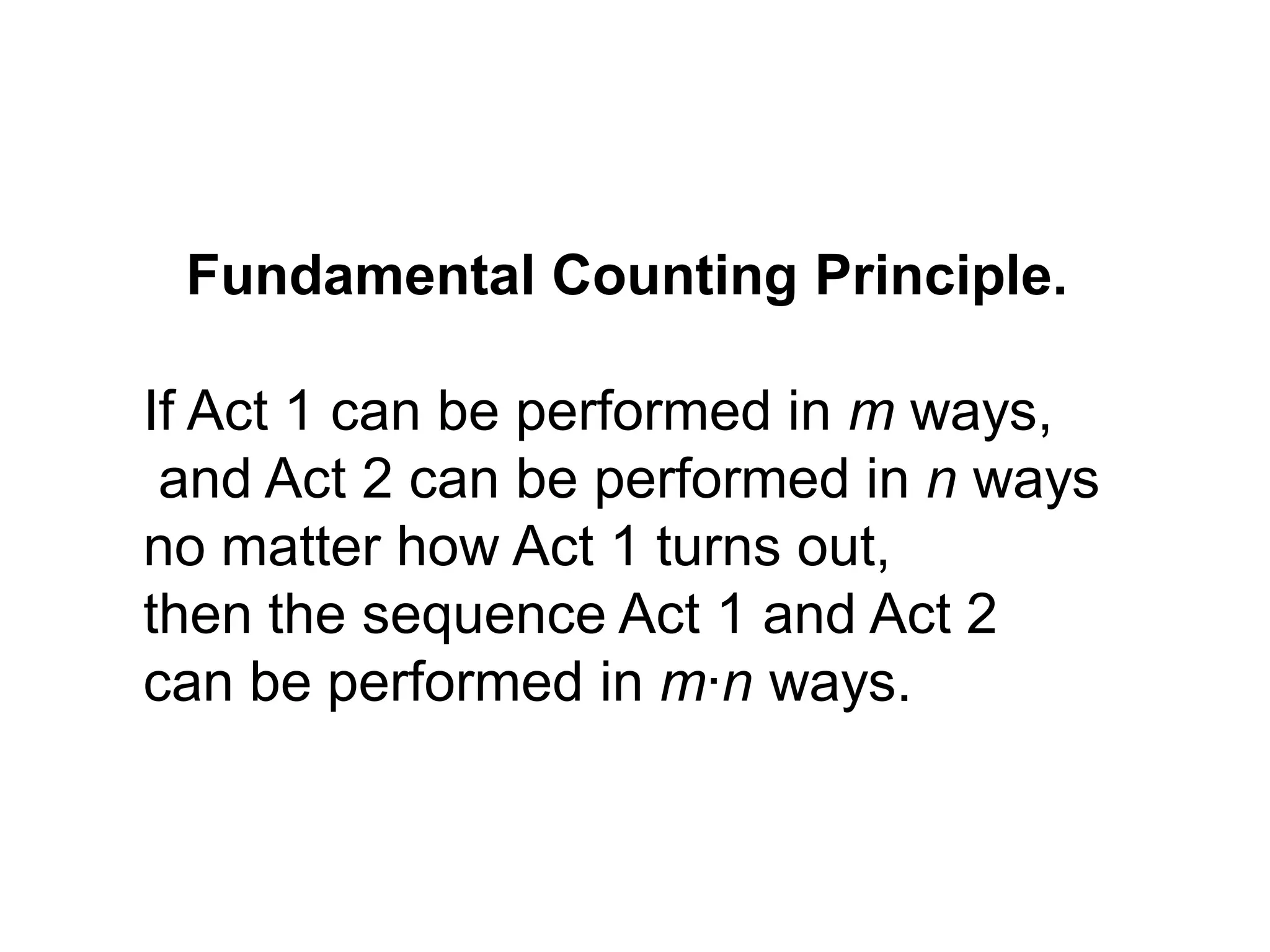
Fundamental Counting Principle.
If Act 1 can be performed in m ways,
and Act 2 can be performed in n ways
no matter how Act 1 turns out,
then the sequence Act 1 and Act 2
can be performed in m·n ways.
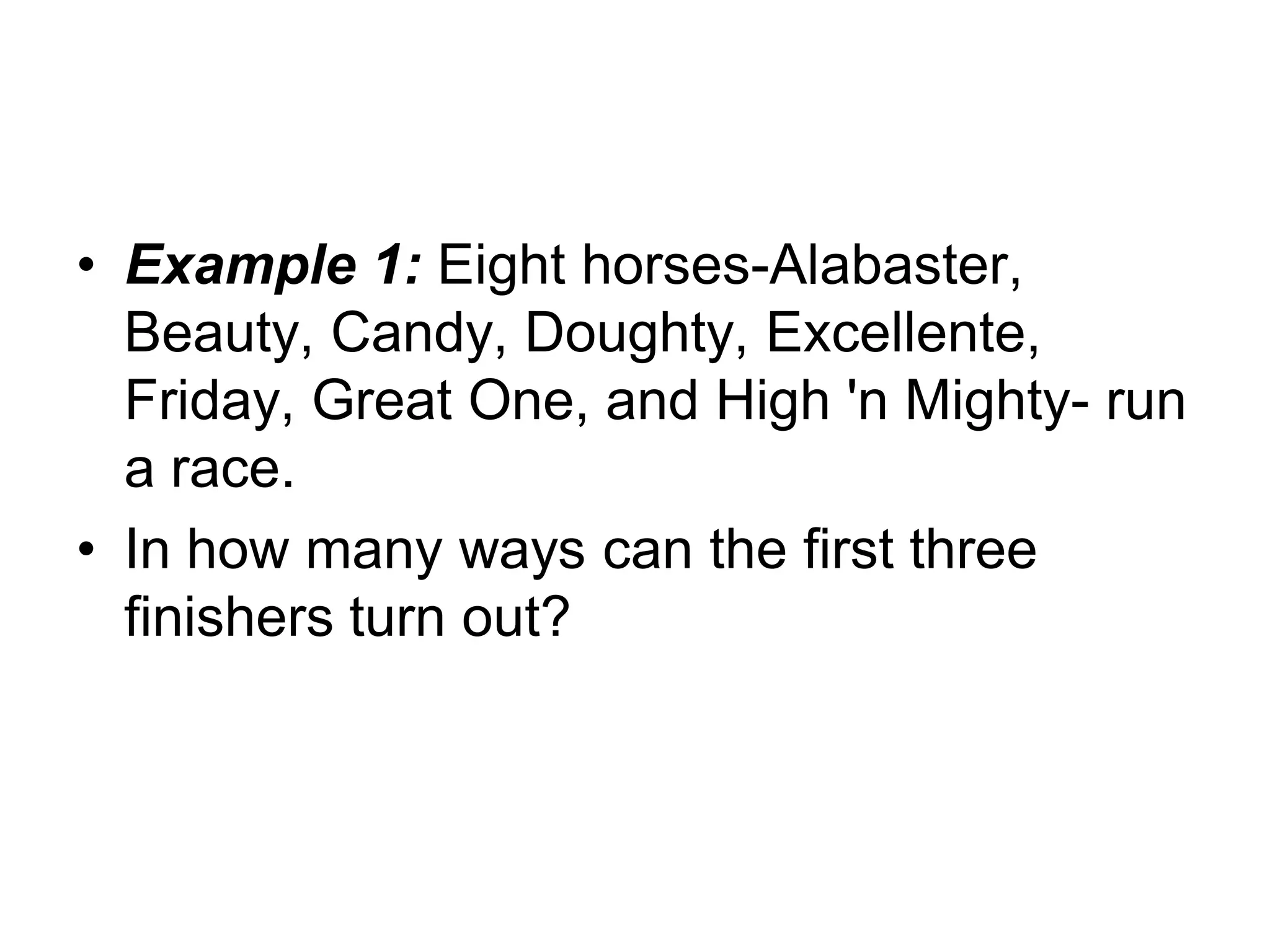
• Example 1: Eight horses-Alabaster,
Beauty, Candy, Doughty, Excellente,
Friday, Great One, and High 'n Mighty- run
a race.
• In how many ways can the first three
finishers turn out?
• Example 1: Eight horses-Alabaster,
Beauty, Candy, Doughty, Excellente,
Friday, Great One, and High 'n Mighty- run
a race.
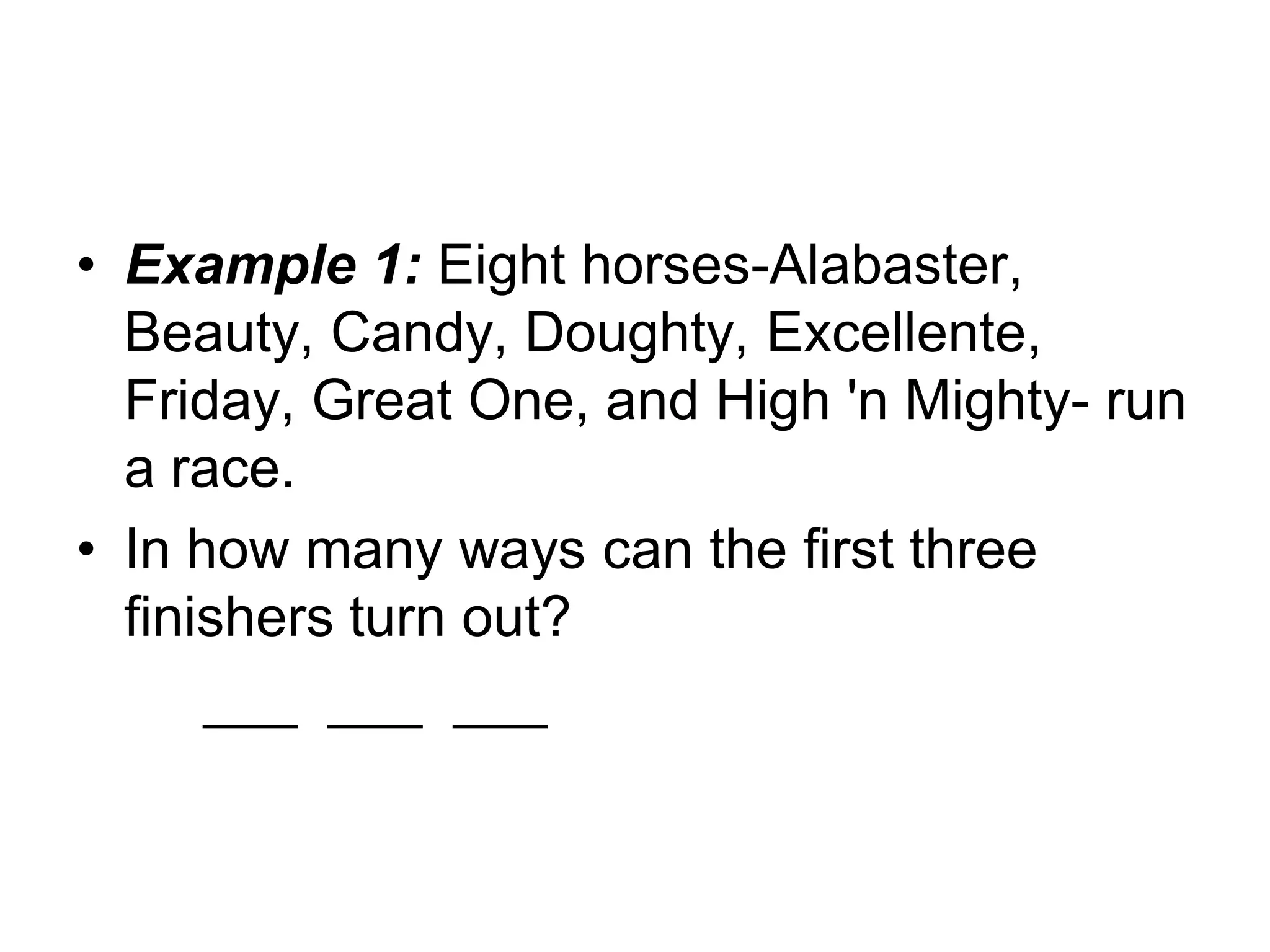
• In how many ways can the first three
finishers turn out?
___ ___ ___
• Example 1: Eight horses-Alabaster,
Beauty, Candy, Doughty, Excellente,
Friday, Great One, and High 'n Mighty- run
a race.
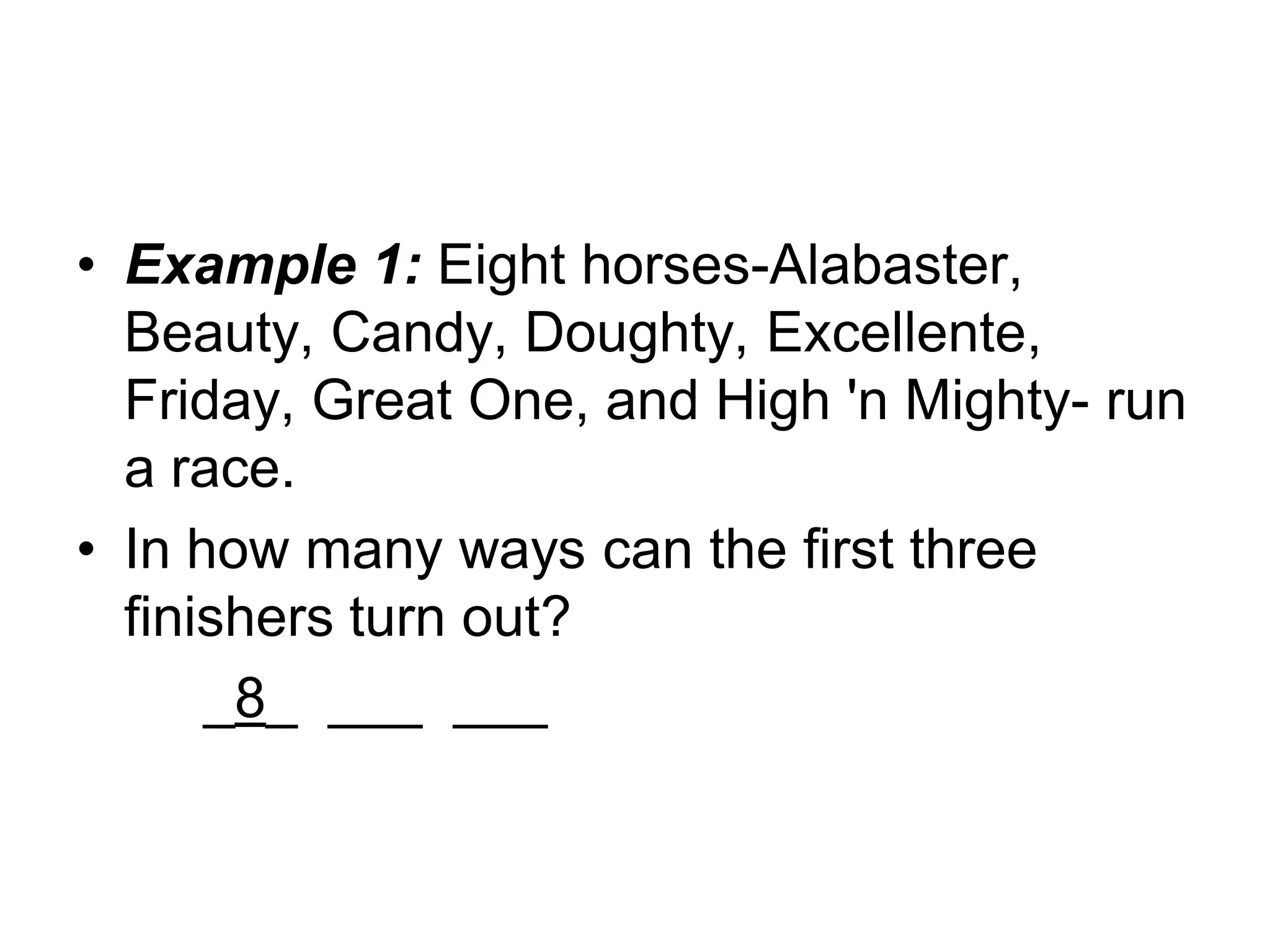
• In how many ways can the first three
finishers turn out?
_8_ ___ ___
• Example 1: Eight horses-Alabaster,
Beauty, Candy, Doughty, Excellente,
Friday, Great One, and High 'n Mighty- run
a race.
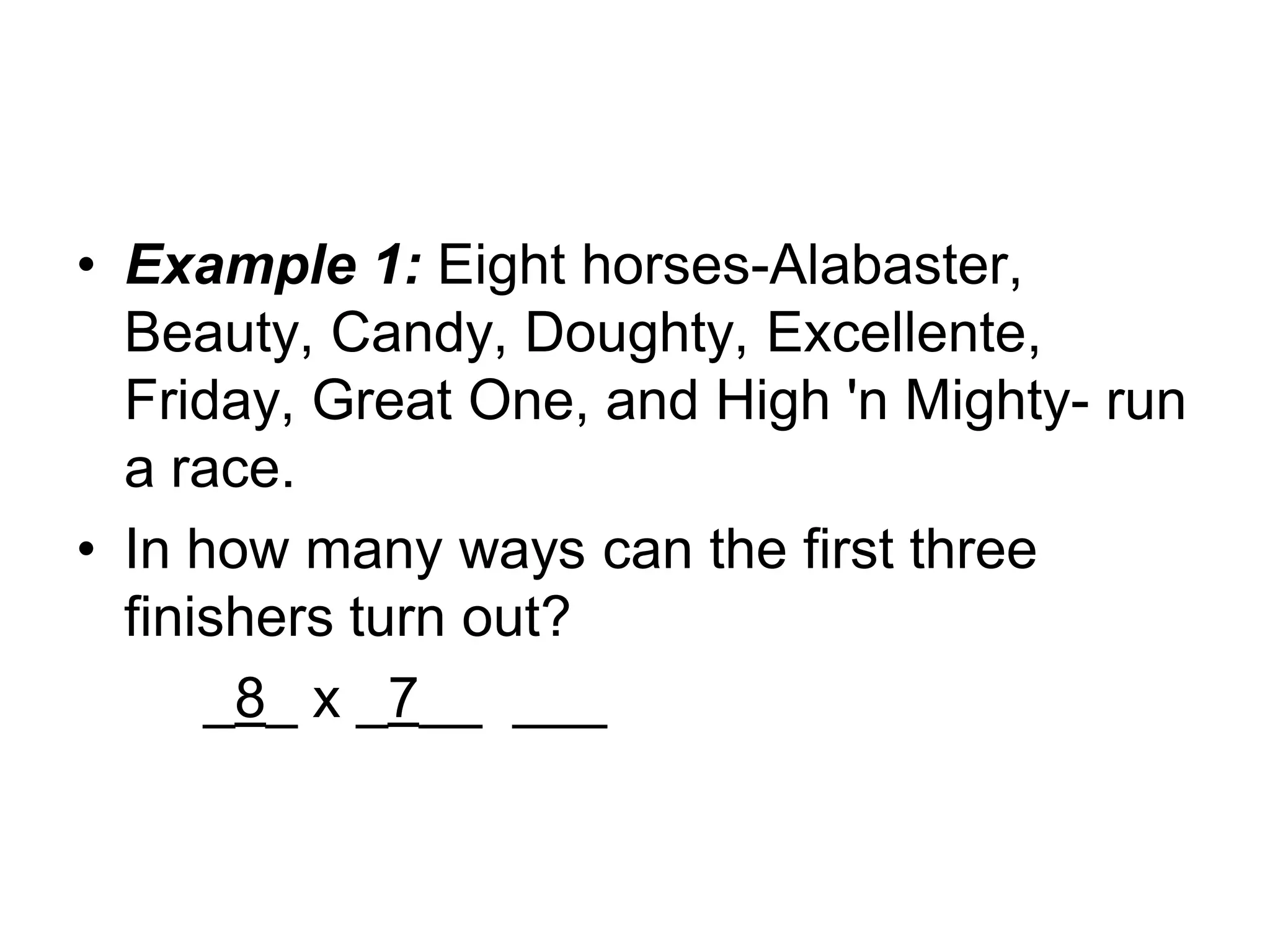
• In how many ways can the first three
finishers turn out?
_8_ x _7__ ___
• Example 1: Eight horses-Alabaster,
Beauty, Candy, Doughty, Excellente,
Friday, Great One, and High 'n Mighty- run
a race.
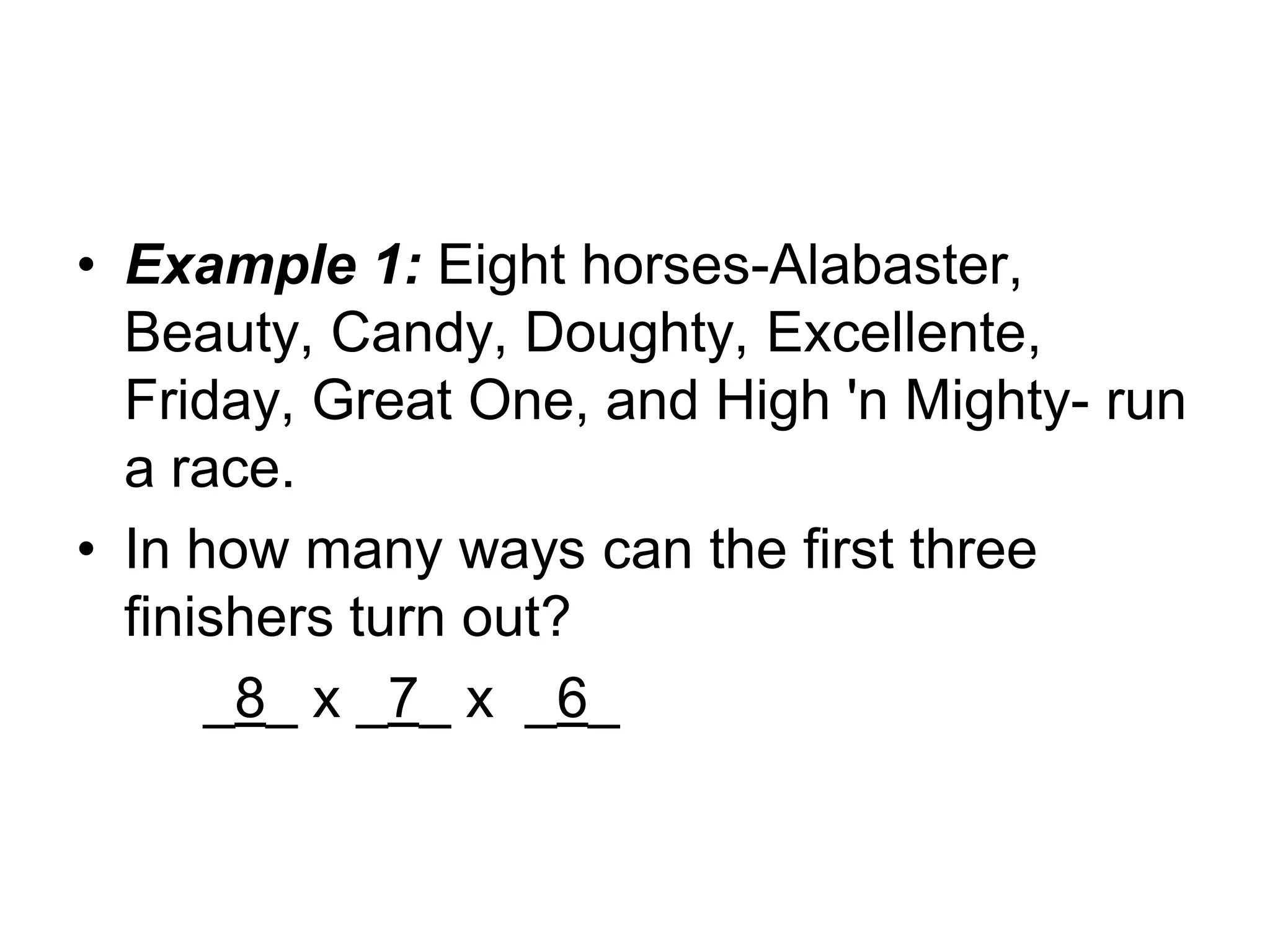
• In how many ways can the first three
finishers turn out?
_8_ x _7_ x _6_
• Example 1: Eight horses-Alabaster,
Beauty, Candy, Doughty, Excellente,
Friday, Great One, and High 'n Mighty- run
a race.
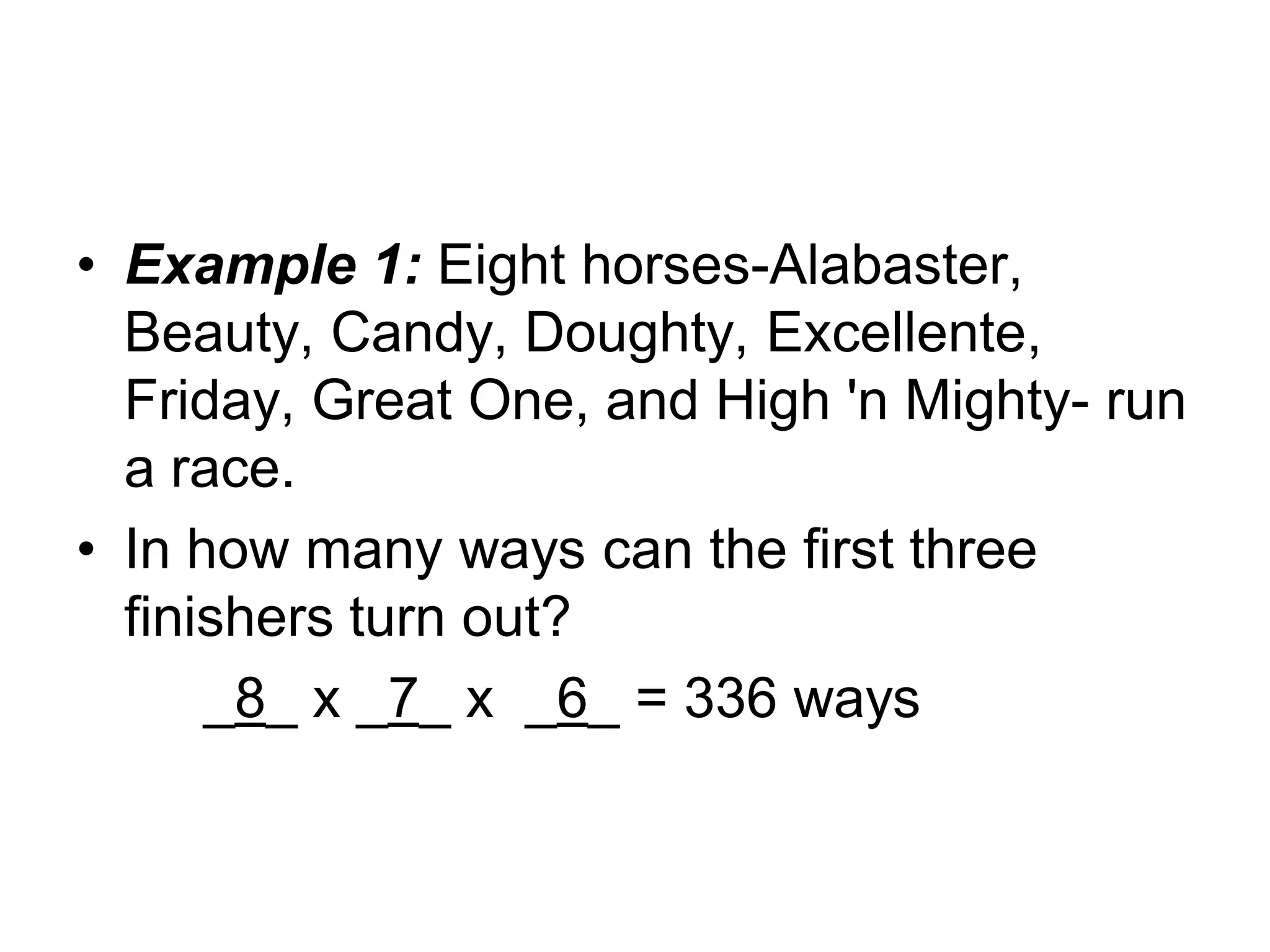
• In how many ways can the first three
finishers turn out?
_8_ x _7_ x _6_ = 336 ways
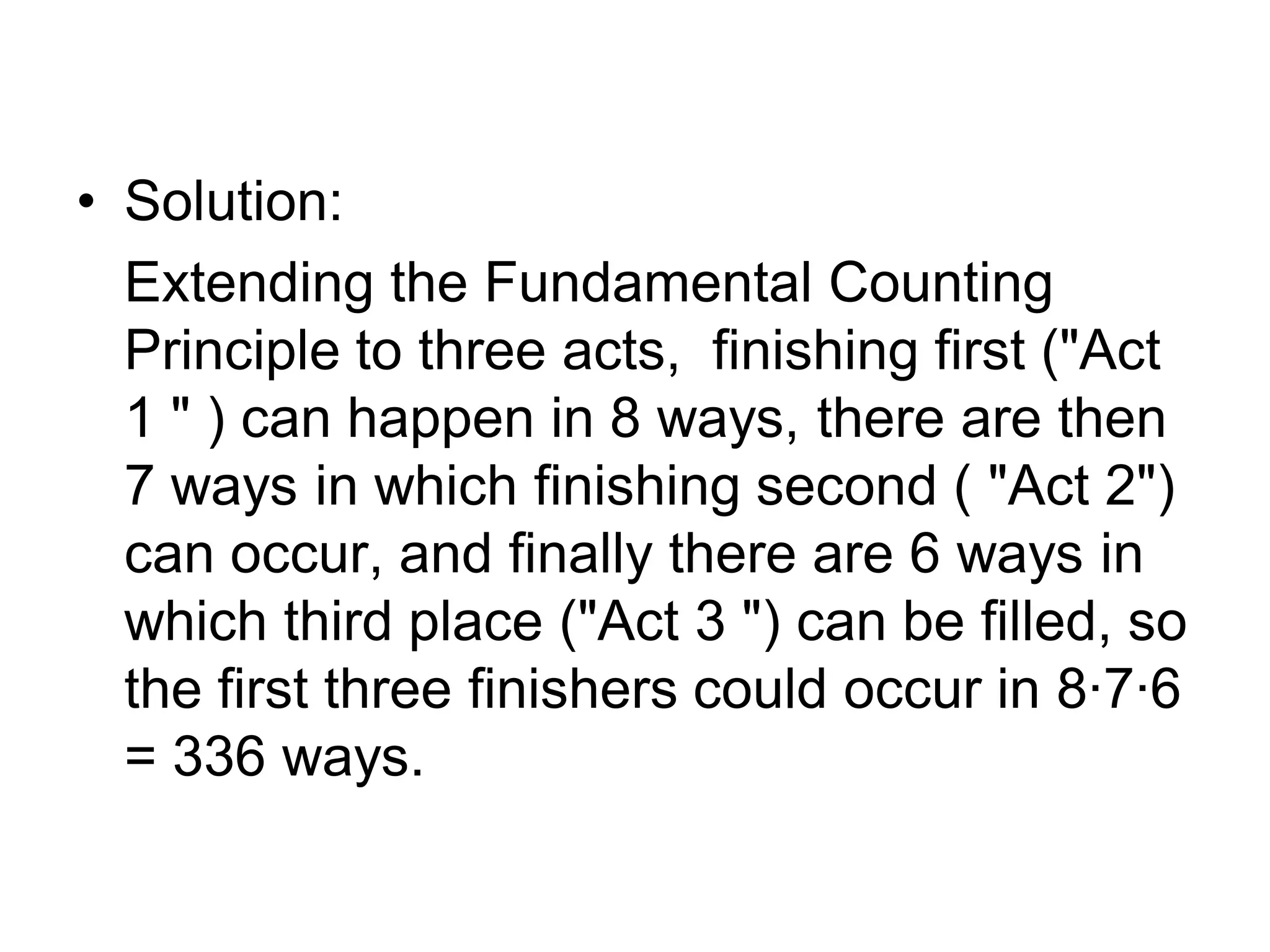
• Solution:
Extending the Fundamental Counting
Principle to three acts, finishing first ("Act
1 " ) can happen in 8 ways, there are then
7 ways in which finishing second ( "Act 2")
can occur, and finally there are 6 ways in
which third place ("Act 3 ") can be filled, so
the first three finishers could occur in 8·7·6
= 336 ways.
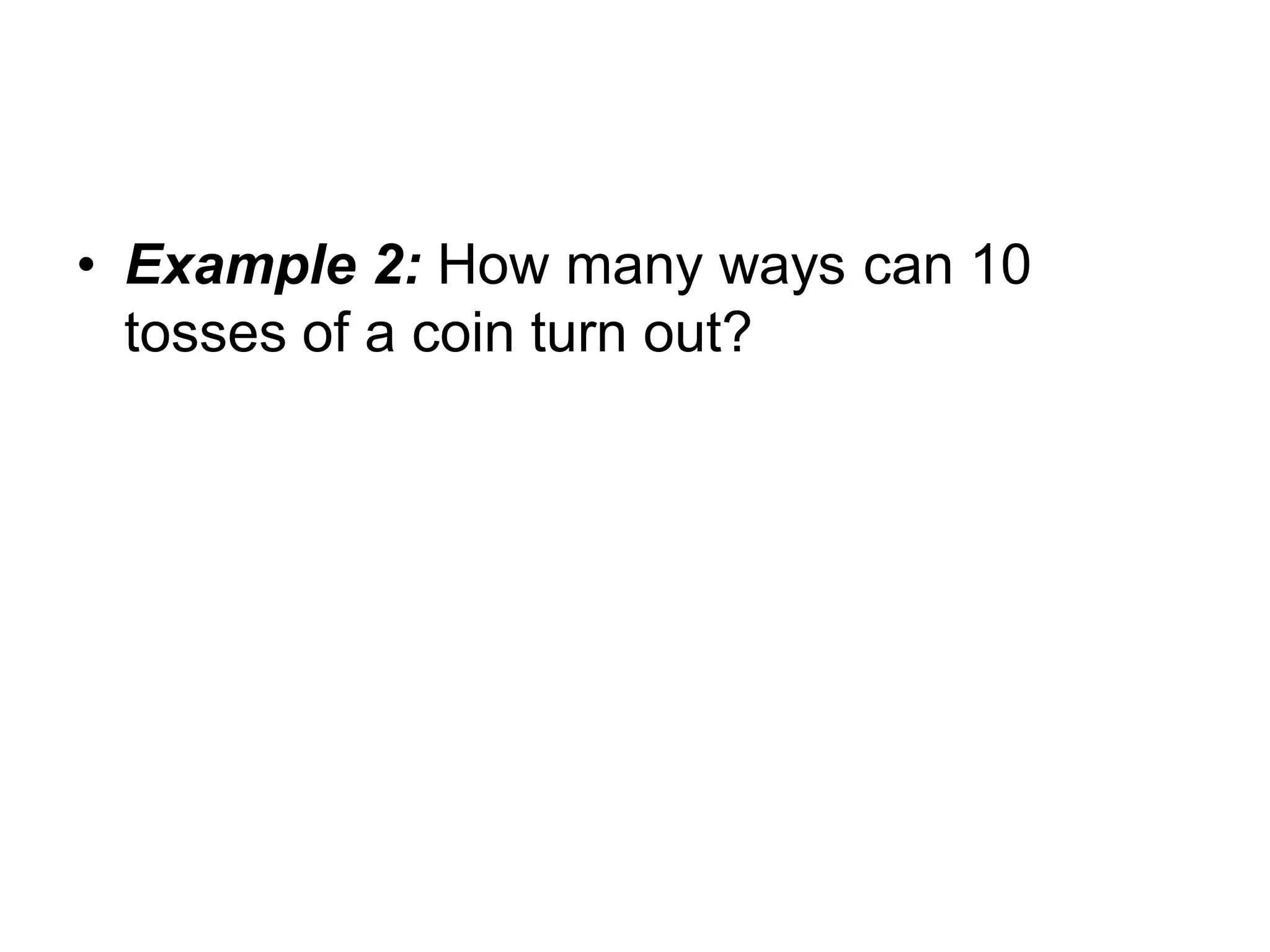
• Example 2: How many ways can 10
tosses of a coin turn out?
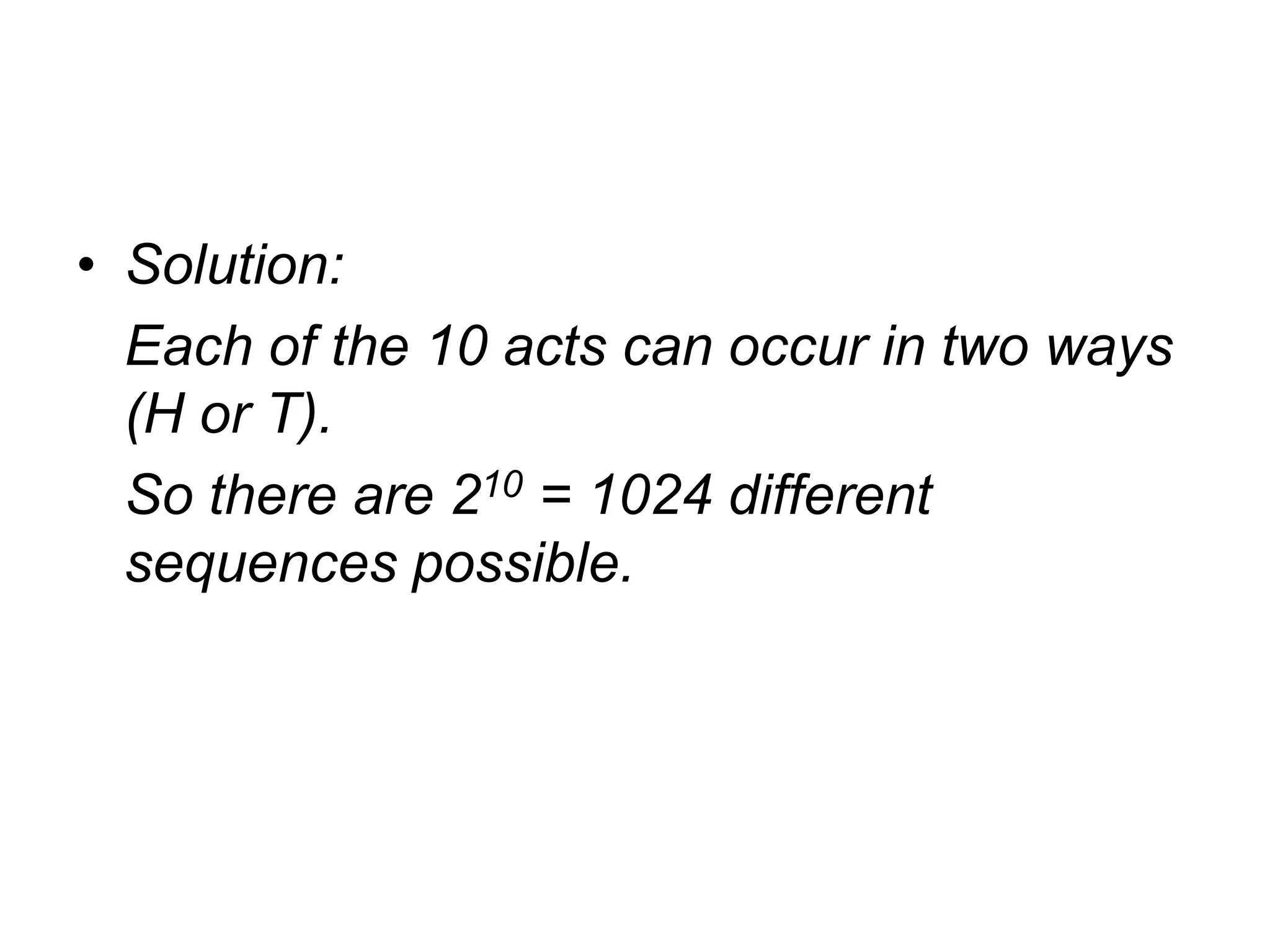
• Solution:
Each of the 10 acts can occur in two ways
(H or T).
So there are 210 = 1024 different
sequences possible.
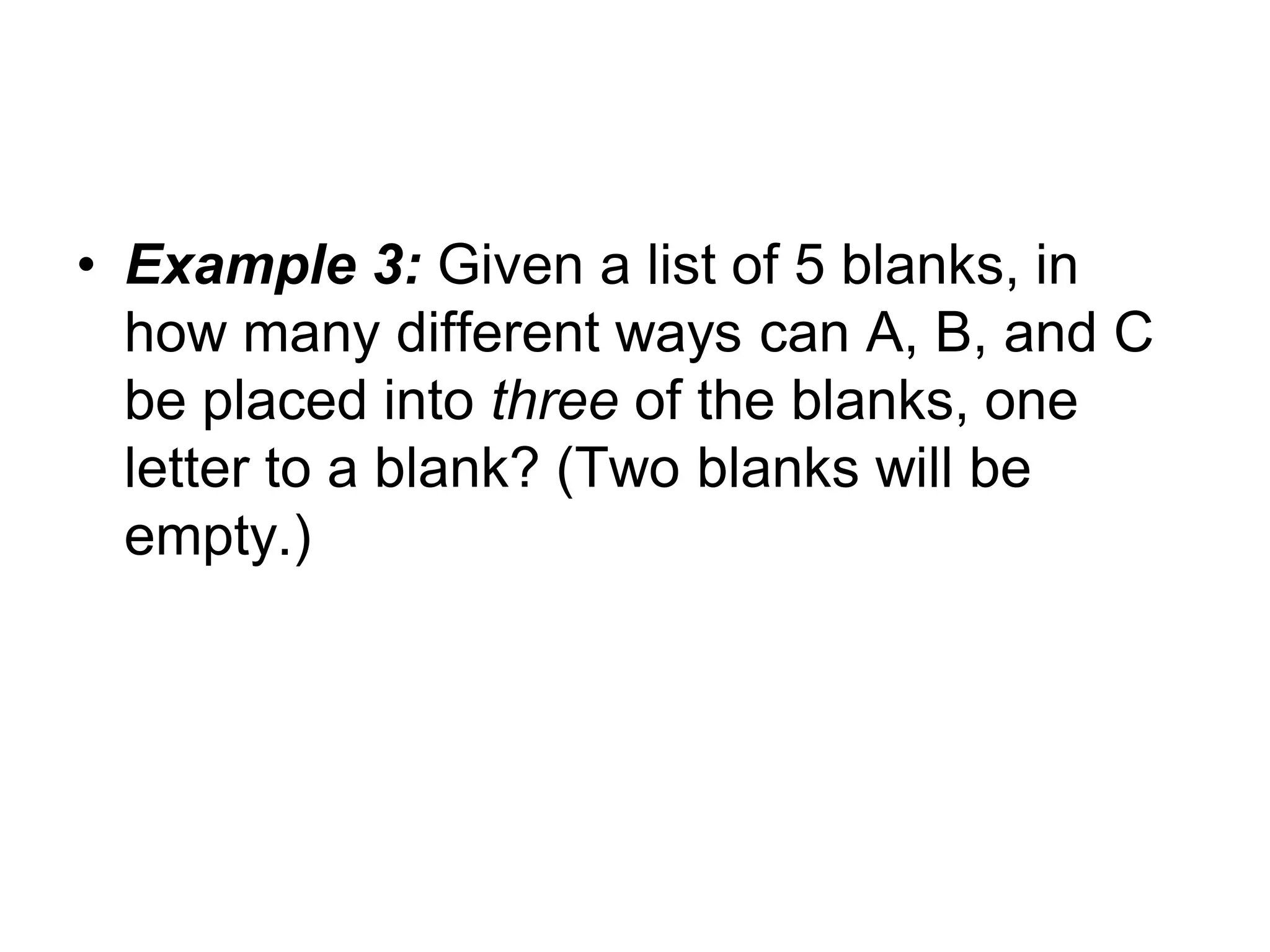
• Example 3: Given a list of 5 blanks, in
how many different ways can A, B, and C
be placed into three of the blanks, one
letter to a blank? (Two blanks will be
empty.)
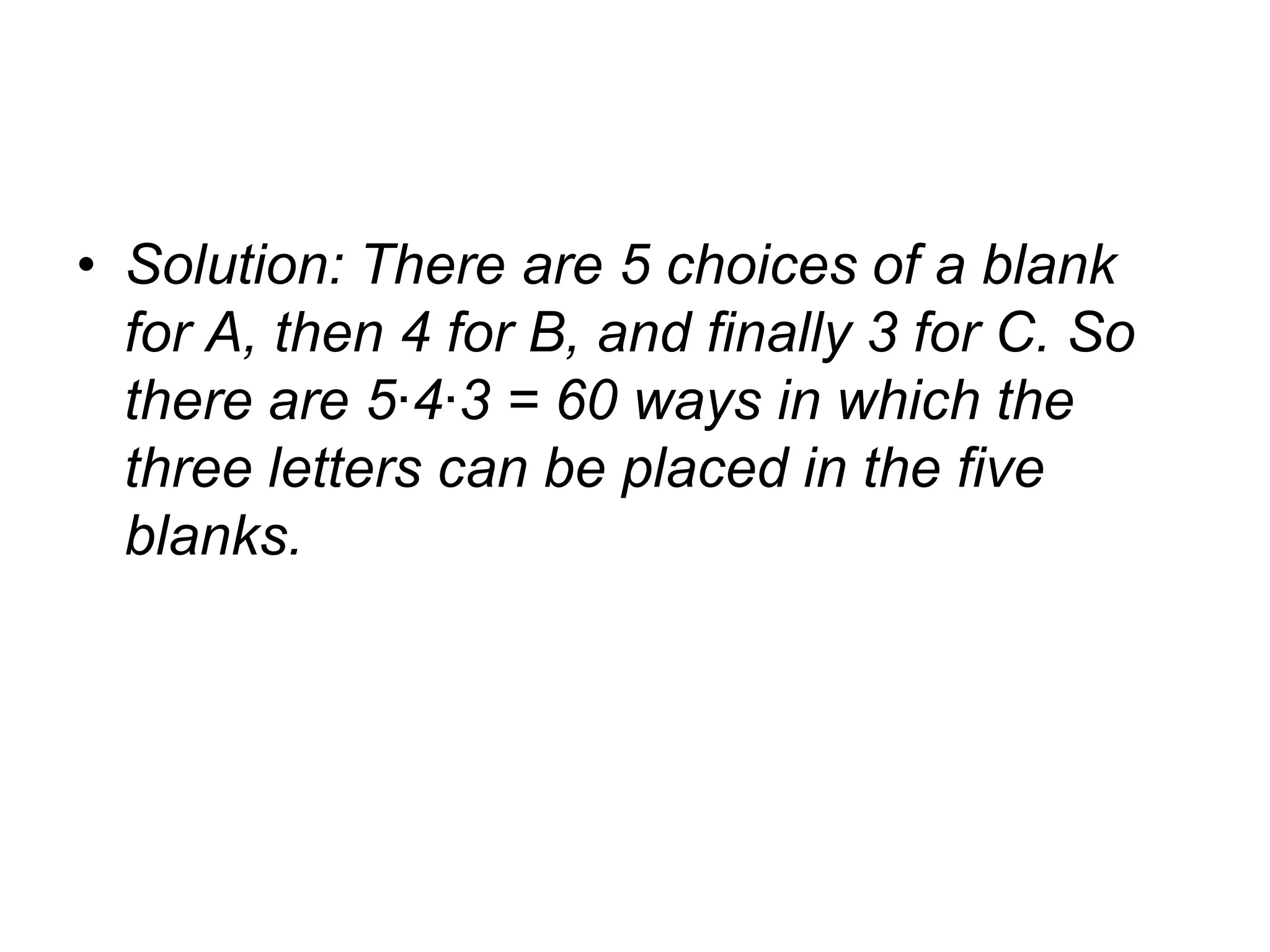
• Solution: There are 5 choices of a blank
for A, then 4 for B, and finally 3 for C. So
there are 5·4·3 = 60 ways in which the
three letters can be placed in the five
blanks.
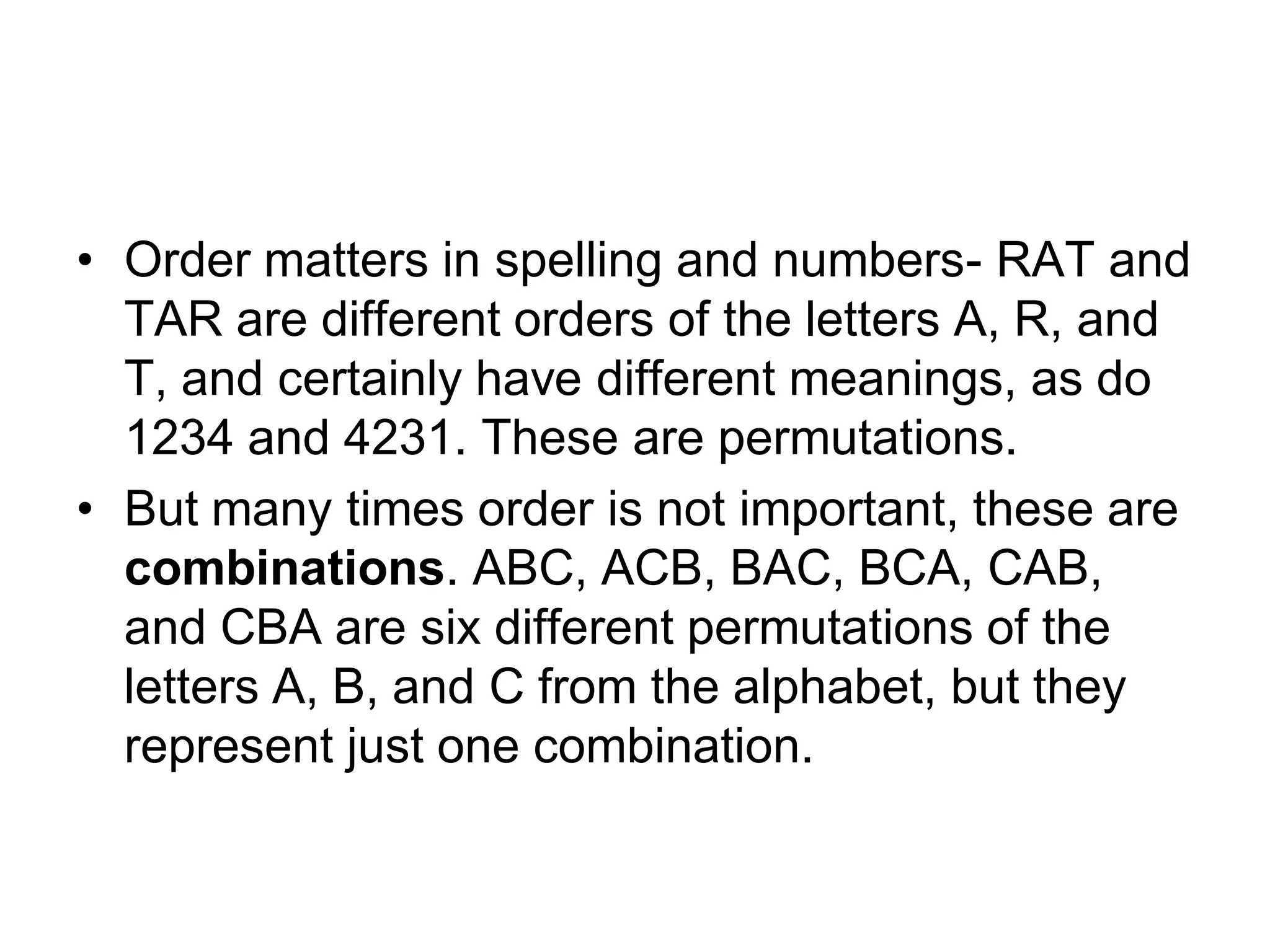
• Order matters in spelling and numbers- RAT and
TAR are different orders of the letters A, R, and
T, and certainly have different meanings, as do
1234 and 4231. These are permutations.
• But many times order is not important, these are
combinations. ABC, ACB, BAC, BCA, CAB,
and CBA are six different permutations of the
letters A, B, and C from the alphabet, but they
represent just one combination.
• Choose one combination of four different
letters from the alphabet.
• How many permutations does this one
combination give?
• Example 4: In how many different ways
could a committee of 5 people be chosen
from a class of 30 students?
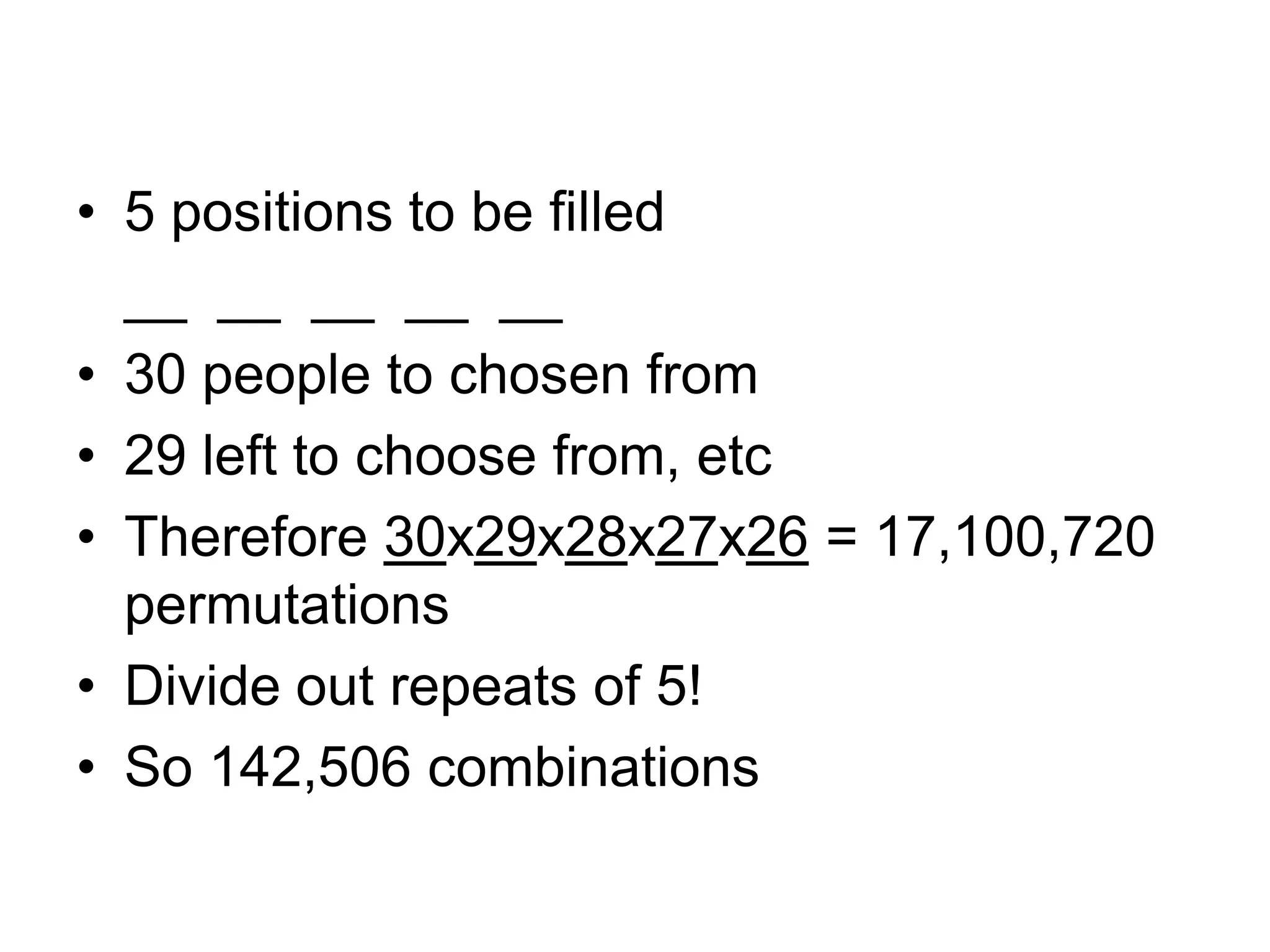
• 5 positions to be filled
__ __ __ __ __
• 30 people to chosen from
• 29 left to choose from, etc
• Therefore 30x29x28x27x26 = 17,100,720
permutations
• Divide out repeats of 5!
• So 142,506 combinations
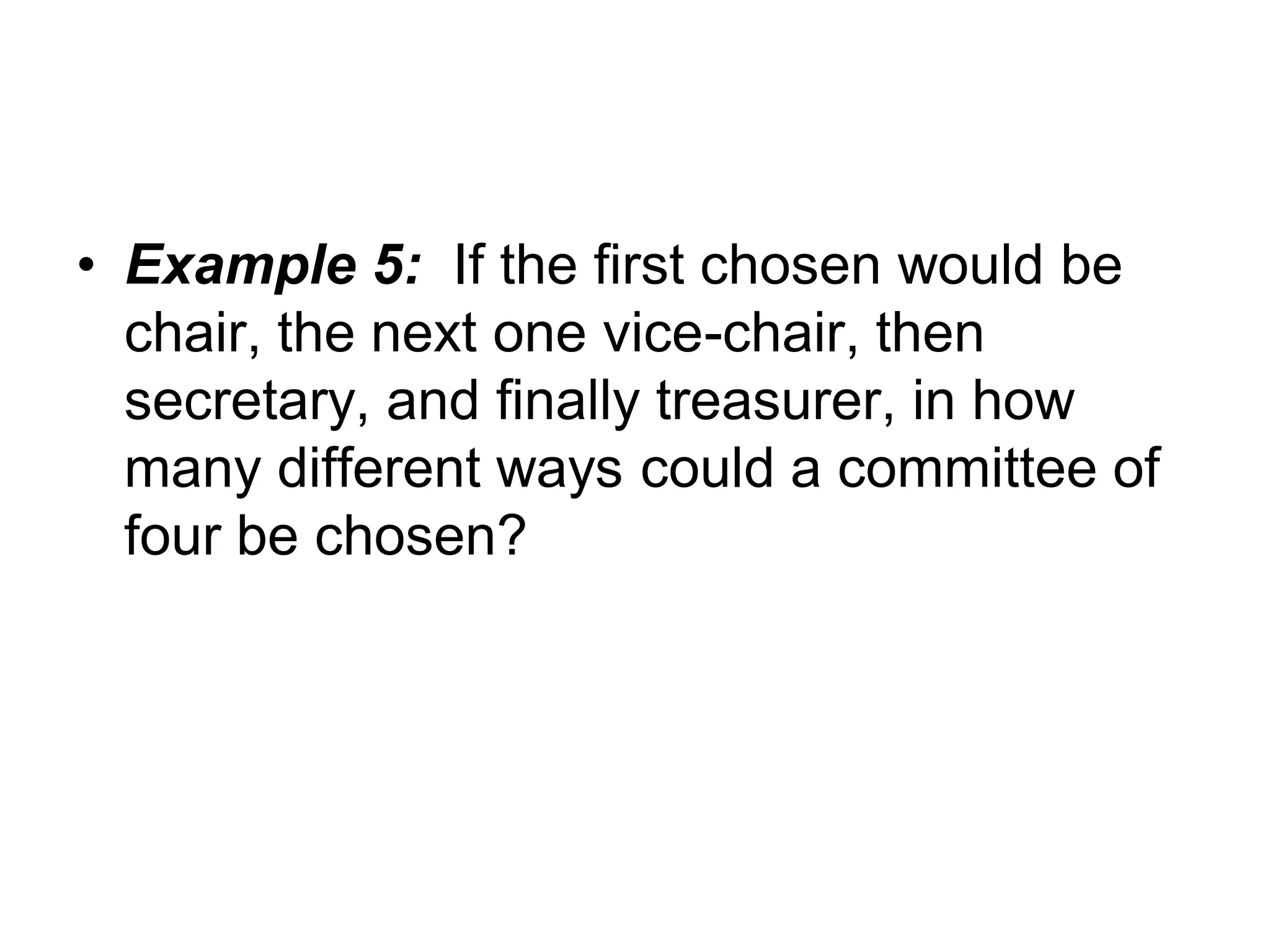
• Example 5: If the first chosen would be
chair, the next one vice-chair, then
secretary, and finally treasurer, in how
many different ways could a committee of
four be chosen?
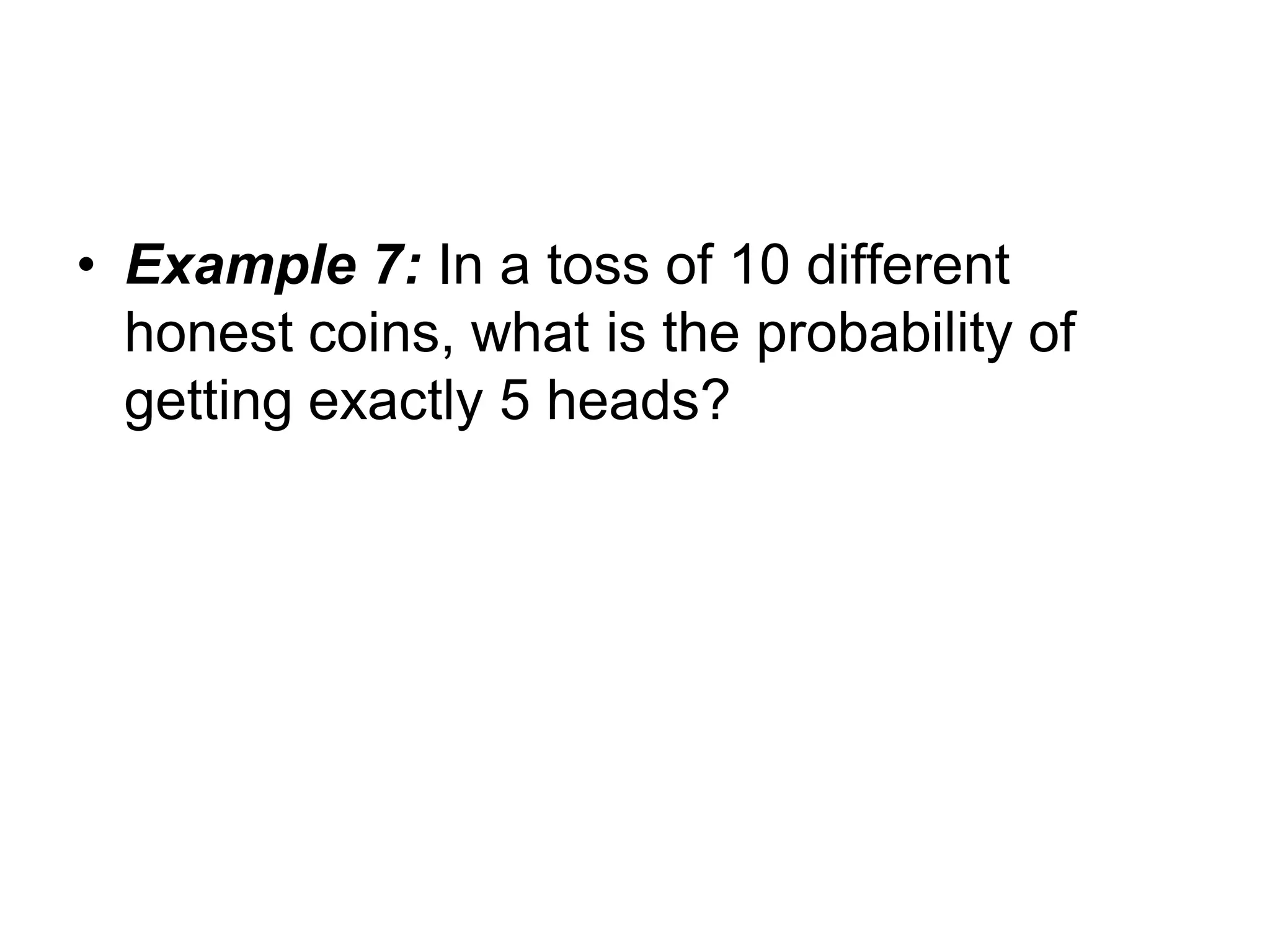
• Example 7: In a toss of 10 different
honest coins, what is the probability of
getting exactly 5 heads?
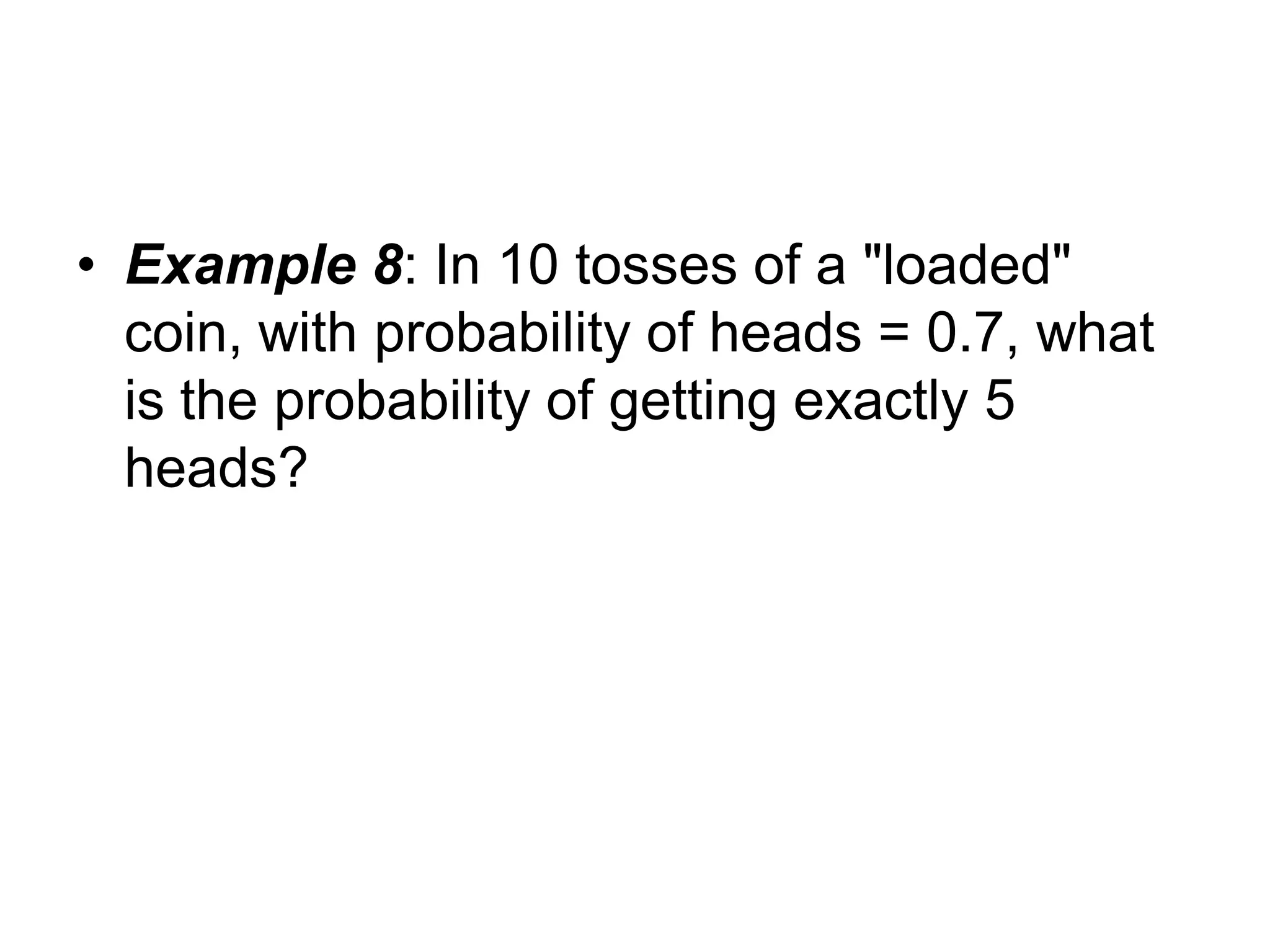
• Example 8: In 10 tosses of a "loaded"
coin, with probability of heads = 0.7, what
is the probability of getting exactly 5
heads?

Combinations and permutations(1)

  • 1.
  • 2.
    Permutation • An arrangementwhere order is important is called a permutation. • An arrangement where order is not important is called combination.
  • 3.
    Seating Arrangement Purpose: Youare a photographer sitting a group in a row for pictures. You need to determine how many different ways you can seat the group. Part One 1. There are three people to sit down in a row. Let the colors red, blue, and green represent the three people. If Red is the first to sit down, show all the possible seating arrangements. (Use colored pencils to show the different arrangements.) 2. If Blue is the first to sit down, show all these possible arrangements. 3. If Green is the first to sit down, show all these possible arrangements. 4. How many total possible seating arrangements are there for three people?
  • 4.
    Part Two 5. Thereare five people in the group. Let the colors red, blue, green, yellow, and purple represent the five people. How many people could sit down first for the picture? 6. If Red sits down, how many people are left to sit down? 7. If Blue sits down, how many people are left to sit down? 8. If Green sits down, how many people are left to sit down? 9. If Yellow sits down, how many people are left to sit down? 10. Multiply how many can sit down at each turn. How many possible seating arrangements are there for five people?
  • 5.
    Part Two 5. Thereare five people in the group. Let the colors red, blue, green, yellow, and purple represent the five people. How many people could sit down first for the picture? 6. If Red sits down, how many people are left to sit down? 7. If Blue sits down, how many people are left to sit down? 8. If Green sits down, how many people are left to sit down? 9. If Yellow sits down, how many people are left to sit down? 10. Multiply how many can sit down at each turn. How many possible seating arrangements are there for five people? P= 5x4x3x2x1 = 120 ways
  • 6.
    • A seatingarrangement is an example of a permutation because the arrangement of the “n” objects is in a specific order. The order is important for a permutation. • When the order does not matter, it is a combination, because you are only interested in the group.
  • 7.
    Extend: . Twelve peopleneed to be photographed, but there are only five chairs. (The rest of the people will be standing behind and their order does not matter.) How many ways can you sit the twelve people on the five chairs?
  • 8.
    Extend: Twelve people needto be photographed, but there are only five chairs. (The rest of the people will be standing behind and their order does not matter.) How many ways can you sit the twelve people on the five chairs? __ __ __ __ __
  • 9.
    Extend: Twelve people needto be photographed, but there are only five chairs. (The rest of the people will be standing behind and their order does not matter.) How many ways can you sit the twelve people on the five chairs? 12 x 11 x 10 x 9 x 8 = 95040 ways
  • 10.
    Permutation • An arrangementwhere order is important is called a permutation. • Example: Mario, Sandy, Fred, and Shanna are running for the offices of president, secretary and treasurer. In how many ways can these offices be filled? 4 x 3 x 2 = 24. The offices can be filled 24 ways.
  • 11.
    Combination • An arrangementwhere order is not important is called combination. • Example: Charles has four coins in his pocket and pulls out three at one time. How many different amounts can he get? 4 6 24 123 234 !3 34 34 xx xxP C
  • 12.
    • Determine ifthe situation represents a permutation or a combination: 1. In how many ways can five books be arranged on a book-shelf in the library? 2. In how many ways can three student-council members be elected from five candidates? 3. Seven students line up to sharpen their pencils. 4. A DJ will play three CD choices from the 5 requests.
  • 13.
    • Determine ifthe situation represents a permutation or a combination: 1. In how many ways can five books be arranged on a book-shelf in the library? permutation 2. In how many ways can three student-council members be elected from five candidates? combination 3. Seven students line up to sharpen their pencils. permutation 4. A DJ will play three CD choices from the 5 requests. combination
  • 14.
    • Find thenumber of events: 1. In how many ways can five books be arranged on a book-shelf in the library? P = 5! = 5x4x3x2x1 = 120 ways
  • 15.
    • Find thenumber of events: 1. In how many ways can five books be arranged on a book-shelf in the library? = 120 ways 2. In how many ways can three student-council members be elected from five candidates? ways10 6 60 !3 345 35 xx C
  • 16.
    • Find thenumber of events: 3. Seven students line up to sharpen their pencils. P=7! = 7x6x5x4x3x2x1 = 5040 ways 4. A DJ will play three CD choices from the 5 requests.
  • 17.
    • Find thenumber of events: 3. Seven students line up to sharpen their pencils. P=7! = 7x6x5x4x3x2x1 = 5040 ways 4. A DJ will play three CD choices from the 5 requests. ways10 6 60 !3 345 35 xx C
  • 18.
    Fundamental Counting Principle. IfAct 1 can be performed in m ways, and Act 2 can be performed in n ways no matter how Act 1 turns out, then the sequence Act 1 and Act 2 can be performed in m·n ways.
  • 19.
    • Example 1:Eight horses-Alabaster, Beauty, Candy, Doughty, Excellente, Friday, Great One, and High 'n Mighty- run a race. • In how many ways can the first three finishers turn out?
  • 20.
    • Example 1:Eight horses-Alabaster, Beauty, Candy, Doughty, Excellente, Friday, Great One, and High 'n Mighty- run a race. • In how many ways can the first three finishers turn out? ___ ___ ___
  • 21.
    • Example 1:Eight horses-Alabaster, Beauty, Candy, Doughty, Excellente, Friday, Great One, and High 'n Mighty- run a race. • In how many ways can the first three finishers turn out? _8_ ___ ___
  • 22.
    • Example 1:Eight horses-Alabaster, Beauty, Candy, Doughty, Excellente, Friday, Great One, and High 'n Mighty- run a race. • In how many ways can the first three finishers turn out? _8_ x _7__ ___
  • 23.
    • Example 1:Eight horses-Alabaster, Beauty, Candy, Doughty, Excellente, Friday, Great One, and High 'n Mighty- run a race. • In how many ways can the first three finishers turn out? _8_ x _7_ x _6_
  • 24.
    • Example 1:Eight horses-Alabaster, Beauty, Candy, Doughty, Excellente, Friday, Great One, and High 'n Mighty- run a race. • In how many ways can the first three finishers turn out? _8_ x _7_ x _6_ = 336 ways
  • 25.
    • Solution: Extending theFundamental Counting Principle to three acts, finishing first ("Act 1 " ) can happen in 8 ways, there are then 7 ways in which finishing second ( "Act 2") can occur, and finally there are 6 ways in which third place ("Act 3 ") can be filled, so the first three finishers could occur in 8·7·6 = 336 ways.
  • 26.
    • Example 2:How many ways can 10 tosses of a coin turn out?
  • 27.
    • Solution: Each ofthe 10 acts can occur in two ways (H or T). So there are 210 = 1024 different sequences possible.
  • 28.
    • Example 3:Given a list of 5 blanks, in how many different ways can A, B, and C be placed into three of the blanks, one letter to a blank? (Two blanks will be empty.)
  • 29.
    • Solution: Thereare 5 choices of a blank for A, then 4 for B, and finally 3 for C. So there are 5·4·3 = 60 ways in which the three letters can be placed in the five blanks.
  • 30.
    • Order mattersin spelling and numbers- RAT and TAR are different orders of the letters A, R, and T, and certainly have different meanings, as do 1234 and 4231. These are permutations. • But many times order is not important, these are combinations. ABC, ACB, BAC, BCA, CAB, and CBA are six different permutations of the letters A, B, and C from the alphabet, but they represent just one combination.
  • 31.
    • Choose onecombination of four different letters from the alphabet. • How many permutations does this one combination give?
  • 32.
    • Example 4:In how many different ways could a committee of 5 people be chosen from a class of 30 students?
  • 33.
    • 5 positionsto be filled __ __ __ __ __ • 30 people to chosen from • 29 left to choose from, etc • Therefore 30x29x28x27x26 = 17,100,720 permutations • Divide out repeats of 5! • So 142,506 combinations
  • 34.
    • Example 5:If the first chosen would be chair, the next one vice-chair, then secretary, and finally treasurer, in how many different ways could a committee of four be chosen?
  • 35.
    • Example 7:In a toss of 10 different honest coins, what is the probability of getting exactly 5 heads?
  • 36.
    • Example 8:In 10 tosses of a "loaded" coin, with probability of heads = 0.7, what is the probability of getting exactly 5 heads?