FUNDAMENTAL
COUNTING PRINCIPLES
Presented by: Noel C. De Luna
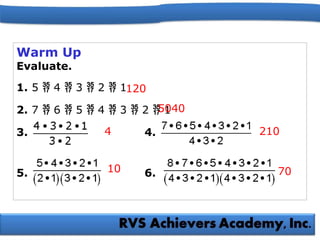
Warm Up
Evaluate.
1. 5  4  3  2  1
2. 7  6  5  4  3  2  1
3. 4.
5. 6.
120
5040
4 210
10 70
Solve problems involving the Fundamental
Counting Principle.
Solve problems involving permutations and
combinations.
Objectives
Fundamental Counting Principle
permutation
factorial
combination
Vocabulary
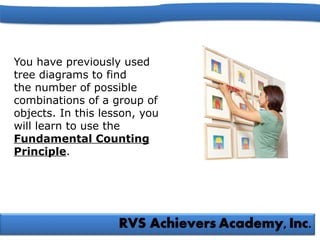
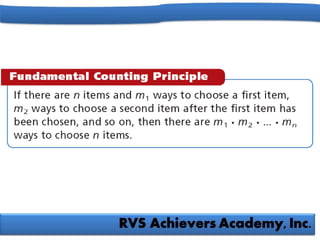
You have previously used
tree diagrams to find
the number of possible
combinations of a group of
objects. In this lesson, you
will learn to use the
Fundamental Counting
Principle.
Example 1A: Using the Fundamental Counting
Principle
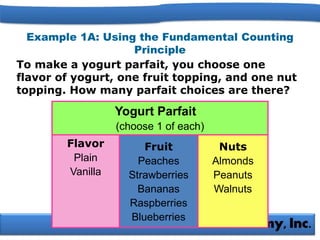
To make a yogurt parfait, you choose one
flavor of yogurt, one fruit topping, and one nut
topping. How many parfait choices are there?
Yogurt Parfait
(choose 1 of each)
Flavor
Plain
Vanilla
Fruit
Peaches
Strawberries
Bananas
Raspberries
Blueberries
Nuts
Almonds
Peanuts
Walnuts
Example 1A Continued
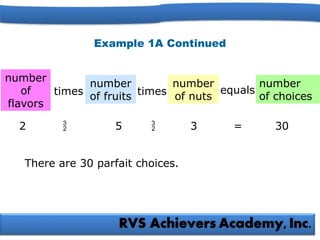
number
of
flavors
times
number
of fruits
number
of nuts
times equals
number
of choices
2  5  3 = 30
There are 30 parfait choices.
Example 1B: Using the Fundamental Counting
Principle
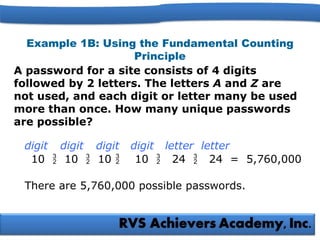
A password for a site consists of 4 digits
followed by 2 letters. The letters A and Z are
not used, and each digit or letter many be used
more than once. How many unique passwords
are possible?
digit digit digit digit letter letter
10  10  10  10  24  24 = 5,760,000
There are 5,760,000 possible passwords.
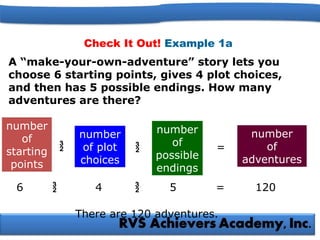
Check It Out! Example 1a
A “make-your-own-adventure” story lets you
choose 6 starting points, gives 4 plot choices,
and then has 5 possible endings. How many
adventures are there?
number
of
starting
points

number
of plot
choices
number
of
possible
endings
 =
number
of
adventures
6  4  5 = 120
There are 120 adventures.
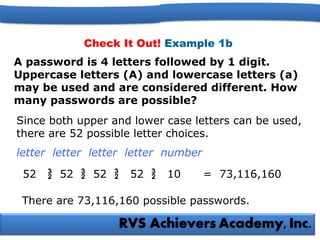
Check It Out! Example 1b
A password is 4 letters followed by 1 digit.
Uppercase letters (A) and lowercase letters (a)
may be used and are considered different. How
many passwords are possible?
Since both upper and lower case letters can be used,
there are 52 possible letter choices.
letter letter letter letter number
52  52  52  52  10 = 73,116,160
There are 73,116,160 possible passwords.
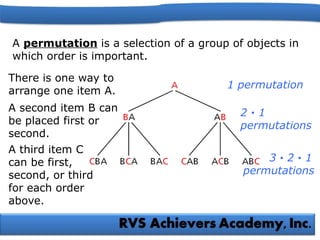
A permutation is a selection of a group of objects in
which order is important.
There is one way to
arrange one item A.
A second item B can
be placed first or
second.
A third item C
can be first,
second, or third
for each order
above.
1 permutation
2 · 1
permutations
3 · 2 · 1
permutations
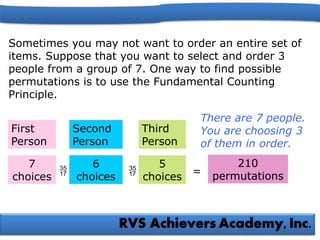
Sometimes you may not want to order an entire set of
items. Suppose that you want to select and order 3
people from a group of 7. One way to find possible
permutations is to use the Fundamental Counting
Principle.
First
Person
Second
Person
Third
Person
There are 7 people.
You are choosing 3
of them in order.
7
choices
6
choices
5
choices
  =
210
permutations
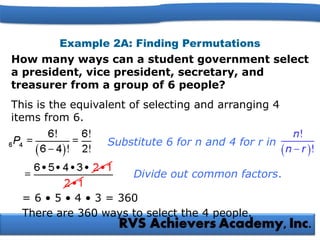
Example 2A: Finding Permutations
How many ways can a student government select
a president, vice president, secretary, and
treasurer from a group of 6 people?
This is the equivalent of selecting and arranging 4
items from 6.
= 6 • 5 • 4 • 3 = 360
Divide out common factors.
There are 360 ways to select the 4 people.
Substitute 6 for n and 4 for r in
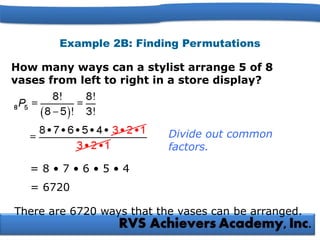
Example 2B: Finding Permutations
How many ways can a stylist arrange 5 of 8
vases from left to right in a store display?
Divide out common
factors.
= 8 • 7 • 6 • 5 • 4
= 6720
There are 6720 ways that the vases can be arranged.
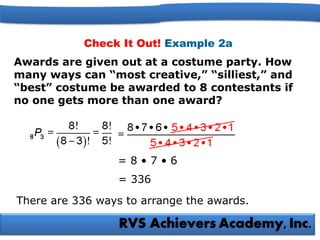
Check It Out! Example 2a
Awards are given out at a costume party. How
many ways can “most creative,” “silliest,” and
“best” costume be awarded to 8 contestants if
no one gets more than one award?
= 8 • 7 • 6
= 336
There are 336 ways to arrange the awards.
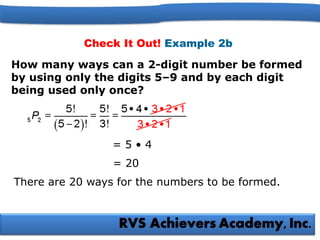
Check It Out! Example 2b
How many ways can a 2-digit number be formed
by using only the digits 5–9 and by each digit
being used only once?
= 5 • 4
= 20
There are 20 ways for the numbers to be formed.
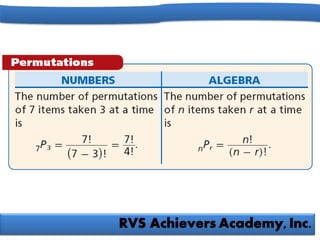
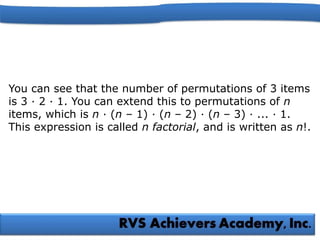
You can see that the number of permutations of 3 items
is 3 · 2 · 1. You can extend this to permutations of n
items, which is n · (n – 1) · (n – 2) · (n – 3) · ... · 1.
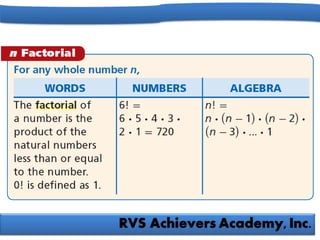
This expression is called n factorial, and is written as n!.
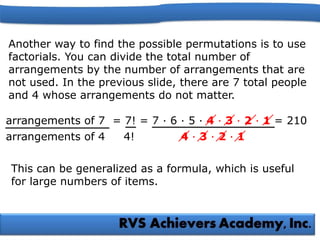
arrangements of 4 4! 4 · 3 · 2 · 1
Another way to find the possible permutations is to use
factorials. You can divide the total number of
arrangements by the number of arrangements that are
not used. In the previous slide, there are 7 total people
and 4 whose arrangements do not matter.
arrangements of 7 = 7! = 7 · 6 · 5 · 4 · 3 · 2 · 1 = 210
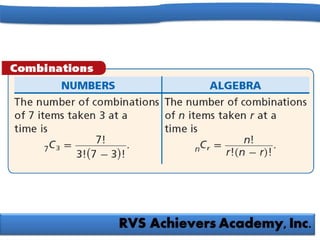
This can be generalized as a formula, which is useful
for large numbers of items.
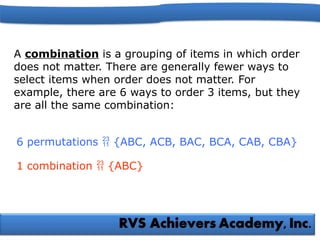
A combination is a grouping of items in which order
does not matter. There are generally fewer ways to
select items when order does not matter. For
example, there are 6 ways to order 3 items, but they
are all the same combination:
6 permutations  {ABC, ACB, BAC, BCA, CAB, CBA}
1 combination  {ABC}
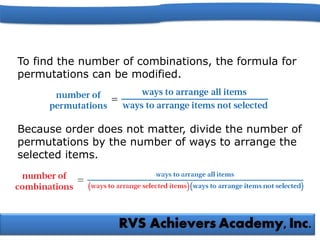
To find the number of combinations, the formula for
permutations can be modified.
Because order does not matter, divide the number of
permutations by the number of ways to arrange the
selected items.
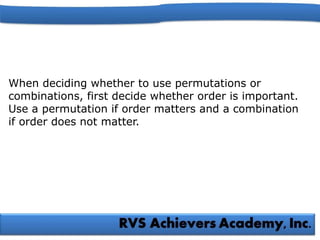
When deciding whether to use permutations or
combinations, first decide whether order is important.
Use a permutation if order matters and a combination
if order does not matter.
You can find permutations and combinations by
using nPr and nCr, respectively, on scientific and
graphing calculators.
Helpful Hint
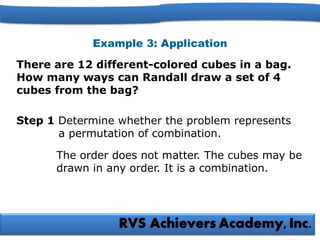
Example 3: Application
There are 12 different-colored cubes in a bag.
How many ways can Randall draw a set of 4
cubes from the bag?
Step 1 Determine whether the problem represents
a permutation of combination.
The order does not matter. The cubes may be
drawn in any order. It is a combination.
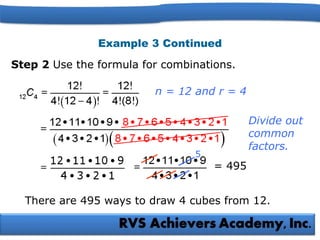
Example 3 Continued
= 495
Divide out
common
factors.
There are 495 ways to draw 4 cubes from 12.
5
Step 2 Use the formula for combinations.
n = 12 and r = 4
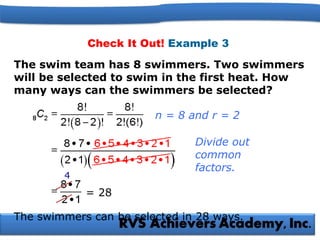
Check It Out! Example 3
The swim team has 8 swimmers. Two swimmers
will be selected to swim in the first heat. How
many ways can the swimmers be selected?
= 28
The swimmers can be selected in 28 ways.
4
Divide out
common
factors.
n = 8 and r = 2
Lesson 1 FUNDAMENTAL COUNTING PRINC.pptx

Lesson 1 FUNDAMENTAL COUNTING PRINC.pptx

  • 1.
  • 2.
    Warm Up Evaluate. 1. 5 4  3  2  1 2. 7  6  5  4  3  2  1 3. 4. 5. 6. 120 5040 4 210 10 70
  • 3.
    Solve problems involvingthe Fundamental Counting Principle. Solve problems involving permutations and combinations. Objectives
  • 4.
  • 5.
    You have previouslyused tree diagrams to find the number of possible combinations of a group of objects. In this lesson, you will learn to use the Fundamental Counting Principle.
  • 7.
    Example 1A: Usingthe Fundamental Counting Principle To make a yogurt parfait, you choose one flavor of yogurt, one fruit topping, and one nut topping. How many parfait choices are there? Yogurt Parfait (choose 1 of each) Flavor Plain Vanilla Fruit Peaches Strawberries Bananas Raspberries Blueberries Nuts Almonds Peanuts Walnuts
  • 8.
    Example 1A Continued number of flavors times number offruits number of nuts times equals number of choices 2  5  3 = 30 There are 30 parfait choices.
  • 9.
    Example 1B: Usingthe Fundamental Counting Principle A password for a site consists of 4 digits followed by 2 letters. The letters A and Z are not used, and each digit or letter many be used more than once. How many unique passwords are possible? digit digit digit digit letter letter 10  10  10  10  24  24 = 5,760,000 There are 5,760,000 possible passwords.
  • 10.
    Check It Out!Example 1a A “make-your-own-adventure” story lets you choose 6 starting points, gives 4 plot choices, and then has 5 possible endings. How many adventures are there? number of starting points  number of plot choices number of possible endings  = number of adventures 6  4  5 = 120 There are 120 adventures.
  • 11.
    Check It Out!Example 1b A password is 4 letters followed by 1 digit. Uppercase letters (A) and lowercase letters (a) may be used and are considered different. How many passwords are possible? Since both upper and lower case letters can be used, there are 52 possible letter choices. letter letter letter letter number 52  52  52  52  10 = 73,116,160 There are 73,116,160 possible passwords.
  • 12.
    A permutation isa selection of a group of objects in which order is important. There is one way to arrange one item A. A second item B can be placed first or second. A third item C can be first, second, or third for each order above. 1 permutation 2 · 1 permutations 3 · 2 · 1 permutations
  • 14.
    Sometimes you maynot want to order an entire set of items. Suppose that you want to select and order 3 people from a group of 7. One way to find possible permutations is to use the Fundamental Counting Principle. First Person Second Person Third Person There are 7 people. You are choosing 3 of them in order. 7 choices 6 choices 5 choices   = 210 permutations
  • 15.
    Example 2A: FindingPermutations How many ways can a student government select a president, vice president, secretary, and treasurer from a group of 6 people? This is the equivalent of selecting and arranging 4 items from 6. = 6 • 5 • 4 • 3 = 360 Divide out common factors. There are 360 ways to select the 4 people. Substitute 6 for n and 4 for r in
  • 16.
    Example 2B: FindingPermutations How many ways can a stylist arrange 5 of 8 vases from left to right in a store display? Divide out common factors. = 8 • 7 • 6 • 5 • 4 = 6720 There are 6720 ways that the vases can be arranged.
  • 17.
    Check It Out!Example 2a Awards are given out at a costume party. How many ways can “most creative,” “silliest,” and “best” costume be awarded to 8 contestants if no one gets more than one award? = 8 • 7 • 6 = 336 There are 336 ways to arrange the awards.
  • 18.
    Check It Out!Example 2b How many ways can a 2-digit number be formed by using only the digits 5–9 and by each digit being used only once? = 5 • 4 = 20 There are 20 ways for the numbers to be formed.
  • 19.
    You can seethat the number of permutations of 3 items is 3 · 2 · 1. You can extend this to permutations of n items, which is n · (n – 1) · (n – 2) · (n – 3) · ... · 1. This expression is called n factorial, and is written as n!.
  • 20.
    arrangements of 44! 4 · 3 · 2 · 1 Another way to find the possible permutations is to use factorials. You can divide the total number of arrangements by the number of arrangements that are not used. In the previous slide, there are 7 total people and 4 whose arrangements do not matter. arrangements of 7 = 7! = 7 · 6 · 5 · 4 · 3 · 2 · 1 = 210 This can be generalized as a formula, which is useful for large numbers of items.
  • 22.
    A combination isa grouping of items in which order does not matter. There are generally fewer ways to select items when order does not matter. For example, there are 6 ways to order 3 items, but they are all the same combination: 6 permutations  {ABC, ACB, BAC, BCA, CAB, CBA} 1 combination  {ABC}
  • 23.
    To find thenumber of combinations, the formula for permutations can be modified. Because order does not matter, divide the number of permutations by the number of ways to arrange the selected items.
  • 25.
    When deciding whetherto use permutations or combinations, first decide whether order is important. Use a permutation if order matters and a combination if order does not matter.
  • 26.
    You can findpermutations and combinations by using nPr and nCr, respectively, on scientific and graphing calculators. Helpful Hint
  • 27.
    Example 3: Application Thereare 12 different-colored cubes in a bag. How many ways can Randall draw a set of 4 cubes from the bag? Step 1 Determine whether the problem represents a permutation of combination. The order does not matter. The cubes may be drawn in any order. It is a combination.
  • 28.
    Example 3 Continued =495 Divide out common factors. There are 495 ways to draw 4 cubes from 12. 5 Step 2 Use the formula for combinations. n = 12 and r = 4
  • 29.
    Check It Out!Example 3 The swim team has 8 swimmers. Two swimmers will be selected to swim in the first heat. How many ways can the swimmers be selected? = 28 The swimmers can be selected in 28 ways. 4 Divide out common factors. n = 8 and r = 2