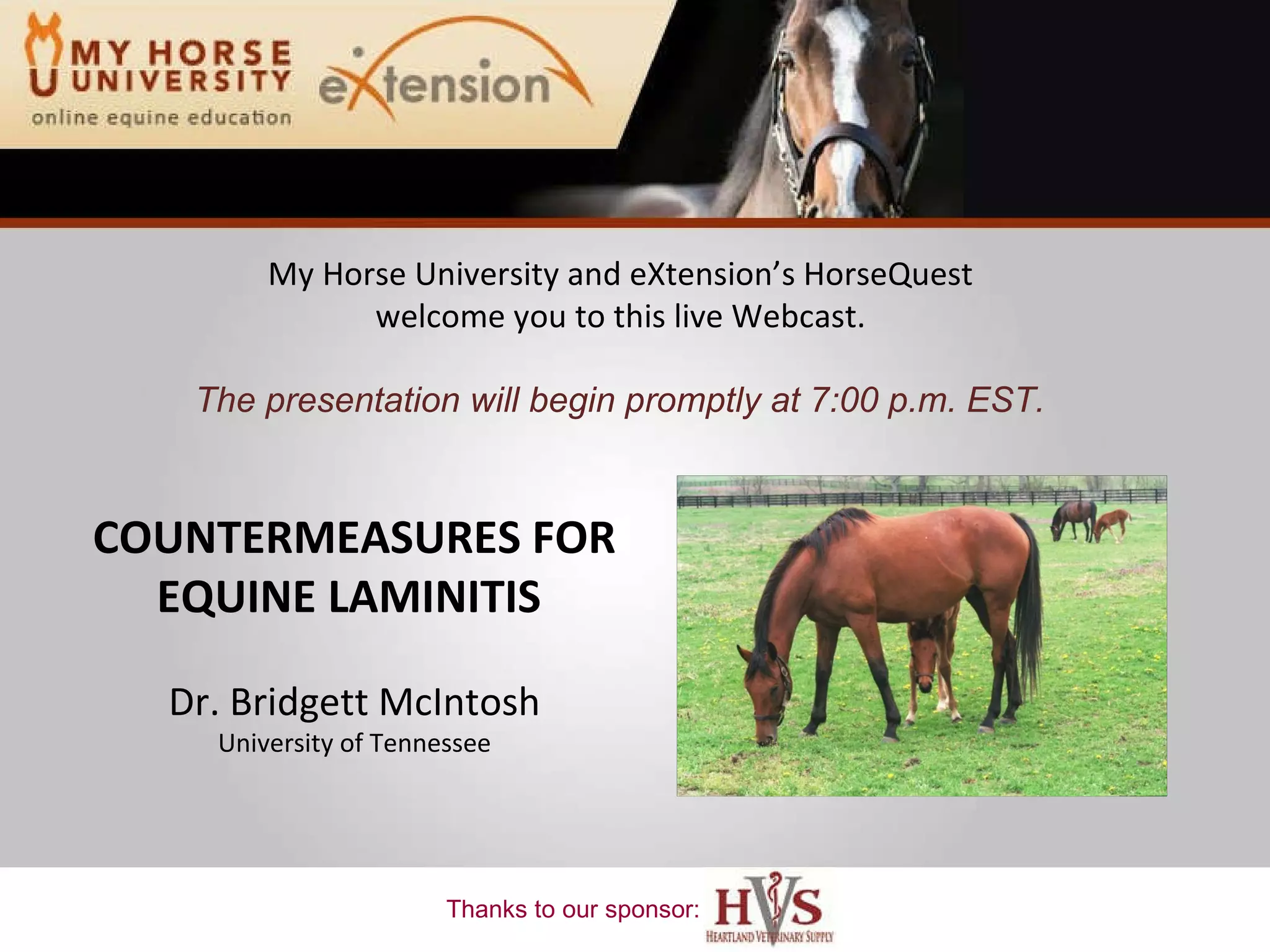
My Horse University and eXtension’s HorseQuest  welcome you to this live Webcast.  The presentation will begin promptly at 7:00 p.m. EST.  COUNTERMEASURES FOR EQUINE LAMINITIS  Dr. Bridgett McIntosh University of Tennessee
Meet our presenter: Dr. Bridgett McIntosh University of Tennessee Dr. Tania Cubitt Performance Horse Nutrition Question facilitator:
Topics of Discussion Laminitis & hoof anatomy Dietary causes of laminitis  Risk factors for laminitis in horses Risk factors in forages and feeds  Current research on pasture associated laminitis Countermeasures for avoidance of laminitis
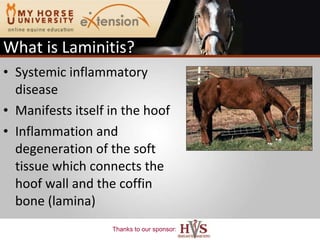
Systemic inflammatory disease Manifests itself in the hoof Inflammation and degeneration of the soft tissue which connects the hoof wall and the coffin bone (lamina) What is Laminitis?
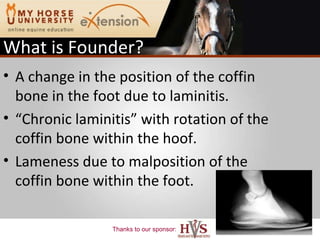
What is Founder? A change in the position of the coffin bone in the foot due to laminitis. “ Chronic laminitis” with rotation of the coffin bone within the hoof. Lameness due to malposition of the coffin bone within the foot.
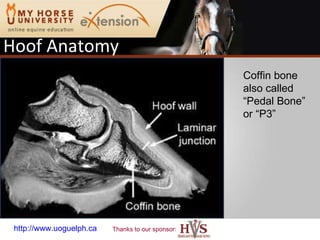
Hoof Anatomy http://www.uoguelph.ca  (Gunn, 2009) Coffin bone also called “Pedal Bone” or “P3”
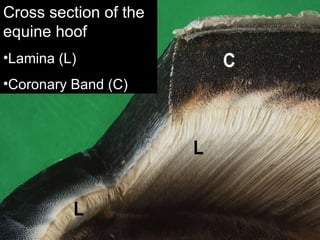
Cross section of the equine hoof Lamina (L) Coronary Band (C)
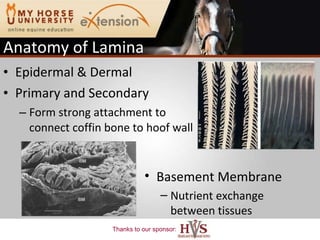
Anatomy of Lamina Epidermal & Dermal Primary and Secondary Form strong attachment to connect coffin bone to hoof wall Pollitt, 1998 Basement Membrane Nutrient exchange between tissues
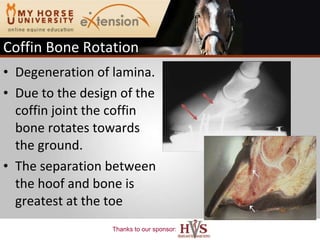
Coffin Bone Rotation Degeneration of lamina. Due to the design of the coffin joint the coffin bone rotates towards the ground. The separation between the hoof and bone is greatest at the toe White, 2005
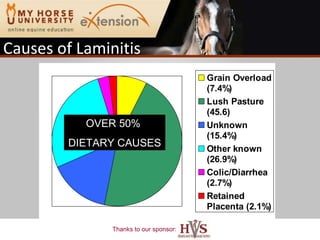
Causes of Laminitis  USDA- NAHMS, 2000 OVER 50%  DIETARY CAUSES
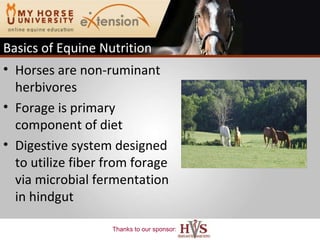
Basics of Equine Nutrition Horses are non-ruminant herbivores Forage is primary component of diet Digestive system designed to utilize fiber from forage via microbial fermentation in hindgut
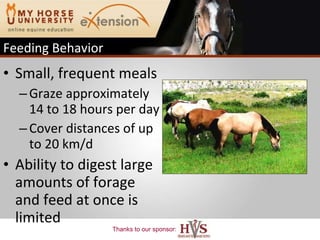
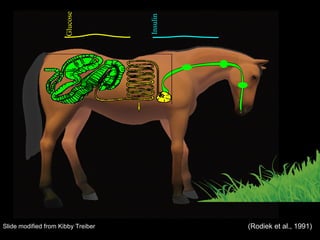
Small, frequent meals Graze approximately 14 to 18 hours per day  Cover distances of up to 20 km/d  Ability to digest large amounts of forage and feed at once is limited Feeding Behavior
Glucose Insulin (Rodiek et al., 1991) Slide modified from Kibby Treiber
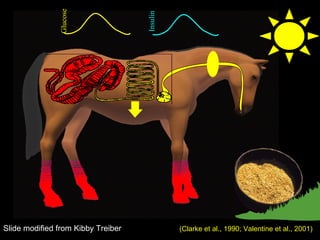
Glucose Insulin (Clarke et al., 1990; Valentine et al., 2001) Slide modified from Kibby Treiber
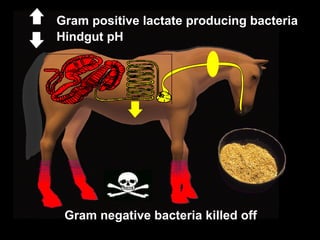
Hindgut pH Gram negative bacteria killed off Gram positive lactate producing bacteria
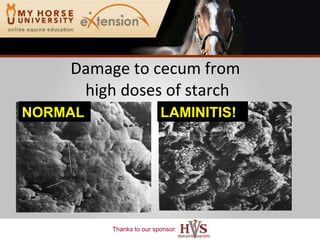
Damage to cecum from  high doses of starch Kreuger et al., 1986 LAMINITIS! NORMAL
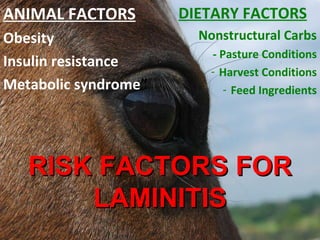
ANIMAL FACTORS Obesity Insulin resistance Metabolic syndrome ” DIETARY FACTORS Nonstructural Carbs - Pasture Conditions Harvest Conditions Feed Ingredients RISK FACTORS FOR LAMINITIS
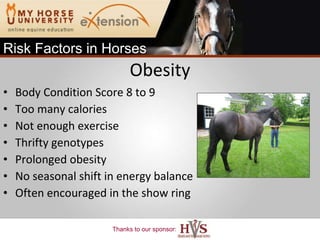
Obesity Body Condition Score 8 to 9 Too many calories Not enough exercise Thrifty genotypes Prolonged obesity No seasonal shift in energy balance Often encouraged in the show ring Risk Factors in Horses
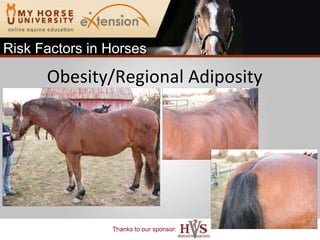
Obesity/Regional Adiposity Risk Factors in Horses
Insulin INSULIN   is a regulatory hormone for metabolism, vascular function, inflammation, tissue remodeling, and growth Secreted by pancreas to move glucose into tissues INSULIN RESISTANCE   is failure of tissues to respond appropriately to insulin (decreased insulin sensitivity)   Insulin Resistance decreases glucose uptake by tissues  Laminitis- affects tissues of hoof (lamina) Risk Factors in Horses
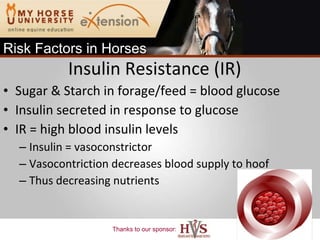
Insulin Resistance (IR) Sugar & Starch in forage/feed = blood glucose Insulin secreted in response to glucose IR = high blood insulin levels Insulin = vasoconstrictor Vasocontriction decreases blood supply to hoof Thus decreasing nutrients Risk Factors in Horses
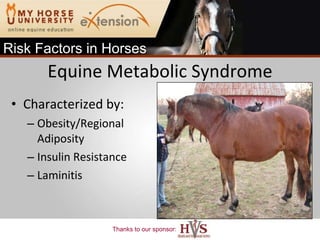
Equine Metabolic Syndrome Characterized by: Obesity/Regional Adiposity Insulin Resistance Laminitis Risk Factors in Horses
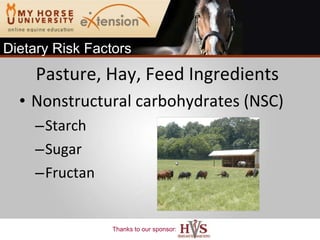
Pasture, Hay, Feed Ingredients Nonstructural carbohydrates (NSC) Starch Sugar Fructan Dietary Risk Factors
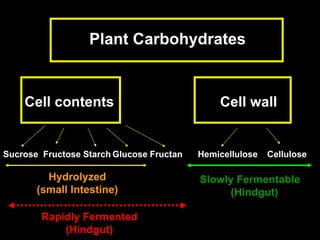
Plant Carbohydrates Cell contents Cell wall Fructan Fructose Starch Sucrose Hemicellulose Cellulose Rapidly Fermented (Hindgut) Glucose Hydrolyzed (small Intestine) Slowly Fermentable  (Hindgut)
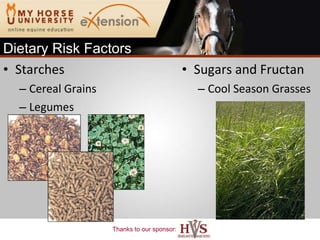
Starches Cereal Grains Legumes Sugars and Fructan Cool Season Grasses Dietary Risk Factors
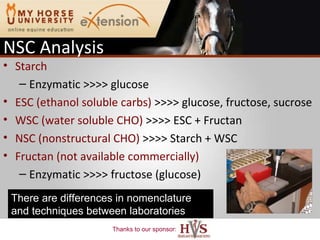
NSC Analysis Starch Enzymatic >>>> glucose  ESC (ethanol soluble carbs)  >>>> glucose, fructose, sucrose  WSC (water soluble CHO)  >>>> ESC + Fructan NSC (nonstructural CHO)  >>>> Starch + WSC Fructan (not available commercially) Enzymatic >>>> fructose (glucose)  There are differences in nomenclature and techniques between laboratories
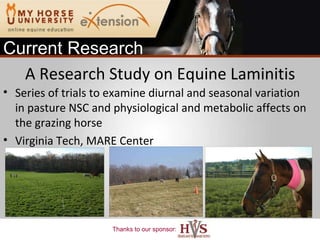
A Research Study on Equine Laminitis Series of trials to examine diurnal and seasonal variation in pasture NSC and physiological and metabolic affects on the grazing horse Virginia Tech, MARE Center  Current Research
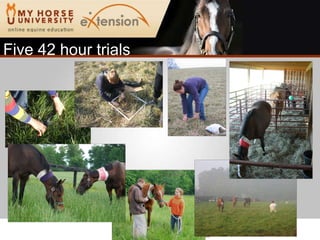
Five 42 hour trials
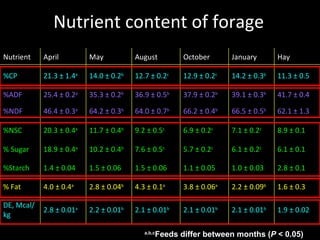
Nutrient content of forage a,b,c Feeds differ between months ( P  < 0.05) Nutrient April May August October January Hay %CP 21.3 ± 1.4 a 14.0 ± 0.2 b 12.7 ± 0.2 c 12.9 ± 0.2 c 14.2 ± 0.3 b 11.3 ± 0.5 %ADF 25.4 ± 0.2 a 35.3 ± 0.2 b 36.9 ± 0.5 b 37.9 ± 0.2 b 39.1 ± 0.3 b 41.7 ± 0.4 %NDF 46.4 ± 0.3 a 64.2 ± 0.3 b 64.0 ± 0.7 b 66.2 ± 0.4 b 66.5 ± 0.5 b 62.1 ± 1.3 %NSC 20.3 ± 0.4 a 11.7 ± 0.4 b 9.2 ± 0.5 c 6.9 ± 0.2 c 7.1 ± 0.2 c 8.9 ± 0.1 % Sugar 18.9 ± 0.4 a 10.2 ± 0.4 b 7.6 ± 0.5 c 5.7 ± 0.2 c 6.1 ± 0.2 c 6.1 ± 0.1 %Starch 1.4 ± 0.04 1.5 ± 0.06 1.5 ± 0.06 1.1 ± 0.05 1.0 ± 0.03 2.8 ± 0.1 % Fat 4.0 ± 0.4 a 2.8 ± 0.04 b 4.3 ± 0.1 a 3.8 ± 0.06 a 2.2 ± 0.09 b 1.6 ± 0.3 DE, Mcal/kg 2.8 ± 0.01 a 2.2 ± 0.01 b 2.1 ± 0.01 b 2.1 ± 0.01 b 2.1 ± 0.01 b 1.9 ± 0.02
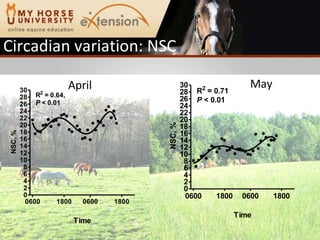
Circadian variation: NSC April May
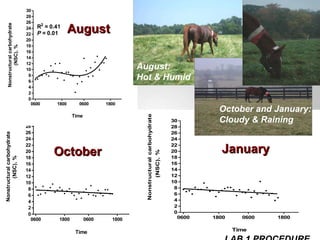
August October January October and January:  Cloudy & Raining August:  Hot & Humid LAB 1 PROCEDURE
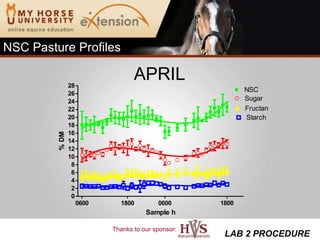
LAB 2 PROCEDURE APRIL NSC Pasture Profiles
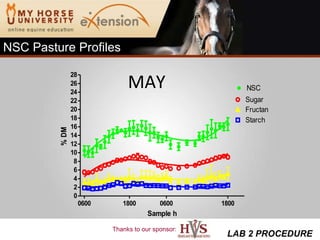
MAY LAB 2 PROCEDURE NSC Pasture Profiles
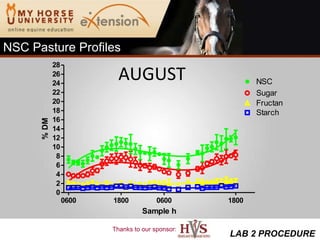
AUGUST LAB 2 PROCEDURE NSC Pasture Profiles
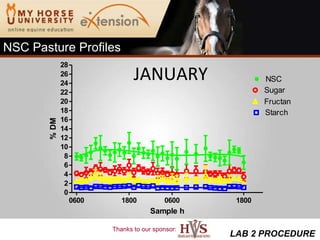
JANUARY LAB 2 PROCEDURE NSC Pasture Profiles
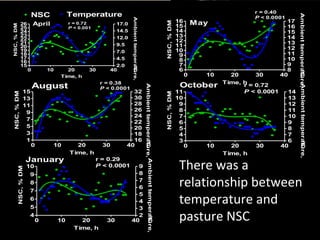
There was a relationship between temperature and pasture NSC
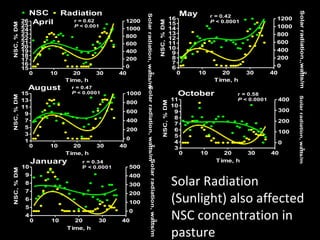
Solar Radiation (Sunlight) also affected NSC concentration in pasture
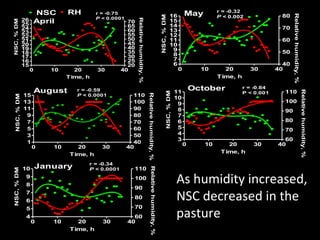
As humidity increased, NSC decreased in the pasture
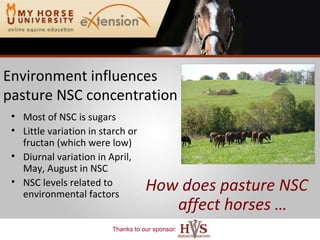
Environment influences pasture NSC concentration Most of NSC is sugars Little variation in starch or fructan (which were low) Diurnal variation in April, May, August in NSC  NSC levels related to environmental factors How does pasture NSC affect horses …
 
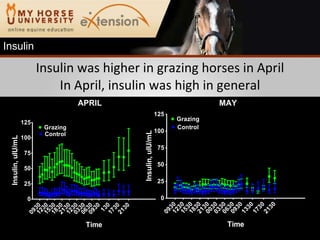
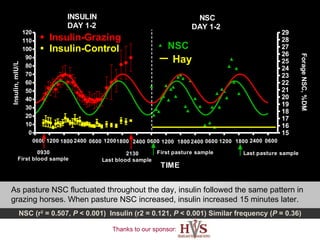
Insulin was higher in grazing horses in April In April, insulin was high in general APRIL MAY Insulin
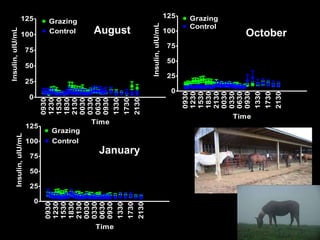
August October January
Evident relationship in April NSC (r 2  = 0.507,  P  < 0.001)  Insulin (r2 = 0.121,  P  < 0.001)   Similar frequency ( P  = 0.36) As pasture NSC fluctuated throughout the day, insulin followed the same pattern in grazing horses. When pasture NSC increased, insulin increased 15 minutes later.
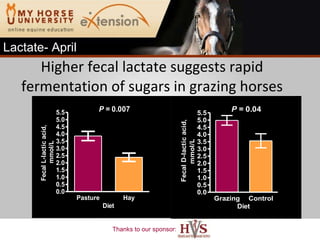
Higher fecal lactate suggests rapid fermentation of sugars in grazing horses Lactate- April
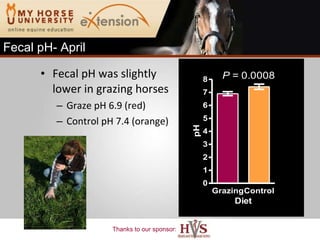
Fecal pH was slightly lower in grazing horses Graze pH 6.9 (red) Control pH 7.4 (orange) Fecal pH- April
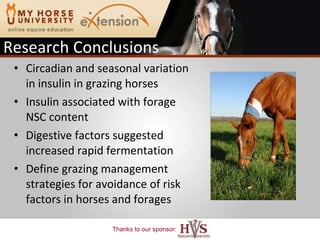
Research Conclusions Circadian and seasonal variation in insulin in grazing horses Insulin associated with forage NSC content  Digestive factors suggested increased rapid fermentation Define grazing management strategies for avoidance of risk factors in horses and forages
Implications of this Research Increased risk of laminitis via exacerbation of insulin resistance and rapid fermentation in the hindgut  Avoid pasture laminitis through grazing management More research needed in different regions, other forage species, different breeds, etc…
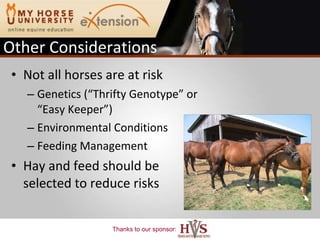
Other Considerations Not all horses are at risk Genetics (“Thrifty Genotype” or “Easy Keeper”) Environmental Conditions Feeding Management Hay and feed should be selected to reduce risks
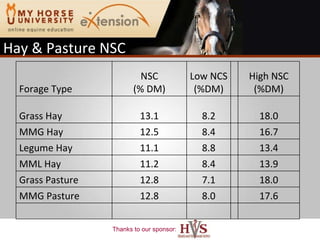
Hay & Pasture NSC www.equianalytical.com 2000-2006, 4,000+ samples Forage Type NSC (% DM) Low NCS (%DM) High NSC (%DM) Grass Hay 13.1 8.2 18.0 MMG Hay 12.5 8.4 16.7 Legume Hay 11.1 8.8 13.4 MML Hay 11.2 8.4 13.9 Grass Pasture 12.8 7.1 18.0 MMG Pasture 12.8 8.0 17.6
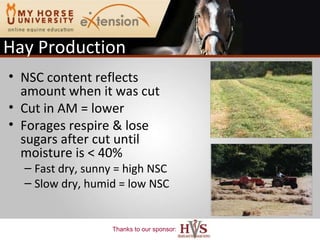
Hay Production  NSC content reflects amount when it was cut Cut in AM = lower Forages respire & lose sugars after cut until moisture is < 40% Fast dry, sunny = high NSC Slow dry, humid = low NSC
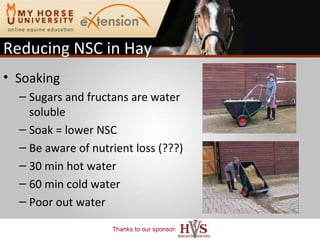
Reducing NSC in Hay Soaking Sugars and fructans are water soluble Soak = lower NSC Be aware of nutrient loss (???) 30 min hot water 60 min cold water Poor out water
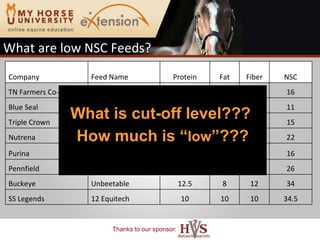
What are low NSC Feeds? What is cut-off level???  How much is “ low ”??? Company Feed Name Protein Fat Fiber NSC TN Farmers Co-op Equilite 1300 13 3 20 16 Blue Seal Carb Gaurd 12 8 25 11 Triple Crown Low Starch 13 6 18 15 Nutrena Safe Choice 14 7 15 22 Purina Ultium 11.7 12.4 18.5 16 Pennfield EnduroEvent Ener-G 10 10 15 26 Buckeye Unbeetable 12.5 8 12 34 SS Legends 12 Equitech 10 10 10 34.5
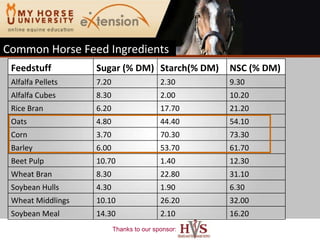
Common Horse Feed Ingredients www.equianalytical.com Feedstuff  Sugar (% DM)  Starch(% DM) NSC (% DM) Alfalfa Pellets  7.20 2.30 9.30 Alfalfa Cubes  8.30 2.00 10.20 Rice Bran  6.20 17.70 21.20 Oats  4.80 44.40 54.10 Corn  3.70 70.30 73.30 Barley  6.00 53.70 61.70 Beet Pulp  10.70 1.40 12.30 Wheat Bran  8.30 22.80 31.10 Soybean Hulls  4.30 1.90 6.30 Wheat Middlings  10.10 26.20 32.00 Soybean Meal  14.30 2.10 16.20
Feeds & Molasses Pure cane molasses 25% water, 50% sugar Commercial horse feeds  filtered and processed,  inhibit mold growth, change color, improve flow rate and prevent freezing app. 40% sugar Example: Feed that is 10% molasses, 1 lb feed = 4% sugar. Feeds vary in molasses content from 0 to 20% Molasses in “molassed beet pulp” is negligible (less than 2%)
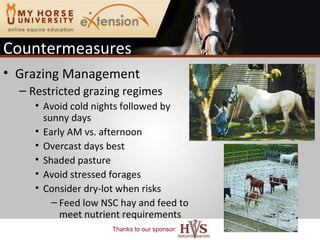
Countermeasures Grazing Management Restricted grazing regimes Avoid cold nights followed by sunny days Early AM vs. afternoon Overcast days best Shaded pasture Avoid stressed forages Consider dry-lot when risks Feed low NSC hay and feed to meet nutrient requirements
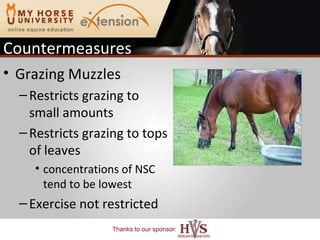
Grazing Muzzles Restricts grazing to small amounts Restricts grazing to tops of leaves concentrations of NSC tend to be lowest  Exercise not restricted Countermeasures
Countermeasures Hay Selection Determine NSC content and select hay less than 10% NSC, mature hay usually best Feed Selection Select nutrient dense low NSC feeds Weight management Short term high doses of Levothyroxine have been shown to reduce weight and increase insulin sensitivity (Frank et al., 2006) Exercise
Misperceptions No data for association of equine IR, Laminitis and EMS with iron, magnesium, chromium or other minerals Avoid “metabolic” supplements “ NSC is bad for all horses” Some classes of horses (ie. racehorses) require high amounts of NSC for readily available energy  Low NSC feeds are for a small population of horses
Take Home Message Determine if your horse is at risk before implementing countermeasures Most horses are not considered “at risk” Only a few individuals within a herd may be susceptible to  dietary laminitis…most often those that are thrifty If your horse is truly at risk, dietary and weight management are the keys to laminitis avoidance
Acknowledgments Dr. Tania Cubitt Virginia Tech MARE Center Michigan State University eXtension
Thank you for attending this live web presentation! For more information about  My Horse University please visit us at: www.myhorseuniversity.com info@myhorseuniversity.com | www.myhorseuniversity.com | 517-353-3123

Countermeasures For Equine Laminitis (Mc Intosh)

  • 1.
    My Horse Universityand eXtension’s HorseQuest welcome you to this live Webcast. The presentation will begin promptly at 7:00 p.m. EST. COUNTERMEASURES FOR EQUINE LAMINITIS Dr. Bridgett McIntosh University of Tennessee
  • 2.
    Meet our presenter:Dr. Bridgett McIntosh University of Tennessee Dr. Tania Cubitt Performance Horse Nutrition Question facilitator:
  • 3.
    Topics of DiscussionLaminitis & hoof anatomy Dietary causes of laminitis Risk factors for laminitis in horses Risk factors in forages and feeds Current research on pasture associated laminitis Countermeasures for avoidance of laminitis
  • 4.
    Systemic inflammatory diseaseManifests itself in the hoof Inflammation and degeneration of the soft tissue which connects the hoof wall and the coffin bone (lamina) What is Laminitis?
  • 5.
    What is Founder?A change in the position of the coffin bone in the foot due to laminitis. “ Chronic laminitis” with rotation of the coffin bone within the hoof. Lameness due to malposition of the coffin bone within the foot.
  • 6.
    Hoof Anatomy http://www.uoguelph.ca (Gunn, 2009) Coffin bone also called “Pedal Bone” or “P3”
  • 7.
    Cross section ofthe equine hoof Lamina (L) Coronary Band (C)
  • 8.
    Anatomy of LaminaEpidermal & Dermal Primary and Secondary Form strong attachment to connect coffin bone to hoof wall Pollitt, 1998 Basement Membrane Nutrient exchange between tissues
  • 9.
    Coffin Bone RotationDegeneration of lamina. Due to the design of the coffin joint the coffin bone rotates towards the ground. The separation between the hoof and bone is greatest at the toe White, 2005
  • 10.
    Causes of Laminitis USDA- NAHMS, 2000 OVER 50% DIETARY CAUSES
  • 11.
    Basics of EquineNutrition Horses are non-ruminant herbivores Forage is primary component of diet Digestive system designed to utilize fiber from forage via microbial fermentation in hindgut
  • 12.
    Small, frequent mealsGraze approximately 14 to 18 hours per day Cover distances of up to 20 km/d Ability to digest large amounts of forage and feed at once is limited Feeding Behavior
  • 13.
    Glucose Insulin (Rodieket al., 1991) Slide modified from Kibby Treiber
  • 14.
    Glucose Insulin (Clarkeet al., 1990; Valentine et al., 2001) Slide modified from Kibby Treiber
  • 15.
    Hindgut pH Gramnegative bacteria killed off Gram positive lactate producing bacteria
  • 16.
    Damage to cecumfrom high doses of starch Kreuger et al., 1986 LAMINITIS! NORMAL
  • 17.
    ANIMAL FACTORS ObesityInsulin resistance Metabolic syndrome ” DIETARY FACTORS Nonstructural Carbs - Pasture Conditions Harvest Conditions Feed Ingredients RISK FACTORS FOR LAMINITIS
  • 18.
    Obesity Body ConditionScore 8 to 9 Too many calories Not enough exercise Thrifty genotypes Prolonged obesity No seasonal shift in energy balance Often encouraged in the show ring Risk Factors in Horses
  • 19.
  • 20.
    Insulin INSULIN is a regulatory hormone for metabolism, vascular function, inflammation, tissue remodeling, and growth Secreted by pancreas to move glucose into tissues INSULIN RESISTANCE is failure of tissues to respond appropriately to insulin (decreased insulin sensitivity) Insulin Resistance decreases glucose uptake by tissues Laminitis- affects tissues of hoof (lamina) Risk Factors in Horses
  • 21.
    Insulin Resistance (IR)Sugar & Starch in forage/feed = blood glucose Insulin secreted in response to glucose IR = high blood insulin levels Insulin = vasoconstrictor Vasocontriction decreases blood supply to hoof Thus decreasing nutrients Risk Factors in Horses
  • 22.
    Equine Metabolic SyndromeCharacterized by: Obesity/Regional Adiposity Insulin Resistance Laminitis Risk Factors in Horses
  • 23.
    Pasture, Hay, FeedIngredients Nonstructural carbohydrates (NSC) Starch Sugar Fructan Dietary Risk Factors
  • 24.
    Plant Carbohydrates Cellcontents Cell wall Fructan Fructose Starch Sucrose Hemicellulose Cellulose Rapidly Fermented (Hindgut) Glucose Hydrolyzed (small Intestine) Slowly Fermentable (Hindgut)
  • 25.
    Starches Cereal GrainsLegumes Sugars and Fructan Cool Season Grasses Dietary Risk Factors
  • 26.
    NSC Analysis StarchEnzymatic >>>> glucose ESC (ethanol soluble carbs) >>>> glucose, fructose, sucrose WSC (water soluble CHO) >>>> ESC + Fructan NSC (nonstructural CHO) >>>> Starch + WSC Fructan (not available commercially) Enzymatic >>>> fructose (glucose) There are differences in nomenclature and techniques between laboratories
  • 27.
    A Research Studyon Equine Laminitis Series of trials to examine diurnal and seasonal variation in pasture NSC and physiological and metabolic affects on the grazing horse Virginia Tech, MARE Center Current Research
  • 28.
  • 29.
    Nutrient content offorage a,b,c Feeds differ between months ( P < 0.05) Nutrient April May August October January Hay %CP 21.3 ± 1.4 a 14.0 ± 0.2 b 12.7 ± 0.2 c 12.9 ± 0.2 c 14.2 ± 0.3 b 11.3 ± 0.5 %ADF 25.4 ± 0.2 a 35.3 ± 0.2 b 36.9 ± 0.5 b 37.9 ± 0.2 b 39.1 ± 0.3 b 41.7 ± 0.4 %NDF 46.4 ± 0.3 a 64.2 ± 0.3 b 64.0 ± 0.7 b 66.2 ± 0.4 b 66.5 ± 0.5 b 62.1 ± 1.3 %NSC 20.3 ± 0.4 a 11.7 ± 0.4 b 9.2 ± 0.5 c 6.9 ± 0.2 c 7.1 ± 0.2 c 8.9 ± 0.1 % Sugar 18.9 ± 0.4 a 10.2 ± 0.4 b 7.6 ± 0.5 c 5.7 ± 0.2 c 6.1 ± 0.2 c 6.1 ± 0.1 %Starch 1.4 ± 0.04 1.5 ± 0.06 1.5 ± 0.06 1.1 ± 0.05 1.0 ± 0.03 2.8 ± 0.1 % Fat 4.0 ± 0.4 a 2.8 ± 0.04 b 4.3 ± 0.1 a 3.8 ± 0.06 a 2.2 ± 0.09 b 1.6 ± 0.3 DE, Mcal/kg 2.8 ± 0.01 a 2.2 ± 0.01 b 2.1 ± 0.01 b 2.1 ± 0.01 b 2.1 ± 0.01 b 1.9 ± 0.02
  • 30.
  • 31.
    August October JanuaryOctober and January: Cloudy & Raining August: Hot & Humid LAB 1 PROCEDURE
  • 32.
    LAB 2 PROCEDUREAPRIL NSC Pasture Profiles
  • 33.
    MAY LAB 2PROCEDURE NSC Pasture Profiles
  • 34.
    AUGUST LAB 2PROCEDURE NSC Pasture Profiles
  • 35.
    JANUARY LAB 2PROCEDURE NSC Pasture Profiles
  • 36.
    There was arelationship between temperature and pasture NSC
  • 37.
    Solar Radiation (Sunlight)also affected NSC concentration in pasture
  • 38.
    As humidity increased,NSC decreased in the pasture
  • 39.
    Environment influences pastureNSC concentration Most of NSC is sugars Little variation in starch or fructan (which were low) Diurnal variation in April, May, August in NSC NSC levels related to environmental factors How does pasture NSC affect horses …
  • 40.
  • 41.
    Insulin was higherin grazing horses in April In April, insulin was high in general APRIL MAY Insulin
  • 42.
  • 43.
    Evident relationship inApril NSC (r 2 = 0.507, P < 0.001) Insulin (r2 = 0.121, P < 0.001) Similar frequency ( P = 0.36) As pasture NSC fluctuated throughout the day, insulin followed the same pattern in grazing horses. When pasture NSC increased, insulin increased 15 minutes later.
  • 44.
    Higher fecal lactatesuggests rapid fermentation of sugars in grazing horses Lactate- April
  • 45.
    Fecal pH wasslightly lower in grazing horses Graze pH 6.9 (red) Control pH 7.4 (orange) Fecal pH- April
  • 46.
    Research Conclusions Circadianand seasonal variation in insulin in grazing horses Insulin associated with forage NSC content Digestive factors suggested increased rapid fermentation Define grazing management strategies for avoidance of risk factors in horses and forages
  • 47.
    Implications of thisResearch Increased risk of laminitis via exacerbation of insulin resistance and rapid fermentation in the hindgut Avoid pasture laminitis through grazing management More research needed in different regions, other forage species, different breeds, etc…
  • 48.
    Other Considerations Notall horses are at risk Genetics (“Thrifty Genotype” or “Easy Keeper”) Environmental Conditions Feeding Management Hay and feed should be selected to reduce risks
  • 49.
    Hay & PastureNSC www.equianalytical.com 2000-2006, 4,000+ samples Forage Type NSC (% DM) Low NCS (%DM) High NSC (%DM) Grass Hay 13.1 8.2 18.0 MMG Hay 12.5 8.4 16.7 Legume Hay 11.1 8.8 13.4 MML Hay 11.2 8.4 13.9 Grass Pasture 12.8 7.1 18.0 MMG Pasture 12.8 8.0 17.6
  • 50.
    Hay Production NSC content reflects amount when it was cut Cut in AM = lower Forages respire & lose sugars after cut until moisture is < 40% Fast dry, sunny = high NSC Slow dry, humid = low NSC
  • 51.
    Reducing NSC inHay Soaking Sugars and fructans are water soluble Soak = lower NSC Be aware of nutrient loss (???) 30 min hot water 60 min cold water Poor out water
  • 52.
    What are lowNSC Feeds? What is cut-off level??? How much is “ low ”??? Company Feed Name Protein Fat Fiber NSC TN Farmers Co-op Equilite 1300 13 3 20 16 Blue Seal Carb Gaurd 12 8 25 11 Triple Crown Low Starch 13 6 18 15 Nutrena Safe Choice 14 7 15 22 Purina Ultium 11.7 12.4 18.5 16 Pennfield EnduroEvent Ener-G 10 10 15 26 Buckeye Unbeetable 12.5 8 12 34 SS Legends 12 Equitech 10 10 10 34.5
  • 53.
    Common Horse FeedIngredients www.equianalytical.com Feedstuff Sugar (% DM) Starch(% DM) NSC (% DM) Alfalfa Pellets 7.20 2.30 9.30 Alfalfa Cubes 8.30 2.00 10.20 Rice Bran 6.20 17.70 21.20 Oats 4.80 44.40 54.10 Corn 3.70 70.30 73.30 Barley 6.00 53.70 61.70 Beet Pulp 10.70 1.40 12.30 Wheat Bran 8.30 22.80 31.10 Soybean Hulls 4.30 1.90 6.30 Wheat Middlings 10.10 26.20 32.00 Soybean Meal 14.30 2.10 16.20
  • 54.
    Feeds & MolassesPure cane molasses 25% water, 50% sugar Commercial horse feeds filtered and processed, inhibit mold growth, change color, improve flow rate and prevent freezing app. 40% sugar Example: Feed that is 10% molasses, 1 lb feed = 4% sugar. Feeds vary in molasses content from 0 to 20% Molasses in “molassed beet pulp” is negligible (less than 2%)
  • 55.
    Countermeasures Grazing ManagementRestricted grazing regimes Avoid cold nights followed by sunny days Early AM vs. afternoon Overcast days best Shaded pasture Avoid stressed forages Consider dry-lot when risks Feed low NSC hay and feed to meet nutrient requirements
  • 56.
    Grazing Muzzles Restrictsgrazing to small amounts Restricts grazing to tops of leaves concentrations of NSC tend to be lowest Exercise not restricted Countermeasures
  • 57.
    Countermeasures Hay SelectionDetermine NSC content and select hay less than 10% NSC, mature hay usually best Feed Selection Select nutrient dense low NSC feeds Weight management Short term high doses of Levothyroxine have been shown to reduce weight and increase insulin sensitivity (Frank et al., 2006) Exercise
  • 58.
    Misperceptions No datafor association of equine IR, Laminitis and EMS with iron, magnesium, chromium or other minerals Avoid “metabolic” supplements “ NSC is bad for all horses” Some classes of horses (ie. racehorses) require high amounts of NSC for readily available energy Low NSC feeds are for a small population of horses
  • 59.
    Take Home MessageDetermine if your horse is at risk before implementing countermeasures Most horses are not considered “at risk” Only a few individuals within a herd may be susceptible to dietary laminitis…most often those that are thrifty If your horse is truly at risk, dietary and weight management are the keys to laminitis avoidance
  • 60.
    Acknowledgments Dr. TaniaCubitt Virginia Tech MARE Center Michigan State University eXtension
  • 61.
    Thank you forattending this live web presentation! For more information about My Horse University please visit us at: www.myhorseuniversity.com info@myhorseuniversity.com | www.myhorseuniversity.com | 517-353-3123

Editor's Notes

  • #8 Dermal lamina
  • #10 As you can see this can be very painful
  • #12 In order to understand how to avoid laminitis, you have to understand digestive physiology