Introduction to Feeding and Care of Donkeys
• Very little of what we know about the care of donkeys and mules
comes from research
• The information that will be shared today comes from both practical
experience dealing with mules and donkeys for over twenty years
and some scientific studies
• We will discuss management and common nutritional diseases
associated with donkeys
• Ulcers
• Insulin Resistances
• Hyperlipidemia
• Hyperlipemia
Feeding Donkeys
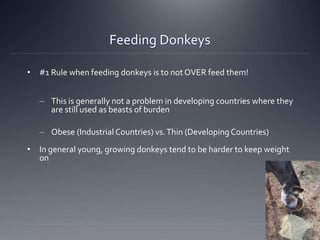
• #1 Rule when feeding donkeys is to not OVER feed them!
– This is generally not a problem in developing countries where they
are still used as beasts of burden
– Obese (Industrial Countries) vs.Thin (DevelopingCountries)
• In general young, growing donkeys tend to be harder to keep weight
on
Feeding Donkeys
• In 2007 Nutritional Requirements for Donkeys were included in the
National Research Council for Nutrient Requirements of Horses 6th edition
• However, little to no nutritional information is available for feeding mules
• Similar to feeding a horse, one should consider the following factors:
– Age (young, mature, old)
– Level ofWork (amount of exercise in hours and how often during the week)
– Environment (severe weather such as below 0 temperatures, wind, rain and
snow, access to shelters can all create an increase in energy demands)
– Weight of the animal (feed on weight not volume)
Donkey Diet Info
 Donkeys have been compared to small ruminants in their ability to
digest poor quality feeds, meaning feeds/forages that are high in fiber
 Tend to think donkeys and mules can survive on less feed when
compared to a horse
 Diets in developing countries are very high in fiber and low in protein
and energy
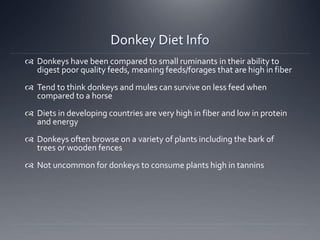
 Donkeys often browse on a variety of plants including the bark of
trees or wooden fences
 Not uncommon for donkeys to consume plants high in tannins
Donkey Diet Info cont.
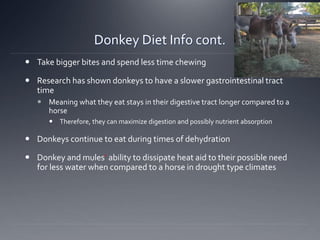
 Take bigger bites and spend less time chewing
 Research has shown donkeys to have a slower gastrointestinal tract
time
 Meaning what they eat stays in their digestive tract longer compared to a
horse
 Therefore, they can maximize digestion and possibly nutrient absorption
 Donkeys continue to eat during times of dehydration
 Donkey and mules’ ability to dissipate heat aid to their possible need
for less water when compared to a horse in drought type climates
Tips for Feeding Donkeys
 Avoid over feeding donkeys
 Monitor their grass intake
 Consider limiting grazing especially for miniature and standard donkeys to the
morning
 Feed based on weight and not volume
 High Fiber and Fat diets work well for both Mules and Donkeys
 Don’t over feed Carbohydrates and Protein
 Donkeys have a unique ability to recycle high levels of urea
 Don’t attempt to rapidly decrease weight in both; can lead to hyperlipemia
 Watch for laminitis in hind limbs prior to front
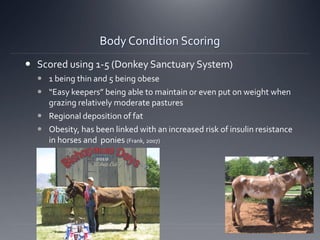
Body Condition Scoring
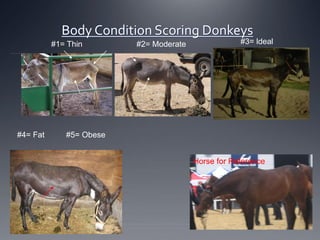
 Scored using 1-5 (Donkey Sanctuary System)
 1 being thin and 5 being obese
 “Easy keepers” being able to maintain or even put on weight when
grazing relatively moderate pastures
 Regional deposition of fat
 Obesity, has been linked with an increased risk of insulin resistance
in horses and ponies (Frank, 2007)
Body Condition Scoring Donkeys
1
#2= Moderate#1= Thin #3= ldeal
#5= Obese#4= Fat
Horse for Reference
Nutritional Conditions in Donkeys:
Gastric Ulcers
 Burden et al. 2008 found:
 41% (n= 533) of necropsied donkeys in 2 yrs had ulcers
 Ulcers more likely to occur in donkeys consuming cereal
based diets (56%) vs forage only (34 %)
 No significant difference seen in donkeys treated with
NSAID’s and presence of ulcers
 Increased chance for ulcers when hyperlipemia has occurred
(63%) vs no occurrence (36%)
Nutritional Conditions in Donkeys: Insulin Resistance
 Described as an adaptative response when energy is limited (Frank, 2007; Kronfeld
et al., 2005; Jenkins et al., 1987)
 Donkeys traditionally lived in an arid environment consumed high forage
diets
 High Forage diets = High in Structural CHO’s and low in NS CHO’s
 High starch rations promote insulin resistance (Hoffman et al., 2003)
 Feast or Famine?
 Typically, donkeys in developing countries experience this phenomena
 Thrifty Genotype?
 Adaptative ability to conserve energy, especially glucose, in times of negative
energy balances
(Kronfeld et al., 2005; Jenkins et al., 1987; Nell, 1962).
Nutritional Conditions in Donkeys: Insulin Resistance
 Negative energy balance (hypoglycemia) during famine
 Decrease Insulin Sensitivity (homeostatic mechanism)
 Maintains normglycemia
 Insulin peaks twice over a period of time
 Insulin aids in glucose transport activity by stimulating glucose
transport proteins
 Tissue less sensitive to Insulin
 Glucose preserved for vital organs and tissues
 Decreases lipid/adipose tissue
 Increases circulating lipids (esp. [triglycerides]) =
hyperlipidemia
(Hoffman et al., 2003; McLean et al., 2010,Treiber et al., 2005)
Nutritional Conditions in Donkeys:
Diagnosing Hyperlipidemia
 Presences of elevated lipid concentrations in blood associated with negative
energy balance & physiologic stress (loss of companion or pregnancy)
 Diagnosis based on clinical signs vs. blood chemistry
 Blood Chemistry:
 Triglyceride (TG) < 500 mg/dL)
 Donkey 66.4 ± 34.2 mg/dL
 range: 23.5-144.0 mg/dL
 HorseTG 14- 77 mg/dL
 Fasted donkeys: 112.7 mg/dL
 Fed donkeys: 33.82 mg/dL
 Clinical Signs:
 Milky plasma samples, lethargy, decreased appetite, depression
(Dugat et al., 2010; McKenzie III, 2010)
Nutritional Conditions in Donkeys:
Diagnosing Hyperlipidemia
 Risk factors for developing hyperlipidemia
 Obesity
 Pregnancy
 Stress
 Diseases
 Insulin Resistance
Nutritional Conditions in Donkeys:
Diagnosing Hyperlipemia
 Common disorder in donkeys due to high levels/
concentrations of serum triglycerides concentrations, a
condition that occurs after hyperlipdemia, visible lipemia and
fatty infiltration of the liver or multiple organ systems
 TG > 500 mg/dL
 Females and obese higher risk for hyperlipemia
 60-80% mortality rate
 Prevalence 3-5 % general population
 11-18% inpatient populations
Burden et al., 2011; McKenzie III, 2011
1) Fasting/
- Energy
balance
2) Increase
lipase
3) Decrease
Insulin
4) HIGH
[FFA]
5) Liver
“re-sterifies” FFAS
to (VLVDL)
6)VLDL in
bloodstream =
hyperlipidemia
7) Continued
increase inVLDL
production =
hyperlipemia
8) Hyperlipemia
can lead to
liver failure
Nutritional Conditions in Donkeys:
Diagnosing Hyperlipemia
 Risk factors for developing hyperlipemia
 Age (older donkeys more likely)
 Environment/area where donkey is kept
 Feeding concentrates
Nutritional Conditions in Donkeys: Preventing
hyperlipidemias
 Avoid stressful situations when possible
 Donkeys like partners, keep the partner with the donkey when possible
 Slowly introduce new and stressful situations
 Example: hauling long distances, try short first, slowly change feeding
routines
 Avoid Negative Energy Balances
 Decrease weight slowly
 Attempt to improve insulin sensitivity
 Consider fat enriched diets (improvesTG clearance), exercise,
pharmacologic approach (at risk animals)
(McKenzie III, 2010)
Conclusion
 Donkeys may have an adaptive ability regardless of body
condition, to conserve energy when compared to horses
 Owners should consider:
 Nutritional value
 Quantity of diets being fed to donkeys (FEMALE’s)
 Avoid obesity and metabolic conditions that could lead to
adverse conditions such as hyperlipemia or laminitis
(Burnham, 2002; June et al., 1992)
Resources
 AAEP Proceedings
 www.ivis.org/proceedings/aaep/2002/910102000110.PDF
 www.ivis.org/proceedings/AAEP/2002/910102000102.PDF
 www.ivis.org/proceedings/aaep/2002/910102000115.PDF
 www.ivis.org/proceedings/aaep/2002/910102000113.PDF
 Burden, F.A., N. DuToit, E. Hazell-Smith, and A.F.Trawford. 2011.
Hyperlipemia in a population of aged donkeys: description, prevalance,
and potential risks factors. JVet Intern Med; 25: 1420-5.
 Donkey Sanctuary,
 http://www.thedonkeysanctuary.org.uk/
 Dugat, S.L.,T.S.Taylor, and N.S. Matthews. 2010. Values for
Triglycerides, Insulin, Cortisol, and ACTH in a herd of normal donkeys. J
EquineVet Sci (30) 3: 141-4.
 Forehead,A.J., Dobson, H., 1997. Plasma glucose and cortisol responses to exogenous insulin in fasted donkeys. Vet.
Sci. 62, 239-245.
Resources
 Frank, N., 2007. Insulin Resistance in Horses. In depth: Endocrinology.
Proceedings American Association of Equine Practitioners. 52, 51-54.
 Hoffman, R.M., Boston, R.C., Stefanovski, D., Kronfeld, D.S., Harris, P.A., 2003.
Obesity and diet affect glucose dynamics and insulin sensitivity inThoroughbred
geldings. J.Anim. Sci. 81, 2333-2335.
 Kronfeld, D.S.,Treiber, K.H., Hess,T.M., Boston, R.C., 2005. Insulin resistance in
the horse: definition, detection, and dietetics. J. Anim. Sci. E. Suppl. 83, E22-23.
 InternationalVeterinary Information Servicehttp://www.ivis.org/home.asp
 McKenzie III, H. Equine Hyperlipidemias,Vet Clin Equine 27 (2011) 59-72.
 McLean, A.K., B.D. Nielsen, M.Yokoyama, C.I. O’Connor, S. Hengemuehle,
W.Wang, R. Geor, and P.A. Harris. 2009. Insulin Resistance in Standard Donkeys
(Equus asinus) ofThree Body Conditions-Thin, Moderate, and Obese. Jrnl of
EquineVet Sci. May 29(5): 406-7.
THANKYOU!

Donkeynutrition

  • 2.
    Introduction to Feedingand Care of Donkeys • Very little of what we know about the care of donkeys and mules comes from research • The information that will be shared today comes from both practical experience dealing with mules and donkeys for over twenty years and some scientific studies • We will discuss management and common nutritional diseases associated with donkeys • Ulcers • Insulin Resistances • Hyperlipidemia • Hyperlipemia
  • 3.
    Feeding Donkeys • #1Rule when feeding donkeys is to not OVER feed them! – This is generally not a problem in developing countries where they are still used as beasts of burden – Obese (Industrial Countries) vs.Thin (DevelopingCountries) • In general young, growing donkeys tend to be harder to keep weight on
  • 4.
    Feeding Donkeys • In2007 Nutritional Requirements for Donkeys were included in the National Research Council for Nutrient Requirements of Horses 6th edition • However, little to no nutritional information is available for feeding mules • Similar to feeding a horse, one should consider the following factors: – Age (young, mature, old) – Level ofWork (amount of exercise in hours and how often during the week) – Environment (severe weather such as below 0 temperatures, wind, rain and snow, access to shelters can all create an increase in energy demands) – Weight of the animal (feed on weight not volume)
  • 5.
    Donkey Diet Info Donkeys have been compared to small ruminants in their ability to digest poor quality feeds, meaning feeds/forages that are high in fiber  Tend to think donkeys and mules can survive on less feed when compared to a horse  Diets in developing countries are very high in fiber and low in protein and energy  Donkeys often browse on a variety of plants including the bark of trees or wooden fences  Not uncommon for donkeys to consume plants high in tannins
  • 6.
    Donkey Diet Infocont.  Take bigger bites and spend less time chewing  Research has shown donkeys to have a slower gastrointestinal tract time  Meaning what they eat stays in their digestive tract longer compared to a horse  Therefore, they can maximize digestion and possibly nutrient absorption  Donkeys continue to eat during times of dehydration  Donkey and mules’ ability to dissipate heat aid to their possible need for less water when compared to a horse in drought type climates
  • 7.
    Tips for FeedingDonkeys  Avoid over feeding donkeys  Monitor their grass intake  Consider limiting grazing especially for miniature and standard donkeys to the morning  Feed based on weight and not volume  High Fiber and Fat diets work well for both Mules and Donkeys  Don’t over feed Carbohydrates and Protein  Donkeys have a unique ability to recycle high levels of urea  Don’t attempt to rapidly decrease weight in both; can lead to hyperlipemia  Watch for laminitis in hind limbs prior to front
  • 8.
    Body Condition Scoring Scored using 1-5 (Donkey Sanctuary System)  1 being thin and 5 being obese  “Easy keepers” being able to maintain or even put on weight when grazing relatively moderate pastures  Regional deposition of fat  Obesity, has been linked with an increased risk of insulin resistance in horses and ponies (Frank, 2007)
  • 9.
    Body Condition ScoringDonkeys 1 #2= Moderate#1= Thin #3= ldeal #5= Obese#4= Fat Horse for Reference
  • 10.
    Nutritional Conditions inDonkeys: Gastric Ulcers  Burden et al. 2008 found:  41% (n= 533) of necropsied donkeys in 2 yrs had ulcers  Ulcers more likely to occur in donkeys consuming cereal based diets (56%) vs forage only (34 %)  No significant difference seen in donkeys treated with NSAID’s and presence of ulcers  Increased chance for ulcers when hyperlipemia has occurred (63%) vs no occurrence (36%)
  • 11.
    Nutritional Conditions inDonkeys: Insulin Resistance  Described as an adaptative response when energy is limited (Frank, 2007; Kronfeld et al., 2005; Jenkins et al., 1987)  Donkeys traditionally lived in an arid environment consumed high forage diets  High Forage diets = High in Structural CHO’s and low in NS CHO’s  High starch rations promote insulin resistance (Hoffman et al., 2003)  Feast or Famine?  Typically, donkeys in developing countries experience this phenomena  Thrifty Genotype?  Adaptative ability to conserve energy, especially glucose, in times of negative energy balances (Kronfeld et al., 2005; Jenkins et al., 1987; Nell, 1962).
  • 12.
    Nutritional Conditions inDonkeys: Insulin Resistance  Negative energy balance (hypoglycemia) during famine  Decrease Insulin Sensitivity (homeostatic mechanism)  Maintains normglycemia  Insulin peaks twice over a period of time  Insulin aids in glucose transport activity by stimulating glucose transport proteins  Tissue less sensitive to Insulin  Glucose preserved for vital organs and tissues  Decreases lipid/adipose tissue  Increases circulating lipids (esp. [triglycerides]) = hyperlipidemia (Hoffman et al., 2003; McLean et al., 2010,Treiber et al., 2005)
  • 13.
    Nutritional Conditions inDonkeys: Diagnosing Hyperlipidemia  Presences of elevated lipid concentrations in blood associated with negative energy balance & physiologic stress (loss of companion or pregnancy)  Diagnosis based on clinical signs vs. blood chemistry  Blood Chemistry:  Triglyceride (TG) < 500 mg/dL)  Donkey 66.4 ± 34.2 mg/dL  range: 23.5-144.0 mg/dL  HorseTG 14- 77 mg/dL  Fasted donkeys: 112.7 mg/dL  Fed donkeys: 33.82 mg/dL  Clinical Signs:  Milky plasma samples, lethargy, decreased appetite, depression (Dugat et al., 2010; McKenzie III, 2010)
  • 14.
    Nutritional Conditions inDonkeys: Diagnosing Hyperlipidemia  Risk factors for developing hyperlipidemia  Obesity  Pregnancy  Stress  Diseases  Insulin Resistance
  • 15.
    Nutritional Conditions inDonkeys: Diagnosing Hyperlipemia  Common disorder in donkeys due to high levels/ concentrations of serum triglycerides concentrations, a condition that occurs after hyperlipdemia, visible lipemia and fatty infiltration of the liver or multiple organ systems  TG > 500 mg/dL  Females and obese higher risk for hyperlipemia  60-80% mortality rate  Prevalence 3-5 % general population  11-18% inpatient populations Burden et al., 2011; McKenzie III, 2011
  • 16.
    1) Fasting/ - Energy balance 2)Increase lipase 3) Decrease Insulin 4) HIGH [FFA] 5) Liver “re-sterifies” FFAS to (VLVDL) 6)VLDL in bloodstream = hyperlipidemia 7) Continued increase inVLDL production = hyperlipemia 8) Hyperlipemia can lead to liver failure
  • 17.
    Nutritional Conditions inDonkeys: Diagnosing Hyperlipemia  Risk factors for developing hyperlipemia  Age (older donkeys more likely)  Environment/area where donkey is kept  Feeding concentrates
  • 18.
    Nutritional Conditions inDonkeys: Preventing hyperlipidemias  Avoid stressful situations when possible  Donkeys like partners, keep the partner with the donkey when possible  Slowly introduce new and stressful situations  Example: hauling long distances, try short first, slowly change feeding routines  Avoid Negative Energy Balances  Decrease weight slowly  Attempt to improve insulin sensitivity  Consider fat enriched diets (improvesTG clearance), exercise, pharmacologic approach (at risk animals) (McKenzie III, 2010)
  • 19.
    Conclusion  Donkeys mayhave an adaptive ability regardless of body condition, to conserve energy when compared to horses  Owners should consider:  Nutritional value  Quantity of diets being fed to donkeys (FEMALE’s)  Avoid obesity and metabolic conditions that could lead to adverse conditions such as hyperlipemia or laminitis (Burnham, 2002; June et al., 1992)
  • 20.
    Resources  AAEP Proceedings www.ivis.org/proceedings/aaep/2002/910102000110.PDF  www.ivis.org/proceedings/AAEP/2002/910102000102.PDF  www.ivis.org/proceedings/aaep/2002/910102000115.PDF  www.ivis.org/proceedings/aaep/2002/910102000113.PDF  Burden, F.A., N. DuToit, E. Hazell-Smith, and A.F.Trawford. 2011. Hyperlipemia in a population of aged donkeys: description, prevalance, and potential risks factors. JVet Intern Med; 25: 1420-5.  Donkey Sanctuary,  http://www.thedonkeysanctuary.org.uk/  Dugat, S.L.,T.S.Taylor, and N.S. Matthews. 2010. Values for Triglycerides, Insulin, Cortisol, and ACTH in a herd of normal donkeys. J EquineVet Sci (30) 3: 141-4.  Forehead,A.J., Dobson, H., 1997. Plasma glucose and cortisol responses to exogenous insulin in fasted donkeys. Vet. Sci. 62, 239-245.
  • 21.
    Resources  Frank, N.,2007. Insulin Resistance in Horses. In depth: Endocrinology. Proceedings American Association of Equine Practitioners. 52, 51-54.  Hoffman, R.M., Boston, R.C., Stefanovski, D., Kronfeld, D.S., Harris, P.A., 2003. Obesity and diet affect glucose dynamics and insulin sensitivity inThoroughbred geldings. J.Anim. Sci. 81, 2333-2335.  Kronfeld, D.S.,Treiber, K.H., Hess,T.M., Boston, R.C., 2005. Insulin resistance in the horse: definition, detection, and dietetics. J. Anim. Sci. E. Suppl. 83, E22-23.  InternationalVeterinary Information Servicehttp://www.ivis.org/home.asp  McKenzie III, H. Equine Hyperlipidemias,Vet Clin Equine 27 (2011) 59-72.  McLean, A.K., B.D. Nielsen, M.Yokoyama, C.I. O’Connor, S. Hengemuehle, W.Wang, R. Geor, and P.A. Harris. 2009. Insulin Resistance in Standard Donkeys (Equus asinus) ofThree Body Conditions-Thin, Moderate, and Obese. Jrnl of EquineVet Sci. May 29(5): 406-7.
  • 22.