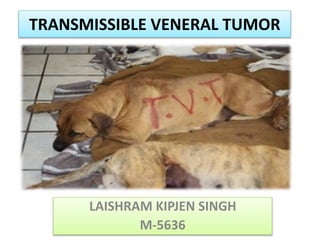
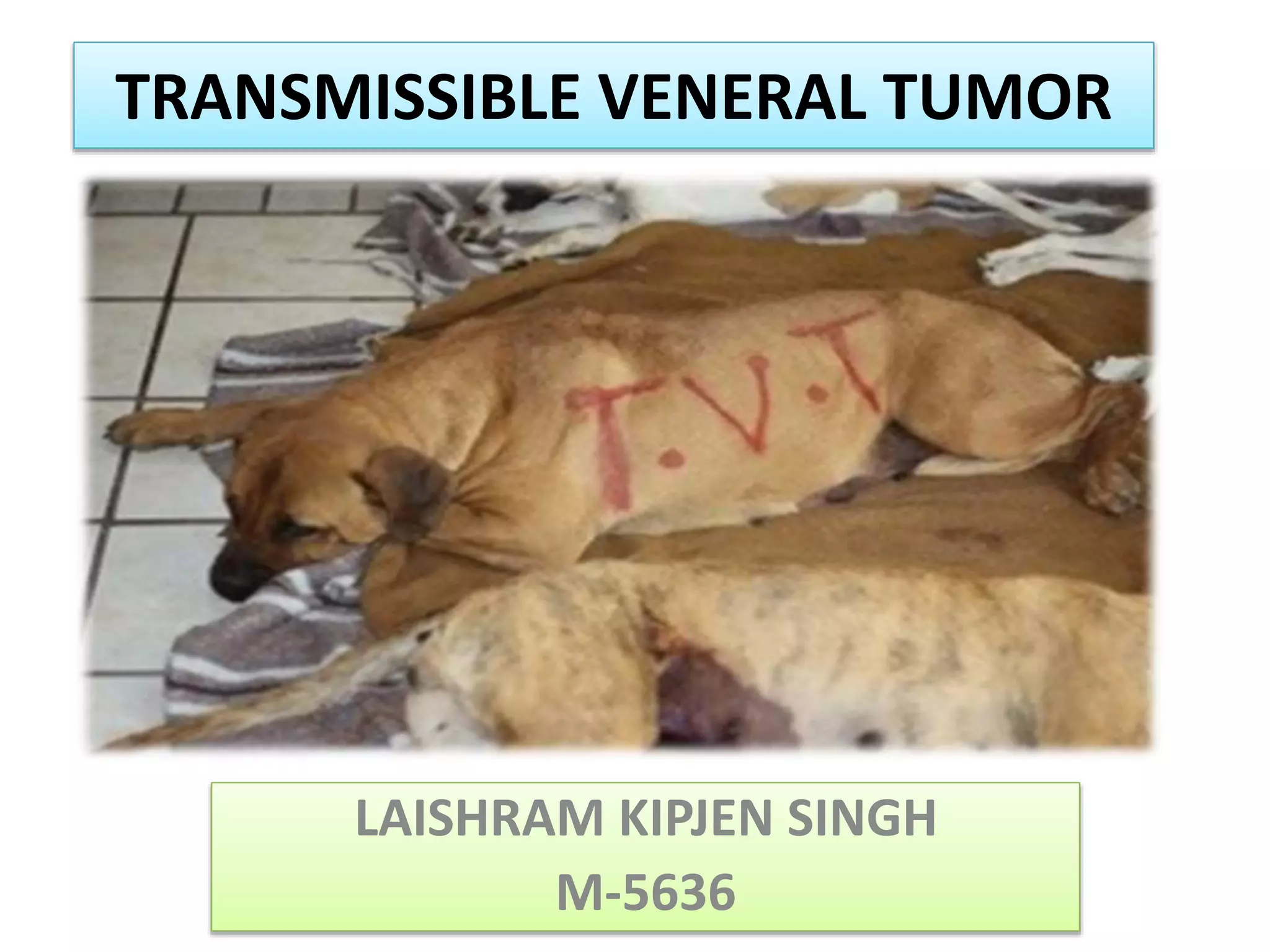
TRANSMISSIBLE VENERAL TUMOR
LAISHRAM KIPJEN SINGH
M-5636
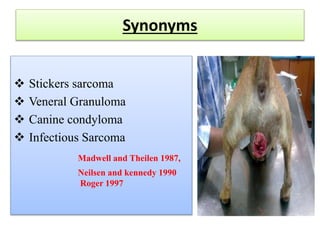
Synonyms
 Stickers sarcoma
 Veneral Granuloma
 Canine condyloma
 Infectious Sarcoma
Madwell and Theilen 1987,
Neilsen and kennedy 1990
Roger 1997
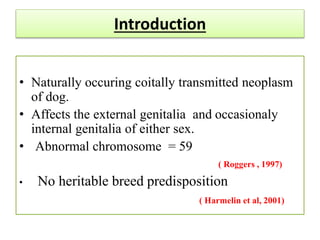
Introduction
• Naturally occuring coitally transmitted neoplasm
of dog.
• Affects the external genitalia and occasionaly
internal genitalia of either sex.
• Abnormal chromosome = 59
( Roggers , 1997)
• No heritable breed predisposition
( Harmelin et al, 2001)
Incidence
• Prevalent in temperate climates.
(Rogers, 1997).
• Uncontrolled breeding practice and free roaming dogs
responsible for most common tumor in india.
(Singh etal.,1991)
• In India: reported 23-43% of the total numbers of tumors
in canine population . (Gandotra et al..,1993)
• Age -2-5 years
( Pandey et al.., 1997)
• In Punjab : 23.5 % - 28.3% ( Singh,1993 & Gandotra et al, 1993)
• Young, intact ,sexually active dogs .
Etiology and transmission
• Origin of cell is unknown but assumed to be an undifferentiated
round cell neoplasm of reticulo endothelial origin.
(Sandunsky et al.,1987, Mozos et al.,1996, Marchal et al, 1997)
• First tumor to be transmitted experimentally by Nowinsky in 1876
(Yang etal..,1991)
• Growth of tumour appears 15 to 60 days after implantation
(Lombard et al, 1968 and Moulton et al, 1978).
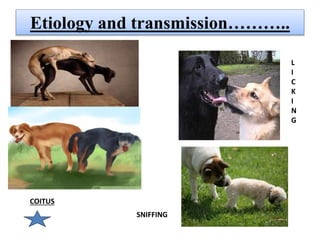
• Exfoliation and transplantation of neoplastic cells due to physical contact
during mating or licking of affected area is responsible for spread onto
genital, oral or nasal mucosa.
(Cohen 1985 and johnston 1991 )
Etiology and transmission………..
L
I
C
K
I
N
G
SNIFFING
COITUS
Metastasis
• < 5-17 % of cases
(Richardson, 1981; Rogers, 1997)
• S/C tissue, skin, lymph nodes, eyes, oral mucosa,
tonsils, hypophysis, brain , bone marrow ,liver, spleen,
peritoneum,
( Moulton, 1978)
• Male (16%) compared to female (2%)
(Boscos et al.,2004)
Gross characteristics
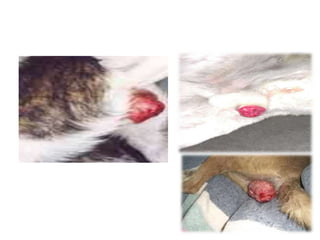
• Small pink to red, 1 mm to 3 mm diameter nodules can be observed 2 or 3
weeks after transplantation.
• Initial lesions – superficial dermo epidermal or pedunculated.
• Multiple nodules fuse – larger, red, haemorrhagic, cauliflower like, friable
mass ( 5cm – 7cm)
• Progress deeper in to the mucosa – multilobular s/c lesion ( 10-15 cm)
• Tumors bleed easily, become larger, normally ulcerate and contaminate
( Hoque, 2002)
Diagnosis
a) History
• Complaint of serosanguineous &
haemorrhagic genital discharge.
• Licking of external genitalia or
protusion of mass.
• Sneezing or epistaxis
Current therapy in
Theriogenology , David A.
Morrow 1986 2nd
edition…Tumors of the
canine reproductive tract
page 527
Diagnosis………………..
b) CLINICAL SIGNS
Male :
caudal part of the glans penis frrom the crura to the bulbus
glandis
occasionally on the prepuce.
phimosis
mass protrude from the penis.
(Das et al, 2000)
Female:
junction between vestibule and caud al vagina
rarely interfere with micturition
haemorrhagic vulvar discharge
if in vagina protrudes from vulva
Extra genital localization
• Signs depending on anatomical location of the tumor
 Epiphora
 Halitosis and tooth loss
 Exophthalmos
 Skin bumps
 Facial
 oral deformation along with regional lymph node
(Roggers 1997)
Diagnosis……………..
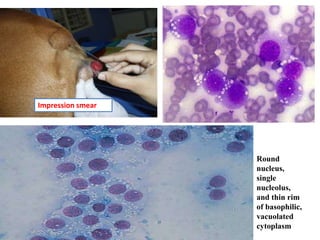
c) Exfoliative vaginal cytology: -
 round to oval cells with large nuclei containing
prominent nucleoli
 eosinophilic vacuolated thin cytoplasm
 nucleus to cytoplasm ratio is higher
d) Abnormal no. of Chromosome.
e) Haematobiological examination- polycythaemia
(Withrow and Mc Ewen, 1989)
f) PCR : Insertion of LINE at 5' end of TVT cell c-myc gene
• Harris Haematoxylin and Eosin
• Wright-Giemsa (WG)
• May-Grunwald-Giemsa
• Leishman-Giemsa
• PAP stain
• New methylene blue
Round
nucleus,
single
nucleolus,
and thin rim
of basophilic,
vacuolated
cytoplasm
Impression smear
Treatment
• Chemotherapy, Surgical excision, Radiotherapy and
Immunotherapy
A) Chemotherapy:- most effective and practical therapy
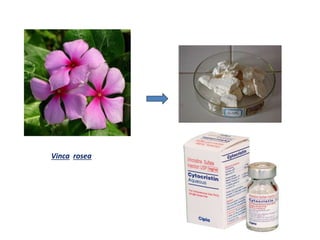
Vincristine: most frequently used drug
(Nak et al, 2005)
 Least Recurrence
 good response
 Least side effects
 Initial stages of progression (<1 yr) :Cure rate
approaches 100%
(Boscos and Ververidis, 2004)
VINCRISTINE
Vinca rosea
Treatment……………..
• Dose- 0.025mg/kg IV-once a week or 0.5-0.7 mg/ m2 BSA
 2 to 8 injections – completely remission 90% of treated cases
(Calvet et al 1982 and Roggers 1997)
DEMERITS
 Myelosupression –leucopenia( if WBC < 4,000 mm3 administration should
be delayed 3-4 days , reduced to 25% of the initial dose)
(Calvet et al,1983)
 Gastro intestinal problems – vomitting (5-7%)
 Paresis due to peripheral neuropathy
 Local tissue lesions caused by extravasation of the drug during IV
application.
 High tetrazoospermia and asthenozoospermia, increase in sperm mid- piece
and tail abnormalities.
Total sperm count decreased to low values (<200 x106) ( Gobello et al 2002)
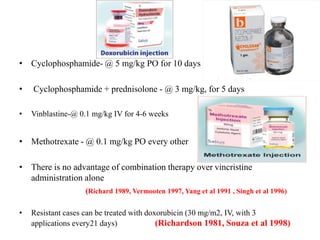
• Cyclophosphamide- @ 5 mg/kg PO for 10 days
• Cyclophosphamide + prednisolone - @ 3 mg/kg, for 5 days
• Vinblastine-@ 0.1 mg/kg IV for 4-6 weeks
• Methotrexate - @ 0.1 mg/kg PO every other
• There is no advantage of combination therapy over vincristine
administration alone
(Richard 1989, Vermooten 1997, Yang et al 1991 , Singh et al 1996)
• Resistant cases can be treated with doxorubicin (30 mg/m2, IV, with 3
applications every21 days) (Richardson 1981, Souza et al 1998)
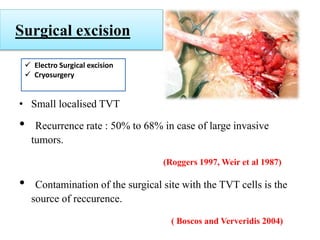
Surgical excision
• Small localised TVT
• Recurrence rate : 50% to 68% in case of large invasive
tumors.
(Roggers 1997, Weir et al 1987)
• Contamination of the surgical site with the TVT cells is the
source of reccurence.
( Boscos and Ververidis 2004)
 Electro Surgical excision
 Cryosurgery
Radiotherapy
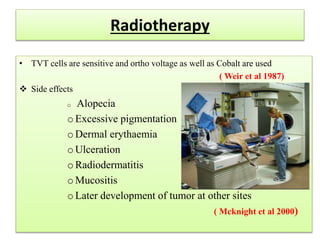
• TVT cells are sensitive and ortho voltage as well as Cobalt are used
( Weir et al 1987)
 Side effects
o Alopecia
oExcessive pigmentation
oDermal erythaemia
oUlceration
oRadiodermatitis
oMucositis
oLater development of tumor at other sites
( Mcknight et al 2000)
Immunotherapy
 Intralesional application of Calmette-Guérin's bacillus (BCG) was
used for three weeks with sporadic success.
 Biotherapy has unfortunately resulted in a high rate of recurrence
(Richardson 1981, Vermooten 1987, amber et al 1990)
 Recurrences occur after immunotherapy using staphylococcus protein
A, BCG or a vaccine made from tumoral cells
( Roggers 1997)
TRANSMISSIBLE VENERAL TUMOR

TRANSMISSIBLE VENERAL TUMOR

  • 1.
  • 2.
    Synonyms  Stickers sarcoma Veneral Granuloma  Canine condyloma  Infectious Sarcoma Madwell and Theilen 1987, Neilsen and kennedy 1990 Roger 1997
  • 3.
    Introduction • Naturally occuringcoitally transmitted neoplasm of dog. • Affects the external genitalia and occasionaly internal genitalia of either sex. • Abnormal chromosome = 59 ( Roggers , 1997) • No heritable breed predisposition ( Harmelin et al, 2001)
  • 4.
    Incidence • Prevalent intemperate climates. (Rogers, 1997). • Uncontrolled breeding practice and free roaming dogs responsible for most common tumor in india. (Singh etal.,1991) • In India: reported 23-43% of the total numbers of tumors in canine population . (Gandotra et al..,1993) • Age -2-5 years ( Pandey et al.., 1997) • In Punjab : 23.5 % - 28.3% ( Singh,1993 & Gandotra et al, 1993) • Young, intact ,sexually active dogs .
  • 5.
    Etiology and transmission •Origin of cell is unknown but assumed to be an undifferentiated round cell neoplasm of reticulo endothelial origin. (Sandunsky et al.,1987, Mozos et al.,1996, Marchal et al, 1997) • First tumor to be transmitted experimentally by Nowinsky in 1876 (Yang etal..,1991) • Growth of tumour appears 15 to 60 days after implantation (Lombard et al, 1968 and Moulton et al, 1978). • Exfoliation and transplantation of neoplastic cells due to physical contact during mating or licking of affected area is responsible for spread onto genital, oral or nasal mucosa. (Cohen 1985 and johnston 1991 )
  • 6.
  • 7.
    Metastasis • < 5-17% of cases (Richardson, 1981; Rogers, 1997) • S/C tissue, skin, lymph nodes, eyes, oral mucosa, tonsils, hypophysis, brain , bone marrow ,liver, spleen, peritoneum, ( Moulton, 1978) • Male (16%) compared to female (2%) (Boscos et al.,2004)
  • 8.
    Gross characteristics • Smallpink to red, 1 mm to 3 mm diameter nodules can be observed 2 or 3 weeks after transplantation. • Initial lesions – superficial dermo epidermal or pedunculated. • Multiple nodules fuse – larger, red, haemorrhagic, cauliflower like, friable mass ( 5cm – 7cm) • Progress deeper in to the mucosa – multilobular s/c lesion ( 10-15 cm) • Tumors bleed easily, become larger, normally ulcerate and contaminate ( Hoque, 2002)
  • 10.
    Diagnosis a) History • Complaintof serosanguineous & haemorrhagic genital discharge. • Licking of external genitalia or protusion of mass. • Sneezing or epistaxis Current therapy in Theriogenology , David A. Morrow 1986 2nd edition…Tumors of the canine reproductive tract page 527
  • 11.
    Diagnosis……………….. b) CLINICAL SIGNS Male: caudal part of the glans penis frrom the crura to the bulbus glandis occasionally on the prepuce. phimosis mass protrude from the penis. (Das et al, 2000) Female: junction between vestibule and caud al vagina rarely interfere with micturition haemorrhagic vulvar discharge if in vagina protrudes from vulva
  • 13.
    Extra genital localization •Signs depending on anatomical location of the tumor  Epiphora  Halitosis and tooth loss  Exophthalmos  Skin bumps  Facial  oral deformation along with regional lymph node (Roggers 1997)
  • 15.
    Diagnosis…………….. c) Exfoliative vaginalcytology: -  round to oval cells with large nuclei containing prominent nucleoli  eosinophilic vacuolated thin cytoplasm  nucleus to cytoplasm ratio is higher d) Abnormal no. of Chromosome. e) Haematobiological examination- polycythaemia (Withrow and Mc Ewen, 1989) f) PCR : Insertion of LINE at 5' end of TVT cell c-myc gene
  • 16.
    • Harris Haematoxylinand Eosin • Wright-Giemsa (WG) • May-Grunwald-Giemsa • Leishman-Giemsa • PAP stain • New methylene blue
  • 17.
    Round nucleus, single nucleolus, and thin rim ofbasophilic, vacuolated cytoplasm Impression smear
  • 18.
    Treatment • Chemotherapy, Surgicalexcision, Radiotherapy and Immunotherapy A) Chemotherapy:- most effective and practical therapy Vincristine: most frequently used drug (Nak et al, 2005)  Least Recurrence  good response  Least side effects  Initial stages of progression (<1 yr) :Cure rate approaches 100% (Boscos and Ververidis, 2004)
  • 19.
  • 20.
    Treatment…………….. • Dose- 0.025mg/kgIV-once a week or 0.5-0.7 mg/ m2 BSA  2 to 8 injections – completely remission 90% of treated cases (Calvet et al 1982 and Roggers 1997) DEMERITS  Myelosupression –leucopenia( if WBC < 4,000 mm3 administration should be delayed 3-4 days , reduced to 25% of the initial dose) (Calvet et al,1983)  Gastro intestinal problems – vomitting (5-7%)  Paresis due to peripheral neuropathy  Local tissue lesions caused by extravasation of the drug during IV application.  High tetrazoospermia and asthenozoospermia, increase in sperm mid- piece and tail abnormalities. Total sperm count decreased to low values (<200 x106) ( Gobello et al 2002)
  • 21.
    • Cyclophosphamide- @5 mg/kg PO for 10 days • Cyclophosphamide + prednisolone - @ 3 mg/kg, for 5 days • Vinblastine-@ 0.1 mg/kg IV for 4-6 weeks • Methotrexate - @ 0.1 mg/kg PO every other • There is no advantage of combination therapy over vincristine administration alone (Richard 1989, Vermooten 1997, Yang et al 1991 , Singh et al 1996) • Resistant cases can be treated with doxorubicin (30 mg/m2, IV, with 3 applications every21 days) (Richardson 1981, Souza et al 1998)
  • 22.
    Surgical excision • Smalllocalised TVT • Recurrence rate : 50% to 68% in case of large invasive tumors. (Roggers 1997, Weir et al 1987) • Contamination of the surgical site with the TVT cells is the source of reccurence. ( Boscos and Ververidis 2004)  Electro Surgical excision  Cryosurgery
  • 23.
    Radiotherapy • TVT cellsare sensitive and ortho voltage as well as Cobalt are used ( Weir et al 1987)  Side effects o Alopecia oExcessive pigmentation oDermal erythaemia oUlceration oRadiodermatitis oMucositis oLater development of tumor at other sites ( Mcknight et al 2000)
  • 24.
    Immunotherapy  Intralesional applicationof Calmette-Guérin's bacillus (BCG) was used for three weeks with sporadic success.  Biotherapy has unfortunately resulted in a high rate of recurrence (Richardson 1981, Vermooten 1987, amber et al 1990)  Recurrences occur after immunotherapy using staphylococcus protein A, BCG or a vaccine made from tumoral cells ( Roggers 1997)