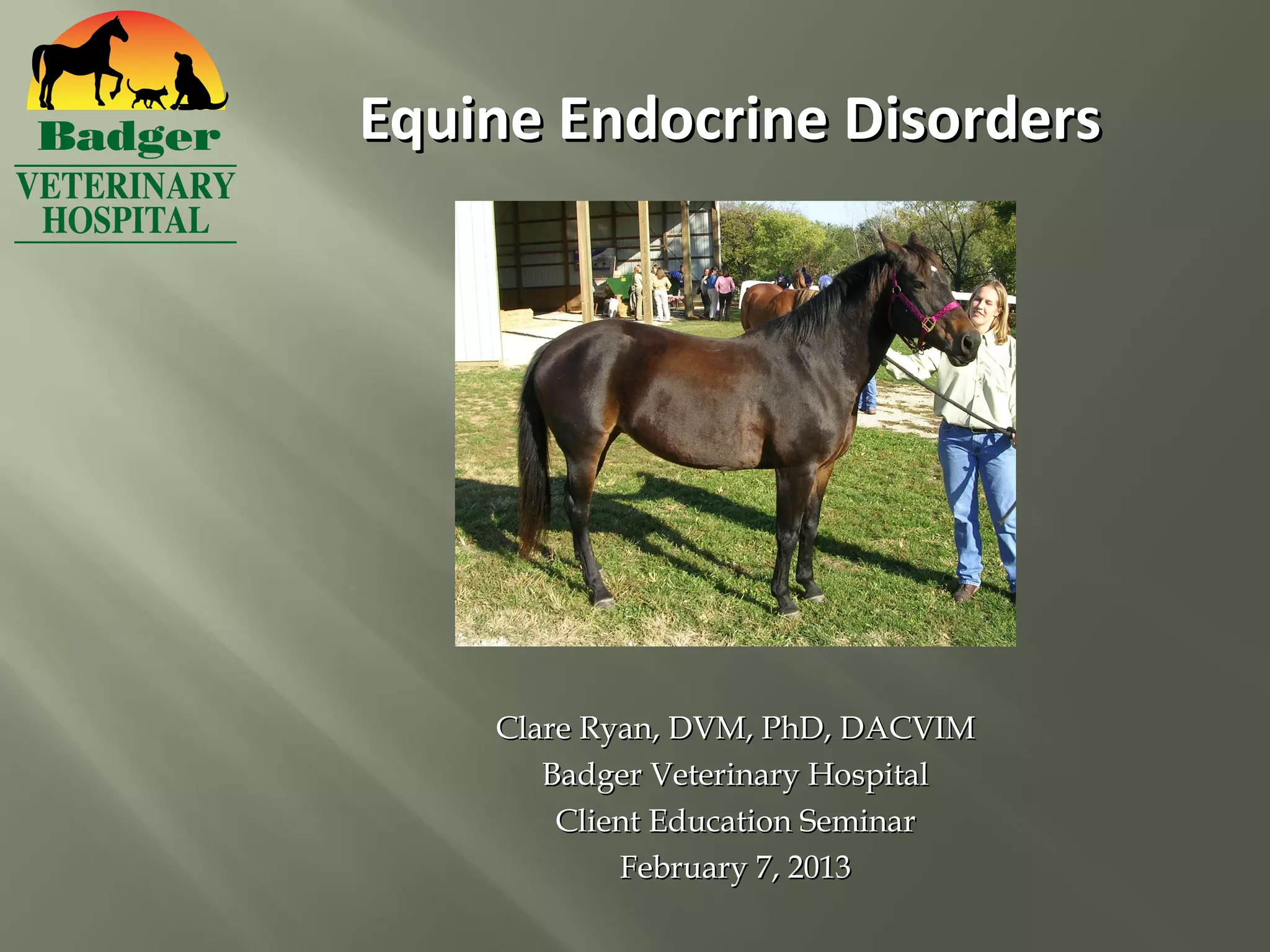
Equine Endocrine Disorders


    Clare Ryan, DVM, PhD, DACVIM
       Badger Veterinary Hospital
        Client Education Seminar
            February 7, 2013
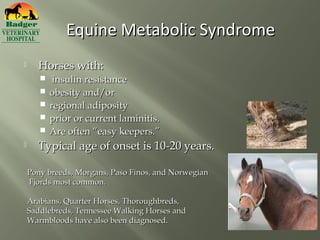
Equine Metabolic Syndrome
     Horses with:
           insulin resistance
          obesity and/or
          regional adiposity
          prior or current laminitis.
          Are often “easy keepers.”
     Typical age of onset is 10-20 years.

    Pony breeds, Morgans, Paso Finos, and Norwegian
    Fjords most common.

    Arabians, Quarter Horses, Thoroughbreds,
    Saddlebreds, Tennessee Walking Horses and
    Warmbloods have also been diagnosed.
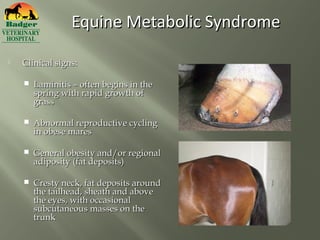
Equine Metabolic Syndrome

   Clinical signs:

       Laminitis – often begins in the
        spring with rapid growth of
        grass

       Abnormal reproductive cycling
        in obese mares

       General obesity and/or regional
        adiposity (fat deposits)

       Cresty neck, fat deposits around
        the tailhead, sheath and above
        the eyes, with occasional
        subcutaneous masses on the
        trunk
Testing

   Insulin/Glucose ratio
       EMS horses are “insulin- resistant”, so insulin levels are elevated


   Leptin

   Oral Sugar Test:
       feed Karo syrup, measure insulin and glucose


   Combined Glucose-Insulin Test:
       Give IV dextrose and insulin, measure glucose and insulin
Treatment

   Weight loss
     Restrictive diet
     Dry lot or grazing muzzle
     No access to rapidly growing/ spring* grass
     No grain or specially formulated low calorie
      supplement
     Levothyroxine (Thyro-L, thyroid supplement)


                               *can happen any time of year!
Treatment Goals

   Improve insulin sensitivity via:
     Weight loss
     Exercise
     Reduction in carbohydrate (NSC) consumption


   Continue to monitor weight carefully
   Repeat insulin: glucose testing
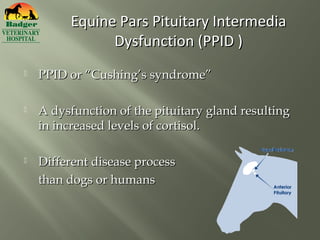
Equine Pars Pituitary Intermedia
               Dysfunction (PPID )
   PPID or “Cushing’s syndrome”

   A dysfunction of the pituitary gland resulting
    in increased levels of cortisol.

   Different disease process
    than dogs or humans
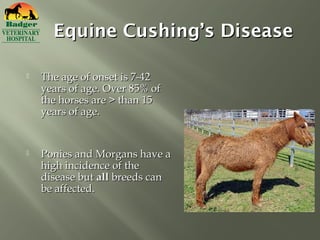
Equine Cushing’s Disease

   The age of onset is 7-42
    years of age. Over 85% of
    the horses are > than 15
    years of age.


   Ponies and Morgans have a
    high incidence of the
    disease but all breeds can
    be affected.
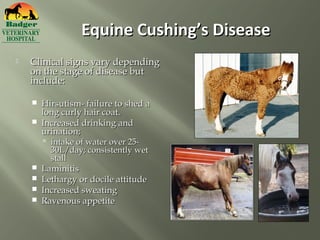
Equine Cushing’s Disease
   Clinical signs vary depending
    on the stage of disease but
    include:

       Hirsutism- failure to shed a
        long curly hair coat.
       Increased drinking and
        urination;
         intake of water over 25-
          30L/day; consistently wet
          stall
       Laminitis
       Lethargy or docile attitude
       Increased sweating
       Ravenous appetite
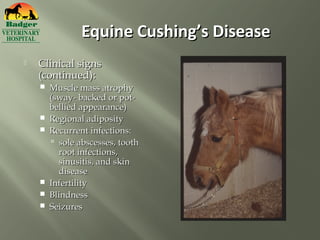
Equine Cushing’s Disease
   Clinical signs
    (continued):
       Muscle mass atrophy
        (sway- backed or pot-
        bellied appearance)
       Regional adiposity
       Recurrent infections:
         sole abscesses, tooth
          root infections,
          sinusitis, and skin
          disease
       Infertility
       Blindness
       Seizures
Testing For Cushing’s
   Dexamethasone supression test:
     Injection of dexamethasone given, measure cortisol in 19 hours
     Seasonal variation


   ACTH
     Single sample
     Seasonal variation


   TRH stimulation test
       If screening tests are normal but Cushing’s still suspected
Treatment for Cushing’s
   There is no cure

   Pergolide (Prascend®)
   Cyproheptadine
Supportive Care
   Keep adequate body condition
   Monitor clinical signs closely
   Retest to assess drug dose, progression of
    disease
   Management of feet with appropriate farrier
    care
Does this sound like your horse?


   Early diagnosis and treatment is the best way to prevent
    laminitis and other complications.

   Call to get more information about testing and treating
    your horse.
     Spring is the best time to test!
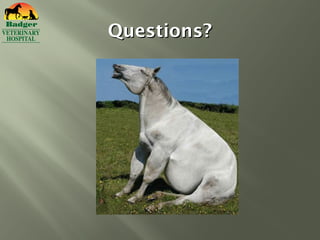
Questions?

Equine Endocrine Disorders slides

  • 1.
    Equine Endocrine Disorders Clare Ryan, DVM, PhD, DACVIM Badger Veterinary Hospital Client Education Seminar February 7, 2013
  • 2.
    Equine Metabolic Syndrome  Horses with:  insulin resistance  obesity and/or  regional adiposity  prior or current laminitis.  Are often “easy keepers.”  Typical age of onset is 10-20 years. Pony breeds, Morgans, Paso Finos, and Norwegian Fjords most common. Arabians, Quarter Horses, Thoroughbreds, Saddlebreds, Tennessee Walking Horses and Warmbloods have also been diagnosed.
  • 3.
    Equine Metabolic Syndrome  Clinical signs:  Laminitis – often begins in the spring with rapid growth of grass  Abnormal reproductive cycling in obese mares  General obesity and/or regional adiposity (fat deposits)  Cresty neck, fat deposits around the tailhead, sheath and above the eyes, with occasional subcutaneous masses on the trunk
  • 4.
    Testing  Insulin/Glucose ratio  EMS horses are “insulin- resistant”, so insulin levels are elevated  Leptin  Oral Sugar Test:  feed Karo syrup, measure insulin and glucose  Combined Glucose-Insulin Test:  Give IV dextrose and insulin, measure glucose and insulin
  • 5.
    Treatment  Weight loss  Restrictive diet  Dry lot or grazing muzzle  No access to rapidly growing/ spring* grass  No grain or specially formulated low calorie supplement  Levothyroxine (Thyro-L, thyroid supplement) *can happen any time of year!
  • 6.
    Treatment Goals  Improve insulin sensitivity via:  Weight loss  Exercise  Reduction in carbohydrate (NSC) consumption  Continue to monitor weight carefully  Repeat insulin: glucose testing
  • 7.
    Equine Pars PituitaryIntermedia Dysfunction (PPID )  PPID or “Cushing’s syndrome”  A dysfunction of the pituitary gland resulting in increased levels of cortisol.  Different disease process than dogs or humans
  • 8.
    Equine Cushing’s Disease  The age of onset is 7-42 years of age. Over 85% of the horses are > than 15 years of age.  Ponies and Morgans have a high incidence of the disease but all breeds can be affected.
  • 9.
    Equine Cushing’s Disease  Clinical signs vary depending on the stage of disease but include:  Hirsutism- failure to shed a long curly hair coat.  Increased drinking and urination;  intake of water over 25- 30L/day; consistently wet stall  Laminitis  Lethargy or docile attitude  Increased sweating  Ravenous appetite
  • 10.
    Equine Cushing’s Disease  Clinical signs (continued):  Muscle mass atrophy (sway- backed or pot- bellied appearance)  Regional adiposity  Recurrent infections:  sole abscesses, tooth root infections, sinusitis, and skin disease  Infertility  Blindness  Seizures
  • 11.
    Testing For Cushing’s  Dexamethasone supression test:  Injection of dexamethasone given, measure cortisol in 19 hours  Seasonal variation  ACTH  Single sample  Seasonal variation  TRH stimulation test  If screening tests are normal but Cushing’s still suspected
  • 12.
    Treatment for Cushing’s  There is no cure  Pergolide (Prascend®)  Cyproheptadine
  • 13.
    Supportive Care  Keep adequate body condition  Monitor clinical signs closely  Retest to assess drug dose, progression of disease  Management of feet with appropriate farrier care
  • 14.
    Does this soundlike your horse?  Early diagnosis and treatment is the best way to prevent laminitis and other complications.  Call to get more information about testing and treating your horse.  Spring is the best time to test!
  • 15.