Dr Jonah Kutto
Calf Coccidiosis
Bovine Coccidiosis
 General about coccidia
- Structure
- Life cycle
- Environmental factors for survival
 Eimeria in cattle
- Prevalence
- Clinical coccidiosis
- Sub-clinical coccidiosis
 Surveillance and control
R.EMEA.MKT.Africa.08.2015.0250
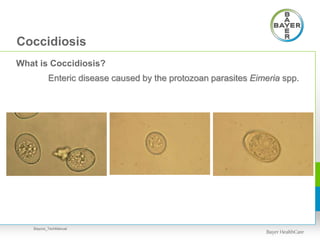
Coccidiosis
What is Coccidiosis?
Enteric disease caused by the protozoan parasites Eimeria spp.
Baycox_TechManual
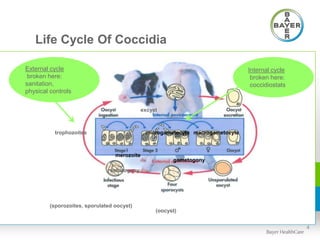
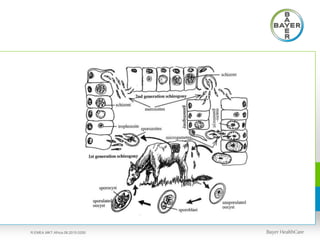
Life Cycle Of Coccidia
4
External cycle
broken here:
sanitation,
physical controls
Internal cycle
broken here:
coccidiostats
(oocyst)
(sporozoites, sporulated oocyst)
macrogametocytemicrogametocyte
excyst
merozoite
trophozoites
schizogony
gametogony
R.EMEA.MKT.Africa.08.2015.0250
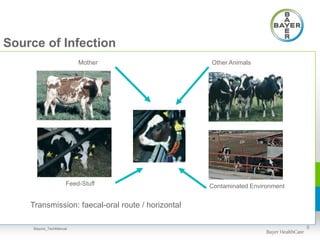
Source of Infection
6
Mother
Feed-Stuff
Other Animals
Contaminated Environment
Transmission: faecal-oral route / horizontal
Baycox_TechManual
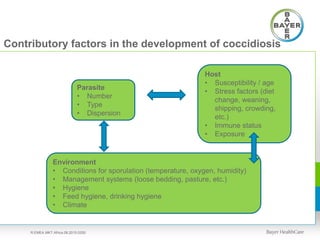
Contributory factors in the development of coccidiosis
Parasite
• Number
• Type
• Dispersion
Host
• Susceptibility / age
• Stress factors (diet
change, weaning,
shipping, crowding,
etc.)
• Immune status
• Exposure
Environment
• Conditions for sporulation (temperature, oxygen, humidity)
• Management systems (loose bedding, pasture, etc.)
• Hygiene
• Feed hygiene, drinking hygiene
• Climate
R.EMEA.MKT.Africa.08.2015.0250
Importance of environment for sporulation
Sporulation time: 2 – 3 days – or more
Sporulation depends on:
 Temperature
Optimum 20 - 25°C (13 - 32°C)
 Oxygen
Anaerobic conditions – no sporulation (but 10% of normal
O₂ - pressure is enough)
 Humidity
Must be > 60% r.h.
 Decaying conditions
Delay sporulation
R.EMEA.MKT.Africa.08.2015.0250
Importance of environment for survival (2)
 Oocyst survival is NOT possible
 Temperatures > 40°C
 Direct sunlight – 4 – 8 hours
 Humidity < 25% r.h.
 Decaying (rotting) conditions
 Cresol-based disinfectants
R.EMEA.MKT.Africa.08.2015.0250
Prevalence of Eimeria in cattle
 Prevalence relatively high:
- 2-100% of calves per herd – varying according to
management (dairy or beef)
- Most frequent in calves 3 weeks to 6 – 12 months
of age
- Few case reports for cows (calving pen)
- Shedding of oocysts at low levels common at all ages
 Transmission pathway: faecal-oral route
- Horizontal (calf-calf via licking, etc.; permanent pastures)
- Cow-calf (calving pen)
R.EMEA.MKT.Africa.08.2015.0250
Eimeria in cattle
 Intestinal protozoan parasite
 20 species worldwide
 Variable pathogenicity
 Variable reproductive
potential – e.g. E. bovis
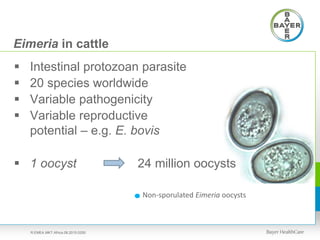
 1 oocyst 24 million oocysts
Non-sporulated Eimeria oocysts
R.EMEA.MKT.Africa.08.2015.0250
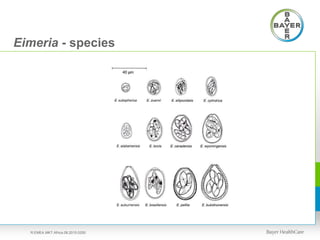
Eimeria - species
R.EMEA.MKT.Africa.08.2015.0250
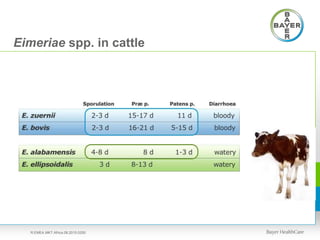
Eimeriae spp. in cattle
R.EMEA.MKT.Africa.08.2015.0250
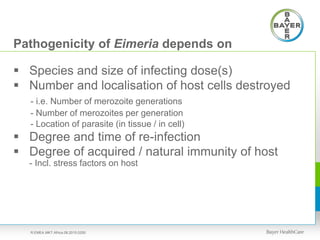
Pathogenicity of Eimeria depends on
 Species and size of infecting dose(s)
 Number and localisation of host cells destroyed
- i.e. Number of merozoite generations
- Number of merozoites per generation
- Location of parasite (in tissue / in cell)
 Degree and time of re-infection
 Degree of acquired / natural immunity of host
- Incl. stress factors on host
R.EMEA.MKT.Africa.08.2015.0250
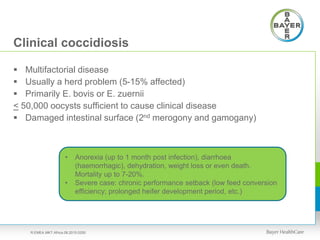
Clinical coccidiosis
 Multifactorial disease
 Usually a herd problem (5-15% affected)
 Primarily E. bovis or E. zuernii
< 50,000 oocysts sufficient to cause clinical disease
 Damaged intestinal surface (2nd merogony and gamogany)
• Anorexia (up to 1 month post infection), diarrhoea
(haemorrhagic), dehydration, weight loss or even death.
Mortality up to 7-20%.
• Severe case: chronic performance setback (low feed conversion
efficiency; prolonged heifer development period, etc.)
R.EMEA.MKT.Africa.08.2015.0250
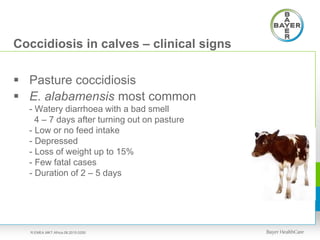
Coccidiosis in calves – clinical signs
 Pasture coccidiosis
 E. alabamensis most common
- Watery diarrhoea with a bad smell
4 – 7 days after turning out on pasture
- Low or no feed intake
- Depressed
- Loss of weight up to 15%
- Few fatal cases
- Duration of 2 – 5 days
R.EMEA.MKT.Africa.08.2015.0250
Clinical Signs
 Depression
 Anorexia (up to 1 month post infection)
 Low or no feed intake
 Loss of weight up to 15%
 Diarrhoea (+/- haemorrhagic)
 Dehydration
 Some mortalities (7-20%)
 Chronic performance setback due to:
- low feed conversion efficiency
- prolonged heifer development period
17Baycox_TechManual
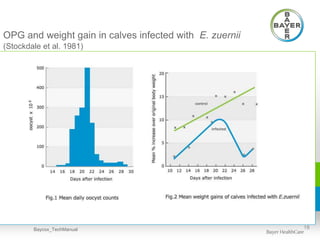
OPG and weight gain in calves infected with E. zuernii
(Stockdale et al. 1981)
18Baycox_TechManual
Sub-clinical Coccidiosis
 Most infections (95%) are sub-clinical
 Any Eimeria species can be involved
 Damaged absorptive surface of intestine
 Weakened immune system
Clinical Signs:
Inappetence
Inferior feed efficiency
Slower weight gain
Longer heifer development periods
Increased susceptibility to 2* infections
19
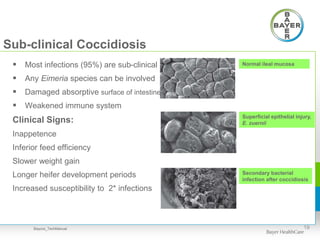
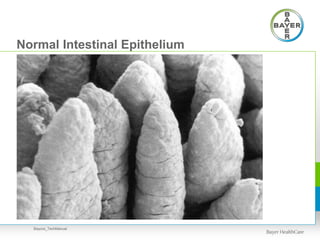
Normal ileal mucosa
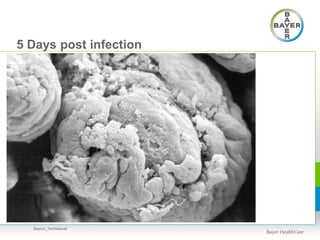
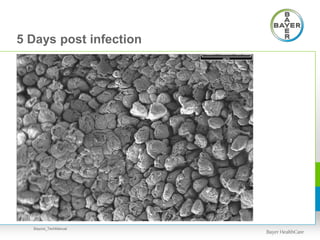
Superficial epithelial injury,
E. zuernii
Secondary bacterial
infection after coccidiosis
Baycox_TechManual
Normal Intestinal Epithelium
Baycox_TechManual
5 Days post infection
Baycox_TechManual
5 Days post infection
Baycox_TechManual
Immunity
 Good (non-sterile) immunity to re-infection
with same species after primary infection:
- Depends on level of primary infection
(>50,000 oocysts; Daugschies et al. 1998)
 Protective immunity:
- Mainly of cellular type
- Species specific
- Boosted by continuous exposure
- Can break under high infection pressure
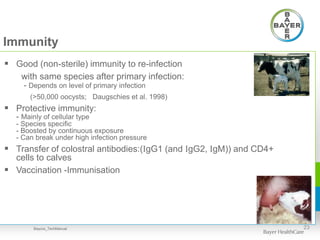
 Transfer of colostral antibodies:(IgG1 (and IgG2, IgM)) and CD4+
cells to calves
 Vaccination -Immunisation
23Baycox_TechManual
Eimeria summary
 Very host specific
 Direct transmission
 Many species – primarily in herbivores and
birds
 Most species - non-pathogenic
 Disease mostly in young animals
 Intestinal coccidia are very common
 Pathogenic intestinal coccidia cause diarrhoea
 The development cycle and its duration depends
on the coccidia species
R.EMEA.MKT.Africa.08.2015.0250
Diagnosis: On-farm surveillance
Look for signs of:
 Faeces matted around tail
 Dull rough hair coat – unthrifty animals
 Pot-bellied in calves
 Blood in faeces and/or watery diarrhoea
 Weight loss, dehydration, pneumonia
 Uneven sized calves
 Then ensure examination of faecal samples for diagnosis (OPG
level; species ID)
25Baycox_TechManual
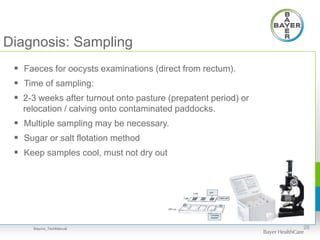
Diagnosis: Sampling
 Faeces for oocysts examinations (direct from rectum).
 Time of sampling:
 2-3 weeks after turnout onto pasture (prepatent period) or
relocation / calving onto contaminated paddocks.
 Multiple sampling may be necessary.
 Sugar or salt flotation method
 Keep samples cool, must not dry out
26Baycox_TechManual
Economic Impact
 Poor health equals economic loss!
 US $700 million annually (Fitzgerald, 1980)
 Surviving calves weigh 22-27 kg less than uninfected
animals even one year post infection
 Chronic performance setback
- low feed conversion efficiency
- prolonged development period
 Reproductive and milk yield performance at an adult age
is negatively affected (Maddox-Hyttel et. al, 2003)
 Treatment costs
27Baycox_TechManual
Prevention
 Hygiene
Cleaning / disinfecting
Control passive vectors (rodents and insects)
 Over crowding
 Stress factors
 Objective: lower infection pressure to break the
chain of infection
Baycox_TechManual
Treatment
Treatment should be initiated before clinical
coccidiosis is evident (metaphylactic treatment)
Prevention is better than cure!
Baycox_TechManual
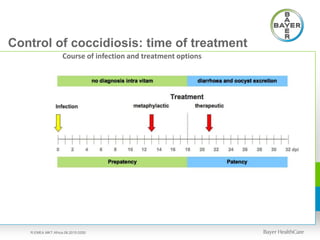
Control of coccidiosis: time of treatment
Course of infection and treatment options
R.EMEA.MKT.Africa.08.2015.0250
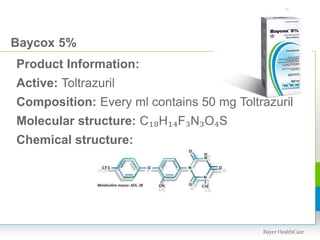
Baycox 5%
Product Information:
Active: Toltrazuril
Composition: Every ml contains 50 mg Toltrazuril
Molecular structure: C₁₈H₁₄F₃N₃O₄S
Chemical structure:
Directions for use
Piglets:
Each piglet must be treated orally at day 3-5 with a single 20 mg
dose Toltrazuril / kg body weight, corresponding to 0.4 ml oral
suspension per kg body mass.
Calves:
Each calf must be treated orally with a single dose of 15 mg
Toltrazuril / kg body weight, corresponding to 3 ml oral
suspension per 10 kg body weight.
Lambs:
Each animal must be treated orally with a single dose of 20 mg
Toltrazuril / kg body weight, corresponding to 4 ml oral
suspension per 10 kg body weight.
General:
Piglets, calves and lambs: To gain maximum benefit,
the animals are to be treated before the expected onset
of clinical signs, ie During the period prepatent. This is
best achieved in situations where the onset pattern of
clinical signs in young or recently included animals are
well known and predictable.
Use only as directed. Shake well before use. Product
must be used within three months after the withdrawal
of the first dose. Thereafter the remaining product is to
be destroyed.
Directions for use
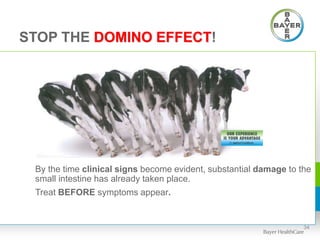
STOP THE DOMINO EFFECT!
By the time clinical signs become evident, substantial damage to the
small intestine has already taken place.
Treat BEFORE symptoms appear.
34
R.EMEA.MKT.Africa.08.2015.0250
Thank you!
R.EMEA.MKT.Africa.08.2015.0250

Calf Coccidiosis

  • 1.
  • 2.
    Bovine Coccidiosis  Generalabout coccidia - Structure - Life cycle - Environmental factors for survival  Eimeria in cattle - Prevalence - Clinical coccidiosis - Sub-clinical coccidiosis  Surveillance and control R.EMEA.MKT.Africa.08.2015.0250
  • 3.
    Coccidiosis What is Coccidiosis? Entericdisease caused by the protozoan parasites Eimeria spp. Baycox_TechManual
  • 4.
    Life Cycle OfCoccidia 4 External cycle broken here: sanitation, physical controls Internal cycle broken here: coccidiostats (oocyst) (sporozoites, sporulated oocyst) macrogametocytemicrogametocyte excyst merozoite trophozoites schizogony gametogony
  • 5.
  • 6.
    Source of Infection 6 Mother Feed-Stuff OtherAnimals Contaminated Environment Transmission: faecal-oral route / horizontal Baycox_TechManual
  • 7.
    Contributory factors inthe development of coccidiosis Parasite • Number • Type • Dispersion Host • Susceptibility / age • Stress factors (diet change, weaning, shipping, crowding, etc.) • Immune status • Exposure Environment • Conditions for sporulation (temperature, oxygen, humidity) • Management systems (loose bedding, pasture, etc.) • Hygiene • Feed hygiene, drinking hygiene • Climate R.EMEA.MKT.Africa.08.2015.0250
  • 8.
    Importance of environmentfor sporulation Sporulation time: 2 – 3 days – or more Sporulation depends on:  Temperature Optimum 20 - 25°C (13 - 32°C)  Oxygen Anaerobic conditions – no sporulation (but 10% of normal O₂ - pressure is enough)  Humidity Must be > 60% r.h.  Decaying conditions Delay sporulation R.EMEA.MKT.Africa.08.2015.0250
  • 9.
    Importance of environmentfor survival (2)  Oocyst survival is NOT possible  Temperatures > 40°C  Direct sunlight – 4 – 8 hours  Humidity < 25% r.h.  Decaying (rotting) conditions  Cresol-based disinfectants R.EMEA.MKT.Africa.08.2015.0250
  • 10.
    Prevalence of Eimeriain cattle  Prevalence relatively high: - 2-100% of calves per herd – varying according to management (dairy or beef) - Most frequent in calves 3 weeks to 6 – 12 months of age - Few case reports for cows (calving pen) - Shedding of oocysts at low levels common at all ages  Transmission pathway: faecal-oral route - Horizontal (calf-calf via licking, etc.; permanent pastures) - Cow-calf (calving pen) R.EMEA.MKT.Africa.08.2015.0250
  • 11.
    Eimeria in cattle Intestinal protozoan parasite  20 species worldwide  Variable pathogenicity  Variable reproductive potential – e.g. E. bovis  1 oocyst 24 million oocysts Non-sporulated Eimeria oocysts R.EMEA.MKT.Africa.08.2015.0250
  • 12.
  • 13.
    Eimeriae spp. incattle R.EMEA.MKT.Africa.08.2015.0250
  • 14.
    Pathogenicity of Eimeriadepends on  Species and size of infecting dose(s)  Number and localisation of host cells destroyed - i.e. Number of merozoite generations - Number of merozoites per generation - Location of parasite (in tissue / in cell)  Degree and time of re-infection  Degree of acquired / natural immunity of host - Incl. stress factors on host R.EMEA.MKT.Africa.08.2015.0250
  • 15.
    Clinical coccidiosis  Multifactorialdisease  Usually a herd problem (5-15% affected)  Primarily E. bovis or E. zuernii < 50,000 oocysts sufficient to cause clinical disease  Damaged intestinal surface (2nd merogony and gamogany) • Anorexia (up to 1 month post infection), diarrhoea (haemorrhagic), dehydration, weight loss or even death. Mortality up to 7-20%. • Severe case: chronic performance setback (low feed conversion efficiency; prolonged heifer development period, etc.) R.EMEA.MKT.Africa.08.2015.0250
  • 16.
    Coccidiosis in calves– clinical signs  Pasture coccidiosis  E. alabamensis most common - Watery diarrhoea with a bad smell 4 – 7 days after turning out on pasture - Low or no feed intake - Depressed - Loss of weight up to 15% - Few fatal cases - Duration of 2 – 5 days R.EMEA.MKT.Africa.08.2015.0250
  • 17.
    Clinical Signs  Depression Anorexia (up to 1 month post infection)  Low or no feed intake  Loss of weight up to 15%  Diarrhoea (+/- haemorrhagic)  Dehydration  Some mortalities (7-20%)  Chronic performance setback due to: - low feed conversion efficiency - prolonged heifer development period 17Baycox_TechManual
  • 18.
    OPG and weightgain in calves infected with E. zuernii (Stockdale et al. 1981) 18Baycox_TechManual
  • 19.
    Sub-clinical Coccidiosis  Mostinfections (95%) are sub-clinical  Any Eimeria species can be involved  Damaged absorptive surface of intestine  Weakened immune system Clinical Signs: Inappetence Inferior feed efficiency Slower weight gain Longer heifer development periods Increased susceptibility to 2* infections 19 Normal ileal mucosa Superficial epithelial injury, E. zuernii Secondary bacterial infection after coccidiosis Baycox_TechManual
  • 20.
  • 21.
    5 Days postinfection Baycox_TechManual
  • 22.
    5 Days postinfection Baycox_TechManual
  • 23.
    Immunity  Good (non-sterile)immunity to re-infection with same species after primary infection: - Depends on level of primary infection (>50,000 oocysts; Daugschies et al. 1998)  Protective immunity: - Mainly of cellular type - Species specific - Boosted by continuous exposure - Can break under high infection pressure  Transfer of colostral antibodies:(IgG1 (and IgG2, IgM)) and CD4+ cells to calves  Vaccination -Immunisation 23Baycox_TechManual
  • 24.
    Eimeria summary  Veryhost specific  Direct transmission  Many species – primarily in herbivores and birds  Most species - non-pathogenic  Disease mostly in young animals  Intestinal coccidia are very common  Pathogenic intestinal coccidia cause diarrhoea  The development cycle and its duration depends on the coccidia species R.EMEA.MKT.Africa.08.2015.0250
  • 25.
    Diagnosis: On-farm surveillance Lookfor signs of:  Faeces matted around tail  Dull rough hair coat – unthrifty animals  Pot-bellied in calves  Blood in faeces and/or watery diarrhoea  Weight loss, dehydration, pneumonia  Uneven sized calves  Then ensure examination of faecal samples for diagnosis (OPG level; species ID) 25Baycox_TechManual
  • 26.
    Diagnosis: Sampling  Faecesfor oocysts examinations (direct from rectum).  Time of sampling:  2-3 weeks after turnout onto pasture (prepatent period) or relocation / calving onto contaminated paddocks.  Multiple sampling may be necessary.  Sugar or salt flotation method  Keep samples cool, must not dry out 26Baycox_TechManual
  • 27.
    Economic Impact  Poorhealth equals economic loss!  US $700 million annually (Fitzgerald, 1980)  Surviving calves weigh 22-27 kg less than uninfected animals even one year post infection  Chronic performance setback - low feed conversion efficiency - prolonged development period  Reproductive and milk yield performance at an adult age is negatively affected (Maddox-Hyttel et. al, 2003)  Treatment costs 27Baycox_TechManual
  • 28.
    Prevention  Hygiene Cleaning /disinfecting Control passive vectors (rodents and insects)  Over crowding  Stress factors  Objective: lower infection pressure to break the chain of infection Baycox_TechManual
  • 29.
    Treatment Treatment should beinitiated before clinical coccidiosis is evident (metaphylactic treatment) Prevention is better than cure! Baycox_TechManual
  • 30.
    Control of coccidiosis:time of treatment Course of infection and treatment options R.EMEA.MKT.Africa.08.2015.0250
  • 31.
    Baycox 5% Product Information: Active:Toltrazuril Composition: Every ml contains 50 mg Toltrazuril Molecular structure: C₁₈H₁₄F₃N₃O₄S Chemical structure:
  • 32.
    Directions for use Piglets: Eachpiglet must be treated orally at day 3-5 with a single 20 mg dose Toltrazuril / kg body weight, corresponding to 0.4 ml oral suspension per kg body mass. Calves: Each calf must be treated orally with a single dose of 15 mg Toltrazuril / kg body weight, corresponding to 3 ml oral suspension per 10 kg body weight. Lambs: Each animal must be treated orally with a single dose of 20 mg Toltrazuril / kg body weight, corresponding to 4 ml oral suspension per 10 kg body weight.
  • 33.
    General: Piglets, calves andlambs: To gain maximum benefit, the animals are to be treated before the expected onset of clinical signs, ie During the period prepatent. This is best achieved in situations where the onset pattern of clinical signs in young or recently included animals are well known and predictable. Use only as directed. Shake well before use. Product must be used within three months after the withdrawal of the first dose. Thereafter the remaining product is to be destroyed. Directions for use
  • 34.
    STOP THE DOMINOEFFECT! By the time clinical signs become evident, substantial damage to the small intestine has already taken place. Treat BEFORE symptoms appear. 34
  • 35.
  • 36.