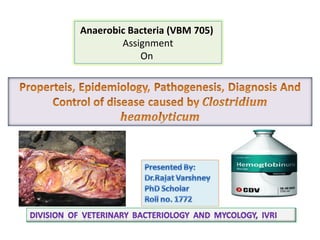

Anaerobic Bacteria (VBM 705)
Assignment
On
Taxonomy
Domain: Bacteria
Phylum: Firmicutes
Class: Clostridia
Order: Clostridiales
Family: Clostridiaceae
Genus: Clostridium
Cluster I : Clostridium sensu stricto
Species : C. haemolyticum
Contd…
• Clostridium novyi Type A:
 Pathogenic
 Gas gangrene in man & animal (Big head in Ram)
 Produce mainly Alpha toxin, a necrotizing and lethal toxin.
• Clostridium novyi Type B:
• Pathogenic
• Produce both alpha toxin and beta toxin
• Black disease (infectious necrotic hepatitis) in sheep.
Contd….
• Clostridium novyi Type C:
 non-pathogenic to laboratory animals
• Clostridium haemolyticum(Clostridium novyi type D)
 Causative agent of Bacillary haemoglobinuria
 Soil borne bacteria
 Produce mainly beta toxin
 Produce alpha toxin if infected with phage of Clostridium
novyi Type A
 C. haemolyticum clustered with C. botulinum types C & D &
C. novyi type B (16S r RNA gene analysis).
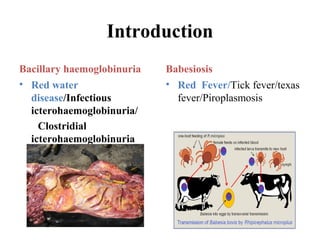
Introduction
Bacillary haemoglobinuria
• Red water
disease/Infectious
icterohaemoglobinuria/
Clostridial
icterohaemoglobinuria
Babesiosis
• Red Fever/Tick fever/texas
fever/Piroplasmosis
Bacillary haemoglobinuria
• An acute, infectious, toxic disease that primarily affects young cattle
on pasture (but may also affect sheep).
• Causative agent- Clostridium haemolyticum(Clostridium novyi
type D)
• This disease can be experimentally produced in rabbit, guinea
pig and mice.
• This organism is often found in livers of healthy cattle.
• The organism has been isolated from bones a year after the
death of an animal from bacillary haemoglobinuria.
Occurrence-
The disease occurs mainly in United states.
Risk factor-
Animal risk factor-
Cattle are usual species involved
Sheep occasionally involved
Pig rarely involved
Environmental risk factor-
Summer and autumn
This disease is highly prevalent in those areas where there is preponderance of
fascioliasis.
Swampy , low lying area, alkaline soil.
Contaminated hay
Epidemiology
Pathogenesis
• Endogenous infection
• Clostridial endospore are dormant in the liver (Kuffer cells).
{Ingestion organism multiply in intestinal tract enter into
systemic circulation localized into liver dormant stage}
• Local liver damage and necrosis (usually caused by a migrating liver
fluke infection or much less commonly due to a high nitrate diet)
• The bacteria spores germinate into vegetative cells that multiply and
produce toxins
Toxin of C.haemolyticum
• Phospholipase C (PLPC):
 Major Toxin
 Beta toxin
 Possesses hemolytic activity
 Responsible for necrosis of hepatocytes, lyses erythrocytes, and
damages capillary endothelium which leads to hemoglobinuria and
loss of vascular fluids into tissues and serous cavities.
• Two minor toxins of C. haemolyticum,
• the η-toxin (tropomyosinase)
• the Θ-toxin which causes opalescense of egg yolk
CLINICAL SIGNS
• Sudden onset of fever, severe depression, abdominal pain
(arched back) and labored breathing;
• Yellow color or pale of gum and eye sclera (jaundice/icteric)
with pinpoint red blood spots (petechia).
• Dark purple/red “port wine” colored urine
(hemoglobinuria) and dark colour feaces.
An opened urinary bladder showing dark
red urine in the lumen.
PM finding s of jaundice / icterus
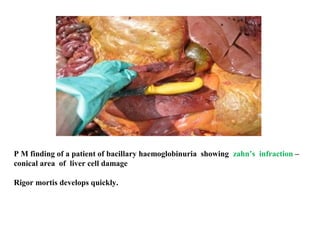
P M finding of a patient of bacillary haemoglobinuria showing zahn’s infraction –
conical area of liver cell damage
Rigor mortis develops quickly.
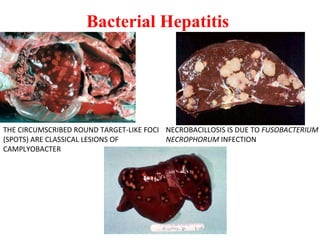
Bacterial Hepatitis
THE CIRCUMSCRIBED ROUND TARGET-LIKE FOCI
(SPOTS) ARE CLASSICAL LESIONS OF
CAMPLYOBACTER
NECROBACILLOSIS IS DUE TO FUSOBACTERIUM
NECROPHORUM INFECTION
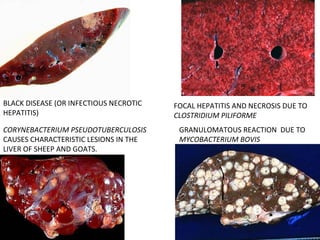
FOCAL HEPATITIS AND NECROSIS DUE TO
CLOSTRIDIUM PILIFORME
CORYNEBACTERIUM PSEUDOTUBERCULOSIS
CAUSES CHARACTERISTIC LESIONS IN THE
LIVER OF SHEEP AND GOATS.
GRANULOMATOUS REACTION DUE TO
MYCOBACTERIUM BOVIS
BLACK DISEASE (OR INFECTIOUS NECROTIC
HEPATITIS)
15
Clostridial Diseases
Bacillary hemoglobinuria
http://w3.vet.cornell.edu/nst/nst.asp?Fun=Image&imgID=8700
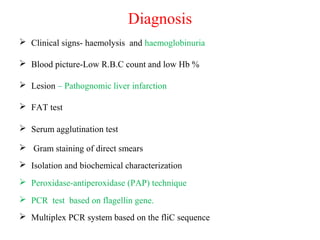
Diagnosis
 Clinical signs- haemolysis and haemoglobinuria
 Blood picture-Low R.B.C count and low Hb %
 Lesion – Pathognomic liver infarction
 FAT test
 Serum agglutination test
 Gram staining of direct smears
 Isolation and biochemical characterization
 Peroxidase-antiperoxidase (PAP) technique
 PCR test based on flagellin gene.
 Multiplex PCR system based on the fliC sequence
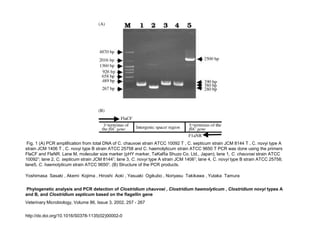
Fig. 1 (A) PCR amplification from total DNA of C. chauvoei strain ATCC 10092 T , C. septicum strain JCM 8144 T , C. novyi type A
strain JCM 1406 T , C. novyi type B strain ATCC 25758 and C. haemolyticum strain ATCC 9650 T PCR was done using the primers
FlaCF and FlaNR. Lane M, molecular size marker (pHY marker, TaKaRa Shuzo Co. Ltd., Japan); lane 1, C. chauvoei strain ATCC
10092T
; lane 2, C. septicum strain JCM 8144T
; lane 3, C. novyi type A strain JCM 1406T
; lane 4, C. novyi type B strain ATCC 25758;
lane5, C. haemolyticum strain ATCC 9650T
. (B) Structure of the PCR products.
Yoshimasa Sasaki , Akemi Kojima , Hiroshi Aoki , Yasuaki Ogikubo , Noriyasu Takikawa , Yutaka Tamura
Phylogenetic analysis and PCR detection of Clostridium chauvoei , Clostridium haemolyticum , Clostridium novyi types A
and B, and Clostridium septicum based on the flagellin gene
Veterinary Microbiology, Volume 86, Issue 3, 2002, 257 - 267
http://dx.doi.org/10.1016/S0378-1135(02)00002-0
Fig. PCR amplification of C. chauvoei , C. haemolyticum , C. novyi type A, C. novyi type B and C. septicum
-specific PCR products. Lane M, molecular size marker (100 bp molecular ruler, Bio-Rad Laboratories Co. Ltd.,
USA
lane 1, C. chauvoei strain ATCC 10092T
; lane 2, C. septicum strain JCM8144T
; lane 3, C. novyi type A strain JCM
1406T
; lane 4, C. novyi type B strain ATCC 25758; lane 5, C. haemolyticum strain ATCC 9650T
.
Yoshimasa Sasaki , Akemi Kojima , Hiroshi Aoki , Yasuaki Ogikubo , Noriyasu Takikawa , Yutaka Tamura
Phylogenetic analysis and PCR detection of Clostridium chauvoei , Clostridium haemolyticum , Clostridium novyi types A
and B, and Clostridium septicum based on the flagellin gene
Veterinary Microbiology, Volume 86, Issue 3, 2002, 257 - 267
http://dx.doi.org/10.1016/S0378-1135(02)00002-0
• Gram positive (but rapidly become Gram negative) straight rods.
• Oval, sub-terminal, bulging Spore
• Most strain are motile by means of peritrichous flagella.
• All strain are actively proteolytic but not saccharolytic.
• All strain are not strict anaerobes
Optimal growth at 37°C with anaerobic gas mixture (80% N2, 10% CO2,
10% H2)
Sheep or rabbit blood agar- haemolysis
Cooked meat broth- meat turns black with putrid smell
Cultures in PYG broth are turbid, usually with a granular or flocculent
sediment (pH - 5.0–5.5 for 24 h.)
Major products of metabolism in PYG broth: propionic, acetic and butyric
acids, abundant H2.
Conti…
Biochemical properties
Positive results for
H2 production(large amount)
hydrolysis gelatin
indole production
lecithinase
 substrate utilized and/or acid produced from glucose.
Variable results for substrate utilized and/or acid produced from:
fructose, galactose (weak), glycerol, inositol, maltose (weak),
mannose, melezitose (weak), melibiose (weak), raffinose (weak),
rhamnose (weak), ribose & trehalose (weak)
Negative results for
 casein hydrolysis
esculin hydrolysis
H2S production
Lipase
nitrate reduction
 starch hydrolysis,
urease,
Voges-Proskauer test
 substrate utilized and/or acid produced from: amygdalin, arabinose,
cellobiose, dulcitol, glycogen, inulin, lactose, mannitol, salicin, sorbitol,
sorbose, starch, sucrose & xylose.
Differential Diagnosis
Haemoglobinuria (red urine) may be arise due to other diseases
also.
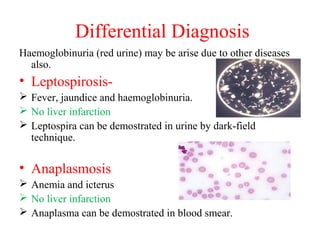
• Leptospirosis-
 Fever, jaundice and haemoglobinuria.
 No liver infarction
 Leptospira can be demostrated in urine by dark-field
technique.
• Anaplasmosis
 Anemia and icterus
 No liver infarction
 Anaplasma can be demostrated in blood smear.
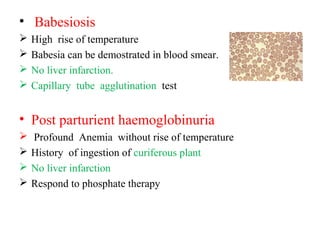
• Babesiosis
 High rise of temperature
 Babesia can be demostrated in blood smear.
 No liver infarction.
 Capillary tube agglutination test
• Post parturient haemoglobinuria
 Profound Anemia without rise of temperature
 History of ingestion of curiferous plant
 No liver infarction
 Respond to phosphate therapy
• Enzootic Heamaturia:
 Red urine without rise of temperature
 History of ingestion of Bracken fern
 Extensive lesions in the wall of urinary bladder.
 Respond to thiamine therapy.
• Myoglobinuria
 No rise of temperature.
 History of grain engorgement
 Muscular degeneration and increased CPK.
 Ammonium sulphate test.
• CHRONIC COPPER POISONING (sheep)
BRONZE COLOURED LIVER
JAUNDICE OF THE GUMS JAUNDICE OF THE
CONJUNCTIVAE
AND THIRD
EYELID
JAUNDICE OF THE
SCLERA OF THE EYE
'GUN METAL' APPEARANCE
OF THE KIDNEYS
Treatment
Early treatment with penicillin or oxytetracycline is
essential as the bacteria are restricted to areas of liver
damage
 Depending on the severity of the disease, IV fluid
therapy and/or blood transfusion may also be required
Hemopoiesis should be facilitated by the provision of
vitamin and mineral supplements containing iron and cu.
Control
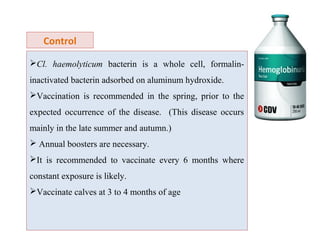
Cl. haemolyticum bacterin is a whole cell, formalin-
inactivated bacterin adsorbed on aluminum hydroxide.
Vaccination is recommended in the spring, prior to the
expected occurrence of the disease. (This disease occurs
mainly in the late summer and autumn.)
 Annual boosters are necessary.
It is recommended to vaccinate every 6 months where
constant exposure is likely.
Vaccinate calves at 3 to 4 months of age
Control
SITEGUARD MLG, CAVALRY 9 and ELECTROID 7
bacterin-toxoid vaccine for the vaccination of healthy cattle and
sheep against diseases caused by Cl. chauvoei, Cl.septicum, Cl.
haemolyticum, Cl. novyi Type B, Cl. Sordellii, Cl.
perfringens Types C&D
Other control methods include rotating pastures and controlling
liver fluke infections.
Thank you for
your attention

C.haemolyticum

  • 1.
    Anaerobic Bacteria (VBM705) Assignment On
  • 2.
    Taxonomy Domain: Bacteria Phylum: Firmicutes Class:Clostridia Order: Clostridiales Family: Clostridiaceae Genus: Clostridium Cluster I : Clostridium sensu stricto Species : C. haemolyticum
  • 4.
    Contd… • Clostridium novyiType A:  Pathogenic  Gas gangrene in man & animal (Big head in Ram)  Produce mainly Alpha toxin, a necrotizing and lethal toxin. • Clostridium novyi Type B: • Pathogenic • Produce both alpha toxin and beta toxin • Black disease (infectious necrotic hepatitis) in sheep.
  • 5.
    Contd…. • Clostridium novyiType C:  non-pathogenic to laboratory animals • Clostridium haemolyticum(Clostridium novyi type D)  Causative agent of Bacillary haemoglobinuria  Soil borne bacteria  Produce mainly beta toxin  Produce alpha toxin if infected with phage of Clostridium novyi Type A  C. haemolyticum clustered with C. botulinum types C & D & C. novyi type B (16S r RNA gene analysis).
  • 6.
    Introduction Bacillary haemoglobinuria • Redwater disease/Infectious icterohaemoglobinuria/ Clostridial icterohaemoglobinuria Babesiosis • Red Fever/Tick fever/texas fever/Piroplasmosis
  • 7.
    Bacillary haemoglobinuria • Anacute, infectious, toxic disease that primarily affects young cattle on pasture (but may also affect sheep). • Causative agent- Clostridium haemolyticum(Clostridium novyi type D) • This disease can be experimentally produced in rabbit, guinea pig and mice. • This organism is often found in livers of healthy cattle. • The organism has been isolated from bones a year after the death of an animal from bacillary haemoglobinuria.
  • 8.
    Occurrence- The disease occursmainly in United states. Risk factor- Animal risk factor- Cattle are usual species involved Sheep occasionally involved Pig rarely involved Environmental risk factor- Summer and autumn This disease is highly prevalent in those areas where there is preponderance of fascioliasis. Swampy , low lying area, alkaline soil. Contaminated hay Epidemiology
  • 9.
    Pathogenesis • Endogenous infection •Clostridial endospore are dormant in the liver (Kuffer cells). {Ingestion organism multiply in intestinal tract enter into systemic circulation localized into liver dormant stage} • Local liver damage and necrosis (usually caused by a migrating liver fluke infection or much less commonly due to a high nitrate diet) • The bacteria spores germinate into vegetative cells that multiply and produce toxins
  • 10.
    Toxin of C.haemolyticum •Phospholipase C (PLPC):  Major Toxin  Beta toxin  Possesses hemolytic activity  Responsible for necrosis of hepatocytes, lyses erythrocytes, and damages capillary endothelium which leads to hemoglobinuria and loss of vascular fluids into tissues and serous cavities. • Two minor toxins of C. haemolyticum, • the η-toxin (tropomyosinase) • the Θ-toxin which causes opalescense of egg yolk
  • 11.
    CLINICAL SIGNS • Suddenonset of fever, severe depression, abdominal pain (arched back) and labored breathing; • Yellow color or pale of gum and eye sclera (jaundice/icteric) with pinpoint red blood spots (petechia). • Dark purple/red “port wine” colored urine (hemoglobinuria) and dark colour feaces. An opened urinary bladder showing dark red urine in the lumen. PM finding s of jaundice / icterus
  • 12.
    P M findingof a patient of bacillary haemoglobinuria showing zahn’s infraction – conical area of liver cell damage Rigor mortis develops quickly.
  • 13.
    Bacterial Hepatitis THE CIRCUMSCRIBEDROUND TARGET-LIKE FOCI (SPOTS) ARE CLASSICAL LESIONS OF CAMPLYOBACTER NECROBACILLOSIS IS DUE TO FUSOBACTERIUM NECROPHORUM INFECTION
  • 14.
    FOCAL HEPATITIS ANDNECROSIS DUE TO CLOSTRIDIUM PILIFORME CORYNEBACTERIUM PSEUDOTUBERCULOSIS CAUSES CHARACTERISTIC LESIONS IN THE LIVER OF SHEEP AND GOATS. GRANULOMATOUS REACTION DUE TO MYCOBACTERIUM BOVIS BLACK DISEASE (OR INFECTIOUS NECROTIC HEPATITIS)
  • 15.
  • 16.
    Diagnosis  Clinical signs-haemolysis and haemoglobinuria  Blood picture-Low R.B.C count and low Hb %  Lesion – Pathognomic liver infarction  FAT test  Serum agglutination test  Gram staining of direct smears  Isolation and biochemical characterization  Peroxidase-antiperoxidase (PAP) technique  PCR test based on flagellin gene.  Multiplex PCR system based on the fliC sequence
  • 17.
    Fig. 1 (A)PCR amplification from total DNA of C. chauvoei strain ATCC 10092 T , C. septicum strain JCM 8144 T , C. novyi type A strain JCM 1406 T , C. novyi type B strain ATCC 25758 and C. haemolyticum strain ATCC 9650 T PCR was done using the primers FlaCF and FlaNR. Lane M, molecular size marker (pHY marker, TaKaRa Shuzo Co. Ltd., Japan); lane 1, C. chauvoei strain ATCC 10092T ; lane 2, C. septicum strain JCM 8144T ; lane 3, C. novyi type A strain JCM 1406T ; lane 4, C. novyi type B strain ATCC 25758; lane5, C. haemolyticum strain ATCC 9650T . (B) Structure of the PCR products. Yoshimasa Sasaki , Akemi Kojima , Hiroshi Aoki , Yasuaki Ogikubo , Noriyasu Takikawa , Yutaka Tamura Phylogenetic analysis and PCR detection of Clostridium chauvoei , Clostridium haemolyticum , Clostridium novyi types A and B, and Clostridium septicum based on the flagellin gene Veterinary Microbiology, Volume 86, Issue 3, 2002, 257 - 267 http://dx.doi.org/10.1016/S0378-1135(02)00002-0
  • 18.
    Fig. PCR amplificationof C. chauvoei , C. haemolyticum , C. novyi type A, C. novyi type B and C. septicum -specific PCR products. Lane M, molecular size marker (100 bp molecular ruler, Bio-Rad Laboratories Co. Ltd., USA lane 1, C. chauvoei strain ATCC 10092T ; lane 2, C. septicum strain JCM8144T ; lane 3, C. novyi type A strain JCM 1406T ; lane 4, C. novyi type B strain ATCC 25758; lane 5, C. haemolyticum strain ATCC 9650T . Yoshimasa Sasaki , Akemi Kojima , Hiroshi Aoki , Yasuaki Ogikubo , Noriyasu Takikawa , Yutaka Tamura Phylogenetic analysis and PCR detection of Clostridium chauvoei , Clostridium haemolyticum , Clostridium novyi types A and B, and Clostridium septicum based on the flagellin gene Veterinary Microbiology, Volume 86, Issue 3, 2002, 257 - 267 http://dx.doi.org/10.1016/S0378-1135(02)00002-0
  • 19.
    • Gram positive(but rapidly become Gram negative) straight rods. • Oval, sub-terminal, bulging Spore • Most strain are motile by means of peritrichous flagella. • All strain are actively proteolytic but not saccharolytic. • All strain are not strict anaerobes
  • 20.
    Optimal growth at37°C with anaerobic gas mixture (80% N2, 10% CO2, 10% H2) Sheep or rabbit blood agar- haemolysis Cooked meat broth- meat turns black with putrid smell Cultures in PYG broth are turbid, usually with a granular or flocculent sediment (pH - 5.0–5.5 for 24 h.) Major products of metabolism in PYG broth: propionic, acetic and butyric acids, abundant H2. Conti…
  • 21.
    Biochemical properties Positive resultsfor H2 production(large amount) hydrolysis gelatin indole production lecithinase  substrate utilized and/or acid produced from glucose. Variable results for substrate utilized and/or acid produced from: fructose, galactose (weak), glycerol, inositol, maltose (weak), mannose, melezitose (weak), melibiose (weak), raffinose (weak), rhamnose (weak), ribose & trehalose (weak)
  • 22.
    Negative results for casein hydrolysis esculin hydrolysis H2S production Lipase nitrate reduction  starch hydrolysis, urease, Voges-Proskauer test  substrate utilized and/or acid produced from: amygdalin, arabinose, cellobiose, dulcitol, glycogen, inulin, lactose, mannitol, salicin, sorbitol, sorbose, starch, sucrose & xylose.
  • 23.
    Differential Diagnosis Haemoglobinuria (redurine) may be arise due to other diseases also. • Leptospirosis-  Fever, jaundice and haemoglobinuria.  No liver infarction  Leptospira can be demostrated in urine by dark-field technique. • Anaplasmosis  Anemia and icterus  No liver infarction  Anaplasma can be demostrated in blood smear.
  • 24.
    • Babesiosis  Highrise of temperature  Babesia can be demostrated in blood smear.  No liver infarction.  Capillary tube agglutination test • Post parturient haemoglobinuria  Profound Anemia without rise of temperature  History of ingestion of curiferous plant  No liver infarction  Respond to phosphate therapy
  • 25.
    • Enzootic Heamaturia: Red urine without rise of temperature  History of ingestion of Bracken fern  Extensive lesions in the wall of urinary bladder.  Respond to thiamine therapy. • Myoglobinuria  No rise of temperature.  History of grain engorgement  Muscular degeneration and increased CPK.  Ammonium sulphate test.
  • 26.
    • CHRONIC COPPERPOISONING (sheep) BRONZE COLOURED LIVER JAUNDICE OF THE GUMS JAUNDICE OF THE CONJUNCTIVAE AND THIRD EYELID JAUNDICE OF THE SCLERA OF THE EYE 'GUN METAL' APPEARANCE OF THE KIDNEYS
  • 27.
    Treatment Early treatment withpenicillin or oxytetracycline is essential as the bacteria are restricted to areas of liver damage  Depending on the severity of the disease, IV fluid therapy and/or blood transfusion may also be required Hemopoiesis should be facilitated by the provision of vitamin and mineral supplements containing iron and cu.
  • 28.
    Control Cl. haemolyticum bacterinis a whole cell, formalin- inactivated bacterin adsorbed on aluminum hydroxide. Vaccination is recommended in the spring, prior to the expected occurrence of the disease. (This disease occurs mainly in the late summer and autumn.)  Annual boosters are necessary. It is recommended to vaccinate every 6 months where constant exposure is likely. Vaccinate calves at 3 to 4 months of age
  • 29.
    Control SITEGUARD MLG, CAVALRY9 and ELECTROID 7 bacterin-toxoid vaccine for the vaccination of healthy cattle and sheep against diseases caused by Cl. chauvoei, Cl.septicum, Cl. haemolyticum, Cl. novyi Type B, Cl. Sordellii, Cl. perfringens Types C&D Other control methods include rotating pastures and controlling liver fluke infections.
  • 30.

Editor's Notes

  • #16 Species:cowTissue:kidney, grossMorphologic DX:Hemoglobinuria, severeEtiologic DX:BACILLARY HEMOGLOBINURIA, DUE TO CLOSTRIDIUM HEMOLYTICUMLesion or DX Name:Lesion Description:Extremely diffusely dark kidneys