My Horse University and eXtension’s HorseQuest
                 welcome you to this live Webcast.


Managing Live Horse Events
  Considerations for Sponsoring
   Programs Using Live Animals

            Karol Dyson
     University of Maryland Extension
Meet our presenter:
         Karol Dyson
         University of Maryland Extension


Question facilitator:   Bonnie Boyden
                        4-H Program Management Specialist
Personal Qualities That Help
•   Sense of humor
•   Energy
•   Thick Skin
•   A need to micromanage (sometimes)
•   Experience in crisis management
•   Flexibility
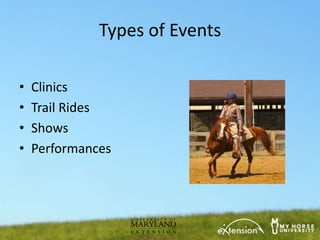
Types of Events

•   Clinics
•   Trail Rides
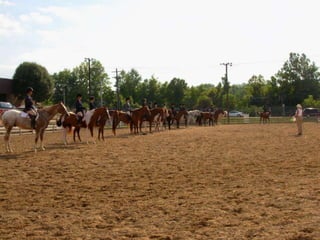
•   Shows
•   Performances
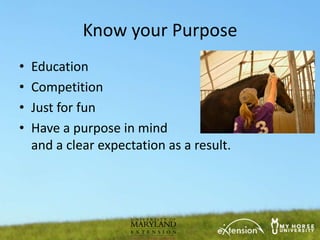
Know your Purpose
•   Education
•   Competition
•   Just for fun
•   Have a purpose in mind
    and a clear expectation as a result.
"By failing to prepare,
you are preparing to fail."
            --
            Benjamin Franklin
Make a Written Plan

•   Start early
•   Select a site
•   Develop a budget
•   Put together a committee
•   Make lists and USE them
•   Plan your work and work your plan
•   Check things off as you go
•   Delegate
•   Know what you delegate & to whom
•   Set a timeline with due dates
•   Check your list at least 2 times a week
Budget
•   Have a written budget
•   Include a cushion “just in case”
•   Brainstorm with your committee
•   Seek donations
•   Consider small grants for educational
    programs
Registration
• Make a plan to include:
  – Fees
  – Rules
  – Deadlines
  – Emergency Contact Information
  – Allergies/Health Issues
  – Remember any required health documents
Items to consider for all audiences
 – Rest rooms
 – Electrical needs
 – Location/facility
 – Supplies needed
 – Awards
 – Selecting officials
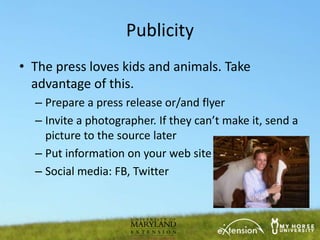
Publicity
• The press loves kids and animals. Take
  advantage of this.
  – Prepare a press release or/and flyer
  – Invite a photographer. If they can’t make it, send a
    picture to the source later
  – Put information on your web site
  – Social media: FB, Twitter
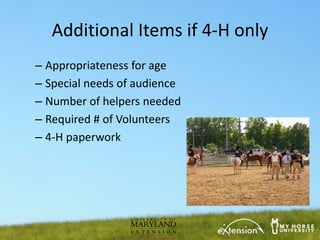
Additional Items if 4-H only
– Appropriateness for age
– Special needs of audience
– Number of helpers needed
– Required # of Volunteers
– 4-H paperwork
Event Personnel
• Paid or Volunteer?
  – If volunteer, what are their qualifications?
  – If instructors, what are their credentials?
     • Technical skills
     • Certifications/carding
     • Experience with children
  – Do they have insurance?
     • Request proof
More Personnel Issues
• Have a written contract, agreement, or
  position description with judges, instructors,
  or other experts, whether paid or volunteer
• Include:
  – Expectation of Time required
  – Pay
  – Expenses Covered
  – Expectations of behavior (theirs!)
Resources
• Horse Show associations
  – Rules and guidelines
• Local horsepersons
  – Timers, steward, secretary
• Businesses
  – Water, straw bales, tent, ice, coolers
Insurance
• Expect the unexpected!
  – Find out what the site requirements are
  – Know what is offered through your organization
  – Consider a separate liability policy
  – Take out your own health insurance to cover
    participants, staff, and volunteers
So Just What is


RISK MANAGEMENT?
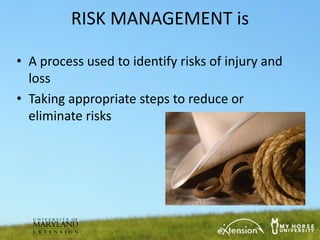
RISK MANAGEMENT is

• A process used to identify risks of injury and
  loss
• Taking appropriate steps to reduce or
  eliminate risks
RISK MANAGEMENT is:
• Pro-active rather than Re-active

• Taking charge rather than just “letting things
  happen”

• Planning for the worst so that it will never
  happen– but IF it does, you will be ready.
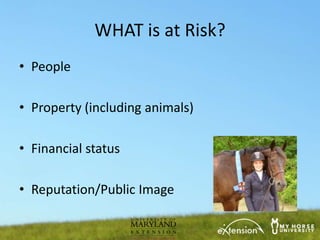
WHAT is at Risk?
• People

• Property (including animals)

• Financial status

• Reputation/Public Image
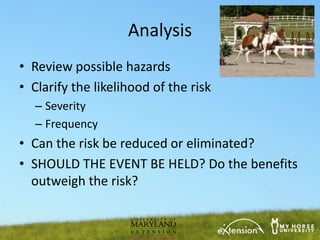
Analysis
• Review possible hazards
• Clarify the likelihood of the risk
   – Severity
   – Frequency
• Can the risk be reduced or eliminated?
• SHOULD THE EVENT BE HELD? Do the benefits
  outweigh the risk?
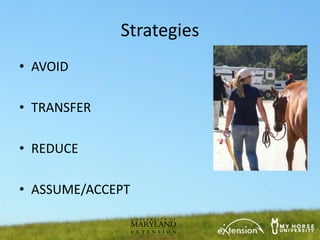
Strategies
• AVOID

• TRANSFER

• REDUCE

• ASSUME/ACCEPT
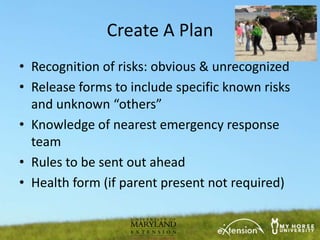
Create A Plan
• Recognition of risks: obvious & unrecognized
• Release forms to include specific known risks
  and unknown “others”
• Knowledge of nearest emergency response
  team
• Rules to be sent out ahead
• Health form (if parent present not required)
Risk Management Planning cont.
•   Be wary of weather
•   Maintain a basic First Aid Kit
•   EMT on grounds if possible
•   Vet on call (farrier if possible)
•   Ratio of adults to children
Safety First
• Your #1 job is to keep participants, audience
  and animals SAFE
• Go OVERBOARD in requiring adherence to all
  accepted guidelines for safe practices
  including equipment, tack, and rules
• Event staff, whether volunteer or paid, should
  follow same policies
Evaluate
• Did the event meet your objectives?
• Did people enjoy themselves and/or learn
  something?
• Were you prepared for any crises that didn’t
  happen? 
• Make notes to improve your next event.
Rewards

At the end of the day:
•   Was it safe?
•   Did people learn?
•   Did it fill a need?
•   Was it worth the time and energy?


• Was it fun?    
QUESTIONS?
RESOURCES

• A Common Sense Approach to Risk Management for Adults Working with
  Children. Bowman, Debra. UME, April, 2001.

• Risk Management for 4-H Youth Development Work, Pracht,Dale,
  Butterfield, Judy, Hink, Jean. University of Florida.

• http://www.maryland4h.org/4HFiles/RiskManagementChecklist09.pdf
Give us your feedback!
• You will receive a survey by email in 1-2 days.
  Please take a few minutes to give us your
  feedback on this webcast. It will help us to
  better serve you!
Upcoming Webcasts
• Tractor and Machinery Safety
  April 24, 2012
  7PM EDT
• Pasture Rotation
  May 1, 2012
  7PM EDT
Thank you for attending this live web presentation!


                For more information about
            My Horse University please visit us at:
               www.myhorseuniversity.com


info@myhorseuniversity.com | www.myhorseuniversity.com | 517-353-3123

Managing Live Horse Events

  • 1.
    My Horse Universityand eXtension’s HorseQuest welcome you to this live Webcast. Managing Live Horse Events Considerations for Sponsoring Programs Using Live Animals Karol Dyson University of Maryland Extension
  • 2.
    Meet our presenter: Karol Dyson University of Maryland Extension Question facilitator: Bonnie Boyden 4-H Program Management Specialist
  • 3.
    Personal Qualities ThatHelp • Sense of humor • Energy • Thick Skin • A need to micromanage (sometimes) • Experience in crisis management • Flexibility
  • 4.
    Types of Events • Clinics • Trail Rides • Shows • Performances
  • 5.
    Know your Purpose • Education • Competition • Just for fun • Have a purpose in mind and a clear expectation as a result.
  • 6.
    "By failing toprepare, you are preparing to fail." -- Benjamin Franklin
  • 7.
    Make a WrittenPlan • Start early • Select a site • Develop a budget • Put together a committee • Make lists and USE them • Plan your work and work your plan
  • 8.
    Check things off as you go • Delegate • Know what you delegate & to whom • Set a timeline with due dates • Check your list at least 2 times a week
  • 9.
    Budget • Have a written budget • Include a cushion “just in case” • Brainstorm with your committee • Seek donations • Consider small grants for educational programs
  • 10.
    Registration • Make aplan to include: – Fees – Rules – Deadlines – Emergency Contact Information – Allergies/Health Issues – Remember any required health documents
  • 11.
    Items to considerfor all audiences – Rest rooms – Electrical needs – Location/facility – Supplies needed – Awards – Selecting officials
  • 12.
    Publicity • The pressloves kids and animals. Take advantage of this. – Prepare a press release or/and flyer – Invite a photographer. If they can’t make it, send a picture to the source later – Put information on your web site – Social media: FB, Twitter
  • 13.
    Additional Items if4-H only – Appropriateness for age – Special needs of audience – Number of helpers needed – Required # of Volunteers – 4-H paperwork
  • 14.
    Event Personnel • Paidor Volunteer? – If volunteer, what are their qualifications? – If instructors, what are their credentials? • Technical skills • Certifications/carding • Experience with children – Do they have insurance? • Request proof
  • 15.
    More Personnel Issues •Have a written contract, agreement, or position description with judges, instructors, or other experts, whether paid or volunteer • Include: – Expectation of Time required – Pay – Expenses Covered – Expectations of behavior (theirs!)
  • 16.
    Resources • Horse Showassociations – Rules and guidelines • Local horsepersons – Timers, steward, secretary • Businesses – Water, straw bales, tent, ice, coolers
  • 17.
    Insurance • Expect theunexpected! – Find out what the site requirements are – Know what is offered through your organization – Consider a separate liability policy – Take out your own health insurance to cover participants, staff, and volunteers
  • 18.
    So Just Whatis RISK MANAGEMENT?
  • 19.
    RISK MANAGEMENT is •A process used to identify risks of injury and loss • Taking appropriate steps to reduce or eliminate risks
  • 20.
    RISK MANAGEMENT is: •Pro-active rather than Re-active • Taking charge rather than just “letting things happen” • Planning for the worst so that it will never happen– but IF it does, you will be ready.
  • 21.
    WHAT is atRisk? • People • Property (including animals) • Financial status • Reputation/Public Image
  • 22.
    Analysis • Review possiblehazards • Clarify the likelihood of the risk – Severity – Frequency • Can the risk be reduced or eliminated? • SHOULD THE EVENT BE HELD? Do the benefits outweigh the risk?
  • 23.
    Strategies • AVOID • TRANSFER •REDUCE • ASSUME/ACCEPT
  • 24.
    Create A Plan •Recognition of risks: obvious & unrecognized • Release forms to include specific known risks and unknown “others” • Knowledge of nearest emergency response team • Rules to be sent out ahead • Health form (if parent present not required)
  • 25.
    Risk Management Planningcont. • Be wary of weather • Maintain a basic First Aid Kit • EMT on grounds if possible • Vet on call (farrier if possible) • Ratio of adults to children
  • 26.
    Safety First • Your#1 job is to keep participants, audience and animals SAFE • Go OVERBOARD in requiring adherence to all accepted guidelines for safe practices including equipment, tack, and rules • Event staff, whether volunteer or paid, should follow same policies
  • 27.
    Evaluate • Did theevent meet your objectives? • Did people enjoy themselves and/or learn something? • Were you prepared for any crises that didn’t happen?  • Make notes to improve your next event.
  • 29.
    Rewards At the endof the day: • Was it safe? • Did people learn? • Did it fill a need? • Was it worth the time and energy? • Was it fun? 
  • 30.
  • 32.
    RESOURCES • A CommonSense Approach to Risk Management for Adults Working with Children. Bowman, Debra. UME, April, 2001. • Risk Management for 4-H Youth Development Work, Pracht,Dale, Butterfield, Judy, Hink, Jean. University of Florida. • http://www.maryland4h.org/4HFiles/RiskManagementChecklist09.pdf
  • 33.
    Give us yourfeedback! • You will receive a survey by email in 1-2 days. Please take a few minutes to give us your feedback on this webcast. It will help us to better serve you!
  • 34.
    Upcoming Webcasts • Tractorand Machinery Safety April 24, 2012 7PM EDT • Pasture Rotation May 1, 2012 7PM EDT
  • 35.
    Thank you forattending this live web presentation! For more information about My Horse University please visit us at: www.myhorseuniversity.com info@myhorseuniversity.com | www.myhorseuniversity.com | 517-353-3123

Editor's Notes

  • #8 Location is crucial: bathrooms, water, electricity, insurance, shade. If at a barn, be sure you understand their expectations & requirements County wide: who is in charge? Is it open? What are the rules? Will come back to these later
  • #10 Basic budget: facility, judges, other staff, awardsBrainstorm: get people w/ diff. experiences- some things may work from dissimiliar eventsDonations- sponsors? Give recognition, allow to set up area to sell somethingEvent could have educational component that could get grant support even if profit making
  • #12 Supplies- from basic office stuff: pens, pencils, staplers, staples, staple guns, plastic covers for courses to numbers, rule books, string/pins hand sanitizer- little things make a difference.
  • #13 Press: barns, tack + feed stores, Pony Clubs and Extension offices
  • #17 Ring prep/dragging
  • #22 People: Members, Families, Volunteers, Staff, CommunityProperty: animals, buildings, equipment, materialsFinances: donations, grants, sales of animalsReputation: good will of community, imageof 4H locally AND in the bigger picture
  • #24 AVOID: REMOVE MAJOR RISKS BY AVOIDING THEM ENTIRELY– ex.: don’t have animals. Have a clinic using props or Transfer: pass the responsibility to someone else. Can you have the Pork Producers/Fair Bd/Parks Dept. Etc sponsor the event?REDUCE: can you eliminate the most dangerous parts? Or require additional safety precautions? Ex . A Jr must have a SR partner as they learn how to pick hooves the correct way, or don’t do hooves, concentrate on grooming coats.ASSUME: good analysis and decision to accept risks with as much care as possible