Business Economics –  Cost Analysis Sameer Gunjal
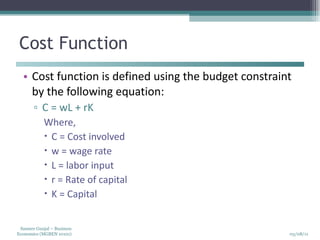
Cost Function Cost function is defined using the budget constraint by the following equation: C = wL + rK Where, C = Cost involved w = wage rate L = labor input r = Rate of capital K = Capital
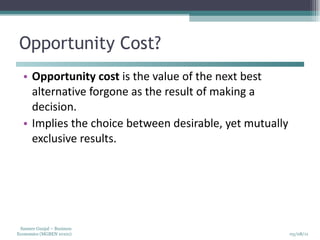
Opportunity Cost? Opportunity cost  is the value of the next best alternative forgone as the result of making a decision. Implies the choice between desirable, yet mutually exclusive results.
Types of Costs Implicit and Explicit costs Implicit costs – Opportunity cost Explicit costs – Out of pocket expenses Direct and Indirect Costs Direct Costs – Raw Materials , etc. Indirect Costs – Admin expenses
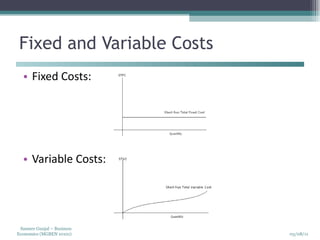
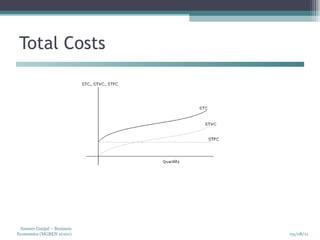
Types of costs Fixed Cost: These are costs that the firm has to pay independently of whether it is operating or not, e.g. rent on a building. Variable Cost: These costs come from the inputs the firm uses in its production process, e.g. the wages paid to laborers. Total Cost: These are the sum of fixed and variable costs. TC = TFC + TVC
Fixed and Variable Costs Fixed Costs: Variable Costs:
Total Costs
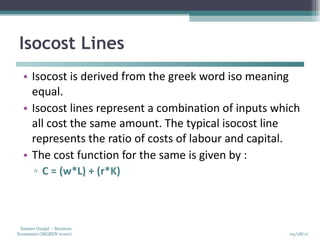
Isocost Lines Isocost is derived from the greek word iso meaning equal. Isocost lines represent  a combination of inputs which all cost the same amount. The typical isocost line represents the ratio of costs of labour and capital.  The  cost function for the same is given by : C = (w*L) + (r*K)
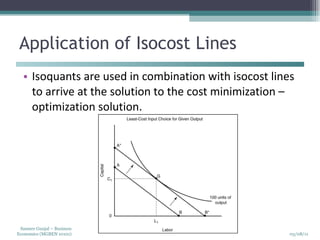
Application of Isocost Lines Isoquants are used in combination with isocost lines to arrive at the solution to the cost minimization – optimization solution.
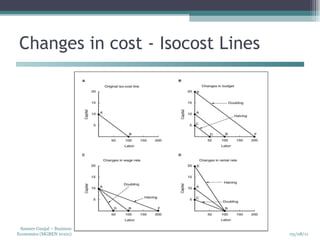
Changes in cost - Isocost Lines
Expansion Path The points of tangency between isoquants and isocost lines each show the least expensive way of producing a particular level of output. Connecting these tangency points gives the firm’s expansion path.
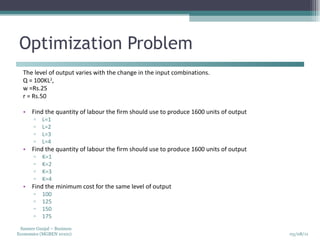
Optimization Problem The level of output varies with the change in the input combinations. Q = 100KL 2 , w =Rs.25 r = Rs.50 Find the quantity of labour the firm should use to produce 1600 units of output L=1 L=2 L=3 L=4 Find the quantity of labour the firm should use to produce 1600 units of output K=1 K=2 K=3 K=4 Find the minimum cost for the same level of output 100 125 150 175
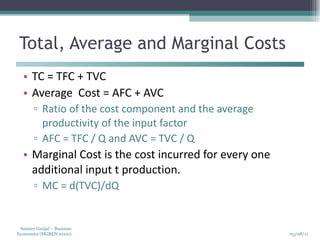
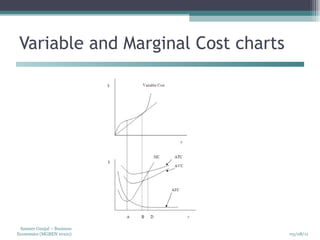
Total, Average and Marginal Costs TC = TFC + TVC Average  Cost = AFC + AVC Ratio of the cost component and the average productivity of the input factor AFC = TFC / Q and AVC = TVC / Q Marginal Cost is the cost incurred for every one additional input t production. MC = d(TVC)/dQ
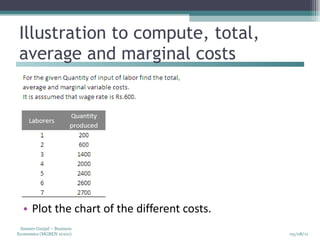
Illustration to compute, total, average and marginal costs Plot the chart of the different costs.
Variable and Marginal Cost charts
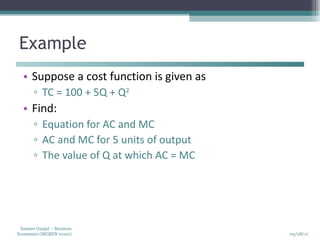
Example Suppose a cost function is given as  TC = 100 + 5Q + Q 2 Find: Equation for AC and MC AC and MC for 5 units of output The value of Q at which AC = MC
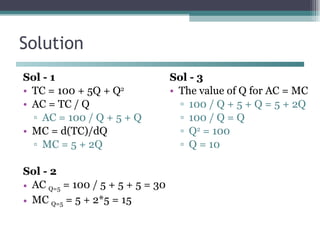
Solution Sol - 1 TC = 100 + 5Q + Q 2 AC = TC / Q AC = 100 / Q + 5 + Q MC = d(TC)/dQ MC = 5 + 2Q Sol - 2 AC  Q=5  = 100 / 5 + 5 + 5 = 30 MC  Q=5  = 5 + 2*5 = 15 Sol - 3 The value of Q for AC = MC 100 / Q + 5 + Q = 5 + 2Q 100 / Q = Q Q 2  = 100 Q = 10
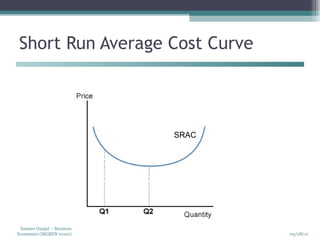
Short Run Average Cost Curve SRAC
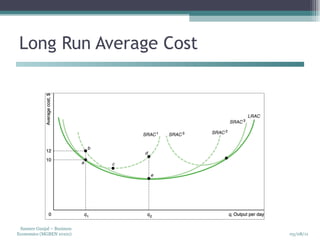
Long Run Average Cost
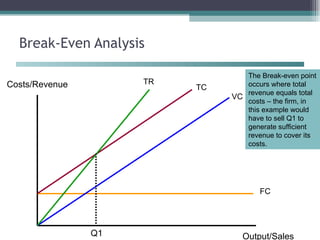
Break-Even Analysis Costs/Revenue Output/Sales FC VC TC TR Q1 The Break-even point occurs where total revenue equals total costs – the firm, in this example would have to sell Q1 to generate sufficient revenue to cover its costs.
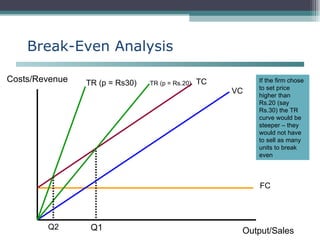
Break-Even Analysis Costs/Revenue Output/Sales FC VC TC TR (p = Rs.20) Q1 If the firm chose to set price higher than Rs.20 (say Rs.30) the TR curve would be steeper – they would not have to sell as many units to break even TR (p = Rs30) Q2
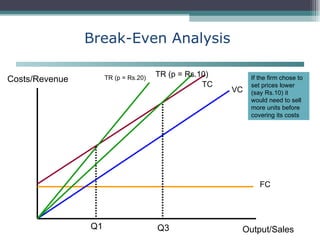
Break-Even Analysis Costs/Revenue Output/Sales FC VC TC TR (p = Rs.20) Q1 If the firm chose to set prices lower (say Rs.10) it would need to sell more units before covering its costs TR (p = Rs.10) Q3
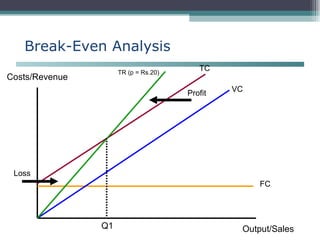
Break-Even Analysis Costs/Revenue Output/Sales FC VC TC TR (p = Rs.20) Q1 Loss Profit
Break Even Analysis Contribution  Contribution is the difference between sales and marginal or variable costs. It contributes toward fixed cost and profit. The concept of contribution helps in deciding breakeven point, profitability of products, departments etc. to perform the following activities:  Selecting product mix or sales mix for profit maximization  Fixing selling prices under different circumstances such as trade depression, export sales, price discrimination etc.
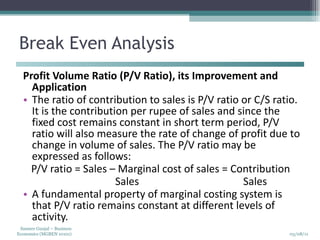
Break Even Analysis Profit Volume Ratio (P/V Ratio), its Improvement and Application  The ratio of contribution to sales is P/V ratio or C/S ratio. It is the contribution per rupee of sales and since the fixed cost remains constant in short term period, P/V ratio will also measure the rate of change of profit due to change in volume of sales. The P/V ratio may be expressed as follows:  P/V ratio = Sales – Marginal cost of sales = Contribution  Sales  Sales  A fundamental property of marginal costing system is that P/V ratio remains constant at different levels of activity.
P/V Analysis A change in fixed cost does not affect P/V ratio. The concept of P/V ratio helps in determining the following:  •  Breakeven point  •  Profit at any volume of sales  •  Sales volume required to earn a desired quantum of profit  •  Profitability of products  •  Processes or departments  The contribution can be increased by increasing the sales price or by reduction of variable costs. Thus, P/V ratio can be improved by the following:  •  Increasing selling price  •  Reducing marginal costs by effectively utilizing men, machines, materials and other services  •  Selling more profitable products, thereby increasing the overall P/V ratio
Breakeven Point  Breakeven point is the volume of sales or production where there is neither profit nor loss. Thus, we can say that:  Contribution = Fixed cost  Now, breakeven point can be easily calculated with the help of fundamental marginal cost equation, P/V ratio or contribution per unit.
Margin of Safety Margin of safety represents the difference between the sales at break-even point and the total actual sales. Three measures of the margin of safety are given below: Margin of Safety = Profit * Sales / (PV ratio) Margin of Safety = Profit / (PV ratio) Margin of Safety = S a  – S b  / S a  * 100
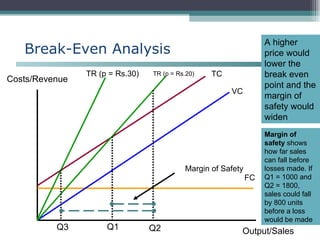
Break-Even Analysis Costs/Revenue Output/Sales FC VC TC TR (p = Rs.20) Q1 Q2 Margin of Safety Margin of safety  shows how far sales can fall before losses made. If Q1 = 1000 and Q2 = 1800, sales could fall by 800 units before a loss would be made TR (p = Rs.30) Q3 A higher price would lower the break even point and the margin of safety would widen
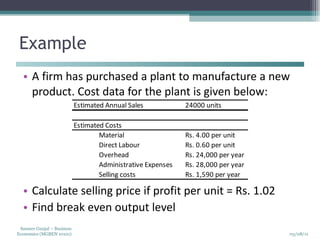
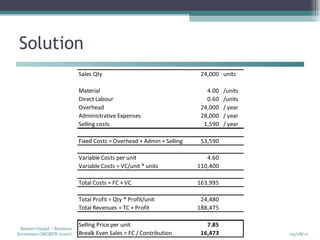
Example A firm has purchased a plant to manufacture a new product. Cost data for the plant is given below: Calculate selling price if profit per unit = Rs. 1.02 Find break even output level
Solution
Break-Even Analysis Remember: A higher price or lower price  does not  mean that break even will  never  be reached!  The BE point depends on the  number of sales needed  to generate revenue to cover costs – the BE chart is NOT time related!
Break-Even Analysis Importance of  Price Elasticity of Demand : Higher prices  might mean fewer sales to break-even but those sales may take a longer time to achieve. Lower prices  might encourage more customers but higher volume needed before sufficient revenue generated to break-even
Break-Even Analysis Links of BE to pricing strategies and elasticity Penetration pricing  – ‘high’ volume, ‘low’ price – more sales to break even Market Skimming  – ‘high’ price ‘low’ volumes – fewer sales to break even Elasticity  – what is likely to happen to sales when prices are increased or decreased?
  Thank You

Business economics cost analysis

  • 1.
    Business Economics – Cost Analysis Sameer Gunjal
  • 2.
    Cost Function Costfunction is defined using the budget constraint by the following equation: C = wL + rK Where, C = Cost involved w = wage rate L = labor input r = Rate of capital K = Capital
  • 3.
    Opportunity Cost? Opportunitycost is the value of the next best alternative forgone as the result of making a decision. Implies the choice between desirable, yet mutually exclusive results.
  • 4.
    Types of CostsImplicit and Explicit costs Implicit costs – Opportunity cost Explicit costs – Out of pocket expenses Direct and Indirect Costs Direct Costs – Raw Materials , etc. Indirect Costs – Admin expenses
  • 5.
    Types of costsFixed Cost: These are costs that the firm has to pay independently of whether it is operating or not, e.g. rent on a building. Variable Cost: These costs come from the inputs the firm uses in its production process, e.g. the wages paid to laborers. Total Cost: These are the sum of fixed and variable costs. TC = TFC + TVC
  • 6.
    Fixed and VariableCosts Fixed Costs: Variable Costs:
  • 7.
  • 8.
    Isocost Lines Isocostis derived from the greek word iso meaning equal. Isocost lines represent a combination of inputs which all cost the same amount. The typical isocost line represents the ratio of costs of labour and capital. The cost function for the same is given by : C = (w*L) + (r*K)
  • 9.
    Application of IsocostLines Isoquants are used in combination with isocost lines to arrive at the solution to the cost minimization – optimization solution.
  • 10.
    Changes in cost- Isocost Lines
  • 11.
    Expansion Path Thepoints of tangency between isoquants and isocost lines each show the least expensive way of producing a particular level of output. Connecting these tangency points gives the firm’s expansion path.
  • 12.
    Optimization Problem Thelevel of output varies with the change in the input combinations. Q = 100KL 2 , w =Rs.25 r = Rs.50 Find the quantity of labour the firm should use to produce 1600 units of output L=1 L=2 L=3 L=4 Find the quantity of labour the firm should use to produce 1600 units of output K=1 K=2 K=3 K=4 Find the minimum cost for the same level of output 100 125 150 175
  • 13.
    Total, Average andMarginal Costs TC = TFC + TVC Average Cost = AFC + AVC Ratio of the cost component and the average productivity of the input factor AFC = TFC / Q and AVC = TVC / Q Marginal Cost is the cost incurred for every one additional input t production. MC = d(TVC)/dQ
  • 14.
    Illustration to compute,total, average and marginal costs Plot the chart of the different costs.
  • 15.
  • 16.
    Example Suppose acost function is given as TC = 100 + 5Q + Q 2 Find: Equation for AC and MC AC and MC for 5 units of output The value of Q at which AC = MC
  • 17.
    Solution Sol -1 TC = 100 + 5Q + Q 2 AC = TC / Q AC = 100 / Q + 5 + Q MC = d(TC)/dQ MC = 5 + 2Q Sol - 2 AC Q=5 = 100 / 5 + 5 + 5 = 30 MC Q=5 = 5 + 2*5 = 15 Sol - 3 The value of Q for AC = MC 100 / Q + 5 + Q = 5 + 2Q 100 / Q = Q Q 2 = 100 Q = 10
  • 18.
    Short Run AverageCost Curve SRAC
  • 19.
  • 20.
    Break-Even Analysis Costs/RevenueOutput/Sales FC VC TC TR Q1 The Break-even point occurs where total revenue equals total costs – the firm, in this example would have to sell Q1 to generate sufficient revenue to cover its costs.
  • 21.
    Break-Even Analysis Costs/RevenueOutput/Sales FC VC TC TR (p = Rs.20) Q1 If the firm chose to set price higher than Rs.20 (say Rs.30) the TR curve would be steeper – they would not have to sell as many units to break even TR (p = Rs30) Q2
  • 22.
    Break-Even Analysis Costs/RevenueOutput/Sales FC VC TC TR (p = Rs.20) Q1 If the firm chose to set prices lower (say Rs.10) it would need to sell more units before covering its costs TR (p = Rs.10) Q3
  • 23.
    Break-Even Analysis Costs/RevenueOutput/Sales FC VC TC TR (p = Rs.20) Q1 Loss Profit
  • 24.
    Break Even AnalysisContribution Contribution is the difference between sales and marginal or variable costs. It contributes toward fixed cost and profit. The concept of contribution helps in deciding breakeven point, profitability of products, departments etc. to perform the following activities: Selecting product mix or sales mix for profit maximization Fixing selling prices under different circumstances such as trade depression, export sales, price discrimination etc.
  • 25.
    Break Even AnalysisProfit Volume Ratio (P/V Ratio), its Improvement and Application The ratio of contribution to sales is P/V ratio or C/S ratio. It is the contribution per rupee of sales and since the fixed cost remains constant in short term period, P/V ratio will also measure the rate of change of profit due to change in volume of sales. The P/V ratio may be expressed as follows: P/V ratio = Sales – Marginal cost of sales = Contribution Sales Sales A fundamental property of marginal costing system is that P/V ratio remains constant at different levels of activity.
  • 26.
    P/V Analysis Achange in fixed cost does not affect P/V ratio. The concept of P/V ratio helps in determining the following: • Breakeven point • Profit at any volume of sales • Sales volume required to earn a desired quantum of profit • Profitability of products • Processes or departments The contribution can be increased by increasing the sales price or by reduction of variable costs. Thus, P/V ratio can be improved by the following: • Increasing selling price • Reducing marginal costs by effectively utilizing men, machines, materials and other services • Selling more profitable products, thereby increasing the overall P/V ratio
  • 27.
    Breakeven Point Breakeven point is the volume of sales or production where there is neither profit nor loss. Thus, we can say that: Contribution = Fixed cost Now, breakeven point can be easily calculated with the help of fundamental marginal cost equation, P/V ratio or contribution per unit.
  • 28.
    Margin of SafetyMargin of safety represents the difference between the sales at break-even point and the total actual sales. Three measures of the margin of safety are given below: Margin of Safety = Profit * Sales / (PV ratio) Margin of Safety = Profit / (PV ratio) Margin of Safety = S a – S b / S a * 100
  • 29.
    Break-Even Analysis Costs/RevenueOutput/Sales FC VC TC TR (p = Rs.20) Q1 Q2 Margin of Safety Margin of safety shows how far sales can fall before losses made. If Q1 = 1000 and Q2 = 1800, sales could fall by 800 units before a loss would be made TR (p = Rs.30) Q3 A higher price would lower the break even point and the margin of safety would widen
  • 30.
    Example A firmhas purchased a plant to manufacture a new product. Cost data for the plant is given below: Calculate selling price if profit per unit = Rs. 1.02 Find break even output level
  • 31.
  • 32.
    Break-Even Analysis Remember:A higher price or lower price does not mean that break even will never be reached! The BE point depends on the number of sales needed to generate revenue to cover costs – the BE chart is NOT time related!
  • 33.
    Break-Even Analysis Importanceof Price Elasticity of Demand : Higher prices might mean fewer sales to break-even but those sales may take a longer time to achieve. Lower prices might encourage more customers but higher volume needed before sufficient revenue generated to break-even
  • 34.
    Break-Even Analysis Linksof BE to pricing strategies and elasticity Penetration pricing – ‘high’ volume, ‘low’ price – more sales to break even Market Skimming – ‘high’ price ‘low’ volumes – fewer sales to break even Elasticity – what is likely to happen to sales when prices are increased or decreased?
  • 35.
    ThankYou