 Presented to:
Sir Ahmed Ghazali
Group Members:
Hassam Khalid 13024854-009
M. Mansha 13024854-001
Faisal Naseer 13024854-048
Atif Afzal 13024854-064
Muhammad Waqas 13024854-050
Cost Theory and Analysis

The expenditure incurred to produce an output or
provide service
Thus the cost incurred in connection with raw
material, labour, other heads constitute the overall
cost of production
What is Cost

Accounting Cost
Economic Cost
Variable Cost
Types of Cost

All those expenses that incurred during
production with adjusted depreciation is
called accounting cost.
Cash payments which firms make for factor
and non-factor input depreciation other
book keeping entries.
Accounting Cost

 Economic costs includes the payments such as rent,
wages, interest and profit, which are paid to factors of
production – land, labour, capital and entrepreneur for
their services.
 Economic Costs = Accounting Costs + Implicit Costs
Economic Cost

 Factors of production or resources, in an economy are
limited and have alternative uses. The cost of sacrifice or
foregone for the next best use of resource is known as
opportunity cost.
Opportunity Cost
Sunk Cost
 A cost that has already been incurred and thus cannot be
recovered.

Cost Function
 Short Run Cost Function
 Long Run Cost Function

Cost Function
Long Run
Marginal
Costs (LMC)
Costs According to Time Period
Short Run Cost Curve Long Run Cost Curve
Total Cost
(TC)
Average
Cost
(AC)
Marginal
Cost (MC)
Long Run
Total Costs
(LTC)
Long Run
Average
Costs (LAC)
Total
Fixed
Costs
(TFC)
Total
Variabl
e
Costs
(TVC)
Averag
e Fixed
Costs
(AFC)
Averag
e
Variabl
e
Costs
(AVC)
[TC =TFC+TVC] [AC = AFC+AVC]
MC = TCn – TCn-1
Or
MC = ΔTC
ΔQ

 In short-run period, some of the firm’s inputs are fixed and
some are variable, and this leads to fixed and variable costs.
 Fixed Cost
 Variable Cost
 Total Cost
 Average Fixed Cost
 Average Variable Cost
 Average Total Cost
 Marginal Cost
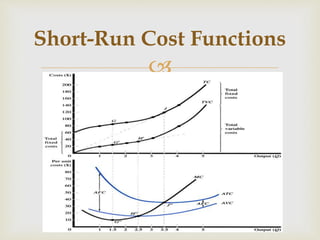
Short-Run Cost Functions

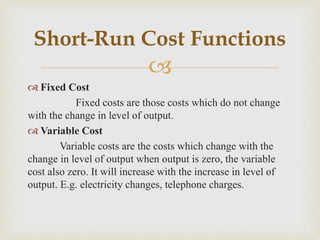
 Fixed Cost
Fixed costs are those costs which do not change
with the change in level of output.
 Variable Cost
Variable costs are the costs which change with the
change in level of output when output is zero, the variable
cost also zero. It will increase with the increase in level of
output. E.g. electricity changes, telephone charges.
Short-Run Cost Functions

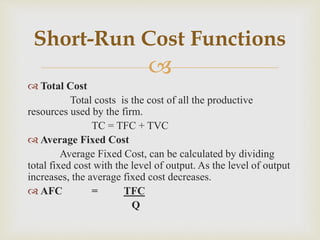
 Total Cost
Total costs is the cost of all the productive
resources used by the firm.
TC = TFC + TVC
 Average Fixed Cost
Average Fixed Cost, can be calculated by dividing
total fixed cost with the level of output. As the level of output
increases, the average fixed cost decreases.
 AFC = TFC
Q
Short-Run Cost Functions

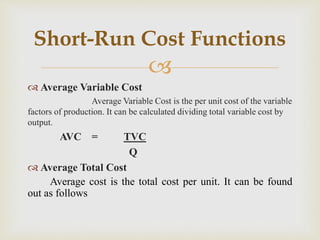
 Average Variable Cost
Average Variable Cost is the per unit cost of the variable
factors of production. It can be calculated dividing total variable cost by
output.
AVC = TVC
Q
 Average Total Cost
Average cost is the total cost per unit. It can be found
out as follows
Short-Run Cost Functions

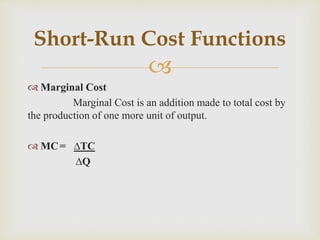
 Marginal Cost
Marginal Cost is an addition made to total cost by
the production of one more unit of output.
 MC= ∆TC
∆Q
Short-Run Cost Functions

Short-Run Cost Functions
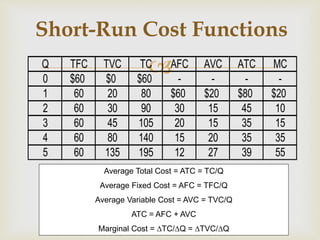
Q TFC TVC TC AFC AVC ATC MC
0 $60 $0 $60 - - - -
1 60 20 80 $60 $20 $80 $20
2 60 30 90 30 15 45 10
3 60 45 105 20 15 35 15
4 60 80 140 15 20 35 35
5 60 135 195 12 27 39 55
Average Total Cost = ATC = TC/Q
Average Fixed Cost = AFC = TFC/Q
Average Variable Cost = AVC = TVC/Q
ATC = AFC + AVC
Marginal Cost = TC/Q = TVC/Q

Short-Run Cost Functions

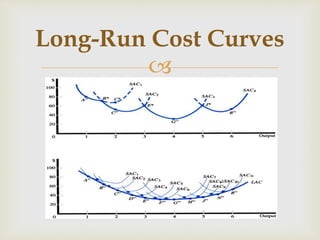
In long run all factors of production are
changeable. In long run a firm can increase its
capacity, equipment, machinery, land, employee,
etc. in order increase output.
Long-Run Cost Curves

Long-Run Cost Curves
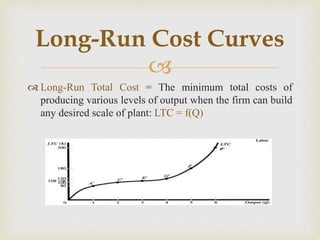
 Long-Run Total Cost = The minimum total costs of
producing various levels of output when the firm can build
any desired scale of plant: LTC = f(Q)

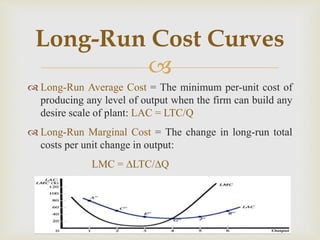
 Long-Run Average Cost = The minimum per-unit cost of
producing any level of output when the firm can build any
desire scale of plant: LAC = LTC/Q
 Long-Run Marginal Cost = The change in long-run total
costs per unit change in output:
LMC = LTC/Q
Long-Run Cost Curves

Long-Run Cost Curves

Long-Run Cost Curves
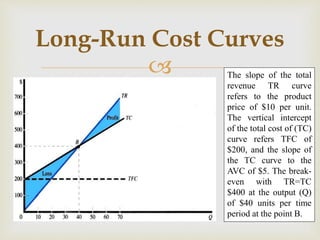
The slope of the total
revenue TR curve
refers to the product
price of $10 per unit.
The vertical intercept
of the total cost of (TC)
curve refers TFC of
$200, and the slope of
the TC curve to the
AVC of $5. The break-
even with TR=TC
$400 at the output (Q)
of $40 units per time
period at the point B.


Economic Presentation: Cost Theory and Analysis

  • 2.
     Presented to: SirAhmed Ghazali Group Members: Hassam Khalid 13024854-009 M. Mansha 13024854-001 Faisal Naseer 13024854-048 Atif Afzal 13024854-064 Muhammad Waqas 13024854-050 Cost Theory and Analysis
  • 3.
     The expenditure incurredto produce an output or provide service Thus the cost incurred in connection with raw material, labour, other heads constitute the overall cost of production What is Cost
  • 4.
  • 5.
     All those expensesthat incurred during production with adjusted depreciation is called accounting cost. Cash payments which firms make for factor and non-factor input depreciation other book keeping entries. Accounting Cost
  • 6.
      Economic costsincludes the payments such as rent, wages, interest and profit, which are paid to factors of production – land, labour, capital and entrepreneur for their services.  Economic Costs = Accounting Costs + Implicit Costs Economic Cost
  • 7.
      Factors ofproduction or resources, in an economy are limited and have alternative uses. The cost of sacrifice or foregone for the next best use of resource is known as opportunity cost. Opportunity Cost Sunk Cost  A cost that has already been incurred and thus cannot be recovered.
  • 8.
     Cost Function  ShortRun Cost Function  Long Run Cost Function
  • 9.
     Cost Function Long Run Marginal Costs(LMC) Costs According to Time Period Short Run Cost Curve Long Run Cost Curve Total Cost (TC) Average Cost (AC) Marginal Cost (MC) Long Run Total Costs (LTC) Long Run Average Costs (LAC) Total Fixed Costs (TFC) Total Variabl e Costs (TVC) Averag e Fixed Costs (AFC) Averag e Variabl e Costs (AVC) [TC =TFC+TVC] [AC = AFC+AVC] MC = TCn – TCn-1 Or MC = ΔTC ΔQ
  • 10.
      In short-runperiod, some of the firm’s inputs are fixed and some are variable, and this leads to fixed and variable costs.  Fixed Cost  Variable Cost  Total Cost  Average Fixed Cost  Average Variable Cost  Average Total Cost  Marginal Cost Short-Run Cost Functions
  • 11.
      Fixed Cost Fixedcosts are those costs which do not change with the change in level of output.  Variable Cost Variable costs are the costs which change with the change in level of output when output is zero, the variable cost also zero. It will increase with the increase in level of output. E.g. electricity changes, telephone charges. Short-Run Cost Functions
  • 12.
      Total Cost Totalcosts is the cost of all the productive resources used by the firm. TC = TFC + TVC  Average Fixed Cost Average Fixed Cost, can be calculated by dividing total fixed cost with the level of output. As the level of output increases, the average fixed cost decreases.  AFC = TFC Q Short-Run Cost Functions
  • 13.
      Average VariableCost Average Variable Cost is the per unit cost of the variable factors of production. It can be calculated dividing total variable cost by output. AVC = TVC Q  Average Total Cost Average cost is the total cost per unit. It can be found out as follows Short-Run Cost Functions
  • 14.
      Marginal Cost MarginalCost is an addition made to total cost by the production of one more unit of output.  MC= ∆TC ∆Q Short-Run Cost Functions
  • 15.
     Short-Run Cost Functions QTFC TVC TC AFC AVC ATC MC 0 $60 $0 $60 - - - - 1 60 20 80 $60 $20 $80 $20 2 60 30 90 30 15 45 10 3 60 45 105 20 15 35 15 4 60 80 140 15 20 35 35 5 60 135 195 12 27 39 55 Average Total Cost = ATC = TC/Q Average Fixed Cost = AFC = TFC/Q Average Variable Cost = AVC = TVC/Q ATC = AFC + AVC Marginal Cost = TC/Q = TVC/Q
  • 16.
  • 17.
     In long runall factors of production are changeable. In long run a firm can increase its capacity, equipment, machinery, land, employee, etc. in order increase output. Long-Run Cost Curves
  • 18.
     Long-Run Cost Curves Long-Run Total Cost = The minimum total costs of producing various levels of output when the firm can build any desired scale of plant: LTC = f(Q)
  • 19.
      Long-Run AverageCost = The minimum per-unit cost of producing any level of output when the firm can build any desire scale of plant: LAC = LTC/Q  Long-Run Marginal Cost = The change in long-run total costs per unit change in output: LMC = LTC/Q Long-Run Cost Curves
  • 20.
  • 21.
     Long-Run Cost Curves Theslope of the total revenue TR curve refers to the product price of $10 per unit. The vertical intercept of the total cost of (TC) curve refers TFC of $200, and the slope of the TC curve to the AVC of $5. The break- even with TR=TC $400 at the output (Q) of $40 units per time period at the point B.
  • 22.