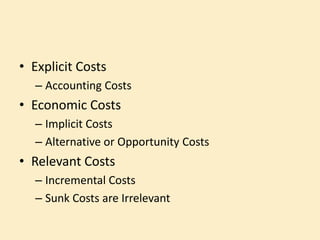
• Explicit Costs
– Accounting Costs
• Economic Costs
– Implicit Costs
– Alternative or Opportunity Costs
• Relevant Costs
– Incremental Costs
– Sunk Costs are Irrelevant
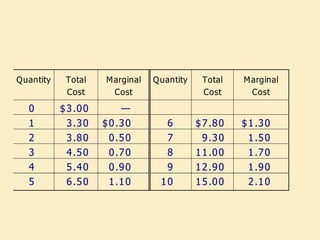
Quantity Total
Cost
Marginal
Cost
Quantity Total
Cost
Marginal
Cost
0 $3.00 —
1 3.30 $0.30 6 $7.80 $1.30
2 3.80 0.50 7 9.30 1.50
3 4.50 0.70 8 11.00 1.70
4 5.40 0.90 9 12.90 1.90
5 6.50 1.10 10 15.00 2.10
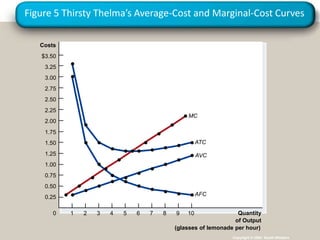
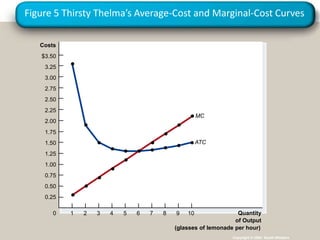
Figure 5 Thirsty Thelma’s Average-Cost and Marginal-Cost Curves
Copyright © 2004 South-Western
Costs
$3.50
3.25
3.00
2.75
2.50
2.25
2.00
1.75
1.50
1.25
1.00
0.75
0.50
0.25
Quantity
of Output
(glasses of lemonade per hour)
0 1 432 765 98 10
MC
ATC
AVC
AFC
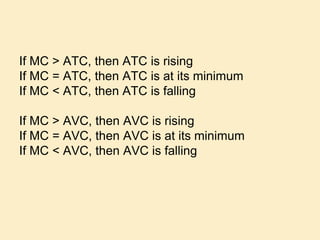
If MC > ATC, then ATC is rising
If MC = ATC, then ATC is at its minimum
If MC < ATC, then ATC is falling
If MC > AVC, then AVC is rising
If MC = AVC, then AVC is at its minimum
If MC < AVC, then AVC is falling
Cost Curves and Their Shapes
• The average total-cost curve is U-shaped.
• At very low levels of output average total cost is
high because fixed cost is spread over only a few
units.
• Average total cost declines as output increases.
• Average total cost starts rising because average
variable cost rises substantially.
• The bottom of the U-shaped ATC curve occurs at
the quantity that minimizes average total cost.
This quantity is sometimes called the efficient
scale of the firm.
Figure 5 Thirsty Thelma’s Average-Cost and Marginal-Cost Curves
Copyright © 2004 South-Western
Costs
$3.50
3.25
3.00
2.75
2.50
2.25
2.00
1.75
1.50
1.25
1.00
0.75
0.50
0.25
Quantity
of Output
(glasses of lemonade per hour)
0 1 432 765 98 10
ATC
MC
COSTS IN THE SHORT RUN AND IN THE
LONG RUN
– In the short run, some costs are fixed.
– In the long run, fixed costs become variable costs.
• Because many costs are fixed in the short run
but variable in the long run, a firm’s long-run
cost curves differ from its short-run cost
curves.
9
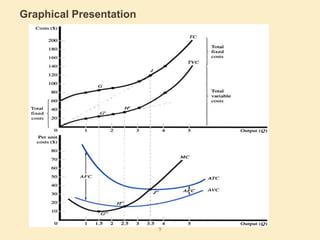
Graphical Presentation
Long-Run Cost Curves
• The long run is the period of time during which:
 Technology is constant
 All inputs and costs are variable
 The firm faces no fixed inputs or costs
 The long run period is a series of short run
periods. [For each short run period there is a
set of TP, AP, MP, MC, AFC, AVC, ATC, TC,
TVC & TFC for each possible scale of plant].
• Long-Run Total Cost = The minimum total costs of
producing various levels of output when the firm
can build any desired scale of plant: LTC = f(Q)
• Long-Run Average Cost = The minimum per-unit
cost of producing any level of output when the firm
can build any desire scale of plant: LAC = LTC/Q
• Long-Run Marginal Cost = The change in long-run
total costs per unit change in output: LMC =
LTC/ Q
12
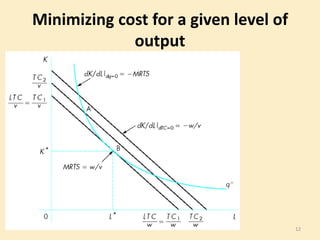
Minimizing cost for a given level of
output
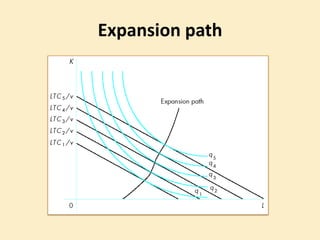
Expansion Path
• Locus of points where isoquant curve and isocost
line are tangent is called expansion path
• It describes the combinations of labor and capital
that the firm will choose to minimize costs at
each level of output.
• Generally, an expansion path has a positive slope
– An increase in LTC, required for producing a higher
level of output, results in both inputs increasing
Expansion path
COST IN THE LONG RUN
7
.
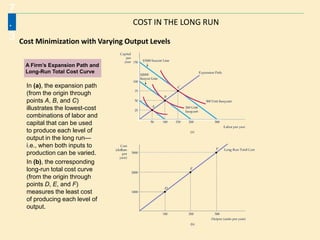
3 Cost Minimization with Varying Output Levels
A Firm’s Expansion Path and
Long-Run Total Cost Curve
In (a), the expansion path
(from the origin through
points A, B, and C)
illustrates the lowest-cost
combinations of labor and
capital that can be used
to produce each level of
output in the long run—
i.e., when both inputs to
production can be varied.
In (b), the corresponding
long-run total cost curve
(from the origin through
points D, E, and F)
measures the least cost
of producing each level of
output.
Shape of the long run cost surve
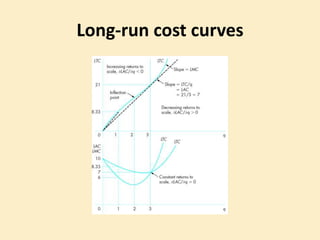
• The LTC curve is a straight line in the previous slide because of
constant returns to scale
• LTC can also be U shaped depending on the returns to scal and
• If the firm has increasing returns to scale , average cost of production
falls with output . When there are decreasing returns to scale, the
average cost of production increases with output.
• The typical LAC curve is a U shaped due to increasing and decreasing
returns to scale.
• LMC lies below the LAC curve when LAC is falling and above it when
LAC is rising. The two curves intersect at A, where the LAC curve
achieves its minimum.
• E=When LAC is constant, LAC and LMC are equal.
•
Long-run cost curves
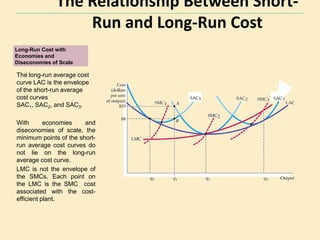
Long-Run Cost with
Economies and
Diseconomies of Scale
The long-run average cost
curve LAC is the envelope
of the short-run average
cost curves
SAC1, SAC2, and SAC3.
With economies and
diseconomies of scale, the
minimum points of the short-
run average cost curves do
not lie on the long-run
average cost curve.
LMC is not the envelope of
the SMCs. Each point on
the LMC is the SMC cost
associated with the cost-
efficient plant.
The Relationship Between Short-
Run and Long-Run Cost
19
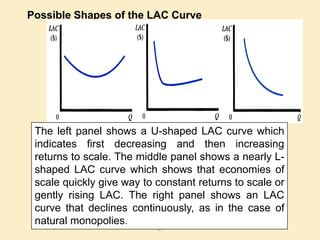
Possible Shapes of the LAC Curve
The left panel shows a U-shaped LAC curve which
indicates first decreasing and then increasing
returns to scale. The middle panel shows a nearly L-
shaped LAC curve which shows that economies of
scale quickly give way to constant returns to scale or
gently rising LAC. The right panel shows an LAC
curve that declines continuously, as in the case of
natural monopolies.
Economies and Diseconomies of Scale
• As output increases, the firm’s average cost of producing that output is likely to
decline, at least to a point.
• This can happen for the following reasons:
1. If the firm operates on a larger scale, workers can specialize in the activities at
which they are most productive.
2. Scale can provide flexibility. By varying the combination of inputs utilized to
produce the firm’s output, managers can organize the production process more
effectively.
3. The firm may be able to acquire some production inputs at lower cost because it
is buying them in large quantities and can therefore negotiate better prices. The
mix of inputs might change with the scale of the firm’s operation if managers
take advantage of lower-cost inputs.
Economies of scale
• Real Economies- which arise due to labour
economies, technical
economies(mechanisation), inventory
economies, selling economies (advertising, dealer
tie-ups etc.), managerial
economies(decentralisation), transport
economies etc.
• Pecuniary economies- lower prices of raw
material, external
finance, advertising., transport, workers die to
better prestige.
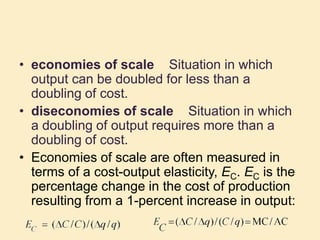
• economies of scale Situation in which
output can be doubled for less than a
doubling of cost.
• diseconomies of scale Situation in which
a doubling of output requires more than a
doubling of cost.
• Economies of scale are often measured in
terms of a cost-output elasticity, EC. EC is the
percentage change in the cost of production
resulting from a 1-percent increase in output:
Economies of Scope
• Situation in which joint output of a single firm
is greater than output that could be achieved
by two different firms when each produces a
single product.
• The joint use of inputs or production
facilities, joint marketing programs, or
common administration. Eg: sheet metal
manufacturers produce scrap metal and
shavings that they can sell
• diseconomies of scope Situation in which
joint output of a single firm is less than could
be achieved by separate firms when each
produces a single product.
24
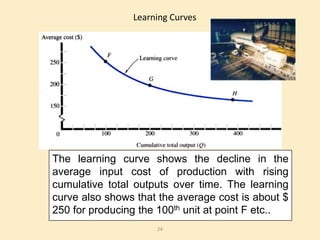
Learning Curves
The learning curve shows the decline in the
average input cost of production with rising
cumulative total outputs over time. The learning
curve also shows that the average cost is about $
250 for producing the 100th unit at point F etc..
Returns to Scale
• Returns to scale can be directly related to long-run
cost curves
• A cost curve may exhibit
increasing, decreasing, and/or constant returns to
scale
– Increasing returns to scale (also called economies of scale)
is where LAC is declining
• ∂LAC/∂q < 0
• Increases in total cost are proportionally smaller than an increase
in output
– Corresponds to concave area of LTC curve
• Implies that inputs less than double for a doubling of output
– Corresponds to LTC also less than doubling
• Decreasing returns to scale (also called diseconomies of scale)
is where LAC is increasing
– ∂LAC/∂q > 0
– Increases in total cost are proportionally larger than an increase in
output
• Corresponds to convex area of LTC curve
– Implies that inputs more than double for a doubling of output
• Corresponds to LTC more than doubling for a doubling of output
• Constant returns to scale (also called constant economies of
scale) corresponds to where ∂LAC/∂q = 0
– Long-run average cost does not change for a given change in output
• If LTC curve is linear, then constant returns to scale exists for all levels of
output

Cost function

  • 2.
    • Explicit Costs –Accounting Costs • Economic Costs – Implicit Costs – Alternative or Opportunity Costs • Relevant Costs – Incremental Costs – Sunk Costs are Irrelevant
  • 3.
    Quantity Total Cost Marginal Cost Quantity Total Cost Marginal Cost 0$3.00 — 1 3.30 $0.30 6 $7.80 $1.30 2 3.80 0.50 7 9.30 1.50 3 4.50 0.70 8 11.00 1.70 4 5.40 0.90 9 12.90 1.90 5 6.50 1.10 10 15.00 2.10
  • 4.
    Figure 5 ThirstyThelma’s Average-Cost and Marginal-Cost Curves Copyright © 2004 South-Western Costs $3.50 3.25 3.00 2.75 2.50 2.25 2.00 1.75 1.50 1.25 1.00 0.75 0.50 0.25 Quantity of Output (glasses of lemonade per hour) 0 1 432 765 98 10 MC ATC AVC AFC
  • 5.
    If MC >ATC, then ATC is rising If MC = ATC, then ATC is at its minimum If MC < ATC, then ATC is falling If MC > AVC, then AVC is rising If MC = AVC, then AVC is at its minimum If MC < AVC, then AVC is falling
  • 6.
    Cost Curves andTheir Shapes • The average total-cost curve is U-shaped. • At very low levels of output average total cost is high because fixed cost is spread over only a few units. • Average total cost declines as output increases. • Average total cost starts rising because average variable cost rises substantially. • The bottom of the U-shaped ATC curve occurs at the quantity that minimizes average total cost. This quantity is sometimes called the efficient scale of the firm.
  • 7.
    Figure 5 ThirstyThelma’s Average-Cost and Marginal-Cost Curves Copyright © 2004 South-Western Costs $3.50 3.25 3.00 2.75 2.50 2.25 2.00 1.75 1.50 1.25 1.00 0.75 0.50 0.25 Quantity of Output (glasses of lemonade per hour) 0 1 432 765 98 10 ATC MC
  • 8.
    COSTS IN THESHORT RUN AND IN THE LONG RUN – In the short run, some costs are fixed. – In the long run, fixed costs become variable costs. • Because many costs are fixed in the short run but variable in the long run, a firm’s long-run cost curves differ from its short-run cost curves.
  • 9.
  • 10.
    Long-Run Cost Curves •The long run is the period of time during which:  Technology is constant  All inputs and costs are variable  The firm faces no fixed inputs or costs  The long run period is a series of short run periods. [For each short run period there is a set of TP, AP, MP, MC, AFC, AVC, ATC, TC, TVC & TFC for each possible scale of plant].
  • 11.
    • Long-Run TotalCost = The minimum total costs of producing various levels of output when the firm can build any desired scale of plant: LTC = f(Q) • Long-Run Average Cost = The minimum per-unit cost of producing any level of output when the firm can build any desire scale of plant: LAC = LTC/Q • Long-Run Marginal Cost = The change in long-run total costs per unit change in output: LMC = LTC/ Q
  • 12.
    12 Minimizing cost fora given level of output
  • 13.
    Expansion Path • Locusof points where isoquant curve and isocost line are tangent is called expansion path • It describes the combinations of labor and capital that the firm will choose to minimize costs at each level of output. • Generally, an expansion path has a positive slope – An increase in LTC, required for producing a higher level of output, results in both inputs increasing
  • 14.
  • 15.
    COST IN THELONG RUN 7 . 3 Cost Minimization with Varying Output Levels A Firm’s Expansion Path and Long-Run Total Cost Curve In (a), the expansion path (from the origin through points A, B, and C) illustrates the lowest-cost combinations of labor and capital that can be used to produce each level of output in the long run— i.e., when both inputs to production can be varied. In (b), the corresponding long-run total cost curve (from the origin through points D, E, and F) measures the least cost of producing each level of output.
  • 16.
    Shape of thelong run cost surve • The LTC curve is a straight line in the previous slide because of constant returns to scale • LTC can also be U shaped depending on the returns to scal and • If the firm has increasing returns to scale , average cost of production falls with output . When there are decreasing returns to scale, the average cost of production increases with output. • The typical LAC curve is a U shaped due to increasing and decreasing returns to scale. • LMC lies below the LAC curve when LAC is falling and above it when LAC is rising. The two curves intersect at A, where the LAC curve achieves its minimum. • E=When LAC is constant, LAC and LMC are equal. •
  • 17.
  • 18.
    Long-Run Cost with Economiesand Diseconomies of Scale The long-run average cost curve LAC is the envelope of the short-run average cost curves SAC1, SAC2, and SAC3. With economies and diseconomies of scale, the minimum points of the short- run average cost curves do not lie on the long-run average cost curve. LMC is not the envelope of the SMCs. Each point on the LMC is the SMC cost associated with the cost- efficient plant. The Relationship Between Short- Run and Long-Run Cost
  • 19.
    19 Possible Shapes ofthe LAC Curve The left panel shows a U-shaped LAC curve which indicates first decreasing and then increasing returns to scale. The middle panel shows a nearly L- shaped LAC curve which shows that economies of scale quickly give way to constant returns to scale or gently rising LAC. The right panel shows an LAC curve that declines continuously, as in the case of natural monopolies.
  • 20.
    Economies and Diseconomiesof Scale • As output increases, the firm’s average cost of producing that output is likely to decline, at least to a point. • This can happen for the following reasons: 1. If the firm operates on a larger scale, workers can specialize in the activities at which they are most productive. 2. Scale can provide flexibility. By varying the combination of inputs utilized to produce the firm’s output, managers can organize the production process more effectively. 3. The firm may be able to acquire some production inputs at lower cost because it is buying them in large quantities and can therefore negotiate better prices. The mix of inputs might change with the scale of the firm’s operation if managers take advantage of lower-cost inputs.
  • 21.
    Economies of scale •Real Economies- which arise due to labour economies, technical economies(mechanisation), inventory economies, selling economies (advertising, dealer tie-ups etc.), managerial economies(decentralisation), transport economies etc. • Pecuniary economies- lower prices of raw material, external finance, advertising., transport, workers die to better prestige.
  • 22.
    • economies ofscale Situation in which output can be doubled for less than a doubling of cost. • diseconomies of scale Situation in which a doubling of output requires more than a doubling of cost. • Economies of scale are often measured in terms of a cost-output elasticity, EC. EC is the percentage change in the cost of production resulting from a 1-percent increase in output:
  • 23.
    Economies of Scope •Situation in which joint output of a single firm is greater than output that could be achieved by two different firms when each produces a single product. • The joint use of inputs or production facilities, joint marketing programs, or common administration. Eg: sheet metal manufacturers produce scrap metal and shavings that they can sell • diseconomies of scope Situation in which joint output of a single firm is less than could be achieved by separate firms when each produces a single product.
  • 24.
    24 Learning Curves The learningcurve shows the decline in the average input cost of production with rising cumulative total outputs over time. The learning curve also shows that the average cost is about $ 250 for producing the 100th unit at point F etc..
  • 25.
    Returns to Scale •Returns to scale can be directly related to long-run cost curves • A cost curve may exhibit increasing, decreasing, and/or constant returns to scale – Increasing returns to scale (also called economies of scale) is where LAC is declining • ∂LAC/∂q < 0 • Increases in total cost are proportionally smaller than an increase in output – Corresponds to concave area of LTC curve • Implies that inputs less than double for a doubling of output – Corresponds to LTC also less than doubling
  • 26.
    • Decreasing returnsto scale (also called diseconomies of scale) is where LAC is increasing – ∂LAC/∂q > 0 – Increases in total cost are proportionally larger than an increase in output • Corresponds to convex area of LTC curve – Implies that inputs more than double for a doubling of output • Corresponds to LTC more than doubling for a doubling of output • Constant returns to scale (also called constant economies of scale) corresponds to where ∂LAC/∂q = 0 – Long-run average cost does not change for a given change in output • If LTC curve is linear, then constant returns to scale exists for all levels of output