COST

(COST MEANS SACRIFICE)
MEANING - COST
“ Cost is a sacrifice or foregoing that has
  occurred or has potential to occur in future,
  measured in monetary terms”

• Cost results in current or future decrease in
  cash or other assets or a current or future
  increase in liability
DETERMINANTS OF COST
• Cost is determined by various factors and each of
  these has significant implications for cost
  decisions.
• An increase in any of these will affect cost
  pattern.
• Important determinant
  – Price(uncontrollable –largely determined by external
    environment)
  – Marginal efficiency and productivity
  – Technology
  – Level of out put.
MATHEMATICAL EXPRESSION- COST


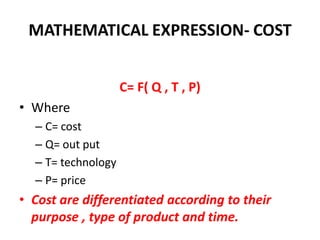
                    C= F( Q , T , P)
• Where
  – C= cost
  – Q= out put
  – T= technology
  – P= price
• Cost are differentiated according to their
  purpose , type of product and time.
TYPES OF COSTS
• There may be different types of costs incurred
  by a firm under different circumstances.
• Cost of a firm may include money or may not
  be measurable in money terms.
• Cost is a function of output in economic
  theory.
• A managerial economist’s concept of cost
  does not necessarily coincide with that of
  accountants.
TYPES OF COST
• Actual Costs / Acquisition / outlay : It means
  the actual expenditure incurred for acquiring
  or producing a good or service. These are
  generally recorded in the books of accounts.
  Eg. Wages paid, cost of materials purchased,
  interest paid, etc.
• Opportunity Cost / Alternative Cost: Revenue
  forgone by not making the best alternative
  use or opportunities.
• Imputed Cost / Implicit cost: They are the costs
  which are not actually incurred but would have
  been incurred in the absence of employment of
  self-owned factors. These are unrecognized by
  the accounting systems. Eg. Rent of own
  building, Salary for Entrepreneur, etc.
• Explicit cost / Paid out costs: Those expenses
  which are actually paid by the firm. Appears in
  the accounting books.
• Sunk Costs / Non-avoidable / Non escapable:
  They are not altered by a change in quantity and
  cannot be recovered. All the past expenses are
  sunk costs Eg Depreciation, interest, machineries
  not in use.
• Incremental / Differential cost ( Avoidable,
  escapable or Differential): It is the additional
  cost due to a change in level or nature of
  business activity.
• Out-of-Pocket costs: These are expenses
  which are current cash payments to the
  outsiders. (All Explicit costs)
• Book Costs: These are business costs which do
  not involve any cash payments but for them a
  provision is made in the books of account. Eg.
  Depreciation, Implicit cost.
• Accounting cost / Past Cost: How much
  expenditure has already been incurred on a
  particular process or on production as such.
• Economic cost / Future cost: Cost relate to
  future.
• Direct costs / Traceable / Assignable: These
  costs have direct relationship with a unit of
  operation.
• Indirect / Non-traceable / Non assignable:
  These costs cannot be easily & definitely
  traced to a plant or department.
• Historical Cost / Original cost: It states the
  cost of plant, equipment and materials at the
  price paid originally for them.
• Replacement cost: It states the cost that the
  firm would have to incur if it wants to replace
  or acquire the same assets now.
• Controllable costs: Costs which are capable of
  being controlled or regulated.
• Non-Controllable cost: costs which cannot be
  subjected to administrative control and
  supervision. Eg. Depreciation, Obsolescence.
• Private costs: Micro level. Costs incurred by an
  individual or a firm for its business activity.
• Social costs: Macro level. Total cost s to the
  society on account of production of a good.
• Shutdown Costs: Those costs incurred when
  firm temporarily stops it operations.
• Abandonment Costs: Costs incurred when the
  firm is retiring altogether.
• Short run costs: a period in which the supply
  of at least one of the inputs cannot be
  changed by the firm. Inputs are fixed.
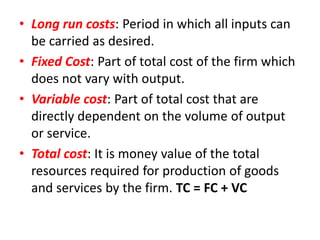
• Long run costs: Period in which all inputs can
  be carried as desired.
• Fixed Cost: Part of total cost of the firm which
  does not vary with output.
• Variable cost: Part of total cost that are
  directly dependent on the volume of output
  or service.
• Total cost: It is money value of the total
  resources required for production of goods
  and services by the firm. TC = FC + VC
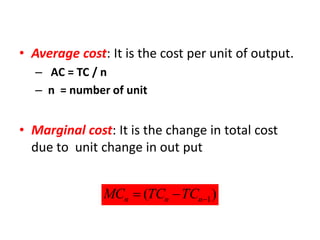
• Average cost: It is the cost per unit of output.
  – AC = TC / n
  – n = number of unit


• Marginal cost: It is the change in total cost
  due to unit change in out put


               MCn  (TCn  TCn1 )
COSTS IN SHORT RUN
• Classification of costs is on the basis of time
  – Short run cost
  – Long run cost
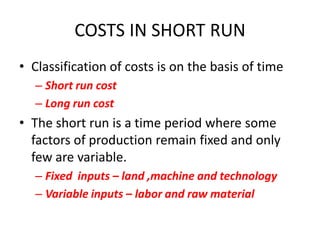
• The short run is a time period where some
  factors of production remain fixed and only
  few are variable.
  – Fixed inputs – land ,machine and technology
  – Variable inputs – labor and raw material
Contd…
• Therefore in short run we divide costs in two
  broad categories
  – Fixed costs
     • Costs on fixed inputs
  – Variable costs
     • Costs on variable inputs
TOTAL COSTS FUNCTIONS AND CURVES
         FOR SHORT RUN
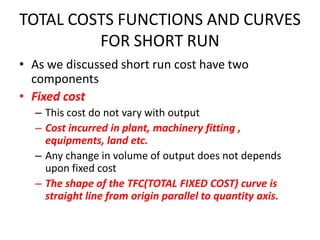
• As we discussed short run cost have two
  components
• Fixed cost
  – This cost do not vary with output
  – Cost incurred in plant, machinery fitting ,
    equipments, land etc.
  – Any change in volume of output does not depends
    upon fixed cost
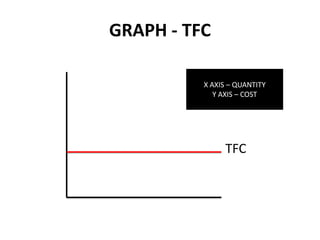
  – The shape of the TFC(TOTAL FIXED COST) curve is
    straight line from origin parallel to quantity axis.
GRAPH - TFC

          X AXIS – QUANTITY
             Y AXIS – COST


               TFC
• Variable cost
  – These are costs that vary with output and are
    incurred in getting more and more inputs.
  – Variable costs are equal to zero if there is no out
    put
  – Cost of raw materials , wages are called variable
    cost.
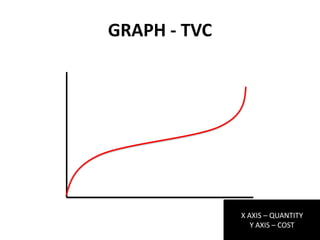
  – TVC is an inverse S shaped upward sloping curve
    starting from origin.
GRAPH - TVC


              X AXIS – QUANTITY
                 Y AXIS – COST
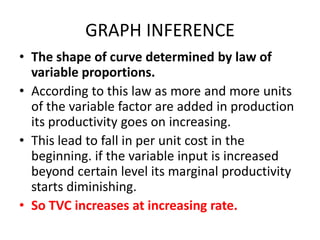
GRAPH INFERENCE
• The shape of curve determined by law of
  variable proportions.
• According to this law as more and more units
  of the variable factor are added in production
  its productivity goes on increasing.
• This lead to fall in per unit cost in the
  beginning. if the variable input is increased
  beyond certain level its marginal productivity
  starts diminishing.
• So TVC increases at increasing rate.
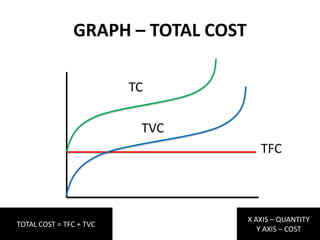
GRAPH – TOTAL COST

                         TC

                          TVC
                                       TFC


                                    X AXIS – QUANTITY
TOTAL COST = TFC + TVC
                                       Y AXIS – COST
SHORT RUN – AVERAGE AND MARGINAL COST
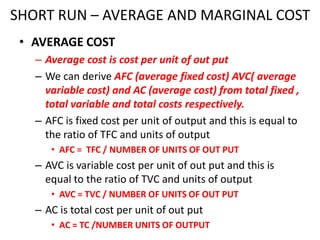
 • AVERAGE COST
   – Average cost is cost per unit of out put
   – We can derive AFC (average fixed cost) AVC( average
     variable cost) and AC (average cost) from total fixed ,
     total variable and total costs respectively.
   – AFC is fixed cost per unit of output and this is equal to
     the ratio of TFC and units of output
      • AFC = TFC / NUMBER OF UNITS OF OUT PUT
   – AVC is variable cost per unit of out put and this is
     equal to the ratio of TVC and units of output
      • AVC = TVC / NUMBER OF UNITS OF OUT PUT
   – AC is total cost per unit of out put
      • AC = TC /NUMBER UNITS OF OUTPUT
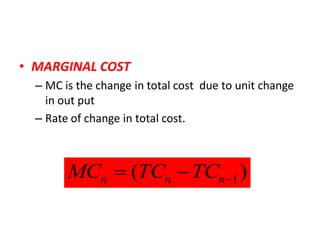
• MARGINAL COST
  – MC is the change in total cost due to unit change
    in out put
  – Rate of change in total cost.


        MCn  (TCn  TCn1 )
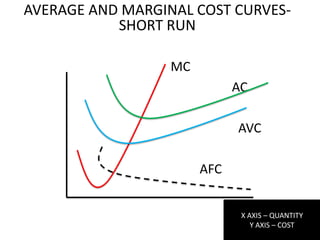
AVERAGE AND MARGINAL COST CURVES-
           SHORT RUN

                  MC
                             AC

                             AVC

                       AFC


                              X AXIS – QUANTITY
                                 Y AXIS – COST
AVC , AFC AND AC GRAPH -
              INFERENCE
• The AVC and AC curve are both U shaped.
  – This explained by law of diminishing returns.
  – Cost decline when there are increasing
    returns(output)
• AC being the sum of AFC and AVC at each
  level of output lies above both AFC and AVC
  curve.
• Initially AC falls with increase in out put
  reaches minimum and then increases.
..contd
•   When both AFC and AVC fall AC also falls.
•   AVC soon reaches minimum and start rising .
•   While AFC continues to fall.
•   How ever the rise in AVC compensate falls in
    AFC and AVC pulls AC up after reaches a
    minimum.
MARGINAL COST GRAPH - INFERENCE
• The magnitude of marginal cost is interlinked
  with changes in average cost.
• When average cost decline MC lies below AC.
• When average costs are constant the MC passes
  through the minimum points of average cost
  curves.
• When average cost rise MC curve lies above
  them.
• AC and AVC fall MC lies below them
• AC and AVC rise MC lies above them.
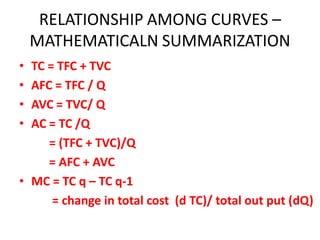
RELATIONSHIP AMONG CURVES –
    MATHEMATICALN SUMMARIZATION
• TC = TFC + TVC
• AFC = TFC / Q
• AVC = TVC/ Q
• AC = TC /Q
     = (TFC + TVC)/Q
     = AFC + AVC
• MC = TC q – TC q-1
      = change in total cost (d TC)/ total out put (dQ)
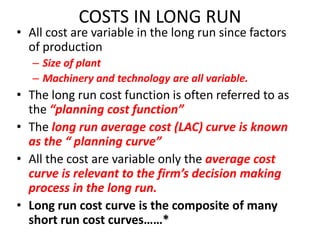
COSTS IN LONG RUN
• All cost are variable in the long run since factors
  of production
   – Size of plant
   – Machinery and technology are all variable.
• The long run cost function is often referred to as
  the “planning cost function”
• The long run average cost (LAC) curve is known
  as the “ planning curve”
• All the cost are variable only the average cost
  curve is relevant to the firm’s decision making
  process in the long run.
• Long run cost curve is the composite of many
  short run cost curves……*
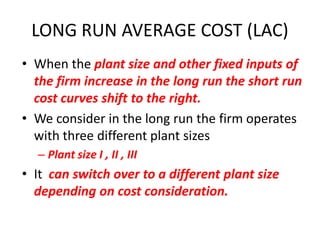
LONG RUN AVERAGE COST (LAC)
• When the plant size and other fixed inputs of
  the firm increase in the long run the short run
  cost curves shift to the right.
• We consider in the long run the firm operates
  with three different plant sizes
  – Plant size I , II , III
• It can switch over to a different plant size
  depending on cost consideration.
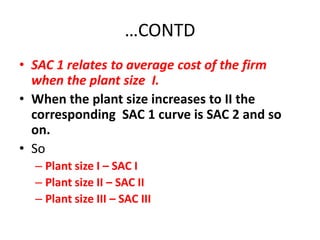
…CONTD
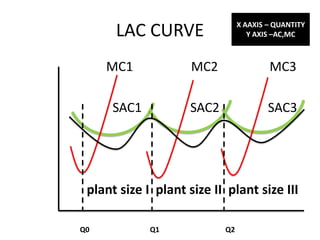
• SAC 1 relates to average cost of the firm
  when the plant size I.
• When the plant size increases to II the
  corresponding SAC 1 curve is SAC 2 and so
  on.
• So
  – Plant size I – SAC I
  – Plant size II – SAC II
  – Plant size III – SAC III
X AAXIS – QUANTITY
      LAC CURVE                     Y AXIS –AC,MC


     MC1             MC2                 MC3

      SAC1           SAC2                SAC3


 plant size I plant size II plant size III

Q0           Q1             Q2
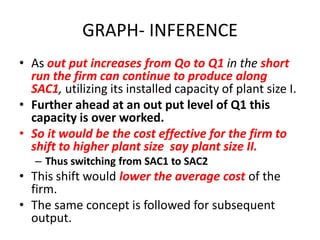
GRAPH- INFERENCE
• As out put increases from Qo to Q1 in the short
  run the firm can continue to produce along
  SAC1, utilizing its installed capacity of plant size I.
• Further ahead at an out put level of Q1 this
  capacity is over worked.
• So it would be the cost effective for the firm to
  shift to higher plant size say plant size II.
   – Thus switching from SAC1 to SAC2
• This shift would lower the average cost of the
  firm.
• The same concept is followed for subsequent
  output.
…contd
• The LAC curve has a scalloping pattern as its
  is drawn with three plant sizes only.
• We assumed that the firm operates with only
  3 alternative plant sizes.
  – But in reality ……………. Multiple such
    alternatives.
  – So in reality it may have multiple SAC also….
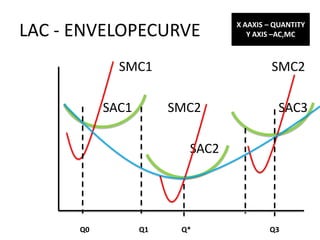
• The LAC function is an envelope of the short
  run cost functions and LAC curves envelopes
  the SAC curve hence LAC curve is also known
  as “ envelope curve”
..contd
• The LAC curve is also known as “planning
  curve”

• According to the entire planning horizon in
  which the managerial economist can select
  the most appropriate plant size , given the
  existing (or expected) level of demand for the
  product.
X AAXIS – QUANTITY
LAC - ENVELOPECURVE                Y AXIS –AC,MC


             SMC1                        SMC2

           SAC1        SMC2                SAC3

                         SAC2


      Q0          Q1    Q*              Q3
LONG RUN MARGINAL COST


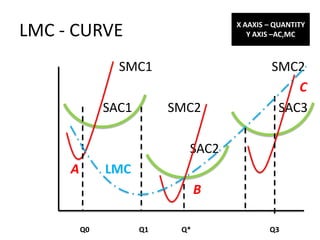
• Long run marginal cost (LMC) curve joints the
  points on the short run marginal cost (SMC)
  curves.
X AAXIS – QUANTITY
LMC - CURVE                            Y AXIS –AC,MC


                SMC1                         SMC2
                                                 C
              SAC1        SMC2                SAC3

                            SAC2
     A        LMC
                                B

         Q0          Q1    Q*               Q3
GRAPH INFERENCE
• At out put level of Qo. The relevant long run
  marginal cost is Aqo.
• The LMC curve joins the points A,B,C
• According to assuming sufficient demand the
  optimum plant size is II.
• So the optimum level of out put is Oq*.
  – Where long run and short run marginal cost and
    average costs are equal.
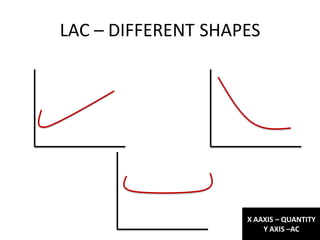
LAC – DIFFERENT SHAPES


                    X AAXIS – QUANTITY
                        Y AXIS –AC
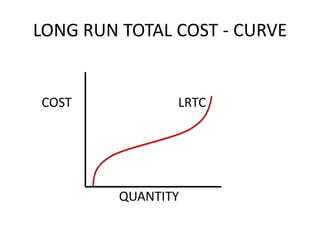
LONG RUN TOTAL COST - CURVE


COST            LRTC


         QUANTITY
GRAPH - INFERENCE
• Once we have the long run average cost of
  producing an output we can readily derive the
  long run total cost of output.
• Since total cost is the quantity of output
  times average cost.
COST OF A MULTIPRODUCT FIRM
• So far we have assumed that the firm
  produces a single good /service.
• How ever in the real business world many
  firms produce more than one product.
• A cost of multiproduct firm is differ from costs
  of single product.
• In order to ascertain the costs of multiproduct
  form we need to first modify some of the cost
  concepts.
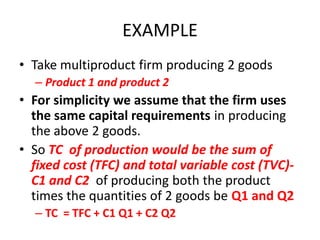
EXAMPLE
• Take multiproduct firm producing 2 goods
  – Product 1 and product 2
• For simplicity we assume that the firm uses
  the same capital requirements in producing
  the above 2 goods.
• So TC of production would be the sum of
  fixed cost (TFC) and total variable cost (TVC)-
  C1 and C2 of producing both the product
  times the quantities of 2 goods be Q1 and Q2
  – TC = TFC + C1 Q1 + C2 Q2
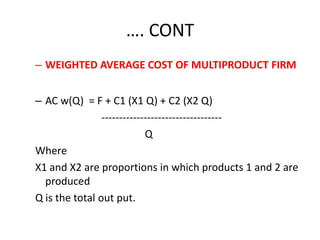
…. CONT
– WEIGHTED AVERAGE COST OF MULTIPRODUCT FIRM


– AC w(Q) = F + C1 (X1 Q) + C2 (X2 Q)
                ----------------------------------
                            Q
Where
X1 and X2 are proportions in which products 1 and 2 are
  produced
Q is the total out put.
COSTS OF JOIN PRODUCTS
• There are certain goods which are produced
  jointly
  – That is if one good is produced the other will
    automatically be produced.
  – Example = normally found in agriculture , minerals
    etc
• Costing of such products is different from
  traditional costs method.
• Two or more products undergo the same
  production process up to split off point
…contd
• Split off point
   – The beyond which joint products acquire
     separate identities and one or more of the
     products may undergo additional processing
     there from.
   – Example
      • Cream and milk
      • Oil and gas
JOINT PRODUCTS – COST CONCEPTS
• In this there would be common costs which
  cannot be identified with a single joint product.
• The join products incur common costs until they
  reach split off point.
• After the split off point the product incurred the
  separate costs.
• The allocation of common costs are according to
   – Physical measure
   – Sales value
LINKAGE BETWEEN COST, REVENUE
           AND OUTPUT
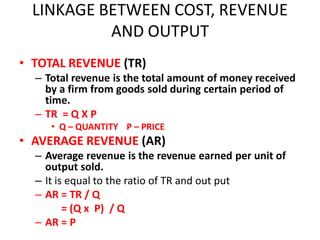
• TOTAL REVENUE (TR)
  – Total revenue is the total amount of money received
    by a firm from goods sold during certain period of
    time.
  – TR = Q X P
     • Q – QUANTITY P – PRICE
• AVERAGE REVENUE (AR)
  – Average revenue is the revenue earned per unit of
    output sold.
  – It is equal to the ratio of TR and out put
  – AR = TR / Q
         = (Q x P) / Q
  – AR = P
…CONTD
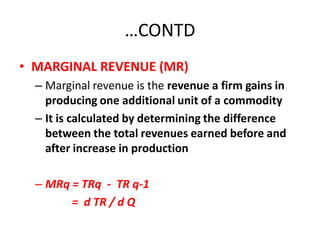
• MARGINAL REVENUE (MR)
  – Marginal revenue is the revenue a firm gains in
    producing one additional unit of a commodity
  – It is calculated by determining the difference
    between the total revenues earned before and
    after increase in production

  – MRq = TRq - TR q-1
        = d TR / d Q
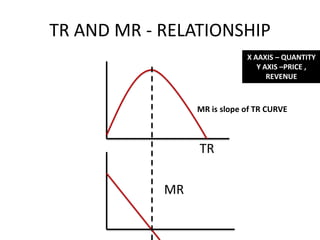
TR AND MR - RELATIONSHIP
                             X AAXIS – QUANTITY
                                Y AXIS –PRICE ,
                                   REVENUE


                 MR is slope of TR CURVE


                 TR

            MR
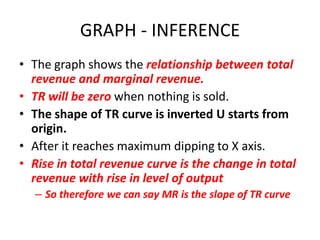
GRAPH - INFERENCE
• The graph shows the relationship between total
  revenue and marginal revenue.
• TR will be zero when nothing is sold.
• The shape of TR curve is inverted U starts from
  origin.
• After it reaches maximum dipping to X axis.
• Rise in total revenue curve is the change in total
  revenue with rise in level of output
   – So therefore we can say MR is the slope of TR curve
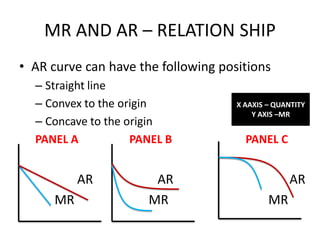
MR AND AR – RELATION SHIP
• AR curve can have the following positions
  – Straight line
  – Convex to the origin             X AAXIS – QUANTITY
                                         Y AXIS –MR
  – Concave to the origin
  PANEL A           PANEL B            PANEL C


           AR          AR                         AR
      MR              MR                     MR
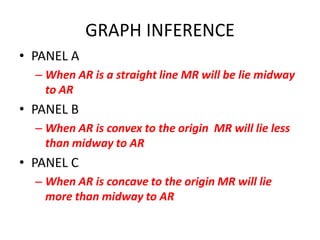
GRAPH INFERENCE
• PANEL A
  – When AR is a straight line MR will be lie midway
    to AR
• PANEL B
  – When AR is convex to the origin MR will lie less
    than midway to AR
• PANEL C
  – When AR is concave to the origin MR will lie
    more than midway to AR
PROFIT MAXIMIZATION
• The profit function shows a range of outputs
  at which the firm makes positive profits
• Two types of profits
  – Normal profit
     • It is amount of return to the firm which must be
       earned to keep in that business activity
     • It is the part of total cost
  – Supernormal profit
     • Any thing above normal profit is super normal profit
     • It is accounting profit occurs when TR > TC
..CONTD
• A firm maximizes profit at the point where
  MR = MC
• Rules of optimization
  – The second order condition of profit
    maximization requires the slope of MR = slope of
    MC
BREAK EVEN ANALYSIS
“Break even point is the point where total cost
  just equals the total revenue it is the no profit
  and no loss point”

• It is also known as cost volume profit analysis
• It is a first step in planning decision
APPROACHES IN BREAK EVEN
              ANALYSIS
•   Graphical method
•   Algebraic method
•   Contribution margin
•   PV ratio
•   Margin of safety.
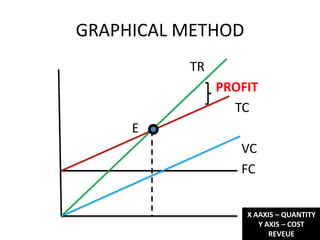
GRAPHICAL METHOD
          TR
               PROFIT
                 TC
     E
                  VC
                  FC


                   X AAXIS – QUANTITY
                      Y AXIS – COST
                         REVEUE
DRAWING -BREAK EVEN GRAPH
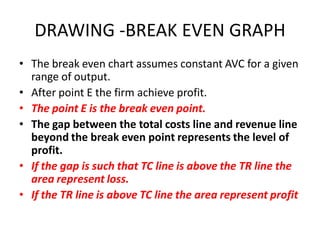
• The break even chart assumes constant AVC for a given
  range of output.
• After point E the firm achieve profit.
• The point E is the break even point.
• The gap between the total costs line and revenue line
  beyond the break even point represents the level of
  profit.
• If the gap is such that TC line is above the TR line the
  area represent loss.
• If the TR line is above TC line the area represent profit
ALGEBRAIC METHOD
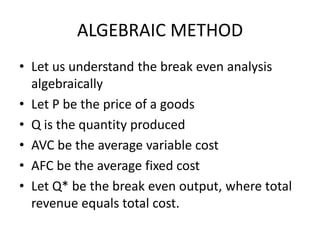
• Let us understand the break even analysis
  algebraically
• Let P be the price of a goods
• Q is the quantity produced
• AVC be the average variable cost
• AFC be the average fixed cost
• Let Q* be the break even output, where total
  revenue equals total cost.
..contd

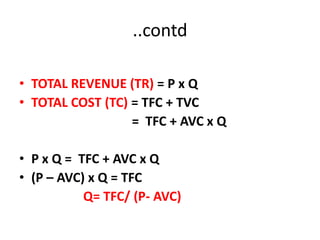
• TOTAL REVENUE (TR) = P x Q
• TOTAL COST (TC) = TFC + TVC
                  = TFC + AVC x Q

• P x Q = TFC + AVC x Q
• (P – AVC) x Q = TFC
           Q= TFC/ (P- AVC)
CONTRIBUTION MARGIN
• Contribution margin per unit sales is the
  difference between price and average variable
  cost
  – CONTRIBUTION MARGIN = P – AVC
• It represents that portion of the price of the
  commodity produced by the firm that can
  cover the fixed costs and contribute to profits
PV RATIO
• Profit volume (PV) ratio is the ratio of
  contribution margin and sales
• It is defined as the ratio of marginal change in
  profit and marginal change in sales

• PV RATIO = CONTRIBUTION / SALES

• BEP = FC / PV RATIO
   – FC = FIXED COST
MARGIN OF SAFETY


• Margin of safety
  = planned sales – break even sales
LIMITATIONS – BREAK EVEN ANALYSIS
• It does not take into account possible changes
  in costs over the time period under
  consideration
• It assumes that whatever is produced is sold
• It does not keep any provision for a changes in
  selling price.
• It does not allow for changes in market
  conditions
• It is difficult to find out BEP in service sector.
ECONOMIES OF SCALE
• “Economies” refer to lower costs hence
  economies of scale would mean lowering of
  costs of production by way of producing in bulk.
• In simple terms economies of scale refers to the
  efficiencies associated with large scale of
  operations.
• When production increases the average cost per
  unit decreases.
• Economies of scale are extremely important in
  real world production processes.
TYPES OF ECONOMICS OF SCALE


• INTERNAL ECONOMIES OF SCALE
  – Cost per unit depends upon the size of the firm
• EXTERNAL ECONOMIES OF SCALE
  – Cost per unit depends upon the size of the
    industry not the firm.
INTERNAL ECONOMIES
• The reason behind the internal economies
  – Specialization
     • Jobs can be broken down into components/process
     • Specialization in particular job
  – Greater efficiency of machine
  – Managerial economies
     • Better supervision, administration, planning & organization
  – Financial economies
     • Large firms going for large volume of production may able to
       raise capital from the market with much less difficulties than
       small firm.
  – Production in stages
     • Houses all the process in production
EXTERNAL ECONOMIES
• The reason behind external economies
• As an industry grows in size would create
  various economies for existing firms in the
  industry
  – Technological advancement.
  – Easier access to cheaper raw materials.
  – Financial institutions in proximity.
  – Pool of skilled labors.
DISECONOMIES OF SCALE
• It is a reverse of economies of scale.
• It is refers to decreases in productivity when
  there are equal increases of all inputs. Assuming
  that no inputs is fixed.
• Diseconomies may rise if the size of operations
  become un widely by size.
  – Coordinating among different work groups and units
    may become complex
  – Management become less effective and thus
    indirectly improve costs

Unit 2 c 2

  • 1.
  • 2.
    MEANING - COST “Cost is a sacrifice or foregoing that has occurred or has potential to occur in future, measured in monetary terms” • Cost results in current or future decrease in cash or other assets or a current or future increase in liability
  • 3.
    DETERMINANTS OF COST •Cost is determined by various factors and each of these has significant implications for cost decisions. • An increase in any of these will affect cost pattern. • Important determinant – Price(uncontrollable –largely determined by external environment) – Marginal efficiency and productivity – Technology – Level of out put.
  • 4.
    MATHEMATICAL EXPRESSION- COST C= F( Q , T , P) • Where – C= cost – Q= out put – T= technology – P= price • Cost are differentiated according to their purpose , type of product and time.
  • 5.
    TYPES OF COSTS •There may be different types of costs incurred by a firm under different circumstances. • Cost of a firm may include money or may not be measurable in money terms. • Cost is a function of output in economic theory. • A managerial economist’s concept of cost does not necessarily coincide with that of accountants.
  • 6.
    TYPES OF COST •Actual Costs / Acquisition / outlay : It means the actual expenditure incurred for acquiring or producing a good or service. These are generally recorded in the books of accounts. Eg. Wages paid, cost of materials purchased, interest paid, etc. • Opportunity Cost / Alternative Cost: Revenue forgone by not making the best alternative use or opportunities.
  • 7.
    • Imputed Cost/ Implicit cost: They are the costs which are not actually incurred but would have been incurred in the absence of employment of self-owned factors. These are unrecognized by the accounting systems. Eg. Rent of own building, Salary for Entrepreneur, etc. • Explicit cost / Paid out costs: Those expenses which are actually paid by the firm. Appears in the accounting books. • Sunk Costs / Non-avoidable / Non escapable: They are not altered by a change in quantity and cannot be recovered. All the past expenses are sunk costs Eg Depreciation, interest, machineries not in use.
  • 8.
    • Incremental /Differential cost ( Avoidable, escapable or Differential): It is the additional cost due to a change in level or nature of business activity. • Out-of-Pocket costs: These are expenses which are current cash payments to the outsiders. (All Explicit costs) • Book Costs: These are business costs which do not involve any cash payments but for them a provision is made in the books of account. Eg. Depreciation, Implicit cost.
  • 9.
    • Accounting cost/ Past Cost: How much expenditure has already been incurred on a particular process or on production as such. • Economic cost / Future cost: Cost relate to future. • Direct costs / Traceable / Assignable: These costs have direct relationship with a unit of operation. • Indirect / Non-traceable / Non assignable: These costs cannot be easily & definitely traced to a plant or department.
  • 10.
    • Historical Cost/ Original cost: It states the cost of plant, equipment and materials at the price paid originally for them. • Replacement cost: It states the cost that the firm would have to incur if it wants to replace or acquire the same assets now. • Controllable costs: Costs which are capable of being controlled or regulated. • Non-Controllable cost: costs which cannot be subjected to administrative control and supervision. Eg. Depreciation, Obsolescence.
  • 11.
    • Private costs:Micro level. Costs incurred by an individual or a firm for its business activity. • Social costs: Macro level. Total cost s to the society on account of production of a good. • Shutdown Costs: Those costs incurred when firm temporarily stops it operations. • Abandonment Costs: Costs incurred when the firm is retiring altogether. • Short run costs: a period in which the supply of at least one of the inputs cannot be changed by the firm. Inputs are fixed.
  • 12.
    • Long runcosts: Period in which all inputs can be carried as desired. • Fixed Cost: Part of total cost of the firm which does not vary with output. • Variable cost: Part of total cost that are directly dependent on the volume of output or service. • Total cost: It is money value of the total resources required for production of goods and services by the firm. TC = FC + VC
  • 13.
    • Average cost:It is the cost per unit of output. – AC = TC / n – n = number of unit • Marginal cost: It is the change in total cost due to unit change in out put MCn  (TCn  TCn1 )
  • 14.
    COSTS IN SHORTRUN • Classification of costs is on the basis of time – Short run cost – Long run cost • The short run is a time period where some factors of production remain fixed and only few are variable. – Fixed inputs – land ,machine and technology – Variable inputs – labor and raw material
  • 15.
    Contd… • Therefore inshort run we divide costs in two broad categories – Fixed costs • Costs on fixed inputs – Variable costs • Costs on variable inputs
  • 16.
    TOTAL COSTS FUNCTIONSAND CURVES FOR SHORT RUN • As we discussed short run cost have two components • Fixed cost – This cost do not vary with output – Cost incurred in plant, machinery fitting , equipments, land etc. – Any change in volume of output does not depends upon fixed cost – The shape of the TFC(TOTAL FIXED COST) curve is straight line from origin parallel to quantity axis.
  • 17.
    GRAPH - TFC X AXIS – QUANTITY Y AXIS – COST TFC
  • 18.
    • Variable cost – These are costs that vary with output and are incurred in getting more and more inputs. – Variable costs are equal to zero if there is no out put – Cost of raw materials , wages are called variable cost. – TVC is an inverse S shaped upward sloping curve starting from origin.
  • 19.
    GRAPH - TVC X AXIS – QUANTITY Y AXIS – COST
  • 20.
    GRAPH INFERENCE • Theshape of curve determined by law of variable proportions. • According to this law as more and more units of the variable factor are added in production its productivity goes on increasing. • This lead to fall in per unit cost in the beginning. if the variable input is increased beyond certain level its marginal productivity starts diminishing. • So TVC increases at increasing rate.
  • 21.
    GRAPH – TOTALCOST TC TVC TFC X AXIS – QUANTITY TOTAL COST = TFC + TVC Y AXIS – COST
  • 22.
    SHORT RUN –AVERAGE AND MARGINAL COST • AVERAGE COST – Average cost is cost per unit of out put – We can derive AFC (average fixed cost) AVC( average variable cost) and AC (average cost) from total fixed , total variable and total costs respectively. – AFC is fixed cost per unit of output and this is equal to the ratio of TFC and units of output • AFC = TFC / NUMBER OF UNITS OF OUT PUT – AVC is variable cost per unit of out put and this is equal to the ratio of TVC and units of output • AVC = TVC / NUMBER OF UNITS OF OUT PUT – AC is total cost per unit of out put • AC = TC /NUMBER UNITS OF OUTPUT
  • 23.
    • MARGINAL COST – MC is the change in total cost due to unit change in out put – Rate of change in total cost. MCn  (TCn  TCn1 )
  • 24.
    AVERAGE AND MARGINALCOST CURVES- SHORT RUN MC AC AVC AFC X AXIS – QUANTITY Y AXIS – COST
  • 25.
    AVC , AFCAND AC GRAPH - INFERENCE • The AVC and AC curve are both U shaped. – This explained by law of diminishing returns. – Cost decline when there are increasing returns(output) • AC being the sum of AFC and AVC at each level of output lies above both AFC and AVC curve. • Initially AC falls with increase in out put reaches minimum and then increases.
  • 26.
    ..contd • When both AFC and AVC fall AC also falls. • AVC soon reaches minimum and start rising . • While AFC continues to fall. • How ever the rise in AVC compensate falls in AFC and AVC pulls AC up after reaches a minimum.
  • 27.
    MARGINAL COST GRAPH- INFERENCE • The magnitude of marginal cost is interlinked with changes in average cost. • When average cost decline MC lies below AC. • When average costs are constant the MC passes through the minimum points of average cost curves. • When average cost rise MC curve lies above them. • AC and AVC fall MC lies below them • AC and AVC rise MC lies above them.
  • 28.
    RELATIONSHIP AMONG CURVES– MATHEMATICALN SUMMARIZATION • TC = TFC + TVC • AFC = TFC / Q • AVC = TVC/ Q • AC = TC /Q = (TFC + TVC)/Q = AFC + AVC • MC = TC q – TC q-1 = change in total cost (d TC)/ total out put (dQ)
  • 29.
    COSTS IN LONGRUN • All cost are variable in the long run since factors of production – Size of plant – Machinery and technology are all variable. • The long run cost function is often referred to as the “planning cost function” • The long run average cost (LAC) curve is known as the “ planning curve” • All the cost are variable only the average cost curve is relevant to the firm’s decision making process in the long run. • Long run cost curve is the composite of many short run cost curves……*
  • 30.
    LONG RUN AVERAGECOST (LAC) • When the plant size and other fixed inputs of the firm increase in the long run the short run cost curves shift to the right. • We consider in the long run the firm operates with three different plant sizes – Plant size I , II , III • It can switch over to a different plant size depending on cost consideration.
  • 31.
    …CONTD • SAC 1relates to average cost of the firm when the plant size I. • When the plant size increases to II the corresponding SAC 1 curve is SAC 2 and so on. • So – Plant size I – SAC I – Plant size II – SAC II – Plant size III – SAC III
  • 32.
    X AAXIS –QUANTITY LAC CURVE Y AXIS –AC,MC MC1 MC2 MC3 SAC1 SAC2 SAC3 plant size I plant size II plant size III Q0 Q1 Q2
  • 33.
    GRAPH- INFERENCE • Asout put increases from Qo to Q1 in the short run the firm can continue to produce along SAC1, utilizing its installed capacity of plant size I. • Further ahead at an out put level of Q1 this capacity is over worked. • So it would be the cost effective for the firm to shift to higher plant size say plant size II. – Thus switching from SAC1 to SAC2 • This shift would lower the average cost of the firm. • The same concept is followed for subsequent output.
  • 34.
    …contd • The LACcurve has a scalloping pattern as its is drawn with three plant sizes only. • We assumed that the firm operates with only 3 alternative plant sizes. – But in reality ……………. Multiple such alternatives. – So in reality it may have multiple SAC also…. • The LAC function is an envelope of the short run cost functions and LAC curves envelopes the SAC curve hence LAC curve is also known as “ envelope curve”
  • 35.
    ..contd • The LACcurve is also known as “planning curve” • According to the entire planning horizon in which the managerial economist can select the most appropriate plant size , given the existing (or expected) level of demand for the product.
  • 36.
    X AAXIS –QUANTITY LAC - ENVELOPECURVE Y AXIS –AC,MC SMC1 SMC2 SAC1 SMC2 SAC3 SAC2 Q0 Q1 Q* Q3
  • 37.
    LONG RUN MARGINALCOST • Long run marginal cost (LMC) curve joints the points on the short run marginal cost (SMC) curves.
  • 38.
    X AAXIS –QUANTITY LMC - CURVE Y AXIS –AC,MC SMC1 SMC2 C SAC1 SMC2 SAC3 SAC2 A LMC B Q0 Q1 Q* Q3
  • 39.
    GRAPH INFERENCE • Atout put level of Qo. The relevant long run marginal cost is Aqo. • The LMC curve joins the points A,B,C • According to assuming sufficient demand the optimum plant size is II. • So the optimum level of out put is Oq*. – Where long run and short run marginal cost and average costs are equal.
  • 40.
    LAC – DIFFERENTSHAPES X AAXIS – QUANTITY Y AXIS –AC
  • 41.
    LONG RUN TOTALCOST - CURVE COST LRTC QUANTITY
  • 42.
    GRAPH - INFERENCE •Once we have the long run average cost of producing an output we can readily derive the long run total cost of output. • Since total cost is the quantity of output times average cost.
  • 43.
    COST OF AMULTIPRODUCT FIRM • So far we have assumed that the firm produces a single good /service. • How ever in the real business world many firms produce more than one product. • A cost of multiproduct firm is differ from costs of single product. • In order to ascertain the costs of multiproduct form we need to first modify some of the cost concepts.
  • 44.
    EXAMPLE • Take multiproductfirm producing 2 goods – Product 1 and product 2 • For simplicity we assume that the firm uses the same capital requirements in producing the above 2 goods. • So TC of production would be the sum of fixed cost (TFC) and total variable cost (TVC)- C1 and C2 of producing both the product times the quantities of 2 goods be Q1 and Q2 – TC = TFC + C1 Q1 + C2 Q2
  • 45.
    …. CONT – WEIGHTEDAVERAGE COST OF MULTIPRODUCT FIRM – AC w(Q) = F + C1 (X1 Q) + C2 (X2 Q) ---------------------------------- Q Where X1 and X2 are proportions in which products 1 and 2 are produced Q is the total out put.
  • 46.
    COSTS OF JOINPRODUCTS • There are certain goods which are produced jointly – That is if one good is produced the other will automatically be produced. – Example = normally found in agriculture , minerals etc • Costing of such products is different from traditional costs method. • Two or more products undergo the same production process up to split off point
  • 47.
    …contd • Split offpoint – The beyond which joint products acquire separate identities and one or more of the products may undergo additional processing there from. – Example • Cream and milk • Oil and gas
  • 48.
    JOINT PRODUCTS –COST CONCEPTS • In this there would be common costs which cannot be identified with a single joint product. • The join products incur common costs until they reach split off point. • After the split off point the product incurred the separate costs. • The allocation of common costs are according to – Physical measure – Sales value
  • 49.
    LINKAGE BETWEEN COST,REVENUE AND OUTPUT • TOTAL REVENUE (TR) – Total revenue is the total amount of money received by a firm from goods sold during certain period of time. – TR = Q X P • Q – QUANTITY P – PRICE • AVERAGE REVENUE (AR) – Average revenue is the revenue earned per unit of output sold. – It is equal to the ratio of TR and out put – AR = TR / Q = (Q x P) / Q – AR = P
  • 50.
    …CONTD • MARGINAL REVENUE(MR) – Marginal revenue is the revenue a firm gains in producing one additional unit of a commodity – It is calculated by determining the difference between the total revenues earned before and after increase in production – MRq = TRq - TR q-1 = d TR / d Q
  • 51.
    TR AND MR- RELATIONSHIP X AAXIS – QUANTITY Y AXIS –PRICE , REVENUE MR is slope of TR CURVE TR MR
  • 52.
    GRAPH - INFERENCE •The graph shows the relationship between total revenue and marginal revenue. • TR will be zero when nothing is sold. • The shape of TR curve is inverted U starts from origin. • After it reaches maximum dipping to X axis. • Rise in total revenue curve is the change in total revenue with rise in level of output – So therefore we can say MR is the slope of TR curve
  • 53.
    MR AND AR– RELATION SHIP • AR curve can have the following positions – Straight line – Convex to the origin X AAXIS – QUANTITY Y AXIS –MR – Concave to the origin PANEL A PANEL B PANEL C AR AR AR MR MR MR
  • 54.
    GRAPH INFERENCE • PANELA – When AR is a straight line MR will be lie midway to AR • PANEL B – When AR is convex to the origin MR will lie less than midway to AR • PANEL C – When AR is concave to the origin MR will lie more than midway to AR
  • 55.
    PROFIT MAXIMIZATION • Theprofit function shows a range of outputs at which the firm makes positive profits • Two types of profits – Normal profit • It is amount of return to the firm which must be earned to keep in that business activity • It is the part of total cost – Supernormal profit • Any thing above normal profit is super normal profit • It is accounting profit occurs when TR > TC
  • 56.
    ..CONTD • A firmmaximizes profit at the point where MR = MC • Rules of optimization – The second order condition of profit maximization requires the slope of MR = slope of MC
  • 57.
    BREAK EVEN ANALYSIS “Breakeven point is the point where total cost just equals the total revenue it is the no profit and no loss point” • It is also known as cost volume profit analysis • It is a first step in planning decision
  • 58.
    APPROACHES IN BREAKEVEN ANALYSIS • Graphical method • Algebraic method • Contribution margin • PV ratio • Margin of safety.
  • 59.
    GRAPHICAL METHOD TR PROFIT TC E VC FC X AAXIS – QUANTITY Y AXIS – COST REVEUE
  • 60.
    DRAWING -BREAK EVENGRAPH • The break even chart assumes constant AVC for a given range of output. • After point E the firm achieve profit. • The point E is the break even point. • The gap between the total costs line and revenue line beyond the break even point represents the level of profit. • If the gap is such that TC line is above the TR line the area represent loss. • If the TR line is above TC line the area represent profit
  • 61.
    ALGEBRAIC METHOD • Letus understand the break even analysis algebraically • Let P be the price of a goods • Q is the quantity produced • AVC be the average variable cost • AFC be the average fixed cost • Let Q* be the break even output, where total revenue equals total cost.
  • 62.
    ..contd • TOTAL REVENUE(TR) = P x Q • TOTAL COST (TC) = TFC + TVC = TFC + AVC x Q • P x Q = TFC + AVC x Q • (P – AVC) x Q = TFC Q= TFC/ (P- AVC)
  • 63.
    CONTRIBUTION MARGIN • Contributionmargin per unit sales is the difference between price and average variable cost – CONTRIBUTION MARGIN = P – AVC • It represents that portion of the price of the commodity produced by the firm that can cover the fixed costs and contribute to profits
  • 64.
    PV RATIO • Profitvolume (PV) ratio is the ratio of contribution margin and sales • It is defined as the ratio of marginal change in profit and marginal change in sales • PV RATIO = CONTRIBUTION / SALES • BEP = FC / PV RATIO – FC = FIXED COST
  • 65.
    MARGIN OF SAFETY •Margin of safety = planned sales – break even sales
  • 66.
    LIMITATIONS – BREAKEVEN ANALYSIS • It does not take into account possible changes in costs over the time period under consideration • It assumes that whatever is produced is sold • It does not keep any provision for a changes in selling price. • It does not allow for changes in market conditions • It is difficult to find out BEP in service sector.
  • 67.
    ECONOMIES OF SCALE •“Economies” refer to lower costs hence economies of scale would mean lowering of costs of production by way of producing in bulk. • In simple terms economies of scale refers to the efficiencies associated with large scale of operations. • When production increases the average cost per unit decreases. • Economies of scale are extremely important in real world production processes.
  • 68.
    TYPES OF ECONOMICSOF SCALE • INTERNAL ECONOMIES OF SCALE – Cost per unit depends upon the size of the firm • EXTERNAL ECONOMIES OF SCALE – Cost per unit depends upon the size of the industry not the firm.
  • 69.
    INTERNAL ECONOMIES • Thereason behind the internal economies – Specialization • Jobs can be broken down into components/process • Specialization in particular job – Greater efficiency of machine – Managerial economies • Better supervision, administration, planning & organization – Financial economies • Large firms going for large volume of production may able to raise capital from the market with much less difficulties than small firm. – Production in stages • Houses all the process in production
  • 70.
    EXTERNAL ECONOMIES • Thereason behind external economies • As an industry grows in size would create various economies for existing firms in the industry – Technological advancement. – Easier access to cheaper raw materials. – Financial institutions in proximity. – Pool of skilled labors.
  • 71.
    DISECONOMIES OF SCALE •It is a reverse of economies of scale. • It is refers to decreases in productivity when there are equal increases of all inputs. Assuming that no inputs is fixed. • Diseconomies may rise if the size of operations become un widely by size. – Coordinating among different work groups and units may become complex – Management become less effective and thus indirectly improve costs