COST CONCEPTS
Theory of costs
 Costs of a firm is incurred to establish the production
unit and to purchase different factors of production.
 Cost of a firm (TC) is classified into two broad
categories - Fixed cost (TFC) and Variable cost
(TVC).
i.e. TC = TFC + TVC
 However, nothing is fixed in the long run.
Concepts of Costs
 Fixed Cost FC : Fixed costs, are those which are
independent of output, that is, they do not change
with changes in output.
 Even if the firm closes down for some time in the
short run remains in business, these costs have to
be borne by it.
 Fixed costs are also known as overhead costs and
include charges such as contractual rent, insurance fee,
maintenance costs, property taxes, interest on the capital
invested, minimum administrative expenses such as
manager's salary, watchman's wages etc.
 Variable cost [VC]: Variable costs, on the other hand,
are those costs which are incurred on the employment
variable factors of production whose amount can be
altered.
 These costs include payments such as wages of labour
employed, prices of the raw materials, fuel and power
used, the expenses incurred on transporting.
Concept of total cost , Average Cost and marginal
cost
 Total cost is the sum of its total variable costs and total
fixed costs. Thus:
TC = TFC + TVC
where TC stands for total cost, TFC for total fixed cost
and TVC for total variable cost.
 Average fixed cost is the total fixed cost divided by the
number of units of output produced.
 Average Variable Cost (AVC): Average variable cost is
the total variable cost divided by the number of units of
output produced. Therefore,
 Average total cost (ATC) is the sum of the average
variable cost [AVC] and average fixed cost [AFC]
 Marginal cost {MC] can be found for further units of
output
where ΔTC represents a change in total cost and ΔQ
represents a unit change in output or total product.
Relationships among AVC, ATC and
MC
 All three cost measures first fall, then remain constant
and eventually rise as output increases
 The rate of change in MC is greater than that in AVC
and hence the minimum MC is at an output lower than
the output at which AVC is minimum
 The ATC falls for a longer range of output then the
AVC and hence the minimum ATC is at a larger output
than the minimum AVC
 When MCAVC is rising
 When MC is below ATC, ATC is falling
 is below AVC, AVC is falling
 When MC is above AVC, When MC is above ATC,
ATC is rising
COST FUNCTION
 The relation between cost and output is called Cost
function.
 The cost function of the firm depends upon the production
conditions and the prices of the factors used for
production.
 It indicates the functional relationship between total cost
and total output. If C represents total cost and Q
represents the level of output, then the cost function is
represented as C = C (Q).
 Cost functions are derived functions. They are derived
from the production functions, which identify the efficient
methods of production available at any particular point of
time.
 The cost function can be derived from the input cost
combinations of the firm, The input costs of the two inputs
of production i.e. labor (L) and capital (K) are given to be
constant as the wage rate (w) and rent (r), respectively.
 Along any expansion path, the level of output increases as
Types of cost
 Explicit costs: are those expenses which are
actually paid by the firm (paid-out costs). Both
costs are equally important while making
business decisions, but sometimes implicit costs
are ignored as they are not as apparent as
explicit costs
 Implicit or Imputed costs: are theoretical costs in
the sense that they can go unrecognized by the
accounting system. In most business decisions,
the total opportunity costs cannot be accounted
for fully because of our inability to include implicit
costs. Implicit costs are the value of forgone
opportunities that does not involve a physical
• Accounting costs: These are the actual or outlay
costs. These costs point out how much
expenditure has already been incurred on a
particular process or on production as such.
• Economic costs: These costs relate to future.
They are in the nature of the incremental costs.
•Opportunity cost can be defined as the cost of
any decision measured in terms of the next best
alternative, which has been sacrificed. In order to
maximize the value of the firm, a manger must
view costs from this perspective.
Short run Cost Functions
•Short run cost functions help in
determining the relationship between
output and costs in the short run.
• With a particular change in
production output, the change in total,
average and marginal costs can be
determined for a given set of cost
functions for a firm.
• The short run average total costs
(SRA TC) and average variable costs
(AVC) are slightly U-shaped.
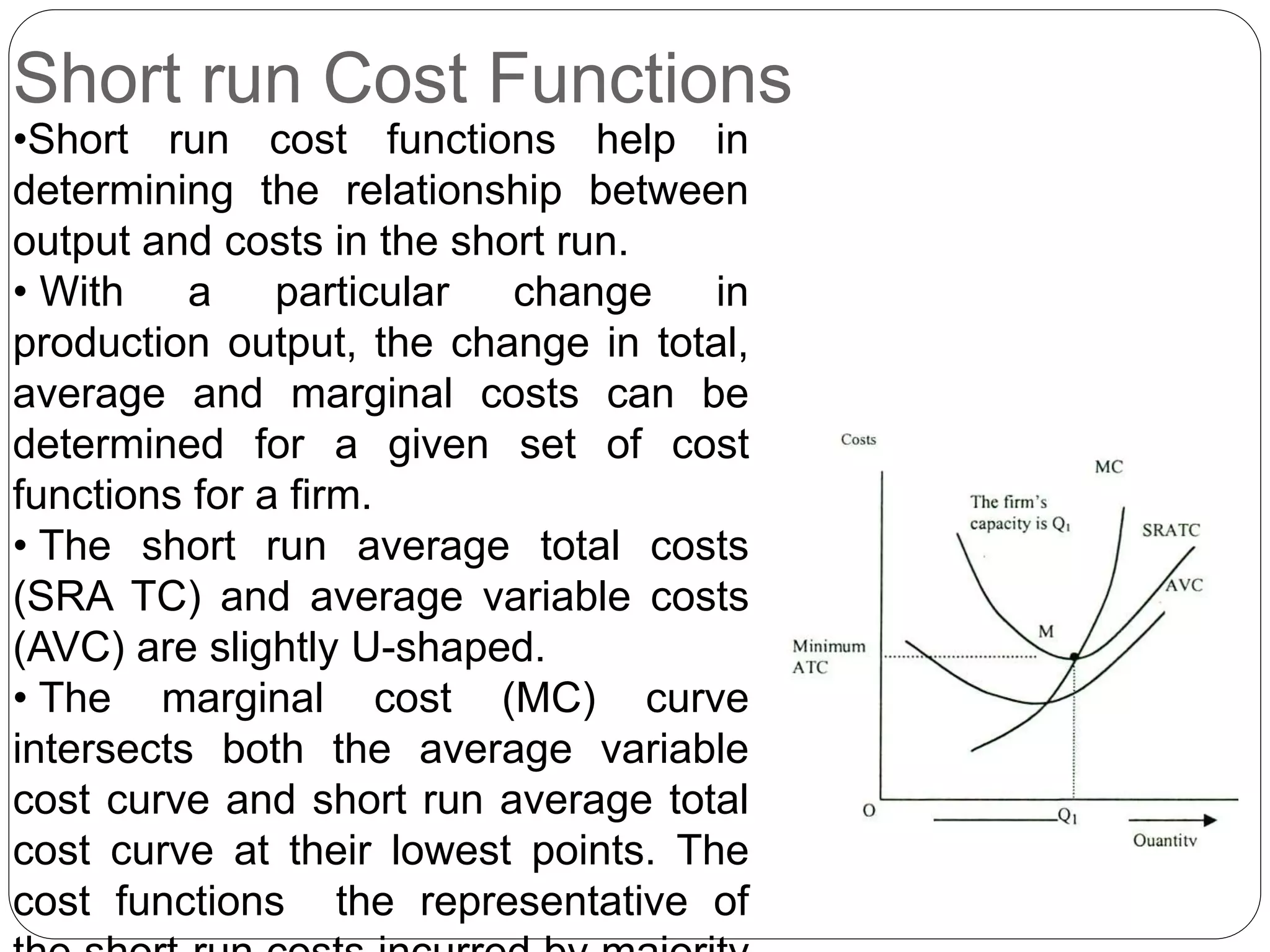
• The marginal cost (MC) curve
intersects both the average variable
cost curve and short run average total
cost curve at their lowest points. The
cost functions the representative of
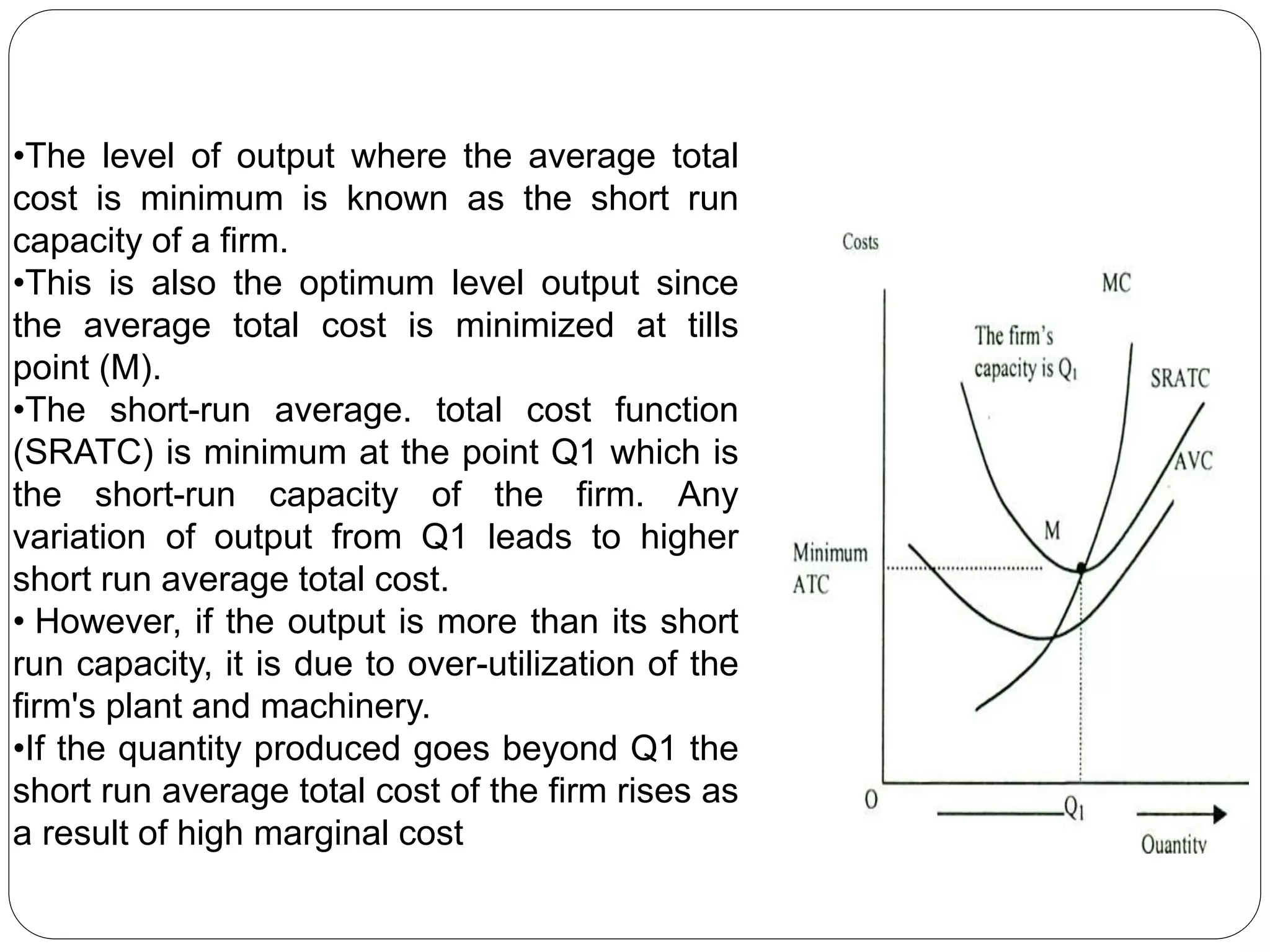
•The level of output where the average total
cost is minimum is known as the short run
capacity of a firm.
•This is also the optimum level output since
the average total cost is minimized at tills
point (M).
•The short-run average. total cost function
(SRATC) is minimum at the point Q1 which is
the short-run capacity of the firm. Any
variation of output from Q1 leads to higher
short run average total cost.
• However, if the output is more than its short
run capacity, it is due to over-utilization of the
firm's plant and machinery.
•If the quantity produced goes beyond Q1 the
short run average total cost of the firm rises as
a result of high marginal cost
The Long-run Cost Function
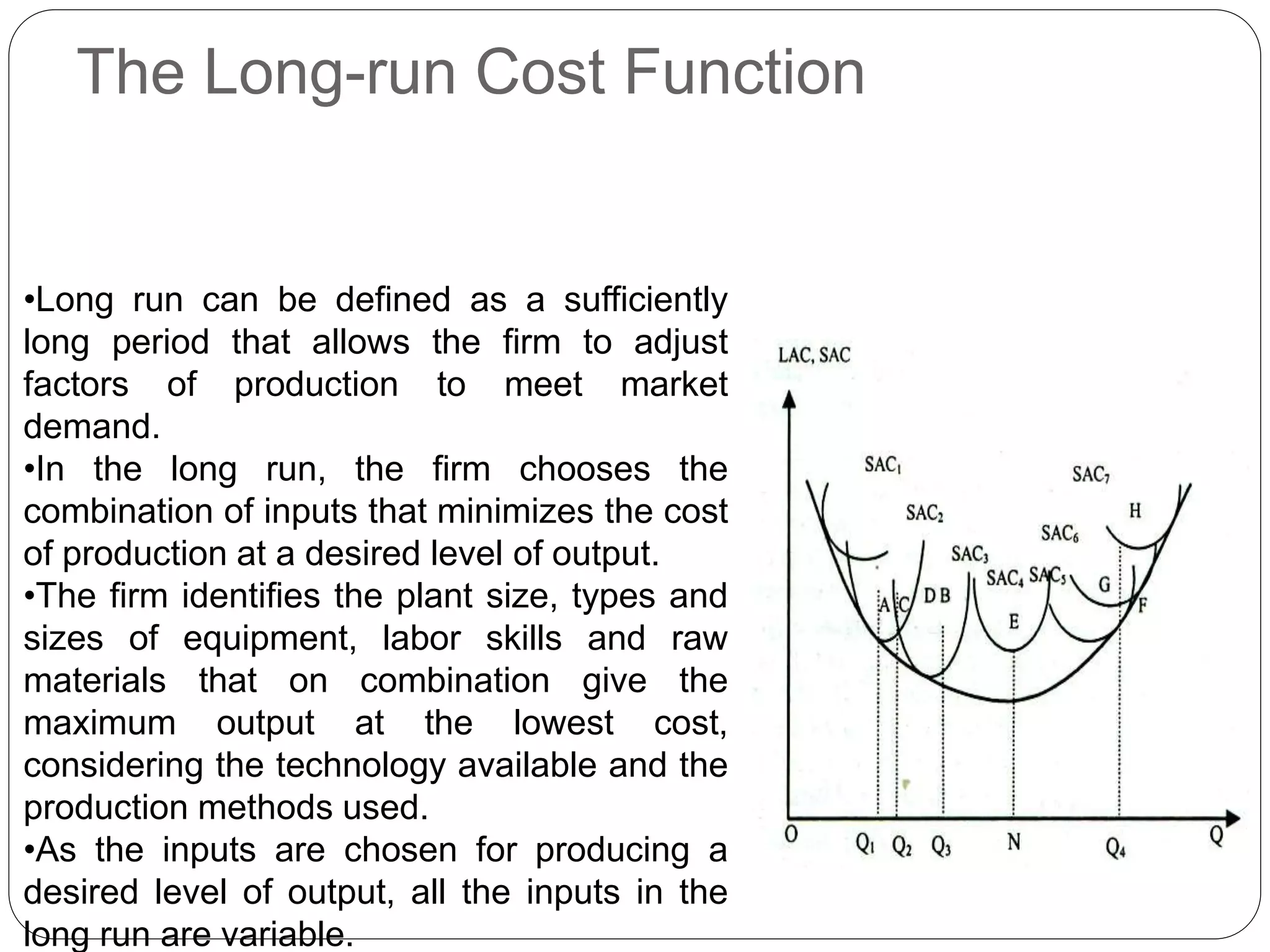
•Long run can be defined as a sufficiently
long period that allows the firm to adjust
factors of production to meet market
demand.
•In the long run, the firm chooses the
combination of inputs that minimizes the cost
of production at a desired level of output.
•The firm identifies the plant size, types and
sizes of equipment, labor skills and raw
materials that on combination give the
maximum output at the lowest cost,
considering the technology available and the
production methods used.
•As the inputs are chosen for producing a
desired level of output, all the inputs in the
long run are variable.
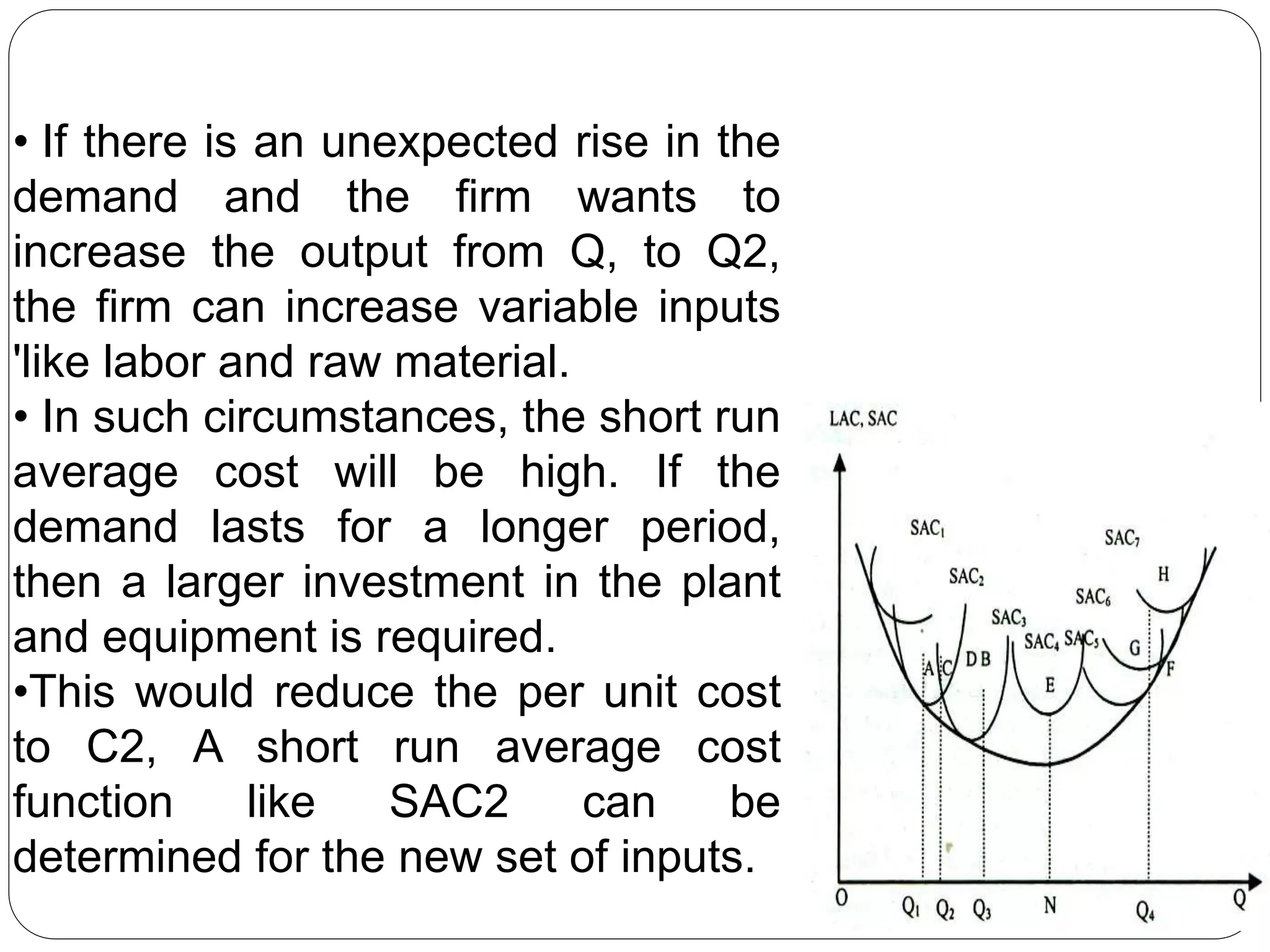
• If there is an unexpected rise in the
demand and the firm wants to
increase the output from Q, to Q2,
the firm can increase variable inputs
'like labor and raw material.
• In such circumstances, the short run
average cost will be high. If the
demand lasts for a longer period,
then a larger investment in the plant
and equipment is required.
•This would reduce the per unit cost
to C2, A short run average cost
function like SAC2 can be
determined for the new set of inputs.
Cost concepts

Cost concepts

  • 1.
  • 2.
    Theory of costs Costs of a firm is incurred to establish the production unit and to purchase different factors of production.  Cost of a firm (TC) is classified into two broad categories - Fixed cost (TFC) and Variable cost (TVC). i.e. TC = TFC + TVC  However, nothing is fixed in the long run.
  • 3.
    Concepts of Costs Fixed Cost FC : Fixed costs, are those which are independent of output, that is, they do not change with changes in output.  Even if the firm closes down for some time in the short run remains in business, these costs have to be borne by it.  Fixed costs are also known as overhead costs and include charges such as contractual rent, insurance fee, maintenance costs, property taxes, interest on the capital invested, minimum administrative expenses such as manager's salary, watchman's wages etc.  Variable cost [VC]: Variable costs, on the other hand, are those costs which are incurred on the employment variable factors of production whose amount can be altered.  These costs include payments such as wages of labour employed, prices of the raw materials, fuel and power used, the expenses incurred on transporting.
  • 4.
    Concept of totalcost , Average Cost and marginal cost  Total cost is the sum of its total variable costs and total fixed costs. Thus: TC = TFC + TVC where TC stands for total cost, TFC for total fixed cost and TVC for total variable cost.  Average fixed cost is the total fixed cost divided by the number of units of output produced.  Average Variable Cost (AVC): Average variable cost is the total variable cost divided by the number of units of output produced. Therefore,  Average total cost (ATC) is the sum of the average variable cost [AVC] and average fixed cost [AFC]  Marginal cost {MC] can be found for further units of output where ΔTC represents a change in total cost and ΔQ represents a unit change in output or total product.
  • 5.
    Relationships among AVC,ATC and MC  All three cost measures first fall, then remain constant and eventually rise as output increases  The rate of change in MC is greater than that in AVC and hence the minimum MC is at an output lower than the output at which AVC is minimum  The ATC falls for a longer range of output then the AVC and hence the minimum ATC is at a larger output than the minimum AVC  When MCAVC is rising  When MC is below ATC, ATC is falling  is below AVC, AVC is falling  When MC is above AVC, When MC is above ATC, ATC is rising
  • 6.
    COST FUNCTION  Therelation between cost and output is called Cost function.  The cost function of the firm depends upon the production conditions and the prices of the factors used for production.  It indicates the functional relationship between total cost and total output. If C represents total cost and Q represents the level of output, then the cost function is represented as C = C (Q).  Cost functions are derived functions. They are derived from the production functions, which identify the efficient methods of production available at any particular point of time.  The cost function can be derived from the input cost combinations of the firm, The input costs of the two inputs of production i.e. labor (L) and capital (K) are given to be constant as the wage rate (w) and rent (r), respectively.  Along any expansion path, the level of output increases as
  • 7.
    Types of cost Explicit costs: are those expenses which are actually paid by the firm (paid-out costs). Both costs are equally important while making business decisions, but sometimes implicit costs are ignored as they are not as apparent as explicit costs  Implicit or Imputed costs: are theoretical costs in the sense that they can go unrecognized by the accounting system. In most business decisions, the total opportunity costs cannot be accounted for fully because of our inability to include implicit costs. Implicit costs are the value of forgone opportunities that does not involve a physical
  • 8.
    • Accounting costs:These are the actual or outlay costs. These costs point out how much expenditure has already been incurred on a particular process or on production as such. • Economic costs: These costs relate to future. They are in the nature of the incremental costs. •Opportunity cost can be defined as the cost of any decision measured in terms of the next best alternative, which has been sacrificed. In order to maximize the value of the firm, a manger must view costs from this perspective.
  • 9.
    Short run CostFunctions •Short run cost functions help in determining the relationship between output and costs in the short run. • With a particular change in production output, the change in total, average and marginal costs can be determined for a given set of cost functions for a firm. • The short run average total costs (SRA TC) and average variable costs (AVC) are slightly U-shaped. • The marginal cost (MC) curve intersects both the average variable cost curve and short run average total cost curve at their lowest points. The cost functions the representative of
  • 10.
    •The level ofoutput where the average total cost is minimum is known as the short run capacity of a firm. •This is also the optimum level output since the average total cost is minimized at tills point (M). •The short-run average. total cost function (SRATC) is minimum at the point Q1 which is the short-run capacity of the firm. Any variation of output from Q1 leads to higher short run average total cost. • However, if the output is more than its short run capacity, it is due to over-utilization of the firm's plant and machinery. •If the quantity produced goes beyond Q1 the short run average total cost of the firm rises as a result of high marginal cost
  • 11.
    The Long-run CostFunction •Long run can be defined as a sufficiently long period that allows the firm to adjust factors of production to meet market demand. •In the long run, the firm chooses the combination of inputs that minimizes the cost of production at a desired level of output. •The firm identifies the plant size, types and sizes of equipment, labor skills and raw materials that on combination give the maximum output at the lowest cost, considering the technology available and the production methods used. •As the inputs are chosen for producing a desired level of output, all the inputs in the long run are variable.
  • 12.
    • If thereis an unexpected rise in the demand and the firm wants to increase the output from Q, to Q2, the firm can increase variable inputs 'like labor and raw material. • In such circumstances, the short run average cost will be high. If the demand lasts for a longer period, then a larger investment in the plant and equipment is required. •This would reduce the per unit cost to C2, A short run average cost function like SAC2 can be determined for the new set of inputs.