Coronary Sinus (CS)
• greater and smaller cardiac veins
• Thebesian veins
• CS -posterior aspect of the coronary groove
• atrial myocardium also drains into the CS via
the various atrial veins and the vein of
Marshall.
• muscular tube
• 2 to 3 cm long
• 1 cm in caliber
• 1 cm above and parallel to the left
atrioventricular junction
• close contact with the left atrium
• enveloped in a sheath of atrial myocardium
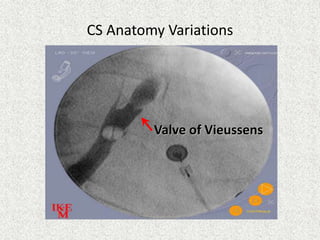
• small valve (valve of Vieussen) =junction of the
great cardiac vein and the CS
• CS =posterior and lateral aspects of the heart
• oblique entry of these small vessels into the CS
=valvular effect
coronary venous anatomy
Histology
• endocardium,
• striated myocardium,
• epicardium and
• a specific conduction system
• CS =small cardiac chamber that joins the other
four chambers at the level of the crux cordis.
• striated myocardial fibers in the media
• cells similar to the P cells of the sinus node
• large number of Purkinje-like cells.
• Numerous groups of ganglionic neurons =
subepicardium
Function
• transfer of blood from the CS to the right
atrium during active CS contraction
• lowest saturated blood in whole body =30 –
35%
• relatively thick
• instead of smooth muscle forming a tunica
media, consists of striated myocardium
continuous with that of the atria
development
• Congenital CS morphologic
• Diverticulum=inferior aspect at its junction
with the middle cardiac vein. ;basis for
posterolateral and left posterior accessory
pathways
• variations in shape, including a wind sock–
shaped, filiform, varicoid, or bifid CS;
Ostial Aneurysm
Easy Access,
no obstructions
14.7%
Hellerstein
Zipes, p. 1013
Narrow CS
Anderson
Wide CS
Zipes, p. 1013
Small with
superior
angulation
8 Fr catheter
CS Anatomy Variations
Large with superior
angulation
8 Fr catheter
CS Anatomy Variations
Balloon
LAO
20
CS Anatomy Variations
Large with inferior
angulation
CS Anatomy Variations
Funnel-shaped with
low origin
CS Anatomy Variations
Wafer-shaped RAO
CS Anatomy Variations
Valve of Vieussens
CS Anatomy Variations
Valve of Vieussens
Gradual Take-off Branch
Anterior Lateral
Gradual
Lateral
Branch
AP
Acute Take-off Branch
Acute Lateral
Branch
AP
Acute take off (Shepherd's crook)
AP
• diameter of the CS is also variable
• Congenital condition
• loading conditions
• presence and extent of atrial myocardium
with the coronary vein
• the presence of underlying cardiac disease or
prior cardiac surgery.
CS Ostia Size
Non-Heart Failure 3-15 mm.
Heart Failure 6-19mm.
Hellerstein study of 150 cadaver hearts
CS size correlated positively with right atrial size and right
atrial pressure, but not with right ventricular pressure or
degree of TR
atrial fibrillation -larger CS
How to visualise CS
• Non invasive
• Echo
• CT
• MRI
• Coronary angiogram
– Direct injection(Retrograde venography via
conventional balloon occlusion angiography)
– During levo phase of arterial angiogram
Uses
• percutaneous techniques for allowing
retroinfusion of oxygenated (arterialized) blood in
the coronary veins of patients considered to be
unsuited for conventional revascularization
procedures.
• regional application of therapeuticagents such as
cardio-protective drugs, cells, or gene vectors.
• access route to the myocardium for
electrophysiology procedures.
• retrograde injection of contrast media to the
myocardium through the heart’s CS.
• administering oxygenated blood to the
ischemic myocardium during
• USAor
• high-risk PTCA
• in cardiac surgery,
• showing an improvement in ischemia and
reducing episodes of chest angina
Access to the Coronary Sinus
• Percutaneous cannulation of the CS
• Access =right and left subclavian veins, the right
internal jugular vein, and the femoral veins.
• Katritsis et al =cannulation of the CS through the
femoral vein using a modified 6 Fr Judkins JL5
catheter
• complications =arrhythmia, dissection, and
perforation with hemopericardium
Retrograde Venous Coronary
Perfusion
• benefit of reverse flow in the coronary venous
system for oxygenation and nutrition of the
myocardial cells
• By perfusing the CS=maintain cardiac
contractions for 90 minutes in a devascularized
feline heart model
• increase coronary perfusion while partially
occluding the CS in animals. These animals
tolerated anterior descendent artery ligation
better than control animals that did not have
partial CS occlusion.
• The multiple descriptions that rule out coronary venous
system compromise due to atherosclerosis encourage even
more research of the coronary venous system as an
alternative system for maintaining nutritional flow to the
myocardium in patients with severe involvement of arterial
circulation.
• Prior to the advent of bypass surgery, surgeons
experimented with arterializations of the coronary venous
system.
• Beck et al refined this procedure during the 1940s. In an
operation known as the Beck II procedure, they would first
obstruct the CS using ligation. After 10 days, during which
the CS had fibrosed, an arterial or venous conduit was
placed between the aorta and the CS.
• The initial experimental work on this procedure was
carried out on dog animal models.
• This revealed two important physiological
characteristics: the CS could tolerate arterial pressure
for a long period of time, and there was not a broad
fistula effect following CS arterialization.
• Beck’s focus was termed “global retroperfusion” as the
methodfor carrying oxygenated blood to the whole
coronary venous system.
• However, they found that the permanent obstruction
of coronary venous drainage was associated with
specific problems, including hemorrhage, fibrosis, and
myocardial edema.
• A second means of venous revascularization, the
selective method, in which blood flow is reversed only
in precise ischemic areas caused by arterial disease,
was proposed by Arealis.
• Using this method, only a small portion of venous
drainage is reversed, with the epicardial and Thebesian
venous systems, and other territories continue to
function normally
• With the advent of bypass surgery, interest in this
technique dwindled; ongoing studies were abandoned
and new studies on this topic were relegated.
• The advent of synchronized diastolic coronary
retroperfusion allowed intermittent venous
drainage of the myocardium, which is
produced during retrograde perfusion.
• This technique has been shown to decrease
pain episodes in patients with unstable angina
and reduce complications in patients
undergoing high-risk PTCA
• In the 1980s, retroperfusion of the CS was used
as a way to protect the myocardium during
angioplasty in this group of patients.
• The technique was able to reduce both anginal
symptoms during PTCA as well as the time to
appearance of ischemia as seen in ST-segment
changes following balloon inflation.
• The main reason for its underutilization seem to
be that the retroperfusion equipment has
technical limitations and is slow to configure; in
addition, it is technically impossible in 10%-20%
of patients
Local Drug Delivery
• Efficacy of retrograde perfusion of pharmacologically active agents
to the myocardium through the coronary sinus
• In intact, non-ischemic myocardiums, the medication concentration
following retroinfusion is similar to that achieved when the
medications are administered intravenously (IV).
• However, in the context of myocardial ischemia, retroinfusion
achieves higher levels of concentration of the medication in the
tissue than when it is administered IV, with the advantage of having
lower peak systemic concentrations and fewer systemic side effects
• Thrombolytic agents, when administered directly in the coronary
veins, act faster, improve functional recovery, and reduce the size of
the infarct compared with systemic administration
Delivery of Genes, Growth Factors
and Stem Cells
• The genomic and proteomic revolution continues
advancing and the underlying molecular biology
of several cardiovascular pathologies is
increasingly well understood
• The success of these treatments depends on
many factors, among which is the ability to be
delivered adequately to the target tissues
• it is assumed that most agents are more effective
and better tolerated if they are delivered locally.
• Delivery of genes to the heart has been attempted using
viral and non-viral vectors
• Adenovirus is the viral vector that has proven most
effective in vivo; however, adverse immune and
inflammatory responses may limit its use
• Direct injection of vectors based on plasmids to the
myocardium has been reported, although the level of gene
expression with this method is relatively low
• Penta et al showed a plasmid gene delivery vector, hDel-1,
known to have angiogenic activity in angiogenesis trials
when it is administered to the myocardium through the
coronary sinus. It was found in high concentrations in the
myocardium, but is absent or at a much lower
concentration in peripheral tissues.
• Growth factors (GF) with angiogenic properties, such as
fibroblast basic growth factor (FGF-2) and vascular
endothelial growth factor (VEGF), induce growth of
collateral coronary vessels.
• Various methods for introducing these GFs to the
myocardium have been studied, such as direct injection to
the myocardium and coronary artery infusion.
• Von Degenfeld et al reported the selective and regulated
use via venous coronary retroinfusion of FGF in a porcine
model of chronic ischemia.
• The venous delivery of GF has been favorably compared
with intracoronary infusion and has also led to greater
levels of meshing of the tissue with FGF-2 and has
improved coronary perfusion through collateral vessels
• Recent studies have emphasized stem cell transplant as an
emerging treatment for patients in end-stage heart failure.
• The two main methods for delivering stem cells to the myocardium
have been researched: these are direct (through intramyocardical
injection) and intracoronary infusion.
• Both methods have proven to be effective.
• However, it has been shown that cells injected directly into the
heart to form small islets may be isolated from native myocardium,
and intracoronary infusion may not allow the cells to reach the
ischemic myocardium
• Suzuki et al reported a rat model of retrograde venous perfusion of
stem cells in the myocardium. This infusion route has been proven
to allow cellular diffusion to all layers of the myocardium with
minimal adverse effects seen during or following the retrograde
infusion.
Coronary Venous System in Cardiac
Elecrophysiology
• The knowledge of coronary venous anatomy is
of vital importance for the practice of modern
electrophysiology.
• The venous system has become a crucial
access route for the invasive management of
pathologies, such as advanced cardiac failure,
atrial fibrillation, and some supraventricular
and ventricular tachycardias
• CS allows percutaneous endocardial access to
posterolateral veins that drain the left ventricle,
through which guides and catheters can be
advanced for placing electrodes used in cardiac
resynchronization therapy through programmed
biventricular stimulation in patients with
advanced heart failure.
• This improves their functional class and
decreases ventricular dyssynchrony which, in
turn, improves the effectiveness of myocardial
contractions, increases forward cardiac output
and decreases regurgitant mitral volume
For biventricular pacing, optimal left ventricular pacing lead position is
within the posterolateral branch of the coronary sinus, followed by the
lateral branch
• CS approach is also useful in managing atrioventricular (AV)
re-entrant arrhythmias, being routinely used as an
alternative approach in the ablation of left accessory
pathways, as the majority of these anomalous connections
tend to have epicardial fibers and insertions which on
occasion cannot be eliminated through conventional
endocavitary ablation
• AV re-entrant tachycardias that use the ligament of
Marshall as a re-entry mechanism have been successfully
eliminated by catheter ablation through the CS and the vein
of Marshall
• Some CS fibromuscular tissue bands have electrical
conducting properties, and cases of atypical atrial flutter
have been described in patients following pulmonary vein
Isolation
• CS endo-epicardial ablation is an important step during
radiofrequency ablation for patients with persistent AF
today
• The ligament of Marshall as an anatomical structure is
a remnant of the left superior vena cava and contains
nerve fibers with significant electrical conduction
properties, connected to the CS muscular tissue in its
proximal portion and with the left pulmonary veins in
its middle portion.
• The vein of Marshall has been a focus point during
ablation of paroxysmal AF in young patients, as this
structure is an important trigger of arrhythmic events
in up to 20% of these cases
• Knowledge of the exact anatomical location of the CS
ostium is paramount during ablation of AV nodal re-entrant
tachycardia (AVNRT), as it helps delineate the anatomical
boundaries of the triangle of Koch, which is made up in its
posteriorportion by the tendon of Todaro, anteriorly by the
septal cusp in the tricuspid ring and inferiorly by the CS
ostium
• The middle portion of this anatomic triangle contains the
compact AV node.
• In patients with AVNRT, there are at least two (and at times
multiple) pathways with different conduction properties
that constitute the necessary circuit for this re-entrant
arrhythmia (classically labeled as slow-fast for typical
AVNRT and fast-slow or slow-slow for atypical AVNRT).
• The slow pathway, which is usually located at the base of
this triangle, is the preferred target of radiofrequency
modulation or cryoablation for treating this arrhythmia, as
the risk of complete heart block using this approach is <1%
• The coronary sinus provides direct access to the cardiac
venous system as a potential approach during mapping and
ablation of ventricular tachycardias originating from an
epicardial substrate.
• By placing electrode catheters into the coronary sinus,
electrical mapping of low-amplitude diastolic potentials
and early local electrograms can guide successful VT
ablation in areas of difficult endocardial access such as the
mitral annulus (via the greater cardac vein) or the left
ventricular summit, at the junction between the greater
cardiac and the anterior interventricular veins.
•The left atrial veins can be used for atrial
pacing. When thresholds are poor in the right
atrium or precise left atrial-left ventricular
synchrony is needed.
•Specific cannulation of the CS and then placing
the lead into an atrial branch can be done.
•Bi-atrial pacing with both a right and left atrial
lead has been attempted for pacing related
therapy of atrial fibrillation
Venous System in Valvular
Interventions
• With the growing interest in structural interventions
and the development of percutaneous techniques for
the treatment of valvular pathologies through
percutaneous routes
• The cardiac venous system, and especially the coronary
sinus, is attractive because it is a structure located
parallel to the posterior portion of the mitral ring and
surrounding up to two thirds of the ring, making it
possible to implant devices via this route with the
capacity to shorten the length of the coronary sinus
and in this way carry out a valvular annuloplasty.
• In a generic way, these devices seek to create
a tension or constriction of the sinus, which is
transmitted to the mitral valvular apparatus
and especially to the valvular ring.
• Currently, there are initial experiences in
humans with the Cardiac Dimensions Carillon
(Cardiac Dimensions), Edwards Monarc
System (Edwards Lifesciences), and the Viacor
PTMA (percutaneous transvenous mitral
annuloplasty)system (Viacor) device
• The Cardiac Dimensions Carillon system consists of a
nitinol guide that has been molded to form a proximal
and a distal anchor; these are joined by bridge
elements with the ability to shorten the length of the
coronary sinus.
• The first studies in humans found a decrease in mitral
valve insufficiency in at least one degree in all cases,
improving left ventricular function and decreasing
ventricular diameter and volume.
• Likewise, a symptomatic improvement was achieved
with a decrease in functional class and improvement
after 6 minutes of continuous walking at 6-months
follow-up exam.
• The Edwards Monarc system is made up of proximal and
distal anchors formed by self-expanding stents, and a
bridge system that joins them.
• The distal anchor is released in the anterior interventricular
vein and the proximal anchor near the coronary sinus
ostium. Once a large part of the mitral ring circumference is
captured, the bridge segment is tensed in order to shorten
it.
• The initial experience with this device showed a one or two
degree reduction in insufficiency in most patients.
• However, the EVOLUTION II study (Clinical Evaluation of the
Edwards Lifesciences Percutaneous Mitral Annuloplasty
System for the Treatment of Mitral Regurgitation) was
suspended due to patient inclusion difficulties
• Lastly, the Viacor PTMA system consists of a
trilumen catheter that may be implanted
through the subclavian, with different nitinol
guides that are advanced through the catheter
lumen.
• Pressure is applied to the central portion of
the posterior mitral ring, thus shortening the
distance between the septum and the distal
wall with a consequent shortening or
constriction of the mitral ring.
• Although the devices are technically feasible to implant in
most patients, technical problems have been described
secondary to the anatomic variations of the coronary sinus,
as well as material fatigue with device fracture, which has
been described with the three devices and is related to the
complex dynamics of compression and torsion that the
device undergoes during the cardiac cycle.
• Another significant limitation is the compression of the
circumflex artery by the device. Most devices that cause
compression of the circumflex artery present dramatic
clinical manifestations during the procedure, forcing the
removal of the device and cancellation of the procedure.
• Evaluation with multidetector scanning is very useful for
detecting the anatomic relationship of the coronary sinus
to the body of the circumflex artery and the marginal
branches in order to decrease this complication
Thebesian Valve
• The ostium of the Coronary Sinus may have a ridge of tissue
that is referred to as the Thebesian Valve.
• This valve originates from
the embryonic Right Venous
Valve and may obstruct
entry to the CS.
• The variations of the thebesian
valve may explain the great
variations in oxygen content
in the blood obtained at
different levels in the right
atrium and right ventricle.
• Thebesian valve is a crescent shaped
structure often found guarding the
mouth of the CS as it opens to the right
atrium.
• It is highly variable and occasionally may
present an obstruction during
cannulation of the CS.
• Makes it difficult to enter the coronary sinus for
electrophysiologist
• Makes it difficult to administer of retrograde cardioplegia
while doing CABG
• Studies have demonstrated
that valves that obstruct a
significant portion of the
CS ostium may be
successfully transversed
by use of modern
cannulation techniques
(i.e. softer-tipped sheath,
preshaped sheath, and
anterior approach)
Divisione di Cardiologia
Parma
LAO 40°
Thebesian Valve
Thebesian
Valve
Thebesian Flap
30.7%
Hellerstein
Thebesian Flap
Thebesian Flap
Remnants of flap
formed a bar like
structure
Fenestrated Flap
10%
Hellerstein
Network
5.3%
Hellerstein
Chiari’s Network
For a Chiari’s
Network, the
Network
extends
out along the
Eustachian
ridge.
0.03 % or 3 out of
1000 hearts
Hellerstein
• A related but distinct entity is the subthebesian
pouch , an outpouching of the right atrial wall
inferior to the CS ostium that can serve as a
substrate for a reentrant circuit causing atrial
flutter .
• It is also described as the subeustachian sinus or
sinus of Keith, although anatomically it is
subthebesian, not subeustachian.
• A deep subthebesian pouch has been described
as a cause of interventional procedural difficulty
and has been reported in 47% of case
Sub Thebesian Pouch,
or a “False CS Ostium”
Anderson
CORONARY SINUS

CORONARY SINUS

  • 1.
    Coronary Sinus (CS) •greater and smaller cardiac veins • Thebesian veins • CS -posterior aspect of the coronary groove • atrial myocardium also drains into the CS via the various atrial veins and the vein of Marshall.
  • 3.
    • muscular tube •2 to 3 cm long • 1 cm in caliber • 1 cm above and parallel to the left atrioventricular junction • close contact with the left atrium • enveloped in a sheath of atrial myocardium • small valve (valve of Vieussen) =junction of the great cardiac vein and the CS • CS =posterior and lateral aspects of the heart • oblique entry of these small vessels into the CS =valvular effect
  • 4.
  • 5.
    Histology • endocardium, • striatedmyocardium, • epicardium and • a specific conduction system • CS =small cardiac chamber that joins the other four chambers at the level of the crux cordis.
  • 6.
    • striated myocardialfibers in the media • cells similar to the P cells of the sinus node • large number of Purkinje-like cells. • Numerous groups of ganglionic neurons = subepicardium
  • 7.
    Function • transfer ofblood from the CS to the right atrium during active CS contraction • lowest saturated blood in whole body =30 – 35% • relatively thick • instead of smooth muscle forming a tunica media, consists of striated myocardium continuous with that of the atria
  • 8.
  • 19.
    • Congenital CSmorphologic • Diverticulum=inferior aspect at its junction with the middle cardiac vein. ;basis for posterolateral and left posterior accessory pathways • variations in shape, including a wind sock– shaped, filiform, varicoid, or bifid CS;
  • 22.
  • 25.
  • 26.
  • 27.
  • 28.
    Small with superior angulation 8 Frcatheter CS Anatomy Variations
  • 29.
    Large with superior angulation 8Fr catheter CS Anatomy Variations Balloon LAO 20
  • 30.
    CS Anatomy Variations Largewith inferior angulation
  • 31.
  • 32.
  • 33.
  • 34.
  • 35.
    Gradual Take-off Branch AnteriorLateral Gradual Lateral Branch AP
  • 36.
    Acute Take-off Branch AcuteLateral Branch AP
  • 37.
    Acute take off(Shepherd's crook) AP
  • 38.
    • diameter ofthe CS is also variable • Congenital condition • loading conditions • presence and extent of atrial myocardium with the coronary vein • the presence of underlying cardiac disease or prior cardiac surgery.
  • 39.
    CS Ostia Size Non-HeartFailure 3-15 mm. Heart Failure 6-19mm. Hellerstein study of 150 cadaver hearts CS size correlated positively with right atrial size and right atrial pressure, but not with right ventricular pressure or degree of TR atrial fibrillation -larger CS
  • 40.
    How to visualiseCS • Non invasive • Echo • CT • MRI • Coronary angiogram – Direct injection(Retrograde venography via conventional balloon occlusion angiography) – During levo phase of arterial angiogram
  • 41.
    Uses • percutaneous techniquesfor allowing retroinfusion of oxygenated (arterialized) blood in the coronary veins of patients considered to be unsuited for conventional revascularization procedures. • regional application of therapeuticagents such as cardio-protective drugs, cells, or gene vectors. • access route to the myocardium for electrophysiology procedures.
  • 42.
    • retrograde injectionof contrast media to the myocardium through the heart’s CS. • administering oxygenated blood to the ischemic myocardium during • USAor • high-risk PTCA • in cardiac surgery, • showing an improvement in ischemia and reducing episodes of chest angina
  • 43.
    Access to theCoronary Sinus • Percutaneous cannulation of the CS • Access =right and left subclavian veins, the right internal jugular vein, and the femoral veins. • Katritsis et al =cannulation of the CS through the femoral vein using a modified 6 Fr Judkins JL5 catheter • complications =arrhythmia, dissection, and perforation with hemopericardium
  • 44.
    Retrograde Venous Coronary Perfusion •benefit of reverse flow in the coronary venous system for oxygenation and nutrition of the myocardial cells • By perfusing the CS=maintain cardiac contractions for 90 minutes in a devascularized feline heart model • increase coronary perfusion while partially occluding the CS in animals. These animals tolerated anterior descendent artery ligation better than control animals that did not have partial CS occlusion.
  • 45.
    • The multipledescriptions that rule out coronary venous system compromise due to atherosclerosis encourage even more research of the coronary venous system as an alternative system for maintaining nutritional flow to the myocardium in patients with severe involvement of arterial circulation. • Prior to the advent of bypass surgery, surgeons experimented with arterializations of the coronary venous system. • Beck et al refined this procedure during the 1940s. In an operation known as the Beck II procedure, they would first obstruct the CS using ligation. After 10 days, during which the CS had fibrosed, an arterial or venous conduit was placed between the aorta and the CS.
  • 46.
    • The initialexperimental work on this procedure was carried out on dog animal models. • This revealed two important physiological characteristics: the CS could tolerate arterial pressure for a long period of time, and there was not a broad fistula effect following CS arterialization. • Beck’s focus was termed “global retroperfusion” as the methodfor carrying oxygenated blood to the whole coronary venous system. • However, they found that the permanent obstruction of coronary venous drainage was associated with specific problems, including hemorrhage, fibrosis, and myocardial edema.
  • 47.
    • A secondmeans of venous revascularization, the selective method, in which blood flow is reversed only in precise ischemic areas caused by arterial disease, was proposed by Arealis. • Using this method, only a small portion of venous drainage is reversed, with the epicardial and Thebesian venous systems, and other territories continue to function normally • With the advent of bypass surgery, interest in this technique dwindled; ongoing studies were abandoned and new studies on this topic were relegated.
  • 48.
    • The adventof synchronized diastolic coronary retroperfusion allowed intermittent venous drainage of the myocardium, which is produced during retrograde perfusion. • This technique has been shown to decrease pain episodes in patients with unstable angina and reduce complications in patients undergoing high-risk PTCA
  • 49.
    • In the1980s, retroperfusion of the CS was used as a way to protect the myocardium during angioplasty in this group of patients. • The technique was able to reduce both anginal symptoms during PTCA as well as the time to appearance of ischemia as seen in ST-segment changes following balloon inflation. • The main reason for its underutilization seem to be that the retroperfusion equipment has technical limitations and is slow to configure; in addition, it is technically impossible in 10%-20% of patients
  • 50.
    Local Drug Delivery •Efficacy of retrograde perfusion of pharmacologically active agents to the myocardium through the coronary sinus • In intact, non-ischemic myocardiums, the medication concentration following retroinfusion is similar to that achieved when the medications are administered intravenously (IV). • However, in the context of myocardial ischemia, retroinfusion achieves higher levels of concentration of the medication in the tissue than when it is administered IV, with the advantage of having lower peak systemic concentrations and fewer systemic side effects • Thrombolytic agents, when administered directly in the coronary veins, act faster, improve functional recovery, and reduce the size of the infarct compared with systemic administration
  • 51.
    Delivery of Genes,Growth Factors and Stem Cells • The genomic and proteomic revolution continues advancing and the underlying molecular biology of several cardiovascular pathologies is increasingly well understood • The success of these treatments depends on many factors, among which is the ability to be delivered adequately to the target tissues • it is assumed that most agents are more effective and better tolerated if they are delivered locally.
  • 52.
    • Delivery ofgenes to the heart has been attempted using viral and non-viral vectors • Adenovirus is the viral vector that has proven most effective in vivo; however, adverse immune and inflammatory responses may limit its use • Direct injection of vectors based on plasmids to the myocardium has been reported, although the level of gene expression with this method is relatively low • Penta et al showed a plasmid gene delivery vector, hDel-1, known to have angiogenic activity in angiogenesis trials when it is administered to the myocardium through the coronary sinus. It was found in high concentrations in the myocardium, but is absent or at a much lower concentration in peripheral tissues.
  • 53.
    • Growth factors(GF) with angiogenic properties, such as fibroblast basic growth factor (FGF-2) and vascular endothelial growth factor (VEGF), induce growth of collateral coronary vessels. • Various methods for introducing these GFs to the myocardium have been studied, such as direct injection to the myocardium and coronary artery infusion. • Von Degenfeld et al reported the selective and regulated use via venous coronary retroinfusion of FGF in a porcine model of chronic ischemia. • The venous delivery of GF has been favorably compared with intracoronary infusion and has also led to greater levels of meshing of the tissue with FGF-2 and has improved coronary perfusion through collateral vessels
  • 54.
    • Recent studieshave emphasized stem cell transplant as an emerging treatment for patients in end-stage heart failure. • The two main methods for delivering stem cells to the myocardium have been researched: these are direct (through intramyocardical injection) and intracoronary infusion. • Both methods have proven to be effective. • However, it has been shown that cells injected directly into the heart to form small islets may be isolated from native myocardium, and intracoronary infusion may not allow the cells to reach the ischemic myocardium • Suzuki et al reported a rat model of retrograde venous perfusion of stem cells in the myocardium. This infusion route has been proven to allow cellular diffusion to all layers of the myocardium with minimal adverse effects seen during or following the retrograde infusion.
  • 55.
    Coronary Venous Systemin Cardiac Elecrophysiology • The knowledge of coronary venous anatomy is of vital importance for the practice of modern electrophysiology. • The venous system has become a crucial access route for the invasive management of pathologies, such as advanced cardiac failure, atrial fibrillation, and some supraventricular and ventricular tachycardias
  • 56.
    • CS allowspercutaneous endocardial access to posterolateral veins that drain the left ventricle, through which guides and catheters can be advanced for placing electrodes used in cardiac resynchronization therapy through programmed biventricular stimulation in patients with advanced heart failure. • This improves their functional class and decreases ventricular dyssynchrony which, in turn, improves the effectiveness of myocardial contractions, increases forward cardiac output and decreases regurgitant mitral volume
  • 57.
    For biventricular pacing,optimal left ventricular pacing lead position is within the posterolateral branch of the coronary sinus, followed by the lateral branch
  • 58.
    • CS approachis also useful in managing atrioventricular (AV) re-entrant arrhythmias, being routinely used as an alternative approach in the ablation of left accessory pathways, as the majority of these anomalous connections tend to have epicardial fibers and insertions which on occasion cannot be eliminated through conventional endocavitary ablation • AV re-entrant tachycardias that use the ligament of Marshall as a re-entry mechanism have been successfully eliminated by catheter ablation through the CS and the vein of Marshall • Some CS fibromuscular tissue bands have electrical conducting properties, and cases of atypical atrial flutter have been described in patients following pulmonary vein Isolation
  • 59.
    • CS endo-epicardialablation is an important step during radiofrequency ablation for patients with persistent AF today • The ligament of Marshall as an anatomical structure is a remnant of the left superior vena cava and contains nerve fibers with significant electrical conduction properties, connected to the CS muscular tissue in its proximal portion and with the left pulmonary veins in its middle portion. • The vein of Marshall has been a focus point during ablation of paroxysmal AF in young patients, as this structure is an important trigger of arrhythmic events in up to 20% of these cases
  • 60.
    • Knowledge ofthe exact anatomical location of the CS ostium is paramount during ablation of AV nodal re-entrant tachycardia (AVNRT), as it helps delineate the anatomical boundaries of the triangle of Koch, which is made up in its posteriorportion by the tendon of Todaro, anteriorly by the septal cusp in the tricuspid ring and inferiorly by the CS ostium • The middle portion of this anatomic triangle contains the compact AV node. • In patients with AVNRT, there are at least two (and at times multiple) pathways with different conduction properties that constitute the necessary circuit for this re-entrant arrhythmia (classically labeled as slow-fast for typical AVNRT and fast-slow or slow-slow for atypical AVNRT).
  • 61.
    • The slowpathway, which is usually located at the base of this triangle, is the preferred target of radiofrequency modulation or cryoablation for treating this arrhythmia, as the risk of complete heart block using this approach is <1% • The coronary sinus provides direct access to the cardiac venous system as a potential approach during mapping and ablation of ventricular tachycardias originating from an epicardial substrate. • By placing electrode catheters into the coronary sinus, electrical mapping of low-amplitude diastolic potentials and early local electrograms can guide successful VT ablation in areas of difficult endocardial access such as the mitral annulus (via the greater cardac vein) or the left ventricular summit, at the junction between the greater cardiac and the anterior interventricular veins.
  • 62.
    •The left atrialveins can be used for atrial pacing. When thresholds are poor in the right atrium or precise left atrial-left ventricular synchrony is needed. •Specific cannulation of the CS and then placing the lead into an atrial branch can be done. •Bi-atrial pacing with both a right and left atrial lead has been attempted for pacing related therapy of atrial fibrillation
  • 64.
    Venous System inValvular Interventions • With the growing interest in structural interventions and the development of percutaneous techniques for the treatment of valvular pathologies through percutaneous routes • The cardiac venous system, and especially the coronary sinus, is attractive because it is a structure located parallel to the posterior portion of the mitral ring and surrounding up to two thirds of the ring, making it possible to implant devices via this route with the capacity to shorten the length of the coronary sinus and in this way carry out a valvular annuloplasty.
  • 65.
    • In ageneric way, these devices seek to create a tension or constriction of the sinus, which is transmitted to the mitral valvular apparatus and especially to the valvular ring. • Currently, there are initial experiences in humans with the Cardiac Dimensions Carillon (Cardiac Dimensions), Edwards Monarc System (Edwards Lifesciences), and the Viacor PTMA (percutaneous transvenous mitral annuloplasty)system (Viacor) device
  • 66.
    • The CardiacDimensions Carillon system consists of a nitinol guide that has been molded to form a proximal and a distal anchor; these are joined by bridge elements with the ability to shorten the length of the coronary sinus. • The first studies in humans found a decrease in mitral valve insufficiency in at least one degree in all cases, improving left ventricular function and decreasing ventricular diameter and volume. • Likewise, a symptomatic improvement was achieved with a decrease in functional class and improvement after 6 minutes of continuous walking at 6-months follow-up exam.
  • 68.
    • The EdwardsMonarc system is made up of proximal and distal anchors formed by self-expanding stents, and a bridge system that joins them. • The distal anchor is released in the anterior interventricular vein and the proximal anchor near the coronary sinus ostium. Once a large part of the mitral ring circumference is captured, the bridge segment is tensed in order to shorten it. • The initial experience with this device showed a one or two degree reduction in insufficiency in most patients. • However, the EVOLUTION II study (Clinical Evaluation of the Edwards Lifesciences Percutaneous Mitral Annuloplasty System for the Treatment of Mitral Regurgitation) was suspended due to patient inclusion difficulties
  • 70.
    • Lastly, theViacor PTMA system consists of a trilumen catheter that may be implanted through the subclavian, with different nitinol guides that are advanced through the catheter lumen. • Pressure is applied to the central portion of the posterior mitral ring, thus shortening the distance between the septum and the distal wall with a consequent shortening or constriction of the mitral ring.
  • 72.
    • Although thedevices are technically feasible to implant in most patients, technical problems have been described secondary to the anatomic variations of the coronary sinus, as well as material fatigue with device fracture, which has been described with the three devices and is related to the complex dynamics of compression and torsion that the device undergoes during the cardiac cycle. • Another significant limitation is the compression of the circumflex artery by the device. Most devices that cause compression of the circumflex artery present dramatic clinical manifestations during the procedure, forcing the removal of the device and cancellation of the procedure. • Evaluation with multidetector scanning is very useful for detecting the anatomic relationship of the coronary sinus to the body of the circumflex artery and the marginal branches in order to decrease this complication
  • 73.
    Thebesian Valve • Theostium of the Coronary Sinus may have a ridge of tissue that is referred to as the Thebesian Valve. • This valve originates from the embryonic Right Venous Valve and may obstruct entry to the CS. • The variations of the thebesian valve may explain the great variations in oxygen content in the blood obtained at different levels in the right atrium and right ventricle.
  • 75.
    • Thebesian valveis a crescent shaped structure often found guarding the mouth of the CS as it opens to the right atrium. • It is highly variable and occasionally may present an obstruction during cannulation of the CS.
  • 76.
    • Makes itdifficult to enter the coronary sinus for electrophysiologist • Makes it difficult to administer of retrograde cardioplegia while doing CABG • Studies have demonstrated that valves that obstruct a significant portion of the CS ostium may be successfully transversed by use of modern cannulation techniques (i.e. softer-tipped sheath, preshaped sheath, and anterior approach)
  • 77.
    Divisione di Cardiologia Parma LAO40° Thebesian Valve Thebesian Valve
  • 78.
  • 79.
  • 80.
    Thebesian Flap Remnants offlap formed a bar like structure
  • 81.
  • 82.
  • 83.
    Chiari’s Network For aChiari’s Network, the Network extends out along the Eustachian ridge. 0.03 % or 3 out of 1000 hearts Hellerstein
  • 84.
    • A relatedbut distinct entity is the subthebesian pouch , an outpouching of the right atrial wall inferior to the CS ostium that can serve as a substrate for a reentrant circuit causing atrial flutter . • It is also described as the subeustachian sinus or sinus of Keith, although anatomically it is subthebesian, not subeustachian. • A deep subthebesian pouch has been described as a cause of interventional procedural difficulty and has been reported in 47% of case
  • 85.
    Sub Thebesian Pouch, ora “False CS Ostium” Anderson