Venous doppler study of
upper limb
Dr Sulav Pradhan
1st year resident
Radiodiagnosis, NAMS
Anatomy
• Superficial veins
1. Cephalic Vein
2. Basilic Vein
3. Median vein of
forearm
Deep veins
1. Brachial vein
2. Axillary vein
3. Subclavian Vein
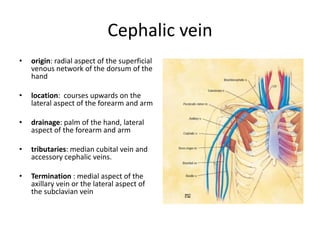
Cephalic vein
• origin: radial aspect of the superficial
venous network of the dorsum of the
hand
• location: courses upwards on the
lateral aspect of the forearm and arm
• drainage: palm of the hand, lateral
aspect of the forearm and arm
• tributaries: median cubital vein and
accessory cephalic veins.
• Termination : medial aspect of the
axillary vein or the lateral aspect of
the subclavian vein
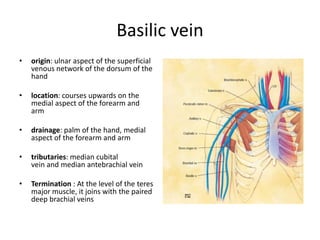
Basilic vein
• origin: ulnar aspect of the superficial
venous network of the dorsum of the
hand
• location: courses upwards on the
medial aspect of the forearm and
arm
• drainage: palm of the hand, medial
aspect of the forearm and arm
• tributaries: median cubital
vein and median antebrachial vein
• Termination : At the level of the teres
major muscle, it joins with the paired
deep brachial veins
Brachial vein
• origin: union of the ulnar and
radial veins in the cubital fossa
• location: courses superiorly in
the upper arm, often in close
proximity to the brachial
artery
• drainage: deep and superficial
palmar venous arches
• termination: union of the
brachial and basilic veins at
the inferior border of teres
major forms the axillary vein
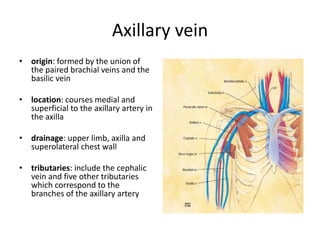
Axillary vein
• origin: formed by the union of
the paired brachial veins and the
basilic vein
• location: courses medial and
superficial to the axillary artery in
the axilla
• drainage: upper limb, axilla and
superolateral chest wall
• tributaries: include the cephalic
vein and five other tributaries
which correspond to the
branches of the axillary artery
Subclavian vein
• starts at the crossing of the lateral
border of the 1st rib
• Arches cephalad, posterior to the
medial clavicle before curving caudally
and receiving its only tributary,
the external jugular vein
• joins the internal jugular vein
posterior to the sternoclavicular
joint, where it forms
the brachiocephalic vein
• The right and left brachiocephalic
veins merge to form the superior vena
cava, which subsequently enters the
right atrium.
• Perforating veins form important pathways of
collateralization in the presence of partial thrombosis.
• In the absence of thrombus they are typically too small
to see, but become more pronounced when they are
recruited to divert flow around a clot.
• Valves are present within the veins of the UE. As one
moves peripherally the location of the first valve is
quite variable, but typically is encountered in the
proximal brachial vein.
Advantages:
• Doppler study is a noninvasive imaging method
• B mode US combined with color flow doppler study provide
anatomical and physiological information as good as that
obtained with venography
• Relatively low cost
• Widely available
• Portabillity
• Proven high accuracy has lead to its primary role in diagnosis
of venous thrombosis
Disadvantages
• dependence on the skill of the operator
• technical difficulties in patients with oedema,
wounds or obesity
• low sensitivity for assessing DVT in the upper
thorax and arms (overlying skeleton, lungs and
large venous collateral pathways)
• difficulty in differentiatingrecanalized thrombus
from fresh thrombus
USES
• Evaluation of suspected DVT
• Evaluation of venous incompetence
• Preoperative vein mapping
• Evaluation of venous system for patency before
the placement of venous catheter
• For initial evaluation of vascular malformation.
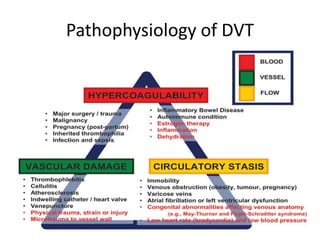
Pathophysiology of DVT
Catheter-related thrombosis:
• caused by several factors.
• The vessel wall may be damaged during
catheter insertion or during infusion of
medication.
• Also, the catheter may impede blood flow
through the vein and cause areas of stasis
• Although the cause of upper extremity DVT
differs from that of the lower extremity, the
pathophysiology of its evolution is similar.
• The sequelae of upper extremity thrombosis are less severe than
those of lower extremity thrombosis.
• Only 10% to 12% of patients with arm DVT develop pulmonary
emboli - majority of these are insignificant.
• manifestations of venous stasis and venous insufficiency caused by
DVT in the arm are less common and less severe than in the leg.
• Chronic swelling, skin changes, and nonhealing venous ulcers are
rare in the arm because of two major factors : extensive collateral
pathways and low hydrostatic pressure as compared to leg veins
Diagnostic Accuracy of Ultrasound
• The accuracy of ultrasound versus venography in
patients with acute DVT of the upper extremity has not
been studied as extensively as in the lower extremity.
• The available literature shows sensitivity ranging from
78% to 100% and specificity of 92% to 100%.
• The lower accuracy in the upper extremity compared
with the lower extremity is a result of the greater
number of technical challenges facing the examiner.
TECHNICAL PROCEDURES
• Similar principles to examination of lower extremity
venous examination:
- gray scale compression
- color Doppler
- spectral Doppler
• Typically, a 9-MHz linear array transducer – for internal
jugular vein and the arm veins through the axillary vein.
• 6-MHz transducer with color Doppler ultrasound capability
is often necessary to visualize the subclavian vein.
Positioning
• patient is positioned
supine, with the arm to
be examined slightly
abducted and rotated
externally.
• patient’s head is turned
slightly to the opposite
side
Scanning Technique
• Subclavian Vein
Patient supine on bed, arms by their side.
Scan in transverse at the antero-lateral base of
the neck.
A coronal, supraclavicular, inferiorly angled
approach is used medially, and a coronal,
infraclavicular, superiorly angled approach is
used laterally
Using colour doppler, find the Jugular vein and
follow inferiorly to the junction with the
subclavian vein.
Follow the subclavian vein laterally using
colour doppler in both longitudinal &
transverse planes to exclude non occlusive
filling defects.
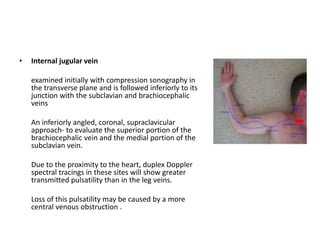
• Internal jugular vein
examined initially with compression sonography in
the transverse plane and is followed inferiorly to its
junction with the subclavian and brachiocephalic
veins
An inferiorly angled, coronal, supraclavicular
approach- to evaluate the superior portion of the
brachiocephalic vein and the medial portion of the
subclavian vein.
Due to the proximity to the heart, duplex Doppler
spectral tracings in these sites will show greater
transmitted pulsatility than in the leg veins.
Loss of this pulsatility may be caused by a more
central venous obstruction .
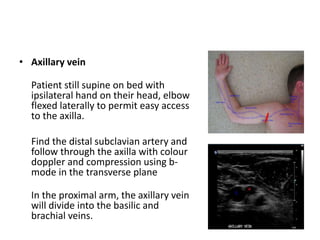
• Axillary vein
Patient still supine on bed with
ipsilateral hand on their head, elbow
flexed laterally to permit easy access
to the axilla.
Find the distal subclavian artery and
follow through the axilla with colour
doppler and compression using b-
mode in the transverse plane
In the proximal arm, the axillary vein
will divide into the basilic and
brachial veins.
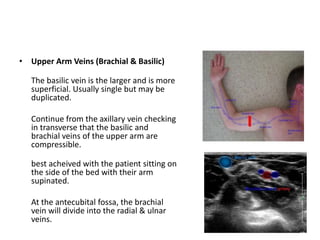
• Upper Arm Veins (Brachial & Basilic)
The basilic vein is the larger and is more
superficial. Usually single but may be
duplicated.
Continue from the axillary vein checking
in transverse that the basilic and
brachial veins of the upper arm are
compressible.
best acheived with the patient sitting on
the side of the bed with their arm
supinated.
At the antecubital fossa, the brachial
vein will divide into the radial & ulnar
veins.
• Forearm veins (Radial & Ulna)
Still with the patient seated on
the side of the bed, follow the
radial and ulnar veins to the
wrist confirming compressibility
and flow.
As with the veins in the calf, the
veins of the forearm generally
run in pairs (venous
commantantes)
Ultrasound and Compression
• Fresh thrombus may be extremely
hypoecoic – difficulty in visualization
- therefore, essential to perform
venous compression in a transverse
plane to rule out the presence of UE
DVT.
• Compression should be light
because fresh clots are soft and firm
pressure may give a false impression
of patency.
• cannot be used in portions of
subclavian vein and in the inominate
vein because of the overlying
structures – Color Doppler and
Spectral Doppler assessment
Ultrasound Color-Doppler
• As a result of right atrial contraction (a-wave) -pushes back
on venous return in the larger central veins- resulting in a
temporary reversal of flow. The color Doppler signal will
fluctuate in direction.
• With the pulse repetition frequency adjusted to a higher
level, the wall filter may suppress perception of slower
laminar flow along the wall, appearance that can be
confusing, mimicking a clot adherent to the wall.
• On the other hand, in the larger veins with the color-
Doppler pulse repetition frequency set relatively low, with
a brisk augment, aliasing may occur.
Ultrasound Spectral-Doppler
• If no thrombus occluding the vein- color spontaneously saturates
all lumen of the vessel.
• Because the veins of the UE are in close proximity to the heart, it is
normal to see a cardiac pulsatility in the spectral analysis.
• Spectral analysis of the caudal internal jugular vein and the medial
subclavian vein demonstrate central venous transmitted cardiac
pulsatility with a, c, v peaks, and x and y descents – rules out
obstruction
• In contrast to the lower extremity veins, the velocity of blood flow
in the veins of the upper extremity increases during inspiration
(inspiratory sniff) due to negative intrathoracic pressure and
increased venous return toward the heart.
• In a normal venous system there will be a
rapid rise and fall in the frequency shift,
whereas if there is a thrombosed venous
segment it will resist flow with damping or
absence of the augmentation response.
• squeeze should be rapid and not excessive –
risk of thrombus dislodgement.
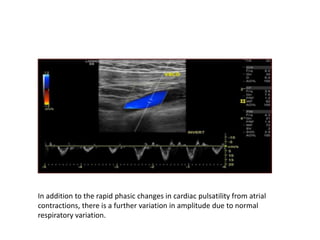
In addition to the rapid phasic changes in cardiac pulsatility from atrial
contractions, there is a further variation in amplitude due to normal
respiratory variation.
Phasicity
Flow changes with respiration
Slow ApneaRapid
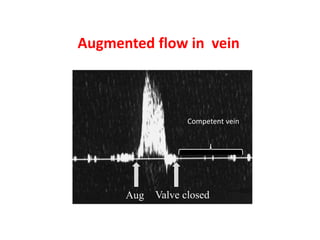
Augmented flow in vein
Aug Valve closed
Competent vein
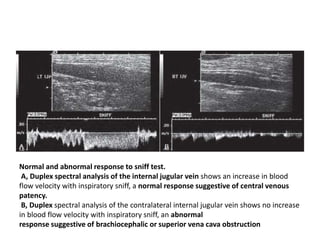
Normal and abnormal response to sniff test.
A, Duplex spectral analysis of the internal jugular vein shows an increase in blood
flow velocity with inspiratory sniff, a normal response suggestive of central venous
patency.
B, Duplex spectral analysis of the contralateral internal jugular vein shows no increase
in blood flow velocity with inspiratory sniff, an abnormal
response suggestive of brachiocephalic or superior vena cava obstruction
Diagnostic criteria of upper extremity
deep vein thrombosis
Fig : A Gray-scale sonogram of the left internal jugular vein (arrows) in the transverse
view shows some echogenic material within it .
Fig B: Probe pressure is being exerted over the vein and the thrombus is preventing
the compression of the vein.
This is the key to positively identifying the presence of this non-occlusive thrombus
within the vein.
Triplex sonogram in the longitudinal view shows an occlusive thrombus in the
left axillary vein.
Patent segment below the clot demonstrates some slow anterograde
flow without respiratory variation or cardiac pulsatility.
POTENTIAL PITFALLS
1. Rouleaux
• Blood flow is anechoic because individual red blood cells are too
small to reflect the incoming sound wave.
• However, in certain conditions as infection, diabetes mellitus or
cancer, red blood cells may stick to each other, a finding that is
named rouleaux - aggregates are large enough to interact with the
insonating beam, manifesting as echoes in the bloodstream, and
are more likely to occur in areas of slow flow, especially in the sinus
behind the cusps of valves.
• If compression easily dislodges these Rouleaux aggregates,
presence of a clot is excluded.
Gray-scale sonogram in the longitudinal
view shows an area of slow flow in
the right internal jugular vein mimicking
deep venous thrombosis.
2. Arm abduction
• Caution should be exercised in interpreting the distal subclavian
vein, which may appear falsely narrowed as it crosses between the
clavicle and the first rib at the thoracic inlet, due to complete
abduction of the upper extremity during examination.
3. Limited acoustic window
• due to bandages used to secure the catheters, radiation-induced
changes on the chest wall or the presence of indwelling catheters
4. Large venous collaterals
• In chronic obstruction, large venous collaterals often coexist and
can be misinterpreted as representing patent normal vessels.
CHRONIC CHANGES AFTER UEDVT
1. Valves
• If valve cusps appear rigid or fixed, this usually represents the
sequela of prior UEDVT.
2. Walls
• The walls of a normal vein are smooth and non obstructive.
• Following recanalization after DVT they become irregular,
thickened, echogenic and rarely calcified.
• Decreased diameter of venous lumina.
3. Venous collaterals
• Over a period of time the intramuscular venous channels expand
and become apparent on color Doppler.
Acute & chronic thrombus
Signs interpreted according to clinical history
• Anechoic or hypoechoic Brightly echogenic
• Homogenous Heterogenous
• Poorly attached or floating Well attached
• Smooth borders Irregular borders
• Spongy & deformable More rigid
• Increase in vein diameter Small & contracted vein
• Small collaterals Large collaterals
Acute thrombus Chronic thrombus
Ultrasound Venous Mapping for
Preoperative Planning of Dialysis Access
• non dominant arm first
• The vein mapped to receive the arterial anastomosis be measured after it is
dilated (use of sequential tourniquet placement or an inflated blood pressure cuff
on the arm) - closely approximates the size of the arterialized vein after fistula
formation.
• forearm vein most commonly used for AVF creation is the cephalic vein.
- assessed for compressibility, thrombus, and size
- minimal diameter of 0.25 cm for all veins used for an AVF
- measured at 7 to 8 sites on arm and forearm
• Veins must be relatively superficial to be easily cannulated after placement of a
fistula. The depth from the skin surface to the cephalic veins of adequate diameter
may be measured to assess the need for a subsequent superficialization
procedure.
• If no suitable upper arm vein for AVF creation
is found, the largest brachial vein and the
axillary vein should be measured for potential
graft placement as previously described.
• A vein with a diameter of at least 0.4 cm is
needed for grafts
• Large branches of veins near the site of a fistula
can result in nonmaturation of the fistula. So, the
sites and sizes of vein branches may be noted.
• The internal jugular and subclavian veins should
be examined bilaterally to document symmetric
respiratory phasicity and transmitted cardiac
pulsatility as well as to exclude outflow stenosis.
References
• Diagnostic Ultrasound 4th edition, Rumack
• http://www.ultrasoundpaedia.com
• https://www.researchgate.net/publication/277248895
_Upper_Extremity_Venous_Ultrasound_Doppler_Clinic
al_Perspectives_Technical_Procedures_and_Pictorial_R
eview
• http://www.aium.org/resources/guidelines/preDialysis
Access.pdf

Venous Doppler upper limb

  • 1.
    Venous doppler studyof upper limb Dr Sulav Pradhan 1st year resident Radiodiagnosis, NAMS
  • 2.
  • 3.
    • Superficial veins 1.Cephalic Vein 2. Basilic Vein 3. Median vein of forearm Deep veins 1. Brachial vein 2. Axillary vein 3. Subclavian Vein
  • 4.
    Cephalic vein • origin:radial aspect of the superficial venous network of the dorsum of the hand • location: courses upwards on the lateral aspect of the forearm and arm • drainage: palm of the hand, lateral aspect of the forearm and arm • tributaries: median cubital vein and accessory cephalic veins. • Termination : medial aspect of the axillary vein or the lateral aspect of the subclavian vein
  • 5.
    Basilic vein • origin:ulnar aspect of the superficial venous network of the dorsum of the hand • location: courses upwards on the medial aspect of the forearm and arm • drainage: palm of the hand, medial aspect of the forearm and arm • tributaries: median cubital vein and median antebrachial vein • Termination : At the level of the teres major muscle, it joins with the paired deep brachial veins
  • 6.
    Brachial vein • origin:union of the ulnar and radial veins in the cubital fossa • location: courses superiorly in the upper arm, often in close proximity to the brachial artery • drainage: deep and superficial palmar venous arches • termination: union of the brachial and basilic veins at the inferior border of teres major forms the axillary vein
  • 7.
    Axillary vein • origin:formed by the union of the paired brachial veins and the basilic vein • location: courses medial and superficial to the axillary artery in the axilla • drainage: upper limb, axilla and superolateral chest wall • tributaries: include the cephalic vein and five other tributaries which correspond to the branches of the axillary artery
  • 8.
    Subclavian vein • startsat the crossing of the lateral border of the 1st rib • Arches cephalad, posterior to the medial clavicle before curving caudally and receiving its only tributary, the external jugular vein • joins the internal jugular vein posterior to the sternoclavicular joint, where it forms the brachiocephalic vein • The right and left brachiocephalic veins merge to form the superior vena cava, which subsequently enters the right atrium.
  • 9.
    • Perforating veinsform important pathways of collateralization in the presence of partial thrombosis. • In the absence of thrombus they are typically too small to see, but become more pronounced when they are recruited to divert flow around a clot. • Valves are present within the veins of the UE. As one moves peripherally the location of the first valve is quite variable, but typically is encountered in the proximal brachial vein.
  • 10.
    Advantages: • Doppler studyis a noninvasive imaging method • B mode US combined with color flow doppler study provide anatomical and physiological information as good as that obtained with venography • Relatively low cost • Widely available • Portabillity • Proven high accuracy has lead to its primary role in diagnosis of venous thrombosis
  • 11.
    Disadvantages • dependence onthe skill of the operator • technical difficulties in patients with oedema, wounds or obesity • low sensitivity for assessing DVT in the upper thorax and arms (overlying skeleton, lungs and large venous collateral pathways) • difficulty in differentiatingrecanalized thrombus from fresh thrombus
  • 12.
    USES • Evaluation ofsuspected DVT • Evaluation of venous incompetence • Preoperative vein mapping • Evaluation of venous system for patency before the placement of venous catheter • For initial evaluation of vascular malformation.
  • 13.
  • 15.
    Catheter-related thrombosis: • causedby several factors. • The vessel wall may be damaged during catheter insertion or during infusion of medication. • Also, the catheter may impede blood flow through the vein and cause areas of stasis
  • 16.
    • Although thecause of upper extremity DVT differs from that of the lower extremity, the pathophysiology of its evolution is similar.
  • 18.
    • The sequelaeof upper extremity thrombosis are less severe than those of lower extremity thrombosis. • Only 10% to 12% of patients with arm DVT develop pulmonary emboli - majority of these are insignificant. • manifestations of venous stasis and venous insufficiency caused by DVT in the arm are less common and less severe than in the leg. • Chronic swelling, skin changes, and nonhealing venous ulcers are rare in the arm because of two major factors : extensive collateral pathways and low hydrostatic pressure as compared to leg veins
  • 19.
    Diagnostic Accuracy ofUltrasound • The accuracy of ultrasound versus venography in patients with acute DVT of the upper extremity has not been studied as extensively as in the lower extremity. • The available literature shows sensitivity ranging from 78% to 100% and specificity of 92% to 100%. • The lower accuracy in the upper extremity compared with the lower extremity is a result of the greater number of technical challenges facing the examiner.
  • 20.
    TECHNICAL PROCEDURES • Similarprinciples to examination of lower extremity venous examination: - gray scale compression - color Doppler - spectral Doppler • Typically, a 9-MHz linear array transducer – for internal jugular vein and the arm veins through the axillary vein. • 6-MHz transducer with color Doppler ultrasound capability is often necessary to visualize the subclavian vein.
  • 21.
    Positioning • patient ispositioned supine, with the arm to be examined slightly abducted and rotated externally. • patient’s head is turned slightly to the opposite side
  • 22.
    Scanning Technique • SubclavianVein Patient supine on bed, arms by their side. Scan in transverse at the antero-lateral base of the neck. A coronal, supraclavicular, inferiorly angled approach is used medially, and a coronal, infraclavicular, superiorly angled approach is used laterally Using colour doppler, find the Jugular vein and follow inferiorly to the junction with the subclavian vein. Follow the subclavian vein laterally using colour doppler in both longitudinal & transverse planes to exclude non occlusive filling defects.
  • 23.
    • Internal jugularvein examined initially with compression sonography in the transverse plane and is followed inferiorly to its junction with the subclavian and brachiocephalic veins An inferiorly angled, coronal, supraclavicular approach- to evaluate the superior portion of the brachiocephalic vein and the medial portion of the subclavian vein. Due to the proximity to the heart, duplex Doppler spectral tracings in these sites will show greater transmitted pulsatility than in the leg veins. Loss of this pulsatility may be caused by a more central venous obstruction .
  • 24.
    • Axillary vein Patientstill supine on bed with ipsilateral hand on their head, elbow flexed laterally to permit easy access to the axilla. Find the distal subclavian artery and follow through the axilla with colour doppler and compression using b- mode in the transverse plane In the proximal arm, the axillary vein will divide into the basilic and brachial veins.
  • 25.
    • Upper ArmVeins (Brachial & Basilic) The basilic vein is the larger and is more superficial. Usually single but may be duplicated. Continue from the axillary vein checking in transverse that the basilic and brachial veins of the upper arm are compressible. best acheived with the patient sitting on the side of the bed with their arm supinated. At the antecubital fossa, the brachial vein will divide into the radial & ulnar veins.
  • 26.
    • Forearm veins(Radial & Ulna) Still with the patient seated on the side of the bed, follow the radial and ulnar veins to the wrist confirming compressibility and flow. As with the veins in the calf, the veins of the forearm generally run in pairs (venous commantantes)
  • 27.
    Ultrasound and Compression •Fresh thrombus may be extremely hypoecoic – difficulty in visualization - therefore, essential to perform venous compression in a transverse plane to rule out the presence of UE DVT. • Compression should be light because fresh clots are soft and firm pressure may give a false impression of patency. • cannot be used in portions of subclavian vein and in the inominate vein because of the overlying structures – Color Doppler and Spectral Doppler assessment
  • 28.
    Ultrasound Color-Doppler • Asa result of right atrial contraction (a-wave) -pushes back on venous return in the larger central veins- resulting in a temporary reversal of flow. The color Doppler signal will fluctuate in direction. • With the pulse repetition frequency adjusted to a higher level, the wall filter may suppress perception of slower laminar flow along the wall, appearance that can be confusing, mimicking a clot adherent to the wall. • On the other hand, in the larger veins with the color- Doppler pulse repetition frequency set relatively low, with a brisk augment, aliasing may occur.
  • 29.
  • 30.
    • If nothrombus occluding the vein- color spontaneously saturates all lumen of the vessel. • Because the veins of the UE are in close proximity to the heart, it is normal to see a cardiac pulsatility in the spectral analysis. • Spectral analysis of the caudal internal jugular vein and the medial subclavian vein demonstrate central venous transmitted cardiac pulsatility with a, c, v peaks, and x and y descents – rules out obstruction • In contrast to the lower extremity veins, the velocity of blood flow in the veins of the upper extremity increases during inspiration (inspiratory sniff) due to negative intrathoracic pressure and increased venous return toward the heart.
  • 31.
    • In anormal venous system there will be a rapid rise and fall in the frequency shift, whereas if there is a thrombosed venous segment it will resist flow with damping or absence of the augmentation response. • squeeze should be rapid and not excessive – risk of thrombus dislodgement.
  • 32.
    In addition tothe rapid phasic changes in cardiac pulsatility from atrial contractions, there is a further variation in amplitude due to normal respiratory variation.
  • 33.
    Phasicity Flow changes withrespiration Slow ApneaRapid
  • 34.
    Augmented flow invein Aug Valve closed Competent vein
  • 35.
    Normal and abnormalresponse to sniff test. A, Duplex spectral analysis of the internal jugular vein shows an increase in blood flow velocity with inspiratory sniff, a normal response suggestive of central venous patency. B, Duplex spectral analysis of the contralateral internal jugular vein shows no increase in blood flow velocity with inspiratory sniff, an abnormal response suggestive of brachiocephalic or superior vena cava obstruction
  • 36.
    Diagnostic criteria ofupper extremity deep vein thrombosis
  • 37.
    Fig : AGray-scale sonogram of the left internal jugular vein (arrows) in the transverse view shows some echogenic material within it . Fig B: Probe pressure is being exerted over the vein and the thrombus is preventing the compression of the vein. This is the key to positively identifying the presence of this non-occlusive thrombus within the vein.
  • 38.
    Triplex sonogram inthe longitudinal view shows an occlusive thrombus in the left axillary vein. Patent segment below the clot demonstrates some slow anterograde flow without respiratory variation or cardiac pulsatility.
  • 39.
    POTENTIAL PITFALLS 1. Rouleaux •Blood flow is anechoic because individual red blood cells are too small to reflect the incoming sound wave. • However, in certain conditions as infection, diabetes mellitus or cancer, red blood cells may stick to each other, a finding that is named rouleaux - aggregates are large enough to interact with the insonating beam, manifesting as echoes in the bloodstream, and are more likely to occur in areas of slow flow, especially in the sinus behind the cusps of valves. • If compression easily dislodges these Rouleaux aggregates, presence of a clot is excluded.
  • 40.
    Gray-scale sonogram inthe longitudinal view shows an area of slow flow in the right internal jugular vein mimicking deep venous thrombosis.
  • 41.
    2. Arm abduction •Caution should be exercised in interpreting the distal subclavian vein, which may appear falsely narrowed as it crosses between the clavicle and the first rib at the thoracic inlet, due to complete abduction of the upper extremity during examination. 3. Limited acoustic window • due to bandages used to secure the catheters, radiation-induced changes on the chest wall or the presence of indwelling catheters 4. Large venous collaterals • In chronic obstruction, large venous collaterals often coexist and can be misinterpreted as representing patent normal vessels.
  • 42.
    CHRONIC CHANGES AFTERUEDVT 1. Valves • If valve cusps appear rigid or fixed, this usually represents the sequela of prior UEDVT. 2. Walls • The walls of a normal vein are smooth and non obstructive. • Following recanalization after DVT they become irregular, thickened, echogenic and rarely calcified. • Decreased diameter of venous lumina. 3. Venous collaterals • Over a period of time the intramuscular venous channels expand and become apparent on color Doppler.
  • 43.
    Acute & chronicthrombus Signs interpreted according to clinical history • Anechoic or hypoechoic Brightly echogenic • Homogenous Heterogenous • Poorly attached or floating Well attached • Smooth borders Irregular borders • Spongy & deformable More rigid • Increase in vein diameter Small & contracted vein • Small collaterals Large collaterals Acute thrombus Chronic thrombus
  • 44.
    Ultrasound Venous Mappingfor Preoperative Planning of Dialysis Access • non dominant arm first • The vein mapped to receive the arterial anastomosis be measured after it is dilated (use of sequential tourniquet placement or an inflated blood pressure cuff on the arm) - closely approximates the size of the arterialized vein after fistula formation. • forearm vein most commonly used for AVF creation is the cephalic vein. - assessed for compressibility, thrombus, and size - minimal diameter of 0.25 cm for all veins used for an AVF - measured at 7 to 8 sites on arm and forearm • Veins must be relatively superficial to be easily cannulated after placement of a fistula. The depth from the skin surface to the cephalic veins of adequate diameter may be measured to assess the need for a subsequent superficialization procedure.
  • 46.
    • If nosuitable upper arm vein for AVF creation is found, the largest brachial vein and the axillary vein should be measured for potential graft placement as previously described. • A vein with a diameter of at least 0.4 cm is needed for grafts
  • 47.
    • Large branchesof veins near the site of a fistula can result in nonmaturation of the fistula. So, the sites and sizes of vein branches may be noted. • The internal jugular and subclavian veins should be examined bilaterally to document symmetric respiratory phasicity and transmitted cardiac pulsatility as well as to exclude outflow stenosis.
  • 49.
    References • Diagnostic Ultrasound4th edition, Rumack • http://www.ultrasoundpaedia.com • https://www.researchgate.net/publication/277248895 _Upper_Extremity_Venous_Ultrasound_Doppler_Clinic al_Perspectives_Technical_Procedures_and_Pictorial_R eview • http://www.aium.org/resources/guidelines/preDialysis Access.pdf