Latest developments in
rheumatic fever
Latest developments in rheumatic fever
• Declare the past, diagnose the present,
fortell the future.
– Hippocrates,460-357 BC
Greek physician
Latest developments in rheumatic fever
Acute rheumatism
• Jean baptiste Bouillaud(1796-1881) argued
convincibly in 1836 that there was a “constant
coincidence either of endocarditis or of
pericarditis with acute articular rheumatism”
Latest developments in rheumatic fever
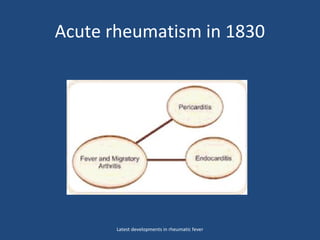
Acute rheumatism in 1830
Latest developments in rheumatic fever
19th
century
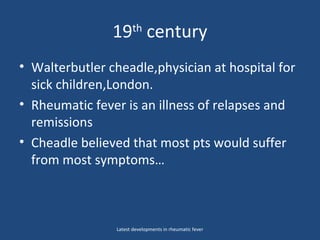
• Walterbutler cheadle,physician at hospital for
sick children,London.
• Rheumatic fever is an illness of relapses and
remissions
• Cheadle believed that most pts would suffer
from most symptoms…
Latest developments in rheumatic fever
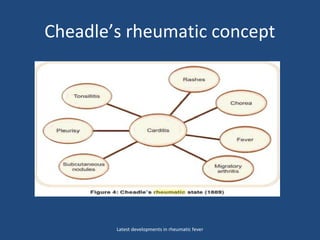
Cheadle’s rheumatic concept
Latest developments in rheumatic fever
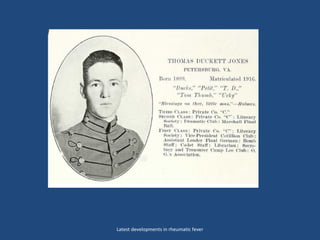
T duckett jones
• Based upon chaedles theory
• In contrast to cheadle,jones seperated the
diverse complaints of rheumatic fever in to
“major” and “minor”
Latest developments in rheumatic fever
JONES CRITERIA AND ITS
EVOLUTION
Latest developments in rheumatic fever
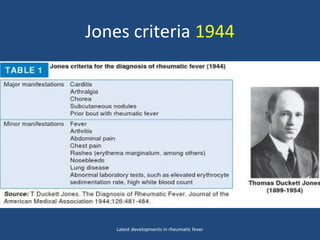
Jones criteria 1944
Latest developments in rheumatic fever
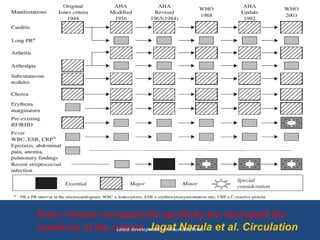
Jones criteria
• Henry duckett jones
• Original-1944
• Subsequently -1956,1965
• Major revision-1992
• Reconfirmed –AHA workshop-2000
• AHA –crucial-modifying,revising,publicising
jones criteria
• Now-AHA scientific statement -2015
Latest developments in rheumatic fever
Every revision increased the specificity but decreased the
sensitivity of the criteria, Jagat Narula et al. CirculationLatest developments in rheumatic fever
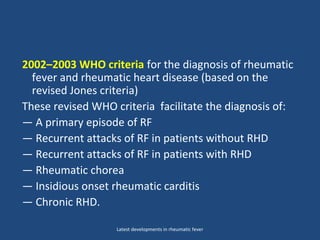
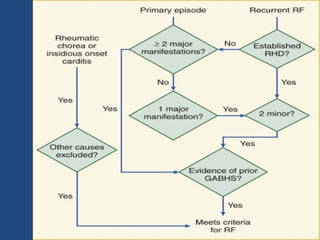
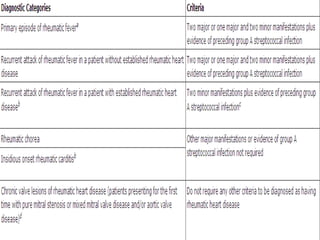
2002–2003 WHO criteria for the diagnosis of rheumatic
fever and rheumatic heart disease (based on the
revised Jones criteria)
These revised WHO criteria facilitate the diagnosis of:
— A primary episode of RF
— Recurrent attacks of RF in patients without RHD
— Recurrent attacks of RF in patients with RHD
— Rheumatic chorea
— Insidious onset rheumatic carditis
— Chronic RHD.
Latest developments in rheumatic fever
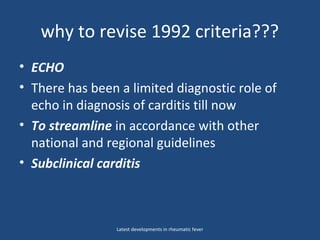
why to revise 1992 criteria???
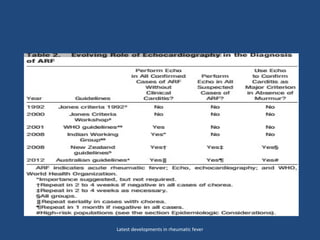
• ECHO
• There has been a limited diagnostic role of
echo in diagnosis of carditis till now
• To streamline in accordance with other
national and regional guidelines
• Subclinical carditis
Latest developments in rheumatic fever
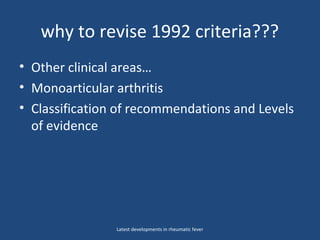
why to revise 1992 criteria???
• Other clinical areas…
• Monoarticular arthritis
• Classification of recommendations and Levels
of evidence
Latest developments in rheumatic fever
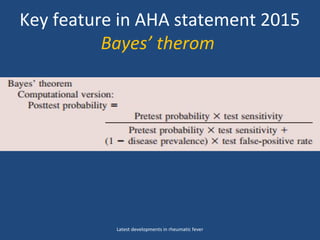
Key feature in AHA statement 2015
Bayes’ therom
Latest developments in rheumatic fever
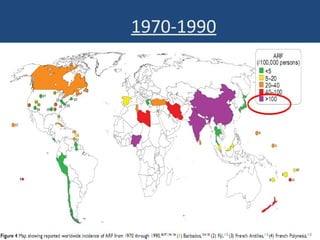
1970-1990
Latest developments in rheumatic fever
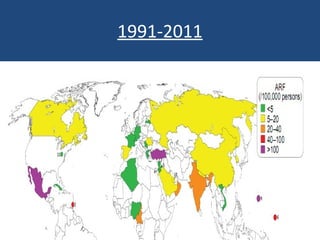
1991-2011
Latest developments in rheumatic fever
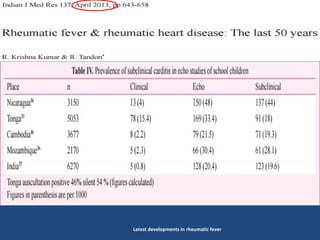
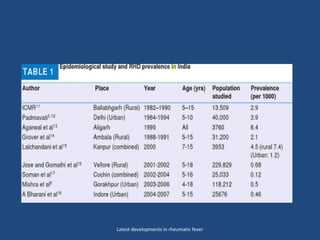
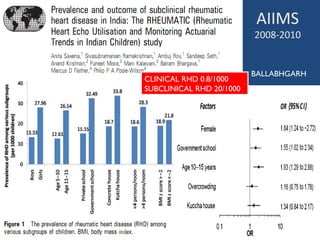
AIIMS
2008-2010
BALLABHGARH
CLINICAL RHD 0.8/1000
SUBCLINICAL RHD 20/1000
Heart
2011;97:201
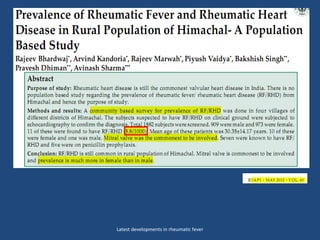
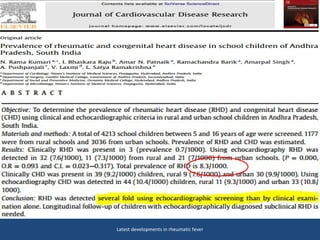
Latest developments in rheumatic fever
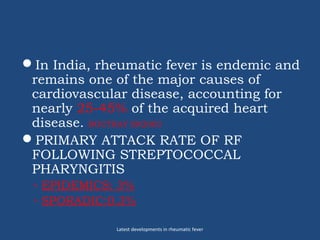
In India, rheumatic fever is endemic and
remains one of the major causes of
cardiovascular disease, accounting for
nearly 25-45% of the acquired heart
disease. ROUTRAY SN2003
PRIMARY ATTACK RATE OF RF
FOLLOWING STREPTOCOCCAL
PHARYNGITIS
◦ EPIDEMICS: 3%
◦ SPORADIC:0.3%
Latest developments in rheumatic fever
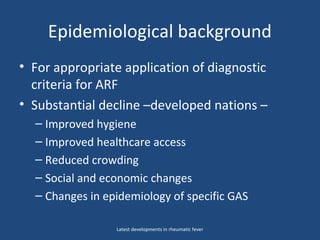
Epidemiological background
• For appropriate application of diagnostic
criteria for ARF
• Substantial decline –developed nations –
– Improved hygiene
– Improved healthcare access
– Reduced crowding
– Social and economic changes
– Changes in epidemiology of specific GAS
Latest developments in rheumatic fever
(Modified from Parry E, Godfrey R, Mabey D, Gill G [eds]:
Principles of Medicine in Africa. 3rd ed. Cambridge, Cambridge
University Press, 2004, p 861.)
• 4 patterns RF in 150 years.
–
A- Preantibiotic fall in the incidence of
ARF of industrialized countries
– B-Persistent high incidence RF
[Africa and south Asia].
– C-Postantibiotic fall in the incidence
of rheumatic fever in countries that
instituted comprehensive programs for
primary and secondary prevention of
rheumatic fever, such as Cuba, Costa
Rica, Martinique, and Guadeloupe.
– D-Fall and rise in the incidence of
rheumatic fever in the formerly Soviet
Republics of Central Asia.
Latest developments in rheumatic fever
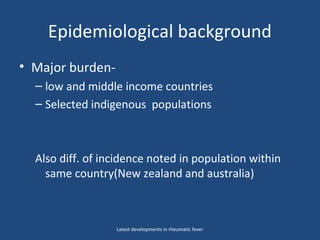
Epidemiological background
• Major burden-
– low and middle income countries
– Selected indigenous populations
Also diff. of incidence noted in population within
same country(New zealand and australia)
Latest developments in rheumatic fever
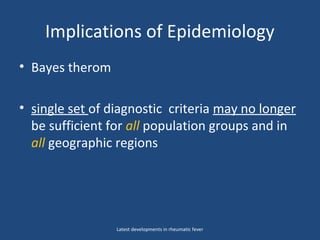
Implications of Epidemiology
• Bayes therom
• single set of diagnostic criteria may no longer
be sufficient for all population groups and in
all geographic regions
Latest developments in rheumatic fever
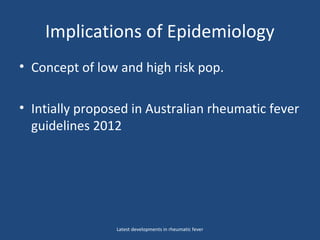
Implications of Epidemiology
• Concept of low and high risk pop.
• Intially proposed in Australian rheumatic fever
guidelines 2012
Latest developments in rheumatic fever
Agent
• Group A beta-haemolytic streptococcus
• A poisonous “GAS”
Latest developments in rheumatic fever
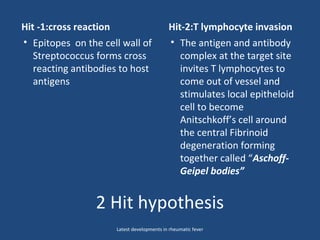
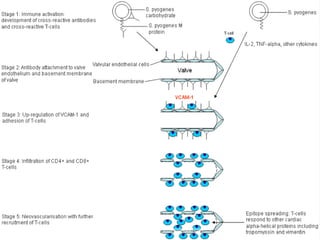
2 Hit hypothesis
Hit -1:cross reaction Hit-2:T lymphocyte invasion
• Epitopes on the cell wall of
Streptococcus forms cross
reacting antibodies to host
antigens
• The antigen and antibody
complex at the target site
invites T lymphocytes to
come out of vessel and
stimulates local epitheloid
cell to become
Anitschkoff’s cell around
the central Fibrinoid
degeneration forming
together called “Aschoff-
Geipel bodies”
Latest developments in rheumatic fever
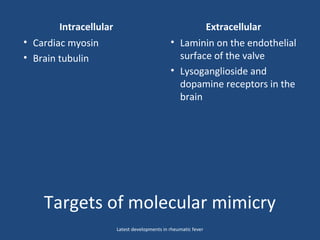
Targets of molecular mimicry
Intracellular Extracellular
• Cardiac myosin
• Brain tubulin
• Laminin on the endothelial
surface of the valve
• Lysoganglioside and
dopamine receptors in the
brain
Latest developments in rheumatic fever
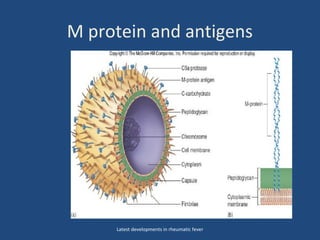
M protein and antigens
Latest developments in rheumatic fever
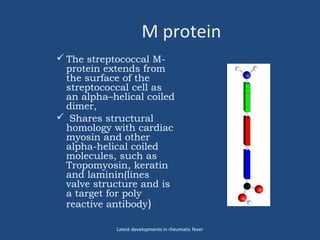
M protein
 The streptococcal M-
protein extends from
the surface of the
streptococcal cell as
an alpha–helical coiled
dimer,
 Shares structural
homology with cardiac
myosin and other
alpha-helical coiled
molecules, such as
Tropomyosin, keratin
and laminin(lines
valve structure and is
a target for poly
reactive antibody)
Latest developments in rheumatic fever
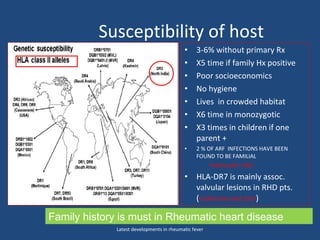
Susceptibility of host
• 3-6% without primary Rx
• X5 time if family Hx positive
• Poor socioeconomics
• No hygiene
• Lives in crowded habitat
• X6 time in monozygotic
• X3 times in children if one
parent +
• 2 % OF ARF INFECTIONS HAVE BEEN
FOUND TO BE FAMILIAL
Padmavathi 1962
• HLA-DR7 is mainly assoc.
valvular lesions in RHD pts.
(Guilherme etal.2007)
Family history is must in Rheumatic heart disease
Latest developments in rheumatic fever
• Aschoff nodule of acute
rheumatic fever. The nodule is
composed of Anitschkow cells;
these have clear nuclei with a
central bar of chromatin, said to
resemble a caterpillar. There is a
central area of fibrin. This central
necrosis is further surrounded by
a mononuclear cell infiltrate.
Myocardial fibres adjacent to the
Aschoff body are undergoing
Fibrinoid necrosis. (Sebire NJ,
Ashworth M, Malone M, Jacques
TS [eds]: Diagnostic Pediatric
Surgical Pathology. Churchill
Livingstone, United Kingdom,
2010.)
Latest developments in rheumatic fever
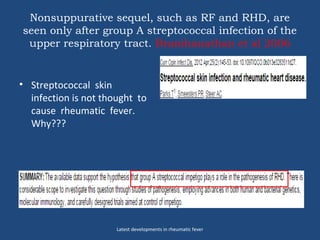
Nonsuppurative sequel, such as RF and RHD, are
seen only after group A streptococcal infection of the
upper respiratory tract. Bramhanathan et al 2006
• Streptococcal skin
infection is not thought to
cause rheumatic fever.
Why???
Latest developments in rheumatic fever
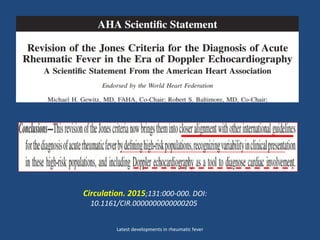
Circulation. 2015;131:000-000. DOI:
10.1161/CIR.0000000000000205
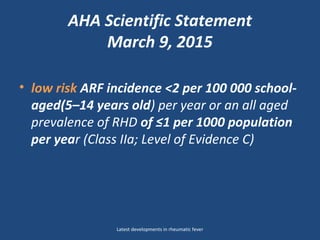
AHA Scientific Statement
March 9, 2015
• low risk ARF incidence <2 per 100 000 school-
aged(5–14 years old) per year or an all aged
prevalence of RHD of ≤1 per 1000 population
per year (Class IIa; Level of Evidence C)
Latest developments in rheumatic fever
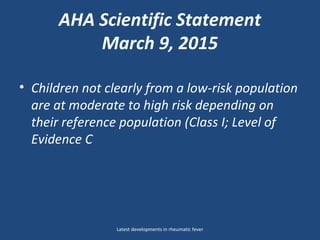
AHA Scientific Statement
March 9, 2015
• Children not clearly from a low-risk population
are at moderate to high risk depending on
their reference population (Class I; Level of
Evidence C
Latest developments in rheumatic fever
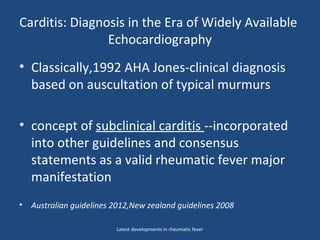
Carditis: Diagnosis in the Era of Widely Available
Echocardiography
• Classically,1992 AHA Jones-clinical diagnosis
based on auscultation of typical murmurs
• concept of subclinical carditis --incorporated
into other guidelines and consensus
statements as a valid rheumatic fever major
manifestation
• Australian guidelines 2012,New zealand guidelines 2008
Latest developments in rheumatic fever
Subclinical carditis
• refers exclusively to the circumstance in which
classic auscultatory findings of valvar
dysfunction either are not present or are not
recognized by the diagnosing clinician but
echocardiography/Doppler studies reveal
mitral or aortic valvulitis
Latest developments in rheumatic fever
Subclinical carditis
• Nearly 70% cases with polyarthralgia have
Echo evidence of carditis.
• Therefore, if arthralgia is taken as a minor
criterion and Echo is not done, then it leads to
gross underdiagnosis of ARF
Latest developments in rheumatic fever
Subcinical carditis-significance
• In reality if pts with polyarthralgia and
subclinical carditis are not evaluated-
– diagnosis is missed and
– ends up with RHD without receiving penicillin
prophylaxis
Latest developments in rheumatic fever
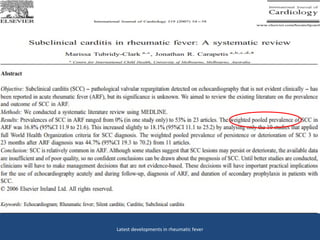
Clinical studies on subclinical
cardits(SC)
• ARF outbreak in Utah-
– Clinically carditis -64%
– SC - 27%
• In general >25 studies: E &D evidence of
MR/AR in ARF pts.despite absence of clinical f.
• Only 1 study found echo: no incremental value
Latest developments in rheumatic fever
Clinical Studies Assessing the Role
of Echocardiography
Latest developments in rheumatic fever
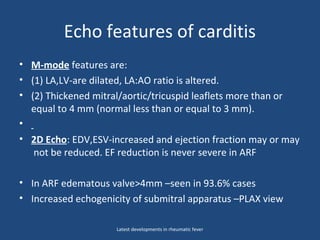
Echo features of carditis
• M-mode features are:
• (1) LA,LV-are dilated, LA:AO ratio is altered.
• (2) Thickened mitral/aortic/tricuspid leaflets more than or
equal to 4 mm (normal less than or equal to 3 mm).
•
• 2D Echo: EDV,ESV-increased and ejection fraction may or may
not be reduced. EF reduction is never severe in ARF
• In ARF edematous valve>4mm –seen in 93.6% cases
• Increased echogenicity of submitral apparatus –PLAX view
Latest developments in rheumatic fever
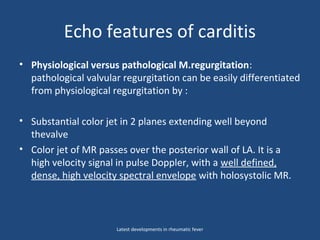
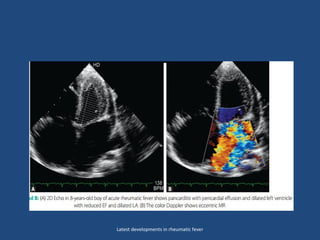
Echo features of carditis
• Physiological versus pathological M.regurgitation:
pathological valvular regurgitation can be easily differentiated
from physiological regurgitation by :
• Substantial color jet in 2 planes extending well beyond
thevalve
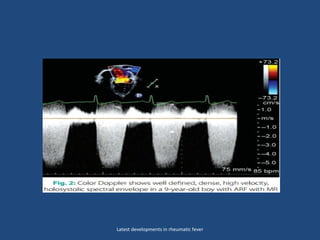
• Color jet of MR passes over the posterior wall of LA. It is a
high velocity signal in pulse Doppler, with a well defined,
dense, high velocity spectral envelope with holosystolic MR.
Latest developments in rheumatic fever
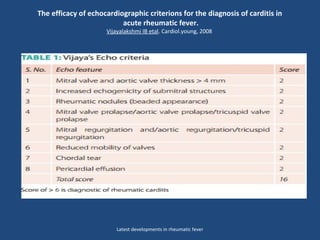
The efficacy of echocardiographic criterions for the diagnosis of carditis in
acute rheumatic fever.
Vijayalakshmi IB etal. Cardiol.young, 2008
Latest developments in rheumatic fever
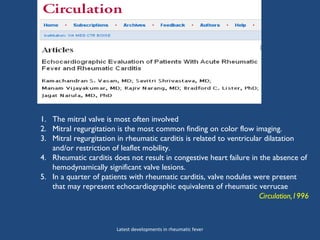
1. The mitral valve is most often involved
2. Mitral regurgitation is the most common finding on color flow imaging.
3. Mitral regurgitation in rheumatic carditis is related to ventricular dilatation
and/or restriction of leaflet mobility.
4. Rheumatic carditis does not result in congestive heart failure in the absence of
hemodynamically significant valve lesions.
5. In a quarter of patients with rheumatic carditis, valve nodules were present
that may represent echocardiographic equivalents of rheumatic verrucae
Circulation,1996
Latest developments in rheumatic fever
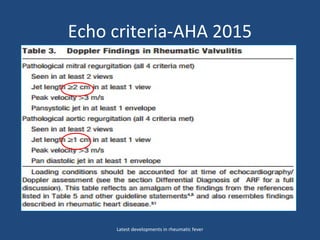
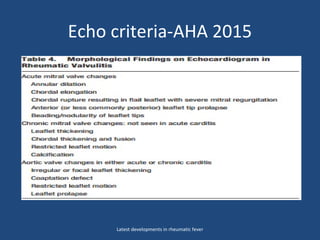
Echo criteria-AHA 2015
Latest developments in rheumatic fever
Echo criteria-AHA 2015
Latest developments in rheumatic fever
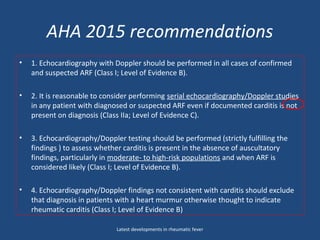
AHA 2015 recommendations
• 1. Echocardiography with Doppler should be performed in all cases of confirmed
and suspected ARF (Class I; Level of Evidence B).
• 2. It is reasonable to consider performing serial echocardiography/Doppler studies
in any patient with diagnosed or suspected ARF even if documented carditis is not
present on diagnosis (Class IIa; Level of Evidence C).
• 3. Echocardiography/Doppler testing should be performed (strictly fulfilling the
findings ) to assess whether carditis is present in the absence of auscultatory
findings, particularly in moderate- to high-risk populations and when ARF is
considered likely (Class I; Level of Evidence B).
• 4. Echocardiography/Doppler findings not consistent with carditis should exclude
that diagnosis in patients with a heart murmur otherwise thought to indicate
rheumatic carditis (Class I; Level of Evidence B)
Latest developments in rheumatic fever
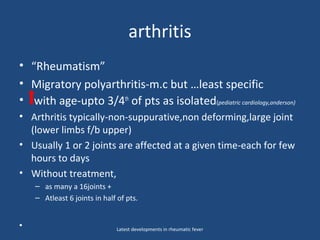
arthritis
• “Rheumatism”
• Migratory polyarthritis-m.c but …least specific
• with age-upto 3/4th
of pts as isolated(pediatric cardiology,anderson)
• Arthritis typically-non-suppurative,non deforming,large joint
(lower limbs f/b upper)
• Usually 1 or 2 joints are affected at a given time-each for few
hours to days
• Without treatment,
– as many a 16joints +
– Atleast 6 joints in half of pts.
• Latest developments in rheumatic fever
PSRA
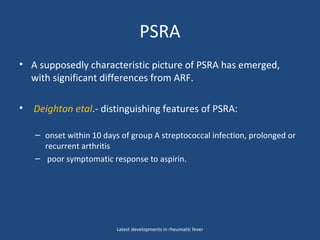
• A supposedly characteristic picture of PSRA has emerged,
with significant differences from ARF.
• Deighton etal.- distinguishing features of PSRA:
– onset within 10 days of group A streptococcal infection, prolonged or
recurrent arthritis
– poor symptomatic response to aspirin.
Latest developments in rheumatic fever
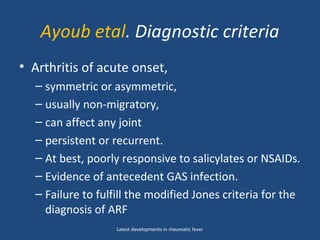
Ayoub etal. Diagnostic criteria
• Arthritis of acute onset,
– symmetric or asymmetric,
– usually non-migratory,
– can affect any joint
– persistent or recurrent.
– At best, poorly responsive to salicylates or NSAIDs.
– Evidence of antecedent GAS infection.
– Failure to fulfill the modified Jones criteria for the
diagnosis of ARF
Latest developments in rheumatic fever
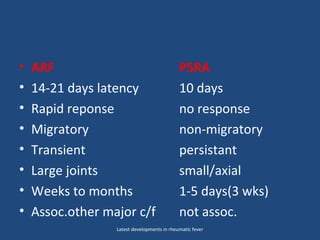
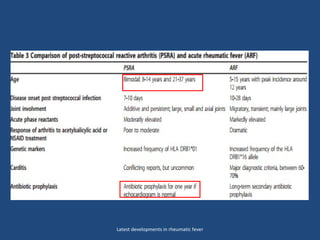
• ARF PSRA
• 14-21 days latency 10 days
• Rapid reponse no response
• Migratory non-migratory
• Transient persistant
• Large joints small/axial
• Weeks to months 1-5 days(3 wks)
• Assoc.other major c/f not assoc.
Latest developments in rheumatic fever
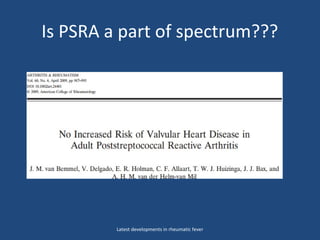
Is PSRA a part of spectrum???
Latest developments in rheumatic fever
PSRA
• Contraversy about secondary prophylaxis
• 5-7% of PSRA pts.- develop RHD
• To be followed up carefully for several months
for carditis.
• Some experts recommend secondary
prophylaxis but effectiveness not well
established
• Netherlands study-PSRA not assoc with long
term cardiac sequelae.
Latest developments in rheumatic fever
Aseptic monoarthritis
• Studies from india,australia and fiji –may be
imp. c/f in selected high risk pop.
• High risk indigenous australians-16-18% of
confirmed cases of ARF
• At present, consideration that monoarthritis may be
part of the ARF spectrum should be limited to
patients from moderate- to high-risk
populations(Class I; Level of Evidence C)
Latest developments in rheumatic fever
polyarthralgia
• Major criteria till 1956
• Need for careful history in all suspected cases
• The inclusion of polyarthralgia as a major
manifestation is applicable only for moderate- or
high-incidence populations and only after careful
consideration and exclusion of other causes of
arthralgia such as autoimmune,viral, or reactive
arthropathies (Class IIb; Level of Evidence C).
Latest developments in rheumatic fever
Other c/f:minor
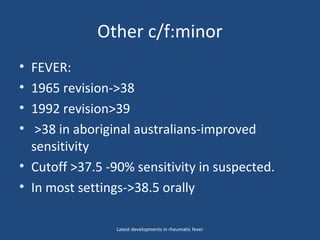
• FEVER:
• 1965 revision->38
• 1992 revision>39
• >38 in aboriginal australians-improved
sensitivity
• Cutoff >37.5 -90% sensitivity in suspected.
• In most settings->38.5 orally
Latest developments in rheumatic fever
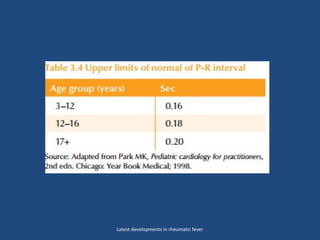
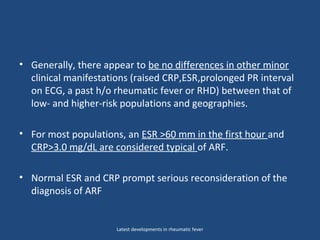
• Generally, there appear to be no differences in other minor
clinical manifestations (raised CRP,ESR,prolonged PR interval
on ECG, a past h/o rheumatic fever or RHD) between that of
low- and higher-risk populations and geographies.
• For most populations, an ESR >60 mm in the first hour and
CRP>3.0 mg/dL are considered typical of ARF.
• Normal ESR and CRP prompt serious reconsideration of the
diagnosis of ARF
Latest developments in rheumatic fever
Evidence of preceeding strepto inf.
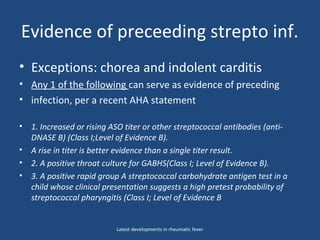
• Exceptions: chorea and indolent carditis
• Any 1 of the following can serve as evidence of preceding
• infection, per a recent AHA statement
• 1. Increased or rising ASO titer or other streptococcal antibodies (anti-
DNASE B) (Class I;Level of Evidence B).
• A rise in titer is better evidence than a single titer result.
• 2. A positive throat culture for GABHS(Class I; Level of Evidence B).
• 3. A positive rapid group A streptococcal carbohydrate antigen test in a
child whose clinical presentation suggests a high pretest probability of
streptococcal pharyngitis (Class I; Level of Evidence B
Latest developments in rheumatic fever
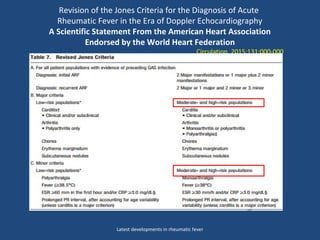
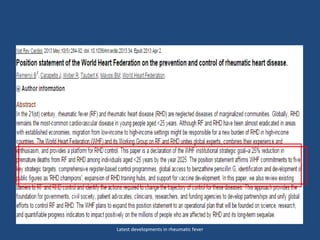
Revision of the Jones Criteria for the Diagnosis of Acute
Rheumatic Fever in the Era of Doppler Echocardiography
A Scientific Statement From the American Heart Association
Endorsed by the World Heart Federation
Circulation. 2015;131:000-000
Latest developments in rheumatic fever
recurrences
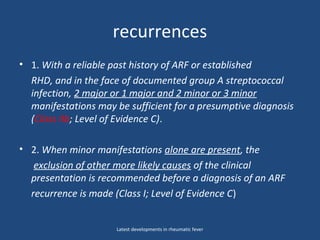
• 1. With a reliable past history of ARF or established
RHD, and in the face of documented group A streptococcal
infection, 2 major or 1 major and 2 minor or 3 minor
manifestations may be sufficient for a presumptive diagnosis
(Class IIb; Level of Evidence C).
• 2. When minor manifestations alone are present, the
exclusion of other more likely causes of the clinical
presentation is recommended before a diagnosis of an ARF
recurrence is made (Class I; Level of Evidence C)
Latest developments in rheumatic fever
“Possible” rheumatic fever
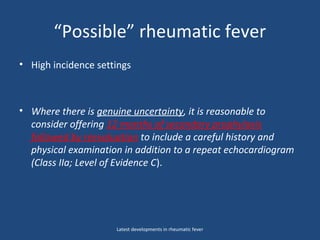
• High incidence settings
• Where there is genuine uncertainty, it is reasonable to
consider offering 12 months of secondary prophylaxis
followed by reevaluation to include a careful history and
physical examination in addition to a repeat echocardiogram
(Class IIa; Level of Evidence C).
Latest developments in rheumatic fever
“Possible” rheumatic fever
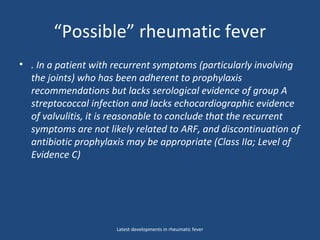
• . In a patient with recurrent symptoms (particularly involving
the joints) who has been adherent to prophylaxis
recommendations but lacks serological evidence of group A
streptococcal infection and lacks echocardiographic evidence
of valvulitis, it is reasonable to conclude that the recurrent
symptoms are not likely related to ARF, and discontinuation of
antibiotic prophylaxis may be appropriate (Class IIa; Level of
Evidence C)
Latest developments in rheumatic fever
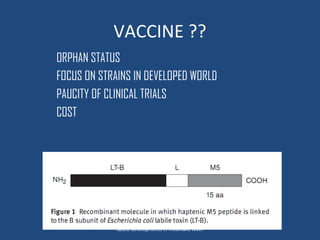
VACCINE ??
ORPHAN STATUS
FOCUS ON STRAINS IN DEVELOPED WORLD
PAUCITY OF CLINICAL TRIALS
COST
Latest developments in rheumatic fever
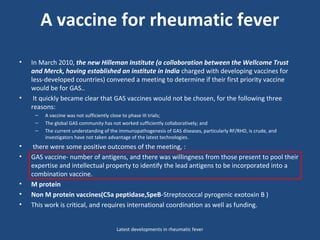
A vaccine for rheumatic fever
• In March 2010, the new Hilleman Institute (a collaboration between the Wellcome Trust
and Merck, having established an institute in India charged with developing vaccines for
less-developed countries) convened a meeting to determine if their first priority vaccine
would be for GAS..
• It quickly became clear that GAS vaccines would not be chosen, for the following three
reasons:
– A vaccine was not sufficiently close to phase III trials;
– The global GAS community has not worked sufficiently collaboratively; and
– The current understanding of the immunopathogenesis of GAS diseases, particularly RF/RHD, is crude, and
investigators have not taken advantage of the latest technologies.
• there were some positive outcomes of the meeting, :
• GAS vaccine- number of antigens, and there was willingness from those present to pool their
expertise and intellectual property to identify the lead antigens to be incorporated into a
combination vaccine.
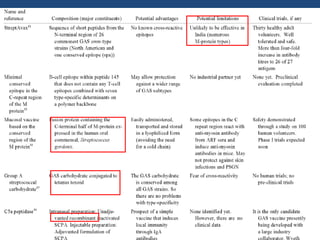
• M protein
• Non M protein vaccines(C5a peptidase,SpeB-Streptococcal pyrogenic exotoxin B )
• This work is critical, and requires international coordination as well as funding.
Latest developments in rheumatic fever
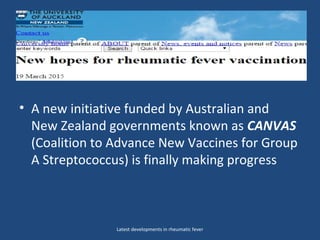
• But now a new initiative funded by the
• A new initiative funded by Australian and
New Zealand governments known as CANVAS
(Coalition to Advance New Vaccines for Group
A Streptococcus) is finally making progress
Latest developments in rheumatic fever
Implantable pencillin
• An implantable form of penicillin could be a major advance.
• Naltrexone implants provide a promising model,
( equivalent daily dose is similar).
Latest developments in rheumatic fever
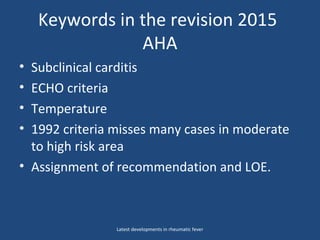
Keywords in the revision 2015
AHA
• Subclinical carditis
• ECHO criteria
• Temperature
• 1992 criteria misses many cases in moderate
to high risk area
• Assignment of recommendation and LOE.
Latest developments in rheumatic fever
Thank you
Latest developments in rheumatic fever

acute rheumatic fever

  • 1.
    Latest developments in rheumaticfever Latest developments in rheumatic fever
  • 2.
    • Declare thepast, diagnose the present, fortell the future. – Hippocrates,460-357 BC Greek physician Latest developments in rheumatic fever
  • 3.
    Acute rheumatism • Jeanbaptiste Bouillaud(1796-1881) argued convincibly in 1836 that there was a “constant coincidence either of endocarditis or of pericarditis with acute articular rheumatism” Latest developments in rheumatic fever
  • 4.
    Acute rheumatism in1830 Latest developments in rheumatic fever
  • 5.
    19th century • Walterbutler cheadle,physicianat hospital for sick children,London. • Rheumatic fever is an illness of relapses and remissions • Cheadle believed that most pts would suffer from most symptoms… Latest developments in rheumatic fever
  • 6.
    Cheadle’s rheumatic concept Latestdevelopments in rheumatic fever
  • 7.
    Latest developments inrheumatic fever
  • 8.
    T duckett jones •Based upon chaedles theory • In contrast to cheadle,jones seperated the diverse complaints of rheumatic fever in to “major” and “minor” Latest developments in rheumatic fever
  • 9.
    JONES CRITERIA ANDITS EVOLUTION Latest developments in rheumatic fever
  • 10.
    Jones criteria 1944 Latestdevelopments in rheumatic fever
  • 11.
    Jones criteria • Henryduckett jones • Original-1944 • Subsequently -1956,1965 • Major revision-1992 • Reconfirmed –AHA workshop-2000 • AHA –crucial-modifying,revising,publicising jones criteria • Now-AHA scientific statement -2015 Latest developments in rheumatic fever
  • 12.
    Every revision increasedthe specificity but decreased the sensitivity of the criteria, Jagat Narula et al. CirculationLatest developments in rheumatic fever
  • 13.
    2002–2003 WHO criteriafor the diagnosis of rheumatic fever and rheumatic heart disease (based on the revised Jones criteria) These revised WHO criteria facilitate the diagnosis of: — A primary episode of RF — Recurrent attacks of RF in patients without RHD — Recurrent attacks of RF in patients with RHD — Rheumatic chorea — Insidious onset rheumatic carditis — Chronic RHD. Latest developments in rheumatic fever
  • 14.
    Latest developments inrheumatic fever
  • 15.
    Latest developments inrheumatic fever
  • 16.
    why to revise1992 criteria??? • ECHO • There has been a limited diagnostic role of echo in diagnosis of carditis till now • To streamline in accordance with other national and regional guidelines • Subclinical carditis Latest developments in rheumatic fever
  • 17.
    why to revise1992 criteria??? • Other clinical areas… • Monoarticular arthritis • Classification of recommendations and Levels of evidence Latest developments in rheumatic fever
  • 18.
    Key feature inAHA statement 2015 Bayes’ therom Latest developments in rheumatic fever
  • 19.
    Latest developments inrheumatic fever
  • 20.
    Latest developments inrheumatic fever
  • 21.
  • 22.
  • 23.
    AIIMS 2008-2010 BALLABHGARH CLINICAL RHD 0.8/1000 SUBCLINICALRHD 20/1000 Heart 2011;97:201 Latest developments in rheumatic fever
  • 24.
    Latest developments inrheumatic fever
  • 25.
    Latest developments inrheumatic fever
  • 26.
    In India, rheumaticfever is endemic and remains one of the major causes of cardiovascular disease, accounting for nearly 25-45% of the acquired heart disease. ROUTRAY SN2003 PRIMARY ATTACK RATE OF RF FOLLOWING STREPTOCOCCAL PHARYNGITIS ◦ EPIDEMICS: 3% ◦ SPORADIC:0.3% Latest developments in rheumatic fever
  • 27.
    Epidemiological background • Forappropriate application of diagnostic criteria for ARF • Substantial decline –developed nations – – Improved hygiene – Improved healthcare access – Reduced crowding – Social and economic changes – Changes in epidemiology of specific GAS Latest developments in rheumatic fever
  • 28.
    (Modified from ParryE, Godfrey R, Mabey D, Gill G [eds]: Principles of Medicine in Africa. 3rd ed. Cambridge, Cambridge University Press, 2004, p 861.) • 4 patterns RF in 150 years. – A- Preantibiotic fall in the incidence of ARF of industrialized countries – B-Persistent high incidence RF [Africa and south Asia]. – C-Postantibiotic fall in the incidence of rheumatic fever in countries that instituted comprehensive programs for primary and secondary prevention of rheumatic fever, such as Cuba, Costa Rica, Martinique, and Guadeloupe. – D-Fall and rise in the incidence of rheumatic fever in the formerly Soviet Republics of Central Asia. Latest developments in rheumatic fever
  • 29.
    Epidemiological background • Majorburden- – low and middle income countries – Selected indigenous populations Also diff. of incidence noted in population within same country(New zealand and australia) Latest developments in rheumatic fever
  • 30.
    Implications of Epidemiology •Bayes therom • single set of diagnostic criteria may no longer be sufficient for all population groups and in all geographic regions Latest developments in rheumatic fever
  • 31.
    Implications of Epidemiology •Concept of low and high risk pop. • Intially proposed in Australian rheumatic fever guidelines 2012 Latest developments in rheumatic fever
  • 32.
    Agent • Group Abeta-haemolytic streptococcus • A poisonous “GAS” Latest developments in rheumatic fever
  • 33.
    2 Hit hypothesis Hit-1:cross reaction Hit-2:T lymphocyte invasion • Epitopes on the cell wall of Streptococcus forms cross reacting antibodies to host antigens • The antigen and antibody complex at the target site invites T lymphocytes to come out of vessel and stimulates local epitheloid cell to become Anitschkoff’s cell around the central Fibrinoid degeneration forming together called “Aschoff- Geipel bodies” Latest developments in rheumatic fever
  • 34.
    Targets of molecularmimicry Intracellular Extracellular • Cardiac myosin • Brain tubulin • Laminin on the endothelial surface of the valve • Lysoganglioside and dopamine receptors in the brain Latest developments in rheumatic fever
  • 35.
    M protein andantigens Latest developments in rheumatic fever
  • 36.
    M protein  Thestreptococcal M- protein extends from the surface of the streptococcal cell as an alpha–helical coiled dimer,  Shares structural homology with cardiac myosin and other alpha-helical coiled molecules, such as Tropomyosin, keratin and laminin(lines valve structure and is a target for poly reactive antibody) Latest developments in rheumatic fever
  • 37.
    Latest developments inrheumatic fever
  • 38.
    Susceptibility of host •3-6% without primary Rx • X5 time if family Hx positive • Poor socioeconomics • No hygiene • Lives in crowded habitat • X6 time in monozygotic • X3 times in children if one parent + • 2 % OF ARF INFECTIONS HAVE BEEN FOUND TO BE FAMILIAL Padmavathi 1962 • HLA-DR7 is mainly assoc. valvular lesions in RHD pts. (Guilherme etal.2007) Family history is must in Rheumatic heart disease Latest developments in rheumatic fever
  • 39.
    • Aschoff noduleof acute rheumatic fever. The nodule is composed of Anitschkow cells; these have clear nuclei with a central bar of chromatin, said to resemble a caterpillar. There is a central area of fibrin. This central necrosis is further surrounded by a mononuclear cell infiltrate. Myocardial fibres adjacent to the Aschoff body are undergoing Fibrinoid necrosis. (Sebire NJ, Ashworth M, Malone M, Jacques TS [eds]: Diagnostic Pediatric Surgical Pathology. Churchill Livingstone, United Kingdom, 2010.) Latest developments in rheumatic fever
  • 40.
    Nonsuppurative sequel, suchas RF and RHD, are seen only after group A streptococcal infection of the upper respiratory tract. Bramhanathan et al 2006 • Streptococcal skin infection is not thought to cause rheumatic fever. Why??? Latest developments in rheumatic fever
  • 41.
    Latest developments inrheumatic fever Circulation. 2015;131:000-000. DOI: 10.1161/CIR.0000000000000205
  • 42.
    AHA Scientific Statement March9, 2015 • low risk ARF incidence <2 per 100 000 school- aged(5–14 years old) per year or an all aged prevalence of RHD of ≤1 per 1000 population per year (Class IIa; Level of Evidence C) Latest developments in rheumatic fever
  • 43.
    AHA Scientific Statement March9, 2015 • Children not clearly from a low-risk population are at moderate to high risk depending on their reference population (Class I; Level of Evidence C Latest developments in rheumatic fever
  • 44.
    Carditis: Diagnosis inthe Era of Widely Available Echocardiography • Classically,1992 AHA Jones-clinical diagnosis based on auscultation of typical murmurs • concept of subclinical carditis --incorporated into other guidelines and consensus statements as a valid rheumatic fever major manifestation • Australian guidelines 2012,New zealand guidelines 2008 Latest developments in rheumatic fever
  • 45.
    Subclinical carditis • refersexclusively to the circumstance in which classic auscultatory findings of valvar dysfunction either are not present or are not recognized by the diagnosing clinician but echocardiography/Doppler studies reveal mitral or aortic valvulitis Latest developments in rheumatic fever
  • 46.
    Subclinical carditis • Nearly70% cases with polyarthralgia have Echo evidence of carditis. • Therefore, if arthralgia is taken as a minor criterion and Echo is not done, then it leads to gross underdiagnosis of ARF Latest developments in rheumatic fever
  • 47.
    Subcinical carditis-significance • Inreality if pts with polyarthralgia and subclinical carditis are not evaluated- – diagnosis is missed and – ends up with RHD without receiving penicillin prophylaxis Latest developments in rheumatic fever
  • 48.
    Clinical studies onsubclinical cardits(SC) • ARF outbreak in Utah- – Clinically carditis -64% – SC - 27% • In general >25 studies: E &D evidence of MR/AR in ARF pts.despite absence of clinical f. • Only 1 study found echo: no incremental value Latest developments in rheumatic fever
  • 49.
    Clinical Studies Assessingthe Role of Echocardiography Latest developments in rheumatic fever
  • 50.
    Echo features ofcarditis • M-mode features are: • (1) LA,LV-are dilated, LA:AO ratio is altered. • (2) Thickened mitral/aortic/tricuspid leaflets more than or equal to 4 mm (normal less than or equal to 3 mm). • • 2D Echo: EDV,ESV-increased and ejection fraction may or may not be reduced. EF reduction is never severe in ARF • In ARF edematous valve>4mm –seen in 93.6% cases • Increased echogenicity of submitral apparatus –PLAX view Latest developments in rheumatic fever
  • 51.
    Echo features ofcarditis • Physiological versus pathological M.regurgitation: pathological valvular regurgitation can be easily differentiated from physiological regurgitation by : • Substantial color jet in 2 planes extending well beyond thevalve • Color jet of MR passes over the posterior wall of LA. It is a high velocity signal in pulse Doppler, with a well defined, dense, high velocity spectral envelope with holosystolic MR. Latest developments in rheumatic fever
  • 52.
    Latest developments inrheumatic fever
  • 53.
    Latest developments inrheumatic fever
  • 54.
    The efficacy ofechocardiographic criterions for the diagnosis of carditis in acute rheumatic fever. Vijayalakshmi IB etal. Cardiol.young, 2008 Latest developments in rheumatic fever
  • 55.
    1. The mitralvalve is most often involved 2. Mitral regurgitation is the most common finding on color flow imaging. 3. Mitral regurgitation in rheumatic carditis is related to ventricular dilatation and/or restriction of leaflet mobility. 4. Rheumatic carditis does not result in congestive heart failure in the absence of hemodynamically significant valve lesions. 5. In a quarter of patients with rheumatic carditis, valve nodules were present that may represent echocardiographic equivalents of rheumatic verrucae Circulation,1996 Latest developments in rheumatic fever
  • 56.
    Echo criteria-AHA 2015 Latestdevelopments in rheumatic fever
  • 57.
    Echo criteria-AHA 2015 Latestdevelopments in rheumatic fever
  • 58.
    Latest developments inrheumatic fever
  • 59.
    AHA 2015 recommendations •1. Echocardiography with Doppler should be performed in all cases of confirmed and suspected ARF (Class I; Level of Evidence B). • 2. It is reasonable to consider performing serial echocardiography/Doppler studies in any patient with diagnosed or suspected ARF even if documented carditis is not present on diagnosis (Class IIa; Level of Evidence C). • 3. Echocardiography/Doppler testing should be performed (strictly fulfilling the findings ) to assess whether carditis is present in the absence of auscultatory findings, particularly in moderate- to high-risk populations and when ARF is considered likely (Class I; Level of Evidence B). • 4. Echocardiography/Doppler findings not consistent with carditis should exclude that diagnosis in patients with a heart murmur otherwise thought to indicate rheumatic carditis (Class I; Level of Evidence B) Latest developments in rheumatic fever
  • 60.
    arthritis • “Rheumatism” • Migratorypolyarthritis-m.c but …least specific • with age-upto 3/4th of pts as isolated(pediatric cardiology,anderson) • Arthritis typically-non-suppurative,non deforming,large joint (lower limbs f/b upper) • Usually 1 or 2 joints are affected at a given time-each for few hours to days • Without treatment, – as many a 16joints + – Atleast 6 joints in half of pts. • Latest developments in rheumatic fever
  • 61.
    PSRA • A supposedlycharacteristic picture of PSRA has emerged, with significant differences from ARF. • Deighton etal.- distinguishing features of PSRA: – onset within 10 days of group A streptococcal infection, prolonged or recurrent arthritis – poor symptomatic response to aspirin. Latest developments in rheumatic fever
  • 62.
    Ayoub etal. Diagnosticcriteria • Arthritis of acute onset, – symmetric or asymmetric, – usually non-migratory, – can affect any joint – persistent or recurrent. – At best, poorly responsive to salicylates or NSAIDs. – Evidence of antecedent GAS infection. – Failure to fulfill the modified Jones criteria for the diagnosis of ARF Latest developments in rheumatic fever
  • 63.
    • ARF PSRA •14-21 days latency 10 days • Rapid reponse no response • Migratory non-migratory • Transient persistant • Large joints small/axial • Weeks to months 1-5 days(3 wks) • Assoc.other major c/f not assoc. Latest developments in rheumatic fever
  • 64.
    Latest developments inrheumatic fever
  • 65.
    Is PSRA apart of spectrum??? Latest developments in rheumatic fever
  • 66.
    PSRA • Contraversy aboutsecondary prophylaxis • 5-7% of PSRA pts.- develop RHD • To be followed up carefully for several months for carditis. • Some experts recommend secondary prophylaxis but effectiveness not well established • Netherlands study-PSRA not assoc with long term cardiac sequelae. Latest developments in rheumatic fever
  • 67.
    Aseptic monoarthritis • Studiesfrom india,australia and fiji –may be imp. c/f in selected high risk pop. • High risk indigenous australians-16-18% of confirmed cases of ARF • At present, consideration that monoarthritis may be part of the ARF spectrum should be limited to patients from moderate- to high-risk populations(Class I; Level of Evidence C) Latest developments in rheumatic fever
  • 68.
    polyarthralgia • Major criteriatill 1956 • Need for careful history in all suspected cases • The inclusion of polyarthralgia as a major manifestation is applicable only for moderate- or high-incidence populations and only after careful consideration and exclusion of other causes of arthralgia such as autoimmune,viral, or reactive arthropathies (Class IIb; Level of Evidence C). Latest developments in rheumatic fever
  • 69.
    Other c/f:minor • FEVER: •1965 revision->38 • 1992 revision>39 • >38 in aboriginal australians-improved sensitivity • Cutoff >37.5 -90% sensitivity in suspected. • In most settings->38.5 orally Latest developments in rheumatic fever
  • 70.
    Latest developments inrheumatic fever
  • 71.
    • Generally, thereappear to be no differences in other minor clinical manifestations (raised CRP,ESR,prolonged PR interval on ECG, a past h/o rheumatic fever or RHD) between that of low- and higher-risk populations and geographies. • For most populations, an ESR >60 mm in the first hour and CRP>3.0 mg/dL are considered typical of ARF. • Normal ESR and CRP prompt serious reconsideration of the diagnosis of ARF Latest developments in rheumatic fever
  • 72.
    Evidence of preceedingstrepto inf. • Exceptions: chorea and indolent carditis • Any 1 of the following can serve as evidence of preceding • infection, per a recent AHA statement • 1. Increased or rising ASO titer or other streptococcal antibodies (anti- DNASE B) (Class I;Level of Evidence B). • A rise in titer is better evidence than a single titer result. • 2. A positive throat culture for GABHS(Class I; Level of Evidence B). • 3. A positive rapid group A streptococcal carbohydrate antigen test in a child whose clinical presentation suggests a high pretest probability of streptococcal pharyngitis (Class I; Level of Evidence B Latest developments in rheumatic fever
  • 73.
    Revision of theJones Criteria for the Diagnosis of Acute Rheumatic Fever in the Era of Doppler Echocardiography A Scientific Statement From the American Heart Association Endorsed by the World Heart Federation Circulation. 2015;131:000-000 Latest developments in rheumatic fever
  • 74.
    recurrences • 1. Witha reliable past history of ARF or established RHD, and in the face of documented group A streptococcal infection, 2 major or 1 major and 2 minor or 3 minor manifestations may be sufficient for a presumptive diagnosis (Class IIb; Level of Evidence C). • 2. When minor manifestations alone are present, the exclusion of other more likely causes of the clinical presentation is recommended before a diagnosis of an ARF recurrence is made (Class I; Level of Evidence C) Latest developments in rheumatic fever
  • 75.
    “Possible” rheumatic fever •High incidence settings • Where there is genuine uncertainty, it is reasonable to consider offering 12 months of secondary prophylaxis followed by reevaluation to include a careful history and physical examination in addition to a repeat echocardiogram (Class IIa; Level of Evidence C). Latest developments in rheumatic fever
  • 76.
    “Possible” rheumatic fever •. In a patient with recurrent symptoms (particularly involving the joints) who has been adherent to prophylaxis recommendations but lacks serological evidence of group A streptococcal infection and lacks echocardiographic evidence of valvulitis, it is reasonable to conclude that the recurrent symptoms are not likely related to ARF, and discontinuation of antibiotic prophylaxis may be appropriate (Class IIa; Level of Evidence C) Latest developments in rheumatic fever
  • 77.
    Latest developments inrheumatic fever
  • 78.
    VACCINE ?? ORPHAN STATUS FOCUSON STRAINS IN DEVELOPED WORLD PAUCITY OF CLINICAL TRIALS COST Latest developments in rheumatic fever
  • 79.
    A vaccine forrheumatic fever • In March 2010, the new Hilleman Institute (a collaboration between the Wellcome Trust and Merck, having established an institute in India charged with developing vaccines for less-developed countries) convened a meeting to determine if their first priority vaccine would be for GAS.. • It quickly became clear that GAS vaccines would not be chosen, for the following three reasons: – A vaccine was not sufficiently close to phase III trials; – The global GAS community has not worked sufficiently collaboratively; and – The current understanding of the immunopathogenesis of GAS diseases, particularly RF/RHD, is crude, and investigators have not taken advantage of the latest technologies. • there were some positive outcomes of the meeting, : • GAS vaccine- number of antigens, and there was willingness from those present to pool their expertise and intellectual property to identify the lead antigens to be incorporated into a combination vaccine. • M protein • Non M protein vaccines(C5a peptidase,SpeB-Streptococcal pyrogenic exotoxin B ) • This work is critical, and requires international coordination as well as funding. Latest developments in rheumatic fever
  • 80.
    Latest developments inrheumatic fever
  • 81.
    Latest developments inrheumatic fever
  • 82.
    • But nowa new initiative funded by the • A new initiative funded by Australian and New Zealand governments known as CANVAS (Coalition to Advance New Vaccines for Group A Streptococcus) is finally making progress Latest developments in rheumatic fever
  • 83.
    Implantable pencillin • Animplantable form of penicillin could be a major advance. • Naltrexone implants provide a promising model, ( equivalent daily dose is similar). Latest developments in rheumatic fever
  • 84.
    Latest developments inrheumatic fever
  • 85.
    Keywords in therevision 2015 AHA • Subclinical carditis • ECHO criteria • Temperature • 1992 criteria misses many cases in moderate to high risk area • Assignment of recommendation and LOE. Latest developments in rheumatic fever
  • 86.