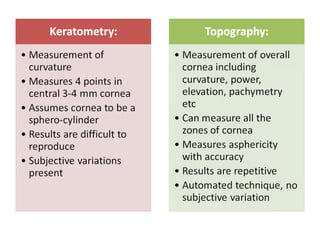
CORNEAL
TOPOGRAPHY
CORNEA
L
DR. MRINMAYEE GHATAK
DO, FMRF (Sankara Nethralaya)
Consultant Ophthalmologist
Kota Eye Hospital & Research Foundation
Kota – INDIA
dr.mrin@gmail.com
• Anterior 1/6th
of eyeball
• Measures 10.6mm Vertically and 11.7mm horizontally
• NOT SPHERICAL, typically described as prolate ellipsoid
• Central 4mm (optical zone or apical zone or corneal cap)
supposed to be spherical
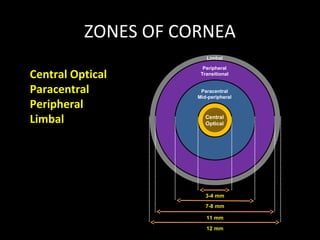
ZONES OF CORNEA
3-4 mm
7-8 mm
11 mm
12 mm
Central
Optical
Limbal
Peripheral
Transitional
Paracentral
Mid-peripheral
Central Optical
Paracentral
Peripheral
Limbal
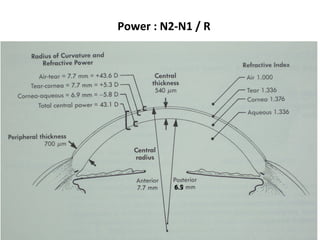
CORNEA - Curvature
• Central 4mm :
– 7.8mm anterior surface
– 6.5mm posterior surface
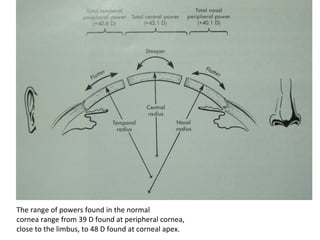
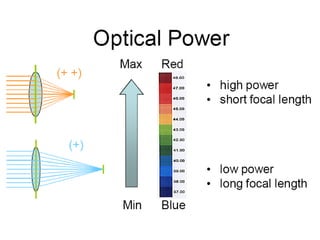
The range of powers found in the normal
cornea range from 39 D found at peripheral cornea,
close to the limbus, to 48 D found at corneal apex.
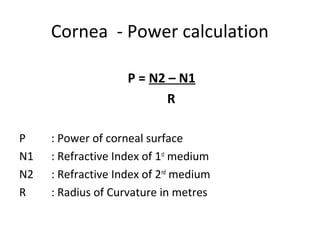
Cornea - Power calculation
P = N2 – N1
R
P : Power of corneal surface
N1 : Refractive Index of 1st
medium
N2 : Refractive Index of 2nd
medium
R : Radius of Curvature in metres
Power : N2-N1 / R
6.5
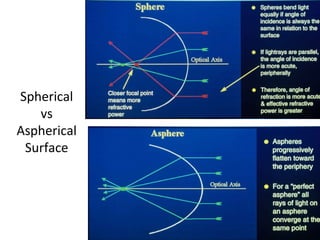
Spherical
vs
Aspherical
Surface
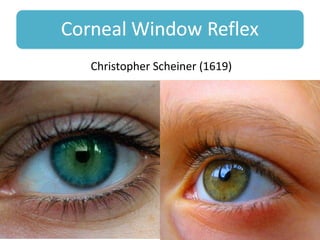
Christopher Scheiner (1619)
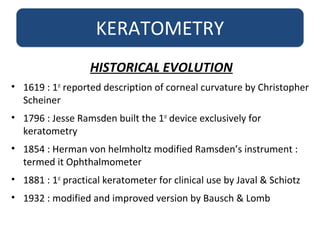
HISTORICAL EVOLUTION
• 1619 : 1st
reported description of corneal curvature by Christopher
Scheiner
• 1796 : Jesse Ramsden built the 1st
device exclusively for
keratometry
• 1854 : Herman von helmholtz modified Ramsden’s instrument :
termed it Ophthalmometer
• 1881 : 1st
practical keratometer for clinical use by Javal & Schiotz
• 1932 : modified and improved version by Bausch & Lomb
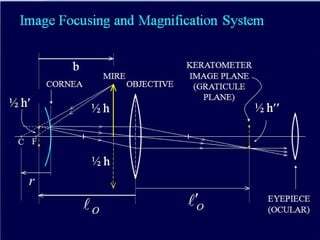
KERATOMETRY
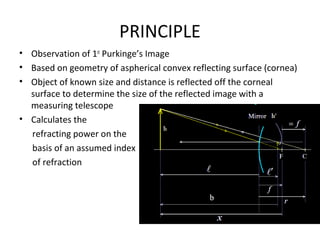
PRINCIPLE
• Observation of 1st
Purkinge’s Image
• Based on geometry of aspherical convex reflecting surface (cornea)
• Object of known size and distance is reflected off the corneal
surface to determine the size of the reflected image with a
measuring telescope
• Calculates the
refracting power on the
basis of an assumed index
of refraction
Advantages of Keratometry
• Accuracy and reproducibility for measuring
regular corneas within normal range of
curvatures (40 -46 D)
• Good for fitting CL and IOL power calculation
• Ease of use
• Low cost
• Minimal maintenance requirements
TYPES OF KERATOMETER
• B & L
– Object size constant
– Amount of doubling varied to produce the image
of fixed size
• Javal Schiotz
– Amount of image doubling is constant
– Measures the object size needed to produce an
image of fixed size
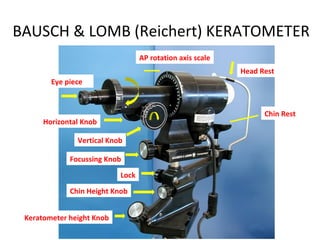
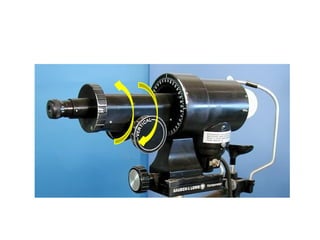
BAUSCH & LOMB (Reichert) KERATOMETER
Eye piece
Vertical Knob
Horizontal Knob
Focussing Knob
Chin Rest
Head Rest
Chin Height Knob
Keratometer height Knob
Lock
AP rotation axis scale
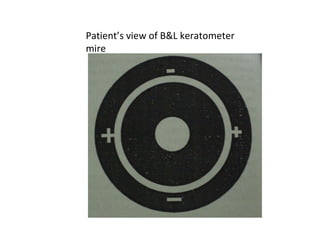
Patient’s view of B&L keratometer
mire
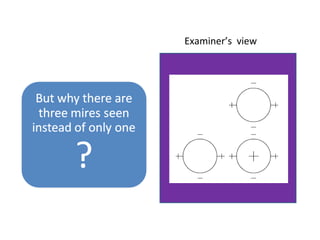
Examiner’s view
•
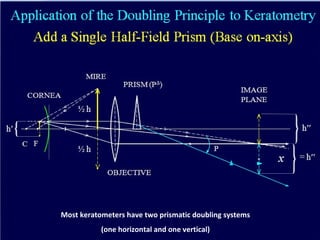
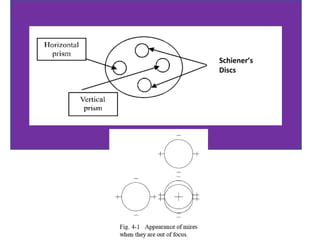
Most keratometers have two prismatic doubling systems
•
(one horizontal and one vertical)
Schiener’s
Discs
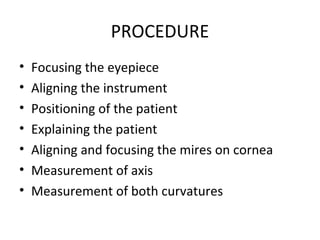
PROCEDURE
• Focusing the eyepiece
• Aligning the instrument
• Positioning of the patient
• Explaining the patient
• Aligning and focusing the mires on cornea
• Measurement of axis
• Measurement of both curvatures
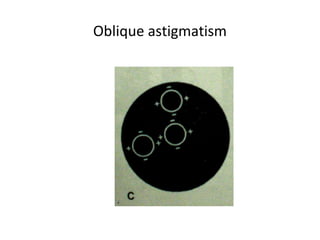
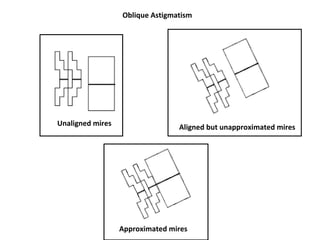
Oblique astigmatism
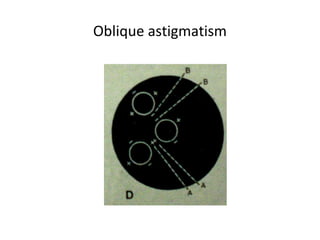
Oblique astigmatism
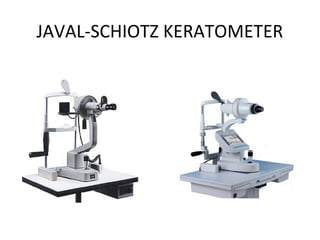
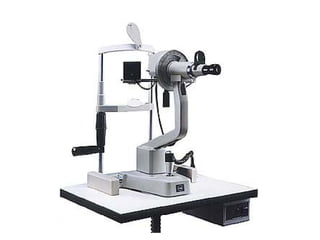
JAVAL-SCHIOTZ KERATOMETER
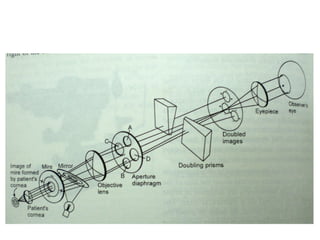
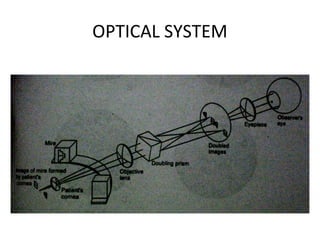
OPTICAL SYSTEM
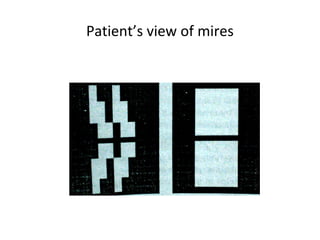
Patient’s view of mires
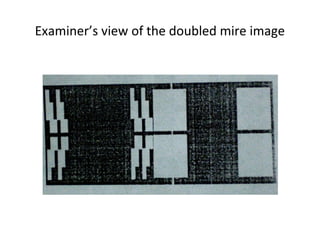
Examiner’s view of the doubled mire image
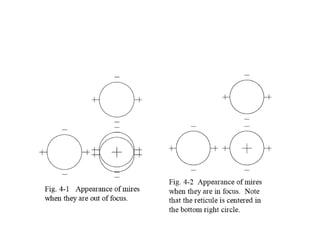
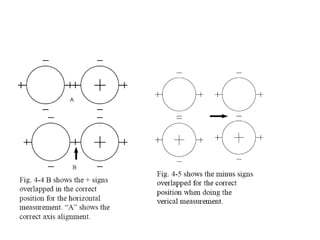
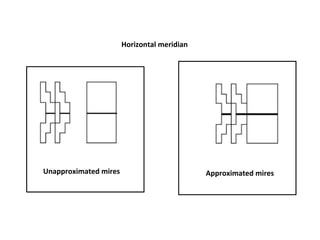
Unapproximated mires Approximated mires
Horizontal meridian
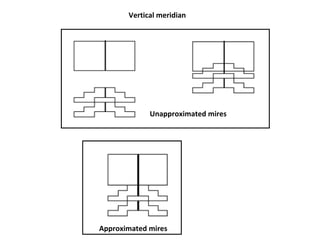
Vertical meridian
Unapproximated mires
Approximated mires
Oblique Astigmatism
Unaligned mires Aligned but unapproximated mires
Approximated mires
KERATOMETRY
KEY POINTS:
• Focus the eyepiece before beginning the
measurement.
• Let the patient blink normally to keep the cornea
smooth.
• Make sure the patient is comfortable while positioned
at the instrument.
• Loosely lock the instrument to avoid accidentally
misaligning it during the measurement.
• Keep the mires centered and focused at all times.
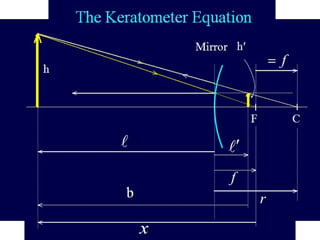
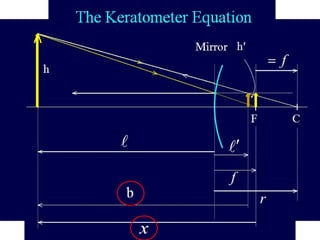
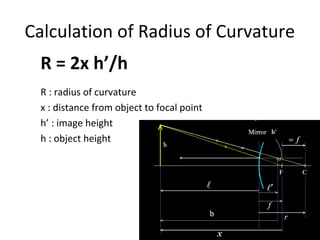
Calculation of Radius of Curvature
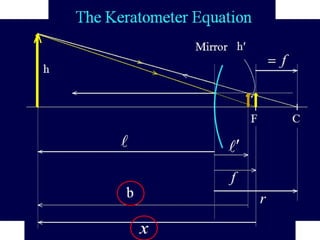
R = 2x h’/h
R : radius of curvature
x : distance from object to focal point
h’ : image height
h : object height
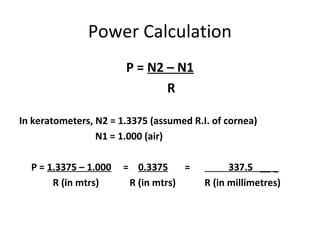
Power Calculation
P = N2 – N1
R
In keratometers, N2 = 1.3375 (assumed R.I. of cornea)
N1 = 1.000 (air)
P = 1.3375 – 1.000 = 0.3375 = 337.5 __ _
R (in mtrs) R (in mtrs) R (in millimetres)
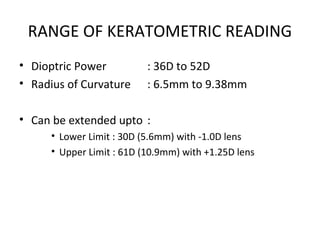
RANGE OF KERATOMETRIC READING
• Dioptric Power : 36D to 52D
• Radius of Curvature : 6.5mm to 9.38mm
• Can be extended upto :
• Lower Limit : 30D (5.6mm) with -1.0D lens
• Upper Limit : 61D (10.9mm) with +1.25D lens
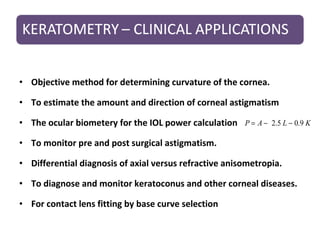
• Objective method for determining curvature of the cornea.
• To estimate the amount and direction of corneal astigmatism
• The ocular biometery for the IOL power calculation
• To monitor pre and post surgical astigmatism.
• Differential diagnosis of axial versus refractive anisometropia.
• To diagnose and monitor keratoconus and other corneal diseases.
• For contact lens fitting by base curve selection
KLAP 9.05.2 −−=
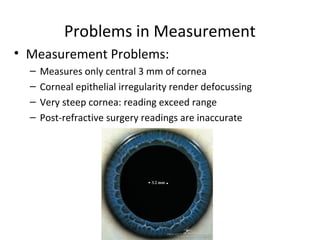
Problems in Measurement
• Measurement Problems:
– Measures only central 3 mm of cornea
– Corneal epithelial irregularity render defocussing
– Very steep cornea: reading exceed range
– Post-refractive surgery readings are inaccurate
Keratometry
Limitations & Assumptions
o Calculations are based on the geometry of a spherical
reflecting surface: the cornea is described as a prolate
(flattening) ellipsoid (true apical radius steeper)
o Quantitative data are based on only four points within the
central 3 millimeters of the cornea (gross qualitative
indication of corneal regularity between them)
o The formula approximates the distance of image as the
distance of focal point from the object
o Power in diopters depends on an assumed index of
refraction
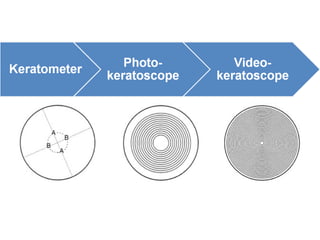
• Keratoscope: instrument that projects
multiple concentric rings (mires) on the
cornea
• Keratoscopy: direct visualization of the rings
• Photokeratoscope: when a still camera is
added to photograph the mires
• Videokeratoscope: when a video camera is
added
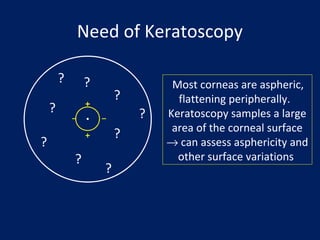
Need of Keratoscopy
?
?
?
?
?
?
?
?
? •
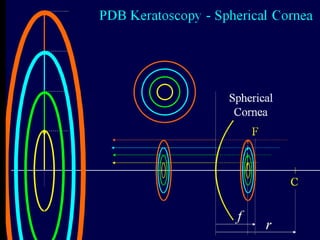
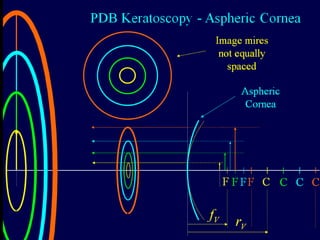
Most corneas are aspheric,
flattening peripherally.
Keratoscopy samples a large
area of the corneal surface
→ can assess asphericity and
other surface variations
KERATOSCOPY - HISTORICAL
• 1870 : 1st
clinical use : Placido : studied the corneal surface by
observing the shape of the concentric rings reflected off the
cornea
• 1880 : Javal : recognised importance the recording the image
photographically
• 1896 : Gullstrand : developed 1st
Photokeratoscope
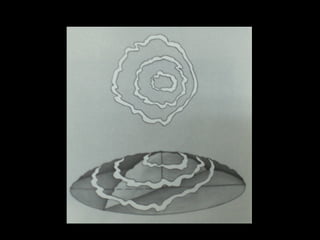
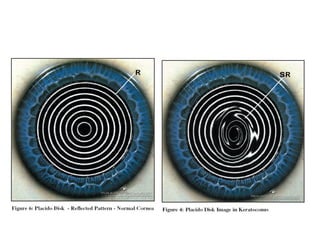
Placido Disc: the Original Corneal Topographer
Placido Disc: observer views
the pattern of concentric
white rings (mires) reflected
from the patient’s cornea
through a central +2 D lens.
Very “qualitative”
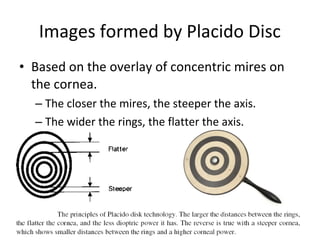
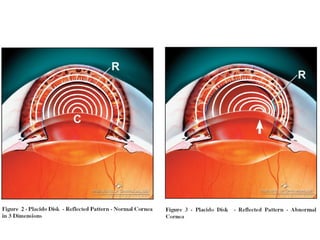
Images formed by Placido Disc
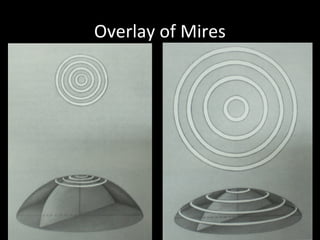
• Based on the overlay of concentric mires on
the cornea.
– The closer the mires, the steeper the axis.
– The wider the rings, the flatter the axis.
Overlay of Mires
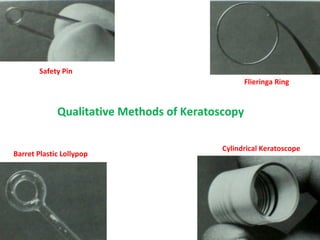
Safety Pin
Flieringa Ring
Barret Plastic Lollypop
Cylindrical Keratoscope
Qualitative Methods of Keratoscopy
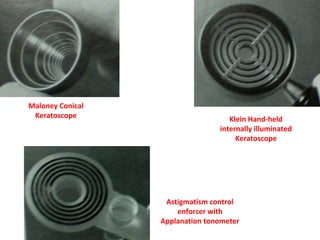
Maloney Conical
Keratoscope Klein Hand-held
internally illuminated
Keratoscope
Astigmatism control
enforcer with
Applanation tonometer
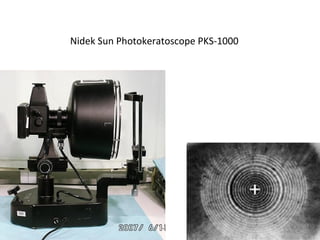
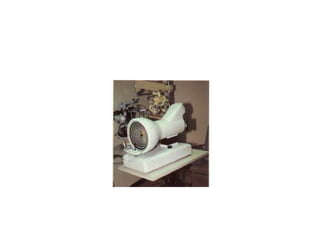
Nidek Sun Photokeratoscope PKS-1000
Limitations of Placido Disc System
•It misses data on the central cornea
• It is only able to acquire limited data points
• It measures slope not height
• It is difficult to focus and align
• In most topographers, the patient is exposed to high light
• Computerized VideoKeratoscopy
• Capturing the keratoscopic details onto a video and displaying
data analysed with mutiple algorithms
• Measures larger area with more points
• Produce permanent reproducible records
• One of the most important developments in diagnostic
instrumentation
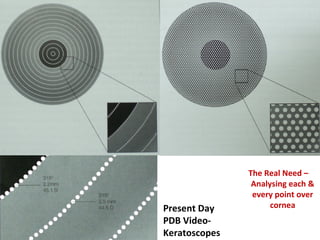
Present Day
PDB Video-
Keratoscopes
The Real Need –
Analysing each &
every point over
cornea
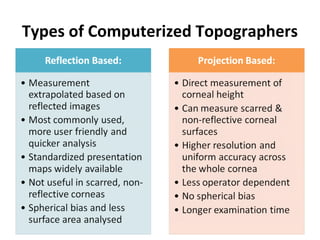
Types of Computerized Topographers
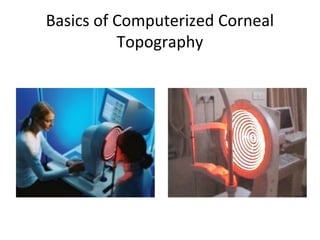
Basics of Computerized Corneal
Topography
Sequence of events
• Projecting Placido Disc Ring Pattern onto
patient’s cornea
• Achieving centration of mires
• Instantaneous capturing of reflected mires by
high resolution digital video-camera
• 256 circumferential points on each ring are
identified
• Analysis of each point is done and processed data
is displayed onto computer screen in various
formats e.g. color maps
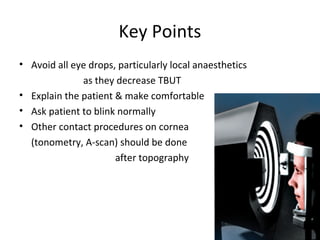
Key Points
• Avoid all eye drops, particularly local anaesthetics
as they decrease TBUT
• Explain the patient & make comfortable
• Ask patient to blink normally
• Other contact procedures on cornea
(tonometry, A-scan) should be done
after topography
Computerized Corneal Topography
Indications & Uses
• Preoperative and postoperative assessment of the refractive patient
• Preoperative and postoperative assessment of penetrating keratoplasty
• Irregular astigmatism
• Corneal distrophies, bullous keratopathy
• Keratoconus (diagnostic and follow-up)
• Follow-up of corneal ulceration or abscess
• Post-traumatic corneal scarring
• Contact lens fitting
• Evaluation of tear film quality
• Reference instrument for IOL-implants to see the corneal difference
before and after surgery
• To study unexplained low visual acuity after any surgical procedure
(trabeculectomy, extracapsular lens extraction, …).
• Preoperative and postoperative assessment of Intacs™ corneal rings
(intrastromal corneal rings)
READING OF TOPOGRAPHICAL DATA
• Check the name of the patient, date of exam and examined
eye.
• type of measurement (height in microns, curvature in mm,
power in D)
• Check the scale & step interval
• study the map (type of map, form of abnormalities)
• Evaluate statistical information
• Compare with topography of the other eye
• Compare with the previous maps
• Numeric power plots
• Keratometry view
• Photokeratoscopic view
• Profile view
• Colour-coded topographic maps
– Most useful
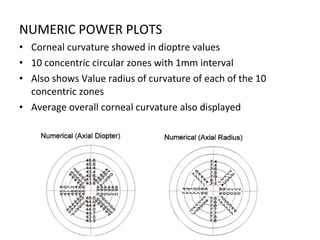
NUMERIC POWER PLOTS
• Corneal curvature showed in dioptre values
• 10 concentric circular zones with 1mm interval
• Also shows Value radius of curvature of each of the 10
concentric zones
• Average overall corneal curvature also displayed
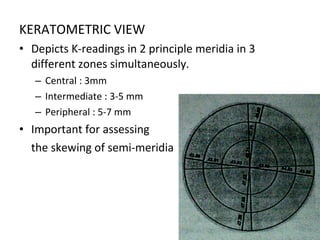
KERATOMETRIC VIEW
• Depicts K-readings in 2 principle meridia in 3
different zones simultaneously.
– Central : 3mm
– Intermediate : 3-5 mm
– Peripheral : 5-7 mm
• Important for assessing
the skewing of semi-meridia
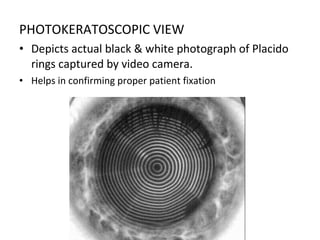
PHOTOKERATOSCOPIC VIEW
• Depicts actual black & white photograph of Placido
rings captured by video camera.
• Helps in confirming proper patient fixation
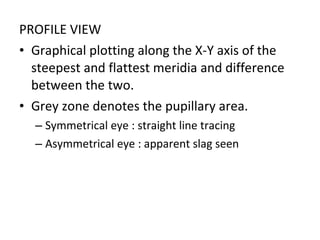
PROFILE VIEW
• Graphical plotting along the X-Y axis of the
steepest and flattest meridia and difference
between the two.
• Grey zone denotes the pupillary area.
– Symmetrical eye : straight line tracing
– Asymmetrical eye : apparent slag seen
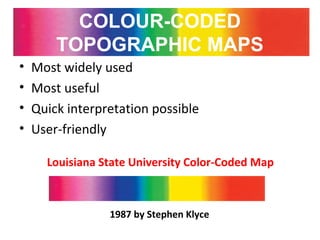
COLOUR-CODED
TOPOGRAPHIC MAPS
• Most widely used
• Most useful
• Quick interpretation possible
• User-friendly
Louisiana State University Color-Coded Map
1987 by Stephen Klyce
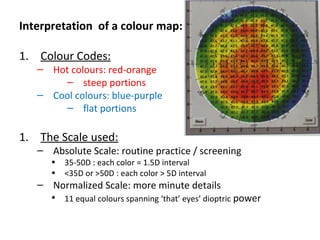
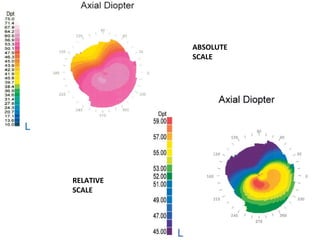
Interpretation of a colour map:
1. Colour Codes:
– Hot colours: red-orange
– steep portions
– Cool colours: blue-purple
– flat portions
1. The Scale used:
– Absolute Scale: routine practice / screening
• 35-50D : each color = 1.5D interval
• <35D or >50D : each color > 5D interval
– Normalized Scale: more minute details
• 11 equal colours spanning ‘that’ eyes’ dioptric power
ABSOLUTE
SCALE
RELATIVE
SCALE
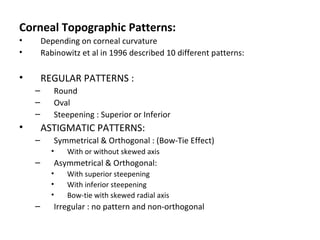
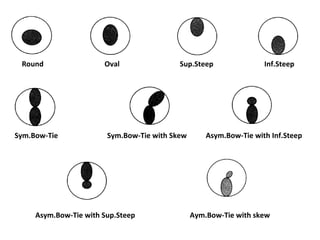
Corneal Topographic Patterns:
• Depending on corneal curvature
• Rabinowitz et al in 1996 described 10 different patterns:
• REGULAR PATTERNS :
– Round
– Oval
– Steepening : Superior or Inferior
• ASTIGMATIC PATTERNS:
– Symmetrical & Orthogonal : (Bow-Tie Effect)
• With or without skewed axis
– Asymmetrical & Orthogonal:
• With superior steepening
• With inferior steepening
• Bow-tie with skewed radial axis
– Irregular : no pattern and non-orthogonal
Aym.Bow-Tie with skew
Round Oval Sup.Steep Inf.Steep
Sym.Bow-Tie Sym.Bow-Tie with Skew Asym.Bow-Tie with Inf.Steep
Asym.Bow-Tie with Sup.Steep
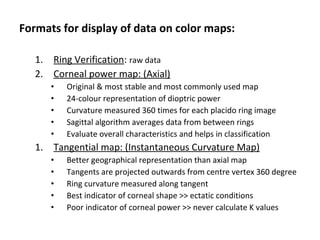
Formats for display of data on color maps:
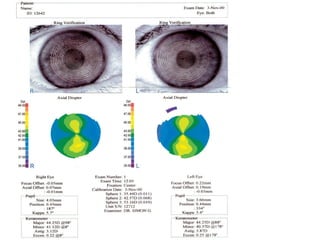
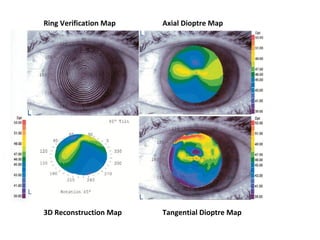
1. Ring Verification: raw data
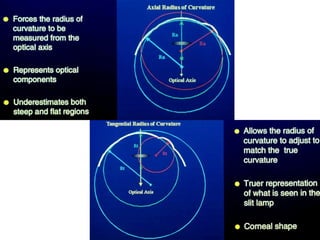
2. Corneal power map: (Axial)
• Original & most stable and most commonly used map
• 24-colour representation of dioptric power
• Curvature measured 360 times for each placido ring image
• Sagittal algorithm averages data from between rings
• Evaluate overall characteristics and helps in classification
1. Tangential map: (Instantaneous Curvature Map)
• Better geographical representation than axial map
• Tangents are projected outwards from centre vertex 360 degree
• Ring curvature measured along tangent
• Best indicator of corneal shape >> ectatic conditions
• Poor indicator of corneal power >> never calculate K values
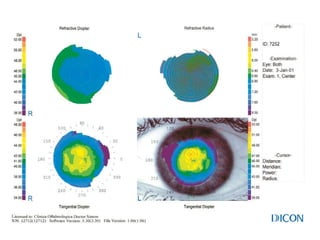
Ring Verification Map Axial Dioptre Map
3D Reconstruction Map Tangential Dioptre Map
Formats for display of data on color maps:
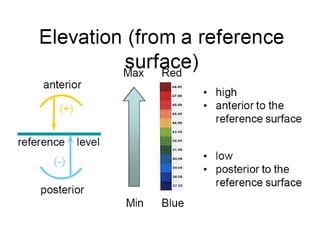
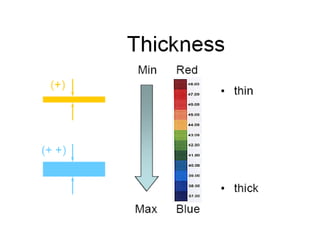
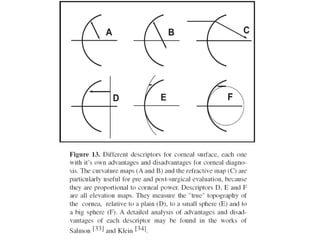
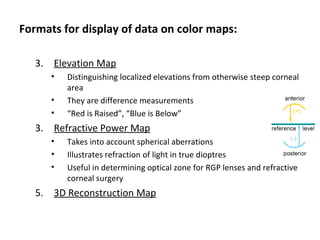
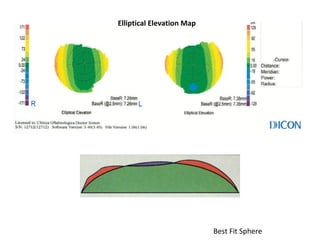
3. Elevation Map
• Distinguishing localized elevations from otherwise steep corneal
area
• They are difference measurements
• “Red is Raised”, “Blue is Below”
3. Refractive Power Map
• Takes into account spherical aberrations
• Illustrates refraction of light in true dioptres
• Useful in determining optical zone for RGP lenses and refractive
corneal surgery
5. 3D Reconstruction Map
Elliptical Elevation Map
Best Fit Sphere
Formats for display of data on color maps:
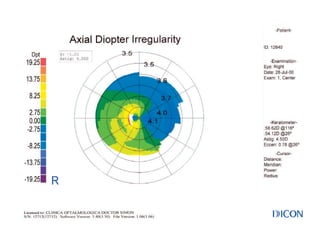
5. Irregularity Map
• Displays distortion of cornea using elevation map with toric
reference
• Hotter colours represent higher value of distortion
• Helps to quickly assess if cornea is causing poor VA
5. Trend & Time Display
• Chronological display of changes
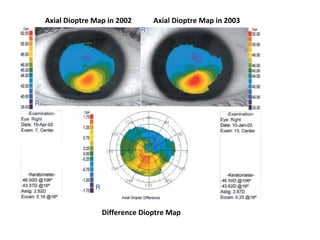
5. Difference Display Map
6. OD/OS Compare Map
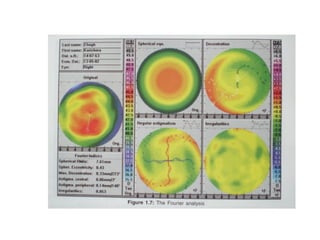
7. Fourier Analysis :
• extract spherical, cylindrical, prismatic and irregular aberrations
Axial Dioptre Map in 2002 Axial Dioptre Map in 2003
Difference Dioptre Map
Other Overlays that can be added
• Pupil Margin
• Grids
• Optical Zone
• Eye Image
• Keratometric Mires
Other Software Application & Displays
• Multiple Display Option
• Keratoconus Pathfinder Application
• Contact Lens Fitting Application
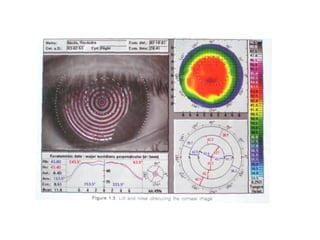
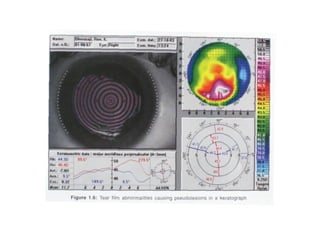
Artefacts of Topography Map
• shadows on the cornea from large eyelashes or
trichiasis
• ptosis or non-sufficient eye opening
• irregularities of the tear film layer (dry eye, mucinous
film, greasy film)
• too short working distance of the small Placido disk
cone
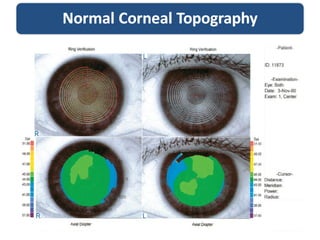
Normal Cornea
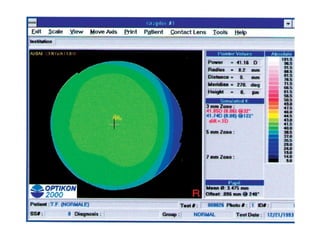
• wide spectrum of normality
• nasal cornea is flatter than temporal.
• physiological astigmatism of around 0.75 diopter.
• can take on many topographic patterns commonly:
– With the rule astigmatism : vertical bow-tie
– Against the rule astigmatism : horizontal bow-tie
• Enantiomorphism : mirror image
Normal Cornea
• Small changes in corneal shape do occur throughout life:
– In infancy the cornea is fairly spherical
– In childhood and adolescence, probably due to eyelid
pressure on a young tissue, cornea becomes slightly
astigmatic with-the-rule
– In the middle age, cornea tends to recover its sphericity
– Late in life, against-the-rule astigmatism tends to develop
• Provides evidence even before SLE can diagnose
• Most sensitive method to distinguish:
– True Early keratoconus
– Asym Bow-tie or Inf. Steepening due to contact lens
warpage
• “Keratoconus Suspect” Patients:
– Specially to diagnose & follow progression
Several Classifications
CLINICO-TOPOGRAPHIC :
1. Keratoconus:
• One or more of clinical signs
• Asymmetrical bow-tie with skewed radial axis pattern (AB/SRAX)
1. Early Keratoconus:
• No Slit-lamp findings, but scissoring reflex on retinoscopy
• AB/SRAX pattern
1. Keratoconus Suspect:
• Only an AB/SRAX pattern
Aym.Bow-Tie with skew
Keratoconus Fruste
• Called “form fruste”
• 1st described by Amsler in 1937.
• Extremely mild form of keratoconus
• Central or para-central zone of irregular astigmatism of
unknown etiology.
• The most striking hallmark - lack of progression
Several Classifications
CENTRAL CORNEAL POWER
– Mild keratoconus : < 48D
– Moderate keratoconus : 48 - 54D
– Advanced keratoconus : >54D
• PACHYMETRY
– Normal cornea : > 543 Microns
– Early keratoconus : ~ 506 Microns
– Moderate keratoconus : ~ 473 Microns
– Advanced keratoconus : ~ 446 Microns
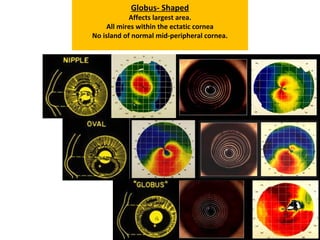
MORPHOLOGY OF ECTASIA
Nipple - Shaped
Small, central ectasia
Less than 5.0mm
High WTR astigmatism
360O
normal peripheral cornea
Oval- Shaped
Varying degree of Inferior mid-periphery steepening.
Island of normal/flatter than normal cornea exactly
located 180O
away .
Globus- Shaped
Affects largest area.
All mires within the ectatic cornea
No island of normal mid-peripheral cornea.
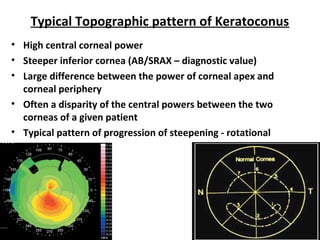
Typical Topographic pattern of Keratoconus
• High central corneal power
• Steeper inferior cornea (AB/SRAX – diagnostic value)
• Large difference between the power of corneal apex and
corneal periphery
• Often a disparity of the central powers between the two
corneas of a given patient
• Typical pattern of progression of steepening - rotational
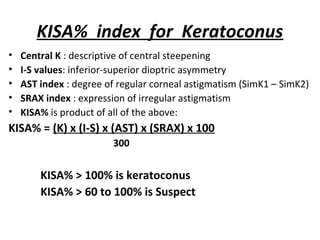
KISA% index for Keratoconus
• Central K : descriptive of central steepening
• I-S values: inferior-superior dioptric asymmetry
• AST index : degree of regular corneal astigmatism (SimK1 – SimK2)
• SRAX index : expression of irregular astigmatism
• KISA% is product of all of the above:
KISA% = (K) x (I-S) x (AST) x (SRAX) x 100
300
KISA% > 100% is keratoconus
KISA% > 60 to 100% is Suspect
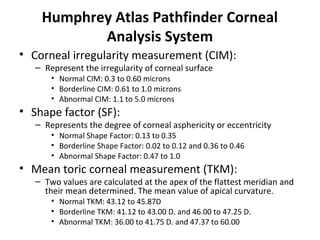
Humphrey Atlas Pathfinder Corneal
Analysis System
• Corneal irregularity measurement (CIM):
– Represent the irregularity of corneal surface
• Normal CIM: 0.3 to 0.60 microns
• Borderline CIM: 0.61 to 1.0 microns
• Abnormal CIM: 1.1 to 5.0 microns
• Shape factor (SF):
– Represents the degree of corneal asphericity or eccentricity
• Normal Shape Factor: 0.13 to 0.35
• Borderline Shape Factor: 0.02 to 0.12 and 0.36 to 0.46
• Abnormal Shape Factor: 0.47 to 1.0
• Mean toric corneal measurement (TKM):
– Two values are calculated at the apex of the flattest meridian and
their mean determined. The mean value of apical curvature.
• Normal TKM: 43.12 to 45.87D
• Borderline TKM: 41.12 to 43.00 D. and 46.00 to 47.25 D.
• Abnormal TKM: 36.00 to 41.75 D. and 47.37 to 60.00
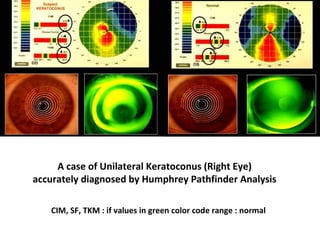
A case of Unilateral Keratoconus (Right Eye)
accurately diagnosed by Humphrey Pathfinder Analysis
CIM, SF, TKM : if values in green color code range : normal
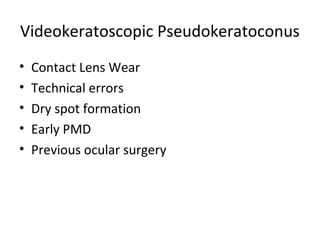
Videokeratoscopic Pseudokeratoconus
• Contact Lens Wear
• Technical errors
• Dry spot formation
• Early PMD
• Previous ocular surgery
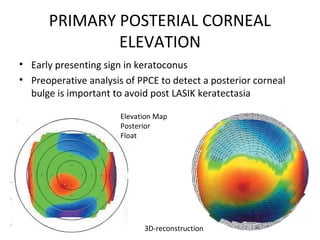
PRIMARY POSTERIAL CORNEAL
ELEVATION
• Early presenting sign in keratoconus
• Preoperative analysis of PPCE to detect a posterior corneal
bulge is important to avoid post LASIK keratectasia
Elevation Map
Posterior
Float
3D-reconstruction
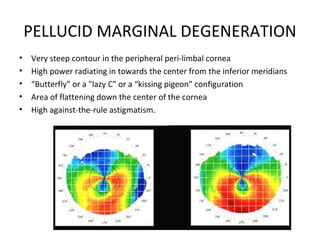
PELLUCID MARGINAL DEGENERATION
• Very steep contour in the peripheral peri-limbal cornea
• High power radiating in towards the center from the inferior meridians
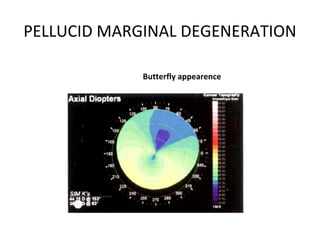
• “Butterfly” or a "lazy C" or a “kissing pigeon” configuration
• Area of flattening down the center of the cornea
• High against-the-rule astigmatism.
Butterfly appearence
PELLUCID MARGINAL DEGENERATION
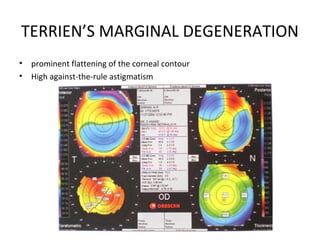
TERRIEN’S MARGINAL DEGENERATION
• prominent flattening of the corneal contour
• High against-the-rule astigmatism
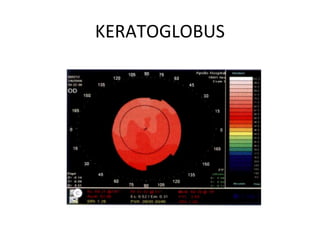
KERATOGLOBUS
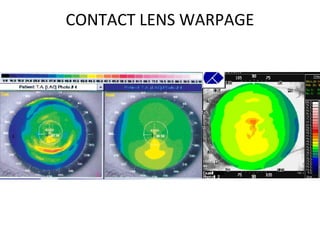
CONTACT LENS WARPAGE
• Harstein : 1st
to note CL induced corneal changes
• WARPAGE: All CL induced changes in corneal topography, reversible or
irreversible, that are not associated with corneal edema
• Signs & Symptoms:
– Mostly asymptomatic
– Changes in refraction and K readings over a period of time
– Changes in curvature and distortion of mires
– Central irregular astigmatism
– Loss of normal progressive flattening from the center to the periphery
• Very commonly confused with keratoconus
• Topographical abnormalities classified as:
• Central irregular astigmatism
• Loss of radial symmetry
• Reversal of normal topographic pattern
• Keratoconus like images
• Inaccurate topography causes hazards in patients
posted for LASIK
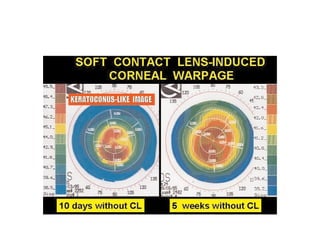
– Soft CL causes:
• Topographic steepening (with keratoconus-like image)
• Increased myopia
• Central corneal thinning
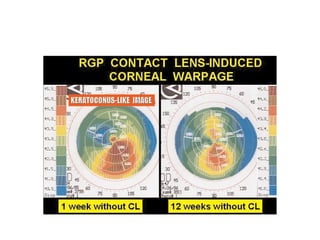
– RGP CL causes:
• Topographic flattening
• Decreased myopia
• Central corneal thinning.
CL Warpage – Special parameters
– Simulated Keratoscopic Readings;
• Average powers of the steepest (SimK1) and the
flattest meridia (SimK2)
– Surface Asymmetry Index;
• Centrally weighted sum of the differences in corneal
power between corresponding points on mires located
180º apart
– Surface Regularity index:
• Calculated on the basis of the local regularity of the
surface over the corneal area within pupillary area.
CONTACT LENS WARPAGE
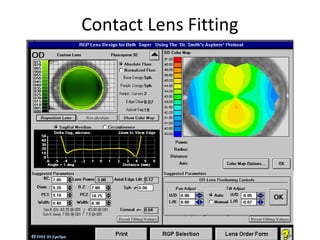
Contact Lens Fitting
Contact Lens Fitting in Keratoconus
• Superior Alignment Fitting Technique for Early Keratoconus
• The Intra-Palpebral Three Point Touch Fitting Technique for
Early Keratoconus
• Aspheric Lens Designs for Early Keratoconus
PENETRATING KERATOPLASTY
• Making decisions about trephination and graft size
• Identifying thin areas to be avoided in the graft-host junction
• Choosing a suturing technique
• Managing selective suture removal or adjustment
• Deciding on the need for a relaxing incision in astigmatism
• Correcting refractive errors by a excimer laser procedure
• Guide the post PKP fitting of a contact lens
Cataract Surgery
• Preoperative Use:
– Most useful for IOL calculation in eyes with irregular surfaces
– Evaluation of astigmatism, previous refractive surgery
– Decision taking on type of surgery
– Planning for site & type of incision
– Has shown that smaller, temporal & scleral incision for phaco cause
less induced astigmatism
• Intra-operative Use:
– to reduce surgically induced astigmatism
– Wound closure
– Application of sutures and adjustment
• Postoperative Use:
– To identify tight sutures and adjust accordingly
– Evaluating and managing Post-op refractive suprises
– Determine causes of poor post-op vision
REFRACTIVE SURGERY
• Should be performed in every case Pre-op:
– To develop a surgical / ablation profile
– To detect pre-existing corneal abnormalities
• Post-op uses to evaluate:
– Decentration
– Multifocality
– Regression
– Induced astigmatism
– Central islands
RADIAL KERATOTOMY (RK)
• Most useful in evaluating Post-RK problems:
– Irregular astigmatism
– Glare, halos (induced spherical aberrations)
– Diurnal changes in refraction & vision (dumble-
shaped or split optical zones)
– Multifocality due to regional change in curvature
with time
ASTIGMATIC KERATOTOMY (AK)
• Pre-op Evaluation of:
– Astigmatism (specially asymmetric)
– Calculating best position & configuration of relaxing
incision
• Post-op evaluation reveals:
– Longer incision : more steepening of un-incised meridian
– Incision closure to limbus: less flattening
– Deeper incision : more effect
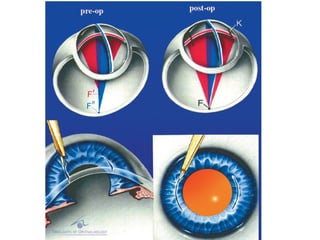
PHOTOREFRACTIVE KERATECTOMY
• Laser ablation of cornea to flatten/steepen
cornea
• VKS used for evaluation of:
– Ablation profile
– Decentration
– Regression and stabilization
– Multifocality and induced aberration
– Central islands diagnosis and follow-up
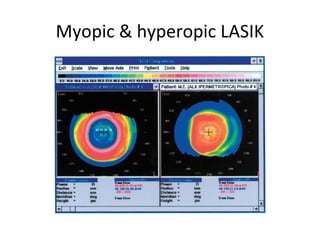
Myopic & hyperopic LASIK
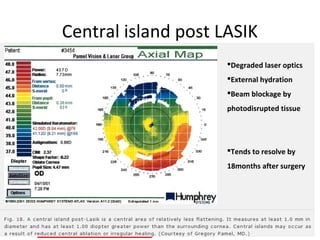
Central island post LASIK
Degraded laser optics
External hydration
Beam blockage by
photodisrupted tissue
Tends to resolve by
18months after surgery
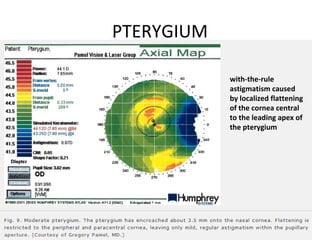
PTERYGIUM
with-the-rule
astigmatism caused
by localized flattening
of the cornea central
to the leading apex of
the pterygium
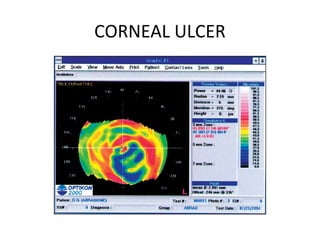
CORNEAL ULCER
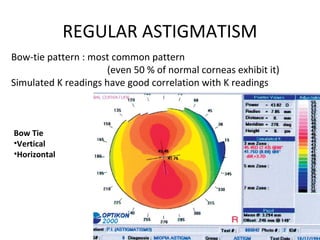
REGULAR ASTIGMATISM
Bow-tie pattern : most common pattern
(even 50 % of normal corneas exhibit it)
Simulated K readings have good correlation with K readings
Bow Tie
•Vertical
•Horizontal
IRREGULAR ASTIGMATISM
• Rarely occurs naturally
• Common causes:
• Dry eye
• Corneal scars
• Ectatic corneal degenerations
• Pterygium
• Trauma
• Surgery (cataract surgery, PKP, and refractive surgery)
• It represents the remainder after subtracting sphere &
cylinder from corneal power map
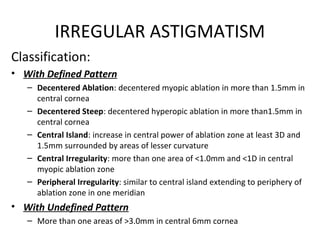
IRREGULAR ASTIGMATISM
Classification:
• With Defined Pattern
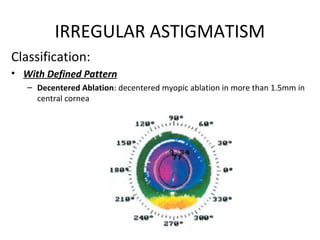
– Decentered Ablation: decentered myopic ablation in more than 1.5mm in
central cornea
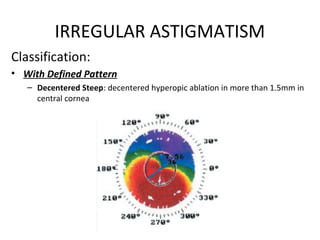
– Decentered Steep: decentered hyperopic ablation in more than1.5mm in
central cornea
– Central Island: increase in central power of ablation zone at least 3D and
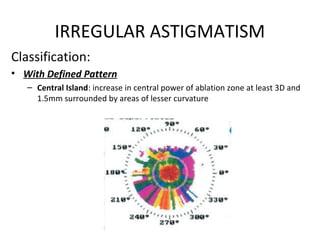
1.5mm surrounded by areas of lesser curvature
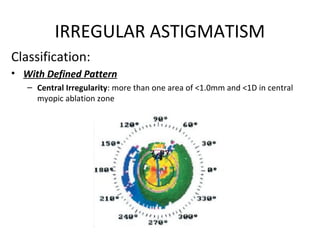
– Central Irregularity: more than one area of <1.0mm and <1D in central
myopic ablation zone
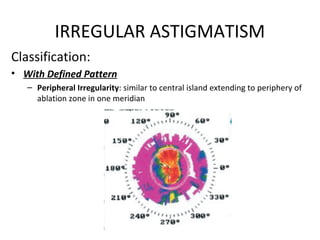
– Peripheral Irregularity: similar to central island extending to periphery of
ablation zone in one meridian
• With Undefined Pattern
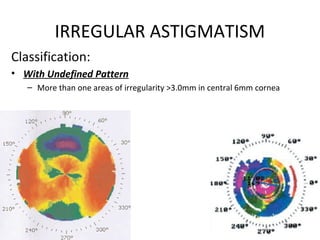
– More than one areas of >3.0mm in central 6mm cornea
IRREGULAR ASTIGMATISM
Classification:
• With Defined Pattern
– Decentered Ablation: decentered myopic ablation in more than 1.5mm in
central cornea
IRREGULAR ASTIGMATISM
Classification:
• With Defined Pattern
– Decentered Steep: decentered hyperopic ablation in more than 1.5mm in
central cornea
IRREGULAR ASTIGMATISM
Classification:
• With Defined Pattern
– Central Island: increase in central power of ablation zone at least 3D and
1.5mm surrounded by areas of lesser curvature
IRREGULAR ASTIGMATISM
Classification:
• With Defined Pattern
– Central Irregularity: more than one area of <1.0mm and <1D in central
myopic ablation zone
IRREGULAR ASTIGMATISM
Classification:
• With Defined Pattern
– Peripheral Irregularity: similar to central island extending to periphery of
ablation zone in one meridian
IRREGULAR ASTIGMATISM
Classification:
• With Undefined Pattern
– More than one areas of irregularity >3.0mm in central 6mm cornea
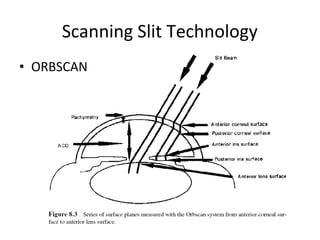
Scanning Slit Technology
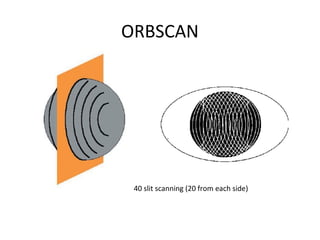
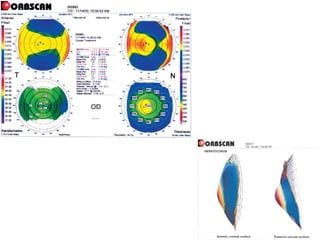
• ORBSCAN
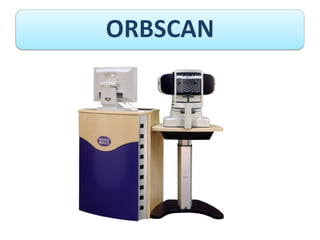
ORBSCAN
40 slit scanning (20 from each side)
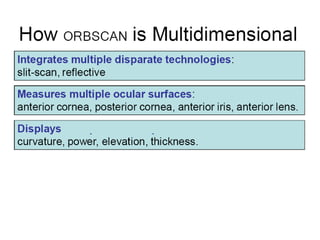
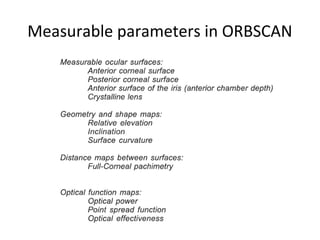
Measurable parameters in ORBSCAN
• Projection based corneal topography
• A grid of horizontal and vertical bars of light (0.2mm apart) is projected
onto the flourescein stained tear film
• Pattern is directly observed and measured
• Entire corneal, limbal and interpalpebral conjunctival surfaces
• Can even measure epithelial defects
• Defines elevation points (not curvature)
• Produces a true topographic map (elevation map)
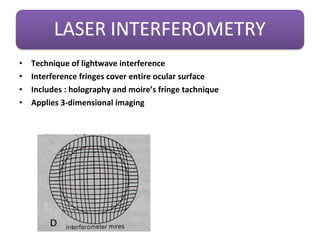
• Technique of lightwave interference
• Interference fringes cover entire ocular surface
• Includes : holography and moire’s fringe tachnique
• Applies 3-dimensional imaging
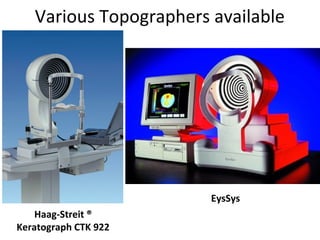
Various Topographers available
Haag-Streit ®
Keratograph CTK 922
EysSys
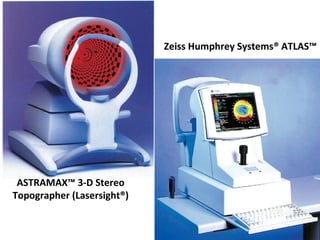
ASTRAMAX™ 3-D Stereo
Topographer (Lasersight®)
Zeiss Humphrey Systems® ATLAS™
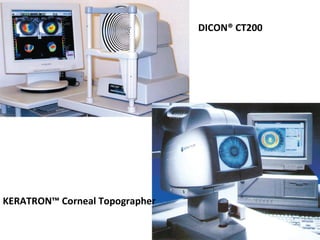
DICON® CT200
KERATRON™ Corneal Topographer
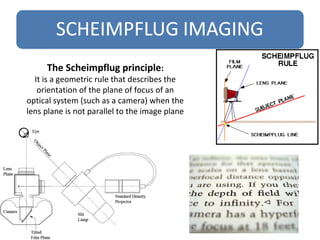
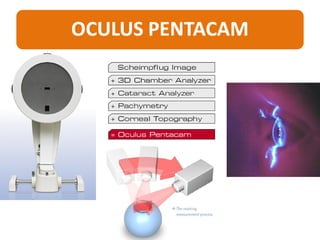
The Scheimpflug principle:
It is a geometric rule that describes the
orientation of the plane of focus of an
optical system (such as a camera) when the
lens plane is not parallel to the image plane
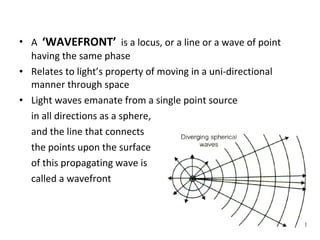
• A ‘WAVEFRONT’ is a locus, or a line or a wave of point
having the same phase
• Relates to light’s property of moving in a uni-directional
manner through space
• Light waves emanate from a single point source
in all directions as a sphere,
and the line that connects
the points upon the surface
of this propagating wave is
called a wavefront
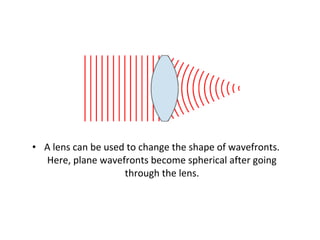
• A lens can be used to change the shape of wavefronts.
Here, plane wavefronts become spherical after going
through the lens.
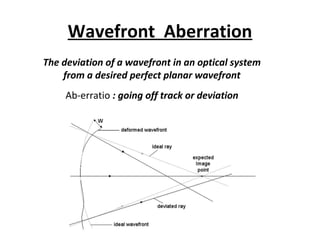
Wavefront Aberration
The deviation of a wavefront in an optical system
from a desired perfect planar wavefront
Ab-erratio : going off track or deviation
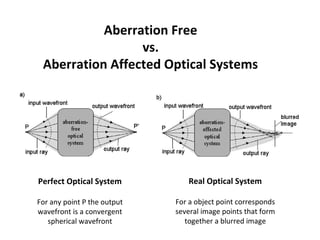
Perfect Optical System
For any point P the output
wavefront is a convergent
spherical wavefront
Real Optical System
For a object point corresponds
several image points that form
together a blurred image
Aberration Free
vs.
Aberration Affected Optical Systems
ABERROPIA
• a refractive error that results in a decrease in the visual
quality that can be attributable to high order aberration
• Not caused by:
– Lower order aberrations : myopia/hyperopia/astigmatism
– Eye diseases : cornea, lens, retina
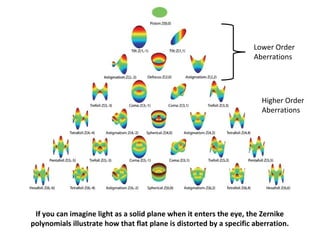
• Measured by Zernike Polynomials:
– Complex methametical calculation
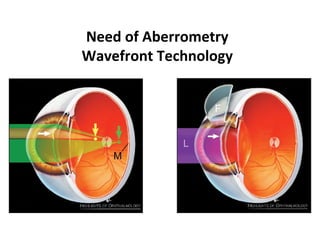
Need of Aberrometry
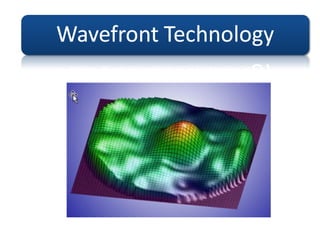
Wavefront Technology
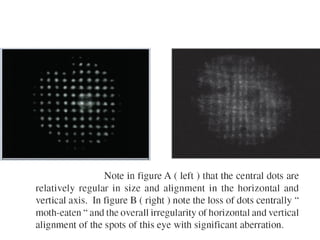
VARIOUS TYPES OF ABERROMETERS
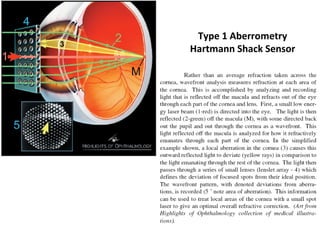
Type 1 Aberrometry
Hartmann Shack Sensor
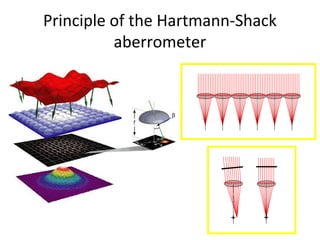
Principle of the Hartmann-Shack
aberrometer
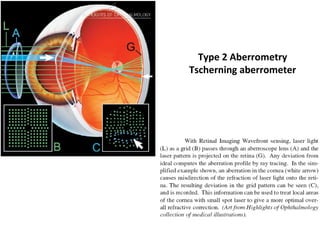
Type 2 Aberrometry
Tscherning aberrometer
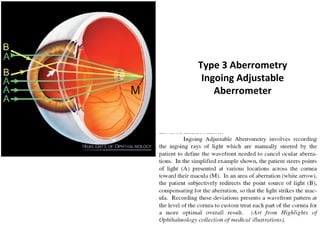
Type 3 Aberrometry
Ingoing Adjustable
Aberrometer
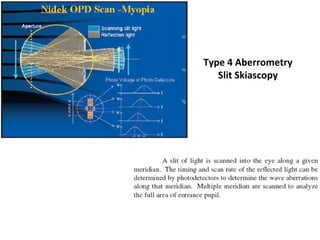
Type 4 Aberrometry
Slit Skiascopy
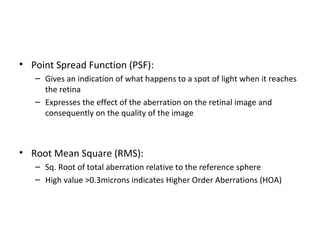
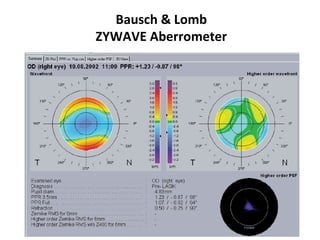
• Point Spread Function (PSF):
– Gives an indication of what happens to a spot of light when it reaches
the retina
– Expresses the effect of the aberration on the retinal image and
consequently on the quality of the image
• Root Mean Square (RMS):
– Sq. Root of total aberration relative to the reference sphere
– High value >0.3microns indicates Higher Order Aberrations (HOA)
If you can imagine light as a solid plane when it enters the eye, the Zernike
polynomials illustrate how that flat plane is distorted by a specific aberration.
Lower Order
Aberrations
Higher Order
Aberrations
Bausch & Lomb
ZYWAVE Aberrometer
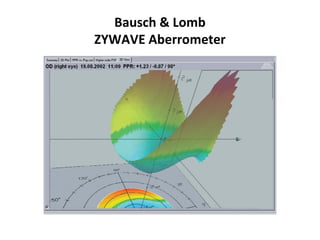
Bausch & Lomb
ZYWAVE Aberrometer
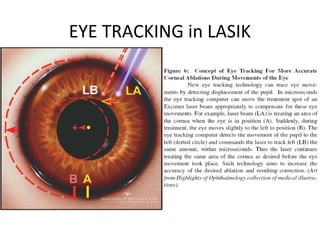
EYE TRACKING in LASIK
Thanks… (References as below)

Corneal topography

  • 1.
    CORNEAL TOPOGRAPHY CORNEA L DR. MRINMAYEE GHATAK DO,FMRF (Sankara Nethralaya) Consultant Ophthalmologist Kota Eye Hospital & Research Foundation Kota – INDIA dr.mrin@gmail.com
  • 2.
    • Anterior 1/6th ofeyeball • Measures 10.6mm Vertically and 11.7mm horizontally • NOT SPHERICAL, typically described as prolate ellipsoid • Central 4mm (optical zone or apical zone or corneal cap) supposed to be spherical
  • 3.
    ZONES OF CORNEA 3-4mm 7-8 mm 11 mm 12 mm Central Optical Limbal Peripheral Transitional Paracentral Mid-peripheral Central Optical Paracentral Peripheral Limbal
  • 4.
    CORNEA - Curvature •Central 4mm : – 7.8mm anterior surface – 6.5mm posterior surface
  • 5.
    The range ofpowers found in the normal cornea range from 39 D found at peripheral cornea, close to the limbus, to 48 D found at corneal apex.
  • 6.
    Cornea - Powercalculation P = N2 – N1 R P : Power of corneal surface N1 : Refractive Index of 1st medium N2 : Refractive Index of 2nd medium R : Radius of Curvature in metres
  • 7.
  • 8.
  • 11.
  • 12.
    HISTORICAL EVOLUTION • 1619: 1st reported description of corneal curvature by Christopher Scheiner • 1796 : Jesse Ramsden built the 1st device exclusively for keratometry • 1854 : Herman von helmholtz modified Ramsden’s instrument : termed it Ophthalmometer • 1881 : 1st practical keratometer for clinical use by Javal & Schiotz • 1932 : modified and improved version by Bausch & Lomb KERATOMETRY
  • 13.
    PRINCIPLE • Observation of1st Purkinge’s Image • Based on geometry of aspherical convex reflecting surface (cornea) • Object of known size and distance is reflected off the corneal surface to determine the size of the reflected image with a measuring telescope • Calculates the refracting power on the basis of an assumed index of refraction
  • 16.
    Advantages of Keratometry •Accuracy and reproducibility for measuring regular corneas within normal range of curvatures (40 -46 D) • Good for fitting CL and IOL power calculation • Ease of use • Low cost • Minimal maintenance requirements
  • 17.
    TYPES OF KERATOMETER •B & L – Object size constant – Amount of doubling varied to produce the image of fixed size • Javal Schiotz – Amount of image doubling is constant – Measures the object size needed to produce an image of fixed size
  • 18.
    BAUSCH & LOMB(Reichert) KERATOMETER Eye piece Vertical Knob Horizontal Knob Focussing Knob Chin Rest Head Rest Chin Height Knob Keratometer height Knob Lock AP rotation axis scale
  • 20.
    Patient’s view ofB&L keratometer mire
  • 21.
  • 22.
    • Most keratometers havetwo prismatic doubling systems • (one horizontal and one vertical)
  • 23.
  • 25.
    PROCEDURE • Focusing theeyepiece • Aligning the instrument • Positioning of the patient • Explaining the patient • Aligning and focusing the mires on cornea • Measurement of axis • Measurement of both curvatures
  • 28.
  • 30.
  • 31.
  • 32.
  • 33.
  • 34.
    Examiner’s view ofthe doubled mire image
  • 35.
    Unapproximated mires Approximatedmires Horizontal meridian
  • 37.
  • 38.
    Oblique Astigmatism Unaligned miresAligned but unapproximated mires Approximated mires
  • 39.
    KERATOMETRY KEY POINTS: • Focusthe eyepiece before beginning the measurement. • Let the patient blink normally to keep the cornea smooth. • Make sure the patient is comfortable while positioned at the instrument. • Loosely lock the instrument to avoid accidentally misaligning it during the measurement. • Keep the mires centered and focused at all times.
  • 41.
    Calculation of Radiusof Curvature R = 2x h’/h R : radius of curvature x : distance from object to focal point h’ : image height h : object height
  • 42.
    Power Calculation P =N2 – N1 R In keratometers, N2 = 1.3375 (assumed R.I. of cornea) N1 = 1.000 (air) P = 1.3375 – 1.000 = 0.3375 = 337.5 __ _ R (in mtrs) R (in mtrs) R (in millimetres)
  • 43.
    RANGE OF KERATOMETRICREADING • Dioptric Power : 36D to 52D • Radius of Curvature : 6.5mm to 9.38mm • Can be extended upto : • Lower Limit : 30D (5.6mm) with -1.0D lens • Upper Limit : 61D (10.9mm) with +1.25D lens
  • 44.
    • Objective methodfor determining curvature of the cornea. • To estimate the amount and direction of corneal astigmatism • The ocular biometery for the IOL power calculation • To monitor pre and post surgical astigmatism. • Differential diagnosis of axial versus refractive anisometropia. • To diagnose and monitor keratoconus and other corneal diseases. • For contact lens fitting by base curve selection KLAP 9.05.2 −−=
  • 45.
    Problems in Measurement •Measurement Problems: – Measures only central 3 mm of cornea – Corneal epithelial irregularity render defocussing – Very steep cornea: reading exceed range – Post-refractive surgery readings are inaccurate
  • 46.
    Keratometry Limitations & Assumptions oCalculations are based on the geometry of a spherical reflecting surface: the cornea is described as a prolate (flattening) ellipsoid (true apical radius steeper) o Quantitative data are based on only four points within the central 3 millimeters of the cornea (gross qualitative indication of corneal regularity between them) o The formula approximates the distance of image as the distance of focal point from the object o Power in diopters depends on an assumed index of refraction
  • 47.
    • Keratoscope: instrumentthat projects multiple concentric rings (mires) on the cornea • Keratoscopy: direct visualization of the rings • Photokeratoscope: when a still camera is added to photograph the mires • Videokeratoscope: when a video camera is added
  • 48.
    Need of Keratoscopy ? ? ? ? ? ? ? ? ?• Most corneas are aspheric, flattening peripherally. Keratoscopy samples a large area of the corneal surface → can assess asphericity and other surface variations
  • 49.
    KERATOSCOPY - HISTORICAL •1870 : 1st clinical use : Placido : studied the corneal surface by observing the shape of the concentric rings reflected off the cornea • 1880 : Javal : recognised importance the recording the image photographically • 1896 : Gullstrand : developed 1st Photokeratoscope
  • 50.
    Placido Disc: theOriginal Corneal Topographer Placido Disc: observer views the pattern of concentric white rings (mires) reflected from the patient’s cornea through a central +2 D lens. Very “qualitative”
  • 51.
    Images formed byPlacido Disc • Based on the overlay of concentric mires on the cornea. – The closer the mires, the steeper the axis. – The wider the rings, the flatter the axis.
  • 52.
  • 58.
    Safety Pin Flieringa Ring BarretPlastic Lollypop Cylindrical Keratoscope Qualitative Methods of Keratoscopy
  • 59.
    Maloney Conical Keratoscope KleinHand-held internally illuminated Keratoscope Astigmatism control enforcer with Applanation tonometer
  • 60.
  • 62.
    Limitations of PlacidoDisc System •It misses data on the central cornea • It is only able to acquire limited data points • It measures slope not height • It is difficult to focus and align • In most topographers, the patient is exposed to high light
  • 63.
    • Computerized VideoKeratoscopy •Capturing the keratoscopic details onto a video and displaying data analysed with mutiple algorithms • Measures larger area with more points • Produce permanent reproducible records • One of the most important developments in diagnostic instrumentation
  • 65.
    Present Day PDB Video- Keratoscopes TheReal Need – Analysing each & every point over cornea
  • 66.
  • 67.
    Basics of ComputerizedCorneal Topography
  • 68.
    Sequence of events •Projecting Placido Disc Ring Pattern onto patient’s cornea • Achieving centration of mires • Instantaneous capturing of reflected mires by high resolution digital video-camera • 256 circumferential points on each ring are identified • Analysis of each point is done and processed data is displayed onto computer screen in various formats e.g. color maps
  • 69.
    Key Points • Avoidall eye drops, particularly local anaesthetics as they decrease TBUT • Explain the patient & make comfortable • Ask patient to blink normally • Other contact procedures on cornea (tonometry, A-scan) should be done after topography
  • 70.
    Computerized Corneal Topography Indications& Uses • Preoperative and postoperative assessment of the refractive patient • Preoperative and postoperative assessment of penetrating keratoplasty • Irregular astigmatism • Corneal distrophies, bullous keratopathy • Keratoconus (diagnostic and follow-up) • Follow-up of corneal ulceration or abscess • Post-traumatic corneal scarring • Contact lens fitting • Evaluation of tear film quality • Reference instrument for IOL-implants to see the corneal difference before and after surgery • To study unexplained low visual acuity after any surgical procedure (trabeculectomy, extracapsular lens extraction, …). • Preoperative and postoperative assessment of Intacs™ corneal rings (intrastromal corneal rings)
  • 71.
    READING OF TOPOGRAPHICALDATA • Check the name of the patient, date of exam and examined eye. • type of measurement (height in microns, curvature in mm, power in D) • Check the scale & step interval • study the map (type of map, form of abnormalities) • Evaluate statistical information • Compare with topography of the other eye • Compare with the previous maps
  • 73.
    • Numeric powerplots • Keratometry view • Photokeratoscopic view • Profile view • Colour-coded topographic maps – Most useful
  • 74.
    NUMERIC POWER PLOTS •Corneal curvature showed in dioptre values • 10 concentric circular zones with 1mm interval • Also shows Value radius of curvature of each of the 10 concentric zones • Average overall corneal curvature also displayed
  • 75.
    KERATOMETRIC VIEW • DepictsK-readings in 2 principle meridia in 3 different zones simultaneously. – Central : 3mm – Intermediate : 3-5 mm – Peripheral : 5-7 mm • Important for assessing the skewing of semi-meridia
  • 76.
    PHOTOKERATOSCOPIC VIEW • Depictsactual black & white photograph of Placido rings captured by video camera. • Helps in confirming proper patient fixation
  • 77.
    PROFILE VIEW • Graphicalplotting along the X-Y axis of the steepest and flattest meridia and difference between the two. • Grey zone denotes the pupillary area. – Symmetrical eye : straight line tracing – Asymmetrical eye : apparent slag seen
  • 78.
    COLOUR-CODED TOPOGRAPHIC MAPS • Mostwidely used • Most useful • Quick interpretation possible • User-friendly Louisiana State University Color-Coded Map 1987 by Stephen Klyce
  • 79.
    Interpretation of acolour map: 1. Colour Codes: – Hot colours: red-orange – steep portions – Cool colours: blue-purple – flat portions 1. The Scale used: – Absolute Scale: routine practice / screening • 35-50D : each color = 1.5D interval • <35D or >50D : each color > 5D interval – Normalized Scale: more minute details • 11 equal colours spanning ‘that’ eyes’ dioptric power
  • 83.
  • 84.
    Corneal Topographic Patterns: •Depending on corneal curvature • Rabinowitz et al in 1996 described 10 different patterns: • REGULAR PATTERNS : – Round – Oval – Steepening : Superior or Inferior • ASTIGMATIC PATTERNS: – Symmetrical & Orthogonal : (Bow-Tie Effect) • With or without skewed axis – Asymmetrical & Orthogonal: • With superior steepening • With inferior steepening • Bow-tie with skewed radial axis – Irregular : no pattern and non-orthogonal
  • 85.
    Aym.Bow-Tie with skew RoundOval Sup.Steep Inf.Steep Sym.Bow-Tie Sym.Bow-Tie with Skew Asym.Bow-Tie with Inf.Steep Asym.Bow-Tie with Sup.Steep
  • 86.
    Formats for displayof data on color maps: 1. Ring Verification: raw data 2. Corneal power map: (Axial) • Original & most stable and most commonly used map • 24-colour representation of dioptric power • Curvature measured 360 times for each placido ring image • Sagittal algorithm averages data from between rings • Evaluate overall characteristics and helps in classification 1. Tangential map: (Instantaneous Curvature Map) • Better geographical representation than axial map • Tangents are projected outwards from centre vertex 360 degree • Ring curvature measured along tangent • Best indicator of corneal shape >> ectatic conditions • Poor indicator of corneal power >> never calculate K values
  • 89.
    Ring Verification MapAxial Dioptre Map 3D Reconstruction Map Tangential Dioptre Map
  • 90.
    Formats for displayof data on color maps: 3. Elevation Map • Distinguishing localized elevations from otherwise steep corneal area • They are difference measurements • “Red is Raised”, “Blue is Below” 3. Refractive Power Map • Takes into account spherical aberrations • Illustrates refraction of light in true dioptres • Useful in determining optical zone for RGP lenses and refractive corneal surgery 5. 3D Reconstruction Map
  • 91.
  • 92.
    Formats for displayof data on color maps: 5. Irregularity Map • Displays distortion of cornea using elevation map with toric reference • Hotter colours represent higher value of distortion • Helps to quickly assess if cornea is causing poor VA 5. Trend & Time Display • Chronological display of changes 5. Difference Display Map 6. OD/OS Compare Map 7. Fourier Analysis : • extract spherical, cylindrical, prismatic and irregular aberrations
  • 94.
    Axial Dioptre Mapin 2002 Axial Dioptre Map in 2003 Difference Dioptre Map
  • 96.
    Other Overlays thatcan be added • Pupil Margin • Grids • Optical Zone • Eye Image • Keratometric Mires
  • 98.
    Other Software Application& Displays • Multiple Display Option • Keratoconus Pathfinder Application • Contact Lens Fitting Application
  • 99.
    Artefacts of TopographyMap • shadows on the cornea from large eyelashes or trichiasis • ptosis or non-sufficient eye opening • irregularities of the tear film layer (dry eye, mucinous film, greasy film) • too short working distance of the small Placido disk cone
  • 103.
    Normal Cornea • widespectrum of normality • nasal cornea is flatter than temporal. • physiological astigmatism of around 0.75 diopter. • can take on many topographic patterns commonly: – With the rule astigmatism : vertical bow-tie – Against the rule astigmatism : horizontal bow-tie • Enantiomorphism : mirror image
  • 104.
    Normal Cornea • Smallchanges in corneal shape do occur throughout life: – In infancy the cornea is fairly spherical – In childhood and adolescence, probably due to eyelid pressure on a young tissue, cornea becomes slightly astigmatic with-the-rule – In the middle age, cornea tends to recover its sphericity – Late in life, against-the-rule astigmatism tends to develop
  • 107.
    • Provides evidenceeven before SLE can diagnose • Most sensitive method to distinguish: – True Early keratoconus – Asym Bow-tie or Inf. Steepening due to contact lens warpage • “Keratoconus Suspect” Patients: – Specially to diagnose & follow progression
  • 108.
    Several Classifications CLINICO-TOPOGRAPHIC : 1.Keratoconus: • One or more of clinical signs • Asymmetrical bow-tie with skewed radial axis pattern (AB/SRAX) 1. Early Keratoconus: • No Slit-lamp findings, but scissoring reflex on retinoscopy • AB/SRAX pattern 1. Keratoconus Suspect: • Only an AB/SRAX pattern Aym.Bow-Tie with skew
  • 109.
    Keratoconus Fruste • Called“form fruste” • 1st described by Amsler in 1937. • Extremely mild form of keratoconus • Central or para-central zone of irregular astigmatism of unknown etiology. • The most striking hallmark - lack of progression
  • 110.
    Several Classifications CENTRAL CORNEALPOWER – Mild keratoconus : < 48D – Moderate keratoconus : 48 - 54D – Advanced keratoconus : >54D • PACHYMETRY – Normal cornea : > 543 Microns – Early keratoconus : ~ 506 Microns – Moderate keratoconus : ~ 473 Microns – Advanced keratoconus : ~ 446 Microns
  • 111.
    MORPHOLOGY OF ECTASIA Nipple- Shaped Small, central ectasia Less than 5.0mm High WTR astigmatism 360O normal peripheral cornea Oval- Shaped Varying degree of Inferior mid-periphery steepening. Island of normal/flatter than normal cornea exactly located 180O away . Globus- Shaped Affects largest area. All mires within the ectatic cornea No island of normal mid-peripheral cornea.
  • 112.
    Typical Topographic patternof Keratoconus • High central corneal power • Steeper inferior cornea (AB/SRAX – diagnostic value) • Large difference between the power of corneal apex and corneal periphery • Often a disparity of the central powers between the two corneas of a given patient • Typical pattern of progression of steepening - rotational
  • 115.
    KISA% index forKeratoconus • Central K : descriptive of central steepening • I-S values: inferior-superior dioptric asymmetry • AST index : degree of regular corneal astigmatism (SimK1 – SimK2) • SRAX index : expression of irregular astigmatism • KISA% is product of all of the above: KISA% = (K) x (I-S) x (AST) x (SRAX) x 100 300 KISA% > 100% is keratoconus KISA% > 60 to 100% is Suspect
  • 116.
    Humphrey Atlas PathfinderCorneal Analysis System • Corneal irregularity measurement (CIM): – Represent the irregularity of corneal surface • Normal CIM: 0.3 to 0.60 microns • Borderline CIM: 0.61 to 1.0 microns • Abnormal CIM: 1.1 to 5.0 microns • Shape factor (SF): – Represents the degree of corneal asphericity or eccentricity • Normal Shape Factor: 0.13 to 0.35 • Borderline Shape Factor: 0.02 to 0.12 and 0.36 to 0.46 • Abnormal Shape Factor: 0.47 to 1.0 • Mean toric corneal measurement (TKM): – Two values are calculated at the apex of the flattest meridian and their mean determined. The mean value of apical curvature. • Normal TKM: 43.12 to 45.87D • Borderline TKM: 41.12 to 43.00 D. and 46.00 to 47.25 D. • Abnormal TKM: 36.00 to 41.75 D. and 47.37 to 60.00
  • 117.
    A case ofUnilateral Keratoconus (Right Eye) accurately diagnosed by Humphrey Pathfinder Analysis CIM, SF, TKM : if values in green color code range : normal
  • 118.
    Videokeratoscopic Pseudokeratoconus • ContactLens Wear • Technical errors • Dry spot formation • Early PMD • Previous ocular surgery
  • 119.
    PRIMARY POSTERIAL CORNEAL ELEVATION •Early presenting sign in keratoconus • Preoperative analysis of PPCE to detect a posterior corneal bulge is important to avoid post LASIK keratectasia Elevation Map Posterior Float 3D-reconstruction
  • 120.
    PELLUCID MARGINAL DEGENERATION •Very steep contour in the peripheral peri-limbal cornea • High power radiating in towards the center from the inferior meridians • “Butterfly” or a "lazy C" or a “kissing pigeon” configuration • Area of flattening down the center of the cornea • High against-the-rule astigmatism.
  • 121.
  • 122.
    TERRIEN’S MARGINAL DEGENERATION •prominent flattening of the corneal contour • High against-the-rule astigmatism
  • 123.
  • 124.
    CONTACT LENS WARPAGE •Harstein : 1st to note CL induced corneal changes • WARPAGE: All CL induced changes in corneal topography, reversible or irreversible, that are not associated with corneal edema • Signs & Symptoms: – Mostly asymptomatic – Changes in refraction and K readings over a period of time – Changes in curvature and distortion of mires – Central irregular astigmatism – Loss of normal progressive flattening from the center to the periphery • Very commonly confused with keratoconus
  • 125.
    • Topographical abnormalitiesclassified as: • Central irregular astigmatism • Loss of radial symmetry • Reversal of normal topographic pattern • Keratoconus like images
  • 126.
    • Inaccurate topographycauses hazards in patients posted for LASIK – Soft CL causes: • Topographic steepening (with keratoconus-like image) • Increased myopia • Central corneal thinning – RGP CL causes: • Topographic flattening • Decreased myopia • Central corneal thinning.
  • 127.
    CL Warpage –Special parameters – Simulated Keratoscopic Readings; • Average powers of the steepest (SimK1) and the flattest meridia (SimK2) – Surface Asymmetry Index; • Centrally weighted sum of the differences in corneal power between corresponding points on mires located 180º apart – Surface Regularity index: • Calculated on the basis of the local regularity of the surface over the corneal area within pupillary area.
  • 128.
  • 131.
  • 132.
    Contact Lens Fittingin Keratoconus • Superior Alignment Fitting Technique for Early Keratoconus • The Intra-Palpebral Three Point Touch Fitting Technique for Early Keratoconus • Aspheric Lens Designs for Early Keratoconus
  • 133.
    PENETRATING KERATOPLASTY • Makingdecisions about trephination and graft size • Identifying thin areas to be avoided in the graft-host junction • Choosing a suturing technique • Managing selective suture removal or adjustment • Deciding on the need for a relaxing incision in astigmatism • Correcting refractive errors by a excimer laser procedure • Guide the post PKP fitting of a contact lens
  • 134.
    Cataract Surgery • PreoperativeUse: – Most useful for IOL calculation in eyes with irregular surfaces – Evaluation of astigmatism, previous refractive surgery – Decision taking on type of surgery – Planning for site & type of incision – Has shown that smaller, temporal & scleral incision for phaco cause less induced astigmatism • Intra-operative Use: – to reduce surgically induced astigmatism – Wound closure – Application of sutures and adjustment • Postoperative Use: – To identify tight sutures and adjust accordingly – Evaluating and managing Post-op refractive suprises – Determine causes of poor post-op vision
  • 135.
    REFRACTIVE SURGERY • Shouldbe performed in every case Pre-op: – To develop a surgical / ablation profile – To detect pre-existing corneal abnormalities • Post-op uses to evaluate: – Decentration – Multifocality – Regression – Induced astigmatism – Central islands
  • 136.
    RADIAL KERATOTOMY (RK) •Most useful in evaluating Post-RK problems: – Irregular astigmatism – Glare, halos (induced spherical aberrations) – Diurnal changes in refraction & vision (dumble- shaped or split optical zones) – Multifocality due to regional change in curvature with time
  • 137.
    ASTIGMATIC KERATOTOMY (AK) •Pre-op Evaluation of: – Astigmatism (specially asymmetric) – Calculating best position & configuration of relaxing incision • Post-op evaluation reveals: – Longer incision : more steepening of un-incised meridian – Incision closure to limbus: less flattening – Deeper incision : more effect
  • 139.
    PHOTOREFRACTIVE KERATECTOMY • Laserablation of cornea to flatten/steepen cornea • VKS used for evaluation of: – Ablation profile – Decentration – Regression and stabilization – Multifocality and induced aberration – Central islands diagnosis and follow-up
  • 140.
  • 141.
    Central island postLASIK Degraded laser optics External hydration Beam blockage by photodisrupted tissue Tends to resolve by 18months after surgery
  • 142.
    PTERYGIUM with-the-rule astigmatism caused by localizedflattening of the cornea central to the leading apex of the pterygium
  • 143.
  • 144.
    REGULAR ASTIGMATISM Bow-tie pattern: most common pattern (even 50 % of normal corneas exhibit it) Simulated K readings have good correlation with K readings Bow Tie •Vertical •Horizontal
  • 145.
    IRREGULAR ASTIGMATISM • Rarelyoccurs naturally • Common causes: • Dry eye • Corneal scars • Ectatic corneal degenerations • Pterygium • Trauma • Surgery (cataract surgery, PKP, and refractive surgery) • It represents the remainder after subtracting sphere & cylinder from corneal power map
  • 146.
    IRREGULAR ASTIGMATISM Classification: • WithDefined Pattern – Decentered Ablation: decentered myopic ablation in more than 1.5mm in central cornea – Decentered Steep: decentered hyperopic ablation in more than1.5mm in central cornea – Central Island: increase in central power of ablation zone at least 3D and 1.5mm surrounded by areas of lesser curvature – Central Irregularity: more than one area of <1.0mm and <1D in central myopic ablation zone – Peripheral Irregularity: similar to central island extending to periphery of ablation zone in one meridian • With Undefined Pattern – More than one areas of >3.0mm in central 6mm cornea
  • 147.
    IRREGULAR ASTIGMATISM Classification: • WithDefined Pattern – Decentered Ablation: decentered myopic ablation in more than 1.5mm in central cornea
  • 148.
    IRREGULAR ASTIGMATISM Classification: • WithDefined Pattern – Decentered Steep: decentered hyperopic ablation in more than 1.5mm in central cornea
  • 149.
    IRREGULAR ASTIGMATISM Classification: • WithDefined Pattern – Central Island: increase in central power of ablation zone at least 3D and 1.5mm surrounded by areas of lesser curvature
  • 150.
    IRREGULAR ASTIGMATISM Classification: • WithDefined Pattern – Central Irregularity: more than one area of <1.0mm and <1D in central myopic ablation zone
  • 151.
    IRREGULAR ASTIGMATISM Classification: • WithDefined Pattern – Peripheral Irregularity: similar to central island extending to periphery of ablation zone in one meridian
  • 152.
    IRREGULAR ASTIGMATISM Classification: • WithUndefined Pattern – More than one areas of irregularity >3.0mm in central 6mm cornea
  • 154.
  • 155.
    ORBSCAN 40 slit scanning(20 from each side)
  • 157.
  • 159.
    • Projection basedcorneal topography • A grid of horizontal and vertical bars of light (0.2mm apart) is projected onto the flourescein stained tear film • Pattern is directly observed and measured • Entire corneal, limbal and interpalpebral conjunctival surfaces • Can even measure epithelial defects • Defines elevation points (not curvature) • Produces a true topographic map (elevation map)
  • 160.
    • Technique oflightwave interference • Interference fringes cover entire ocular surface • Includes : holography and moire’s fringe tachnique • Applies 3-dimensional imaging
  • 161.
    Various Topographers available Haag-Streit® Keratograph CTK 922 EysSys
  • 162.
    ASTRAMAX™ 3-D Stereo Topographer(Lasersight®) Zeiss Humphrey Systems® ATLAS™
  • 163.
  • 165.
    The Scheimpflug principle: Itis a geometric rule that describes the orientation of the plane of focus of an optical system (such as a camera) when the lens plane is not parallel to the image plane
  • 168.
    • A ‘WAVEFRONT’is a locus, or a line or a wave of point having the same phase • Relates to light’s property of moving in a uni-directional manner through space • Light waves emanate from a single point source in all directions as a sphere, and the line that connects the points upon the surface of this propagating wave is called a wavefront
  • 169.
    • A lenscan be used to change the shape of wavefronts. Here, plane wavefronts become spherical after going through the lens.
  • 170.
    Wavefront Aberration The deviationof a wavefront in an optical system from a desired perfect planar wavefront Ab-erratio : going off track or deviation
  • 171.
    Perfect Optical System Forany point P the output wavefront is a convergent spherical wavefront Real Optical System For a object point corresponds several image points that form together a blurred image Aberration Free vs. Aberration Affected Optical Systems
  • 172.
    ABERROPIA • a refractiveerror that results in a decrease in the visual quality that can be attributable to high order aberration • Not caused by: – Lower order aberrations : myopia/hyperopia/astigmatism – Eye diseases : cornea, lens, retina • Measured by Zernike Polynomials: – Complex methametical calculation
  • 173.
  • 174.
    VARIOUS TYPES OFABERROMETERS
  • 175.
  • 176.
    Principle of theHartmann-Shack aberrometer
  • 177.
  • 178.
    Type 3 Aberrometry IngoingAdjustable Aberrometer
  • 179.
  • 180.
    • Point SpreadFunction (PSF): – Gives an indication of what happens to a spot of light when it reaches the retina – Expresses the effect of the aberration on the retinal image and consequently on the quality of the image • Root Mean Square (RMS): – Sq. Root of total aberration relative to the reference sphere – High value >0.3microns indicates Higher Order Aberrations (HOA)
  • 181.
    If you canimagine light as a solid plane when it enters the eye, the Zernike polynomials illustrate how that flat plane is distorted by a specific aberration. Lower Order Aberrations Higher Order Aberrations
  • 183.
  • 184.
  • 185.
  • 186.