CORNEAL TOPOGRAPHY
Suraj Chhetri
B. Optometry
16th batch
 The word topography derived from Greek word : ‘topos’
(place) and ‘graphein’ (to draw)
 Corneal topography corresponds to the graphic
representation of the geometrical properties of corneal
surface
 Tomography
Derived from Greek word : Tomos (slice/
section) and grapho (to write )
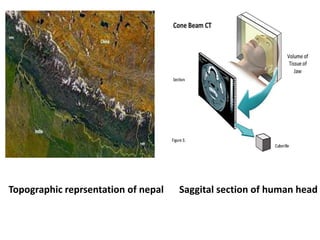
Topographic reprsentation of nepal Saggital section of human head
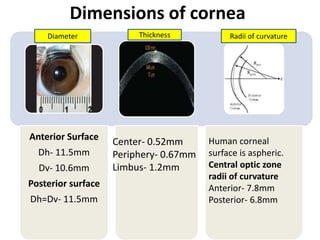
Dimensions of cornea
Anterior Surface
Dh- 11.5mm
Dv- 10.6mm
Posterior surface
Dh=Dv- 11.5mm
Center- 0.52mm
Periphery- 0.67mm
Limbus- 1.2mm
Human corneal
surface is aspheric.
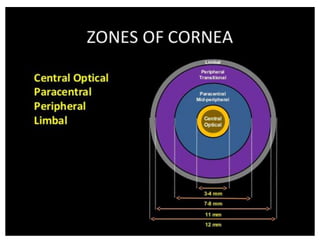
Central optic zone
radii of curvature
Anterior- 7.8mm
Posterior- 6.8mm
Diameter Thickness Radii of curvature
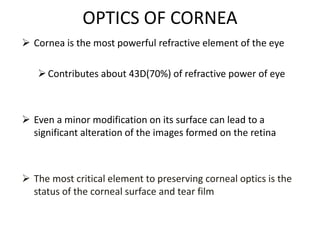
OPTICS OF CORNEA
 Cornea is the most powerful refractive element of the eye
Contributes about 43D(70%) of refractive power of eye
 Even a minor modification on its surface can lead to a
significant alteration of the images formed on the retina
 The most critical element to preserving corneal optics is the
status of the corneal surface and tear film
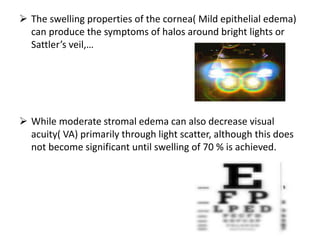
 The swelling properties of the cornea( Mild epithelial edema)
can produce the symptoms of halos around bright lights or
Sattler’s veil,…
 While moderate stromal edema can also decrease visual
acuity( VA) primarily through light scatter, although this does
not become significant until swelling of 70 % is achieved.
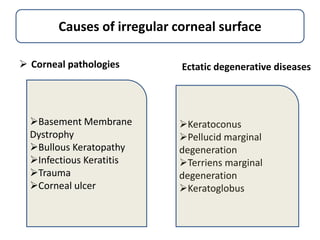
Causes of irregular corneal surface
 Corneal pathologies Ectatic degenerative diseases
Basement Membrane
Dystrophy
Bullous Keratopathy
Infectious Keratitis
Trauma
Corneal ulcer
Keratoconus
Pellucid marginal
degeneration
Terriens marginal
degeneration
Keratoglobus
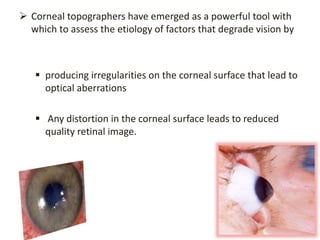
 Corneal topographers have emerged as a powerful tool with
which to assess the etiology of factors that degrade vision by
 producing irregularities on the corneal surface that lead to
optical aberrations
 Any distortion in the corneal surface leads to reduced
quality retinal image.
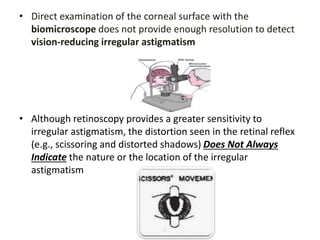
• Direct examination of the corneal surface with the
biomicroscope does not provide enough resolution to detect
vision-reducing irregular astigmatism
• Although retinoscopy provides a greater sensitivity to
irregular astigmatism, the distortion seen in the retinal reflex
(e.g., scissoring and distorted shadows) Does Not Always
Indicate the nature or the location of the irregular
astigmatism
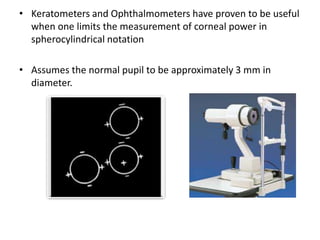
• Keratometers and Ophthalmometers have proven to be useful
when one limits the measurement of corneal power in
spherocylindrical notation
• Assumes the normal pupil to be approximately 3 mm in
diameter.
• Clinicians have long sought a device that
the entire surface of the cornea
• Issues of corneal regularity, symmetry, and the general nature
of the peripheral cornea are important for the understanding
of corneal optics.
• Reflection techniques, such as the Placido disk, keratometry,
photokeratoscopy, and corneal topography all arise from this
principle
• However, it was not until the development of corneal
topography that clinicians were provided with easily under-
stood color-coded maps of corneal curvature as well as
quantitative indices of irregular astigmatism that correlate
with potential visual acuity
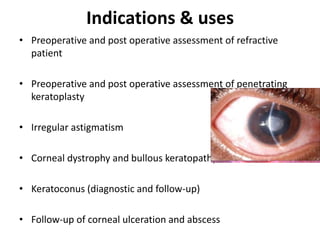
Indications & uses
• Preoperative and post operative assessment of refractive
patient
• Preoperative and post operative assessment of penetrating
keratoplasty
• Irregular astigmatism
• Corneal dystrophy and bullous keratopathy
• Keratoconus (diagnostic and follow-up)
• Follow-up of corneal ulceration and abscess
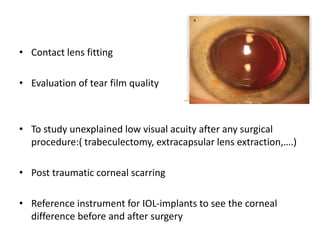
• Contact lens fitting
• Evaluation of tear film quality
• To study unexplained low visual acuity after any surgical
procedure:( trabeculectomy, extracapsular lens extraction,….)
• Post traumatic corneal scarring
• Reference instrument for IOL-implants to see the corneal
difference before and after surgery
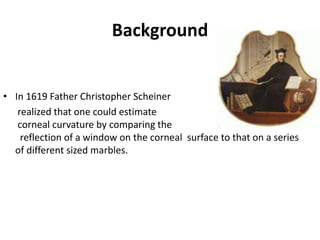
Background
• In 1619 Father Christopher Scheiner
realized that one could estimate
corneal curvature by comparing the
reflection of a window on the corneal surface to that on a series
of different sized marbles.
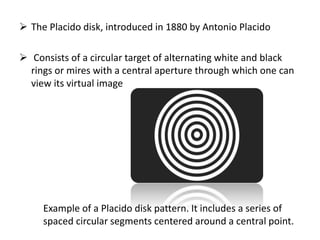
 The Placido disk, introduced in 1880 by Antonio Placido
 Consists of a circular target of alternating white and black
rings or mires with a central aperture through which one can
view its virtual image
Example of a Placido disk pattern. It includes a series of
spaced circular segments centered around a central point.
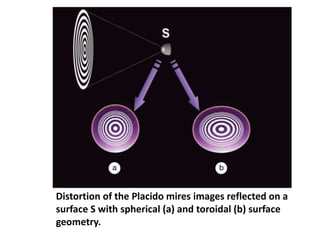
Distortion of the Placido mires images reflected on a
surface S with spherical (a) and toroidal (b) surface
geometry.
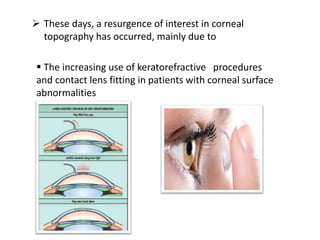
 These days, a resurgence of interest in corneal
topography has occurred, mainly due to
 The increasing use of keratorefractive procedures
and contact lens fitting in patients with corneal surface
abnormalities
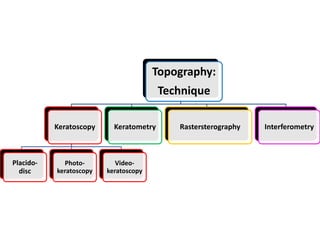
Topography:
Technique
Keratoscopy
Placido-
disc
Photo-
keratoscopy
Video-
keratoscopy
Keratometry Rastersterography Interferometry
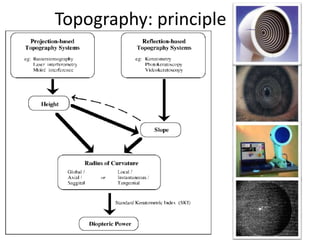
Topography: principle
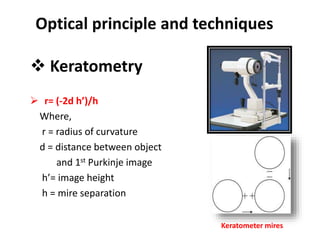
Optical principle and techniques
 Keratometry
 r= (-2d h’)/h
Where,
r = radius of curvature
d = distance between object
and 1st Purkinje image
h’= image height
h = mire separation
Keratometer mires
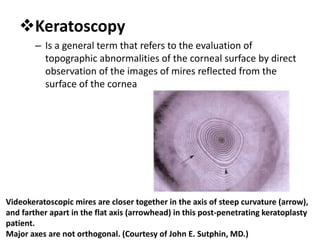
Keratoscopy
– Is a general term that refers to the evaluation of
topographic abnormalities of the corneal surface by direct
observation of the images of mires reflected from the
surface of the cornea
Videokeratoscopic mires are closer together in the axis of steep curvature (arrow),
and farther apart in the flat axis (arrowhead) in this post-penetrating keratoplasty
patient.
Major axes are not orthogonal. (Courtesy of John E. Sutphin, MD.)
Small degrees of abnormalities of corneal shape go
undetected.
Could not be used in cornea with epithelial defects and
stromal ulcers because cornea cannot reflect the target
Placido disc is used only as a gross method of qualitative
assessment of the corneal surface
Disadvantages
Photokeratoscopy
When a photographic film camera is attached to a
keratoscope, it is a photokeratoscope
In the technique, the keratoscopic image is photographed
and the size of the images on the photographic film can be
changed to change the size of the corneal image
The image of most photokeratoscope rings covers the
paracentral, overlapping into the central and peripheral
zones but leaving the optically important central 2-3 mm
as well as the peripheral cornea
Current photokeratoscopes ( eg., Nidek PKS-1000 or
Keracorneascope) have 9-15 rings which cover 55-75% of
the corneal surface
The corneal cylinders of up to 3 D can escape detection
by use of photokeratoscopy
Videokeratoscopy
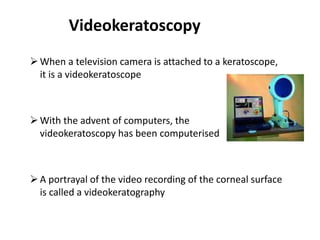
When a television camera is attached to a keratoscope,
it is a videokeratoscope
With the advent of computers, the
videokeratoscopy has been computerised
A portrayal of the video recording of the corneal surface
is called a videokeratography
Videokeratoscopy
• Presently,
the computer-assisted videokeratoscopy
corneal topography.
It covers approximately 95% of the corneal surface
Rastersterography
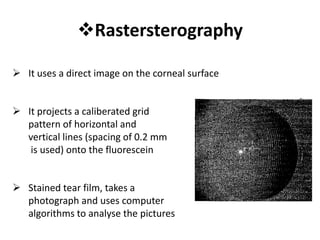
 It uses a direct image on the corneal surface
 It projects a caliberated grid
pattern of horizontal and
vertical lines (spacing of 0.2 mm
is used) onto the fluorescein
 Stained tear film, takes a
photograph and uses computer
algorithms to analyse the pictures
Rasterserography
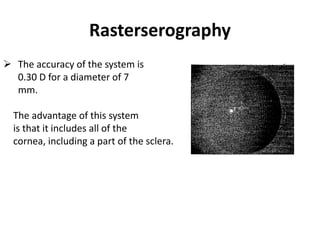
 The accuracy of the system is
0.30 D for a diameter of 7
mm.
The advantage of this system
is that it includes all of the
cornea, including a part of the sclera.
interferometry
It uses the technique of light wave interference.
This method has become obsolete and is of no concern to
present-world study of corneal topography.
Computer Topography Systems
 Presently the term corneal topography system (CTS), or
videokeratography, implies computerised, video-
assisted technique that provides detailed information
about the shape of the corneal surface
 The technique has an excellent accuracy and
repeatability.
 Most corneal topographers evaluate 8000-10000
specific points across the entire corneal surface.
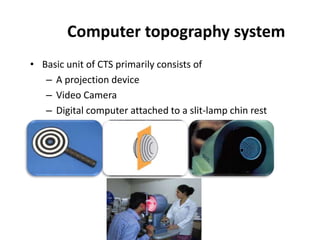
• Basic unit of CTS primarily consists of
– A projection device
– Video Camera
– Digital computer attached to a slit-lamp chin rest
Computer topography system
Different types of CTS
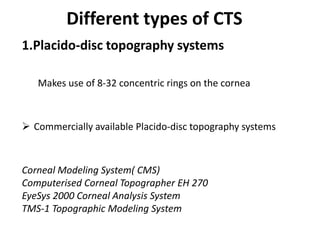
1.Placido-disc topography systems
Makes use of 8-32 concentric rings on the cornea
 Commercially available Placido-disc topography systems
Corneal Modeling System( CMS)
Computerised Corneal Topographer EH 270
EyeSys 2000 Corneal Analysis System
TMS-1 Topographic Modeling System
2. Slit-imaging topography systems
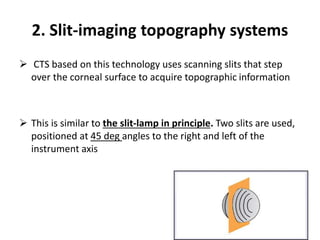
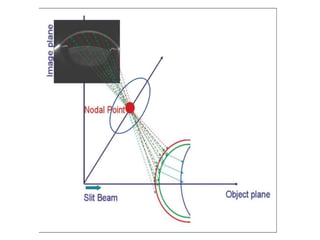
 CTS based on this technology uses scanning slits that step
over the corneal surface to acquire topographic information
 This is similar to the slit-lamp in principle. Two slits are used,
positioned at 45 deg angles to the right and left of the
instrument axis
Slit-imaging topography systems
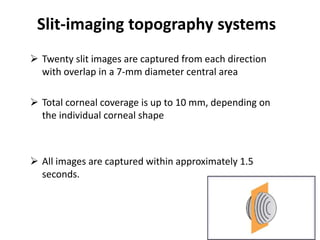
 Twenty slit images are captured from each direction
with overlap in a 7-mm diameter central area
 Total corneal coverage is up to 10 mm, depending on
the individual corneal shape
 All images are captured within approximately 1.5
seconds.
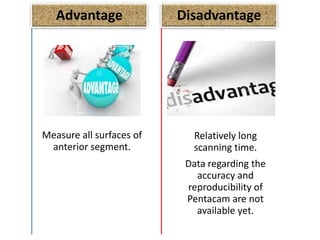
Measure all surfaces of
anterior segment.
Advantage
Relatively long
scanning time.
Data regarding the
accuracy and
reproducibility of
Pentacam are not
available yet.
Disadvantage
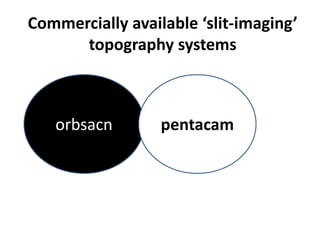
Commercially available ‘slit-imaging’
topography systems
orbsacn pentacam
Orbscan
 Most recent of the commercially available topography
systems.
 It combines a slit scanning system and Plasido’s disk
 Measures elevation and curvature of anterior and
posterior surfaces of cornea along with full
pachymetry map.
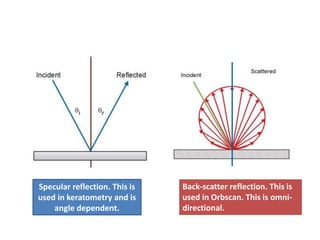
 It uses the principle of back-scattered reflection,
unlike the specular reflection employed in
keratometry.
Back-scatter reflection. This is
used in Orbscan. This is omni-
directional.
Specular reflection. This is
used in keratometry and is
angle dependent.
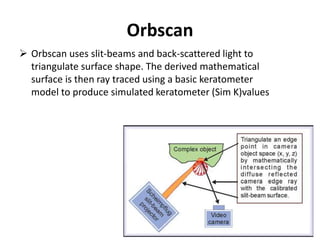
Orbscan
 Orbscan uses slit-beams and back-scattered light to
triangulate surface shape. The derived mathematical
surface is then ray traced using a basic keratometer
model to produce simulated keratometer (Sim K)values
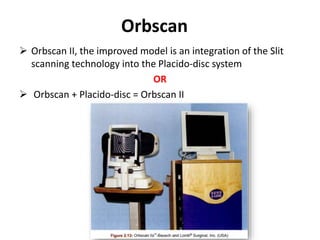
Orbscan
 Orbscan II, the improved model is an integration of the Slit
scanning technology into the Placido-disc system
OR
 Orbscan + Placido-disc = Orbscan II
HOW IS RECORDING MADE?
40 slit images (40 slits limbus to limbus)are acquired in
two 0.7 second periods.
During acquisition, involuntary saccades typically move
the eye by 50 microns.
 Eye movement is measured from anterior reflections of
stationary slit beam and other light sources.
Eye tracking data permit saccadic movements to be
subtracted form the final topographic surface.
Orbscan
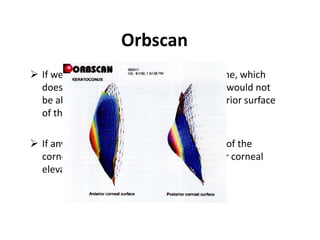
 If we were doing topography with a machine, which
does not have slit scan imaging facility, we would not
be able to see the topography of the posterior surface
of the cornea
 If any abnormality in the posterior surface of the
cornea, for example as in primary posterior corneal
elevation this would not be diagnosed
Orbscan
 Then if we perform Lasik on such a patient we would
create an iatrogenic keratectesia. The orbscan helps us
to detect the abnormalities on the posterior surface of
the cornea.
 Colour meanings in the spectral direction ( from blue
to red)
 Red = high, steep, sharp, shallow, thin, or focused
 Blue = low, level, flat, deep, thick, or aberrated.
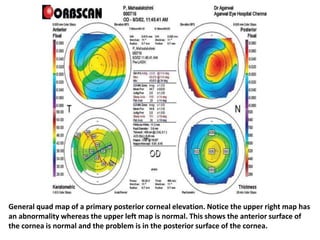
General quad map of a primary posterior corneal elevation. Notice the upper right map has
an abnormality whereas the upper left map is normal. This shows the anterior surface of
the cornea is normal and the problem is in the posterior surface of the cornea.
Pentacam
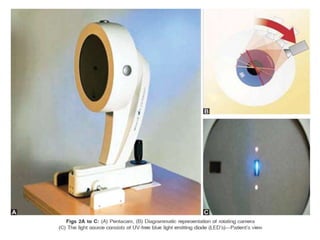
 Images the anterior segment of the eye, using a rotating
Scheimpflug camera, and pictures in these dimensions of the
anterior segment are shown by this rotating process
 The images captured are then used to construct the anterior
corneal surface (corneal topography), posterior corneal
surface and anterior axis and anterior lens surfaces
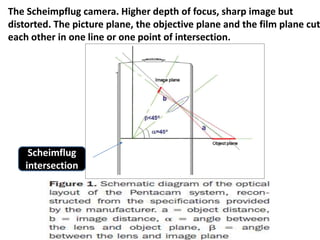
 The Scheimpflug is modification of slit- lamp camera.
 Has modified geometry to improve depth of focus and include
distortion correction algorithms.
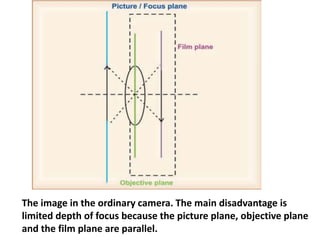
The image in the ordinary camera. The main disadvantage is
limited depth of focus because the picture plane, objective plane
and the film plane are parallel.
Scheimflug
intersection
The Scheimpflug camera. Higher depth of focus, sharp image but
distorted. The picture plane, the objective plane and the film plane cut
each other in one line or one point of intersection.
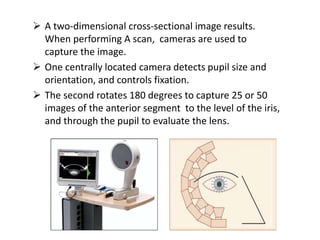
 A two-dimensional cross-sectional image results.
When performing A scan, cameras are used to
capture the image.
 One centrally located camera detects pupil size and
orientation, and controls fixation.
 The second rotates 180 degrees to capture 25 or 50
images of the anterior segment to the level of the iris,
and through the pupil to evaluate the lens.
Pentacam
 500 true elevation data points are generated per image to
yield up to 25,000 points for each surface.
 Data points are captured for the center of the cornea, an area
that placido disc topographers and slit scanning devices are
unable to evaluate.
(Based on an elevation map)
Formats for display of data on color maps
1. Corneal Power Map (Axial or Sagittal)
– 24-colour representation of dioptric power at various
points on the cornea
What is the axial curvature then???
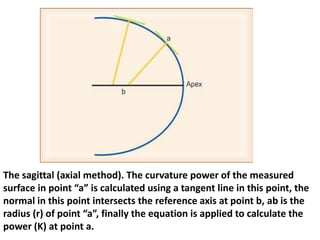
The sagittal (axial method). The curvature power of the measured
surface in point “a” is calculated using a tangent line in this point, the
normal in this point intersects the reference axis at point b, ab is the
radius (r) of point “a”, finally the equation is applied to calculate the
power (K) at point a.
Corneal Power Map (Axial or Sagittal)
Axial curvature closely approximates the power of the
central 1-2 mm of the cornea but fails to describe the true
shape and power of the peripheral cornea.
For almost sphere cornea… the curvature is almost the
same from the centre to the periphery.
In fact, cornea are not always spherical.
This is not a good descriptor
in corneal topography.
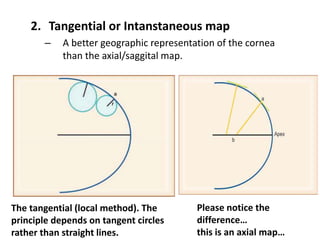
2. Tangential or Intanstaneous map
– A better geographic representation of the cornea
than the axial/saggital map.
The tangential (local method). The
principle depends on tangent circles
rather than straight lines.
Please notice the
difference…
this is an axial map…
3. Elevation map
 Elevation is not measured by Placido-based
topographers, but certain assumptions allow the
construction of elevation maps
 Elevation of a point on the corneal surface
displays the height of the point on the corneal
surface relative to a spherical surface.
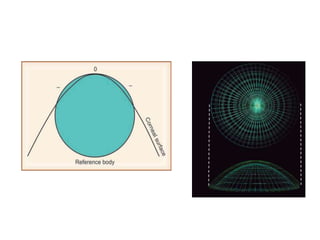
 The reference surface is mostly considered to
be a sphere, or, to be precise, a Best Fit Sphere ( BFS)
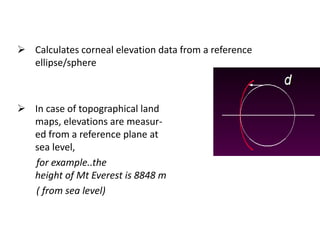
 Calculates corneal elevation data from a reference
ellipse/sphere
 In case of topographical land
maps, elevations are measur-
ed from a reference plane at
sea level,
for example..the
height of Mt Everest is 8848 m
( from sea level)
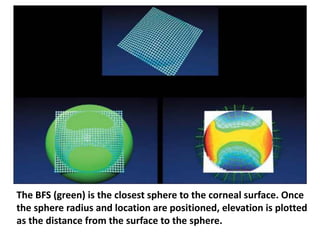
The BFS (green) is the closest sphere to the corneal surface. Once
the sphere radius and location are positioned, elevation is plotted
as the distance from the surface to the sphere.
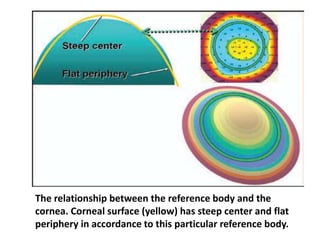
The relationship between the reference body and the
cornea. Corneal surface (yellow) has steep center and flat
periphery in accordance to this particular reference body.
4. Refractive Power Map
 Optical power maps (or ‘refractive maps’) are
functional maps and should not be confounded
with curvature maps.
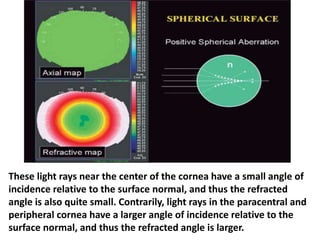
 Since the cornea suffers aberrations, the
refraction varies along the meridians even if the
curvature does not change….owing to spherical
aberration..esp…positive spherical aberration.
 Why????
These light rays near the center of the cornea have a small angle of
incidence relative to the surface normal, and thus the refracted
angle is also quite small. Contrarily, light rays in the paracentral and
peripheral cornea have a larger angle of incidence relative to the
surface normal, and thus the refracted angle is larger.
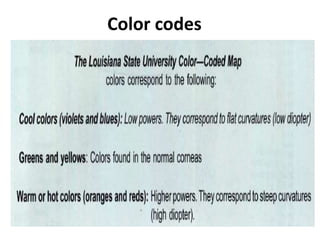
Color codes
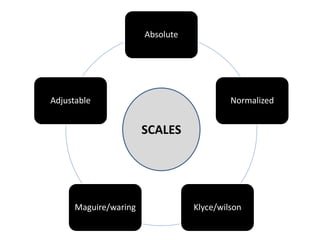
Absolute
Normalized
Klyce/wilsonMaguire/waring
Adjustable
SCALES
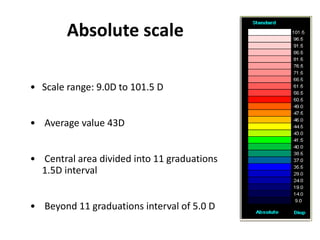
Absolute scale
• Scale range: 9.0D to 101.5 D
• Average value 43D
• Central area divided into 11 graduations
1.5D interval
• Beyond 11 graduations interval of 5.0 D
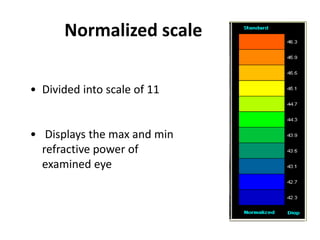
Normalized scale
• Divided into scale of 11
• Displays the max and min
refractive power of
examined eye
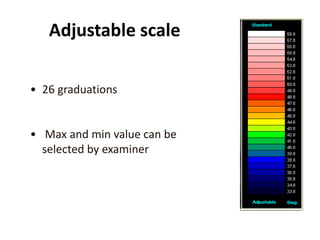
Adjustable scale
• 26 graduations
• Max and min value can be
selected by examiner
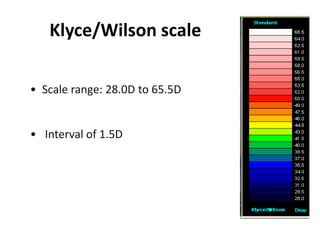
Klyce/Wilson scale
• Scale range: 28.0D to 65.5D
• Interval of 1.5D
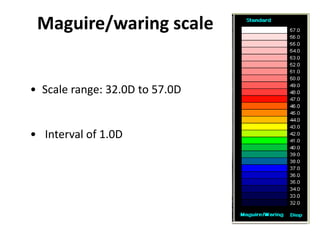
Maguire/waring scale
• Scale range: 32.0D to 57.0D
• Interval of 1.0D
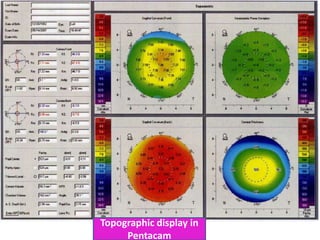
Topographic display in
Pentacam
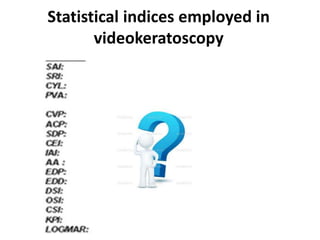
Statistical indices employed in
videokeratoscopy
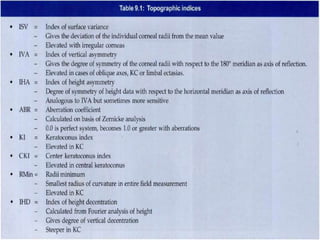
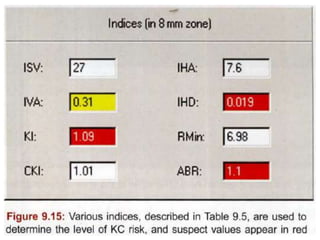
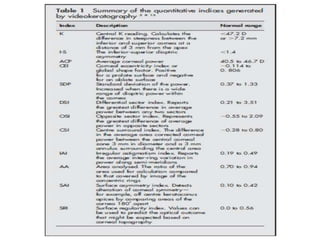
SimK: Simulated keratometry
 It is obtained from the greatest power observed on
the corneal surface from an average of rings 12-16
along every meridian
 The power and axis orthogonal to the highest power
are also reported as they are in traditional
keratometry
 Higher than normal values are often associated with
keratoconus, penetrating keratoplasty, and the
occasional steep normal. Lower than normal values
occur with myopic refractive surgical corrections and
the rare flat normal.
SimK2: Simulated keratometry.
– SimK2 is the power of the flat meridian orthogonal (90°) to
SimK1.
MinK: Minimum Keratometry Value
 Often the meridians of highest and lowest power are
not orthogonal.
It is useful to know the meridian for which the actual
minimum power occurs, particularly in the planning of
astigmatic keratotomy.
 This situation most often occurs with keratoconus,
penetrating keratoplasty, and trauma, although it may be
present after cataract surgery as well.
• SAI: Surface Asymmetry Index
– The SAI measures the difference in corneal powers at
every ring (180° apart) over the entire corneal surface.
– The SAI is often higher than normal in keratoconus,
penetrating keratoplasty, decentered myopic refractive
surgical procedures, trauma, and contact lens warpage.
– Adequate spectacle correction is often not achieved when
SAI is high.
• Cyl: Simulated keratometric cylinder
– The simulated keratometric cylinder of the corneal surface
is obtained from the Sim K readings.
– Higher than normal values of Cyl are associated with
several pathologies, trauma, and surgery.
• SDP: Standard Deviation of corneal Power
– The SDP is calculated from the distribution of all corneal
powers in a videokeratography.
– SDP is often high for keratoconus corneas, transplants,
and trauma - all situations in which there is a wide range
of powers occurring in the measured topography.
CVP: Coefficient of Variation of corneal Power
The CVP is calculated from the Standard Deviation of
corneal Powers (SDP) divided by the grand average of
corneal powers.
High values are found in Keratoconus, corneal transplants.
• IAI: Irregular Astigmatism Index
The IAI is an area-compensated average summation of
inter-ring power variations along every meridian for the
entire corneal surface analyzed.
The IAI increases as local irregular astigmatism in the
corneal surface increases. IAI is high in corneal transplants
shortly after surgery; persistence often sub optimal best
spectacle corrected vision.
EDP: Elevation/Depression Power
EDP calculates the average power of apparent islands and
valleys for those areas of the cornea that are within the
demarcated pupil.
SRI: Surface Regularity Index
The SRI is a correlate to potential visual acuity and is a
measure of local fluctuations in central corneal power.
 When SRI is elevated, the corneal surface ahead of the
entrance pupil will be irregular, leading to a reduction in
best spectacle-corrected visual acuity. High SRI values are
found with dry eyes, contact lens wear, trauma, and
penetrating keratoplasty
PVA: Potential Visual Acuity
Irregularities in corneal topography ahead of the
entrance pupil reduce the visual potential of the
eye.
The consequence of these irregularities are
assessed by the calculation of the Surface
Regularity Index which has been correlated to PVA
in a published clinical study.
The PVA is given as the range of best spectacle-
corrected Snellen visual acuity that might be
expected from a functionally normal eye with the
topographical characteristics of the analyzed
cornea.
ACP : Average Corneal Power
The ACP is an area-corrected average of the corneal power
ahead of the entrance pupil.
 It is generally equal to the keratometric spherical
equivalent except for decentered refractive surgical
procedures.
Abnormal values occur for the same reasons as for
keratometry
CEI: Corneal Eccentricity Index
– The CEI is a measure of corneal eccentricity, a global shape
factor.
– A positive (normal) value is obtained for a prolate surface,
a nil value for a sphere and a negative value is used to
indicate an oblate surface.
– Out of range values include keratoconus (higher than
normal) and negative values often found with contact lens
wear and myopic refractive surgical corrections.
EDD: Elevation/Depression Diameter
EDD is the equivalent diameter of the area found to
contain powers within the pupil 1 Diopter or more from
the mode.
It is calculated from twice the square root of this area
divided by Pi.
The units are mm.
LogMAR: Log of the Minimum Angle of Resolution
LogMAR is a standard unit for expressing high contrast (Snellen)
visual acuity.
It relates directly to how well the eye can discriminate between
two points of light.
KPI: Keratoconus Prediction Index
The Keratoconus Prediction Index is less than 0.225 for
normals.
It is obtained by discriminant analysis of corneal statistical
indexes.
This numerical estimator is used to indicate the presence
of a keratoconus pattern in corneal topography1
1 (Invest Ophthalmol Vis Sci 35:2749-2757, 1994)
• KSI: Keratoconus Severity Index
– Keratoconus suspect is interpreted when KSI reaches 0.15
– Clinical keratoconus is triggered at a KSI of 0.30 2
2 (Invest Ophthalmol Vis Sci 38:2290-2299, 1997)
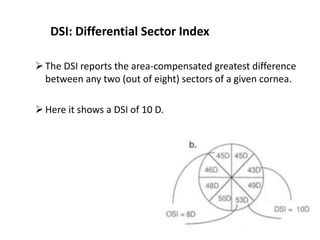
DSI: Differential Sector Index
The DSI reports the area-compensated greatest difference
between any two (out of eight) sectors of a given cornea.
Here it shows a DSI of 10 D.
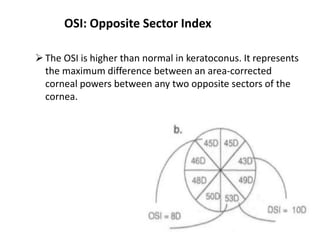
OSI: Opposite Sector Index
The OSI is higher than normal in keratoconus. It represents
the maximum difference between an area-corrected
corneal powers between any two opposite sectors of the
cornea.
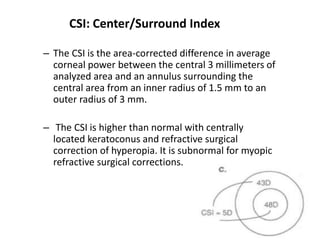
CSI: Center/Surround Index
– The CSI is the area-corrected difference in average
corneal power between the central 3 millimeters of
analyzed area and an annulus surrounding the
central area from an inner radius of 1.5 mm to an
outer radius of 3 mm.
– The CSI is higher than normal with centrally
located keratoconus and refractive surgical
correction of hyperopia. It is subnormal for myopic
refractive surgical corrections.
Corneal Topogaphic patterns in
NORMAL CORNEAS
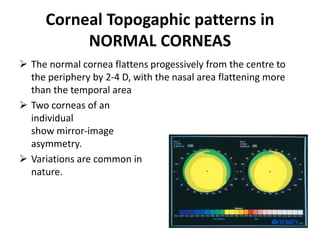
 The normal cornea flattens progessively from the centre to
the periphery by 2-4 D, with the nasal area flattening more
than the temporal area
 Two corneas of an
individual
show mirror-image
asymmetry.
 Variations are common in
nature.
Corneal Topogaphic patterns
in NORMAL CORNEAS
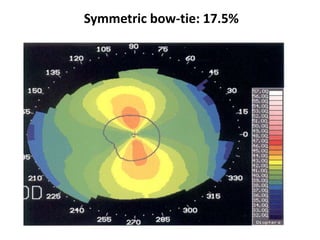
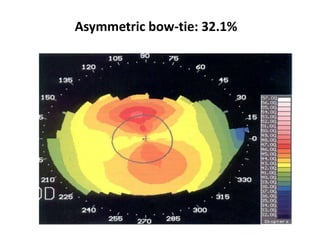
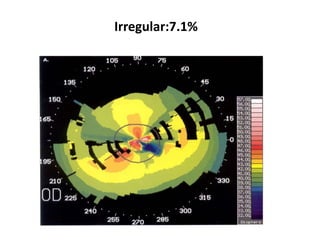
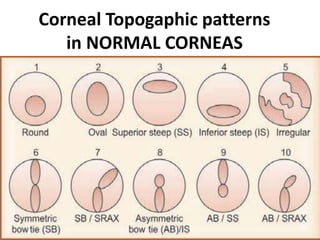
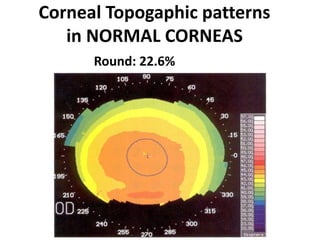
• Depending on the corneal curvature, Rabinowitz et al. in
1996 described 10 different corneal topographic
patterns in normal eyes.
Corneal Topogaphic patterns
in NORMAL CORNEAS
Round: 22.6%
Symmetric bow-tie: 17.5%
Asymmetric bow-tie: 32.1%
Irregular:7.1%
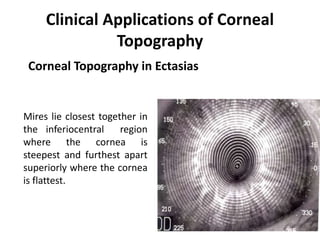
Clinical Applications of Corneal
Topography
Corneal Topography in Ectasias
Mires lie closest together in
the inferiocentral region
where the cornea is
steepest and furthest apart
superiorly where the cornea
is flattest.
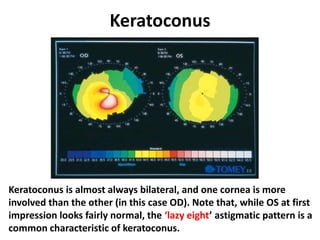
Keratoconus
Keratoconus is almost always bilateral, and one cornea is more
involved than the other (in this case OD). Note that, while OS at first
impression looks fairly normal, the ‘lazy eight’ astigmatic pattern is a
common characteristic of keratoconus.
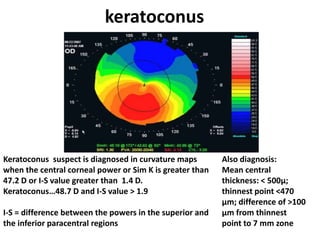
keratoconus
Keratoconus suspect is diagnosed in curvature maps
when the central corneal power or Sim K is greater than
47.2 D or I-S value greater than 1.4 D.
Keratoconus…48.7 D and I-S value > 1.9
I-S = difference between the powers in the superior and
the inferior paracentral regions
Also diagnosis:
Mean central
thickness: < 500μ;
thinnest point <470
μm; difference of >100
μm from thinnest
point to 7 mm zone
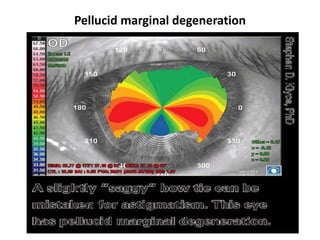
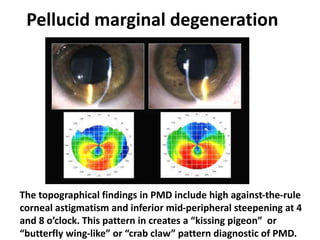
Pellucid marginal degeneration
The topographical findings in PMD include high against-the-rule
corneal astigmatism and inferior mid-peripheral steepening at 4
and 8 o’clock. This pattern in creates a “kissing pigeon” or
“butterfly wing-like” or “crab claw” pattern diagnostic of PMD.
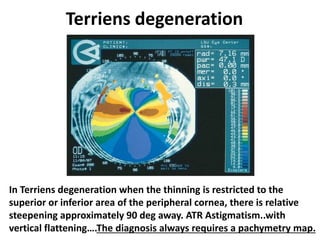
Terriens degeneration
In Terriens degeneration when the thinning is restricted to the
superior or inferior area of the peripheral cornea, there is relative
steepening approximately 90 deg away. ATR Astigmatism..with
vertical flattening….The diagnosis always requires a pachymetry map.
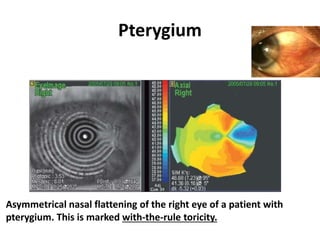
Pterygium
Asymmetrical nasal flattening of the right eye of a patient with
pterygium. This is marked with-the-rule toricity.
Clinical Applications of Corneal Topography
• Photorefractive keratectomy (PRK) and Laser-assisted in-situ
keratomileusis (LASIK)
– Information about the quality, diameter and centration of
the ablated zone along with its stability over a course of
time.
–
Decentration---halos or glare effect
Irregular ablation zone---decreased visual acuity
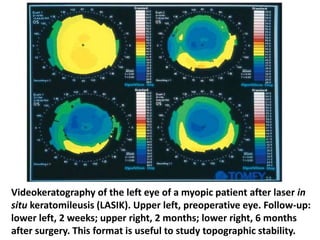
Videokeratography of the left eye of a myopic patient after laser in
situ keratomileusis (LASIK). Upper left, preoperative eye. Follow-up:
lower left, 2 weeks; upper right, 2 months; lower right, 6 months
after surgery. This format is useful to study topographic stability.
References

Corneal topography by suraj

  • 1.
  • 2.
     The wordtopography derived from Greek word : ‘topos’ (place) and ‘graphein’ (to draw)  Corneal topography corresponds to the graphic representation of the geometrical properties of corneal surface  Tomography Derived from Greek word : Tomos (slice/ section) and grapho (to write )
  • 3.
    Topographic reprsentation ofnepal Saggital section of human head
  • 4.
    Dimensions of cornea AnteriorSurface Dh- 11.5mm Dv- 10.6mm Posterior surface Dh=Dv- 11.5mm Center- 0.52mm Periphery- 0.67mm Limbus- 1.2mm Human corneal surface is aspheric. Central optic zone radii of curvature Anterior- 7.8mm Posterior- 6.8mm Diameter Thickness Radii of curvature
  • 6.
    OPTICS OF CORNEA Cornea is the most powerful refractive element of the eye Contributes about 43D(70%) of refractive power of eye  Even a minor modification on its surface can lead to a significant alteration of the images formed on the retina  The most critical element to preserving corneal optics is the status of the corneal surface and tear film
  • 7.
     The swellingproperties of the cornea( Mild epithelial edema) can produce the symptoms of halos around bright lights or Sattler’s veil,…  While moderate stromal edema can also decrease visual acuity( VA) primarily through light scatter, although this does not become significant until swelling of 70 % is achieved.
  • 8.
    Causes of irregularcorneal surface  Corneal pathologies Ectatic degenerative diseases Basement Membrane Dystrophy Bullous Keratopathy Infectious Keratitis Trauma Corneal ulcer Keratoconus Pellucid marginal degeneration Terriens marginal degeneration Keratoglobus
  • 9.
     Corneal topographershave emerged as a powerful tool with which to assess the etiology of factors that degrade vision by  producing irregularities on the corneal surface that lead to optical aberrations  Any distortion in the corneal surface leads to reduced quality retinal image.
  • 10.
    • Direct examinationof the corneal surface with the biomicroscope does not provide enough resolution to detect vision-reducing irregular astigmatism • Although retinoscopy provides a greater sensitivity to irregular astigmatism, the distortion seen in the retinal reflex (e.g., scissoring and distorted shadows) Does Not Always Indicate the nature or the location of the irregular astigmatism
  • 11.
    • Keratometers andOphthalmometers have proven to be useful when one limits the measurement of corneal power in spherocylindrical notation • Assumes the normal pupil to be approximately 3 mm in diameter.
  • 12.
    • Clinicians havelong sought a device that the entire surface of the cornea • Issues of corneal regularity, symmetry, and the general nature of the peripheral cornea are important for the understanding of corneal optics.
  • 13.
    • Reflection techniques,such as the Placido disk, keratometry, photokeratoscopy, and corneal topography all arise from this principle • However, it was not until the development of corneal topography that clinicians were provided with easily under- stood color-coded maps of corneal curvature as well as quantitative indices of irregular astigmatism that correlate with potential visual acuity
  • 14.
    Indications & uses •Preoperative and post operative assessment of refractive patient • Preoperative and post operative assessment of penetrating keratoplasty • Irregular astigmatism • Corneal dystrophy and bullous keratopathy • Keratoconus (diagnostic and follow-up) • Follow-up of corneal ulceration and abscess
  • 15.
    • Contact lensfitting • Evaluation of tear film quality • To study unexplained low visual acuity after any surgical procedure:( trabeculectomy, extracapsular lens extraction,….) • Post traumatic corneal scarring • Reference instrument for IOL-implants to see the corneal difference before and after surgery
  • 16.
    Background • In 1619Father Christopher Scheiner realized that one could estimate corneal curvature by comparing the reflection of a window on the corneal surface to that on a series of different sized marbles.
  • 17.
     The Placidodisk, introduced in 1880 by Antonio Placido  Consists of a circular target of alternating white and black rings or mires with a central aperture through which one can view its virtual image Example of a Placido disk pattern. It includes a series of spaced circular segments centered around a central point.
  • 18.
    Distortion of thePlacido mires images reflected on a surface S with spherical (a) and toroidal (b) surface geometry.
  • 19.
     These days,a resurgence of interest in corneal topography has occurred, mainly due to  The increasing use of keratorefractive procedures and contact lens fitting in patients with corneal surface abnormalities
  • 20.
  • 21.
  • 22.
    Optical principle andtechniques  Keratometry  r= (-2d h’)/h Where, r = radius of curvature d = distance between object and 1st Purkinje image h’= image height h = mire separation Keratometer mires
  • 23.
    Keratoscopy – Is ageneral term that refers to the evaluation of topographic abnormalities of the corneal surface by direct observation of the images of mires reflected from the surface of the cornea Videokeratoscopic mires are closer together in the axis of steep curvature (arrow), and farther apart in the flat axis (arrowhead) in this post-penetrating keratoplasty patient. Major axes are not orthogonal. (Courtesy of John E. Sutphin, MD.)
  • 24.
    Small degrees ofabnormalities of corneal shape go undetected. Could not be used in cornea with epithelial defects and stromal ulcers because cornea cannot reflect the target Placido disc is used only as a gross method of qualitative assessment of the corneal surface Disadvantages
  • 25.
    Photokeratoscopy When a photographicfilm camera is attached to a keratoscope, it is a photokeratoscope In the technique, the keratoscopic image is photographed and the size of the images on the photographic film can be changed to change the size of the corneal image
  • 26.
    The image ofmost photokeratoscope rings covers the paracentral, overlapping into the central and peripheral zones but leaving the optically important central 2-3 mm as well as the peripheral cornea Current photokeratoscopes ( eg., Nidek PKS-1000 or Keracorneascope) have 9-15 rings which cover 55-75% of the corneal surface The corneal cylinders of up to 3 D can escape detection by use of photokeratoscopy
  • 27.
    Videokeratoscopy When a televisioncamera is attached to a keratoscope, it is a videokeratoscope With the advent of computers, the videokeratoscopy has been computerised A portrayal of the video recording of the corneal surface is called a videokeratography
  • 28.
    Videokeratoscopy • Presently, the computer-assistedvideokeratoscopy corneal topography. It covers approximately 95% of the corneal surface
  • 29.
    Rastersterography  It usesa direct image on the corneal surface  It projects a caliberated grid pattern of horizontal and vertical lines (spacing of 0.2 mm is used) onto the fluorescein  Stained tear film, takes a photograph and uses computer algorithms to analyse the pictures
  • 30.
    Rasterserography  The accuracyof the system is 0.30 D for a diameter of 7 mm. The advantage of this system is that it includes all of the cornea, including a part of the sclera.
  • 31.
    interferometry It uses thetechnique of light wave interference. This method has become obsolete and is of no concern to present-world study of corneal topography.
  • 32.
    Computer Topography Systems Presently the term corneal topography system (CTS), or videokeratography, implies computerised, video- assisted technique that provides detailed information about the shape of the corneal surface  The technique has an excellent accuracy and repeatability.  Most corneal topographers evaluate 8000-10000 specific points across the entire corneal surface.
  • 33.
    • Basic unitof CTS primarily consists of – A projection device – Video Camera – Digital computer attached to a slit-lamp chin rest Computer topography system
  • 34.
    Different types ofCTS 1.Placido-disc topography systems Makes use of 8-32 concentric rings on the cornea  Commercially available Placido-disc topography systems Corneal Modeling System( CMS) Computerised Corneal Topographer EH 270 EyeSys 2000 Corneal Analysis System TMS-1 Topographic Modeling System
  • 35.
    2. Slit-imaging topographysystems  CTS based on this technology uses scanning slits that step over the corneal surface to acquire topographic information  This is similar to the slit-lamp in principle. Two slits are used, positioned at 45 deg angles to the right and left of the instrument axis
  • 36.
    Slit-imaging topography systems Twenty slit images are captured from each direction with overlap in a 7-mm diameter central area  Total corneal coverage is up to 10 mm, depending on the individual corneal shape  All images are captured within approximately 1.5 seconds.
  • 37.
    Measure all surfacesof anterior segment. Advantage Relatively long scanning time. Data regarding the accuracy and reproducibility of Pentacam are not available yet. Disadvantage
  • 38.
  • 39.
    Orbscan  Most recentof the commercially available topography systems.  It combines a slit scanning system and Plasido’s disk  Measures elevation and curvature of anterior and posterior surfaces of cornea along with full pachymetry map.  It uses the principle of back-scattered reflection, unlike the specular reflection employed in keratometry.
  • 40.
    Back-scatter reflection. Thisis used in Orbscan. This is omni- directional. Specular reflection. This is used in keratometry and is angle dependent.
  • 41.
    Orbscan  Orbscan usesslit-beams and back-scattered light to triangulate surface shape. The derived mathematical surface is then ray traced using a basic keratometer model to produce simulated keratometer (Sim K)values
  • 42.
    Orbscan  Orbscan II,the improved model is an integration of the Slit scanning technology into the Placido-disc system OR  Orbscan + Placido-disc = Orbscan II
  • 43.
    HOW IS RECORDINGMADE? 40 slit images (40 slits limbus to limbus)are acquired in two 0.7 second periods. During acquisition, involuntary saccades typically move the eye by 50 microns.  Eye movement is measured from anterior reflections of stationary slit beam and other light sources. Eye tracking data permit saccadic movements to be subtracted form the final topographic surface.
  • 44.
    Orbscan  If wewere doing topography with a machine, which does not have slit scan imaging facility, we would not be able to see the topography of the posterior surface of the cornea  If any abnormality in the posterior surface of the cornea, for example as in primary posterior corneal elevation this would not be diagnosed
  • 45.
    Orbscan  Then ifwe perform Lasik on such a patient we would create an iatrogenic keratectesia. The orbscan helps us to detect the abnormalities on the posterior surface of the cornea.  Colour meanings in the spectral direction ( from blue to red)  Red = high, steep, sharp, shallow, thin, or focused  Blue = low, level, flat, deep, thick, or aberrated.
  • 46.
    General quad mapof a primary posterior corneal elevation. Notice the upper right map has an abnormality whereas the upper left map is normal. This shows the anterior surface of the cornea is normal and the problem is in the posterior surface of the cornea.
  • 47.
    Pentacam  Images theanterior segment of the eye, using a rotating Scheimpflug camera, and pictures in these dimensions of the anterior segment are shown by this rotating process  The images captured are then used to construct the anterior corneal surface (corneal topography), posterior corneal surface and anterior axis and anterior lens surfaces  The Scheimpflug is modification of slit- lamp camera.  Has modified geometry to improve depth of focus and include distortion correction algorithms.
  • 48.
    The image inthe ordinary camera. The main disadvantage is limited depth of focus because the picture plane, objective plane and the film plane are parallel.
  • 49.
    Scheimflug intersection The Scheimpflug camera.Higher depth of focus, sharp image but distorted. The picture plane, the objective plane and the film plane cut each other in one line or one point of intersection.
  • 51.
     A two-dimensionalcross-sectional image results. When performing A scan, cameras are used to capture the image.  One centrally located camera detects pupil size and orientation, and controls fixation.  The second rotates 180 degrees to capture 25 or 50 images of the anterior segment to the level of the iris, and through the pupil to evaluate the lens.
  • 52.
    Pentacam  500 trueelevation data points are generated per image to yield up to 25,000 points for each surface.  Data points are captured for the center of the cornea, an area that placido disc topographers and slit scanning devices are unable to evaluate. (Based on an elevation map)
  • 54.
    Formats for displayof data on color maps 1. Corneal Power Map (Axial or Sagittal) – 24-colour representation of dioptric power at various points on the cornea What is the axial curvature then???
  • 55.
    The sagittal (axialmethod). The curvature power of the measured surface in point “a” is calculated using a tangent line in this point, the normal in this point intersects the reference axis at point b, ab is the radius (r) of point “a”, finally the equation is applied to calculate the power (K) at point a.
  • 56.
    Corneal Power Map(Axial or Sagittal) Axial curvature closely approximates the power of the central 1-2 mm of the cornea but fails to describe the true shape and power of the peripheral cornea. For almost sphere cornea… the curvature is almost the same from the centre to the periphery. In fact, cornea are not always spherical. This is not a good descriptor in corneal topography.
  • 57.
    2. Tangential orIntanstaneous map – A better geographic representation of the cornea than the axial/saggital map. The tangential (local method). The principle depends on tangent circles rather than straight lines. Please notice the difference… this is an axial map…
  • 58.
    3. Elevation map Elevation is not measured by Placido-based topographers, but certain assumptions allow the construction of elevation maps  Elevation of a point on the corneal surface displays the height of the point on the corneal surface relative to a spherical surface.  The reference surface is mostly considered to be a sphere, or, to be precise, a Best Fit Sphere ( BFS)
  • 59.
     Calculates cornealelevation data from a reference ellipse/sphere  In case of topographical land maps, elevations are measur- ed from a reference plane at sea level, for example..the height of Mt Everest is 8848 m ( from sea level)
  • 61.
    The BFS (green)is the closest sphere to the corneal surface. Once the sphere radius and location are positioned, elevation is plotted as the distance from the surface to the sphere.
  • 62.
    The relationship betweenthe reference body and the cornea. Corneal surface (yellow) has steep center and flat periphery in accordance to this particular reference body.
  • 63.
    4. Refractive PowerMap  Optical power maps (or ‘refractive maps’) are functional maps and should not be confounded with curvature maps.  Since the cornea suffers aberrations, the refraction varies along the meridians even if the curvature does not change….owing to spherical aberration..esp…positive spherical aberration.  Why????
  • 64.
    These light raysnear the center of the cornea have a small angle of incidence relative to the surface normal, and thus the refracted angle is also quite small. Contrarily, light rays in the paracentral and peripheral cornea have a larger angle of incidence relative to the surface normal, and thus the refracted angle is larger.
  • 65.
  • 66.
  • 67.
    Absolute scale • Scalerange: 9.0D to 101.5 D • Average value 43D • Central area divided into 11 graduations 1.5D interval • Beyond 11 graduations interval of 5.0 D
  • 68.
    Normalized scale • Dividedinto scale of 11 • Displays the max and min refractive power of examined eye
  • 69.
    Adjustable scale • 26graduations • Max and min value can be selected by examiner
  • 70.
    Klyce/Wilson scale • Scalerange: 28.0D to 65.5D • Interval of 1.5D
  • 71.
    Maguire/waring scale • Scalerange: 32.0D to 57.0D • Interval of 1.0D
  • 72.
  • 75.
    Statistical indices employedin videokeratoscopy
  • 76.
    SimK: Simulated keratometry It is obtained from the greatest power observed on the corneal surface from an average of rings 12-16 along every meridian  The power and axis orthogonal to the highest power are also reported as they are in traditional keratometry  Higher than normal values are often associated with keratoconus, penetrating keratoplasty, and the occasional steep normal. Lower than normal values occur with myopic refractive surgical corrections and the rare flat normal.
  • 77.
    SimK2: Simulated keratometry. –SimK2 is the power of the flat meridian orthogonal (90°) to SimK1.
  • 78.
    MinK: Minimum KeratometryValue  Often the meridians of highest and lowest power are not orthogonal. It is useful to know the meridian for which the actual minimum power occurs, particularly in the planning of astigmatic keratotomy.  This situation most often occurs with keratoconus, penetrating keratoplasty, and trauma, although it may be present after cataract surgery as well.
  • 79.
    • SAI: SurfaceAsymmetry Index – The SAI measures the difference in corneal powers at every ring (180° apart) over the entire corneal surface. – The SAI is often higher than normal in keratoconus, penetrating keratoplasty, decentered myopic refractive surgical procedures, trauma, and contact lens warpage. – Adequate spectacle correction is often not achieved when SAI is high.
  • 80.
    • Cyl: Simulatedkeratometric cylinder – The simulated keratometric cylinder of the corneal surface is obtained from the Sim K readings. – Higher than normal values of Cyl are associated with several pathologies, trauma, and surgery.
  • 81.
    • SDP: StandardDeviation of corneal Power – The SDP is calculated from the distribution of all corneal powers in a videokeratography. – SDP is often high for keratoconus corneas, transplants, and trauma - all situations in which there is a wide range of powers occurring in the measured topography.
  • 82.
    CVP: Coefficient ofVariation of corneal Power The CVP is calculated from the Standard Deviation of corneal Powers (SDP) divided by the grand average of corneal powers. High values are found in Keratoconus, corneal transplants.
  • 83.
    • IAI: IrregularAstigmatism Index The IAI is an area-compensated average summation of inter-ring power variations along every meridian for the entire corneal surface analyzed. The IAI increases as local irregular astigmatism in the corneal surface increases. IAI is high in corneal transplants shortly after surgery; persistence often sub optimal best spectacle corrected vision.
  • 84.
    EDP: Elevation/Depression Power EDPcalculates the average power of apparent islands and valleys for those areas of the cornea that are within the demarcated pupil.
  • 85.
    SRI: Surface RegularityIndex The SRI is a correlate to potential visual acuity and is a measure of local fluctuations in central corneal power.  When SRI is elevated, the corneal surface ahead of the entrance pupil will be irregular, leading to a reduction in best spectacle-corrected visual acuity. High SRI values are found with dry eyes, contact lens wear, trauma, and penetrating keratoplasty
  • 86.
    PVA: Potential VisualAcuity Irregularities in corneal topography ahead of the entrance pupil reduce the visual potential of the eye. The consequence of these irregularities are assessed by the calculation of the Surface Regularity Index which has been correlated to PVA in a published clinical study. The PVA is given as the range of best spectacle- corrected Snellen visual acuity that might be expected from a functionally normal eye with the topographical characteristics of the analyzed cornea.
  • 87.
    ACP : AverageCorneal Power The ACP is an area-corrected average of the corneal power ahead of the entrance pupil.  It is generally equal to the keratometric spherical equivalent except for decentered refractive surgical procedures. Abnormal values occur for the same reasons as for keratometry
  • 88.
    CEI: Corneal EccentricityIndex – The CEI is a measure of corneal eccentricity, a global shape factor. – A positive (normal) value is obtained for a prolate surface, a nil value for a sphere and a negative value is used to indicate an oblate surface. – Out of range values include keratoconus (higher than normal) and negative values often found with contact lens wear and myopic refractive surgical corrections.
  • 89.
    EDD: Elevation/Depression Diameter EDDis the equivalent diameter of the area found to contain powers within the pupil 1 Diopter or more from the mode. It is calculated from twice the square root of this area divided by Pi. The units are mm.
  • 90.
    LogMAR: Log ofthe Minimum Angle of Resolution LogMAR is a standard unit for expressing high contrast (Snellen) visual acuity. It relates directly to how well the eye can discriminate between two points of light.
  • 91.
    KPI: Keratoconus PredictionIndex The Keratoconus Prediction Index is less than 0.225 for normals. It is obtained by discriminant analysis of corneal statistical indexes. This numerical estimator is used to indicate the presence of a keratoconus pattern in corneal topography1 1 (Invest Ophthalmol Vis Sci 35:2749-2757, 1994)
  • 92.
    • KSI: KeratoconusSeverity Index – Keratoconus suspect is interpreted when KSI reaches 0.15 – Clinical keratoconus is triggered at a KSI of 0.30 2 2 (Invest Ophthalmol Vis Sci 38:2290-2299, 1997)
  • 93.
    DSI: Differential SectorIndex The DSI reports the area-compensated greatest difference between any two (out of eight) sectors of a given cornea. Here it shows a DSI of 10 D.
  • 94.
    OSI: Opposite SectorIndex The OSI is higher than normal in keratoconus. It represents the maximum difference between an area-corrected corneal powers between any two opposite sectors of the cornea.
  • 95.
    CSI: Center/Surround Index –The CSI is the area-corrected difference in average corneal power between the central 3 millimeters of analyzed area and an annulus surrounding the central area from an inner radius of 1.5 mm to an outer radius of 3 mm. – The CSI is higher than normal with centrally located keratoconus and refractive surgical correction of hyperopia. It is subnormal for myopic refractive surgical corrections.
  • 97.
    Corneal Topogaphic patternsin NORMAL CORNEAS  The normal cornea flattens progessively from the centre to the periphery by 2-4 D, with the nasal area flattening more than the temporal area  Two corneas of an individual show mirror-image asymmetry.  Variations are common in nature.
  • 98.
    Corneal Topogaphic patterns inNORMAL CORNEAS • Depending on the corneal curvature, Rabinowitz et al. in 1996 described 10 different corneal topographic patterns in normal eyes.
  • 99.
    Corneal Topogaphic patterns inNORMAL CORNEAS Round: 22.6%
  • 100.
  • 101.
  • 102.
  • 103.
    Clinical Applications ofCorneal Topography Corneal Topography in Ectasias Mires lie closest together in the inferiocentral region where the cornea is steepest and furthest apart superiorly where the cornea is flattest.
  • 104.
    Keratoconus Keratoconus is almostalways bilateral, and one cornea is more involved than the other (in this case OD). Note that, while OS at first impression looks fairly normal, the ‘lazy eight’ astigmatic pattern is a common characteristic of keratoconus.
  • 105.
    keratoconus Keratoconus suspect isdiagnosed in curvature maps when the central corneal power or Sim K is greater than 47.2 D or I-S value greater than 1.4 D. Keratoconus…48.7 D and I-S value > 1.9 I-S = difference between the powers in the superior and the inferior paracentral regions Also diagnosis: Mean central thickness: < 500μ; thinnest point <470 μm; difference of >100 μm from thinnest point to 7 mm zone
  • 106.
  • 107.
    Pellucid marginal degeneration Thetopographical findings in PMD include high against-the-rule corneal astigmatism and inferior mid-peripheral steepening at 4 and 8 o’clock. This pattern in creates a “kissing pigeon” or “butterfly wing-like” or “crab claw” pattern diagnostic of PMD.
  • 108.
    Terriens degeneration In Terriensdegeneration when the thinning is restricted to the superior or inferior area of the peripheral cornea, there is relative steepening approximately 90 deg away. ATR Astigmatism..with vertical flattening….The diagnosis always requires a pachymetry map.
  • 109.
    Pterygium Asymmetrical nasal flatteningof the right eye of a patient with pterygium. This is marked with-the-rule toricity.
  • 110.
    Clinical Applications ofCorneal Topography • Photorefractive keratectomy (PRK) and Laser-assisted in-situ keratomileusis (LASIK) – Information about the quality, diameter and centration of the ablated zone along with its stability over a course of time. – Decentration---halos or glare effect Irregular ablation zone---decreased visual acuity
  • 111.
    Videokeratography of theleft eye of a myopic patient after laser in situ keratomileusis (LASIK). Upper left, preoperative eye. Follow-up: lower left, 2 weeks; upper right, 2 months; lower right, 6 months after surgery. This format is useful to study topographic stability.
  • 112.