MECHANISMS AND TERMINOLOGIES IN
BINOCULAR VISION
MODERATOR: Mr. Pankaj Ray Adhikari
PRESENTANTED BY: Kajal Bhagat
2nd batch BOVS ,NAMS
Biratnagar Eye Hospital
CONTENT:
▪ Corresponding retinal points
▪ Horopter
▪ Panum’s fusional area
▪ Fixation disparity
▪ Associated phorias
Corresponding retinal points:
INTRODUCTION:
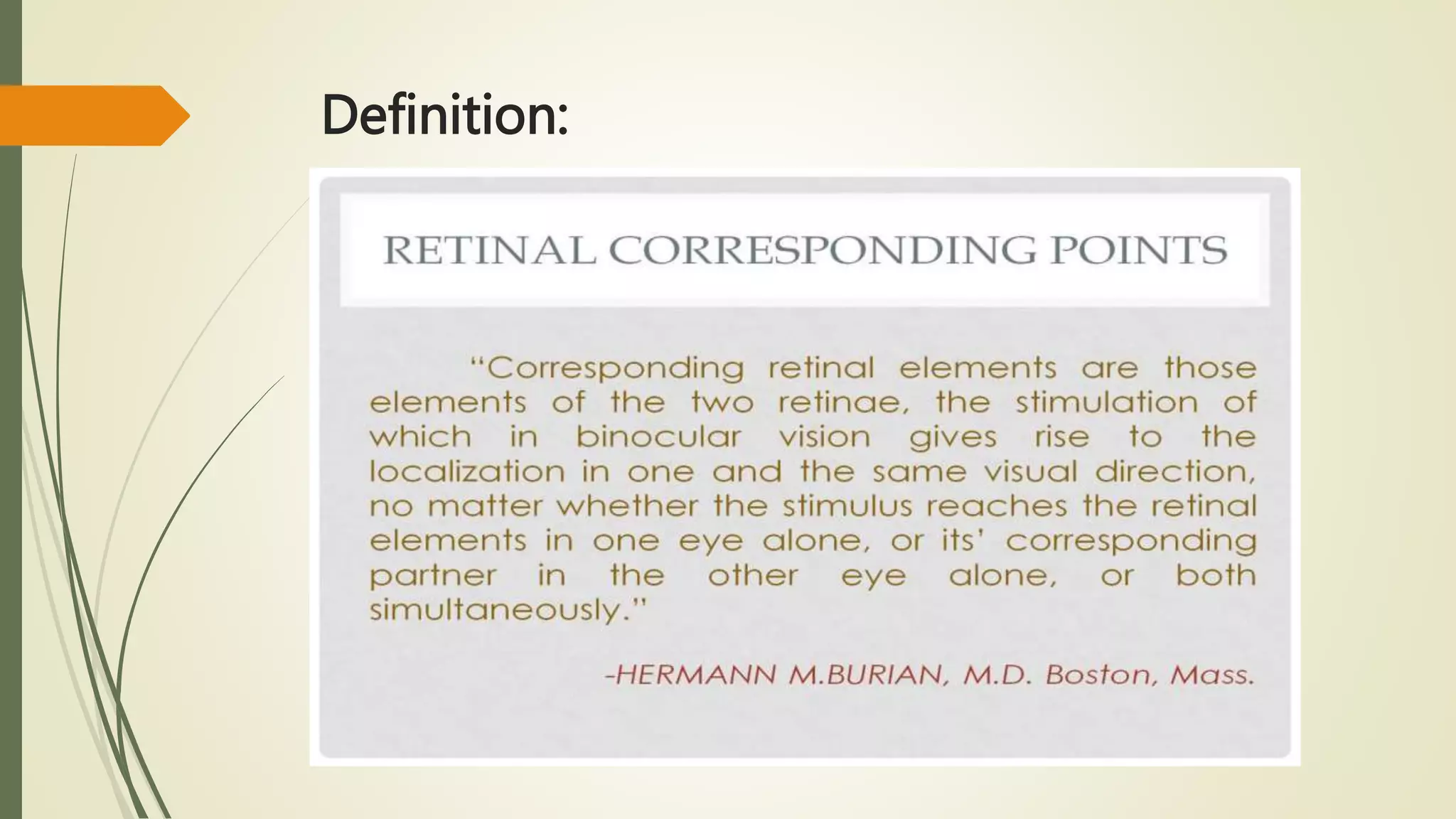
⮚ Two points (or small areas), one in each retina, which when
simultaneously stimulated give rise to the perception of a
single object.
⮚ These points share a common subjective visual direction.
⮚ Image falling on corresponding points give rise to a single
mental impression to visual direction.
⮚ Example: Fovea of two eyes.
Definition:
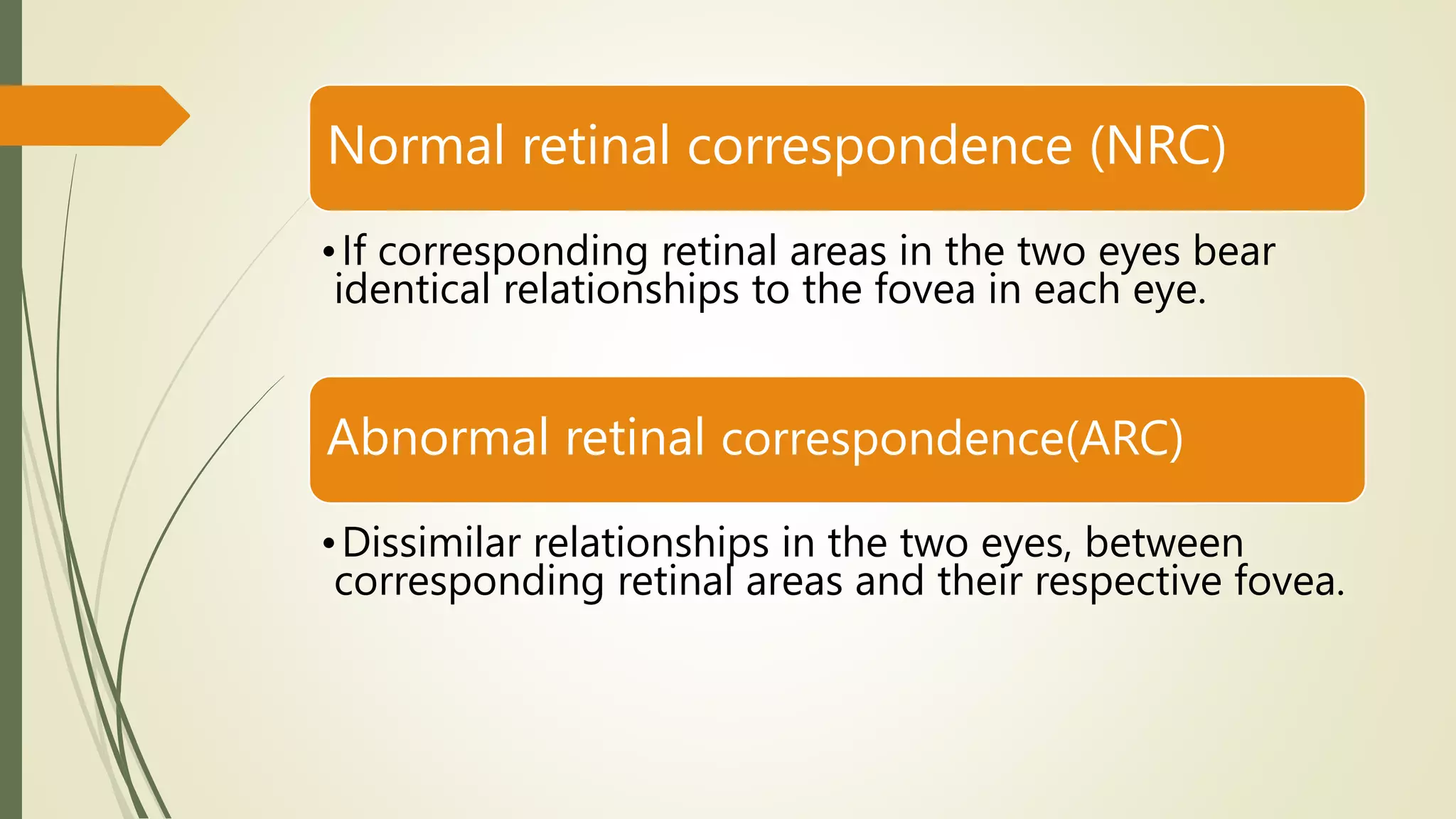
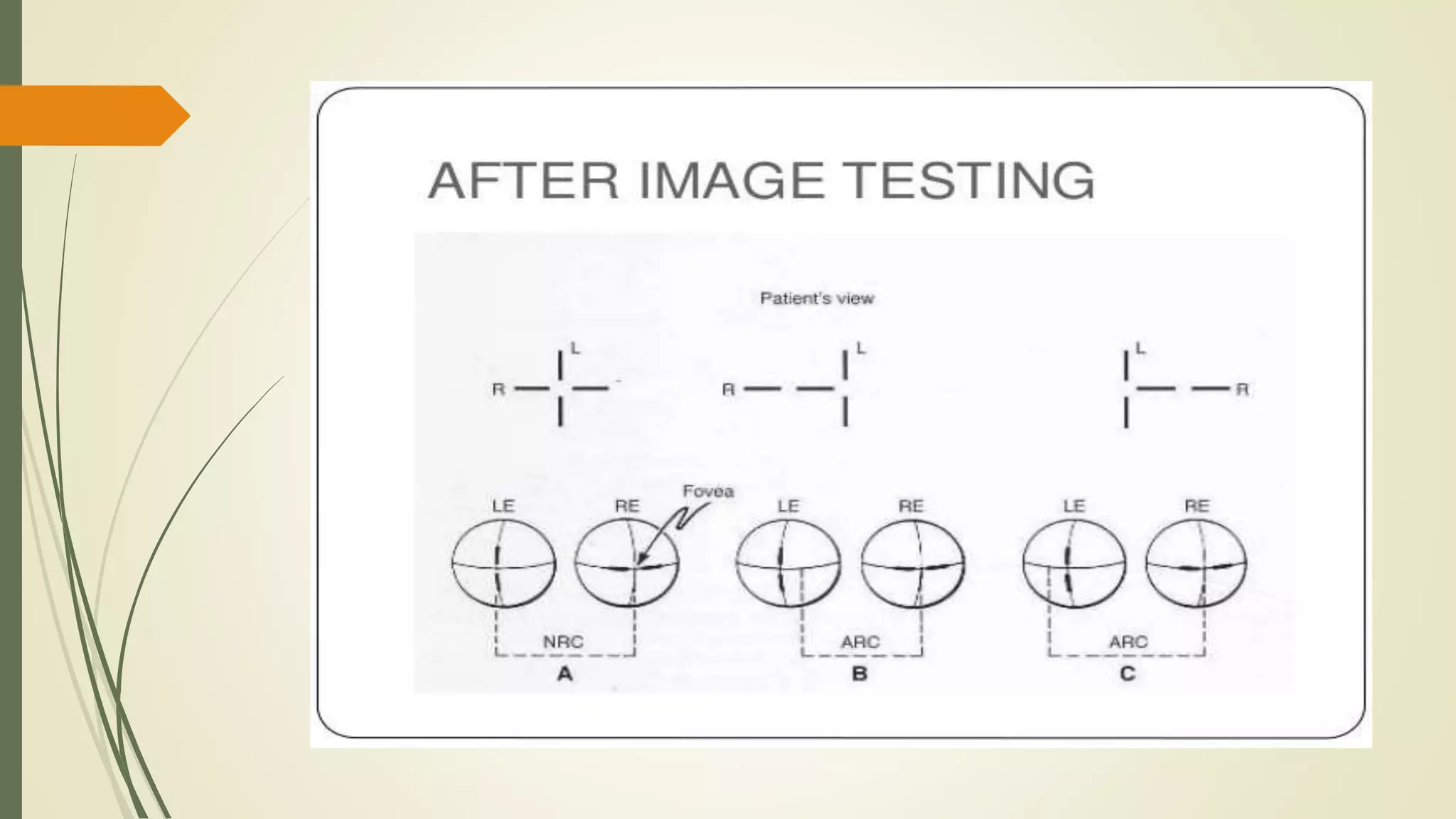
Normal retinal correspondence (NRC)
•If corresponding retinal areas in the two eyes bear
identical relationships to the fovea in each eye.
Abnormal retinal correspondence(ARC)
•Dissimilar relationships in the two eyes, between
corresponding retinal areas and their respective fovea.
⮚ Corresponding retinal points are principal points of two retina
that give rise in binocular vision.
⮚ Single vision is the hallmark of retinal correspondence.
Tests for retinal correspondence:
⮚ Worth’s four dot test
⮚ Bagolini striated glasses test
⮚ After image test
⮚ Red filter test
HOROPTER:
⮚ The term horopter was introduced by Franciscus Aguilonius in
1613 A.D.
⮚ Literally means the horizon of vision.
⮚ Derived from two Greek words horos and opter.
horos = limit
horopter
opter = person who looks
CONTINUED:
⮚ Horopter is defined as the locus of all object
point that are imaged on corresponding
retinal elements at a given fixing distance.
⮚ In other words, the horopter can be defined
as the sum of total points in physical space
that stimulate corresponding retinal elements
of the two eyes.
CONTINUED:
⮚ It is an imaginary surface (usually slightly curved either
concave or convex towards the observer), centered on the
fixation point that moves with eye.
⮚ Shape of horopter according
to fixation distance:
▪ For abathic distance- 1m
Frontoparallel plane
▪ Beyond 1m
convex for observer
▪ Near than 1m
concave for observer
CONTINUED:
❖ Geometrical /Theoretical Horopter Curve:
-Horizontal (Vieth Muller Circle)
-Vertical
❖ Empirical Horopter:
-Horizontal
-Vertical
Vieth Muller Circle(VMC):
 A theoretical circle in
space in front of an
observer containing
points that falls on
corresponding retinal
locations in the two eyes
when a point in a circle
is fixated.
Vertical Geometric Horopter:
 The straight line on the sagittal plane and passing through
the intersection between the sagittal plane and the vieth
Muller circle(typically if the observer fixates straight ahead,
but not necessarily)
Empirical Horopter:
 Actual experimental determination of the horopter curve.
 Flatter than the theoretical horopter.
 Distribution of the corresponding elements are nor the same
in the nasal and temporal part of the retina.
 Shape varies to person to person i.e, each person has his
personal horopter.
HERING-HILLEBRAND DEVIATION:
 The Hering-Hillebrand
deviation describes the
mismatch between the
theoretical and empirical
horopter.
 When the horopter is
determined experimentally, The
Hering-Hillebrand deviation
describes the fact that the
empirical horopter does not fall
on the geometrical horopter.
MEASURING HOROPTER:
PANUM’S FUSIONAL AREA:
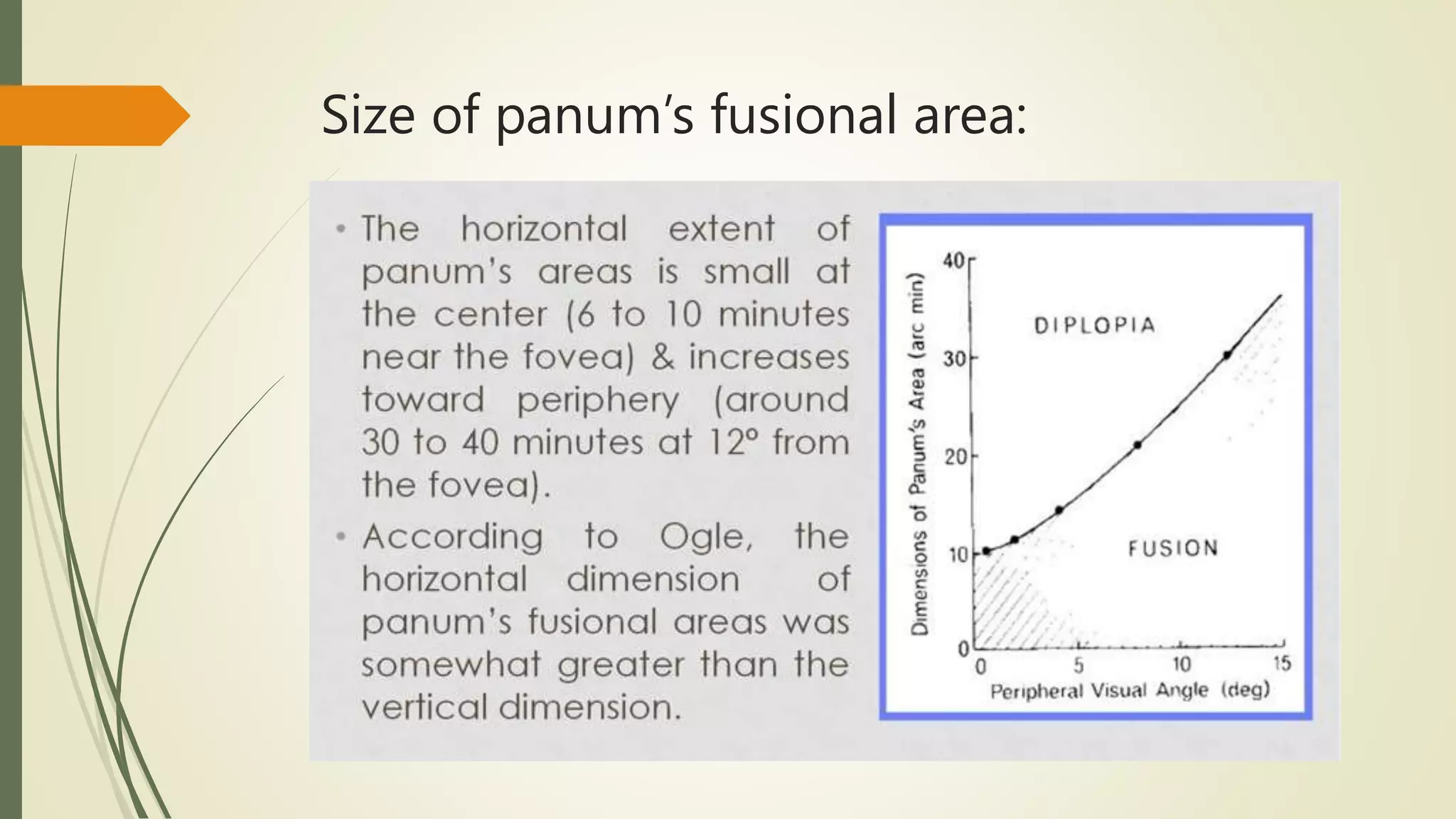
⮚ Panum, the Danish physiologist first reported this phenomenon.
⮚ Panum’s area: The retinal area surrounding the corresponding retinal
points within which BSV can be maintained.
⮚ Panum’s space: A narrow band around the horopter within which
object gives rise to BSV.
Size of panum’s fusional area:
Illustration:
In this diagram, both eyes are looking at the red dot, the fixation object. The lines
from the dot show the direction the light goes from the object to where it falls on the
foveae of both eyes. The fovea is indicated by the small dot in the middle of each
retina. The green dot, the disparity object. It does not fall on the foveae of the two
eyes. The bright blue arc is the horopter. The dark blue area around the horopter
is Panum's area of fusion. Source: https://isle.hanover.edu
⮚ When the disparity object is inside of Panum's
area of fusion, the image is fused and we have
a single percept of the object.
⮚ When the object is outside of Panum's area of
fusion, we can see two images of the object.
That is double vision or diplopia.
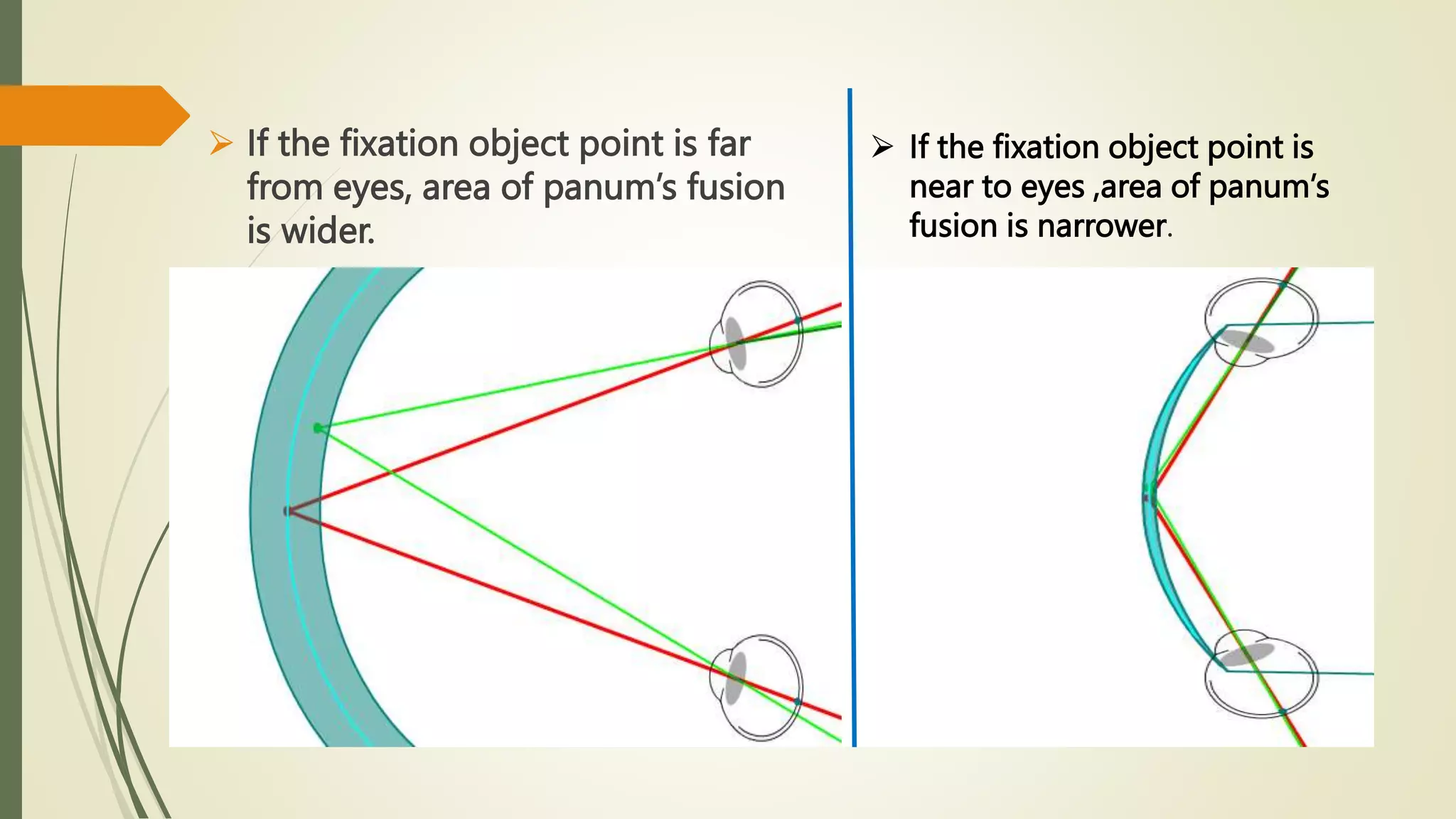
⮚ If the fixation object point is
near to eyes ,area of panum’s
fusion is narrower.
⮚ If the fixation object point is far
from eyes, area of panum’s fusion
is wider.
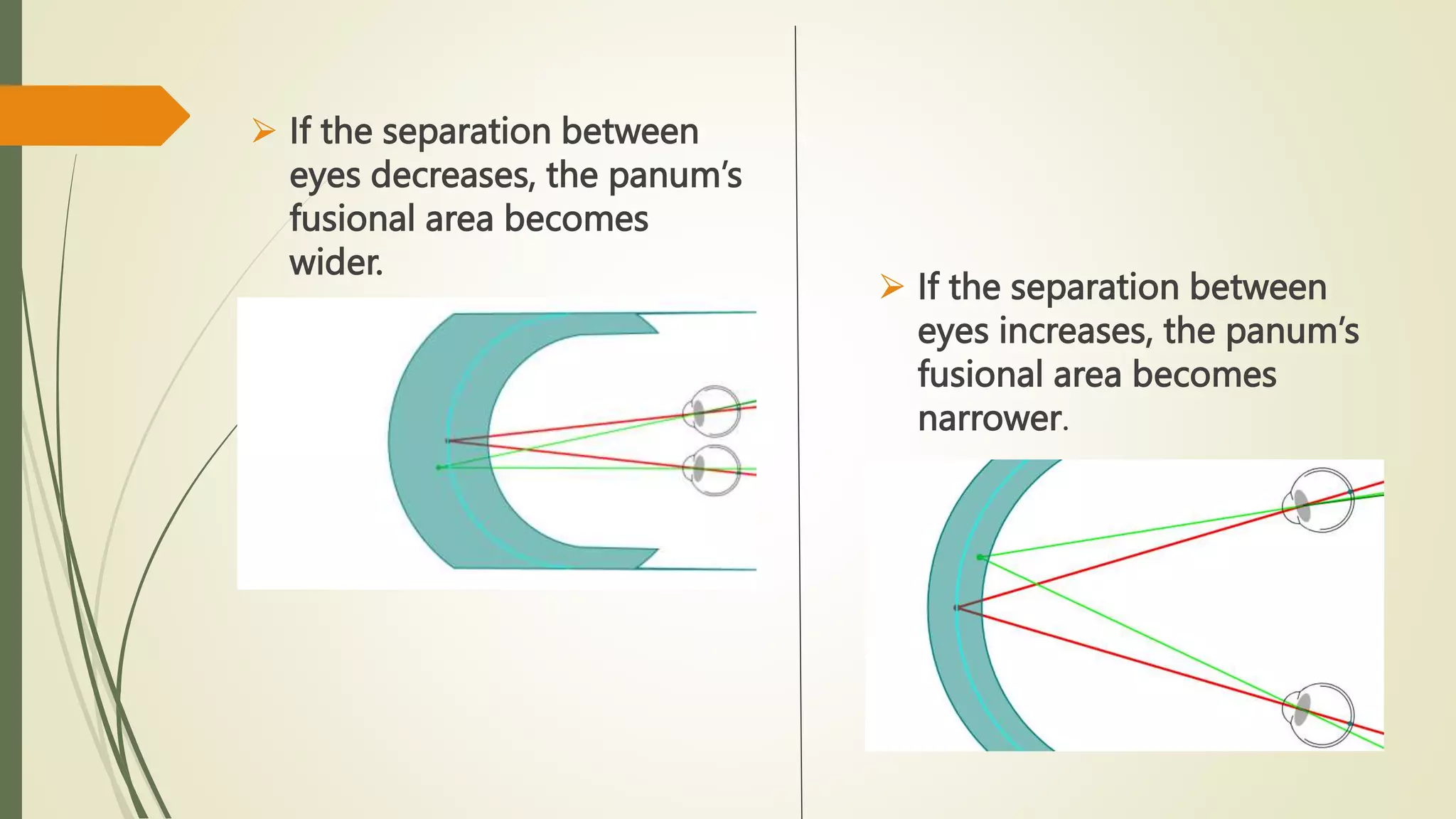
⮚ If the separation between
eyes decreases, the panum’s
fusional area becomes
wider.
⮚ If the separation between
eyes increases, the panum’s
fusional area becomes
narrower.
FIXATION DISPARITY:
 Fixation disparity is a small error in the visual system.
 Fixation disparity exists when there is a small misalignment of
the eyes when viewing with binocular vision. The misalignment
may be vertical, horizontal or both
 The misalignment (a few minutes of arc) is much smaller than
that of strabismus, which prevents binocular vision, although it
may reduce a patient's level of stereopsis.
 It doesn't give rise to diplopia because the disparity with which
the fixation point is imaged on the two retinae is less than the
size of panum’s fusional area.
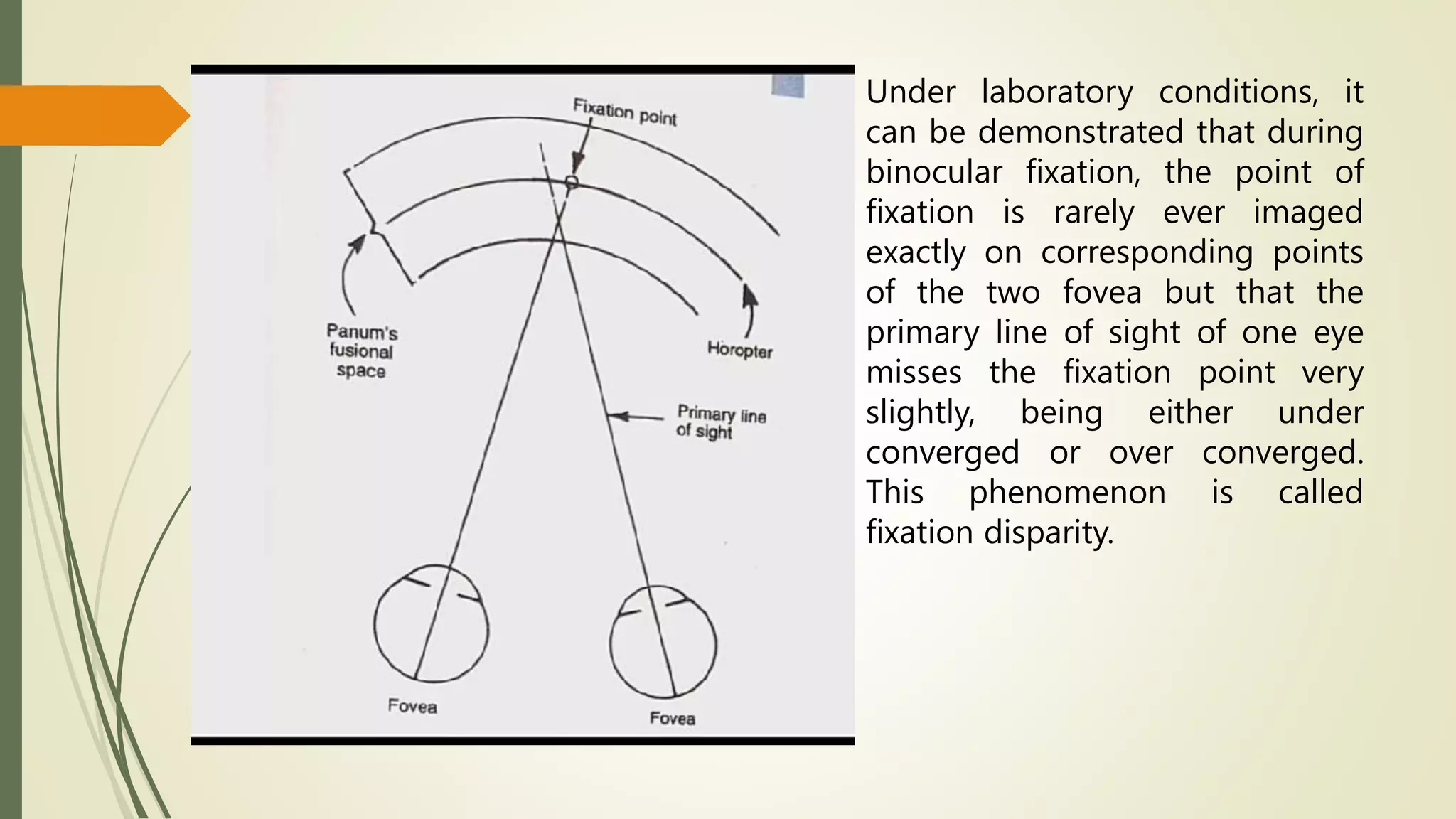
Under laboratory conditions, it
can be demonstrated that during
binocular fixation, the point of
fixation is rarely ever imaged
exactly on corresponding points
of the two fovea but that the
primary line of sight of one eye
misses the fixation point very
slightly, being either under
converged or over converged.
This phenomenon is called
fixation disparity.
Definition:
 Fixation disparity can be defined as the condition in which the
image of binocularly fixed object are not imaged on exactly
corresponding retinal points but are still within panum’s
fusional area.
NOTE: A patient may or may not have fixation disparity and a
patient may have a different fixation disparity at distance than
near.
History:
Types:
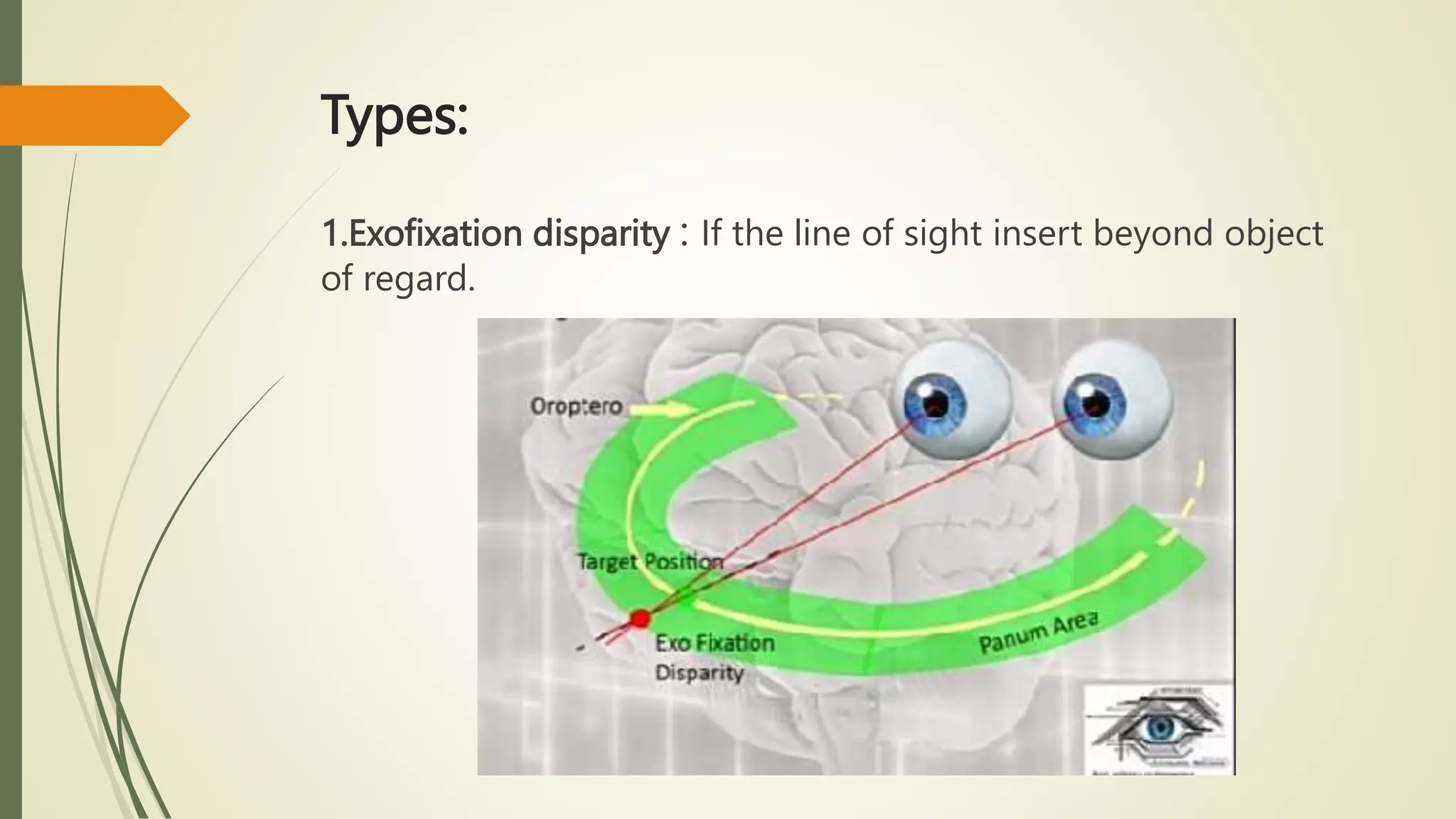
1.Exofixation disparity : If the line of sight insert beyond object
of regard.
2.Esofixation disparity : If the line of sight intersect before object
of regard.
3. Hyperfixation disparity: If the line of sight intersect above object
of regard.
4. Hypofixation disparity: If the line of sight intersect beyond object
of regard.
Fixation disparity curve:
 A fixation disparity curve is an x, y coordinate plot of the angular amount of FD in
minute of arc as a function of the amount of prism through which the patient views.
Components of FD curve:
the horizontal axis intercept
(associated phoria)
The vertical axis intercept
(FD amount)
Slope at the vertical axis intercept
The centre of symmetry
Shape / type of curve
In the commonly used classification system of ogle et al, FDCs are
categorized as type I, II, III and IV
TYPE I:
• Present in about 55% of the population.
• The curve has vertically ascending and descending segments that asymptote on the
base-in and base-out sides and a relatively flat central portion.
• Patients are usually asymptomatic.
Type II:
• Present in about 30% population.
• A curve is flat on the base out side
and ascends in base-in side.
• Most type II occurs with esophoria.
Type III:
• Present in about 10% of
population.
• The curve is flat on the
base-in side and descends
on the base-out side.
• Most often found in high
exophoria
Type IV:
• Present in person with unstable
binocularity.
• The curve is flat on the base-in
and base-out sides and has a
higher slope in the central
portion.
• Seen in poorly developed
binocular coordination.
Measurement of fixation disparity:
There are several methods to quantify fixation disparity.
They are:
1.Mallett card
2.The Bernell lantern slide,
3.The Wesson Card
4.The Disparometer
Mallet fixation disparity test:
Associated Phoria:
References :
 Squint and orthopics -A.K. khurana
 Anatomy and physiology of eye – A.K. Khurana
 Clinical procedure in optometry
 Slideshare
 internet
MECHANISMS AND TERMINOLOGIES IN BINOCULAR VISION.pptx

MECHANISMS AND TERMINOLOGIES IN BINOCULAR VISION.pptx

  • 1.
    MECHANISMS AND TERMINOLOGIESIN BINOCULAR VISION MODERATOR: Mr. Pankaj Ray Adhikari PRESENTANTED BY: Kajal Bhagat 2nd batch BOVS ,NAMS Biratnagar Eye Hospital
  • 2.
    CONTENT: ▪ Corresponding retinalpoints ▪ Horopter ▪ Panum’s fusional area ▪ Fixation disparity ▪ Associated phorias
  • 3.
    Corresponding retinal points: INTRODUCTION: ⮚Two points (or small areas), one in each retina, which when simultaneously stimulated give rise to the perception of a single object. ⮚ These points share a common subjective visual direction. ⮚ Image falling on corresponding points give rise to a single mental impression to visual direction. ⮚ Example: Fovea of two eyes.
  • 5.
  • 6.
    Normal retinal correspondence(NRC) •If corresponding retinal areas in the two eyes bear identical relationships to the fovea in each eye. Abnormal retinal correspondence(ARC) •Dissimilar relationships in the two eyes, between corresponding retinal areas and their respective fovea.
  • 7.
    ⮚ Corresponding retinalpoints are principal points of two retina that give rise in binocular vision. ⮚ Single vision is the hallmark of retinal correspondence.
  • 8.
    Tests for retinalcorrespondence: ⮚ Worth’s four dot test ⮚ Bagolini striated glasses test ⮚ After image test ⮚ Red filter test
  • 12.
    HOROPTER: ⮚ The termhoropter was introduced by Franciscus Aguilonius in 1613 A.D. ⮚ Literally means the horizon of vision. ⮚ Derived from two Greek words horos and opter. horos = limit horopter opter = person who looks
  • 13.
    CONTINUED: ⮚ Horopter isdefined as the locus of all object point that are imaged on corresponding retinal elements at a given fixing distance. ⮚ In other words, the horopter can be defined as the sum of total points in physical space that stimulate corresponding retinal elements of the two eyes.
  • 14.
    CONTINUED: ⮚ It isan imaginary surface (usually slightly curved either concave or convex towards the observer), centered on the fixation point that moves with eye. ⮚ Shape of horopter according to fixation distance: ▪ For abathic distance- 1m Frontoparallel plane ▪ Beyond 1m convex for observer ▪ Near than 1m concave for observer
  • 15.
    CONTINUED: ❖ Geometrical /TheoreticalHoropter Curve: -Horizontal (Vieth Muller Circle) -Vertical ❖ Empirical Horopter: -Horizontal -Vertical
  • 16.
    Vieth Muller Circle(VMC): A theoretical circle in space in front of an observer containing points that falls on corresponding retinal locations in the two eyes when a point in a circle is fixated.
  • 17.
    Vertical Geometric Horopter: The straight line on the sagittal plane and passing through the intersection between the sagittal plane and the vieth Muller circle(typically if the observer fixates straight ahead, but not necessarily)
  • 18.
    Empirical Horopter:  Actualexperimental determination of the horopter curve.  Flatter than the theoretical horopter.  Distribution of the corresponding elements are nor the same in the nasal and temporal part of the retina.  Shape varies to person to person i.e, each person has his personal horopter.
  • 19.
    HERING-HILLEBRAND DEVIATION:  TheHering-Hillebrand deviation describes the mismatch between the theoretical and empirical horopter.  When the horopter is determined experimentally, The Hering-Hillebrand deviation describes the fact that the empirical horopter does not fall on the geometrical horopter.
  • 20.
  • 21.
    PANUM’S FUSIONAL AREA: ⮚Panum, the Danish physiologist first reported this phenomenon. ⮚ Panum’s area: The retinal area surrounding the corresponding retinal points within which BSV can be maintained. ⮚ Panum’s space: A narrow band around the horopter within which object gives rise to BSV.
  • 22.
    Size of panum’sfusional area:
  • 23.
    Illustration: In this diagram,both eyes are looking at the red dot, the fixation object. The lines from the dot show the direction the light goes from the object to where it falls on the foveae of both eyes. The fovea is indicated by the small dot in the middle of each retina. The green dot, the disparity object. It does not fall on the foveae of the two eyes. The bright blue arc is the horopter. The dark blue area around the horopter is Panum's area of fusion. Source: https://isle.hanover.edu
  • 24.
    ⮚ When thedisparity object is inside of Panum's area of fusion, the image is fused and we have a single percept of the object. ⮚ When the object is outside of Panum's area of fusion, we can see two images of the object. That is double vision or diplopia.
  • 25.
    ⮚ If thefixation object point is near to eyes ,area of panum’s fusion is narrower. ⮚ If the fixation object point is far from eyes, area of panum’s fusion is wider.
  • 26.
    ⮚ If theseparation between eyes decreases, the panum’s fusional area becomes wider. ⮚ If the separation between eyes increases, the panum’s fusional area becomes narrower.
  • 27.
    FIXATION DISPARITY:  Fixationdisparity is a small error in the visual system.  Fixation disparity exists when there is a small misalignment of the eyes when viewing with binocular vision. The misalignment may be vertical, horizontal or both  The misalignment (a few minutes of arc) is much smaller than that of strabismus, which prevents binocular vision, although it may reduce a patient's level of stereopsis.  It doesn't give rise to diplopia because the disparity with which the fixation point is imaged on the two retinae is less than the size of panum’s fusional area.
  • 28.
    Under laboratory conditions,it can be demonstrated that during binocular fixation, the point of fixation is rarely ever imaged exactly on corresponding points of the two fovea but that the primary line of sight of one eye misses the fixation point very slightly, being either under converged or over converged. This phenomenon is called fixation disparity.
  • 29.
    Definition:  Fixation disparitycan be defined as the condition in which the image of binocularly fixed object are not imaged on exactly corresponding retinal points but are still within panum’s fusional area. NOTE: A patient may or may not have fixation disparity and a patient may have a different fixation disparity at distance than near.
  • 30.
  • 31.
    Types: 1.Exofixation disparity :If the line of sight insert beyond object of regard.
  • 32.
    2.Esofixation disparity :If the line of sight intersect before object of regard.
  • 33.
    3. Hyperfixation disparity:If the line of sight intersect above object of regard.
  • 34.
    4. Hypofixation disparity:If the line of sight intersect beyond object of regard.
  • 35.
    Fixation disparity curve: A fixation disparity curve is an x, y coordinate plot of the angular amount of FD in minute of arc as a function of the amount of prism through which the patient views. Components of FD curve: the horizontal axis intercept (associated phoria) The vertical axis intercept (FD amount) Slope at the vertical axis intercept The centre of symmetry Shape / type of curve
  • 36.
    In the commonlyused classification system of ogle et al, FDCs are categorized as type I, II, III and IV TYPE I: • Present in about 55% of the population. • The curve has vertically ascending and descending segments that asymptote on the base-in and base-out sides and a relatively flat central portion. • Patients are usually asymptomatic.
  • 37.
    Type II: • Presentin about 30% population. • A curve is flat on the base out side and ascends in base-in side. • Most type II occurs with esophoria.
  • 38.
    Type III: • Presentin about 10% of population. • The curve is flat on the base-in side and descends on the base-out side. • Most often found in high exophoria
  • 39.
    Type IV: • Presentin person with unstable binocularity. • The curve is flat on the base-in and base-out sides and has a higher slope in the central portion. • Seen in poorly developed binocular coordination.
  • 40.
    Measurement of fixationdisparity: There are several methods to quantify fixation disparity. They are: 1.Mallett card 2.The Bernell lantern slide, 3.The Wesson Card 4.The Disparometer
  • 41.
  • 42.
  • 43.
    References :  Squintand orthopics -A.K. khurana  Anatomy and physiology of eye – A.K. Khurana  Clinical procedure in optometry  Slideshare  internet