By :
Pankaj gola
(2k11/se/047)
Vikas sharma
(2k11/se/085)
Ravi kumar
(2k11/se/057)
Akhilesh
(2k10/se/008)
SOFTWARE
COMPONENT MODEL
-CORBA MODEL-
Component-based software engineering
(CBSE) (also known as component-based
development (CBD)) is a branch of software
engineering that emphasizes the separation
of concerns in respect of the wide-ranging
functionality available throughout a given
software system.
COMPONENT BASED SOFTWARE
ENGINEERING(CBSE)
 “A software component is a unit of composition with
contractually specified interfaces and explicit context
dependencies only. A software component can be deployed
independently and is subject to composition by third
parties.”
 Unit of composition – combine components to build
systems
 Binary units – black boxes, not source code
 Contractually specified interfaces – mechanism for
interface definition, such as Interface Definition
Language
 Independent production – separation of concerns
 Deployed and composed by third parties – reusable units
assembled like parts supplied by manufacturers
-1996 European Conference on Object-Oriented
Programming
SOFTWARE COMPONENTS
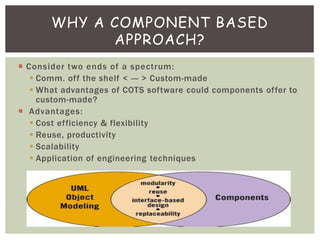
 Consider two ends of a spectrum:
 Comm. off the shelf < --- > Custom-made
 What advantages of COTS software could components offer to
custom-made?
 Advantages:
 Cost efficiency & flexibility
 Reuse, productivity
 Scalability
 Application of engineering techniques
WHY A COMPONENT BASED
APPROACH?
CBSE
models
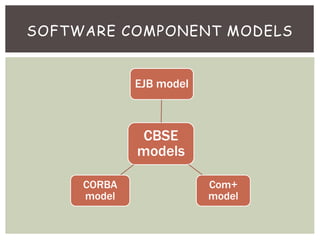
EJB model
Com+
model
CORBA
model
SOFTWARE COMPONENT MODELS
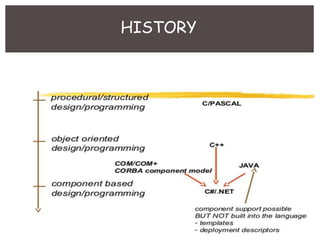
HISTORY
 Common Object Request Broker Architecture
 Created by Object Management Group (consortium of 700+
companies)
 Defines how distributed, heterogeneous objects can interoperate
 Location Transparency
 Client has no idea where object resides, where it is local or remote
 Objects
 Gives object-oriented benefits at a higher level
 E.g. encapsulation – must access through IDL, polymorphism,
inheritance of interfaces, exception handling
 Portable
 across platforms, languages, networks
 Standard
CORBA MODEL
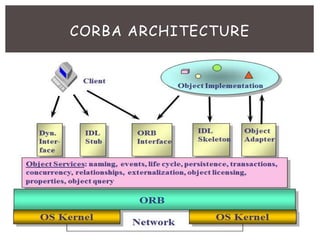
 Interface Definition Language (IDL)
 Similar to interfaces in Java or C++ abstract classes
 Defines protocol to be used between devices
 Allows “wrappers” for legacy systems
 Application Programming Interface (API)
 Ensures consistency for clients and CORBA objects (in theory)
 Object Request Broker (ORB)
 Middleware establishing client/server relationship
 Allows transparent invocation of methods
 Intercepts calls, and deals with them
 Find an object that can implement the request, pass it the parameters,
invoke its method, and return the results
 Client remains ignorant of how calls are dealt with
CORBA ARCHITECTURE
CORBA ARCHITECTURE
 interface Stock {
 double price ();
 readonly attribute string symbol;
 readonly attribute string full_name;
 };
 interface Stock_Factory {
 Stock get_stock (in string stock_symbol)
 raises (Invalid_Stock_Symbol);
 };
 What feature does this look like from another language? Why?
IDL INTERFACE FOR QUOTER
 In Client.cpp:
 int main (int argc, char* argv[])
 {
 try {
 //First initialize the ORB...
 CORBA::ORB_var orb = CORBA::ORB_init(argc,argv,""/*ORB
name*/);
 //Get reference to desired object and call methods to this
object
 orb->destroy(); //Done, free orb resources
 }
 catch (CORBA::Exception &ex) {
 std::cerr << "CORBA exception raised!" << std::endl;
 }
 return 0;
 }
CLIENT - MANAGE ORB IN STOCK
QUOTER
 In Client.cpp:
 #include "QuoterC.h”
 //Get reference to desired object
CORBA::Object_var factory_object =
orb->string_to_object(argv[1]);
 //Call methods through this object
Quoter::Stock_Factory_var factory = //Get a factory
Quoter::Stock_Factory::_narrow(factory_object.in
());
 for (int i = 2; i != argc; ++i) {
try { //Get the stock object
Quoter::Stock_var stock = factory-
>get_stock(argv[i]);
 }
 }
CLIENT - GET QUOTER OBJECT
REFERENCE
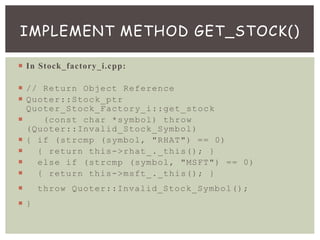
 In Stock_factory_i.cpp:
 // Return Object Reference
 Quoter::Stock_ptr
Quoter_Stock_Factory_i::get_stock
 (const char *symbol) throw
(Quoter::Invalid_Stock_Symbol)
 { if (strcmp (symbol, "RHAT") == 0)
 { return this->rhat_._this(); }
 else if (strcmp (symbol, "MSFT") == 0)
 { return this->msft_._this(); }
 throw Quoter::Invalid_Stock_Symbol();
 }
IMPLEMENT METHOD GET_STOCK()
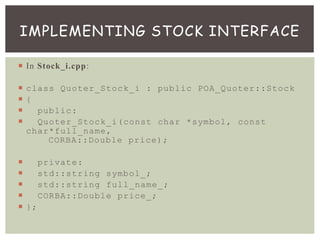
 In Stock_i.cpp:
 class Quoter_Stock_i : public POA_Quoter::Stock
 {
 public:
 Quoter_Stock_i(const char *symbol, const
char*full_name,
CORBA::Double price);
 private:
 std::string symbol_;
 std::string full_name_;
 CORBA::Double price_;
 };
IMPLEMENTING STOCK INTERFACE
 int main (int argc, char* argv[])
 { try
 { // First initialize the ORB
 CORBA::ORB_var orb = CORBA::ORB_init(argc,argv,""/*ORB name
*/);
 CORBA::Object_var poa_object =
 orb->resolve_initial_references ("RootPOA");
 PortableServer::POA_var poa =
 PortableServer::POA::_narrow (poa_object.in ());
 PortableServer::POAManager_var poa_manager =
 poa->the_POAManager ();
 poa_manager->activate ();

 //The application code goes here!
 //Clean up the server objects (wait until destruction is done)
 poa->destroy(1, 1); orb->destroy();
 }
 catch (CORBA::Exception &ex)
{ std::cerr << "CORBA exception raised!" << std::endl; }
 return 0;
}
IMPLEMENT SERVER
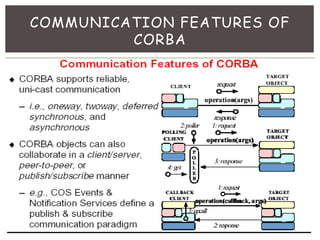
COMMUNICATION FEATURES OF
CORBA
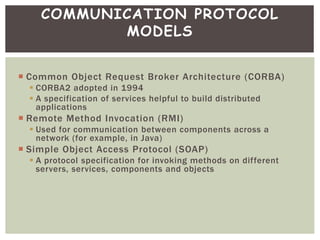
 Common Object Request Broker Architecture (CORBA)
 CORBA2 adopted in 1994
 A specification of services helpful to build distributed
applications
 Remote Method Invocation (RMI)
 Used for communication between components across a
network (for example, in Java)
 Simple Object Access Protocol (SOAP)
 A protocol specification for invoking methods on different
servers, services, components and objects
COMMUNICATION PROTOCOL
MODELS
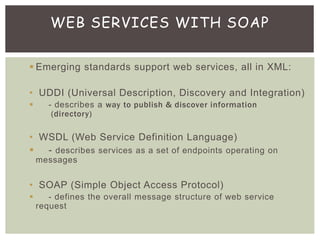
 Emerging standards support web services, all in XML:
• UDDI (Universal Description, Discovery and Integration)
 - describes a way to publish & discover information
(directory)
• WSDL (Web Service Definition Language)
 - describes services as a set of endpoints operating on
messages
• SOAP (Simple Object Access Protocol)
 - defines the overall message structure of web service
request
WEB SERVICES WITH SOAP
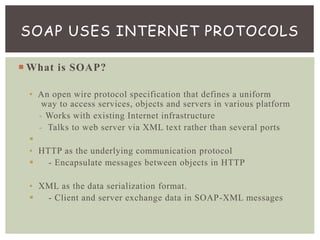
 What is SOAP?
• An open wire protocol specification that defines a uniform
way to access services, objects and servers in various platform
- Works with existing Internet infrastructure
- Talks to web server via XML text rather than several ports

• HTTP as the underlying communication protocol
 - Encapsulate messages between objects in HTTP
• XML as the data serialization format.
 - Client and server exchange data in SOAP-XML messages
SOAP USES INTERNET PROTOCOLS
[FROM WHAT THE HECK IS SOAP
ANYWAY BY DAVID PLATT ]
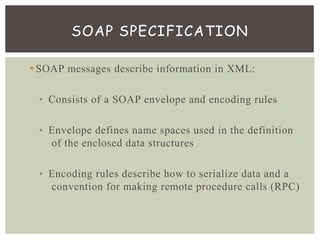
SOAP messages describe information in XML:
• Consists of a SOAP envelope and encoding rules
• Envelope defines name spaces used in the definition
of the enclosed data structures
• Encoding rules describe how to serialize data and a
convention for making remote procedure calls (RPC)
SOAP SPECIFICATION
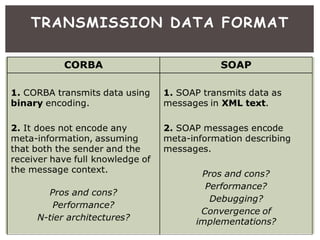
TRANSMISSION DATA FORMAT
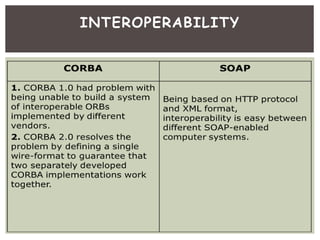
INTEROPERABILITY
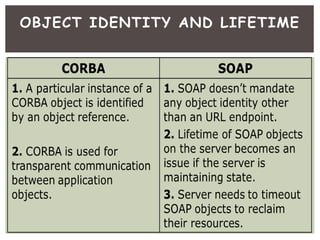
OBJECT IDENTITY AND LIFETIME
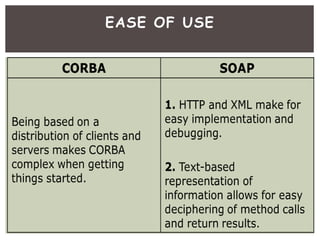
EASE OF USE
Thank you
 Wikipedia
 Google
REFERENCES

Corba model ppt

  • 1.
    By : Pankaj gola (2k11/se/047) Vikassharma (2k11/se/085) Ravi kumar (2k11/se/057) Akhilesh (2k10/se/008) SOFTWARE COMPONENT MODEL -CORBA MODEL-
  • 2.
    Component-based software engineering (CBSE)(also known as component-based development (CBD)) is a branch of software engineering that emphasizes the separation of concerns in respect of the wide-ranging functionality available throughout a given software system. COMPONENT BASED SOFTWARE ENGINEERING(CBSE)
  • 3.
     “A softwarecomponent is a unit of composition with contractually specified interfaces and explicit context dependencies only. A software component can be deployed independently and is subject to composition by third parties.”  Unit of composition – combine components to build systems  Binary units – black boxes, not source code  Contractually specified interfaces – mechanism for interface definition, such as Interface Definition Language  Independent production – separation of concerns  Deployed and composed by third parties – reusable units assembled like parts supplied by manufacturers -1996 European Conference on Object-Oriented Programming SOFTWARE COMPONENTS
  • 4.
     Consider twoends of a spectrum:  Comm. off the shelf < --- > Custom-made  What advantages of COTS software could components offer to custom-made?  Advantages:  Cost efficiency & flexibility  Reuse, productivity  Scalability  Application of engineering techniques WHY A COMPONENT BASED APPROACH?
  • 5.
  • 6.
  • 7.
     Common ObjectRequest Broker Architecture  Created by Object Management Group (consortium of 700+ companies)  Defines how distributed, heterogeneous objects can interoperate  Location Transparency  Client has no idea where object resides, where it is local or remote  Objects  Gives object-oriented benefits at a higher level  E.g. encapsulation – must access through IDL, polymorphism, inheritance of interfaces, exception handling  Portable  across platforms, languages, networks  Standard CORBA MODEL
  • 8.
     Interface DefinitionLanguage (IDL)  Similar to interfaces in Java or C++ abstract classes  Defines protocol to be used between devices  Allows “wrappers” for legacy systems  Application Programming Interface (API)  Ensures consistency for clients and CORBA objects (in theory)  Object Request Broker (ORB)  Middleware establishing client/server relationship  Allows transparent invocation of methods  Intercepts calls, and deals with them  Find an object that can implement the request, pass it the parameters, invoke its method, and return the results  Client remains ignorant of how calls are dealt with CORBA ARCHITECTURE
  • 9.
  • 10.
     interface Stock{  double price ();  readonly attribute string symbol;  readonly attribute string full_name;  };  interface Stock_Factory {  Stock get_stock (in string stock_symbol)  raises (Invalid_Stock_Symbol);  };  What feature does this look like from another language? Why? IDL INTERFACE FOR QUOTER
  • 11.
     In Client.cpp: int main (int argc, char* argv[])  {  try {  //First initialize the ORB...  CORBA::ORB_var orb = CORBA::ORB_init(argc,argv,""/*ORB name*/);  //Get reference to desired object and call methods to this object  orb->destroy(); //Done, free orb resources  }  catch (CORBA::Exception &ex) {  std::cerr << "CORBA exception raised!" << std::endl;  }  return 0;  } CLIENT - MANAGE ORB IN STOCK QUOTER
  • 12.
     In Client.cpp: #include "QuoterC.h”  //Get reference to desired object CORBA::Object_var factory_object = orb->string_to_object(argv[1]);  //Call methods through this object Quoter::Stock_Factory_var factory = //Get a factory Quoter::Stock_Factory::_narrow(factory_object.in ());  for (int i = 2; i != argc; ++i) { try { //Get the stock object Quoter::Stock_var stock = factory- >get_stock(argv[i]);  }  } CLIENT - GET QUOTER OBJECT REFERENCE
  • 13.
     In Stock_factory_i.cpp: // Return Object Reference  Quoter::Stock_ptr Quoter_Stock_Factory_i::get_stock  (const char *symbol) throw (Quoter::Invalid_Stock_Symbol)  { if (strcmp (symbol, "RHAT") == 0)  { return this->rhat_._this(); }  else if (strcmp (symbol, "MSFT") == 0)  { return this->msft_._this(); }  throw Quoter::Invalid_Stock_Symbol();  } IMPLEMENT METHOD GET_STOCK()
  • 14.
     In Stock_i.cpp: class Quoter_Stock_i : public POA_Quoter::Stock  {  public:  Quoter_Stock_i(const char *symbol, const char*full_name, CORBA::Double price);  private:  std::string symbol_;  std::string full_name_;  CORBA::Double price_;  }; IMPLEMENTING STOCK INTERFACE
  • 15.
     int main(int argc, char* argv[])  { try  { // First initialize the ORB  CORBA::ORB_var orb = CORBA::ORB_init(argc,argv,""/*ORB name */);  CORBA::Object_var poa_object =  orb->resolve_initial_references ("RootPOA");  PortableServer::POA_var poa =  PortableServer::POA::_narrow (poa_object.in ());  PortableServer::POAManager_var poa_manager =  poa->the_POAManager ();  poa_manager->activate ();   //The application code goes here!  //Clean up the server objects (wait until destruction is done)  poa->destroy(1, 1); orb->destroy();  }  catch (CORBA::Exception &ex) { std::cerr << "CORBA exception raised!" << std::endl; }  return 0; } IMPLEMENT SERVER
  • 16.
  • 17.
     Common ObjectRequest Broker Architecture (CORBA)  CORBA2 adopted in 1994  A specification of services helpful to build distributed applications  Remote Method Invocation (RMI)  Used for communication between components across a network (for example, in Java)  Simple Object Access Protocol (SOAP)  A protocol specification for invoking methods on different servers, services, components and objects COMMUNICATION PROTOCOL MODELS
  • 18.
     Emerging standardssupport web services, all in XML: • UDDI (Universal Description, Discovery and Integration)  - describes a way to publish & discover information (directory) • WSDL (Web Service Definition Language)  - describes services as a set of endpoints operating on messages • SOAP (Simple Object Access Protocol)  - defines the overall message structure of web service request WEB SERVICES WITH SOAP
  • 19.
     What isSOAP? • An open wire protocol specification that defines a uniform way to access services, objects and servers in various platform - Works with existing Internet infrastructure - Talks to web server via XML text rather than several ports  • HTTP as the underlying communication protocol  - Encapsulate messages between objects in HTTP • XML as the data serialization format.  - Client and server exchange data in SOAP-XML messages SOAP USES INTERNET PROTOCOLS
  • 20.
    [FROM WHAT THEHECK IS SOAP ANYWAY BY DAVID PLATT ]
  • 21.
    SOAP messages describeinformation in XML: • Consists of a SOAP envelope and encoding rules • Envelope defines name spaces used in the definition of the enclosed data structures • Encoding rules describe how to serialize data and a convention for making remote procedure calls (RPC) SOAP SPECIFICATION
  • 22.
  • 23.
  • 24.
  • 25.
  • 26.
  • 27.