
SELECTING COTS VENDOR IN
CBSE PROCESS
THE POTENTIAL BENEFITS OF USING COTS ARE
INCREASED PRODUCT RELIABILITY AND STABILITY,
AT
SHORTER DEVELOPMENT TIME AND REDUCED
WHAT IS COTS ?
 Commercial-Off-The-Shelf
 There is no agreed definition
 “ COTS are products:
that are sold, leased or licensed to the general
public;
that is usually available without source code;
that is supported and evolved by the vendor
who returns the intellectual property rights ”
Software Engineering Institute
Need For Vendor Selection Process
In an effort to reduce implementation, operating, and
maintenance cost and time Commercial-Off-The-Shelf (COTS)
based software development has been considered as an
alternative strategy to in-house development. However, using
COTS packages introduces various burdens, including COTS
evaluation, assessment, familiarization, and vendor interaction.
The central problem is how to select a desirable COTS software
package vendor that can be easily incorporated into an existing
corporate information technology (IT) infrastructure.
COTS DEFINITION
 COTS Definition
software product, supplied by a vendor,
integrated into the system to provide
operational functionality
or delivered with the system to sustain
maintenance efforts.
 COTS encountered
Domain specific packages for attitude and
orbit determination, mission control, mission
planning
What Makes COTS-Based Systems
Challenging?
 COTS-based systems come in many forms
One substantial product (suite) tailored to
provide functionality
Multiple products from multiple suppliers
integrated with other components to
collectively provide functionality
 A solution based on COTS products includes
COTS-based system (composed of tailored
COTS products, other components, integration
code)
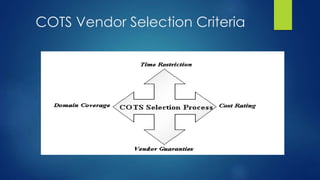
COTS Vendor Selection Criteria
Main Dimensions of COTS Selection
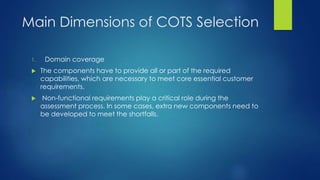
1. Domain coverage
 The components have to provide all or part of the required
capabilities, which are necessary to meet core essential customer
requirements.
 Non-functional requirements play a critical role during the
assessment process. In some cases, extra new components need to
be developed to meet the shortfalls.
2. Time Restriction
• Selection is a time consuming activity, where a
considerable amount of time is necessary to search
and screen all the potential COTS candidates.
3. Costs Rating
• The expenses when selecting COTS products will be
influenced by factors such as: license acquisition, cost
of support, adaptation expenses, and maintenance
prices.
4. Vendor Guaranties
• Vendor reputation and maturity, number and kind of
applications that already use the COTS, clauses
characteristics of the maintenance licenses.
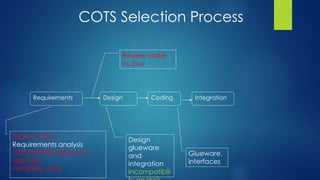
COTS Selection Process
Requirements Design Coding
Make vs. Buy
Requirements analysis
COTS identification and
selection
Feasibility study
Design
glueware
and
integration
Incompatibili
Integration
Glueware,
interfaces
Review make
vs. buy
COTS Vendor Selection Process
Phase 1: Form an Evaluation Team

 Identify team members (technical experts,
 subject matter experts, end users, etc.)
 Identify stakeholders (funding customers, business owners, etc).
Phase 2: Apply Team Non-Software Process
 Define objectives and goals
 Set timescale and effort needed
 Identify tasks to perform
 Determine due dates / milestones
 Identify risks, benefits, trade-offs
 Identify multiple strategies
 Present Plan to Stakeholders
 Agree on process of addressing issues discovered during project
Phase 3: Identify COTS criteria
 Gather the functional and non-functional requirements.
 Differentiate the “must-have” from the “nice-to-have” in the requirements
 Define selection criteria for Level I COTS filter
 Address the vendor qualification (reputation, financial status, ranking among competitors)
 Address product quality
 Address the inter-operable factors with regards to either the organization’s current IT
infrastructure or other third party components at a high level
 Address any pre-conception of the architecture of the system and the COTS software
package (e.g., it uses a middle-ware web server and a back-end database system)
Phase 4: Apply Level I Filter to COTS products
using published vendor information
 Obtain list of COTS software products to evaluate
 Obtain public information on the products
 Apply the Level I COTS filter to products
 Interview in-house developers and users, if applicable
 Perform analysis (trade-offs, and rank)
 Identify COTS candidates for further evaluation
 Develop Level II COTS filter
 Map feature requirements to product requirements
 Define measurable factors for each of the product requirements
 Create use case scenarios based on the functional requirements
Current problems with COTS-Based
Development
 Products from different vendors have to be integrated and tailored to provide
complete system functionality
 Customers have limited access to product´s internals design
 COTS lifecycle is determined by vendor.
The importance of the Selection
Process
 Includes the understanding of user requirements
 Careful analysis of the capabilities and limitations of each COTS
candidate
 Assessment of products´ quality
Selection Process Challenges
 Lack of well defined process
 Use of inappropriate evaluation criteria
 Back-box nature of COTS components
 Unclear system expectations
 Rapid rate of changes of COTS

Selecting cots vendor in cbse process

  • 1.
    SELECTING COTS VENDORIN CBSE PROCESS THE POTENTIAL BENEFITS OF USING COTS ARE INCREASED PRODUCT RELIABILITY AND STABILITY, AT SHORTER DEVELOPMENT TIME AND REDUCED
  • 2.
    WHAT IS COTS?  Commercial-Off-The-Shelf  There is no agreed definition  “ COTS are products: that are sold, leased or licensed to the general public; that is usually available without source code; that is supported and evolved by the vendor who returns the intellectual property rights ” Software Engineering Institute
  • 3.
    Need For VendorSelection Process In an effort to reduce implementation, operating, and maintenance cost and time Commercial-Off-The-Shelf (COTS) based software development has been considered as an alternative strategy to in-house development. However, using COTS packages introduces various burdens, including COTS evaluation, assessment, familiarization, and vendor interaction. The central problem is how to select a desirable COTS software package vendor that can be easily incorporated into an existing corporate information technology (IT) infrastructure.
  • 4.
    COTS DEFINITION  COTSDefinition software product, supplied by a vendor, integrated into the system to provide operational functionality or delivered with the system to sustain maintenance efforts.  COTS encountered Domain specific packages for attitude and orbit determination, mission control, mission planning
  • 5.
    What Makes COTS-BasedSystems Challenging?  COTS-based systems come in many forms One substantial product (suite) tailored to provide functionality Multiple products from multiple suppliers integrated with other components to collectively provide functionality  A solution based on COTS products includes COTS-based system (composed of tailored COTS products, other components, integration code)
  • 6.
  • 7.
    Main Dimensions ofCOTS Selection 1. Domain coverage  The components have to provide all or part of the required capabilities, which are necessary to meet core essential customer requirements.  Non-functional requirements play a critical role during the assessment process. In some cases, extra new components need to be developed to meet the shortfalls.
  • 8.
    2. Time Restriction •Selection is a time consuming activity, where a considerable amount of time is necessary to search and screen all the potential COTS candidates. 3. Costs Rating • The expenses when selecting COTS products will be influenced by factors such as: license acquisition, cost of support, adaptation expenses, and maintenance prices. 4. Vendor Guaranties • Vendor reputation and maturity, number and kind of applications that already use the COTS, clauses characteristics of the maintenance licenses.
  • 9.
    COTS Selection Process RequirementsDesign Coding Make vs. Buy Requirements analysis COTS identification and selection Feasibility study Design glueware and integration Incompatibili Integration Glueware, interfaces Review make vs. buy
  • 10.
    COTS Vendor SelectionProcess Phase 1: Form an Evaluation Team   Identify team members (technical experts,  subject matter experts, end users, etc.)  Identify stakeholders (funding customers, business owners, etc).
  • 11.
    Phase 2: ApplyTeam Non-Software Process  Define objectives and goals  Set timescale and effort needed  Identify tasks to perform  Determine due dates / milestones  Identify risks, benefits, trade-offs  Identify multiple strategies  Present Plan to Stakeholders  Agree on process of addressing issues discovered during project
  • 12.
    Phase 3: IdentifyCOTS criteria  Gather the functional and non-functional requirements.  Differentiate the “must-have” from the “nice-to-have” in the requirements  Define selection criteria for Level I COTS filter  Address the vendor qualification (reputation, financial status, ranking among competitors)  Address product quality  Address the inter-operable factors with regards to either the organization’s current IT infrastructure or other third party components at a high level  Address any pre-conception of the architecture of the system and the COTS software package (e.g., it uses a middle-ware web server and a back-end database system)
  • 13.
    Phase 4: ApplyLevel I Filter to COTS products using published vendor information  Obtain list of COTS software products to evaluate  Obtain public information on the products  Apply the Level I COTS filter to products  Interview in-house developers and users, if applicable  Perform analysis (trade-offs, and rank)  Identify COTS candidates for further evaluation  Develop Level II COTS filter  Map feature requirements to product requirements  Define measurable factors for each of the product requirements  Create use case scenarios based on the functional requirements
  • 14.
    Current problems withCOTS-Based Development  Products from different vendors have to be integrated and tailored to provide complete system functionality  Customers have limited access to product´s internals design  COTS lifecycle is determined by vendor.
  • 15.
    The importance ofthe Selection Process  Includes the understanding of user requirements  Careful analysis of the capabilities and limitations of each COTS candidate  Assessment of products´ quality
  • 16.
    Selection Process Challenges Lack of well defined process  Use of inappropriate evaluation criteria  Back-box nature of COTS components  Unclear system expectations  Rapid rate of changes of COTS