ppt24
1
Topics for today
 CORBA
 DCOM
2
CORBA (Common Object Request
Broker Architecture)
A specification or standard which specifies how objects
communicate with each other over a network.
It is a middleware based architecture
The ORB is the heart of the distributed component
architecture
Allows developers to define distributed component
architectures without worrying about the underlying network
Communications and programming language
Motivation behind CORBA
Distributed applications cause a lot of problems
• Participating systems may be heterogeneous
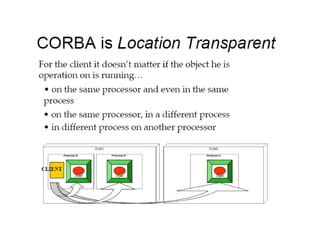
• Access to remote services has to be location transparent
• Remote objects have to be found and activated
• State of objects has to be kept persistent and consistent
• Security has to be dealt with
so we want an architecture that…
• …supports a remote method invocation paradigm
• …provides location transparency
• …allows to add, exchange, or remove services
dynamically
• …hides system details from the developer
The result is the CORBA architecture
What is CORBA?
• CORBA is a standard (not a product!)
• allows objects to transparently make requests and
receive responses
• enables interoperability between different applications
• 􀂃 on different machines
• 􀂃 in heterogeneously distributed environments
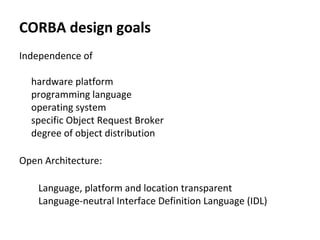
CORBA design goals
Independence of
hardware platform
programming language
operating system
specific Object Request Broker
degree of object distribution
Open Architecture:
Language, platform and location transparent
Language-neutral Interface Definition Language (IDL)
ORB Core
Ways to achieve the goals of CORBA
• Interface Definition Language (IDL)
• Object Request Broker (ORB)
• Internet Inter-ORB protocol (IIOP)
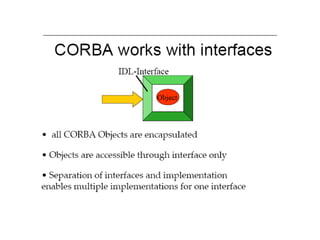
Interface Definition Language (IDL)
• Language Independence
• Defines Object Interfaces
• Hides underlying object implementation
• Language mappings exist for C, C++, Java,
Cobol, Smalltalk, and Ada
Object Request Broker (ORB)
• What is it?
• ORB Architecture (CORBA architecture)
Application
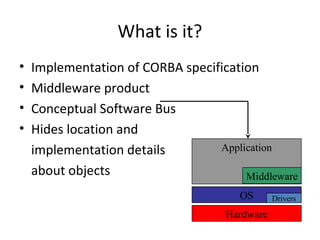
What is it?
• Implementation of CORBA specification
• Middleware product
• Conceptual Software Bus
• Hides location and
implementation details
about objects
Hardware
OS Drivers
Middleware
Two major task of ORB’s
• The ORB locates a remote component, given
its reference.
• The ORB also makes sure that the called
method receives the parameters over the
network correctly. This process is known as
Marshalling. In reverse manner, the ORB also
makes sure that the calling component
receives back the return values, if any, from
the called method. This process is known as
Un-Marshalling.
Example of how the ORB’s work
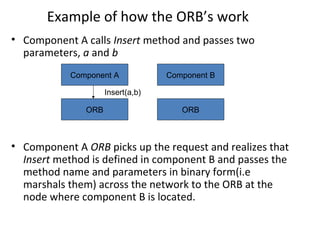
• Component A calls Insert method and passes two
parameters, a and b
• Component A ORB picks up the request and realizes that
Insert method is defined in component B and passes the
method name and parameters in binary form(i.e
marshals them) across the network to the ORB at the
node where component B is located.
Component A
ORB
Component B
ORB
Insert(a,b)
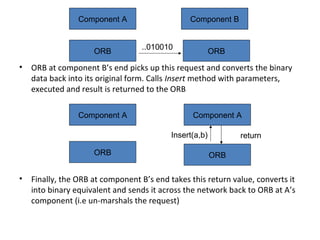
• ORB at component B’s end picks up this request and converts the binary
data back into its original form. Calls Insert method with parameters,
executed and result is returned to the ORB
• Finally, the ORB at component B’s end takes this return value, converts it
into binary equivalent and sends it across the network back to ORB at A’s
component (i.e un-marshals the request)
ORB ORB
Component BComponent A
..010010
ORBORB
Component AComponent A
returnInsert(a,b)
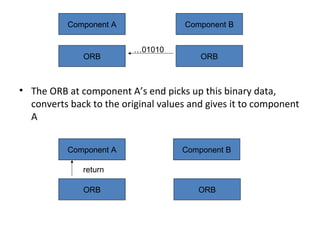
• The ORB at component A’s end picks up this binary data,
converts back to the original values and gives it to component
A
Component A
ORBORB
Component B
…01010
Component A
ORB ORB
Component B
return
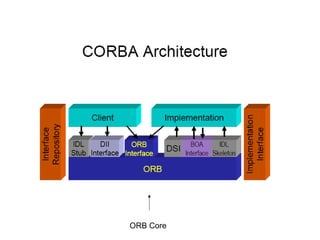
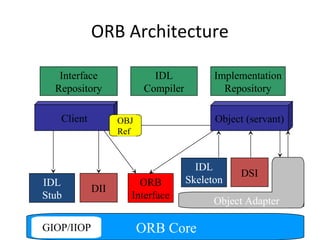
ORB Architecture
Interface
Repository
IDL
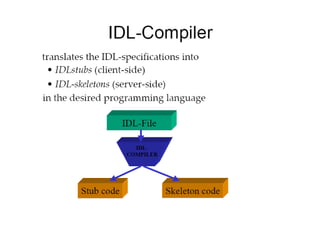
Compiler
Implementation
Repository
Client Object (servant)
ORB Core
IDL
Skeleton
DSI
ORB
Interface
IDL
Stub
DII
OBJ
Ref
GIOP/IIOP
Object Adapter
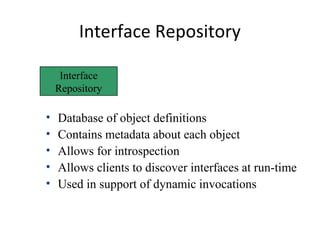
Interface Repository
Interface
Repository
Object Adapter
• Database of object definitions
• Contains metadata about each object
• Allows for introspection
• Allows clients to discover interfaces at run-time
• Used in support of dynamic invocations
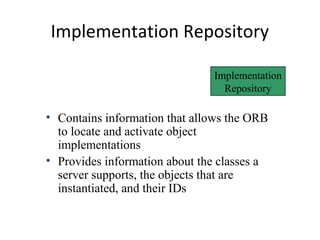
Implementation Repository
Implementation
Repository
Object Adapter
• Contains information that allows the ORB
to locate and activate object
implementations
• Provides information about the classes a
server supports, the objects that are
instantiated, and their IDs
ORB Core
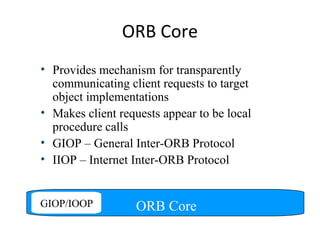
ORB CoreGIOP/IOOP
• Provides mechanism for transparently
communicating client requests to target
object implementations
• Makes client requests appear to be local
procedure calls
• GIOP – General Inter-ORB Protocol
• IIOP – Internet Inter-ORB Protocol
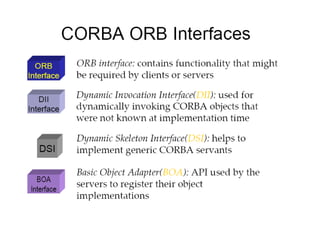
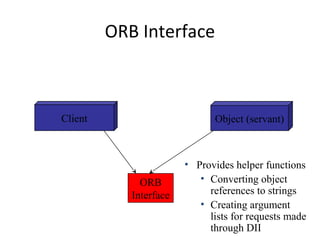
ORB Interface
Client Object (servant)
ORB
Interface
Object Adapter
• Provides helper functions
• Converting object
references to strings
• Creating argument
lists for requests made
through DII
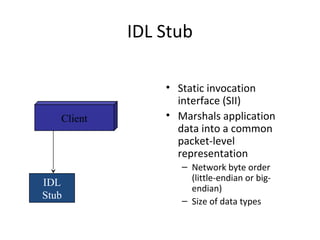
IDL Stub
• Static invocation
interface (SII)
• Marshals application
data into a common
packet-level
representation
– Network byte order
(little-endian or big-
endian)
– Size of data types
Client
IDL
Stub
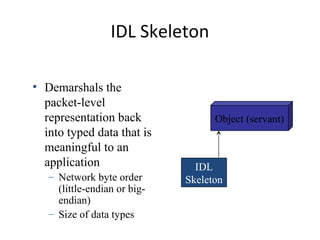
IDL Skeleton
Object (servant)
IDL
Skeleton
• Demarshals the
packet-level
representation back
into typed data that is
meaningful to an
application
– Network byte order
(little-endian or big-
endian)
– Size of data types
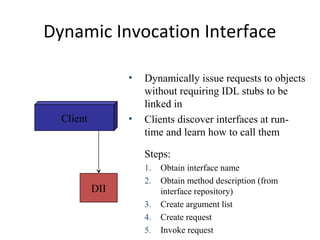
Dynamic Invocation Interface
Client
DII
Object Adapter
• Dynamically issue requests to objects
without requiring IDL stubs to be
linked in
• Clients discover interfaces at run-
time and learn how to call them
Steps:
1. Obtain interface name
2. Obtain method description (from
interface repository)
3. Create argument list
4. Create request
5. Invoke request
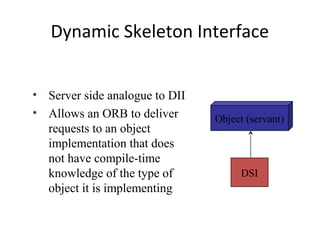
Dynamic Skeleton Interface
Object (servant)
DSI
Object Adapter
• Server side analogue to DII
• Allows an ORB to deliver
requests to an object
implementation that does
not have compile-time
knowledge of the type of
object it is implementing
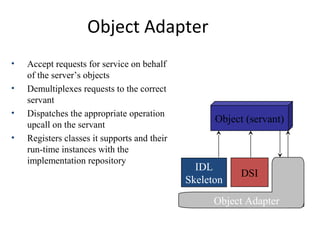
Object Adapter
Object (servant)
IDL
Skeleton
DSI
Object Adapter
• Accept requests for service on behalf
of the server’s objects
• Demultiplexes requests to the correct
servant
• Dispatches the appropriate operation
upcall on the servant
• Registers classes it supports and their
run-time instances with the
implementation repository
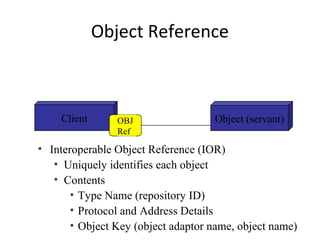
Object Reference
Client Object (servant)OBJ
Ref
Object Adapter
• Interoperable Object Reference (IOR)
• Uniquely identifies each object
• Contents
• Type Name (repository ID)
• Protocol and Address Details
• Object Key (object adaptor name, object name)
GIOP-General Inter ORB Protocol
DCOM (Distributed Component Object
Model)
• It is a microsoft’s version of the distributed
component based computing solutions.
• Popularly know as COM with a long wire.
• Based on the object oriented principle of
keeping an object’s interface separate from its
implementation.
• Similar to CORBA where COM components
interact with each other over the network.
• Every COM component is registered in the
Windows registry of the operating system
Differences between CORBA and DCOM
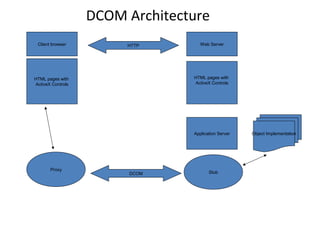
• Java applets are the clients in case of CORBA whereas in
DCOM ActiveX controls are usually the clients
• Client side infrastructure in DCOM is called Proxy and the
server side is Stub.
• In DCOM when a component wants to invoke a method of
another component that is remotely located, the caller has to
obtain the CLSID of the component to be called.
CLSID is a class identifier that identifies any DCOM component
all over the world.
CLSID is 128 bits that includes the date and detailed time
values when the component was created.
DCOM Architecture
Client browser
HTML pages with
ActiveX Controls
HTML pages with
ActiveX Controls
Web Server
Application Server
Proxy
HTTP
DCOM Stub
Object Implementation
Corba

Corba

  • 1.
  • 2.
    Topics for today CORBA  DCOM 2
  • 3.
    CORBA (Common ObjectRequest Broker Architecture) A specification or standard which specifies how objects communicate with each other over a network. It is a middleware based architecture The ORB is the heart of the distributed component architecture Allows developers to define distributed component architectures without worrying about the underlying network Communications and programming language
  • 4.
    Motivation behind CORBA Distributedapplications cause a lot of problems • Participating systems may be heterogeneous • Access to remote services has to be location transparent • Remote objects have to be found and activated • State of objects has to be kept persistent and consistent • Security has to be dealt with
  • 5.
    so we wantan architecture that… • …supports a remote method invocation paradigm • …provides location transparency • …allows to add, exchange, or remove services dynamically • …hides system details from the developer The result is the CORBA architecture
  • 6.
    What is CORBA? •CORBA is a standard (not a product!) • allows objects to transparently make requests and receive responses • enables interoperability between different applications • 􀂃 on different machines • 􀂃 in heterogeneously distributed environments
  • 7.
    CORBA design goals Independenceof hardware platform programming language operating system specific Object Request Broker degree of object distribution Open Architecture: Language, platform and location transparent Language-neutral Interface Definition Language (IDL)
  • 10.
  • 12.
    Ways to achievethe goals of CORBA • Interface Definition Language (IDL) • Object Request Broker (ORB) • Internet Inter-ORB protocol (IIOP)
  • 13.
    Interface Definition Language(IDL) • Language Independence • Defines Object Interfaces • Hides underlying object implementation • Language mappings exist for C, C++, Java, Cobol, Smalltalk, and Ada
  • 14.
    Object Request Broker(ORB) • What is it? • ORB Architecture (CORBA architecture)
  • 15.
    Application What is it? •Implementation of CORBA specification • Middleware product • Conceptual Software Bus • Hides location and implementation details about objects Hardware OS Drivers Middleware
  • 16.
    Two major taskof ORB’s • The ORB locates a remote component, given its reference. • The ORB also makes sure that the called method receives the parameters over the network correctly. This process is known as Marshalling. In reverse manner, the ORB also makes sure that the calling component receives back the return values, if any, from the called method. This process is known as Un-Marshalling.
  • 17.
    Example of howthe ORB’s work • Component A calls Insert method and passes two parameters, a and b • Component A ORB picks up the request and realizes that Insert method is defined in component B and passes the method name and parameters in binary form(i.e marshals them) across the network to the ORB at the node where component B is located. Component A ORB Component B ORB Insert(a,b)
  • 18.
    • ORB atcomponent B’s end picks up this request and converts the binary data back into its original form. Calls Insert method with parameters, executed and result is returned to the ORB • Finally, the ORB at component B’s end takes this return value, converts it into binary equivalent and sends it across the network back to ORB at A’s component (i.e un-marshals the request) ORB ORB Component BComponent A ..010010 ORBORB Component AComponent A returnInsert(a,b)
  • 19.
    • The ORBat component A’s end picks up this binary data, converts back to the original values and gives it to component A Component A ORBORB Component B …01010 Component A ORB ORB Component B return
  • 20.
    ORB Architecture Interface Repository IDL Compiler Implementation Repository Client Object(servant) ORB Core IDL Skeleton DSI ORB Interface IDL Stub DII OBJ Ref GIOP/IIOP Object Adapter
  • 21.
    Interface Repository Interface Repository Object Adapter •Database of object definitions • Contains metadata about each object • Allows for introspection • Allows clients to discover interfaces at run-time • Used in support of dynamic invocations
  • 23.
    Implementation Repository Implementation Repository Object Adapter •Contains information that allows the ORB to locate and activate object implementations • Provides information about the classes a server supports, the objects that are instantiated, and their IDs
  • 24.
    ORB Core ORB CoreGIOP/IOOP •Provides mechanism for transparently communicating client requests to target object implementations • Makes client requests appear to be local procedure calls • GIOP – General Inter-ORB Protocol • IIOP – Internet Inter-ORB Protocol
  • 25.
    ORB Interface Client Object(servant) ORB Interface Object Adapter • Provides helper functions • Converting object references to strings • Creating argument lists for requests made through DII
  • 26.
    IDL Stub • Staticinvocation interface (SII) • Marshals application data into a common packet-level representation – Network byte order (little-endian or big- endian) – Size of data types Client IDL Stub
  • 27.
    IDL Skeleton Object (servant) IDL Skeleton •Demarshals the packet-level representation back into typed data that is meaningful to an application – Network byte order (little-endian or big- endian) – Size of data types
  • 28.
    Dynamic Invocation Interface Client DII ObjectAdapter • Dynamically issue requests to objects without requiring IDL stubs to be linked in • Clients discover interfaces at run- time and learn how to call them Steps: 1. Obtain interface name 2. Obtain method description (from interface repository) 3. Create argument list 4. Create request 5. Invoke request
  • 29.
    Dynamic Skeleton Interface Object(servant) DSI Object Adapter • Server side analogue to DII • Allows an ORB to deliver requests to an object implementation that does not have compile-time knowledge of the type of object it is implementing
  • 30.
    Object Adapter Object (servant) IDL Skeleton DSI ObjectAdapter • Accept requests for service on behalf of the server’s objects • Demultiplexes requests to the correct servant • Dispatches the appropriate operation upcall on the servant • Registers classes it supports and their run-time instances with the implementation repository
  • 31.
    Object Reference Client Object(servant)OBJ Ref Object Adapter • Interoperable Object Reference (IOR) • Uniquely identifies each object • Contents • Type Name (repository ID) • Protocol and Address Details • Object Key (object adaptor name, object name)
  • 32.
  • 34.
    DCOM (Distributed ComponentObject Model) • It is a microsoft’s version of the distributed component based computing solutions. • Popularly know as COM with a long wire. • Based on the object oriented principle of keeping an object’s interface separate from its implementation. • Similar to CORBA where COM components interact with each other over the network. • Every COM component is registered in the Windows registry of the operating system
  • 35.
    Differences between CORBAand DCOM • Java applets are the clients in case of CORBA whereas in DCOM ActiveX controls are usually the clients • Client side infrastructure in DCOM is called Proxy and the server side is Stub. • In DCOM when a component wants to invoke a method of another component that is remotely located, the caller has to obtain the CLSID of the component to be called. CLSID is a class identifier that identifies any DCOM component all over the world. CLSID is 128 bits that includes the date and detailed time values when the component was created.
  • 36.
    DCOM Architecture Client browser HTMLpages with ActiveX Controls HTML pages with ActiveX Controls Web Server Application Server Proxy HTTP DCOM Stub Object Implementation