Odessa innovation week. Developers day
Interface Definition Languages
Ruslan Shevchenko
<ruslan@shevchenko.kiev.ua>
@rssh1
Consultant @ Lynx Capital Partners
Plan
❖ Historical Overview [1990-2015]
❖ from Sun RPC and CGI to Thrift & RESTFull services
❖ Today-s landscape
❖ IDL-s and today application patterns
❖ Future
Historical Overvies: early times
1990. Web not exists yet.
Xamarin modes is discussed:
• two-sided hyperlinks
• decentralized document servers
• publishing hyperlink = publishing document
Protocols: File exchange.
Terminal Access
Custom
Services on top of command-line
or custom protocols
Historical Overview: ONC RPC
1991 - 1995 Sun (then ONC) RPC
RPC = Remote Procedure Call Service specs = C structures
+ function definitions
Some RPC-based services are still in use
(NFS)
RPC still available in standard Unix-based
OS distributives. (Linux/MacOS/FreeBSD)
Historical Overview: ONC RPC (2)
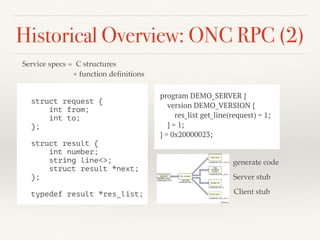
Service specs = C structures
+ function definitions
struct request {
int from;
int to;
};
struct result {
int number;
string line<>;
struct result *next;
};
typedef result *res_list;
program DEMO_SERVER {
version DEMO_VERSION {
res_list get_line(request) = 1;
} = 1;
} = 0x20000023;
generate code
Server stub
Client stub
Historical Overview: CGI
1993 CGI (NASA http server, than W3C)
CGI = Common Gateway Interface
No service specs.
Inputs of programs are request
Name/Value pairs (as strings)
Standard output of external program
directed to browser
Historical Overview: CGI (2)
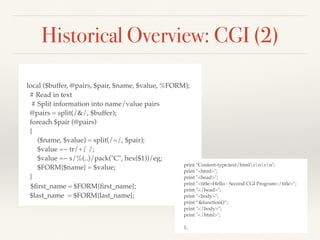
local ($buffer, @pairs, $pair, $name, $value, %FORM);
# Read in text
# Split information into name/value pairs
@pairs = split(/&/, $buffer);
foreach $pair (@pairs)
{
($name, $value) = split(/=/, $pair);
$value =~ tr/+/ /;
$value =~ s/%(..)/pack("C", hex($1))/eg;
$FORM{$name} = $value;
}
$first_name = $FORM{first_name};
$last_name = $FORM{last_name};
print "Content-type:text/htmlrnrn";
print "<html>";
print "<head>";
print "<title>Hello - Second CGI Program</title>";
print "</head>";
print "<body>";
print “&function()“;
print "</body>";
print "</html>";
1;
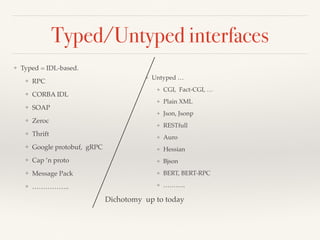
Typed/Untyped interfaces
❖ Typed = IDL-based.
❖ RPC
❖ CORBA IDL
❖ SOAP
❖ Zeroc
❖ Thrift
❖ Google protobuf, gRPC
❖ Cap ’n proto
❖ Message Pack
❖ ……………..
❖ Untyped …
❖ CGI, Fact-CGI, …
❖ Plain XML
❖ Json, Jsonp
❖ RESTfull
❖ Auro
❖ Hessian
❖ Bjson
❖ BERT, BERT-RPC
❖ ………..
Dichotomy up to today
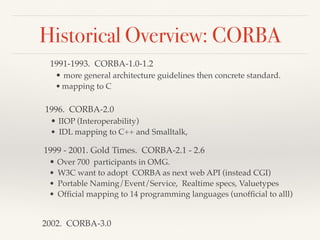
Historical Overview: CORBA
1991-1993. CORBA-1.0-1.2
• more general architecture guidelines then concrete standard.
• mapping to C
1996. CORBA-2.0
• IIOP (Interoperability)
• IDL mapping to C++ and Smalltalk,
1999 - 2001. Gold Times. CORBA-2.1 - 2.6
• Over 700 participants in OMG.
• W3C want to adopt CORBA as next web API (instead CGI)
• Portable Naming/Event/Service, Realtime specs, Valuetypes
• Official mapping to 14 programming languages (unofficial to alll)
2002. CORBA-3.0
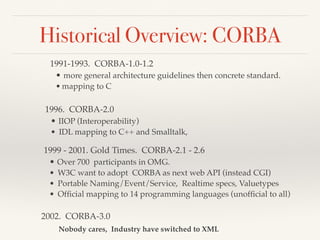
Historical Overview: CORBA
1991-1993. CORBA-1.0-1.2
• more general architecture guidelines then concrete standard.
• mapping to C
1996. CORBA-2.0
• IIOP (Interoperability)
• IDL mapping to C++ and Smalltalk,
1999 - 2001. Gold Times. CORBA-2.1 - 2.6
• Over 700 participants in OMG.
• W3C want to adopt CORBA as next web API (instead CGI)
• Portable Naming/Event/Service, Realtime specs, Valuetypes
• Official mapping to 14 programming languages (unofficial to all)
2002. CORBA-3.0
Nobody cares, Industry have switched to XML
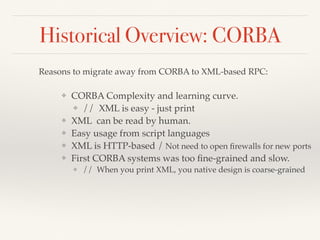
Historical Overview: CORBA
Reasons to migrate away from CORBA to XML-based RPC:
❖ CORBA Complexity and learning curve.
❖ // XML is easy - just print
❖ XML can be read by human.
❖ Easy usage from script languages
❖ XML is HTTP-based / Not need to open firewalls for new ports
❖ First CORBA systems was too fine-grained and slow.
❖ // When you print XML, you native design is coarse-grained
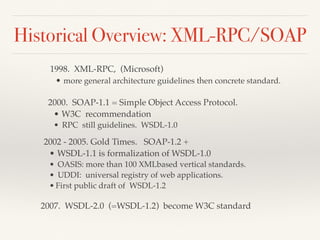
Historical Overview: XML-RPC/SOAP
1998. XML-RPC, (Microsoft)
• more general architecture guidelines then concrete standard.
2000. SOAP-1.1 = Simple Object Access Protocol.
• W3C recommendation
• RPC still guidelines. WSDL-1.0
2002 - 2005. Gold Times. SOAP-1.2 +
• WSDL-1.1 is formalization of WSDL-1.0
• OASIS: more than 100 XMLbased vertical standards.
• UDDI: universal registry of web applications.
• First public draft of WSDL-1.2
2007. WSDL-2.0 (=WSDL-1.2) become W3C standard
Historical Overview: XML-RPC/SOAP
1998. XML-RPC, (Microsoft)
• more general architecture guidelines then concrete standard.
2000. SOAP-1.1 = Simple Object Access Protocol.
• W3C recommendation
• RPC still guidelines. WSDL-1.0
2002 - 2005. Gold Times. SOAP-1.2 +
• WSDL-1.1 is formalization of WSDL-1.0
• OASIS: more than 100 XMLbased vertical standards.
• UDDI: universal registry of web applications.
• First public draft of WSDL-1.2
2007. WSDL-2.0 (=WSDL-1.2) become W3C standard
Nobody cares, Industry have switched to JSON/REST
Historical Overview: XML-RPC/SOAP
Reasons to migrate away from XML-based RPC to JSON:
❖ WSDL/SOAP Complexity and learning curve.
❖ // JSON is easy - just print
❖ JSON can be read by human.
❖ Easy usage from script languages.
❖ XML is too bloated.
Historical Overview: JSON-based API-s
2001. JSON (Douglas Crockford)
• Used for interaction for client-side javascript
2000. REST = Representational State Transfer.
• Phd of Roy Thomas.
• Architecture guidelines without concrete specification.
• Formulated in terms of XML API.
2002. Yahoo implements 1-st public JSON-based web service
2006 - 201(>5). Gold times.
• RESTfull/JSON is ‘default’ API for web apps
• Validation: JSONPath, JSONScheme, JSONRPC
• Typed extensions [Auro], binary variants [BJSON].
?
Mainstream loop
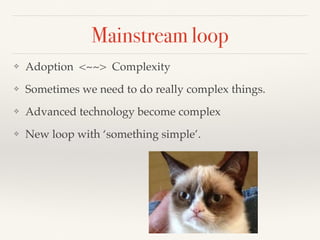
❖ Adoption <~~> Complexity
❖ Sometimes we need to do really complex things.
❖ Advanced technology become complex
❖ New loop with ‘something simple’.
IDL-based architecture today
Actually useful
❖ google protocol buffers, grpc: google.
https://developers.google.com/protocol-buffers/
❖ thrift: facebook. (opened via submiting to Apache)
https://thrift.apache.org/
❖ cap-n-proto: Sandstorm.ua
https://capnproto.org/
❖ Other …
❖ zeroc (http://zeroc.com)
❖ MessagePack (http://msgpack.org)
❖ FlatBuffers, SOE (Simple Object Encoding)
❖ …………………………
Pretty close to main ideas of CORBA IDL,
Still have no valuetypes
IDL-based architecture today
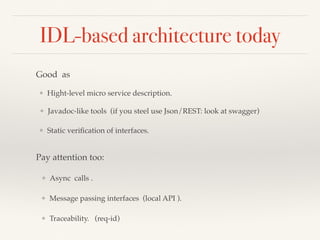
Good as
❖ Hight-level micro service description.
❖ Javadoc-like tools (if you steel use Json/REST: look at swagger)
❖ Static verification of interfaces.
Pay attention too:
❖ Async calls .
❖ Message passing interfaces (local API ).
❖ Traceability. (req-id)
IDL-based architecture today
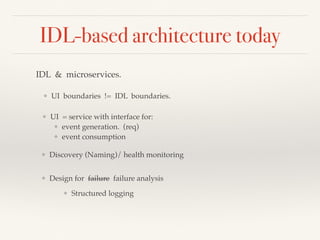
IDL & microservices.
❖ UI boundaries != IDL boundaries.
❖ Discovery (Naming)/ health monitoring
❖ UI = service with interface for:
❖ event generation. (req)
❖ event consumption
❖ Design for failure failure analysis
❖ Structured logging
Future directions
Learning curve ~ task complexity
software development ~ car driving
Gradual complexity
Thanks for attention.
❖ Questions, discussions:
❖ @rssh1
❖ ruslan@shevchenko.kiev.ua
❖ https://github.com/rssh

IDLs

  • 1.
    Odessa innovation week.Developers day Interface Definition Languages Ruslan Shevchenko <ruslan@shevchenko.kiev.ua> @rssh1 Consultant @ Lynx Capital Partners
  • 2.
    Plan ❖ Historical Overview[1990-2015] ❖ from Sun RPC and CGI to Thrift & RESTFull services ❖ Today-s landscape ❖ IDL-s and today application patterns ❖ Future
  • 3.
    Historical Overvies: earlytimes 1990. Web not exists yet. Xamarin modes is discussed: • two-sided hyperlinks • decentralized document servers • publishing hyperlink = publishing document Protocols: File exchange. Terminal Access Custom Services on top of command-line or custom protocols
  • 4.
    Historical Overview: ONCRPC 1991 - 1995 Sun (then ONC) RPC RPC = Remote Procedure Call Service specs = C structures + function definitions Some RPC-based services are still in use (NFS) RPC still available in standard Unix-based OS distributives. (Linux/MacOS/FreeBSD)
  • 5.
    Historical Overview: ONCRPC (2) Service specs = C structures + function definitions struct request { int from; int to; }; struct result { int number; string line<>; struct result *next; }; typedef result *res_list; program DEMO_SERVER { version DEMO_VERSION { res_list get_line(request) = 1; } = 1; } = 0x20000023; generate code Server stub Client stub
  • 6.
    Historical Overview: CGI 1993CGI (NASA http server, than W3C) CGI = Common Gateway Interface No service specs. Inputs of programs are request Name/Value pairs (as strings) Standard output of external program directed to browser
  • 7.
    Historical Overview: CGI(2) local ($buffer, @pairs, $pair, $name, $value, %FORM); # Read in text # Split information into name/value pairs @pairs = split(/&/, $buffer); foreach $pair (@pairs) { ($name, $value) = split(/=/, $pair); $value =~ tr/+/ /; $value =~ s/%(..)/pack("C", hex($1))/eg; $FORM{$name} = $value; } $first_name = $FORM{first_name}; $last_name = $FORM{last_name}; print "Content-type:text/htmlrnrn"; print "<html>"; print "<head>"; print "<title>Hello - Second CGI Program</title>"; print "</head>"; print "<body>"; print “&function()“; print "</body>"; print "</html>"; 1;
  • 8.
    Typed/Untyped interfaces ❖ Typed= IDL-based. ❖ RPC ❖ CORBA IDL ❖ SOAP ❖ Zeroc ❖ Thrift ❖ Google protobuf, gRPC ❖ Cap ’n proto ❖ Message Pack ❖ …………….. ❖ Untyped … ❖ CGI, Fact-CGI, … ❖ Plain XML ❖ Json, Jsonp ❖ RESTfull ❖ Auro ❖ Hessian ❖ Bjson ❖ BERT, BERT-RPC ❖ ……….. Dichotomy up to today
  • 9.
    Historical Overview: CORBA 1991-1993.CORBA-1.0-1.2 • more general architecture guidelines then concrete standard. • mapping to C 1996. CORBA-2.0 • IIOP (Interoperability) • IDL mapping to C++ and Smalltalk, 1999 - 2001. Gold Times. CORBA-2.1 - 2.6 • Over 700 participants in OMG. • W3C want to adopt CORBA as next web API (instead CGI) • Portable Naming/Event/Service, Realtime specs, Valuetypes • Official mapping to 14 programming languages (unofficial to alll) 2002. CORBA-3.0
  • 10.
    Historical Overview: CORBA 1991-1993.CORBA-1.0-1.2 • more general architecture guidelines then concrete standard. • mapping to C 1996. CORBA-2.0 • IIOP (Interoperability) • IDL mapping to C++ and Smalltalk, 1999 - 2001. Gold Times. CORBA-2.1 - 2.6 • Over 700 participants in OMG. • W3C want to adopt CORBA as next web API (instead CGI) • Portable Naming/Event/Service, Realtime specs, Valuetypes • Official mapping to 14 programming languages (unofficial to all) 2002. CORBA-3.0 Nobody cares, Industry have switched to XML
  • 11.
    Historical Overview: CORBA Reasonsto migrate away from CORBA to XML-based RPC: ❖ CORBA Complexity and learning curve. ❖ // XML is easy - just print ❖ XML can be read by human. ❖ Easy usage from script languages ❖ XML is HTTP-based / Not need to open firewalls for new ports ❖ First CORBA systems was too fine-grained and slow. ❖ // When you print XML, you native design is coarse-grained
  • 12.
    Historical Overview: XML-RPC/SOAP 1998.XML-RPC, (Microsoft) • more general architecture guidelines then concrete standard. 2000. SOAP-1.1 = Simple Object Access Protocol. • W3C recommendation • RPC still guidelines. WSDL-1.0 2002 - 2005. Gold Times. SOAP-1.2 + • WSDL-1.1 is formalization of WSDL-1.0 • OASIS: more than 100 XMLbased vertical standards. • UDDI: universal registry of web applications. • First public draft of WSDL-1.2 2007. WSDL-2.0 (=WSDL-1.2) become W3C standard
  • 13.
    Historical Overview: XML-RPC/SOAP 1998.XML-RPC, (Microsoft) • more general architecture guidelines then concrete standard. 2000. SOAP-1.1 = Simple Object Access Protocol. • W3C recommendation • RPC still guidelines. WSDL-1.0 2002 - 2005. Gold Times. SOAP-1.2 + • WSDL-1.1 is formalization of WSDL-1.0 • OASIS: more than 100 XMLbased vertical standards. • UDDI: universal registry of web applications. • First public draft of WSDL-1.2 2007. WSDL-2.0 (=WSDL-1.2) become W3C standard Nobody cares, Industry have switched to JSON/REST
  • 14.
    Historical Overview: XML-RPC/SOAP Reasonsto migrate away from XML-based RPC to JSON: ❖ WSDL/SOAP Complexity and learning curve. ❖ // JSON is easy - just print ❖ JSON can be read by human. ❖ Easy usage from script languages. ❖ XML is too bloated.
  • 15.
    Historical Overview: JSON-basedAPI-s 2001. JSON (Douglas Crockford) • Used for interaction for client-side javascript 2000. REST = Representational State Transfer. • Phd of Roy Thomas. • Architecture guidelines without concrete specification. • Formulated in terms of XML API. 2002. Yahoo implements 1-st public JSON-based web service 2006 - 201(>5). Gold times. • RESTfull/JSON is ‘default’ API for web apps • Validation: JSONPath, JSONScheme, JSONRPC • Typed extensions [Auro], binary variants [BJSON]. ?
  • 16.
    Mainstream loop ❖ Adoption<~~> Complexity ❖ Sometimes we need to do really complex things. ❖ Advanced technology become complex ❖ New loop with ‘something simple’.
  • 17.
    IDL-based architecture today Actuallyuseful ❖ google protocol buffers, grpc: google. https://developers.google.com/protocol-buffers/ ❖ thrift: facebook. (opened via submiting to Apache) https://thrift.apache.org/ ❖ cap-n-proto: Sandstorm.ua https://capnproto.org/ ❖ Other … ❖ zeroc (http://zeroc.com) ❖ MessagePack (http://msgpack.org) ❖ FlatBuffers, SOE (Simple Object Encoding) ❖ ………………………… Pretty close to main ideas of CORBA IDL, Still have no valuetypes
  • 18.
    IDL-based architecture today Goodas ❖ Hight-level micro service description. ❖ Javadoc-like tools (if you steel use Json/REST: look at swagger) ❖ Static verification of interfaces. Pay attention too: ❖ Async calls . ❖ Message passing interfaces (local API ). ❖ Traceability. (req-id)
  • 19.
    IDL-based architecture today IDL& microservices. ❖ UI boundaries != IDL boundaries. ❖ Discovery (Naming)/ health monitoring ❖ UI = service with interface for: ❖ event generation. (req) ❖ event consumption ❖ Design for failure failure analysis ❖ Structured logging
  • 20.
    Future directions Learning curve~ task complexity software development ~ car driving Gradual complexity
  • 21.
    Thanks for attention. ❖Questions, discussions: ❖ @rssh1 ❖ ruslan@shevchenko.kiev.ua ❖ https://github.com/rssh