DCOM Vs. CORBA

    Presented By
  Chandrika Mavram

        Date
    Dec 1st, 1999.
INDEX

1.   Terminology Used
2.   About DCOM
3.   About CORBA
4.   Features
5.   Interaction Between Server and Client
6.   DCOM Architecture
7.   CORBA Architecture
Index Cont’d
8. Different Layers
9. Sample Application
10. Top Layer - Basic Programming Architecture
11. Middle Layer - Remoting Architecture
12. Bottom Layer - WIRE Protocol Architecture
13. Summary
14. References
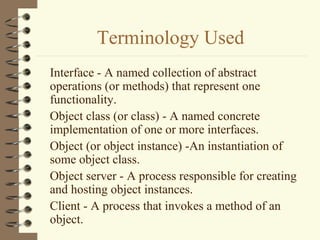
Terminology Used
Interface - A named collection of abstract
operations (or methods) that represent one
functionality.
Object class (or class) - A named concrete
implementation of one or more interfaces.
Object (or object instance) -An instantiation of
some object class.
Object server - A process responsible for creating
and hosting object instances.
Client - A process that invokes a method of an
object.
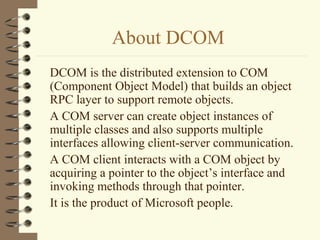
About DCOM
DCOM is the distributed extension to COM
(Component Object Model) that builds an object
RPC layer to support remote objects.
A COM server can create object instances of
multiple classes and also supports multiple
interfaces allowing client-server communication.
A COM client interacts with a COM object by
acquiring a pointer to the object’s interface and
invoking methods through that pointer.
It is the product of Microsoft people.
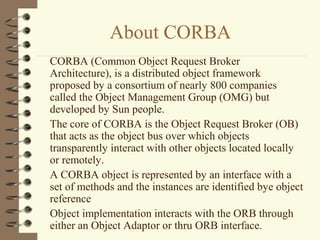
About CORBA
CORBA (Common Object Request Broker
Architecture), is a distributed object framework
proposed by a consortium of nearly 800 companies
called the Object Management Group (OMG) but
developed by Sun people.
The core of CORBA is the Object Request Broker (OB)
that acts as the object bus over which objects
transparently interact with other objects located locally
or remotely.
A CORBA object is represented by an interface with a
set of methods and the instances are identified bye object
reference
Object implementation interacts with the ORB through
either an Object Adaptor or thru ORB interface.
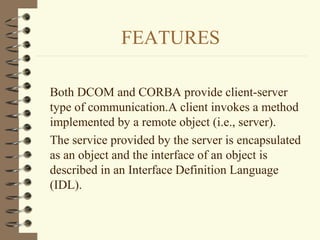
FEATURES

Both DCOM and CORBA provide client-server
type of communication.A client invokes a method
implemented by a remote object (i.e., server).
The service provided by the server is encapsulated
as an object and the interface of an object is
described in an Interface Definition Language
(IDL).
Features Cont’d
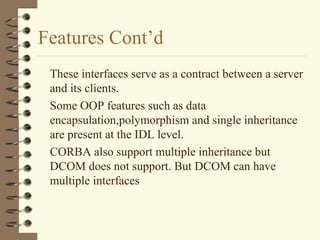
 These interfaces serve as a contract between a server
 and its clients.
 Some OOP features such as data
 encapsulation,polymorphism and single inheritance
 are present at the IDL level.
 CORBA also support multiple inheritance but
 DCOM does not support. But DCOM can have
 multiple interfaces
Interaction Between Server & Client

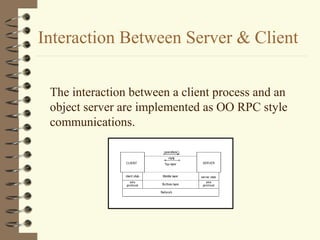
 The interaction between a client process and an
 object server are implemented as OO RPC style
 communications.
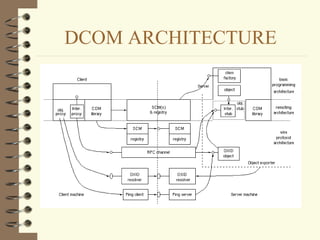
DCOM ARCHITECTURE
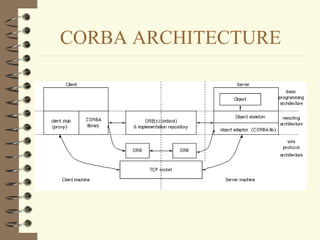
CORBA ARCHITECTURE
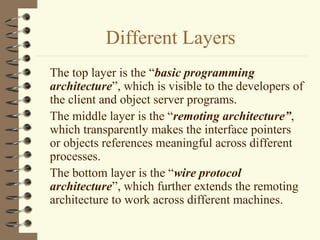
Different Layers
The top layer is the “basic programming
architecture”, which is visible to the developers of
the client and object server programs.
The middle layer is the “remoting architecture”,
which transparently makes the interface pointers
or objects references meaningful across different
processes.
The bottom layer is the “wire protocol
architecture”, which further extends the remoting
architecture to work across different machines.
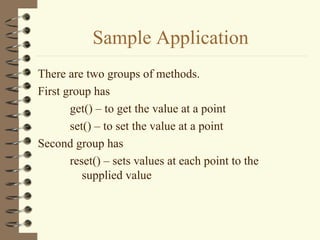
Sample Application
There are two groups of methods.
First group has
       get() – to get the value at a point
       set() – to set the value at a point
Second group has
       reset() – sets values at each point to the
          supplied value
DCOM IDL                                                           CORBA IDL
 // definition of IGrid1                                           interface grid1
      [ object, uuid(3CFDB283-CCC5-11D0-BA0B-00A0C90DF8BC),        {
         helpstring("IGrid1 Interface"), pointer_default(unique)      long get(in short n, in short m);
      ]                                                               void set(in short n, in short m, in long
    interface IGrid1 : IUnknown       {                                   value);
                                                                   };
    import "unknwn.idl";
                                                                   interface grid2
   HRESULT get([in] SHORT n, [in] SHORT m, [out] LONG *value);
                                                                   {
    HRESULT set([in] SHORT n, [in] SHORT m, [in] LONG value);
                                                                      void reset(in long value);
   };                                                              };
// definition of IGrid2                                            interface grid: grid1, grid2
 [ object, uuid(3CFDB284-CCC5-11D0-BA0B-00A0C90DF8BC),
     helpstring("IGrid2 Interface"), pointer_default(unique)
 ]
interface IGrid2 : IUnknown        {
    import "unknwn.idl";
     HRESULT reset([in] LONG value);
};
//uuid and definition of type library
 [ uuid(3CFDB281-CCC5-11D0-BA0B-00A0C90DF8BC),
     version(1.0), helpstring("grid 1.0 Type Library)
 ]
 library GRIDLib
 {
   importlib("stdole32.tlb");
    // definition of the component
    [ uuid(3CFDB287-CCC5-11D0-BA0B-00A0C90DF8BC),
       helpstring("Grid Class")
    ]
     coclass CGri
      { [default] interface IGrid1;
          interface IGrid2;
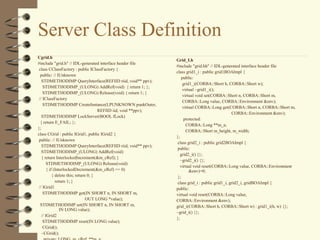
Server Class Definition
Cgrid.h
                                                                 Grid_I.h
#include "grid.h" // IDL-generated interface header file
                                                                 #include "grid.hh" // IDL-generated interface header file
 class CClassFactory : public IClassFactory {
                                                                 class grid1_i : public grid1BOAImpl {
  public: // IUnknown
                                                                     public:
   STDMETHODIMP QueryInterface(REFIID riid, void** ppv);
                                                                      grid1_i(CORBA::Short h, CORBA::Short w);
    STDMETHODIMP_(ULONG) AddRef(void) { return 1; };
                                                                      virtual ~grid1_i();
    STDMETHODIMP_(ULONG) Release(void) { return 1; }
                                                                      virtual void set(CORBA::Short n, CORBA::Short m,
 // IClassFactory
                                                                      CORBA::Long value, CORBA::Environment &env);
    STDMETHODIMP CreateInstance(LPUNKNOWN punkOuter,
                                                                      virtual CORBA::Long get(CORBA::Short n, CORBA::Short m,
                                      REFIID iid, void **ppv);
                                                                                                  CORBA::Environment &env);
   STDMETHODIMP LockServer(BOOL fLock)
                                                                       protected:
  { return E_FAIL; };
                                                                        CORBA::Long **m_a;
};
                                                                        CORBA::Short m_height, m_width;
class CGrid : public IGrid1, public IGrid2 {
                                                                 };
 public: // IUnknown
                                                                  class grid2_i : public grid2BOAImpl {
   STDMETHODIMP QueryInterface(REFIID riid, void** ppv);
                                                                  public:
   STDMETHODIMP_(ULONG) AddRef(void)
                                                                    grid2_i() {};
   { return InterlockedIncrement(&m_cRef); }
                                                                    ~grid2_i() {};
       STDMETHODIMP_(ULONG) Release(void)
                                                                    virtual void reset(CORBA::Long value, CORBA::Environment
       { if (InterlockedDecrement(&m_cRef) == 0)                          &env)=0;
           { delete this; return 0; }                             };
             return 1; }                                          class grid_i : public grid1_i, grid2_i, gridBOAImpl {
 // IGrid1                                                       public:
    STDMETHODIMP get(IN SHORT n, IN SHORT m,                     virtual void reset(CORBA::Long value,
                                OUT LONG *value);                CORBA::Environment &env);
  STDMETHODIMP set(IN SHORT n, IN SHORT m,                       grid_i(CORBA::Short h, CORBA::Short w) : grid1_i(h, w) {};
                IN LONG value);
                                                                 ~grid_i() {};
   // IGrid2
                                                                 };
    STDMETHODIMP reset(IN LONG value);
    CGrid();
   ~CGrid();
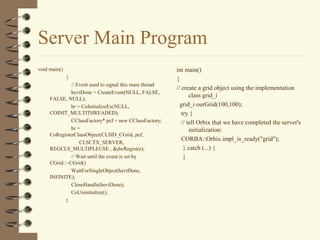
Server Main Program
void main()                                              int main()
              {                                          {
              // Event used to signal this main thread
                                                         // create a grid object using the implementation
              hevtDone = CreateEvent(NULL, FALSE,
                                                                class grid_i
     FALSE, NULL);
              hr = CoInitializeEx(NULL,                    grid_i ourGrid(100,100);
     COINIT_MULTITHREADED);                                 try {
              CClassFactory* pcf = new CClassFactory;       // tell Orbix that we have completed the server's
              hr =                                              initialization:
     CoRegisterClassObject(CLSID_CGrid, pcf,
                                                            CORBA::Orbix.impl_is_ready("grid");
                  CLSCTX_SERVER,
     REGCLS_MULTIPLEUSE , &dwRegister);                      } catch (...) {
              // Wait until the event is set by              }
     CGrid::~CGrid()
              WaitForSingleObject(hevtDone,
     INFINITE);
              CloseHandle(hevtDone);
              CoUninitialize();
            }
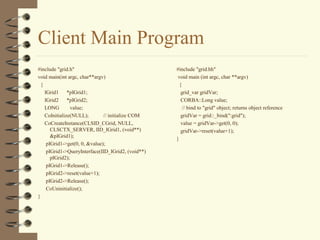
Client Main Program
#include "grid.h"                                   #include "grid.hh"
void main(int argc, char**argv)                      void main (int argc, char **argv)
  {                                                   {
    IGrid1 *pIGrid1;                                   grid_var gridVar;
    IGrid2 *pIGrid2;                                   CORBA::Long value;
    LONG         value;                                 // bind to "grid" object; returns object reference
    CoInitialize(NULL);        // initialize COM       gridVar = grid::_bind(":grid");
    CoCreateInstance(CLSID_CGrid, NULL,                value = gridVar->get(0, 0);
       CLSCTX_SERVER, IID_IGrid1, (void**)             gridVar->reset(value+1);
       &pIGrid1);                                   }
     pIGrid1->get(0, 0, &value);
     pIGrid1->QueryInterface(IID_IGrid2, (void**)
       pIGrid2);
     pIGrid1->Release();
     pIGrid2->reset(value+1);
     pIGrid2->Release();
     CoUninitialize();
}
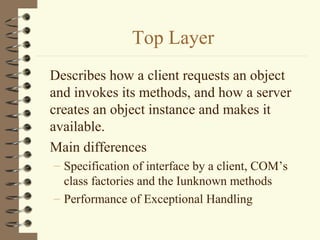
Top Layer
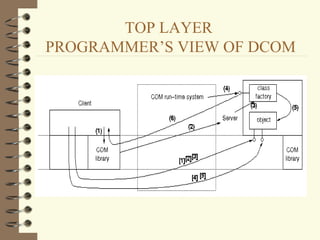
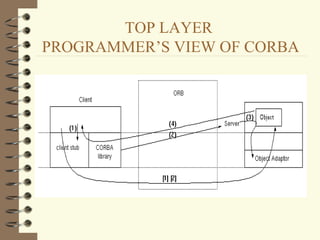
Describes how a client requests an object
and invokes its methods, and how a server
creates an object instance and makes it
available.
Main differences
– Specification of interface by a client, COM’s
  class factories and the Iunknown methods
– Performance of Exceptional Handling
TOP LAYER
PROGRAMMER’S VIEW OF DCOM
TOP LAYER
PROGRAMMER’S VIEW OF CORBA
Middle Layer
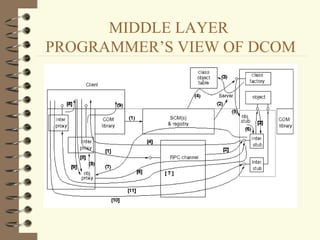
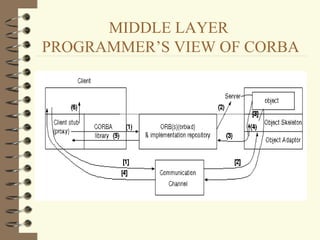
Consists of infrastructure necessary for
providing the client and the server with the
illustion that they are in the same address
space.
Main differences include
– how server objects are registered.
– when the proxy/stub/skeleton instances are
  created.
MIDDLE LAYER
PROGRAMMER’S VIEW OF DCOM
MIDDLE LAYER
PROGRAMMER’S VIEW OF CORBA
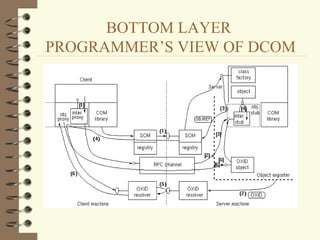
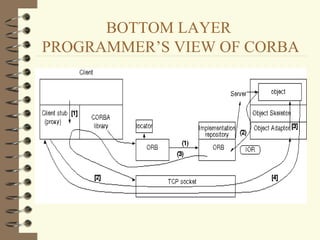
Bottom Layer
Specifies the wire protocol for supporting
the client and the server running on
different machines.
Main differences
– how remote interface pointers or object
  references are represented to convey server
  endpoint representation to client
– standard format in which the data is marshaled
  for transmission in heterogeneous environment
BOTTOM LAYER
PROGRAMMER’S VIEW OF DCOM
BOTTOM LAYER
PROGRAMMER’S VIEW OF CORBA
Summary
   The three-layer step-by-step descriptions have shown that the architectures
 of DCOM and CORBA are basically similar.
   They both provide the distributed objects infrastructure for transparent
 activation and accessing of remote objects.

  • First,DCOM supports objects with multiple interfaces and provides a
    standard QueryInterface() method to navigate among the interfaces. This
    also introduces the notion of an object proxy/stub dynamically loading
    multiple interface proxies/stubs in the remoting layer. Such concepts do
    not exist in CORBA.

  • Second, every CORBA interface inherits from CORBA::Object, the
    constructor of which implicitly performs such common tasks as object
    registration, object reference generation, skeleton instantiation, etc. In
    DCOM, such tasks are either explicitly performed by the server programs
    or handled dynamically by DCOM run-time system.
Summary Cont’d
 • Third, DCOM's wire protocol is strongly tied to RPC, but
   CORBA's is not. Finally, we would like to point out that DCOM
   specification contains many details that are considered as
   implementation issues and not specified by CORBA.
References
1.   http://www.omg.org/corba/beginners.html
2.   http://www.microsoft.com/ntserver/guide/dcom/asp
3.   http://www.bell-labs.com/~emerald/dcom_corba/Pap

Dcom vs. corba

  • 1.
    DCOM Vs. CORBA Presented By Chandrika Mavram Date Dec 1st, 1999.
  • 2.
    INDEX 1. Terminology Used 2. About DCOM 3. About CORBA 4. Features 5. Interaction Between Server and Client 6. DCOM Architecture 7. CORBA Architecture
  • 3.
    Index Cont’d 8. DifferentLayers 9. Sample Application 10. Top Layer - Basic Programming Architecture 11. Middle Layer - Remoting Architecture 12. Bottom Layer - WIRE Protocol Architecture 13. Summary 14. References
  • 4.
    Terminology Used Interface -A named collection of abstract operations (or methods) that represent one functionality. Object class (or class) - A named concrete implementation of one or more interfaces. Object (or object instance) -An instantiation of some object class. Object server - A process responsible for creating and hosting object instances. Client - A process that invokes a method of an object.
  • 5.
    About DCOM DCOM isthe distributed extension to COM (Component Object Model) that builds an object RPC layer to support remote objects. A COM server can create object instances of multiple classes and also supports multiple interfaces allowing client-server communication. A COM client interacts with a COM object by acquiring a pointer to the object’s interface and invoking methods through that pointer. It is the product of Microsoft people.
  • 6.
    About CORBA CORBA (CommonObject Request Broker Architecture), is a distributed object framework proposed by a consortium of nearly 800 companies called the Object Management Group (OMG) but developed by Sun people. The core of CORBA is the Object Request Broker (OB) that acts as the object bus over which objects transparently interact with other objects located locally or remotely. A CORBA object is represented by an interface with a set of methods and the instances are identified bye object reference Object implementation interacts with the ORB through either an Object Adaptor or thru ORB interface.
  • 7.
    FEATURES Both DCOM andCORBA provide client-server type of communication.A client invokes a method implemented by a remote object (i.e., server). The service provided by the server is encapsulated as an object and the interface of an object is described in an Interface Definition Language (IDL).
  • 8.
    Features Cont’d Theseinterfaces serve as a contract between a server and its clients. Some OOP features such as data encapsulation,polymorphism and single inheritance are present at the IDL level. CORBA also support multiple inheritance but DCOM does not support. But DCOM can have multiple interfaces
  • 9.
    Interaction Between Server& Client The interaction between a client process and an object server are implemented as OO RPC style communications.
  • 10.
  • 11.
  • 12.
    Different Layers The toplayer is the “basic programming architecture”, which is visible to the developers of the client and object server programs. The middle layer is the “remoting architecture”, which transparently makes the interface pointers or objects references meaningful across different processes. The bottom layer is the “wire protocol architecture”, which further extends the remoting architecture to work across different machines.
  • 13.
    Sample Application There aretwo groups of methods. First group has get() – to get the value at a point set() – to set the value at a point Second group has reset() – sets values at each point to the supplied value
  • 14.
    DCOM IDL CORBA IDL // definition of IGrid1 interface grid1 [ object, uuid(3CFDB283-CCC5-11D0-BA0B-00A0C90DF8BC), { helpstring("IGrid1 Interface"), pointer_default(unique) long get(in short n, in short m); ] void set(in short n, in short m, in long interface IGrid1 : IUnknown { value); }; import "unknwn.idl"; interface grid2 HRESULT get([in] SHORT n, [in] SHORT m, [out] LONG *value); { HRESULT set([in] SHORT n, [in] SHORT m, [in] LONG value); void reset(in long value); }; }; // definition of IGrid2 interface grid: grid1, grid2 [ object, uuid(3CFDB284-CCC5-11D0-BA0B-00A0C90DF8BC), helpstring("IGrid2 Interface"), pointer_default(unique) ] interface IGrid2 : IUnknown { import "unknwn.idl"; HRESULT reset([in] LONG value); }; //uuid and definition of type library [ uuid(3CFDB281-CCC5-11D0-BA0B-00A0C90DF8BC), version(1.0), helpstring("grid 1.0 Type Library) ] library GRIDLib { importlib("stdole32.tlb"); // definition of the component [ uuid(3CFDB287-CCC5-11D0-BA0B-00A0C90DF8BC), helpstring("Grid Class") ] coclass CGri { [default] interface IGrid1; interface IGrid2;
  • 15.
    Server Class Definition Cgrid.h Grid_I.h #include "grid.h" // IDL-generated interface header file #include "grid.hh" // IDL-generated interface header file class CClassFactory : public IClassFactory { class grid1_i : public grid1BOAImpl { public: // IUnknown public: STDMETHODIMP QueryInterface(REFIID riid, void** ppv); grid1_i(CORBA::Short h, CORBA::Short w); STDMETHODIMP_(ULONG) AddRef(void) { return 1; }; virtual ~grid1_i(); STDMETHODIMP_(ULONG) Release(void) { return 1; } virtual void set(CORBA::Short n, CORBA::Short m, // IClassFactory CORBA::Long value, CORBA::Environment &env); STDMETHODIMP CreateInstance(LPUNKNOWN punkOuter, virtual CORBA::Long get(CORBA::Short n, CORBA::Short m, REFIID iid, void **ppv); CORBA::Environment &env); STDMETHODIMP LockServer(BOOL fLock) protected: { return E_FAIL; }; CORBA::Long **m_a; }; CORBA::Short m_height, m_width; class CGrid : public IGrid1, public IGrid2 { }; public: // IUnknown class grid2_i : public grid2BOAImpl { STDMETHODIMP QueryInterface(REFIID riid, void** ppv); public: STDMETHODIMP_(ULONG) AddRef(void) grid2_i() {}; { return InterlockedIncrement(&m_cRef); } ~grid2_i() {}; STDMETHODIMP_(ULONG) Release(void) virtual void reset(CORBA::Long value, CORBA::Environment { if (InterlockedDecrement(&m_cRef) == 0) &env)=0; { delete this; return 0; } }; return 1; } class grid_i : public grid1_i, grid2_i, gridBOAImpl { // IGrid1 public: STDMETHODIMP get(IN SHORT n, IN SHORT m, virtual void reset(CORBA::Long value, OUT LONG *value); CORBA::Environment &env); STDMETHODIMP set(IN SHORT n, IN SHORT m, grid_i(CORBA::Short h, CORBA::Short w) : grid1_i(h, w) {}; IN LONG value); ~grid_i() {}; // IGrid2 }; STDMETHODIMP reset(IN LONG value); CGrid(); ~CGrid();
  • 16.
    Server Main Program voidmain() int main() { { // Event used to signal this main thread // create a grid object using the implementation hevtDone = CreateEvent(NULL, FALSE, class grid_i FALSE, NULL); hr = CoInitializeEx(NULL, grid_i ourGrid(100,100); COINIT_MULTITHREADED); try { CClassFactory* pcf = new CClassFactory; // tell Orbix that we have completed the server's hr = initialization: CoRegisterClassObject(CLSID_CGrid, pcf, CORBA::Orbix.impl_is_ready("grid"); CLSCTX_SERVER, REGCLS_MULTIPLEUSE , &dwRegister); } catch (...) { // Wait until the event is set by } CGrid::~CGrid() WaitForSingleObject(hevtDone, INFINITE); CloseHandle(hevtDone); CoUninitialize(); }
  • 17.
    Client Main Program #include"grid.h" #include "grid.hh" void main(int argc, char**argv) void main (int argc, char **argv) { { IGrid1 *pIGrid1; grid_var gridVar; IGrid2 *pIGrid2; CORBA::Long value; LONG value; // bind to "grid" object; returns object reference CoInitialize(NULL); // initialize COM gridVar = grid::_bind(":grid"); CoCreateInstance(CLSID_CGrid, NULL, value = gridVar->get(0, 0); CLSCTX_SERVER, IID_IGrid1, (void**) gridVar->reset(value+1); &pIGrid1); } pIGrid1->get(0, 0, &value); pIGrid1->QueryInterface(IID_IGrid2, (void**) pIGrid2); pIGrid1->Release(); pIGrid2->reset(value+1); pIGrid2->Release(); CoUninitialize(); }
  • 18.
    Top Layer Describes howa client requests an object and invokes its methods, and how a server creates an object instance and makes it available. Main differences – Specification of interface by a client, COM’s class factories and the Iunknown methods – Performance of Exceptional Handling
  • 19.
  • 20.
  • 21.
    Middle Layer Consists ofinfrastructure necessary for providing the client and the server with the illustion that they are in the same address space. Main differences include – how server objects are registered. – when the proxy/stub/skeleton instances are created.
  • 22.
  • 23.
  • 24.
    Bottom Layer Specifies thewire protocol for supporting the client and the server running on different machines. Main differences – how remote interface pointers or object references are represented to convey server endpoint representation to client – standard format in which the data is marshaled for transmission in heterogeneous environment
  • 25.
  • 26.
  • 27.
    Summary The three-layer step-by-step descriptions have shown that the architectures of DCOM and CORBA are basically similar. They both provide the distributed objects infrastructure for transparent activation and accessing of remote objects. • First,DCOM supports objects with multiple interfaces and provides a standard QueryInterface() method to navigate among the interfaces. This also introduces the notion of an object proxy/stub dynamically loading multiple interface proxies/stubs in the remoting layer. Such concepts do not exist in CORBA. • Second, every CORBA interface inherits from CORBA::Object, the constructor of which implicitly performs such common tasks as object registration, object reference generation, skeleton instantiation, etc. In DCOM, such tasks are either explicitly performed by the server programs or handled dynamically by DCOM run-time system.
  • 28.
    Summary Cont’d •Third, DCOM's wire protocol is strongly tied to RPC, but CORBA's is not. Finally, we would like to point out that DCOM specification contains many details that are considered as implementation issues and not specified by CORBA.
  • 29.
    References 1. http://www.omg.org/corba/beginners.html 2. http://www.microsoft.com/ntserver/guide/dcom/asp 3. http://www.bell-labs.com/~emerald/dcom_corba/Pap