1 of 25
Common Object Request Broker Architecture

• Since 1989, the Object Management Group (OMG) has
  been standardizing an open middleware specification to
  support distributed applications.

• A powerful language-independent and platform-
  independent technology

• Supports multiple implementation languages
      For Example: Java & C++


                                                      2 of 25
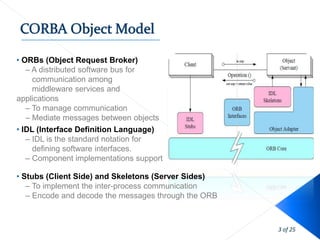
• ORBs (Object Request Broker)
   – A distributed software bus for
     communication among
     middleware services and
applications
   – To manage communication
   – Mediate messages between objects
• IDL (Interface Definition Language)
   – IDL is the standard notation for
     defining software interfaces.
   – Component implementations support

• Stubs (Client Side) and Skeletons (Server Sides)
   – To implement the inter-process communication
   – Encode and decode the messages through the ORB


                                                      3 of 25
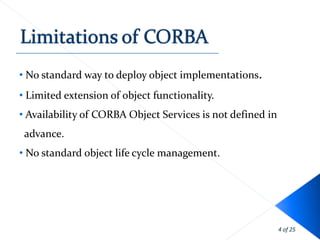
• No standard way to deploy object implementations.
• Limited extension of object functionality.
• Availability of CORBA Object Services is not defined in
 advance.
• No standard object life cycle management.


                                                            4 of 25
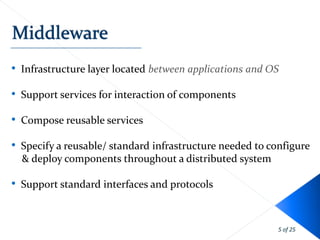
• Infrastructure layer located between applications and OS

• Support services for interaction of components

• Compose reusable services

• Specify a reusable/ standard infrastructure needed to configure
  & deploy components throughout a distributed system

• Support standard interfaces and protocols


                                                          5 of 25
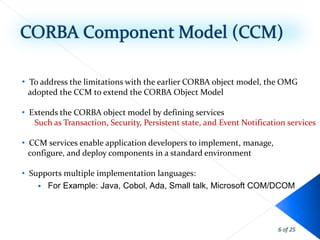
• To address the limitations with the earlier CORBA object model, the OMG
 adopted the CCM to extend the CORBA Object Model

• Extends the CORBA object model by defining services
   Such as Transaction, Security, Persistent state, and Event Notification services

• CCM services enable application developers to implement, manage,
  configure, and deploy components in a standard environment

• Supports multiple implementation languages:
     For Example: Java, Cobol, Ada, Small talk, Microsoft COM/DCOM


                                                                        6 of 25
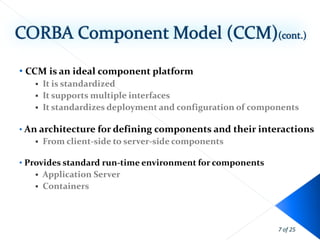
• CCM is an ideal component platform
      It is standardized
      It supports multiple interfaces
      It standardizes deployment and configuration of components

• An architecture for defining components and their interactions
      From client-side to server-side components

• Provides standard run-time environment for components
      Application Server
      Containers


                                                            7 of 25
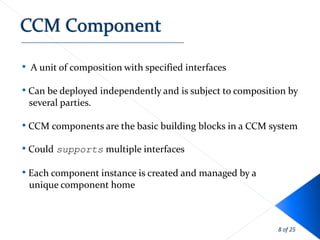
• A unit of composition with specified interfaces

• Can be deployed independently and is subject to composition by
 several parties.

• CCM components are the basic building blocks in a CCM system
• Could supports multiple interfaces

• Each component instance is created and managed by a
 unique component home


                                                           8 of 25
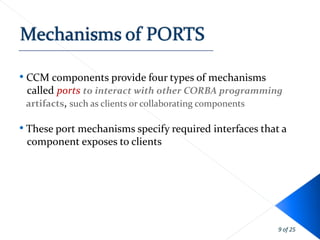
• CCM components provide four types of mechanisms
 called ports to interact with other CORBA programming
 artifacts, such as clients or collaborating components

• These port mechanisms specify required interfaces that a
 component exposes to clients


                                                        9 of 25
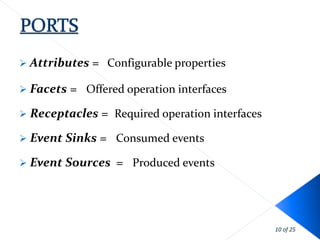
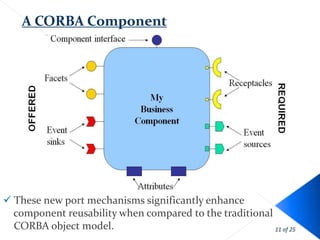
 Attributes   = Configurable properties

 Facets   = Offered operation interfaces
 Receptacles    = Required operation interfaces
 Event Sinks   = Consumed events
 Event Sources    = Produced events


                                                   10 of 25
A CORBA Component


 These new port mechanisms significantly enhance
  component reusability when compared to the traditional
  CORBA object model.                                    11 of 25
 Service Components:.
     • It is created and destroyed by the particular CCM Client that it is
        associated with
     • It's lifetime is restricted to that of one single operation request
     • Service components do not survive a System shutdown
 Session Components:
     • Similar to Service Components but:
        There are two types of Session Components
            – Stateless Session Components
            – Stateful Session Components

Process Components:
    • May however be shared by multiple CCM Clients.
    • Their states can be persisted and stored.
    • Hence the can survive System Shutdowns.
                                                                   12 of 25
• Act the interface between a CORBA component and the outside as world

• A CCM client never accesses a CORBA component directly
• Provides simplified interfaces for CORBA Services
     - Security, Transactions, Persistence, and Events notification

• A container encapsulates a component implementation and
 provides a run-time environment for the component it manages


                                                                  13 of 25
   Component implementations depend upon the standard CORBA
    Portable Object Adapter (POA) to dispatch coming client requests
    to their corresponding servants

 The CCM component model         implementation uses the
    Component description to create and configure the POA hierarchy
    automatically and to locate the common services defined by CCM

   Container creates its own POA for all the interfaces it manages.


                                                                14 of 25
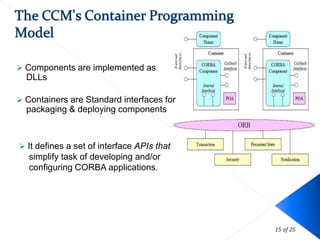
 Components are implemented as
  DLLs

 Containers are Standard interfaces for
  packaging & deploying components


 It defines a set of interface APIs that
   simplify task of developing and/or
   configuring CORBA applications.


                                            15 of 25
• Persistent Containers :
  – Their states are saved between invocations.

• Transient Containers :
  – They are non- persistent components whose states are
  not
     saved at all.


                                                  16 of 25
   CCM containers also manage the lifetime of component
    servants.

 A CCM provider defines a ServantLocator that is responsible
    for supporting these policies.

 When a ServantLocator is installed, a POA delegates the
    responsibility of activating and deactivating` servants to it.


                                                             17 of 25
• Components can be deployed in component servers that have no advance
  knowledge of how to configure and instantiate these deployed
  components.

• Components need generic interfaces to assist component servers that
  install and manage them.

• CCM components can interact with external entities, such as services
  provided by an ORB, other components, or clients via ports.


                                                                 18 of 25
   In large-scale distributed systems, the packaging and deploying of
    components can become complicated.

 To simplify the effort of   developing components, CCM defines
    standard techniques.

   CCM describes components, and their dependencies using Open
    Software Description (OSD), which is an XML Document Type
    Definition (DTD) defined by the WWW Consortium.

   Components are packaged in assembly files and package descriptors
    are XML documents conforming to the OSD DTD that describe the
    contents of an assembly file and their dependencies.


                                                                   19 of 25
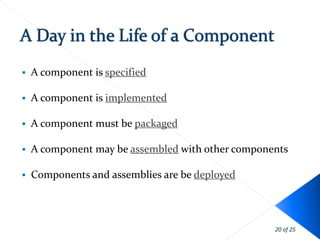
   A component is specified

   A component is implemented

   A component must be packaged

   A component may be assembled with other components

   Components and assemblies are be deployed


                                                   20 of 25
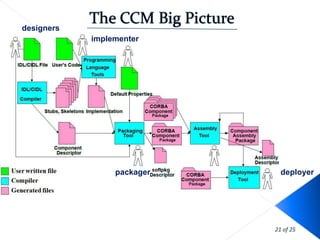
designers
            implementer


                 packager     deployer


                            21 of 25
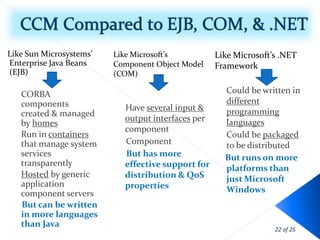
Like Sun Microsystems’   • Like Microsoft’s      • Like Microsoft’s .NET
Enterprise Java Beans      Component Object Model Framework
(EJB)                      (COM)

  • CORBA                                            • Could be written in
    components                                         different
                             Have several input &      programming
    created & managed
                             output interfaces per     languages
    by homes
                             component
  • Run in containers                                • Could be packaged
    that manage system       Component                 to be distributed
    services                 But has more              But runs on more
    transparently            effective support for     platforms than
  • Hosted by generic        distribution & QoS        just Microsoft
    application              properties
    component servers                                  Windows
    But can be written
    in more languages
    than Java
                                                                   22 of 25
 CCM can be extended to support other non-functional
  properties, such as QoS properties
 The CCM specification is large and complex. Therefore, ORB
 providers have only started implementing the specification
 recently.
 The CCM programming model is thus suitable for proven
 technologies and existing services to develop the next-
generation
 of highly scalable distributed applications.


                                                      23 of 25
[1] Wang, Schmidt, O’Ryan ‘CORBA Component Model’ www.cs.wustl.edu/~schmidt/cbse

[2] Object Management Group, Inc., CORBA Success Stories, 2000.
URL: http://www.corba.org/success.htm

[3] N. Wang et. al., Applying Reflective Middleware Techniques to Optimize a QoS- enabled
CORBA Component Model Implementation, 24th Computer Software and Applications
Conference, Taipei, Taiwan, 2000a.

[4] Jeff Mischkinsky, "CORBA 3.0 New Components chapters,“ OMG TC Document
 ptc/99-10-04, October

[5] Gopalan Suresh Raj "Enterprise Java Computing-Applications and Architecture"
(Cambridge University Press, June '99) and "The Awesome Power
of JavaBeans" (Manning, July'98), (http://www.execpc.com/~gopalan)


                                                                                   24 of 25
25 of 25

CORBA Component Model

  • 1.
  • 2.
    Common Object RequestBroker Architecture • Since 1989, the Object Management Group (OMG) has been standardizing an open middleware specification to support distributed applications. • A powerful language-independent and platform- independent technology • Supports multiple implementation languages  For Example: Java & C++ 2 of 25
  • 3.
    • ORBs (ObjectRequest Broker) – A distributed software bus for communication among middleware services and applications – To manage communication – Mediate messages between objects • IDL (Interface Definition Language) – IDL is the standard notation for defining software interfaces. – Component implementations support • Stubs (Client Side) and Skeletons (Server Sides) – To implement the inter-process communication – Encode and decode the messages through the ORB 3 of 25
  • 4.
    • No standardway to deploy object implementations. • Limited extension of object functionality. • Availability of CORBA Object Services is not defined in advance. • No standard object life cycle management. 4 of 25
  • 5.
    • Infrastructure layerlocated between applications and OS • Support services for interaction of components • Compose reusable services • Specify a reusable/ standard infrastructure needed to configure & deploy components throughout a distributed system • Support standard interfaces and protocols 5 of 25
  • 6.
    • To addressthe limitations with the earlier CORBA object model, the OMG adopted the CCM to extend the CORBA Object Model • Extends the CORBA object model by defining services Such as Transaction, Security, Persistent state, and Event Notification services • CCM services enable application developers to implement, manage, configure, and deploy components in a standard environment • Supports multiple implementation languages:  For Example: Java, Cobol, Ada, Small talk, Microsoft COM/DCOM 6 of 25
  • 7.
    • CCM isan ideal component platform  It is standardized  It supports multiple interfaces  It standardizes deployment and configuration of components • An architecture for defining components and their interactions  From client-side to server-side components • Provides standard run-time environment for components  Application Server  Containers 7 of 25
  • 8.
    • A unitof composition with specified interfaces • Can be deployed independently and is subject to composition by several parties. • CCM components are the basic building blocks in a CCM system • Could supports multiple interfaces • Each component instance is created and managed by a unique component home 8 of 25
  • 9.
    • CCM componentsprovide four types of mechanisms called ports to interact with other CORBA programming artifacts, such as clients or collaborating components • These port mechanisms specify required interfaces that a component exposes to clients 9 of 25
  • 10.
     Attributes = Configurable properties  Facets = Offered operation interfaces  Receptacles = Required operation interfaces  Event Sinks = Consumed events  Event Sources = Produced events 10 of 25
  • 11.
    A CORBA Component These new port mechanisms significantly enhance component reusability when compared to the traditional CORBA object model. 11 of 25
  • 12.
     Service Components:. • It is created and destroyed by the particular CCM Client that it is associated with • It's lifetime is restricted to that of one single operation request • Service components do not survive a System shutdown  Session Components: • Similar to Service Components but: There are two types of Session Components – Stateless Session Components – Stateful Session Components Process Components: • May however be shared by multiple CCM Clients. • Their states can be persisted and stored. • Hence the can survive System Shutdowns. 12 of 25
  • 13.
    • Act theinterface between a CORBA component and the outside as world • A CCM client never accesses a CORBA component directly • Provides simplified interfaces for CORBA Services - Security, Transactions, Persistence, and Events notification • A container encapsulates a component implementation and provides a run-time environment for the component it manages 13 of 25
  • 14.
    Component implementations depend upon the standard CORBA Portable Object Adapter (POA) to dispatch coming client requests to their corresponding servants  The CCM component model implementation uses the Component description to create and configure the POA hierarchy automatically and to locate the common services defined by CCM  Container creates its own POA for all the interfaces it manages. 14 of 25
  • 15.
     Components areimplemented as DLLs  Containers are Standard interfaces for packaging & deploying components  It defines a set of interface APIs that simplify task of developing and/or configuring CORBA applications. 15 of 25
  • 16.
    • Persistent Containers: – Their states are saved between invocations. • Transient Containers : – They are non- persistent components whose states are not saved at all. 16 of 25
  • 17.
    CCM containers also manage the lifetime of component servants.  A CCM provider defines a ServantLocator that is responsible for supporting these policies.  When a ServantLocator is installed, a POA delegates the responsibility of activating and deactivating` servants to it. 17 of 25
  • 18.
    • Components canbe deployed in component servers that have no advance knowledge of how to configure and instantiate these deployed components. • Components need generic interfaces to assist component servers that install and manage them. • CCM components can interact with external entities, such as services provided by an ORB, other components, or clients via ports. 18 of 25
  • 19.
    In large-scale distributed systems, the packaging and deploying of components can become complicated.  To simplify the effort of developing components, CCM defines standard techniques.  CCM describes components, and their dependencies using Open Software Description (OSD), which is an XML Document Type Definition (DTD) defined by the WWW Consortium.  Components are packaged in assembly files and package descriptors are XML documents conforming to the OSD DTD that describe the contents of an assembly file and their dependencies. 19 of 25
  • 20.
    A component is specified  A component is implemented  A component must be packaged  A component may be assembled with other components  Components and assemblies are be deployed 20 of 25
  • 21.
    designers implementer packager deployer 21 of 25
  • 22.
    Like Sun Microsystems’ • Like Microsoft’s • Like Microsoft’s .NET Enterprise Java Beans Component Object Model Framework (EJB) (COM) • CORBA • Could be written in components different Have several input & programming created & managed output interfaces per languages by homes component • Run in containers • Could be packaged that manage system Component to be distributed services But has more But runs on more transparently effective support for platforms than • Hosted by generic distribution & QoS just Microsoft application properties component servers Windows But can be written in more languages than Java 22 of 25
  • 23.
     CCM canbe extended to support other non-functional properties, such as QoS properties  The CCM specification is large and complex. Therefore, ORB providers have only started implementing the specification recently.  The CCM programming model is thus suitable for proven technologies and existing services to develop the next- generation of highly scalable distributed applications. 23 of 25
  • 24.
    [1] Wang, Schmidt,O’Ryan ‘CORBA Component Model’ www.cs.wustl.edu/~schmidt/cbse [2] Object Management Group, Inc., CORBA Success Stories, 2000. URL: http://www.corba.org/success.htm [3] N. Wang et. al., Applying Reflective Middleware Techniques to Optimize a QoS- enabled CORBA Component Model Implementation, 24th Computer Software and Applications Conference, Taipei, Taiwan, 2000a. [4] Jeff Mischkinsky, "CORBA 3.0 New Components chapters,“ OMG TC Document ptc/99-10-04, October [5] Gopalan Suresh Raj "Enterprise Java Computing-Applications and Architecture" (Cambridge University Press, June '99) and "The Awesome Power of JavaBeans" (Manning, July'98), (http://www.execpc.com/~gopalan) 24 of 25
  • 25.