
COMPONENT BASED
EMBEDDED SYSTEMS
ANJALI SEJWAL 2K11/SE/007
CHARU MEHNDIRATTA 2K11/SE/025
NIKITA JAIN 2K11/SE/045
SONALI DEV 2K11/SE/076
SUNITA TANDON 2K11/SE/077
INTRODUCTION
What is Component Based Technology?
● It deals with the idea of breaking large, complex
software applications into a series of pre-built and easily
developed, understood, and changeable software
modules.
● It facilitates cheap and quick delivery of software
solutions.
What is Embedded System?
● A computer system that is part of a larger system and
performs some of the requirements of that system; for
example, a computer system used in an aircraft or rapid
transit system.
What is Embedded System?
An embedded system is a computer system with a
dedicated function within a larger mechanical or
electrical system, often with real-time computing
constraints
For example, a computer system used in an aircraft or
rapid transit system.
Embedded systems range from portable devices such
as digital watches and MP3 players, to large
stationary installations like traffic lights, factory
controllers, and largely complex systems like hybrid
vehicles, MRI, and avionics.
What is Embedded System?
Properties typical of embedded computers
●Low power consumption,
●Small size,
●Rugged operating ranges
● Low per-unit cost
●User interface
●Processors in embedded systems
●Ready made computer boards
NEED FOR COMPONENT BASED
EMBEDDED SYSTEMS
●Huge market arises for embedded devices, and thus
for software for them
●Similar basic functionalities are repeated
●New functionalities specific to the devices are added
constantly
●Shorter development time is required
●Better quality is expected
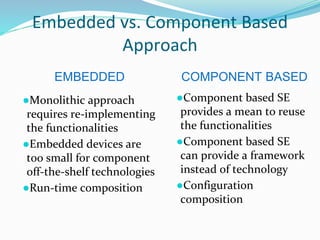
SOLUTION TO THESE PROBLEMS?
SOFTWARE
COMPONENTS
EMBEDDED
DEVICE
COMBININGCBT & EMBEDDED SYSTEM TECHNOLOGY
Embedded vs. Component Based
Approach
EMBEDDED
●Monolithic approach
requires re-implementing
the functionalities
●Embedded devices are
too small for component
off-the-shelf technologies
●Run-time composition
COMPONENT BASED
●Component based SE
provides a mean to reuse
the functionalities
●Component based SE
can provide a framework
instead of technology
●Configuration
composition
Embedded vs. Component Based
Approach contd..
EMBEDDED
●Coarse-grained
components
●Black-box reuse
●Binary independence
COMPONENT BASED
●Fine-grained
components
●White-box reuse or
Gray-box reuse (glass-
box)
●Source level portability
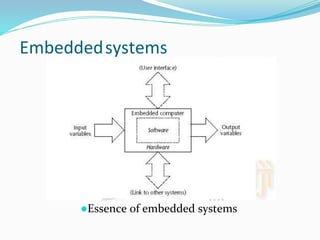
Embeddedsystems
●Essence of embedded systems
Widely used component models for
embedded systems
•Direct use of component models
– CORBA (telecommunication)
– COM/DCOM, .NET – process industry
•Improved component-models (with added
functionalities) – OPC (OLE process control Foundation)
•Restricted (use of) component-models to achieve
predictability – Using only specification (IDL) , no
multiple interface, etc.
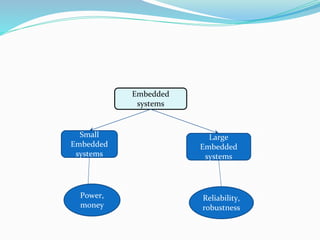
Embedded
systems
Small
Embedded
systems
Large
Embedded
systems
Power,
money
Reliability,
robustness
Specific requirements of embedded
systems
• Real-time requirements
• Resource consumption – CPU, Memory, Power, Physical
space
• Dependability – Safety, reliability, availability
• Life-cycle properties (long life systems) –
Maintainability, expandability – Portability
• Increasing interoperability
Real-time Properties
● Related to time
● Includes response time, execution time, deadline,
latency time.
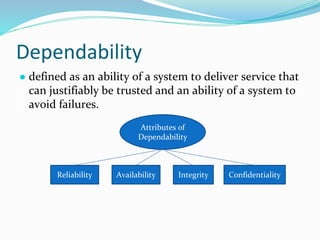
Dependability
● defined as an ability of a system to deliver service that
can justifiably be trusted and an ability of a system to
avoid failures.
Attributes of
Dependability
Reliability Availability Integrity Confidentiality
Resource Consumption
● Depends on size of system and production costs.
● Includes factors
-CPU
-Memory
-Power
-Physical space
Life Cycle Properties
● For long time systems
● Maintainability, expandability
● Portability
State of the practice & experience
for Embedded Systems
• Embedded systems comprise a scale from ultra small devices
with simple functionality, through small systems with
sophisticated functions, to large, possibly distributed systems,
where the management of the complexity is the main challenge.
•A common characteristic of all systems is increasing importance
of software.
•For example, software development costs for industrial robots
make today about 75% of total costs, while in car industry it is
today about 30%. Some ten, fifteen years ago this number was
about 25% for robots and neglect able for cars.
•A second common characteristic is increasing interoperability.
AutomotiveIndustry
●Within the automotive industry, the component-based
approach has a relatively long tradition, as these systems
are typically built from system components that are either
developed in-house or provided by external suppliers
●the entire control system of an advanced car includes a
number of Electronic Control Units (ECUs) equipped with
software that implements vehicle functions. ECUs are
treated as system components that can be developed and
build independently of each other and of the entire system
●The ECUs are connected to the system (the car) through
sensors and actuators and between themselves via one or
several buses. Usually the buses are integrations points
and their protocols specify the communications between
the ECUs.
IndustrialAutomation
●Typical application domains of industrial automation are
in control of industrial processes, power supply, industrial
robots. Industrial automation domain comprises a large
area of control, monitoring and optimization systems
●Most control systems are manufactured in rather large
volumes, and must to a large extent be configurable to suit
a variety of customer contexts.
●They can be classified according to different levels of
control:
i) Process level (for example, a valve in a water pipeline, a
boiler, etc.)
(ii) Field level that concerns sensors, actuators, drivers, etc
(iii) Group control level that concerns controller devices
and applications which control a group of related process
level devices in a closed-loop fashion
(iv) Process control level i.s. operator stations and
processing systems with their applications for plant-wide
remote supervision and control
(v)Production or manufacturing management level that
includes systems and applications for production planning.
ConsumerElectronics
●Consumer electronics products, such as TV, VCR, and
DVD, are developed and delivered in form of product
families
●Production is organized into product lines - this allows
many variations on a central product definition
●A product line is a top-down, planned, proactive approach
to achieve reuse of software within a family or population
of products. It is based on use of a common architecture
and core functions included into the product platform and
basic components
● Because of the requirements for low hardware and
production costs, general-purpose component technologies
have not been used, but rather more dedicated and simpler
propriety models have been developed
●An example of such a component model is the Koala
component model used at Philips . Koala is a component
model and an architectural description language to build a
large diversity of products from a repository of components.
Koala is designed to build consumer products such as
televisions, video recorders, CD and DVD players and
recorders, and combinations of them.
Otherdomains:
●Telecommunication, avionics and aerospace,
transportation, computer games, home electronics,
navigation systems, etc
●While there is many similarities between these domains
there are also very different requirements for their
functional and extra-functional properties
●The consequences are that the requirements for
component -based technologies are different, and
consequently we cannot expect to have one component
model.
Basic concepts for Component
based Embedded Systems
It includes the following features:-
● Contractually specified interfaces
● Component as a unit of composition and independent deployment
● Explicit context dependencies
● Component granularity
● Reuse
● Location transparency
● Component wiring
● Portability, platform independence
Component-based approach for
small embedded systems
● Contractually specified interfaces
❖ Contract addresses the functional requirements of the
component.
❖ In embedded environment there is also another aspect –
non-functional requirements, like memory consumption,
response time, processing power required, etc. All of them
need to be addressed as part of the contract
● Interfaces
❖ The interfaces are usually implemented as object interfaces
that supports
➢ Polymorphism
➢ Late Binding
➢ Address some semantic specification
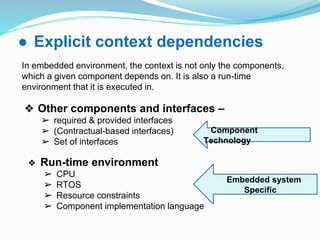
● Explicit context dependencies
❖ Run-time environment
➢ CPU
➢ RTOS
➢ Resource constraints
➢ Component implementation language
In embedded environment, the context is not only the components,
which a given component depends on. It is also a run-time
environment that it is executed in.
❖ Other components and interfaces –
➢ required & provided interfaces
➢ (Contractual-based interfaces)
➢ Set of interfaces
Component
Technology
Embedded system
Specific
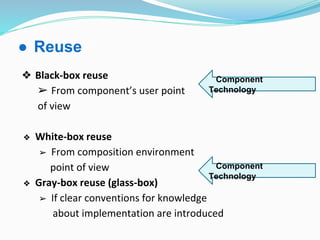
● Reuse
❖ Black-box reuse
➢ From component’s user point
of view
❖ White-box reuse
➢ From composition environment
point of view
❖ Gray-box reuse (glass-box)
➢ If clear conventions for knowledge
about implementation are introduced
Component
Technology
Component
Technology
● Portability, Platform independence
❖ Binary independence
❖ Source level portability
➢ Design-time composition
➢ Run-time environment restrictions
❖ Source level portability requires
➢ Agreement on implementation
language
➢ Agreement on available libraries
➢ Providing proper abstractions (i.e. RTOS API)
Component
Technology
Component
Technology
Component-based approach
for LARGE embedded systems
● Here the resource constraints are not the primary concerns.
● The complexity and interoperability play much more important
role.
● Since the complexity the development of such system is very
expensive and cutting the development costs is highly
prioritized.
● For this reason general-purpose component technologies are
of more interesting than in a case for small systems.
Scope of improvements
• Direct use of component models
– CORBA (telecommunication)
– COM/DCOM, .NET – process industry
• Improved component-models (with added functionalities) –
OPC (OLE process control Foundation)
• Restricted (use of) component-models to achieve predictability
– Using only specification (IDL) , no multiple interface, etc.
The priorities of CBSE for
embedded systems are:
●Predicting system properties. A research challenge today is to
predict system properties from the component properties. This
is interesting for system integration, to achieve predictability,
etc.
●Development of widely adopted component models for real-
time systems. Such a model should be supported by technology
for generating necessary runtime infrastructure, generation of
monitors to check conformance with contracts, etc.
Thank you!

Embedded system.pptx

  • 1.
    COMPONENT BASED EMBEDDED SYSTEMS ANJALISEJWAL 2K11/SE/007 CHARU MEHNDIRATTA 2K11/SE/025 NIKITA JAIN 2K11/SE/045 SONALI DEV 2K11/SE/076 SUNITA TANDON 2K11/SE/077
  • 2.
    INTRODUCTION What is ComponentBased Technology? ● It deals with the idea of breaking large, complex software applications into a series of pre-built and easily developed, understood, and changeable software modules. ● It facilitates cheap and quick delivery of software solutions. What is Embedded System? ● A computer system that is part of a larger system and performs some of the requirements of that system; for example, a computer system used in an aircraft or rapid transit system.
  • 3.
    What is EmbeddedSystem? An embedded system is a computer system with a dedicated function within a larger mechanical or electrical system, often with real-time computing constraints For example, a computer system used in an aircraft or rapid transit system. Embedded systems range from portable devices such as digital watches and MP3 players, to large stationary installations like traffic lights, factory controllers, and largely complex systems like hybrid vehicles, MRI, and avionics.
  • 4.
    What is EmbeddedSystem? Properties typical of embedded computers ●Low power consumption, ●Small size, ●Rugged operating ranges ● Low per-unit cost ●User interface ●Processors in embedded systems ●Ready made computer boards
  • 5.
    NEED FOR COMPONENTBASED EMBEDDED SYSTEMS ●Huge market arises for embedded devices, and thus for software for them ●Similar basic functionalities are repeated ●New functionalities specific to the devices are added constantly ●Shorter development time is required ●Better quality is expected
  • 6.
    SOLUTION TO THESEPROBLEMS? SOFTWARE COMPONENTS EMBEDDED DEVICE COMBININGCBT & EMBEDDED SYSTEM TECHNOLOGY
  • 7.
    Embedded vs. ComponentBased Approach EMBEDDED ●Monolithic approach requires re-implementing the functionalities ●Embedded devices are too small for component off-the-shelf technologies ●Run-time composition COMPONENT BASED ●Component based SE provides a mean to reuse the functionalities ●Component based SE can provide a framework instead of technology ●Configuration composition
  • 8.
    Embedded vs. ComponentBased Approach contd.. EMBEDDED ●Coarse-grained components ●Black-box reuse ●Binary independence COMPONENT BASED ●Fine-grained components ●White-box reuse or Gray-box reuse (glass- box) ●Source level portability
  • 9.
  • 10.
    Widely used componentmodels for embedded systems •Direct use of component models – CORBA (telecommunication) – COM/DCOM, .NET – process industry •Improved component-models (with added functionalities) – OPC (OLE process control Foundation) •Restricted (use of) component-models to achieve predictability – Using only specification (IDL) , no multiple interface, etc.
  • 11.
  • 12.
    Specific requirements ofembedded systems • Real-time requirements • Resource consumption – CPU, Memory, Power, Physical space • Dependability – Safety, reliability, availability • Life-cycle properties (long life systems) – Maintainability, expandability – Portability • Increasing interoperability
  • 13.
    Real-time Properties ● Relatedto time ● Includes response time, execution time, deadline, latency time.
  • 14.
    Dependability ● defined asan ability of a system to deliver service that can justifiably be trusted and an ability of a system to avoid failures. Attributes of Dependability Reliability Availability Integrity Confidentiality
  • 15.
    Resource Consumption ● Dependson size of system and production costs. ● Includes factors -CPU -Memory -Power -Physical space
  • 16.
    Life Cycle Properties ●For long time systems ● Maintainability, expandability ● Portability
  • 17.
    State of thepractice & experience for Embedded Systems • Embedded systems comprise a scale from ultra small devices with simple functionality, through small systems with sophisticated functions, to large, possibly distributed systems, where the management of the complexity is the main challenge. •A common characteristic of all systems is increasing importance of software. •For example, software development costs for industrial robots make today about 75% of total costs, while in car industry it is today about 30%. Some ten, fifteen years ago this number was about 25% for robots and neglect able for cars. •A second common characteristic is increasing interoperability.
  • 18.
    AutomotiveIndustry ●Within the automotiveindustry, the component-based approach has a relatively long tradition, as these systems are typically built from system components that are either developed in-house or provided by external suppliers ●the entire control system of an advanced car includes a number of Electronic Control Units (ECUs) equipped with software that implements vehicle functions. ECUs are treated as system components that can be developed and build independently of each other and of the entire system ●The ECUs are connected to the system (the car) through sensors and actuators and between themselves via one or several buses. Usually the buses are integrations points and their protocols specify the communications between the ECUs.
  • 19.
    IndustrialAutomation ●Typical application domainsof industrial automation are in control of industrial processes, power supply, industrial robots. Industrial automation domain comprises a large area of control, monitoring and optimization systems ●Most control systems are manufactured in rather large volumes, and must to a large extent be configurable to suit a variety of customer contexts.
  • 20.
    ●They can beclassified according to different levels of control: i) Process level (for example, a valve in a water pipeline, a boiler, etc.) (ii) Field level that concerns sensors, actuators, drivers, etc (iii) Group control level that concerns controller devices and applications which control a group of related process level devices in a closed-loop fashion (iv) Process control level i.s. operator stations and processing systems with their applications for plant-wide remote supervision and control (v)Production or manufacturing management level that includes systems and applications for production planning.
  • 21.
    ConsumerElectronics ●Consumer electronics products,such as TV, VCR, and DVD, are developed and delivered in form of product families ●Production is organized into product lines - this allows many variations on a central product definition ●A product line is a top-down, planned, proactive approach to achieve reuse of software within a family or population of products. It is based on use of a common architecture and core functions included into the product platform and basic components
  • 22.
    ● Because ofthe requirements for low hardware and production costs, general-purpose component technologies have not been used, but rather more dedicated and simpler propriety models have been developed ●An example of such a component model is the Koala component model used at Philips . Koala is a component model and an architectural description language to build a large diversity of products from a repository of components. Koala is designed to build consumer products such as televisions, video recorders, CD and DVD players and recorders, and combinations of them.
  • 23.
    Otherdomains: ●Telecommunication, avionics andaerospace, transportation, computer games, home electronics, navigation systems, etc ●While there is many similarities between these domains there are also very different requirements for their functional and extra-functional properties ●The consequences are that the requirements for component -based technologies are different, and consequently we cannot expect to have one component model.
  • 24.
    Basic concepts forComponent based Embedded Systems It includes the following features:- ● Contractually specified interfaces ● Component as a unit of composition and independent deployment ● Explicit context dependencies ● Component granularity ● Reuse ● Location transparency ● Component wiring ● Portability, platform independence
  • 25.
    Component-based approach for smallembedded systems ● Contractually specified interfaces ❖ Contract addresses the functional requirements of the component. ❖ In embedded environment there is also another aspect – non-functional requirements, like memory consumption, response time, processing power required, etc. All of them need to be addressed as part of the contract
  • 26.
    ● Interfaces ❖ Theinterfaces are usually implemented as object interfaces that supports ➢ Polymorphism ➢ Late Binding ➢ Address some semantic specification
  • 27.
    ● Explicit contextdependencies ❖ Run-time environment ➢ CPU ➢ RTOS ➢ Resource constraints ➢ Component implementation language In embedded environment, the context is not only the components, which a given component depends on. It is also a run-time environment that it is executed in. ❖ Other components and interfaces – ➢ required & provided interfaces ➢ (Contractual-based interfaces) ➢ Set of interfaces Component Technology Embedded system Specific
  • 28.
    ● Reuse ❖ Black-boxreuse ➢ From component’s user point of view ❖ White-box reuse ➢ From composition environment point of view ❖ Gray-box reuse (glass-box) ➢ If clear conventions for knowledge about implementation are introduced Component Technology Component Technology
  • 29.
    ● Portability, Platformindependence ❖ Binary independence ❖ Source level portability ➢ Design-time composition ➢ Run-time environment restrictions ❖ Source level portability requires ➢ Agreement on implementation language ➢ Agreement on available libraries ➢ Providing proper abstractions (i.e. RTOS API) Component Technology Component Technology
  • 31.
    Component-based approach for LARGEembedded systems ● Here the resource constraints are not the primary concerns. ● The complexity and interoperability play much more important role. ● Since the complexity the development of such system is very expensive and cutting the development costs is highly prioritized. ● For this reason general-purpose component technologies are of more interesting than in a case for small systems.
  • 32.
    Scope of improvements •Direct use of component models – CORBA (telecommunication) – COM/DCOM, .NET – process industry • Improved component-models (with added functionalities) – OPC (OLE process control Foundation) • Restricted (use of) component-models to achieve predictability – Using only specification (IDL) , no multiple interface, etc.
  • 33.
    The priorities ofCBSE for embedded systems are: ●Predicting system properties. A research challenge today is to predict system properties from the component properties. This is interesting for system integration, to achieve predictability, etc. ●Development of widely adopted component models for real- time systems. Such a model should be supported by technology for generating necessary runtime infrastructure, generation of monitors to check conformance with contracts, etc.
  • 34.