contraception 
DR Manal Behery 
2014
Definition of Contraception 
• Contraception = “Against Conception” 
• The intentional prevention of pregnancy 
through the use of various devices, agents,drugs, 
sexual practices or surgical procedures.
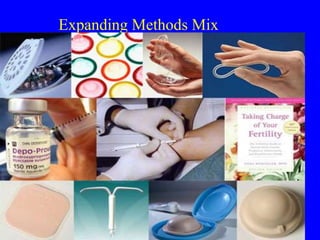
Expanding Methods Mix
How do you choose?
Top five factors to consider when selecting a 
method of fertility control. 
•Cost 
•Effectiveness of protections from STDs 
•Safety and side effects 
•Comfort and ease of use 
•Reversibility and future fertility
The only 100% effective way to 
prevent pregnancy and STD 
is to be sexually 
Abstinent 
or to Postpone 
sexual involvement.
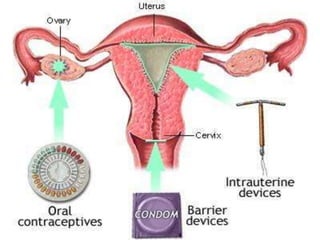
Four Types of Birth Control 
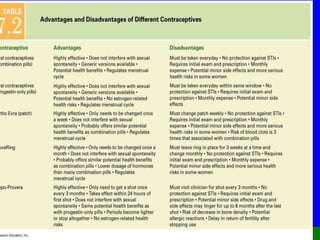
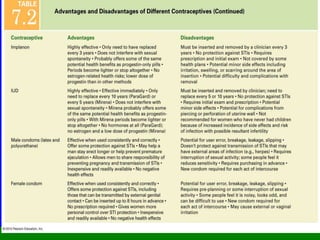
• Hormonal Methods 
• Barrier methods! 
• Surgical Methods 
• Behavioral Methods
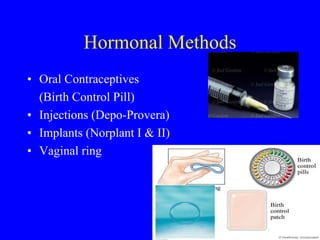
Hormonal Methods 
• Oral Contraceptives 
(Birth Control Pill) 
• Injections (Depo-Provera) 
• Implants (Norplant I & II) 
• Vaginal ring
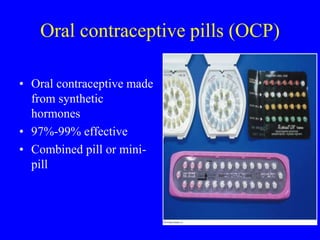
Oral contraceptive pills (OCP) 
• Oral contraceptive made 
from synthetic 
hormones 
• 97%-99% effective 
• Combined pill or mini-pill
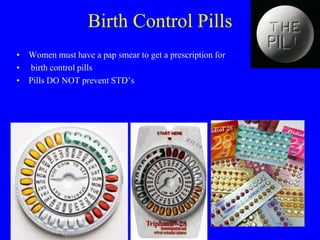
Birth Control Pills 
• Women must have a pap smear to get a prescription for 
• birth control pills 
• Pills DO NOT prevent STD’s
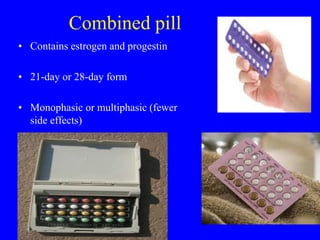
Combined pill 
• Contains estrogen and progestin 
• 21-day or 28-day form 
• Monophasic or multiphasic (fewer 
side effects)
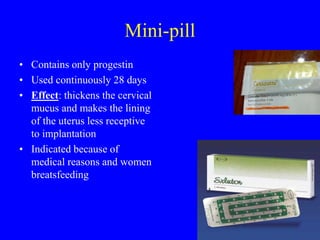
Mini-pill 
• Contains only progestin 
• Used continuously 28 days 
• Effect: thickens the cervical 
mucus and makes the lining 
of the uterus less receptive 
to implantation 
• Indicated because of 
medical reasons and women 
breatsfeeding
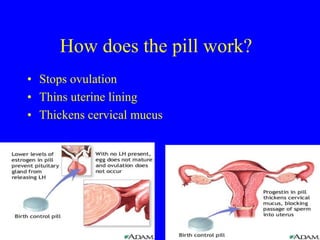
How does the pill work? 
• Stops ovulation 
• Thins uterine lining 
• Thickens cervical mucus
Pro’s 
• ↓ Acne 
• ↓ Hair growth 
• ↓Breast cysts 
• ↓ Ovarian cysts 
• ↓ Ovarian carcinoma 
• ↓ Dysmenorrhea 
• ↓ Endometrial carcinoma 
• ↓ PID 
• ↓ Risk of ectopic 
pregnancy 
• ↓ Anemia 
• ↓ Osteoporosis
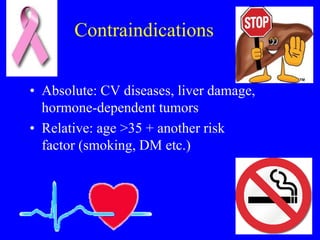
Contraindications 
• Absolute: CV diseases, liver damage, 
hormone-dependent tumors 
• Relative: age >35 + another risk 
factor (smoking, DM etc.)
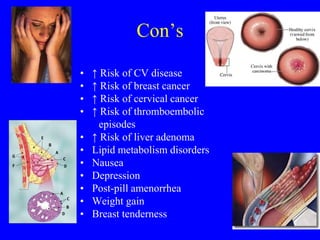
Con’s 
• ↑ Risk of CV disease 
• ↑ Risk of breast cancer 
• ↑ Risk of cervical cancer 
• ↑ Risk of thromboembolic 
episodes 
• ↑ Risk of liver adenoma 
• Lipid metabolism disorders 
• Nausea 
• Depression 
• Post-pill amenorrhea 
• Weight gain 
• Breast tenderness
Taking the Pill 
• Once a day at the same time everyday 
• Use condoms for first month 
• Use condoms when on antibiotics 
• Use condoms for 1 week if you miss a pill or take 
one late 
• The pill offers no protection from STD’s
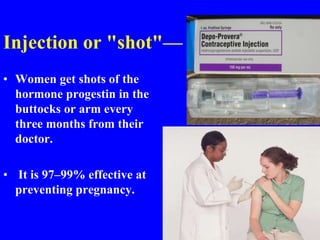
Injection or "shot"— 
• Women get shots of the 
hormone progestin in the 
buttocks or arm every 
three months from their 
doctor. 
• It is 97–99% effective at 
preventing pregnancy.
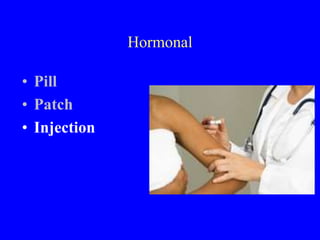
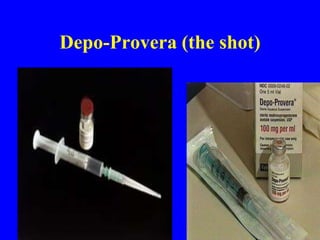
Depo-Provera (the shot)
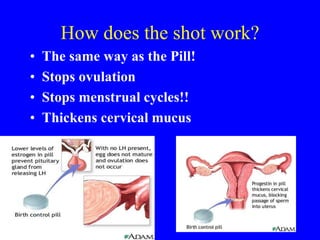
How does the shot work? 
• The same way as the Pill! 
• Stops ovulation 
• Stops menstrual cycles!! 
• Thickens cervical mucus
SIDE EFFECTS 
• Extremely irregular menstrual bleeding and 
spotting for 3-6 months! 
• NO PERIOD  after 3-6 months 
• Weight change 
• Breast tenderness 
• Mood change 
*not every woman has side-effects!
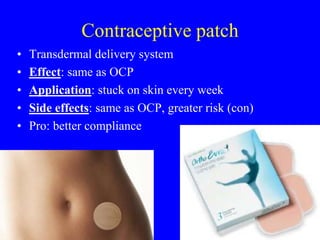
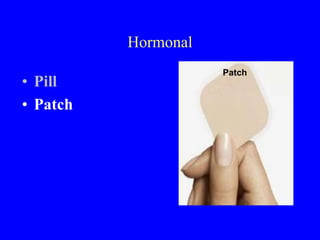
Contraceptive patch 
• Transdermal delivery system 
• Effect: same as OCP 
• Application: stuck on skin every week 
• Side effects: same as OCP, greater risk (con) 
• Pro: better compliance
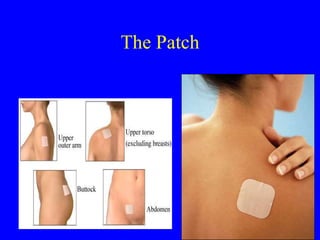
The Patch
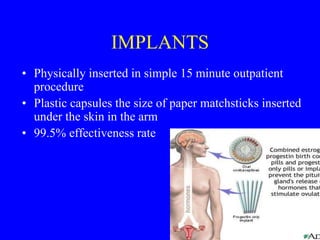
IMPLANTS 
• Physically inserted in simple 15 minute outpatient 
procedure 
• Plastic capsules the size of paper matchsticks inserted 
under the skin in the arm 
• 99.5% effectiveness rate
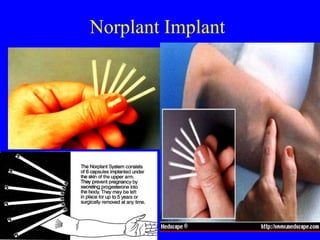
Norplant Implant
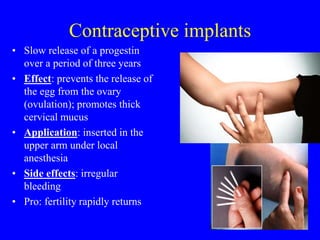
Contraceptive implants 
• Slow release of a progestin 
over a period of three years 
• Effect: prevents the release of 
the egg from the ovary 
(ovulation); promotes thick 
cervical mucus 
• Application: inserted in the 
upper arm under local 
anesthesia 
• Side effects: irregular 
bleeding 
• Pro: fertility rapidly returns
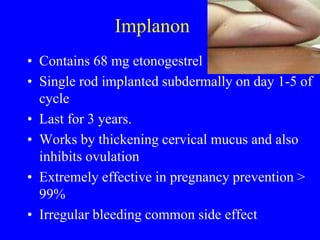
Implanon 
• Contains 68 mg etonogestrel 
• Single rod implanted subdermally on day 1-5 of 
cycle 
• Last for 3 years. 
• Works by thickening cervical mucus and also 
inhibits ovulation 
• Extremely effective in pregnancy prevention > 
99% 
• Irregular bleeding common side effect
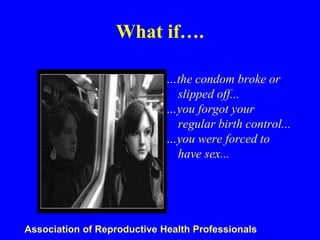
What if…. 
…the condom broke or 
slipped off... 
…you forgot your 
regular birth control... 
…you were forced to 
have sex... 
Association of Reproductive Health Professionals
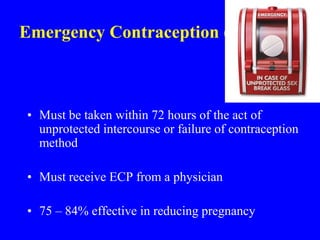
Emergency Contraception (ECP) 
• Must be taken within 72 hours of the act of 
unprotected intercourse or failure of contraception 
method 
• Must receive ECP from a physician 
• 75 – 84% effective in reducing pregnancy
How EC ACT? 
• Floods the ovaries with high amount of hormone 
and prevents ovulation 
• Alters the environment of the uterus, making it 
disruptive to the egg and sperm 
• Two sets of pills taken exactly 12 hours apart
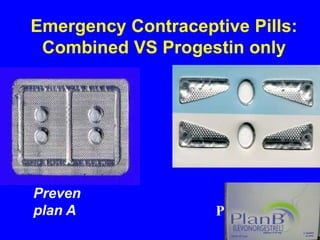
Emergency Contraceptive Pills: 
Combined VS Progestin only 
Preven 
plan A 
Plan B
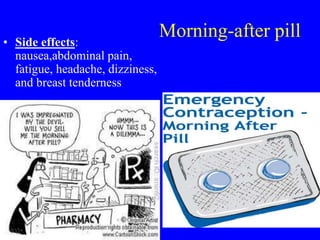
Morning-after pill 
• Side effects: 
nausea,abdominal pain, 
fatigue, headache, dizziness, 
and breast tenderness
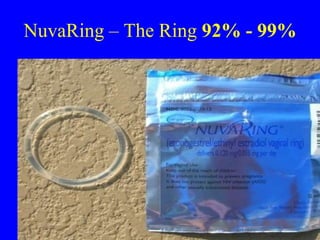
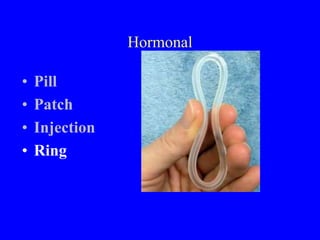
NuvaRing – The Ring 92% - 99%
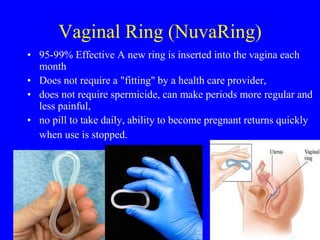
Vaginal Ring (NuvaRing) 
• 95-99% Effective A new ring is inserted into the vagina each 
month 
• Does not require a "fitting" by a health care provider, 
• does not require spermicide, can make periods more regular and 
less painful, 
• no pill to take daily, ability to become pregnant returns quickly 
when use is stopped.
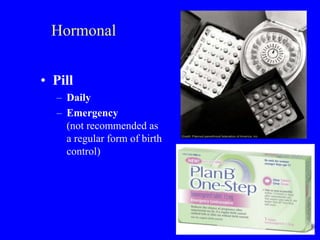
Hormonal 
• Pill 
– Daily 
– Emergency 
(not recommended as 
a regular form of birth 
control)
Hormonal 
• Pill 
• Patch 
Patch
Hormonal 
• Pill 
• Patch 
• Injection
Hormonal 
• Pill 
• Patch 
• Injection 
• Ring
Hormonal 
• Pill 
• Patch 
• Injection 
• Ring 
• Progesterone IUD IUD
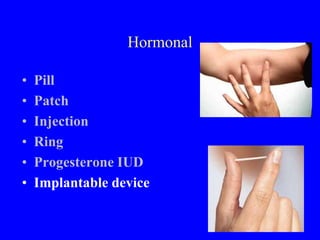
Hormonal 
• Pill 
• Patch 
• Injection 
• Ring 
• Progesterone IUD 
• Implantable device
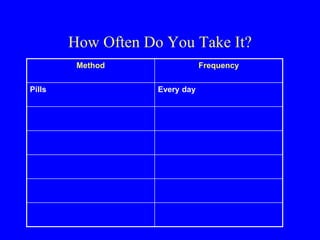
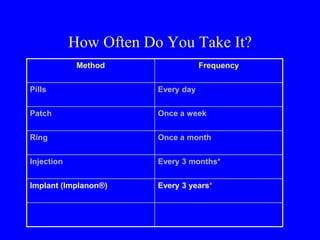
How Often Do You Take It? 
Method Frequency 
Pills Every day
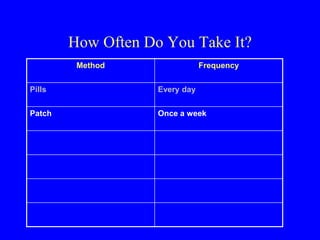
How Often Do You Take It? 
Method Frequency 
Pills Every day 
Patch Once a week
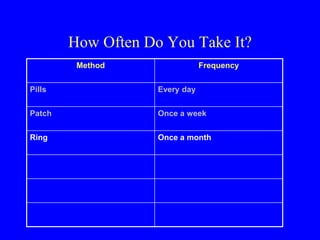
How Often Do You Take It? 
Method Frequency 
Pills Every day 
Patch Once a week 
Ring Once a month
How Often Do You Take It? 
Method Frequency 
Pills Every day 
Patch Once a week 
Ring Once a month 
Injection Every 3 months* 
Implant (Implanon®) Every 3 years*
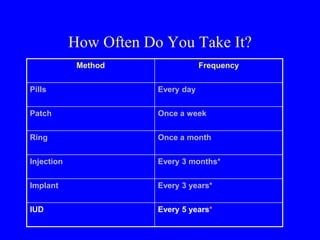
How Often Do You Take It? 
Method Frequency 
Pills Every day 
Patch Once a week 
Ring Once a month 
Injection Every 3 months* 
Implant Every 3 years* 
IUD Every 5 years*
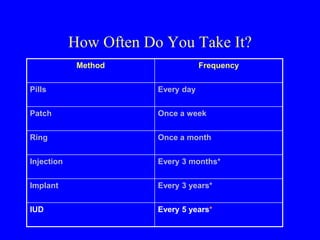
How Often Do You Take It? 
Method Frequency 
Pills Every day 
Patch Once a week 
Ring Once a month 
Injection Every 3 months* 
Implant Every 3 years* 
IUD Every 5 years*
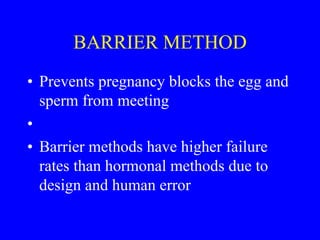
BARRIER METHOD 
• Prevents pregnancy blocks the egg and 
sperm from meeting 
• 
• Barrier methods have higher failure 
rates than hormonal methods due to 
design and human error
BARRIER METHODS 
• Spermicides 
• Male Condom 
• Female Condom 
• Diaphragm 
• Cervical Cap
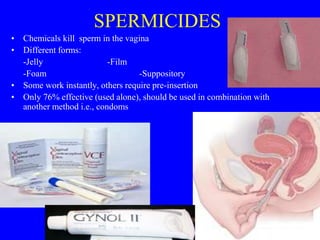
SPERMICIDES 
• Chemicals kill sperm in the vagina 
• Different forms: 
-Jelly -Film 
-Foam -Suppository 
• Some work instantly, others require pre-insertion 
• Only 76% effective (used alone), should be used in combination with 
another method i.e., condoms
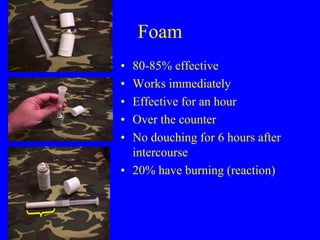
Foam 
• 80-85% effective 
• Works immediately 
• Effective for an hour 
• Over the counter 
• No douching for 6 hours after 
intercourse 
• 20% have burning (reaction)
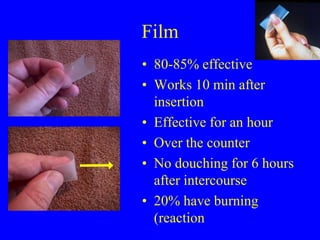
Film 
• 80-85% effective 
• Works 10 min after 
insertion 
• Effective for an hour 
• Over the counter 
• No douching for 6 hours 
after intercourse 
• 20% have burning 
(reaction)
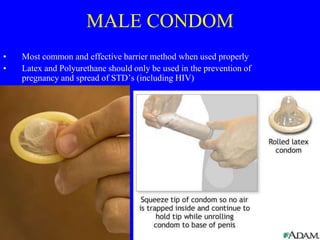
MALE CONDOM 
• Most common and effective barrier method when used properly 
• Latex and Polyurethane should only be used in the prevention of 
pregnancy and spread of STD’s (including HIV)
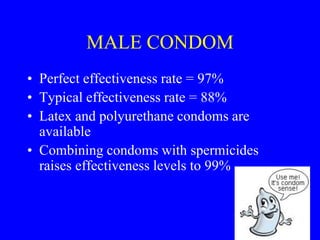
MALE CONDOM 
• Perfect effectiveness rate = 97% 
• Typical effectiveness rate = 88% 
• Latex and polyurethane condoms are 
available 
• Combining condoms with spermicides 
raises effectiveness levels to 99%
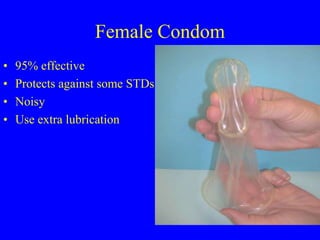
Female Condom 
• 95% effective 
• Protects against some STDs 
• Noisy 
• Use extra lubrication
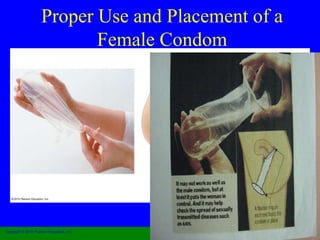
Proper Use and Placement of a 
Female Condom 
Copyright © 2010 Pearson Education, Inc.
DIAPRAGHM 
• Perfect Effectiveness Rate = 94% 
• Typical Effectiveness Rate = 80% 
• Latex barrier placed inside vagina during 
intercourse 
• Fitted by physician 
• Spermicidal jelly before insertion 
• Inserted up to 18 hours before intercourse and can 
be left in for a total of 24 hours
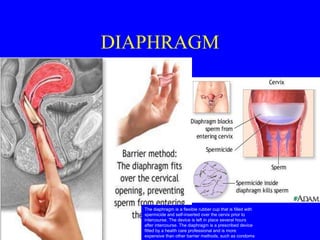
DIAPHRAGM 
The diaphragm is a flexible rubber cup that is filled with 
spermicide and self-inserted over the cervix prior to 
intercourse. The device is left in place several hours 
after intercourse. The diaphragm is a prescribed device 
fitted by a health care professional and is more 
expensive than other barrier methods, such as condoms
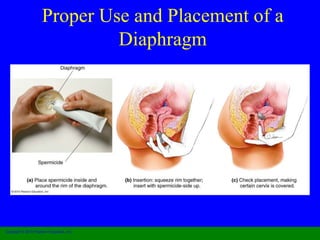
Proper Use and Placement of a 
Diaphragm 
Copyright © 2010 Pearson Education, Inc.
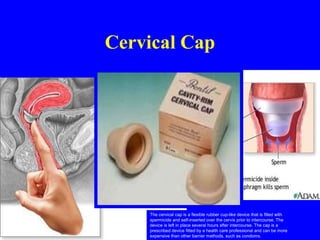
CERVICAL CAP 
• Latex barrier inserted in vagina before intercourse 
• “Caps” around cervix with suction 
• Fill with spermicidal jelly prior to use 
• Can be left in body for up to a total of 48 hours 
• Must be left in place six hours after sexual 
intercourse 
• Perfect effectiveness rate = 91% 
• Typical effectiveness rate = 80%
Cervical Cap 
The cervical cap is a flexible rubber cup-like device that is filled with 
spermicide and self-inserted over the cervix prior to intercourse. The 
device is left in place several hours after intercourse. The cap is a 
prescribed device fitted by a health care professional and can be more 
expensive than other barrier methods, such as condoms.
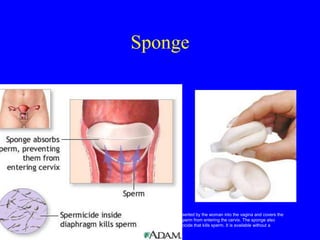
Sponge 
The sponge is inserted by the woman into the vagina and covers the 
cervix blocking sperm from entering the cervix. The sponge also 
contains a spermicide that kills sperm. It is available without a 
prescription
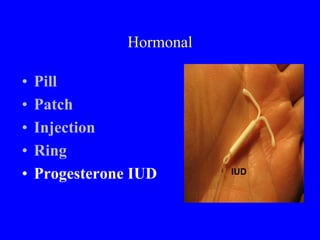
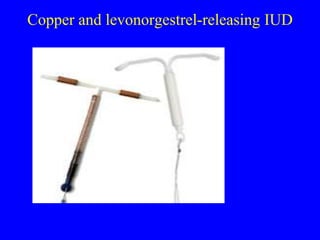
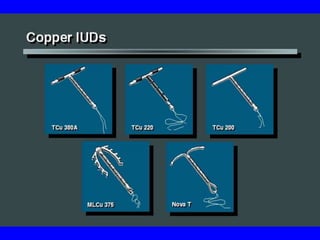
Copper and levonorgestrel-releasing IUD
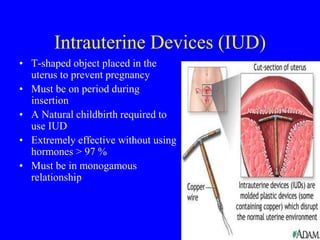
Intrauterine Devices (IUD) 
• T-shaped object placed in the 
uterus to prevent pregnancy 
• Must be on period during 
insertion 
• A Natural childbirth required to 
use IUD 
• Extremely effective without using 
hormones > 97 % 
• Must be in monogamous 
relationship
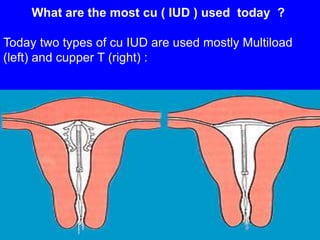
What are the most cu ( IUD ) used today ? 
Today two types of cu IUD are used mostly Multiload 
(left) and cupper T (right) :
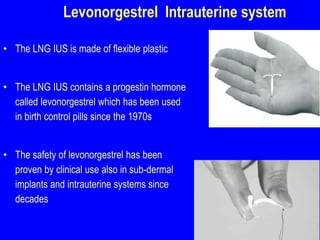
Levonorgestrel Intrauterine system 
• The LNG IUS is made of flexible plastic 
• The LNG IUS contains a progestin hormone 
called levonorgestrel which has been used 
in birth control pills since the 1970s 
• The safety of levonorgestrel has been 
proven by clinical use also in sub-dermal 
implants and intrauterine systems since 
decades
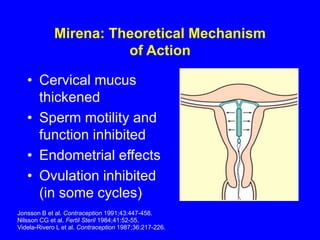
Mirena: Theoretical Mechanism 
of Action 
• Cervical mucus 
thickened 
• Sperm motility and 
function inhibited 
• Endometrial effects 
• Ovulation inhibited 
(in some cycles) 
Jonsson B et al. Contraception 1991;43:447-458. 
Nilsson CG et al. Fertil Steril 1984;41:52-55. 
Videla-Rivero L et al. Contraception 1987;36:217-226.
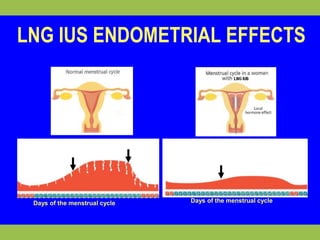
LNG IUS ENDOMETRIAL EFFECTS 
Ovulation 
Ovulation 
Menstruation 
Days of the menstrual cycle Days of the menstrual cycle
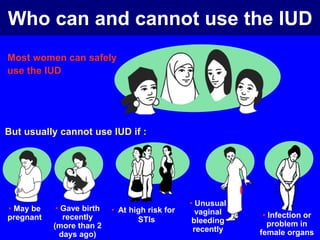
Who can and cannot use the IUD 
Most women can safely 
use the IUD 
But usually cannot use IUD if : 
• May be 
pregnant 
• Gave birth 
recently 
(more than 2 
days ago) 
• Unusual 
vaginal 
bleeding 
recently 
• At high risk for 
STIs 
• Infection or 
problem in 
female organs
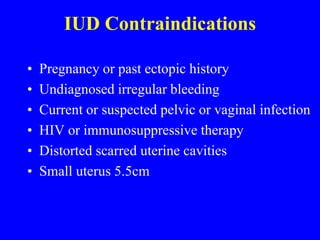
IUD Contraindications 
• Pregnancy or past ectopic history 
• Undiagnosed irregular bleeding 
• Current or suspected pelvic or vaginal infection 
• HIV or immunosuppressive therapy 
• Distorted scarred uterine cavities 
• Small uterus 5.5cm
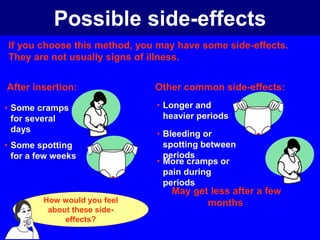
Possible side-effects 
If you choose this method, you may have some side-effects. 
They are not usually signs of illness. 
After insertion: 
• Some cramps 
for several 
days 
• Some spotting 
for a few weeks 
Other common side-effects: 
• Longer and 
heavier periods 
• Bleeding or 
spotting between 
periods 
• More cramps or 
pain during 
periods 
May get less after a few 
How would you feel months 
about these side-effects?
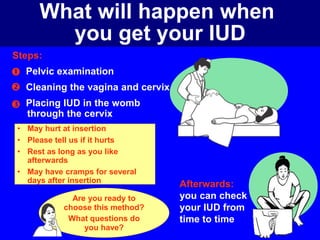
What will happen when 
Steps: 
you get your IUD 
Pelvic examination 
Cleaning the vagina and cervix 
Placing IUD in the womb 
through the cervix 
• May hurt at insertion 
• Please tell us if it hurts 
• Rest as long as you like 
afterwards 
• May have cramps for several 
days after insertion 
 
 
 
Afterwards: 
you can check 
your IUD from 
time to time 
Are you ready to 
choose this method? 
What questions do 
you have?
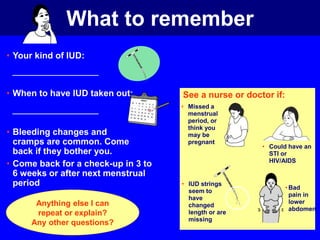
What to remember 
• Your kind of IUD: 
• When to have IUD taken out: 
• Bleeding changes and 
cramps are common. Come 
back if they bother you. 
• Come back for a check-up in 3 to 
6 weeks or after next menstrual 
period 
See a nurse or doctor if: 
• Missed a 
menstrual 
period, or 
think you 
may be 
pregnant 
• Could have an 
STI or 
HIV/AIDS 
• IUD strings 
seem to 
have 
changed 
length or are 
missing 
•Bad 
pain in 
lower 
abdomen 
Anything else I can 
repeat or explain? 
Any other questions?
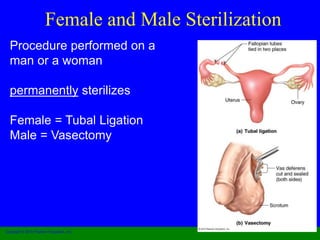
Female and Male Sterilization 
Procedure performed on a 
man or a woman 
permanently sterilizes 
Female = Tubal Ligation 
Male = Vasectomy 
Copyright © 2010 Pearson Education, Inc.
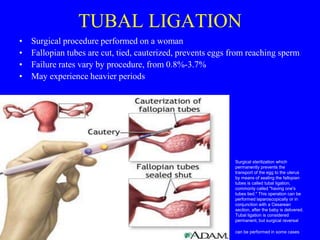
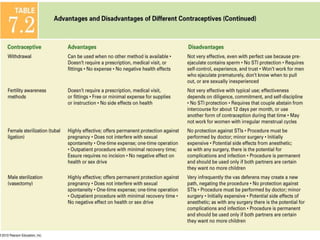
TUBAL LIGATION 
• Surgical procedure performed on a woman 
• Fallopian tubes are cut, tied, cauterized, prevents eggs from reaching sperm 
• Failure rates vary by procedure, from 0.8%-3.7% 
• May experience heavier periods 
Surgical sterilization which 
permanently prevents the 
transport of the egg to the uterus 
by means of sealing the fallopian 
tubes is called tubal ligation, 
commonly called "having one's 
tubes tied." This operation can be 
performed laparoscopically or in 
conjunction with a Cesarean 
section, after the baby is delivered. 
Tubal ligation is considered 
permanent, but surgical reversal 
can be performed in some cases
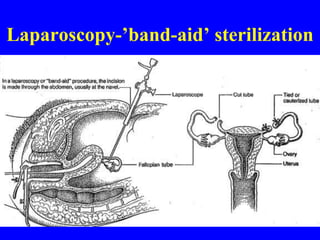
Laparoscopy-’band-aid’ sterilization
vasectomy 
• Ligation of Vas Deferens tube 
• Faster and easier recovery than a tubal ligation 
• Failure rate = 0.1%, more effective than 
female sterilization
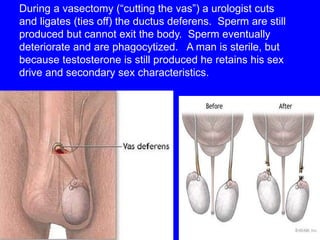
During a vasectomy (“cutting the vas”) a urologist cuts 
and ligates (ties off) the ductus deferens. Sperm are still 
produced but cannot exit the body. Sperm eventually 
deteriorate and are phagocytized. A man is sterile, but 
because testosterone is still produced he retains his sex 
drive and secondary sex characteristics.
METHODS BASED ON 
INFORMATION 
• Withdrawal 
• Natural Family Planning 
• Fertility Awareness Method 
• Abstinence
Behavioral Methods 
• Withdrawal: removing the penis from the vagina 
just before ejaculation 
• Abstinence or outercourse(kissing, hugging, touching) 
• Fertility awareness 
– Cervical mucus method 
– Body temperature method 
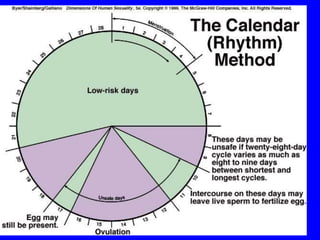
– Calendar method
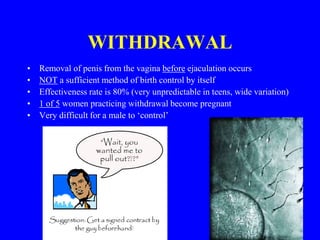
WITHDRAWAL 
• Removal of penis from the vagina before ejaculation occurs 
• NOT a sufficient method of birth control by itself 
• Effectiveness rate is 80% (very unpredictable in teens, wide variation) 
• 1 of 5 women practicing withdrawal become pregnant 
• Very difficult for a male to ‘control’
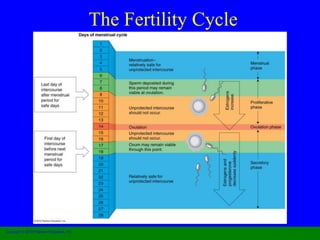
Natural Family Planning & 
Fertility Awareness Method 
• Women take a class on the menstrual cycle to 
calculate more fertile times 
• NFP abstains from sex during the calculated fertile 
time 
• Perfect effectiveness rate = 91% 
• Typical effectiveness rate = 75% 
• No 100% safe day-irregular periods
The Fertility Cycle 
Copyright © 2010 Pearson Education, Inc.
Contraception for undergraduate

Contraception for undergraduate

  • 1.
  • 2.
    Definition of Contraception • Contraception = “Against Conception” • The intentional prevention of pregnancy through the use of various devices, agents,drugs, sexual practices or surgical procedures.
  • 3.
  • 4.
    How do youchoose?
  • 5.
    Top five factorsto consider when selecting a method of fertility control. •Cost •Effectiveness of protections from STDs •Safety and side effects •Comfort and ease of use •Reversibility and future fertility
  • 6.
    The only 100%effective way to prevent pregnancy and STD is to be sexually Abstinent or to Postpone sexual involvement.
  • 7.
    Four Types ofBirth Control • Hormonal Methods • Barrier methods! • Surgical Methods • Behavioral Methods
  • 9.
    Hormonal Methods •Oral Contraceptives (Birth Control Pill) • Injections (Depo-Provera) • Implants (Norplant I & II) • Vaginal ring
  • 10.
    Oral contraceptive pills(OCP) • Oral contraceptive made from synthetic hormones • 97%-99% effective • Combined pill or mini-pill
  • 11.
    Birth Control Pills • Women must have a pap smear to get a prescription for • birth control pills • Pills DO NOT prevent STD’s
  • 12.
    Combined pill •Contains estrogen and progestin • 21-day or 28-day form • Monophasic or multiphasic (fewer side effects)
  • 13.
    Mini-pill • Containsonly progestin • Used continuously 28 days • Effect: thickens the cervical mucus and makes the lining of the uterus less receptive to implantation • Indicated because of medical reasons and women breatsfeeding
  • 14.
    How does thepill work? • Stops ovulation • Thins uterine lining • Thickens cervical mucus
  • 15.
    Pro’s • ↓Acne • ↓ Hair growth • ↓Breast cysts • ↓ Ovarian cysts • ↓ Ovarian carcinoma • ↓ Dysmenorrhea • ↓ Endometrial carcinoma • ↓ PID • ↓ Risk of ectopic pregnancy • ↓ Anemia • ↓ Osteoporosis
  • 16.
    Contraindications • Absolute:CV diseases, liver damage, hormone-dependent tumors • Relative: age >35 + another risk factor (smoking, DM etc.)
  • 17.
    Con’s • ↑Risk of CV disease • ↑ Risk of breast cancer • ↑ Risk of cervical cancer • ↑ Risk of thromboembolic episodes • ↑ Risk of liver adenoma • Lipid metabolism disorders • Nausea • Depression • Post-pill amenorrhea • Weight gain • Breast tenderness
  • 18.
    Taking the Pill • Once a day at the same time everyday • Use condoms for first month • Use condoms when on antibiotics • Use condoms for 1 week if you miss a pill or take one late • The pill offers no protection from STD’s
  • 19.
    Injection or "shot"— • Women get shots of the hormone progestin in the buttocks or arm every three months from their doctor. • It is 97–99% effective at preventing pregnancy.
  • 20.
  • 21.
    How does theshot work? • The same way as the Pill! • Stops ovulation • Stops menstrual cycles!! • Thickens cervical mucus
  • 22.
    SIDE EFFECTS •Extremely irregular menstrual bleeding and spotting for 3-6 months! • NO PERIOD  after 3-6 months • Weight change • Breast tenderness • Mood change *not every woman has side-effects!
  • 23.
    Contraceptive patch •Transdermal delivery system • Effect: same as OCP • Application: stuck on skin every week • Side effects: same as OCP, greater risk (con) • Pro: better compliance
  • 24.
  • 25.
    IMPLANTS • Physicallyinserted in simple 15 minute outpatient procedure • Plastic capsules the size of paper matchsticks inserted under the skin in the arm • 99.5% effectiveness rate
  • 26.
  • 27.
    Contraceptive implants •Slow release of a progestin over a period of three years • Effect: prevents the release of the egg from the ovary (ovulation); promotes thick cervical mucus • Application: inserted in the upper arm under local anesthesia • Side effects: irregular bleeding • Pro: fertility rapidly returns
  • 28.
    Implanon • Contains68 mg etonogestrel • Single rod implanted subdermally on day 1-5 of cycle • Last for 3 years. • Works by thickening cervical mucus and also inhibits ovulation • Extremely effective in pregnancy prevention > 99% • Irregular bleeding common side effect
  • 29.
    What if…. …thecondom broke or slipped off... …you forgot your regular birth control... …you were forced to have sex... Association of Reproductive Health Professionals
  • 30.
    Emergency Contraception (ECP) • Must be taken within 72 hours of the act of unprotected intercourse or failure of contraception method • Must receive ECP from a physician • 75 – 84% effective in reducing pregnancy
  • 31.
    How EC ACT? • Floods the ovaries with high amount of hormone and prevents ovulation • Alters the environment of the uterus, making it disruptive to the egg and sperm • Two sets of pills taken exactly 12 hours apart
  • 32.
    Emergency Contraceptive Pills: Combined VS Progestin only Preven plan A Plan B
  • 33.
    Morning-after pill •Side effects: nausea,abdominal pain, fatigue, headache, dizziness, and breast tenderness
  • 34.
    NuvaRing – TheRing 92% - 99%
  • 35.
    Vaginal Ring (NuvaRing) • 95-99% Effective A new ring is inserted into the vagina each month • Does not require a "fitting" by a health care provider, • does not require spermicide, can make periods more regular and less painful, • no pill to take daily, ability to become pregnant returns quickly when use is stopped.
  • 36.
    Hormonal • Pill – Daily – Emergency (not recommended as a regular form of birth control)
  • 37.
    Hormonal • Pill • Patch Patch
  • 38.
    Hormonal • Pill • Patch • Injection
  • 39.
    Hormonal • Pill • Patch • Injection • Ring
  • 40.
    Hormonal • Pill • Patch • Injection • Ring • Progesterone IUD IUD
  • 41.
    Hormonal • Pill • Patch • Injection • Ring • Progesterone IUD • Implantable device
  • 42.
    How Often DoYou Take It? Method Frequency Pills Every day
  • 43.
    How Often DoYou Take It? Method Frequency Pills Every day Patch Once a week
  • 44.
    How Often DoYou Take It? Method Frequency Pills Every day Patch Once a week Ring Once a month
  • 45.
    How Often DoYou Take It? Method Frequency Pills Every day Patch Once a week Ring Once a month Injection Every 3 months* Implant (Implanon®) Every 3 years*
  • 46.
    How Often DoYou Take It? Method Frequency Pills Every day Patch Once a week Ring Once a month Injection Every 3 months* Implant Every 3 years* IUD Every 5 years*
  • 47.
    How Often DoYou Take It? Method Frequency Pills Every day Patch Once a week Ring Once a month Injection Every 3 months* Implant Every 3 years* IUD Every 5 years*
  • 48.
    BARRIER METHOD •Prevents pregnancy blocks the egg and sperm from meeting • • Barrier methods have higher failure rates than hormonal methods due to design and human error
  • 49.
    BARRIER METHODS •Spermicides • Male Condom • Female Condom • Diaphragm • Cervical Cap
  • 50.
    SPERMICIDES • Chemicalskill sperm in the vagina • Different forms: -Jelly -Film -Foam -Suppository • Some work instantly, others require pre-insertion • Only 76% effective (used alone), should be used in combination with another method i.e., condoms
  • 51.
    Foam • 80-85%effective • Works immediately • Effective for an hour • Over the counter • No douching for 6 hours after intercourse • 20% have burning (reaction)
  • 52.
    Film • 80-85%effective • Works 10 min after insertion • Effective for an hour • Over the counter • No douching for 6 hours after intercourse • 20% have burning (reaction)
  • 53.
    MALE CONDOM •Most common and effective barrier method when used properly • Latex and Polyurethane should only be used in the prevention of pregnancy and spread of STD’s (including HIV)
  • 54.
    MALE CONDOM •Perfect effectiveness rate = 97% • Typical effectiveness rate = 88% • Latex and polyurethane condoms are available • Combining condoms with spermicides raises effectiveness levels to 99%
  • 55.
    Female Condom •95% effective • Protects against some STDs • Noisy • Use extra lubrication
  • 56.
    Proper Use andPlacement of a Female Condom Copyright © 2010 Pearson Education, Inc.
  • 57.
    DIAPRAGHM • PerfectEffectiveness Rate = 94% • Typical Effectiveness Rate = 80% • Latex barrier placed inside vagina during intercourse • Fitted by physician • Spermicidal jelly before insertion • Inserted up to 18 hours before intercourse and can be left in for a total of 24 hours
  • 58.
    DIAPHRAGM The diaphragmis a flexible rubber cup that is filled with spermicide and self-inserted over the cervix prior to intercourse. The device is left in place several hours after intercourse. The diaphragm is a prescribed device fitted by a health care professional and is more expensive than other barrier methods, such as condoms
  • 59.
    Proper Use andPlacement of a Diaphragm Copyright © 2010 Pearson Education, Inc.
  • 60.
    CERVICAL CAP •Latex barrier inserted in vagina before intercourse • “Caps” around cervix with suction • Fill with spermicidal jelly prior to use • Can be left in body for up to a total of 48 hours • Must be left in place six hours after sexual intercourse • Perfect effectiveness rate = 91% • Typical effectiveness rate = 80%
  • 61.
    Cervical Cap Thecervical cap is a flexible rubber cup-like device that is filled with spermicide and self-inserted over the cervix prior to intercourse. The device is left in place several hours after intercourse. The cap is a prescribed device fitted by a health care professional and can be more expensive than other barrier methods, such as condoms.
  • 62.
    Sponge The spongeis inserted by the woman into the vagina and covers the cervix blocking sperm from entering the cervix. The sponge also contains a spermicide that kills sperm. It is available without a prescription
  • 63.
  • 64.
    Intrauterine Devices (IUD) • T-shaped object placed in the uterus to prevent pregnancy • Must be on period during insertion • A Natural childbirth required to use IUD • Extremely effective without using hormones > 97 % • Must be in monogamous relationship
  • 69.
    What are themost cu ( IUD ) used today ? Today two types of cu IUD are used mostly Multiload (left) and cupper T (right) :
  • 70.
    Levonorgestrel Intrauterine system • The LNG IUS is made of flexible plastic • The LNG IUS contains a progestin hormone called levonorgestrel which has been used in birth control pills since the 1970s • The safety of levonorgestrel has been proven by clinical use also in sub-dermal implants and intrauterine systems since decades
  • 71.
    Mirena: Theoretical Mechanism of Action • Cervical mucus thickened • Sperm motility and function inhibited • Endometrial effects • Ovulation inhibited (in some cycles) Jonsson B et al. Contraception 1991;43:447-458. Nilsson CG et al. Fertil Steril 1984;41:52-55. Videla-Rivero L et al. Contraception 1987;36:217-226.
  • 72.
    LNG IUS ENDOMETRIALEFFECTS Ovulation Ovulation Menstruation Days of the menstrual cycle Days of the menstrual cycle
  • 73.
    Who can andcannot use the IUD Most women can safely use the IUD But usually cannot use IUD if : • May be pregnant • Gave birth recently (more than 2 days ago) • Unusual vaginal bleeding recently • At high risk for STIs • Infection or problem in female organs
  • 74.
    IUD Contraindications •Pregnancy or past ectopic history • Undiagnosed irregular bleeding • Current or suspected pelvic or vaginal infection • HIV or immunosuppressive therapy • Distorted scarred uterine cavities • Small uterus 5.5cm
  • 75.
    Possible side-effects Ifyou choose this method, you may have some side-effects. They are not usually signs of illness. After insertion: • Some cramps for several days • Some spotting for a few weeks Other common side-effects: • Longer and heavier periods • Bleeding or spotting between periods • More cramps or pain during periods May get less after a few How would you feel months about these side-effects?
  • 76.
    What will happenwhen Steps: you get your IUD Pelvic examination Cleaning the vagina and cervix Placing IUD in the womb through the cervix • May hurt at insertion • Please tell us if it hurts • Rest as long as you like afterwards • May have cramps for several days after insertion    Afterwards: you can check your IUD from time to time Are you ready to choose this method? What questions do you have?
  • 77.
    What to remember • Your kind of IUD: • When to have IUD taken out: • Bleeding changes and cramps are common. Come back if they bother you. • Come back for a check-up in 3 to 6 weeks or after next menstrual period See a nurse or doctor if: • Missed a menstrual period, or think you may be pregnant • Could have an STI or HIV/AIDS • IUD strings seem to have changed length or are missing •Bad pain in lower abdomen Anything else I can repeat or explain? Any other questions?
  • 78.
    Female and MaleSterilization Procedure performed on a man or a woman permanently sterilizes Female = Tubal Ligation Male = Vasectomy Copyright © 2010 Pearson Education, Inc.
  • 79.
    TUBAL LIGATION •Surgical procedure performed on a woman • Fallopian tubes are cut, tied, cauterized, prevents eggs from reaching sperm • Failure rates vary by procedure, from 0.8%-3.7% • May experience heavier periods Surgical sterilization which permanently prevents the transport of the egg to the uterus by means of sealing the fallopian tubes is called tubal ligation, commonly called "having one's tubes tied." This operation can be performed laparoscopically or in conjunction with a Cesarean section, after the baby is delivered. Tubal ligation is considered permanent, but surgical reversal can be performed in some cases
  • 80.
  • 81.
    vasectomy • Ligationof Vas Deferens tube • Faster and easier recovery than a tubal ligation • Failure rate = 0.1%, more effective than female sterilization
  • 82.
    During a vasectomy(“cutting the vas”) a urologist cuts and ligates (ties off) the ductus deferens. Sperm are still produced but cannot exit the body. Sperm eventually deteriorate and are phagocytized. A man is sterile, but because testosterone is still produced he retains his sex drive and secondary sex characteristics.
  • 83.
    METHODS BASED ON INFORMATION • Withdrawal • Natural Family Planning • Fertility Awareness Method • Abstinence
  • 84.
    Behavioral Methods •Withdrawal: removing the penis from the vagina just before ejaculation • Abstinence or outercourse(kissing, hugging, touching) • Fertility awareness – Cervical mucus method – Body temperature method – Calendar method
  • 85.
    WITHDRAWAL • Removalof penis from the vagina before ejaculation occurs • NOT a sufficient method of birth control by itself • Effectiveness rate is 80% (very unpredictable in teens, wide variation) • 1 of 5 women practicing withdrawal become pregnant • Very difficult for a male to ‘control’
  • 86.
    Natural Family Planning& Fertility Awareness Method • Women take a class on the menstrual cycle to calculate more fertile times • NFP abstains from sex during the calculated fertile time • Perfect effectiveness rate = 91% • Typical effectiveness rate = 75% • No 100% safe day-irregular periods
  • 87.
    The Fertility Cycle Copyright © 2010 Pearson Education, Inc.
  • 91.
    Copyright © 2010Pearson Education, Inc.
  • 92.
    Copyright © 2010Pearson Education, Inc.
  • 93.
    Copyright © 2010Pearson Education, Inc.
  • 94.
    Copyright © 2010Pearson Education, Inc.