Contraception and family planning
LEARNING OBJECTIVES
• To explore misbeliefs associated with contraception and the full range of
contraceptive methods
• To know the main components of family planning and contraceptive services
• To provide quality counseling on contraception and contraceptive choices to
women and gender non-conforming people who use drugs
• To identify the main barriers to accessing contraception and potential
approaches to overcome the barriers
BASIC INFORMATION AND CHOICES
• There are a lot of beliefs and misconceptions associated with contraceptives methods. For
example:
 Contraceptive methods can cause infertility
 Women lose libido with hormonal contraception
 Contraceptive methods can cause birth defects
• Health professional and harm reduction providers may also share these beliefs.
• The lack of accurate information will impact and limit people’s choices around pregnancy
prevention.
• Every person will have different needs and preferences for contraception.
Give them a choice!
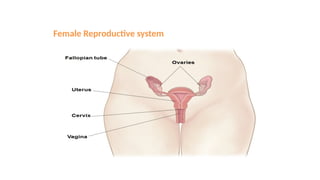
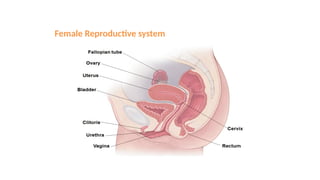
Female Reproductive system
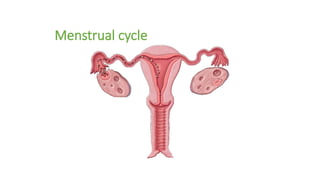
Menstrual cycle
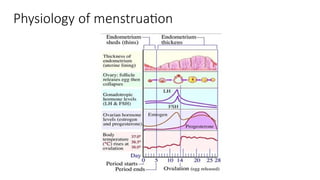
Physiology of menstruation
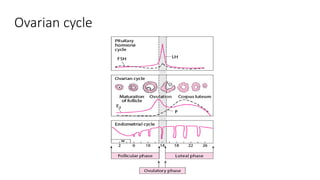
Ovarian cycle
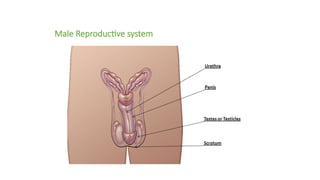
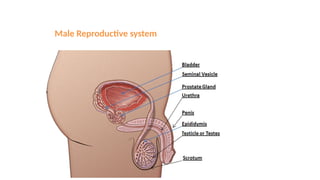
Male Reproductive system
Contraception
• There are many types of contraception widely used now days for
family planning purposes.
• Each method has its advantages and suits special cases and not
necessarily suits others and the choice of contraception depends
on different needs of the patients like the period of contraception
and also doctor should decide which method suits needs more.
• No method of contraception is completely effective.
• Types:-
1. Natural contraception
2. Mechanical contraception
3. Hormonal contraception
4. Surgical contraception
METHODS OF CONTRACEPTION
• The main effective methods of contraception are:
• Hormonal methods: implants, pills (progestogen and
combined),IUD, injectables
• Other methods: copper IUD, vasectomy and female
sterilisation
• Barrier methods: internal (female) and external (male)
condoms, diaphragm
• Other methods exist but are less effective and are not under the
control of women (for instance the natural method of withdrawal).
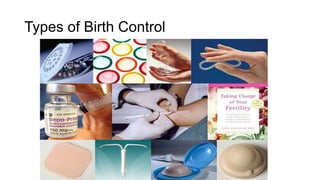
Types of Birth Control
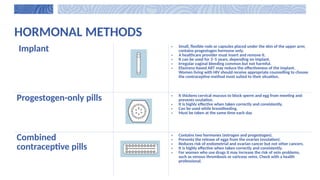
HORMONAL METHODS
Implant • Small, flexible rods or capsules placed under the skin of the upper arm;
contains progestogen hormone only.
• A healthcare provider must insert and remove it.
• It can be used for 3–5 years, depending on implant.
• Irregular vaginal bleeding common but not harmful.
• Efavirenz-based ART may reduce the effectiveness of the implant.
Women living with HIV should receive appropriate counselling to choose
the contraceptive method most suited to their situation.
Progestogen-only pills • It thickens cervical mucous to block sperm and egg from meeting and
prevents ovulation.
• It is highly effective when taken correctly and consistently.
• Can be used while breastfeeding.
• Must be taken at the same time each day
Combined
contraceptive pills
• Contains two hormones (estrogen and progestogen).
• Prevents the release of eggs from the ovaries (ovulation).
• Reduces risk of endometrial and ovarian cancer but not other cancers.
• It is highly effective when taken correctly and consistently.
• For women who use drugs it may increase the risk of vein problems,
such as venous thrombosis or varicose veins. Check with a health
professional.
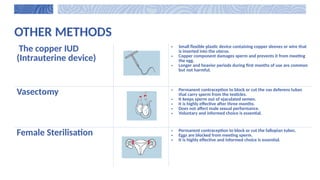
OTHER METHODS
The copper IUD
(Intrauterine device)
• Small flexible plastic device containing copper sleeves or wire that
is inserted into the uterus.
• Copper component damages sperm and prevents it from meeting
the egg.
• Longer and heavier periods during first months of use are common
but not harmful.
Vasectomy • Permanent contraception to block or cut the vas deferens tubes
that carry sperm from the testicles.
• It keeps sperm out of ejaculated semen.
• It is highly effective after three months.
• Does not affect male sexual performance.
• Voluntary and informed choice is essential.
Female Sterilisation • Permanent contraception to block or cut the fallopian tubes.
• Eggs are blocked from meeting sperm.
• It is highly effective and informed choice is essential.
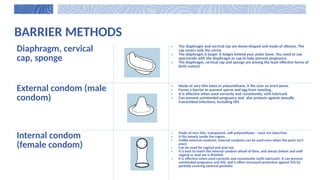
BARRIER METHODS
Diaphragm, cervical
cap, sponge
• The diaphragm and cervical cap are dome-shaped and made of silicone. The
cap covers only the cervix.
• The diaphragm is larger. It lodges behind your pubic bone. You need to use
spermicide with the diaphragm or cap to help prevent pregnancy.
• The diaphragm, cervical cap and sponge are among the least effective forms of
birth control.
External condom (male
condom)
• Made of very thin latex or polyurethane, it fits over an erect penis.
• Forms a barrier to prevent sperm and egg from meeting.
• It is effective when used correctly and consistently, with lubricant.
• Can prevent unintended pregnancy and also protects against sexually
transmitted infections, including HIV.
Internal condom
(female condom)
• Made of very thin, transparent, soft polyurethane – most are latex-free.
• It fits loosely inside the vagina.
• Unlike external condoms, internal condoms can be used even when the penis isn’t
erect.
• Can be used for vaginal and anal sex.
• It is best to insert the internal condom ahead of time, and always before and until
vaginal or anal sex is finished.
• It is effective when used correctly and consistently (with lubricant). It can prevent
unintended pregnancy and HIV, and it offers increased protection against SITs by
partially covering external genitalia.
STIs and Pregnancy Prevention
• Abstinence
• Hormonal Methods
• Non-hormonal Methods
What is the most effective method
of preventing pregnancy and STIs?
Abstinence
•avoiding vaginal intercourse (penis to vagina sex),
•avoiding oral (mouth to penis or vagina sex) and anal
intercourse (penis to anus sex), or
•avoiding genital contact (any type of direct touching
of the partner's penis or vagina)
Abstaining is not necessarily forever, and it is not only
for virgins.
What is abstinence?
• Abstinence is the only 100% effective method
against STIs and pregnancy if you do not have
vaginal, anal, oral sex or skin to skin contact.
• What are alternative ways that a person who is
abstinent can be intimate with a partner?
Abstinence
Hormonal methods of
birth control
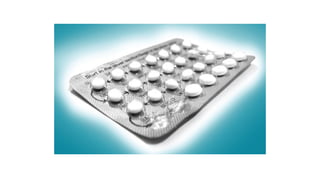
The pill
• A hormonal method that contains:
a. estrogen and progesterone or
b. progesterone only
• Prevents the release of a mature egg
• Thickens cervical mucous
• Changes the lining of the uterus
• Typical effectiveness rate is 91%
Positive Benefits of Birth Control Pills
Prevents pregnancy
Eases menstrual
cramps
Shortens period
Regulates period
Decreases incidence
of ovarian cysts
Prevents ovarian and
uterine cancer
Decreases acne
Side-effects
• Breast tenderness
• Nausea
• Increase in headaches
• Moodiness
• Weight change
Taking the Pill
Once a day at the same time everyday
Use condoms for first month
Use condoms when on antibiotics
Use condoms for 1 week if you miss a pill or take one late
The pill offers no protection from STD’s
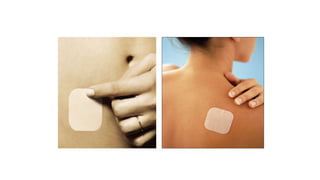
Transdermal patch
• A patch that releases hormones through the skin
• Thin, smooth and beige patch
• Prevents the release of a mature egg
• Thickens cervical mucous
• Changes the lining of the uterus
• Typical effectiveness rate is 91%
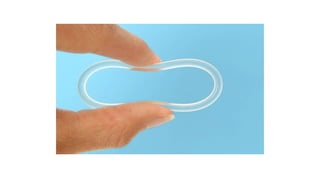
Nuva Ring (vaginal ring)
• Soft and flexible ring, inserted into the vagina
• The ring slowly releases hormones while in the
vagina for 3 weeks
• Prevents the release of a mature egg
• Thickens cervical mucous
• Changes the lining of the uterus
• Typical effectiveness rate is 91%
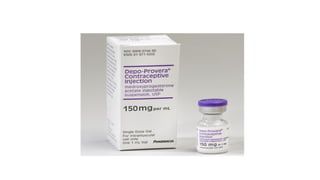
Depo Provera – Injectable contraceptive
• An injection of progestin administered every 12
to 13 weeks
• Prevents the release of a mature egg
• Thickens cervical mucous
• Changes the lining of the uterus
• Typical effectiveness rate is 94%
SIDE EFFECTS
Extremely irregular menstrual bleeding and
spotting for 3-6 months!
NO PERIOD  after 3-6 months
Weight change
Breast tenderness
Mood change
*NOT EVERY WOMAN HAS SIDE-EFFECTS!
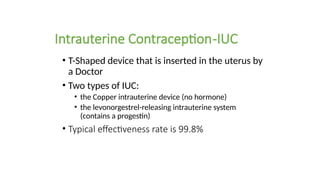
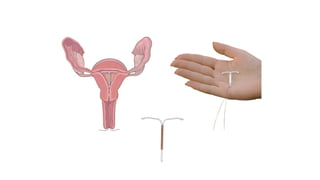
Intrauterine Contraception-IUC
• T-Shaped device that is inserted in the uterus by
a Doctor
• Two types of IUC:
• the Copper intrauterine device (no hormone)
• the levonorgestrel-releasing intrauterine system
(contains a progestin)
• Typical effectiveness rate is 99.8%
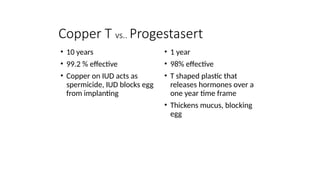
Copper T vs.. Progestasert
• 10 years
• 99.2 % effective
• Copper on IUD acts as
spermicide, IUD blocks egg
from implanting
• 1 year
• 98% effective
• T shaped plastic that
releases hormones over a
one year time frame
• Thickens mucus, blocking
egg
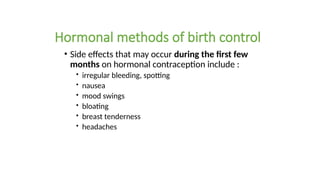
Hormonal methods of birth control
• Side effects that may occur during the first few
months on hormonal contraception include :
 irregular bleeding, spotting
 nausea
 mood swings
 bloating
 breast tenderness
 headaches
Emergency contraception
• Can be taken up to 5 days after intercourse
• The sooner it is taken, the better it works
• Delays or prevents the release of an egg
• May prevent implementation of a fertilized egg
• 95 % effective if taken within 24 hours after
intercourse
• 85% effective if taken 25-48 hours after intercourse
• 58% effective if taken 49-72 hours after intercourse
Barrier methods
(non-hormonal)
BARRIER METHODS
• Spermicides
• Male Condom
• Female Condom
• Diaphragm
• Cervical Cap
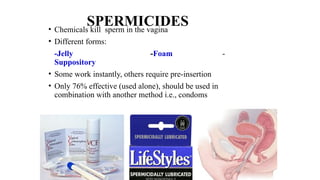
SPERMICIDES
• Chemicals kill sperm in the vagina
• Different forms:
-Jelly -Foam -
Suppository
• Some work instantly, others require pre-insertion
• Only 76% effective (used alone), should be used in
combination with another method i.e., condoms
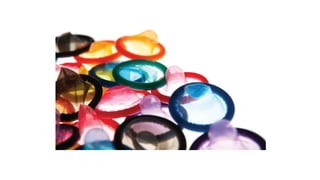
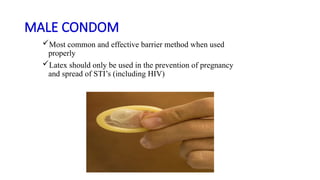
MALE CONDOM
Most common and effective barrier method when used
properly
Latex should only be used in the prevention of pregnancy
and spread of STI’s (including HIV)
MALE CONDOM
• Typical effectiveness rate = 88%
• available
• Combining condoms with spermicides raises effectiveness levels to 99%
FEMALE CONDOM
• Made as an alternative to male condoms
• Polyurethane
• Physically inserted in the vagina
• Typical rate = 79%
• Woman can use female condom if partner refuses
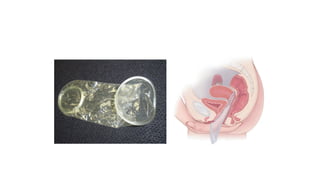
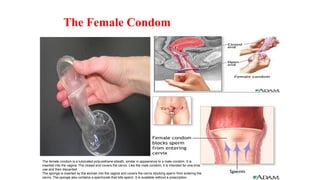
The Female Condom
The female condom is a lubricated polyurethane sheath, similar in appearance to a male condom. It is
inserted into the vagina. The closed end covers the cervix. Like the male condom, it is intended for one-time
use and then discarded.
The sponge is inserted by the woman into the vagina and covers the cervix blocking sperm from entering the
cervix. The sponge also contains a spermicide that kills sperm. It is available without a prescription.
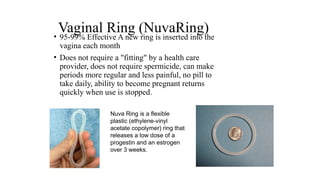
Vaginal Ring (NuvaRing)
• 95-99% Effective A new ring is inserted into the
vagina each month
• Does not require a "fitting" by a health care
provider, does not require spermicide, can make
periods more regular and less painful, no pill to
take daily, ability to become pregnant returns
quickly when use is stopped.
Nuva Ring is a flexible
plastic (ethylene-vinyl
acetate copolymer) ring that
releases a low dose of a
progestin and an estrogen
over 3 weeks.
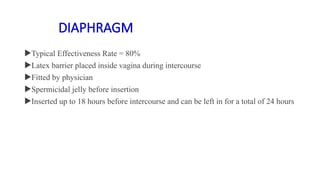
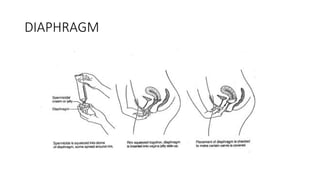
DIAPHRAGM
Typical Effectiveness Rate = 80%
Latex barrier placed inside vagina during intercourse
Fitted by physician
Spermicidal jelly before insertion
Inserted up to 18 hours before intercourse and can be left in for a total of 24 hours
DIAPHRAGM
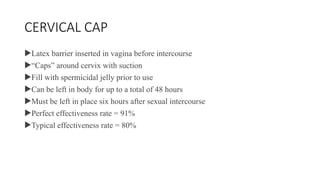
CERVICAL CAP
Latex barrier inserted in vagina before intercourse
“Caps” around cervix with suction
Fill with spermicidal jelly prior to use
Can be left in body for up to a total of 48 hours
Must be left in place six hours after sexual intercourse
Perfect effectiveness rate = 91%
Typical effectiveness rate = 80%
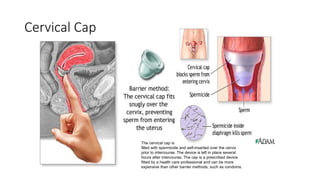
Cervical Cap
The cervical cap is a flexible rubber cup-like device that is
filled with spermicide and self-inserted over the cervix
prior to intercourse. The device is left in place several
hours after intercourse. The cap is a prescribed device
fitted by a health care professional and can be more
expensive than other barrier methods, such as condoms.
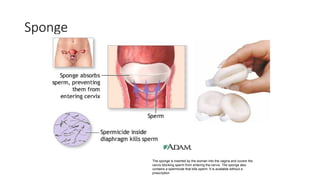
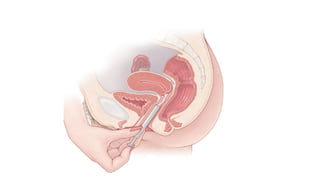
Sponge
The sponge is inserted by the woman into the vagina and covers the
cervix blocking sperm from entering the cervix. The sponge also
contains a spermicide that kills sperm. It is available without a
prescription
Sponge and Spermicides
• The sponge is a soft, disposable, device with a
spermicide
• Typical effectiveness is 76%-88%
• Fits over the cervix
• Traps and absorbs sperm to increase effect of
spermicide
• Spermicide in the sponge disables the sperm
• Effective for up to 12 hours
• Spermicides disable sperm
• Typical effectiveness is 88%onge
Surgical
Methods
STERILIZATION
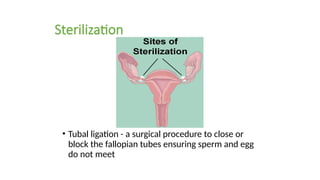
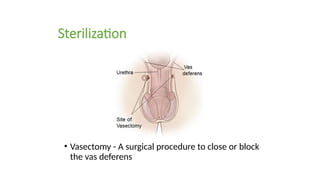
• Procedure performed on a man or a woman permanently sterilizes
• Female = Tubal Ligation
• Male = Vasectomy
Sterilization
• Tubal ligation - a surgical procedure to close or
block the fallopian tubes ensuring sperm and egg
do not meet
Sterilization
• Vasectomy - A surgical procedure to close or block
the vas deferens
VASECTOMY
• Male sterilization procedure
• Ligation of Vas Deferens tube
• Faster and easier recovery than a tubal ligation
• Failure rate = 0.1%, more effective than female sterilization
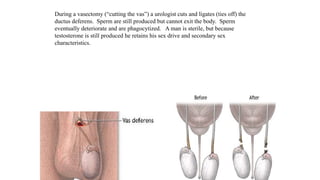
During a vasectomy (“cutting the vas”) a urologist cuts and ligates (ties off) the
ductus deferens. Sperm are still produced but cannot exit the body. Sperm
eventually deteriorate and are phagocytized. A man is sterile, but because
testosterone is still produced he retains his sex drive and secondary sex
characteristics.
Important to take note
DUAL PROTECTION
People who use drugs and their sexual partners must be counselled on dual protection
strategies to prevent the transmission of HIV and STIs, as well as to avoid unintended
pregnancy. These include:
• Condoms, plus another contraceptive method
• Condoms, plus emergency contraception if condom fails
• Selectively using condoms and another method (for example, using the pill
with the main partner, but the pill plus condoms with others).
METHADONE AND CONTRACEPTION
• Offering contraception services in conjunction with substance use treatment like
methdaone could help the women and gender non-conforming people who use drugs
meet their needs for contraception.
• It can reduce unintended pregnancy. There is no evidence that methadone is
incompatible with contraceptive methods.
HIV treatment and hormonal contraception
• There is no evidence of incompatibility between ARVs and hormonal contraceptives.
COUNSELLING SKILLS
• Importance of providing accurate information
• Non-judgmental attitudes
• Active listening
• Clear communication without technical words – use simple language
• Respect people’s right to confidentiality, privacy and informed choice
• Non-discrimination (regardless of their age, family or social status, sexual behaviour,
kind and frequency of drug use, etc.)

contraception and family planning basic.pptx

  • 1.
  • 2.
    LEARNING OBJECTIVES • Toexplore misbeliefs associated with contraception and the full range of contraceptive methods • To know the main components of family planning and contraceptive services • To provide quality counseling on contraception and contraceptive choices to women and gender non-conforming people who use drugs • To identify the main barriers to accessing contraception and potential approaches to overcome the barriers
  • 3.
    BASIC INFORMATION ANDCHOICES • There are a lot of beliefs and misconceptions associated with contraceptives methods. For example:  Contraceptive methods can cause infertility  Women lose libido with hormonal contraception  Contraceptive methods can cause birth defects • Health professional and harm reduction providers may also share these beliefs. • The lack of accurate information will impact and limit people’s choices around pregnancy prevention. • Every person will have different needs and preferences for contraception. Give them a choice!
  • 4.
  • 5.
  • 6.
  • 7.
  • 8.
  • 9.
  • 10.
  • 11.
    Contraception • There aremany types of contraception widely used now days for family planning purposes. • Each method has its advantages and suits special cases and not necessarily suits others and the choice of contraception depends on different needs of the patients like the period of contraception and also doctor should decide which method suits needs more. • No method of contraception is completely effective. • Types:- 1. Natural contraception 2. Mechanical contraception 3. Hormonal contraception 4. Surgical contraception
  • 12.
    METHODS OF CONTRACEPTION •The main effective methods of contraception are: • Hormonal methods: implants, pills (progestogen and combined),IUD, injectables • Other methods: copper IUD, vasectomy and female sterilisation • Barrier methods: internal (female) and external (male) condoms, diaphragm • Other methods exist but are less effective and are not under the control of women (for instance the natural method of withdrawal).
  • 13.
  • 14.
    HORMONAL METHODS Implant •Small, flexible rods or capsules placed under the skin of the upper arm; contains progestogen hormone only. • A healthcare provider must insert and remove it. • It can be used for 3–5 years, depending on implant. • Irregular vaginal bleeding common but not harmful. • Efavirenz-based ART may reduce the effectiveness of the implant. Women living with HIV should receive appropriate counselling to choose the contraceptive method most suited to their situation. Progestogen-only pills • It thickens cervical mucous to block sperm and egg from meeting and prevents ovulation. • It is highly effective when taken correctly and consistently. • Can be used while breastfeeding. • Must be taken at the same time each day Combined contraceptive pills • Contains two hormones (estrogen and progestogen). • Prevents the release of eggs from the ovaries (ovulation). • Reduces risk of endometrial and ovarian cancer but not other cancers. • It is highly effective when taken correctly and consistently. • For women who use drugs it may increase the risk of vein problems, such as venous thrombosis or varicose veins. Check with a health professional.
  • 15.
    OTHER METHODS The copperIUD (Intrauterine device) • Small flexible plastic device containing copper sleeves or wire that is inserted into the uterus. • Copper component damages sperm and prevents it from meeting the egg. • Longer and heavier periods during first months of use are common but not harmful. Vasectomy • Permanent contraception to block or cut the vas deferens tubes that carry sperm from the testicles. • It keeps sperm out of ejaculated semen. • It is highly effective after three months. • Does not affect male sexual performance. • Voluntary and informed choice is essential. Female Sterilisation • Permanent contraception to block or cut the fallopian tubes. • Eggs are blocked from meeting sperm. • It is highly effective and informed choice is essential.
  • 16.
    BARRIER METHODS Diaphragm, cervical cap,sponge • The diaphragm and cervical cap are dome-shaped and made of silicone. The cap covers only the cervix. • The diaphragm is larger. It lodges behind your pubic bone. You need to use spermicide with the diaphragm or cap to help prevent pregnancy. • The diaphragm, cervical cap and sponge are among the least effective forms of birth control. External condom (male condom) • Made of very thin latex or polyurethane, it fits over an erect penis. • Forms a barrier to prevent sperm and egg from meeting. • It is effective when used correctly and consistently, with lubricant. • Can prevent unintended pregnancy and also protects against sexually transmitted infections, including HIV. Internal condom (female condom) • Made of very thin, transparent, soft polyurethane – most are latex-free. • It fits loosely inside the vagina. • Unlike external condoms, internal condoms can be used even when the penis isn’t erect. • Can be used for vaginal and anal sex. • It is best to insert the internal condom ahead of time, and always before and until vaginal or anal sex is finished. • It is effective when used correctly and consistently (with lubricant). It can prevent unintended pregnancy and HIV, and it offers increased protection against SITs by partially covering external genitalia.
  • 17.
    STIs and PregnancyPrevention • Abstinence • Hormonal Methods • Non-hormonal Methods
  • 18.
    What is themost effective method of preventing pregnancy and STIs? Abstinence
  • 19.
    •avoiding vaginal intercourse(penis to vagina sex), •avoiding oral (mouth to penis or vagina sex) and anal intercourse (penis to anus sex), or •avoiding genital contact (any type of direct touching of the partner's penis or vagina) Abstaining is not necessarily forever, and it is not only for virgins. What is abstinence?
  • 20.
    • Abstinence isthe only 100% effective method against STIs and pregnancy if you do not have vaginal, anal, oral sex or skin to skin contact. • What are alternative ways that a person who is abstinent can be intimate with a partner? Abstinence
  • 21.
  • 22.
    The pill • Ahormonal method that contains: a. estrogen and progesterone or b. progesterone only • Prevents the release of a mature egg • Thickens cervical mucous • Changes the lining of the uterus • Typical effectiveness rate is 91%
  • 23.
    Positive Benefits ofBirth Control Pills Prevents pregnancy Eases menstrual cramps Shortens period Regulates period Decreases incidence of ovarian cysts Prevents ovarian and uterine cancer Decreases acne
  • 24.
    Side-effects • Breast tenderness •Nausea • Increase in headaches • Moodiness • Weight change
  • 26.
    Taking the Pill Oncea day at the same time everyday Use condoms for first month Use condoms when on antibiotics Use condoms for 1 week if you miss a pill or take one late The pill offers no protection from STD’s
  • 27.
    Transdermal patch • Apatch that releases hormones through the skin • Thin, smooth and beige patch • Prevents the release of a mature egg • Thickens cervical mucous • Changes the lining of the uterus • Typical effectiveness rate is 91%
  • 29.
    Nuva Ring (vaginalring) • Soft and flexible ring, inserted into the vagina • The ring slowly releases hormones while in the vagina for 3 weeks • Prevents the release of a mature egg • Thickens cervical mucous • Changes the lining of the uterus • Typical effectiveness rate is 91%
  • 31.
    Depo Provera –Injectable contraceptive • An injection of progestin administered every 12 to 13 weeks • Prevents the release of a mature egg • Thickens cervical mucous • Changes the lining of the uterus • Typical effectiveness rate is 94%
  • 32.
    SIDE EFFECTS Extremely irregularmenstrual bleeding and spotting for 3-6 months! NO PERIOD  after 3-6 months Weight change Breast tenderness Mood change *NOT EVERY WOMAN HAS SIDE-EFFECTS!
  • 34.
    Intrauterine Contraception-IUC • T-Shapeddevice that is inserted in the uterus by a Doctor • Two types of IUC: • the Copper intrauterine device (no hormone) • the levonorgestrel-releasing intrauterine system (contains a progestin) • Typical effectiveness rate is 99.8%
  • 35.
    Copper T vs..Progestasert • 10 years • 99.2 % effective • Copper on IUD acts as spermicide, IUD blocks egg from implanting • 1 year • 98% effective • T shaped plastic that releases hormones over a one year time frame • Thickens mucus, blocking egg
  • 37.
    Hormonal methods ofbirth control • Side effects that may occur during the first few months on hormonal contraception include :  irregular bleeding, spotting  nausea  mood swings  bloating  breast tenderness  headaches
  • 38.
    Emergency contraception • Canbe taken up to 5 days after intercourse • The sooner it is taken, the better it works • Delays or prevents the release of an egg • May prevent implementation of a fertilized egg • 95 % effective if taken within 24 hours after intercourse • 85% effective if taken 25-48 hours after intercourse • 58% effective if taken 49-72 hours after intercourse
  • 39.
  • 40.
    BARRIER METHODS • Spermicides •Male Condom • Female Condom • Diaphragm • Cervical Cap
  • 43.
    SPERMICIDES • Chemicals killsperm in the vagina • Different forms: -Jelly -Foam - Suppository • Some work instantly, others require pre-insertion • Only 76% effective (used alone), should be used in combination with another method i.e., condoms
  • 44.
    MALE CONDOM Most commonand effective barrier method when used properly Latex should only be used in the prevention of pregnancy and spread of STI’s (including HIV)
  • 45.
    MALE CONDOM • Typicaleffectiveness rate = 88% • available • Combining condoms with spermicides raises effectiveness levels to 99%
  • 46.
    FEMALE CONDOM • Madeas an alternative to male condoms • Polyurethane • Physically inserted in the vagina • Typical rate = 79% • Woman can use female condom if partner refuses
  • 47.
    The Female Condom Thefemale condom is a lubricated polyurethane sheath, similar in appearance to a male condom. It is inserted into the vagina. The closed end covers the cervix. Like the male condom, it is intended for one-time use and then discarded. The sponge is inserted by the woman into the vagina and covers the cervix blocking sperm from entering the cervix. The sponge also contains a spermicide that kills sperm. It is available without a prescription.
  • 48.
    Vaginal Ring (NuvaRing) •95-99% Effective A new ring is inserted into the vagina each month • Does not require a "fitting" by a health care provider, does not require spermicide, can make periods more regular and less painful, no pill to take daily, ability to become pregnant returns quickly when use is stopped. Nuva Ring is a flexible plastic (ethylene-vinyl acetate copolymer) ring that releases a low dose of a progestin and an estrogen over 3 weeks.
  • 49.
    DIAPHRAGM Typical Effectiveness Rate= 80% Latex barrier placed inside vagina during intercourse Fitted by physician Spermicidal jelly before insertion Inserted up to 18 hours before intercourse and can be left in for a total of 24 hours
  • 50.
  • 51.
    CERVICAL CAP Latex barrierinserted in vagina before intercourse “Caps” around cervix with suction Fill with spermicidal jelly prior to use Can be left in body for up to a total of 48 hours Must be left in place six hours after sexual intercourse Perfect effectiveness rate = 91% Typical effectiveness rate = 80%
  • 52.
    Cervical Cap The cervicalcap is a flexible rubber cup-like device that is filled with spermicide and self-inserted over the cervix prior to intercourse. The device is left in place several hours after intercourse. The cap is a prescribed device fitted by a health care professional and can be more expensive than other barrier methods, such as condoms.
  • 53.
    Sponge The sponge isinserted by the woman into the vagina and covers the cervix blocking sperm from entering the cervix. The sponge also contains a spermicide that kills sperm. It is available without a prescription
  • 54.
    Sponge and Spermicides •The sponge is a soft, disposable, device with a spermicide • Typical effectiveness is 76%-88% • Fits over the cervix • Traps and absorbs sperm to increase effect of spermicide • Spermicide in the sponge disables the sperm • Effective for up to 12 hours • Spermicides disable sperm • Typical effectiveness is 88%onge
  • 56.
  • 57.
    STERILIZATION • Procedure performedon a man or a woman permanently sterilizes • Female = Tubal Ligation • Male = Vasectomy
  • 58.
    Sterilization • Tubal ligation- a surgical procedure to close or block the fallopian tubes ensuring sperm and egg do not meet
  • 59.
    Sterilization • Vasectomy -A surgical procedure to close or block the vas deferens
  • 60.
    VASECTOMY • Male sterilizationprocedure • Ligation of Vas Deferens tube • Faster and easier recovery than a tubal ligation • Failure rate = 0.1%, more effective than female sterilization
  • 61.
    During a vasectomy(“cutting the vas”) a urologist cuts and ligates (ties off) the ductus deferens. Sperm are still produced but cannot exit the body. Sperm eventually deteriorate and are phagocytized. A man is sterile, but because testosterone is still produced he retains his sex drive and secondary sex characteristics.
  • 62.
  • 63.
    DUAL PROTECTION People whouse drugs and their sexual partners must be counselled on dual protection strategies to prevent the transmission of HIV and STIs, as well as to avoid unintended pregnancy. These include: • Condoms, plus another contraceptive method • Condoms, plus emergency contraception if condom fails • Selectively using condoms and another method (for example, using the pill with the main partner, but the pill plus condoms with others).
  • 64.
    METHADONE AND CONTRACEPTION •Offering contraception services in conjunction with substance use treatment like methdaone could help the women and gender non-conforming people who use drugs meet their needs for contraception. • It can reduce unintended pregnancy. There is no evidence that methadone is incompatible with contraceptive methods. HIV treatment and hormonal contraception • There is no evidence of incompatibility between ARVs and hormonal contraceptives.
  • 65.
    COUNSELLING SKILLS • Importanceof providing accurate information • Non-judgmental attitudes • Active listening • Clear communication without technical words – use simple language • Respect people’s right to confidentiality, privacy and informed choice • Non-discrimination (regardless of their age, family or social status, sexual behaviour, kind and frequency of drug use, etc.)

Editor's Notes

  • #4 Fallopian tube: connects ovaries to the uterus, creating passageway for the egg to be transported from the ovaries to the uterus Ovary: main reproductive organ. They produce hormones and eggs Uterus: connects all the organs. This is where a baby develops. Cervix: neck of the vagina Vagina: muscular tube leading from external genitals to the cervix. Menstrual blood leaves the body through this passageway. A penis is inserted in to the vagina during vaginal sex. A baby is delivered from the uterus through the cervix and vaginal opening. Source www.sexandu.ca
  • #5 Fallopian tube: connects ovaries to the uterus, creating passageway for the egg to be transported from the ovaries to the uterus Ovary: main reproductive organ. They produce hormones and eggs Uterus: connects all the organs. This is where a baby develops. Cervix: neck of the vagina Vagina: muscular tube leading from external genitals to the cervix. Menstrual blood leaves the body through this passageway. A penis is inserted in to the vagina during vaginal sex. A baby is delivered from the uterus through the cervix and vaginal opening. Source www.sexandu.ca
  • #6 Review menstrual cycle. Girls are born with hundreds of thousands of tiny eggs, called ova – one is called an ovum. These egg cells are only half formed. At puberty, hormones tell the ovaries it is time to start releasing ova. Usually one egg at a time matures (develops) and is released from an ovary. At the same time, the uterus starts to grow a thick lining on the inside wall. The lining has lots of tiny blood vessels. The lining is there to protect and feed an egg that has combined with a sperm to form a fertilized egg. If an egg does not meet a sperm, the lining is not needed. It breaks up. Mixed with some blood it comes out the uterus into the vagina and then out the vaginal opening. This is called menstruation but lots of females just call it their period. If a woman is not pregnant then her ovary will release another egg, the lining build up and, if the egg is not fertilized, she has another period. This is called the menstrual cycle.
  • #9 Urethra Penis: delivers sperm through the urethra Testes/Testicles: produce and store millions of tiny sperm cells. They also produce the hormone testosterone Scrotum: contains the testicles
  • #10 Urethra Seminal vesicle: secrets a thick fluid that nourishes the sperm. Prostate gland: enlarges to block urine from leaving the bladder when sperm is ejaculated. Penis: delivers sperm through the urethra. Epididymis: where sperm matures. Testes/Testicles: produce and store millions of tiny sperm cells. They also produce the hormone testosterone. Scrotum: contains the testicles.
  • #17 Ways to prevent STIs and Pregnancy Note: hormonal methods will not prevent STIs
  • #19 Abstinence is a personal choice. It is the only 100% effective method against STIs and pregnancy if you do not have vaginal, anal, oral sex or skin to skin contact.
  • #20 Alternative ways – hugging, holding hands, kissing
  • #22 https://www.healthunit.com/the-pill Need prescription from doctor What are the advantages? 1. One of the most effective reversible birth control methods when taken consistently and reliably 2. Simple and easy to use 3. Regulates menstrual cycle and reduces cramps 4. Does not interfere with intercourse 5. Decreases acne 6. Reduces the risks of endometrial and ovarian cancer 7. May reduce perimenopausal symptoms What are the disadvantages? 1. Must be taken every day. The progestin-only pill must be taken at the same time every day 2. May cause irregular bleeding or spotting 3. Effectiveness may be reduced by other medications 4. Should not be used by women over the age of 35 who smoke 5. May increase the risk of blood clots, particularly in women who have certain blood disorders or a family history of blood clots 6. Does not protect against STIs 7. May increase the number of headaches 8. May not be suitable for breastfeeding women
  • #25 Oral Contraceptive (The Pill)
  • #27 https://www.healthunit.com/evra Need prescription from a doctor What are the advantages? 1. A reversible and highly effective birth control method 2. Once-a-week regimen; no daily contraceptive routine required 3. Simple and easy to use 4. Regulates menstrual cycle and reduces cramps 5. Does not interfere with intercourse 6. Expected to provide other benefits similar to oral contraceptives; research is needed What are the disadvantages? 1. May cause irregular bleeding or spotting 2. May cause breast sensitivity or headache 3. Does not protect against STIs 4. Patch may detach from skin (less than 2%) 5. Possible skin irritation at the application site
  • #28 Transdermal Patch or EVRA Can be placed on the buttocks, upper outer arms, lower abdomen, or upper torso excluding the breast
  • #29 http://www.sexualityandu.ca/video/single/vaginal-ring-nuvaring What are the advantages? 1. A reversible and highly effective birth control method 2. Once-a-month regimen; no daily contraceptive routine required 3. Regulates menstrual cycles 4. Does not interfere with intercourse 5. Does not require daily attention 6. Expected to provide other benefits similar to oral contraceptives; research is needed What are the disadvantages? 1. Does not protect against STIs 2. May cause irregular bleeding or spotting 3. May cause side effects such as headache, nausea, or breast tenderness 4. May cause vaginal discomfort 5. The ring may be expelled from the vagina but this is uncommon
  • #30 Vaginal Ring or Nuvaring
  • #31 What are the advantages? 1. One of the most effective reversible birth control methods available 2. Does not contain estrogen 3. No daily contraceptive routine required; 1 injection lasts for 3 months 4. Effectiveness is not reduced by other common medications 5. May be suitable for breastfeeding women or women who smoke 6. With continued use, menstrual cycles cease in over half of users after the first year, and two-thirds of users after two years of use 7. Improves symptoms of endometriosis 8. Reduces the risk of endometrial cancer 9. Effective immediately when given during the first 5 days of a normal menstrual period What are the disadvantages? 1. Initially, irregular bleeding is the most common side effect 2. Decrease in bone mineral density which may be reversible when a woman stops taking the injection. Calcium supplementation is advised. 3. May be associated with weight gain in some women 4. Takes an average of nine months after the last injection for the ovaries to start releasing eggs again 5. Does not protect against STIs 6. The lack of a monthly period may be bothersome for some women
  • #33 Injectable contraceptive or “Depo-Provera” or “the needle”
  • #34 Advantages -One of the most effective forms of birth control -Reversible -Can be in for 3-10 years depending on type inserted -Low cost when averaged over duration of insertion -Option for women who are breastfeeding or cannot take estrogen -Reduces risk of endometrial cancer Disadvantages -May cause irregular bleeding/spotting when first inserted -Large up-front cost -Pain/discomfort during insertion -Rare risks with the insertion could include infection, perforation of the uterus, or expulsion of the IUC -Provides no protection against STIs LNG-IUS Advantages -Very low dose of hormone -May make periods lighter with less cramping -Many women won’t get a period ~6 months after insertion -Improves symptoms of endometriosis Disadvantages -Risk of hormonal side effects: acne, headaches, breast tenderness, changes in mood -Irregular bleeding, light or no periods (some think of this as an advantage, others as a disadvantage) Source: www.sexandu.ca
  • #36 Intrauterine System (IUS)
  • #37 Reason: Your body is getting used to birth control Fluctuating hormone levels when you start When will it stop? Most symptoms are normal and will decrease or stop in the first 2-3 months. If they bother you or don’t get better: Talk to your healthcare provider There might be a method that’s better suited for you.
  • #38 https://www.healthunit.com/emergency-contraception Two options: Plan B : Plan B is a safe form of emergency contraception that only contains progestin. It is used to prevent pregnancy up to 72 hours (3 days) after a single act of unprotected intercourse, however, there is some evidence that it may be used up to 120 hours (5 days) after unprotected intercourse, but that it may not be as effective. It may not be effective for women who weigh more than 165 pounds. According to Health Canada Plan B is not effective if you are over 176 pounds. Plan B is not intended as a method of birth control; it is for emergency use only. 2. Ella: Ella is a type of emergency contraceptive pill (ECP) that is available only by prescription. The active ingredient of Ella is ulipristal acetate. It works by blocking the effects of the hormone progesterone. Ella is used to prevent pregnancy up to 120 hours (5 days) after unprotected intercourse. It may be less effective for women who have a Body Mass Index (BMI) over 30kg/m2 or are 194 pounds or more. Ella is not intended as a method of birth control; it is for emergency use only. Emergency contraception is intended for occasional use only. You should not rely on EC as your primary method of birth control, as it’s less effective than regular contraceptive methods.  It does not, by any means, protect against Sexually transmitted infections. Someone who takes ECP should expect their period to come at the regular time.  If their period is late they should see a medical professional for a pregnancy test. Emergency Contraception (EC) can prevent an unplanned pregnancy in the following situations: No contraception was used Missed birth control pills, patch, or ring The condom slipped, broke, or leaked The diaphragm or cervical cap is dislodged during sexual intercourse or was removed too early Error in the calculation of the fertility period Non-consensual sexual intercourse (sexual assault) If implantation does occur, EC does not harm fetus Insertion of a copper IUD up to five days after unprotected sex can also be used an emergency contraception
  • #42 Female Condom
  • #54 ** At the discretion of teacher whether to include this method of contraception ** - not widely used spermicides can cause vaginal irritation which can increase the risk of STI transmission
  • #55 ** At the discretion of teacher whether to include this method of contraception ** - not widely used What are the advantages? 1. Does not contain hormones 2. Can be used by women who are breastfeeding 3. Can be used by women who smoke 4. Spermicide may provide added lubrication What are the disadvantages? 1. Must be available at time of intercourse 2. Does not protect against certain STIs 3. Cannot be used by people who are allergic to spermicides 4. Requires proper insertion technique 5. Sponge users may experience vaginal irritation or infection 6. Spermicide must be inserted into the vagina in advance (time depends on product) 7. If left in the vagina in excess of the recommended time, symptoms of toxic shock syndrome may appear
  • #58 Female sterilization = tubal ligation Permanent; only for couples who are absolutely sure their family is complete Abdominal surgery
  • #59 How does it work? • The vas deferens are closed so that no sperm is released to fertilize the egg • Common techniques include: • Conventional vasectomy – one or two incision are made in the scrotum to reach the vas deferens • No-scalpel vasectomy – a puncture opening is made in the scrotum • Vas deferens are closed by: • Electric current (cauterization) • A mechanical method, such as a clip • Removal of a small segment of each tube • Another form of contraception is required until a semen analysis shows no sperm What are the advantages? 1. No contraceptive routine required; nothing to remember 2. Private 3. Does not interfere with intercourse 4. No significant long-term side effects 5. Simple procedure 6. Less invasive and more cost-effective than tubal ligation for women 7. Allows the male partner to assume some responsibility for birth control What are the disadvantages? 1. Difficult to have reversed 2. Possible post-sterilization regret 3. Possible short-term surgery-related complications: pain and swelling; vasovagal reaction; infection at the incision site 4. Does not protect against STIs 5. Not effective immediately. Must do a follow-up sperm analysis that shows no sperm are present in the semen Typical effectiveness is 98%