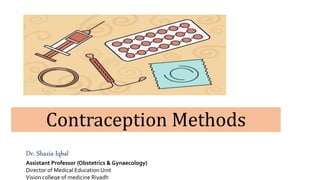
Contraception Methods
Dr. Shazia Iqbal
Assistant Professor (Obstetrics & Gynaecology)
Director of Medical Education Unit
Vision college of medicine Riyadh
Case
• A 24-year-old, G0P0, woman presesnts to her gynecologist for a
scheduled routine visit. She denies any acute complaints and reports
to be in excellent health. She is sexually active with only one male
partner and uses condoms consistently, which is her only method of
contraception. Both her and her partner were recently tested for
sexually transmitted infections and results were negative.
She reports concern because approximately 2 days ago, she had
intercourse and the condom broke. She feels that she is not prepared
to care for a child and inquires about the "morning after pill." After a
discussion, she requests the copper intrauterine device as emergency
contraception and as a contraceptive method to decrease the risk of
future pregnancy.
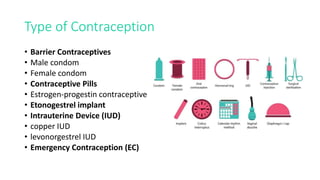
Type of Contraception
• Barrier Contraceptives
• Male condom
• Female condom
• Contraceptive Pills
• Estrogen-progestin contraceptive
• Etonogestrel implant
• Intrauterine Device (IUD)
• copper IUD
• levonorgestrel IUD
• Emergency Contraception (EC)
Barrier Contraceptives
Male condom
• creates a barrier that prevents contact with genital lesions, penile,
vaginal, and anal discharges
• if used correctly and consistently, condoms may reduce the risk of
pregnancy and acquiring or transmitting sexually transmitted
infections (STIs)
with typical use, there is an 18% pregnancy rate
Disadvantages
- reduced sensitivity during
intercourse
- latex sensitivity
- reversible
- accessible
- protection
against STI
- cost
Advantages
Female condom
• another barrier mode of contraception that may reduce the risk of
pregnancy and STIs
with typical use, there is a 21% pregnancy rate
Contraceptive Pills
Estrogen-progestin contraceptive
mechanism of action
- inhibition of the midcycle luteinizing hormone (LH) surge
- impairs ovulation
- Thins uterine lining
- Thickens cervical mucus
with typical use, there is a 9% pregnancy rate
side effects
1. hypercoagulability (DVT and PE)
2. Hypertension
3. cholelithiasis and cholecystitis caused by increased gallbladder stasis
4. Depression
5. Nausea
6. drug interactions
7. hepatic adenoma
Contraindications
• :≥ 35 years of age and smoking ≥15 cigarettes/day
• venous thromboembolism
• ischemic heart disease
• stroke history
• breast cancer
• cirrhosis
• migraine with aura
Non-contraceptive benefits
• Reduce the risk of ovarian and endometrial cancer
• Can treat acne and hirsutism
• Shortens period
• Regulates period
Progestin-only contraceptive
Mechanism of action
• endometrial decasualization and eventual atrophy leads to
endometrium being less suitable for implantation
• thickening of cervical mucous leading to
decreased permeability for sperm
impairs tubal peristalsis and motility
with typical use, there is a 9% pregnancy rate
Benefits
• Can serve as an alternative contraceptive in women with
contraindications to estrogen or if estrogen causes additional health
risks
• Can be used immediately post-partum
• Protective against the development of endometrial cancer
Side effects of OCPS
• menstrual irregularity
• Amenorrhea
• weight gain
• headache
• Nausea
• abdominal pain
• Vomiting
• reduction in bone density
• dizziness
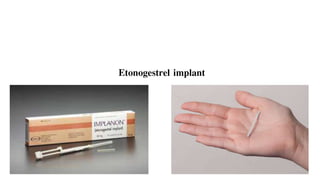
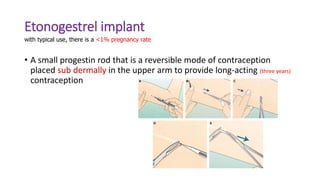
Etonogestrel implant
• A small progestin rod that is a reversible mode of contraception
placed sub dermally in the upper arm to provide long-acting (three years)
contraception
with typical use, there is a <1% pregnancy rate
Intrauterine Device (IUD)
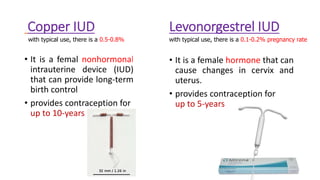
Copper IUD
• It is a femal nonhormonal
intrauterine device (IUD)
that can provide long-term
birth control
• provides contraception for
up to 10-years
with typical use, there is a 0.5-0.8%
Levonorgestrel IUD
• It is a female hormone that can
cause changes in cervix and
uterus.
• provides contraception for
up to 5-years
with typical use, there is a 0.1-0.2% pregnancy rate
Emergency Contraception (EC)
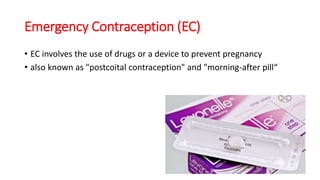
• EC involves the use of drugs or a device to prevent pregnancy
• also known as "postcoital contraception" and "morning-after pill“
Indications
• recent unprotected intercourse
• recent possible failure of a different mode of contraception (e.g.,
condom breakage)
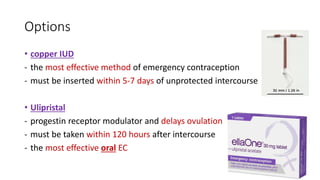
Options
• copper IUD
- the most effective method of emergency contraception
- must be inserted within 5-7 days of unprotected intercourse
• Ulipristal
- progestin receptor modulator and delays ovulation
- must be taken within 120 hours after intercourse
- the most effective oral EC
• Levonorgestrel
- taken within 72 hours after intercourse
- still is effective up to 120 hours after intercourse
- efficacy is reduced
- available over-the-counter
•Efficacy trend
◦ copper IUD > ulipristal > levonorgestrel
Reference
• https://www.amboss.com/us/knowledge/Hormonal_contr
aceptives
• Oxford Handbook of Obstetrics and Gynecology 3rd Edition
• https://step2.medbullets.com/gynecology/120201/contrac
eption
Thank you

Contraception 01.04.2021

  • 1.
    Contraception Methods Dr. ShaziaIqbal Assistant Professor (Obstetrics & Gynaecology) Director of Medical Education Unit Vision college of medicine Riyadh
  • 2.
    Case • A 24-year-old,G0P0, woman presesnts to her gynecologist for a scheduled routine visit. She denies any acute complaints and reports to be in excellent health. She is sexually active with only one male partner and uses condoms consistently, which is her only method of contraception. Both her and her partner were recently tested for sexually transmitted infections and results were negative.
  • 3.
    She reports concernbecause approximately 2 days ago, she had intercourse and the condom broke. She feels that she is not prepared to care for a child and inquires about the "morning after pill." After a discussion, she requests the copper intrauterine device as emergency contraception and as a contraceptive method to decrease the risk of future pregnancy.
  • 4.
    Type of Contraception •Barrier Contraceptives • Male condom • Female condom • Contraceptive Pills • Estrogen-progestin contraceptive • Etonogestrel implant • Intrauterine Device (IUD) • copper IUD • levonorgestrel IUD • Emergency Contraception (EC)
  • 5.
  • 6.
    Male condom • createsa barrier that prevents contact with genital lesions, penile, vaginal, and anal discharges • if used correctly and consistently, condoms may reduce the risk of pregnancy and acquiring or transmitting sexually transmitted infections (STIs) with typical use, there is an 18% pregnancy rate
  • 7.
    Disadvantages - reduced sensitivityduring intercourse - latex sensitivity - reversible - accessible - protection against STI - cost Advantages
  • 8.
    Female condom • anotherbarrier mode of contraception that may reduce the risk of pregnancy and STIs with typical use, there is a 21% pregnancy rate
  • 9.
  • 10.
    Estrogen-progestin contraceptive mechanism ofaction - inhibition of the midcycle luteinizing hormone (LH) surge - impairs ovulation - Thins uterine lining - Thickens cervical mucus with typical use, there is a 9% pregnancy rate
  • 11.
    side effects 1. hypercoagulability(DVT and PE) 2. Hypertension 3. cholelithiasis and cholecystitis caused by increased gallbladder stasis 4. Depression 5. Nausea 6. drug interactions 7. hepatic adenoma
  • 12.
    Contraindications • :≥ 35years of age and smoking ≥15 cigarettes/day • venous thromboembolism • ischemic heart disease • stroke history • breast cancer • cirrhosis • migraine with aura
  • 13.
    Non-contraceptive benefits • Reducethe risk of ovarian and endometrial cancer • Can treat acne and hirsutism • Shortens period • Regulates period
  • 14.
    Progestin-only contraceptive Mechanism ofaction • endometrial decasualization and eventual atrophy leads to endometrium being less suitable for implantation • thickening of cervical mucous leading to decreased permeability for sperm impairs tubal peristalsis and motility with typical use, there is a 9% pregnancy rate
  • 15.
    Benefits • Can serveas an alternative contraceptive in women with contraindications to estrogen or if estrogen causes additional health risks • Can be used immediately post-partum • Protective against the development of endometrial cancer
  • 16.
    Side effects ofOCPS • menstrual irregularity • Amenorrhea • weight gain • headache • Nausea • abdominal pain • Vomiting • reduction in bone density • dizziness
  • 17.
  • 18.
    Etonogestrel implant • Asmall progestin rod that is a reversible mode of contraception placed sub dermally in the upper arm to provide long-acting (three years) contraception with typical use, there is a <1% pregnancy rate
  • 19.
  • 20.
    Copper IUD • Itis a femal nonhormonal intrauterine device (IUD) that can provide long-term birth control • provides contraception for up to 10-years with typical use, there is a 0.5-0.8% Levonorgestrel IUD • It is a female hormone that can cause changes in cervix and uterus. • provides contraception for up to 5-years with typical use, there is a 0.1-0.2% pregnancy rate
  • 21.
  • 22.
    Emergency Contraception (EC) •EC involves the use of drugs or a device to prevent pregnancy • also known as "postcoital contraception" and "morning-after pill“
  • 23.
    Indications • recent unprotectedintercourse • recent possible failure of a different mode of contraception (e.g., condom breakage)
  • 24.
    Options • copper IUD -the most effective method of emergency contraception - must be inserted within 5-7 days of unprotected intercourse • Ulipristal - progestin receptor modulator and delays ovulation - must be taken within 120 hours after intercourse - the most effective oral EC
  • 25.
    • Levonorgestrel - takenwithin 72 hours after intercourse - still is effective up to 120 hours after intercourse - efficacy is reduced - available over-the-counter
  • 26.
    •Efficacy trend ◦ copperIUD > ulipristal > levonorgestrel
  • 28.
    Reference • https://www.amboss.com/us/knowledge/Hormonal_contr aceptives • OxfordHandbook of Obstetrics and Gynecology 3rd Edition • https://step2.medbullets.com/gynecology/120201/contrac eption
  • 29.