Family planning :Current Contraceptive  Scenario  in India  IMA DISTRICT LEVEL WORKSHOP ON CONTRACEPTIVE UPDATES & SAFE ABORTION TECHNIQUES
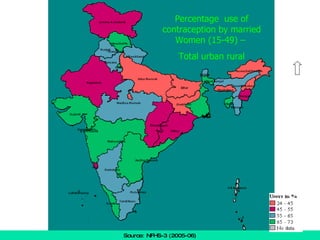
Contraceptive Updates Seminar, October 2005 Source: NFHS-3 (2005-06) Percentage  use of contraception by married Women (15-49) –  Total urban rural N
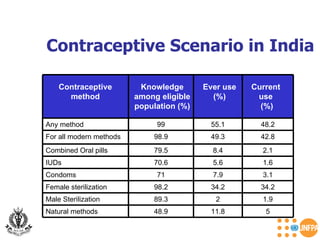
Knowledge among eligible population (%) Contraceptive method Ever use (%) Current  use  (%) Contraceptive Scenario in India Any method 99 55.1 48.2 For all modern methods 98.9 49.3 42.8 Combined Oral pills 79.5 8.4 2.1 IUDs 70.6 5.6 1.6 Condoms 71 7.9 3.1 Female sterilization 98.2 34.2 34.2 Male Sterilization 89.3 2 1.9 Natural methods 48.9 11.8 5
Total Fertility Rate The total fertility rate (TFR, sometimes also called the fertility rate, period total fertility rate (PTFR) or total period fertility rate (TPFR)) of a population is the average number of children that would be born to a woman over her lifetime if (1) she were to experience the exact current age-specific  fertility  rates (ASFRs) through her lifetime, and (2) she were to survive from birth through the end of her reproductive life. It is obtained by summing the single-year age-specific rates at a given time. Contraceptive Updates Seminar, October 2005
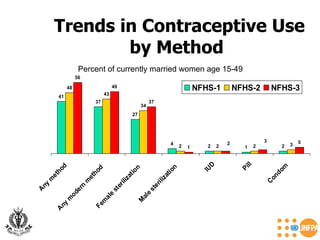
Trends in Contraceptive Use by Method Percent of currently married women age 15-49
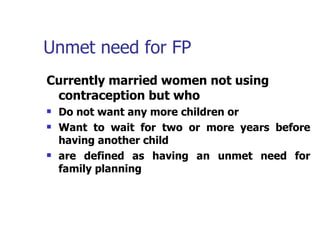
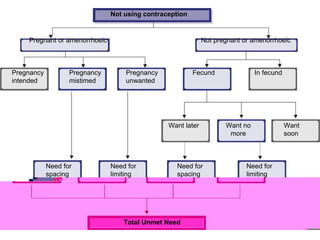
Unmet need for FP Currently married women not using contraception but who Do not want any more children or Want to wait for two or more years before having another child are defined as having an unmet need for family planning
Not using contraception Pregnant or amenorrhoeic Not pregnant or amenorrhoeic Pregnancy  intended Pregnancy  mistimed Need for spacing Need for limiting Fecund In fecund Want later Want no more Want soon Need for spacing Need for limiting Total Unmet Need Pregnancy  unwanted
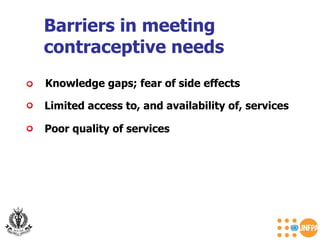
Knowledge gaps; fear of side effects Limited access to, and availability of, services Poor quality of services Barriers in meeting  contraceptive needs
Knowledge Gaps Counselling: Key element for ensuring informed choice, correct and consistent use and continuation of method; Understanding relative effectiveness of the method; Correct use of the method; how it works;  Common side-effects; health risks and benefits of the method; signs and symptoms that would necessitate a return to the clinic;  Information on return to fertility after discontinuing method use; and information on STI protection . Contraceptive Updates Seminar December 2004
Access and Quality of Services Skilled providers are key to increase access for contraceptives  Providers Skilled in Clinical procedures as per the guidelines  Counseling- General and method specific Follow up actions  Management of side effects Ctd…….. Contraceptive Updates Seminar December 2004
Access and Quality of Services Physical infrastructure and supplies Site readiness as per prescribed norms Equipments Consistent and quality supplies Availability of educational materials for prospective and current users Contraceptive Updates Seminar December 2004
Clients with special needs Adolescents Are eligible to use any method of contraception and must have access to a variety of contraceptive choices  Many of the same issues regarding appropriate contraceptive use that apply to older clients apply to young people  Social and behavioral issues important considerations in the choice and use of contraceptives.  Expanding the method choices can lead to improved satisfaction, increased acceptance and increased prevalence of contraceptive use.  Proper education and counseling both before and at the time of method selection   Contraceptive Updates Seminar December 2004
Clients with special needs Additional consideration for individuals with a physical disability, mental disability or with serious psychiatric disease  The reproductive rights of the individual must be considered in any such decisions  Clients with mental disabilities may have difficulty remembering to take pills daily. Clients with physical disabilities may have difficulty obtaining supplies or otherwise accessing the family planning services   Contraceptive Updates Seminar December 2004
Need for Spacing Methods WE NEED SPACING METHODS FOR SAVING LIVES AS WELL AS  POPULATION STABILIZATION FOR A QUALITY LIFE. Birth interval is strongly associated with child mortality. A child born <1- ½ year  after the previous sibling will have 3 TIMES THE CHANCE OF DYING than after a 3 years spacing interval
Spacing Methods for Contraception Barrier Contraceptives:  Male Condoms Female Condoms Natural   Contraceptives: LAM SDM Oral Contraceptives  Injectable Contraceptives Intra Uterine Contraceptive Devices (IUCDs)
Male condom Barrier Contraceptive Condom is a sheath made of latex rubber to fit over a man’s erect penis. Condoms are available in different sizes, shapes, colors and textures. Some condoms are coated with a lubricant or with spermicide Barrier Contraceptive
Condoms help in preventing pregnancy as well as spread of sexually transmitted infections If used correctly, they prevent sperms and ST infections entering the vagina or organisms from vagina entering the penis. With typical use; 14 pregnancies per 100 women in the first year of use. With correct and consistent use every time; 3 pregnancies per 100 women in the first year of use. How do condoms work?
Prevent pregnancy as well as STIs including HIV. Enables a man to take responsibility of preventing pregnancy and disease. Can be used by men of any age  Easily available . Safe, no hormonal side effects. Easy to keep at hand in case of unexpected sex. Can be stopped at any time. Can be used without seeing a healthcare provider first. Often help to prevent premature ejaculation (help man last longer during sex). Advantages
Latex condoms may cause itching for a few people who are allergic to latex. Also, some people may be allergic to lubricant on some brands of condoms. May decrease sensation, making sex less enjoyable for either partner. Couple must take the time to put the condom on the erect penis before sex. Supply must be ready even if the man or woman is not expecting to have sex. Small possibility that condom might slip off or break during sexual intercourse. If not properly stored, the condoms can go weak and break or  if used with oil-based lubricants. Disadvantages
Only one condition prevents use of condoms—severe allergy to latex rubber (severe redness, itching, swelling after condom use).  If the client is at risk of STIs or HIV, she/he should continue to use condoms during sexual intercourse despite the allergy. In general, anyone can use condom safely and effectively if not allergic to latex. Medical Eligibility
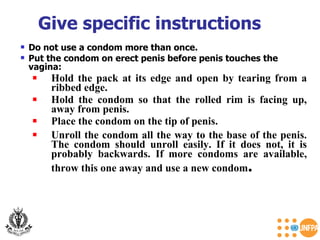
Do not use a condom more than once. Put the condom on erect penis before penis touches the vagina: Hold the pack at its edge and open by tearing from a ribbed edge. Hold the condom so that the rolled rim is facing up, away from penis. Place the condom on the tip of penis. Unroll the condom all the way to the base of the penis. The condom should unroll easily. If it does not, it is probably backwards. If more condoms are available, throw this one away and use a new condom . Give specific instructions
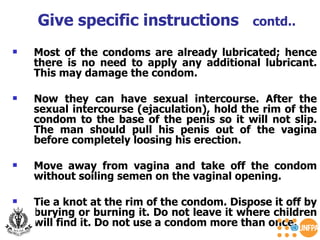
Most of the condoms are already lubricated; hence there is no need to apply any additional lubricant. This may damage the condom.  Now they can have sexual intercourse. After the sexual intercourse (ejaculation), hold the rim of the condom to the base of the penis so it will not slip. The man should pull his penis out of the vagina before completely loosing his erection.  Move away from vagina and take off the condom without soiling semen on the vaginal opening.  Tie a knot at the rim of the condom. Dispose it off by burying or burning it. Do not leave it where children will find it. Do not use a condom more than once. Give specific instructions  contd..
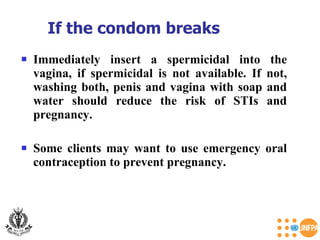
Immediately insert a spermicidal into the vagina, if spermicidal is not available. If not, washing both, penis and vagina with soap and water should reduce the risk of STIs and pregnancy.  Some clients may want to use emergency oral contraception to prevent pregnancy. If the condom breaks
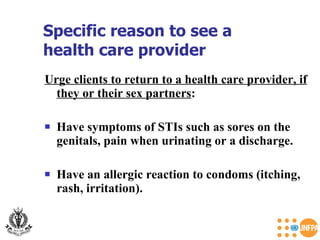
Urge clients to return to a health care provider, if they or their sex partners : Have symptoms of STIs such as sores on the genitals, pain when urinating or a discharge. Have an allergic reaction to condoms (itching, rash, irritation). Specific reason to see a health care provider
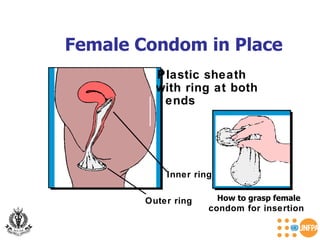
The Female Condom (FC) is a viable option for women to protect themselves from pregnancy and STIs including HIV.   FC is a thin, soft, loose-fitting polyurethane plastic pouch like device that lines the vagina.  It has two flexible rings, an inner ring at the closed end, used to insert the device inside the vagina and hold it in place, and an outer ring which remains outside the vagina and covers the external genitalia.  The device being made of polyurethane can be used with any type of lubricant without compromising its integrity. This is advantageous in countries where water-based lubricants are hard to find. FEMALE CONDOM
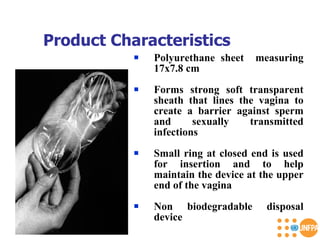
Product Characteristics  Polyurethane sheet  measuring 17x7.8 cm Forms strong soft transparent sheath that lines the vagina to create a barrier against sperm and sexually transmitted infections Small ring at closed end is used for insertion and to help maintain the device at the upper end of the vagina Non biodegradable disposal device
Female Condom in Place   Inner ring Outer ring Plastic sheath with ring at both ends How to grasp female condom for insertion
Key lessons learnt FC is not just a product, it needs to be an overall programme Integration into existing strategies and approaches  Interaction between user and outreach worker and service provider critical for acceptance Interpersonal communication backed up with regular demonstration Leadership affects acceptability Not an issue of demand or use; but cost and access
Effectiveness in pregnancy and disease prevention Contraceptive effectiveness and disease prevention rates seem comparable to those for male condoms 6 months failure rate 0.8% in Japan to 9.5% in Three Latin American sites Estimated annual accidental pregnancy rates for consistent and correct use Female condom 5%; Male Latex condom 3%; Diaphragm 6%; Spermicides 6% WHO Study to compare efficacy is under way Polyurethane is impermeable to small viruses e.g.., CMV, Herpes, Hepatitis B and HIV
Acceptability The female condom has been found to have acceptability among both men and women. Studies in numerous countries and in many different settings show that on an average 50-70 % of male and female participants found the female condom to be acceptable.   Source: The Female Condom. A Guide for Planning and Programming.  WHO and UNAIDS. 2000
Safety Female condom is both strong and durable. No special storage arrangements have to be made because the polyurethane is not affected by changes in temperature and humidity.  Research confirms that the female condom does not have any serious side effects. It does not alter the vaginal flora or cause significant skin irritation, allergic reaction or vaginal trauma.   Source: The Female Condom. A Guide for Planning and Programming. WHO and UNAIDS. 2000
Advantages   Female-controlled No medical condition appear to limit use. More comfortable to men, less decrease in sensation than male latex condoms. As a result, sensitivity of male partner may not be substantially reduced. It also offers ease of use by men with erectile dysfunction.
Advantages   Contd… Offer greater protection as it covers both internal and external genitalia. Stronger (polyurethane is 40% more stronger than latex) therefore less frequent breakage (1% compared to 4% for male condoms) Longer shelf-life even under unfavorable storage conditions. CSWs found that female condom allowed them to continue their job without interruption during menstruation (study fro Guatemala and Mexico
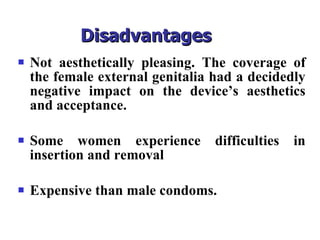
Disadvantages   Not aesthetically pleasing. The coverage of the female external genitalia had a decidedly negative impact on the device’s aesthetics and acceptance. Some women experience difficulties in insertion and removal  Expensive than male condoms.
How to use ? Some time before the sex, the woman places the closed end of the female condom high in her vagina.  The closed end contains a flexible, removable ring to help with insertion.  A large flexible ring around the open end of the condom stays outside covering external genitalia.
Effectiveness Pregnancies per 100 women in the first year of the use- as commonly used 21. If used correctly and consistently-5.
Lactational Amenorrhea Method (LAM) LAM is the use of breastfeeding as a spacing method. LAM provides natural protection against pregnancy and encourages using other method at the proper time. Stops ovulation (release of eggs from ovaries) as it changes the rate of release of natural hormones. Effective as commonly used: 2 pregnancies per 100 women in the first 6 months after childbirth. When used correctly and consistently: 0.5 pregnancies per 100 women in the first 6 months after childbirth.
Correct and consistent use means: Her baby is less than 6 months (she has given childbirth within last 6 months) After last childbirth her menstrual period has not returned She is fully breastfeeding—day and night, (at least 8-10 times a day, at least once in 4 hours) and at least once in night (night feeding regularly not more than 6 hours apart) and at least 85% of her baby’s feedings should be breastfeed.
Advantages of LAM  Can be used immediately after childbirth Encourages the best breastfeeding patterns Effectively prevents pregnancy at least 6 months and may be longer if a woman keeps breastfeeding often, day and night. No direct cost .No supplies or procedure required to prevent pregnancy. No hormonal side effects. No need to do anything at the time of sexual inter course
Advantages of LAM Counseling on LAM encourages starting a follow on method at the proper time. Breastfeeding practices required by LAM have other health benefits for mother and baby Provides the healthiest food for baby Protects the baby from life-threatening diarrhea. Helps protect the baby from diseases like measles  and pneumonia by passing mother’s immunities to  baby. Help develop close bondage between mother and baby .
Disadvantages  Effectiveness after 6 months is not certain Frequent breastfeeding may be inconvenient or difficult for some women, especially working mothers No protection against STIs including HIV If the mother has HIV, there is a small chance that breast milk will pass HIV to the baby.
Medical Eligibility  Most women  CAN  use LAM safely and effectively   A woman can use LAM after childbirth, if : Her baby is less than 6 months (she has given childbirth within last 6 months) After last childbirth her menstrual period has not returned She is fully breastfeeding—day and night, (at least 8-10 times a day, at least once in 4 hours) and at least once in night (night feeding regularly not more than 6 hours apart) and at least 85% of her baby’s feedings should be breastfeed.
Explaining how to use  Breastfeed often: An ideal pattern is at least 8-10 times a day including at least once at night.  Breastfeed properly: Counsel her on breastfeeding technique and diet  Start other foods when baby is 6 months old. Breastfeed before giving other food, if possible.
Start another family planning method when:  Her menstrual period return (bleeding in the first 56 days, or 8 weeks, after childbirth is not considered menstrual bleeding) OR She stops fully or nearly fully breastfeeding. OR Her baby is 6 months old (about the time when baby starts sitting up) OR She no longer wants to rely on LAM for family planning
Standard Day Method Fertility Awareness Based Method
Introduction The standard days method (SDM) is a new natural family planning method for women with menstrual cycles ranging between 26 and 32 days.  This method involves identifying the fertile days during each menstrual cycle.
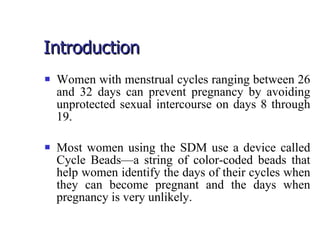
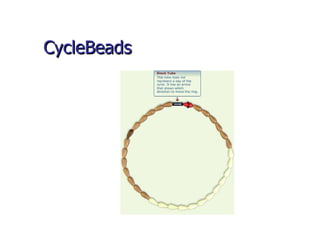
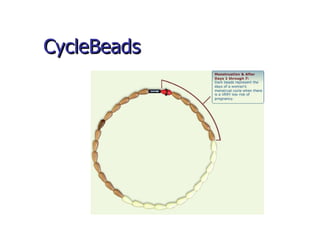
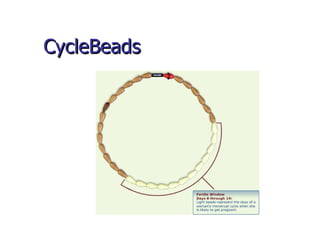
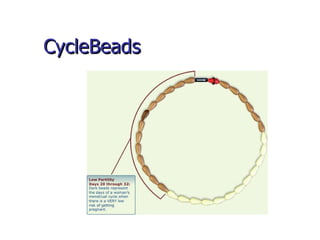
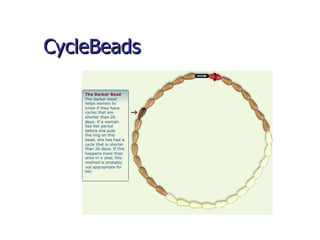
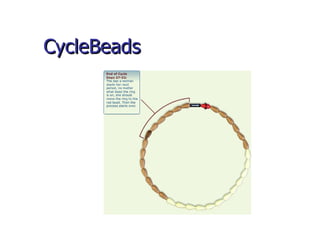
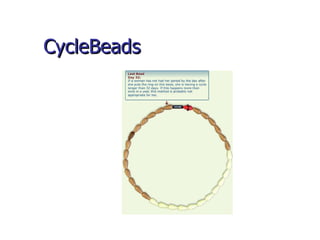
Introduction Women with menstrual cycles ranging between 26 and 32 days can prevent pregnancy by avoiding unprotected sexual intercourse on days 8 through 19. Most women using the SDM use a device called Cycle Beads—a string of color-coded beads that help women identify the days of their cycles when they can become pregnant and the days when pregnancy is very unlikely.
CycleBeads
CycleBeads
CycleBeads
CycleBeads
CycleBeads
CycleBeads
CycleBeads
SDM instructions: On the day that your menstrual period starts, hold the Cycle Beads and move the rubber ring onto the first red bead. Each day, move the rubber ring onto the next bead, moving in the direction of the arrow. Avoid sexual intercourse or unprotected sexual intercourse on the days when the rubber ring is on any of the white beads.
Return if,: You are not happy with the method. You think you are pregnant. You want information about or want to start using another family planning method. You think there is any chance you may have been exposed to  HIV infection  or any other  sexually transmitted infection (STI)
Oral Contraceptives and Emergency Contraceptive Pills Contraceptive Updates Seminar, October 2005
Types Contraceptive Updates Seminar, October 2005 Progesterone-Only oral contraceptive pills   Combined oral contraceptives Monophasic: Standard dose, low dose and very  low dose pills   Multiphasic: Biphasic, Triphasic pills
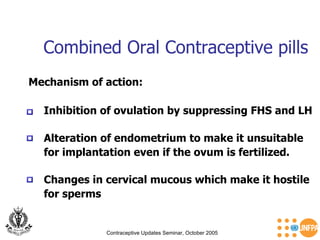
Combined Oral Contraceptive pills Contraceptive Updates Seminar, October 2005 Alteration of endometrium to make it unsuitable  for implantation even if the ovum is fertilized. Mechanism of action: Changes in cervical mucous which make it hostile  for sperms Inhibition of ovulation by suppressing FHS and LH
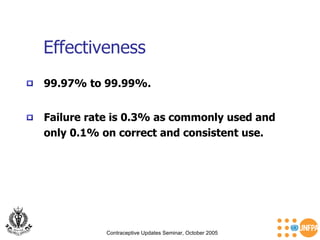
Effectiveness Contraceptive Updates Seminar, October 2005 Failure rate is 0.3% as commonly used and  only 0.1% on correct and consistent use.   99.97% to 99.99%.
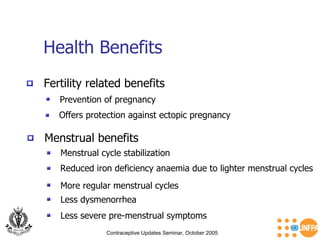
Health Benefits Contraceptive Updates Seminar, October 2005 Fertility related benefits Prevention of pregnancy  Offers protection against ectopic pregnancy   Menstrual benefits Menstrual cycle stabilization Reduced iron deficiency anaemia due to lighter menstrual cycles  More regular menstrual cycles  Less dysmenorrhea   Less severe pre-menstrual symptoms
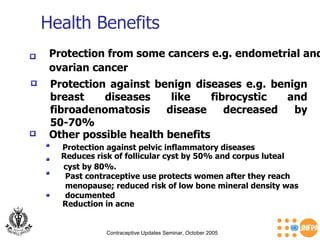
Health Benefits Contraceptive Updates Seminar, October 2005 Protection from some cancers  e.g. endometrial and ovarian cancer   Protection against benign diseases e.g. benign breast diseases like fibrocystic and  fibroadenomatosis disease decreased by 50-70%  Other possible health benefits   Protection against pelvic inflammatory diseases   Reduces risk of follicular cyst by 50% and corpus luteal cyst by 80%.   Past contraceptive use protects women after they reach menopause; reduced risk of low bone mineral density was documented   Reduction in acne
Side effects Contraceptive Updates Seminar, October 2005 Breakthrough bleeding-common with low dose  progesterone pills due to low or absent estrogen. Nausea, vomiting, decreased appetite; usually pass off after 2-3 months of use Oligo and ammenorrhoea due to lack of proliferation  of endometrium of cycle. Common among women  who had menstrual problems before starting oral  contraceptive pills.
Side effects Contraceptive Updates Seminar, October 2005 Vaginal discharge due to congestion and  hypertrophy of cervical epithelium. Breast changes- oedema, heaviness and tenderness. Chloasma Weight gain in some cases due to estrogen and progesterone . Acne and oily skin.
ELIGIBILITY CRITERIA: (For low dose combined contraceptive pills) Contraceptive Updates Seminar, October 2005 Most women can use Combined Oral Contraceptives. Are of any age, including adolescents and over 40  (except women 35 years or older and who smoke) Smoke cigarettes but are under age 35 Have just had abortion or miscarriage
ELIGIBILITY CRITERIA: (For low dose combined contraceptive pills) Contraceptive Updates Seminar, October 2005 Heavy, painful menstrual periods or iron deficiency  anemia (condition may improve)   Benign breast disease   Diabetes without vascular, kidney, eye or nerve disease   Irregular menstrual periods   Mild headaches   Malaria  Varicose veins
ELIGIBILITY CRITERIA: (For low dose combined contraceptive pills) Contraceptive Updates Seminar, October 2005 Thyroid disease  Endometriosis Pelvic inflammatory disease  Begin ovarian tumour Past ectopic pregnancy Uterine fibroids Tuberculosis (unless taking Rifampicin)
Who cannot use COCs? Contraceptive Updates Seminar, October 2005 Fully Breastfeeding within 6 month postpartum; If partially BF she  can start  after six weeks  Are age 35+ and smoke more than 15 cigarettes per day  Have multiple risk factors for arterial cardiovascular disease  Have hypertension with systolic BP 140-159 and diastolic 90-99  and those having vascular disease.  Have clear history of deep vein thrombosis (DVT), pulmonary thrombosis or current DVT or pulmonary thrombosis.  Have known thrombogenic mutations.  Have current history of ischemic heart disease or known hyperlipidaemias
Who cannot use COCs? Contraceptive Updates Seminar, October 2005 Women who have Migraine with aura  Current breast cancer  Diabetes with neuropathy, retinopathy, nephropathy  and other vascular disease  Acute hepatitis or severe cirrhosis of liver or benign or malignant liver tumours  Complicated pulmonary hypertension, risk of atrial fibrillation, history of subacute bacterial endocarditis
Important Contraceptive Updates Seminar, October 2005 Women having the above health conditions should  be encouraged to use other more appropriate  contraceptives than COCs.
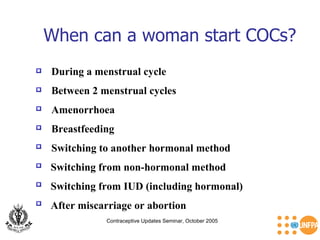
When can a woman start COCs? Contraceptive Updates Seminar, October 2005 During a menstrual cycle  Amenorrhoea  Between 2 menstrual cycles  Breastfeeding  Switching to another hormonal method  Switching from non-hormonal method  After miscarriage or abortion  Switching from IUD (including hormonal)
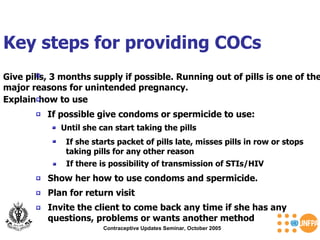
Key steps for providing COCs Contraceptive Updates Seminar, October 2005 Give pills, 3 months supply if possible. Running out of pills is one of the major reasons for unintended pregnancy. Explain how to use If possible give condoms or spermicide to use: Until she can start taking the pills   If she starts packet of pills late, misses pills in row or stops taking pills for any other reason  If there is possibility of transmission of STIs/HIV  Show her how to use condoms and spermicide.  Invite the client to come back any time if she has any questions, problems or wants another method  Plan for return visit
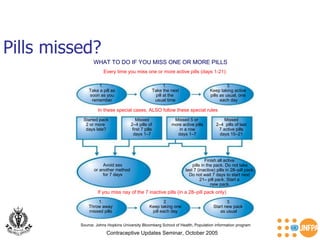
Pills missed? Contraceptive Updates Seminar, October 2005 WHAT TO DO IF YOU MISS ONE OR MORE PILLS Every time you miss one or more active pills (days 1-21): In these special cases, ALSO follow these special rules If you miss nay of the 7 inactive pills (in a 28–pill pack only) 1.  Take a pill as soon as you remember 1.  Take the next pill at the  usual time 3. Keep taking active  pills as usual, one  each day Source: Johns Hopkins University Bloomberg School of Health, Population information program Started pack 2 or more  days late? Missed 2–4 pills of  first 7 pills days 1–7 Missed 5 or  more active pills in a row days 1–7 Missed 2–4  pills of last 7 active pills days 15–21 Avoid sex or another method  for 7 days Finish all active  pills in the pack. Do not take last 7 (inactive) pills in 28–pill pack. Do not wait 7 days to start next  21– pill pack. Start a  new pack. 1. Throw away missed pills 2. Keep taking one pill each day 3. Start new pack  as usual
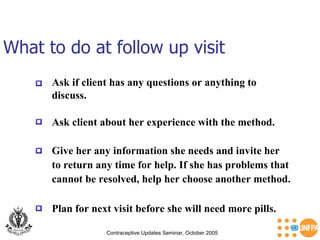
What to do at follow up visit Contraceptive Updates Seminar, October 2005 Ask if client has any questions or anything to discuss. Ask client about her experience with the method. Give her any information she needs and invite her  to return any time for help. If she has problems that  cannot be resolved, help her choose another method. Plan for next visit before she will need more pills.
Emergency Contraceptive Pills (ECPs) Contraceptive Updates Seminar, October 2005 Emergency contraception:   Is method of contraception used before missing a period to prevent pregnancy. It is also called “morning after” or post-coital contraception.
Indications for using emergency contraception  Contraceptive Updates Seminar, October 2005 A woman who had unprotected sex, and wants to prevent pregnancy. For example:   She did not expect to have sex and was not using  any contraception   Sex was forced  Condom broke or slipped She ran out of contraceptives, or was irregular in  taking pills and did not use condoms or spermicide. She is late for a contraceptive injection.
What pills can be used as ECPs? Contraceptive Updates Seminar, October 2005 Progestin-only dedicated products: Levonorgesterol pills  are generally used GOI emergency contraceptive pills also available  through public systems Several commercial preparations available in market
Contraceptive Updates Seminar, October 2005 Levonorgesterol alone EC pills-  A dedicated product 0.75 mg of tablets Levonorgestel available in India. The current recommendation: 1 pill of LNG 0.75 mg  to be taken as soon as possible after unprotected  coitus (within 72 hours) followed by another pill 12  hours later. Depending on the composition 1 pill of 1.5mg  in a single dose can be taken.
GOI Guidelines Contraceptive Updates Seminar, October 2005 The Government of India guidelines for Emergency Contraception recommend use of Levonorgestrel  (progestogen only) LNG as a “dedicated  product” for effective emergency contraception. The Drug Controller of India has approved only  Levonorgestrel for use as ECP.
How effective are ECPs? Contraceptive Updates Seminar, October 2005 Pregnancy rate 8%, if women have sex once in the  second or third week of the menstrual cycle without using contraception. Pregnancy rate 2% if women use combined oral contraceptives for emergency contraception  Pregnancy rate 1% if women use progestin-only  ECPs
How do ECPs work? Contraceptive Updates Seminar, October 2005 Probable mechanisms are: Inhibition or delay of ovulation Thickening of cervical mucous Direct inhibition of fertilization Histological and biochemical alteration in endometrium  leading to impaired endometrial receptivity to implantation  of the fertilized egg Alteration in transport of egg, sperm and embryo Interference with corpus luteum function and luteolysis
Medical eligibility criteria for Emergency Oral Contraception Contraceptive Updates Seminar, October 2005 Any woman can use emergency oral contraception  if she is not already pregnant within the stipulated  time period.
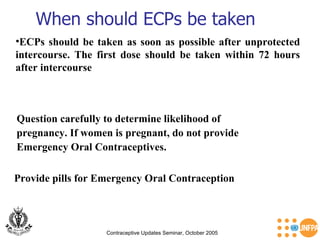
When should ECPs be taken Contraceptive Updates Seminar, October 2005 ECPs should be taken as soon as possible after unprotected intercourse. The first dose should be taken within 72 hours after intercourse Question carefully to determine likelihood of  pregnancy. If women is pregnant, do not provide  Emergency Oral Contraceptives. Provide pills for Emergency Oral Contraception
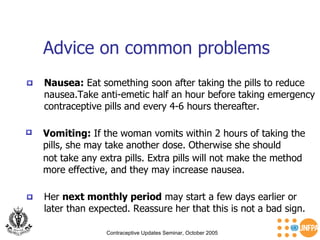
Advice on common problems  Contraceptive Updates Seminar, October 2005 Nausea:  Eat something soon after taking the pills to reduce nausea.Take anti-emetic half an hour before taking emergency contraceptive pills and every 4-6 hours thereafter. Vomiting:  If the woman vomits within 2 hours of taking the pills, she may take another dose. Otherwise she should  not take any extra pills. Extra pills will not make the method more effective, and they may increase nausea. Her  next monthly period  may start a few days earlier or later than expected. Reassure her that this is not a bad sign.
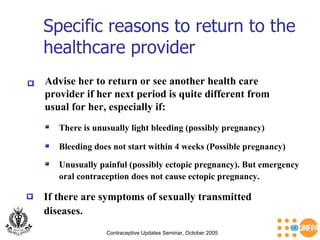
Specific reasons to return to the healthcare provider  Contraceptive Updates Seminar, October 2005 Advise her to return or see another health care  provider if her next period is quite different from  usual for her, especially if: There is unusually light bleeding (possibly pregnancy)   Bleeding does not start within 4 weeks (Possible pregnancy)  Unusually painful (possibly ectopic pregnancy). But emergency oral contraception does not cause ectopic pregnancy. If there are symptoms of sexually transmitted  diseases.
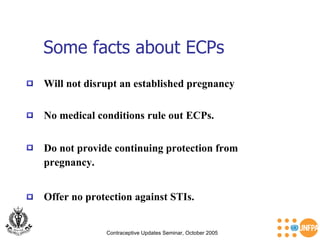
Some facts about ECPs Contraceptive Updates Seminar, October 2005 Will not disrupt an established pregnancy Offer no protection against STIs.  Do not provide continuing protection from pregnancy. No medical conditions rule out ECPs.
Providing ECPs: Key steps Contraceptive Updates Seminar, October 2005 Help the client feel at ease.  Ask when unprotected sex took place.  Give the woman pills. Explain how to take them.  She can take first dose at once.
Providing ECPs: Key steps Contraceptive Updates Seminar, October 2005 Explain and discuss important points about ECPs.  Discuss her ongoing need for contraception  Tell her that if she vomits within 2 hours of taking  pills, she may take another dose.


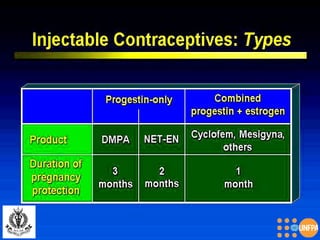
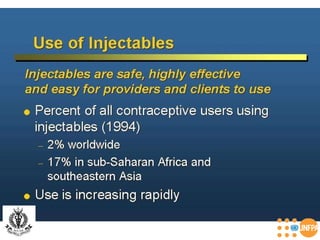
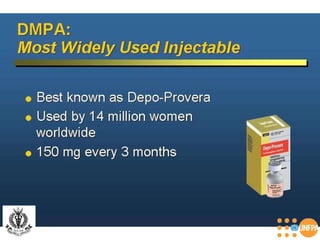
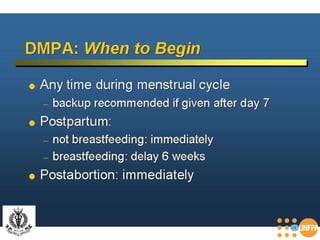
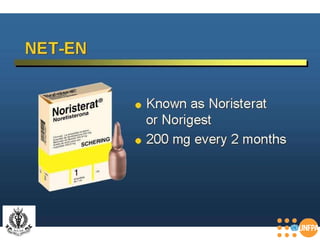
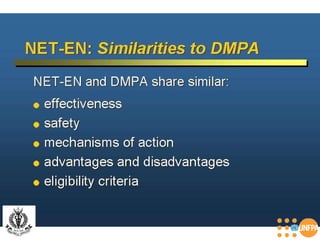
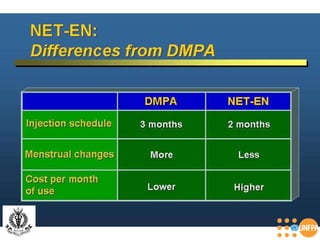
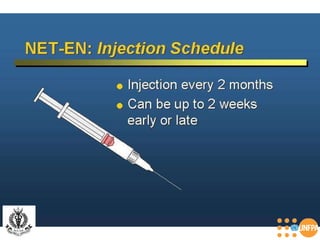
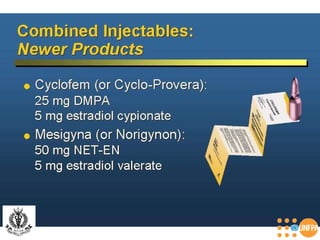
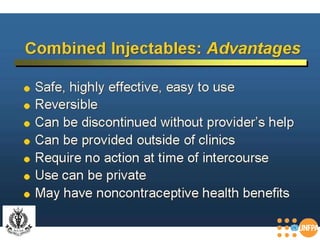
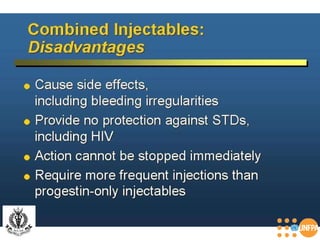
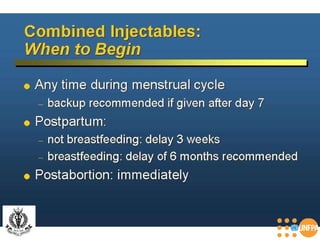
In India DMPA currently approved and available in 106  countries and NET-EN in over 60 countries.   Some social marketing organizations also  provide ICs   Approved by Drug Controller of India and  commercially available.
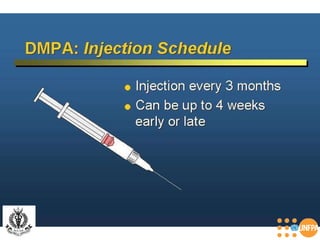
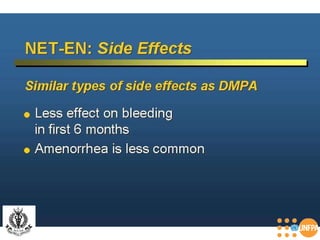
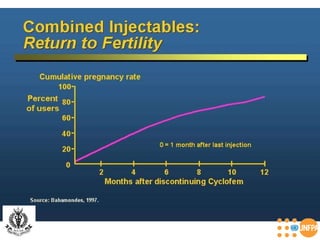
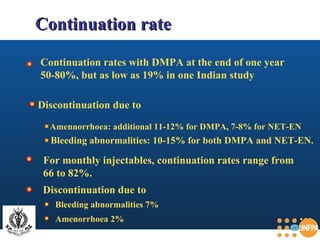
Continuation rates with DMPA at the end of one year 50-80%, but as low as 19% in one Indian study  Discontinuation due to  Continuation rate … Amennorrhoea: additional 11-12% for DMPA, 7-8% for NET-EN Bleeding abnormalities: 10-15% for both DMPA and NET-EN. For monthly injectables, continuation rates range from 66 to 82%.  Discontinuation due to  Amenorrhoea 2% Bleeding abnormalities 7%
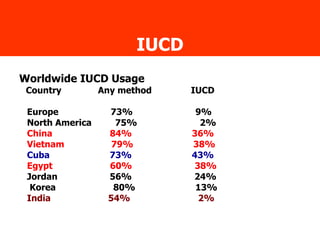
IUCD Worldwide IUCD Usage Country  Any method  IUCD Europe  73%  9% North America  75%  2% China  84%  36% Vietnam  79%  38% Cuba  73%  43% Egypt  60%  38%   Jordan  56%  24%  Korea  80%  13%  India  54%  2%
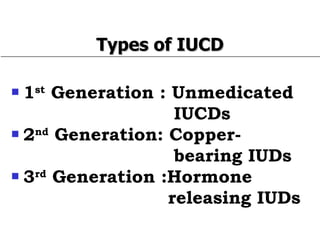
Types of IUCD 1 st  Generation : Unmedicated  IUCDs  2 nd  Generation: Copper-  bearing IUDs 3 rd  Generation :Hormone  releasing IUDs
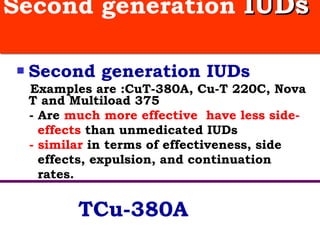
Second generation  IUDs   Second generation IUDs   Examples are :CuT-380A, Cu-T 220C, Nova T and Multiload 375  - Are  much more effective  have less side-  effects  than unmedicated IUDs - similar  in terms of effectiveness, side  effects, expulsion, and continuation  rates.  TCu-380A
IUCD 380 A : An Excellent Spacing Method •   C omparable to Female sterilisation 10 YRS EFFECTIVENESS  “ REVERSIBLE STERILIZATION ” Completely reversible   Very safe for most women,  including postpartum, post abortion, or interval, breastfeeding, young Nulliparous Cochraine Review National F.P. Programme
Re-emergence of the IUCD Recent research has led to important changes in  WHO eligibility criteria Risk of upper genital infections is negligible Despite many  misconceptions,  IUCD users have  higher satisfaction rates  than users of many other methods (99% vs 91% for pill users)
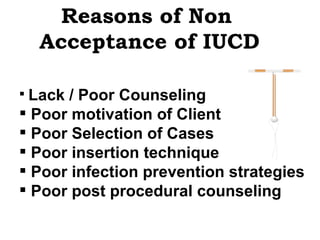
Reasons of Non  Acceptance of IUCD Lack / Poor Counseling  Poor motivation of Client Poor Selection of Cases Poor insertion technique Poor infection prevention strategies Poor post procedural counseling
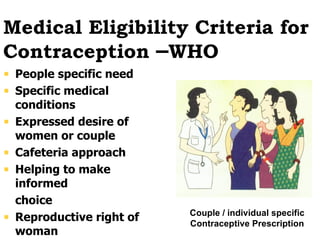
Medical Eligibility Criteria for Contraception  – WHO People specific need Specific medical conditions  Expressed desire of women or couple Cafeteria approach Helping to make informed  choice Reproductive right of woman Couple / individual specific Contraceptive Prescription
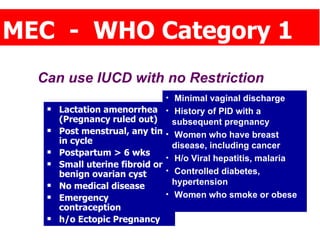
MEC  -  WHO Category 1 Lactation amenorrhea (Pregnancy ruled out) Post menstrual, any time in cycle Postpartum > 6 wks Small uterine fibroid or benign ovarian cyst No medical disease Emergency contraception h/o Ectopic Pregnancy Can use IUCD with no Restriction Minimal vaginal discharge History of PID with a  subsequent pregnancy Women who have breast disease, including cancer H/o Viral hepatitis, malaria Controlled diabetes, hypertension Women who smoke or obese
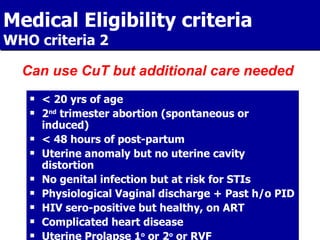
Medical Eligibility criteria WHO criteria 2 < 20 yrs of age 2 nd  trimester abortion (spontaneous or induced) < 48 hours of post-partum Uterine anomaly but no uterine cavity distortion No genital infection but at risk for STIs Physiological Vaginal discharge + Past h/o PID HIV sero-positive but healthy, on ART Complicated heart disease  Uterine Prolapse 1 o  or 2 o  or RVF Can use CuT but additional care needed
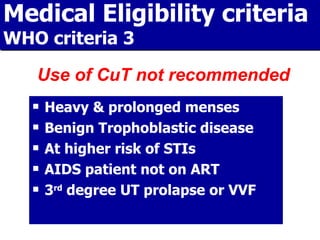
Medical Eligibility criteria WHO criteria 3 Heavy & prolonged menses Benign Trophoblastic disease At higher risk of STIs AIDS patient not on ART 3 rd  degree UT prolapse or VVF Use of CuT not recommended
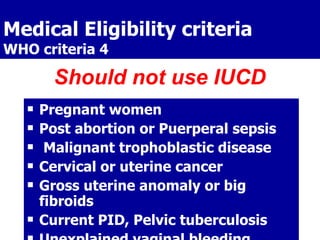
Medical Eligibility criteria WHO criteria 4 Pregnant women Post abortion or Puerperal sepsis Malignant trophoblastic disease Cervical or uterine cancer Gross uterine anomaly or big fibroids Current PID, Pelvic tuberculosis Unexplained vaginal bleeding Should not use IUCD
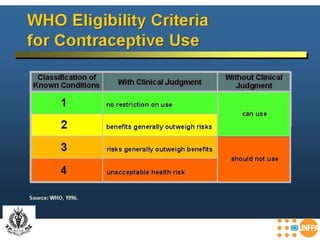
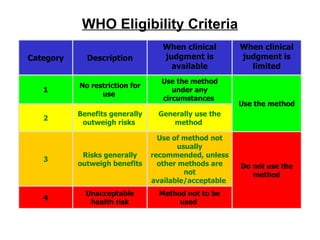
WHO Eligibility Criteria Source : WHO 2004. Category Description When clinical judgment is available When clinical judgment is limited 1 No restriction for use  Use the method under any circumstances  Use the method 2 Benefits generally outweigh risks  Generally use the method  3 Risks generally outweigh benefits Use of method not usually recommended, unless other methods are not available/acceptable  Do not use the method 4 Unacceptable health risk Method not to be used
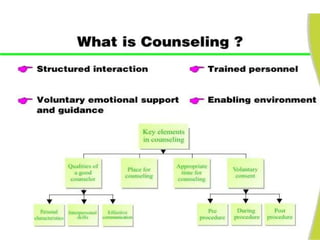
Counselling Giving need-based correct and useful information. Facilitating the client to make informed decision. Going beyond the presenting condition and symptoms and identifying the non-visible factors.
Counselor must facilitate the client to: Choose and use a method. Solve any problems.  Get accurate information.  Assure  the client about  privacy and confidentiality.
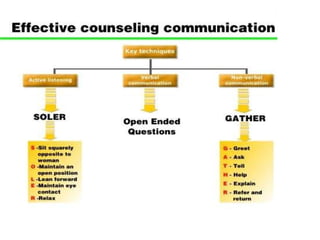
GOOD COUNSELOR G-good technical knowledge O-obtains information O-objectively answers  D-demonstrates professionalism
REMEMBER!   Counseling does not terminate when the client accepts a method or undergoes the procedure, its process completes when the acceptor returns to the service centre/provider for follow up and goes back home with satisfaction.
Certain clarification related to medical eligibility   Postpartum   Evidence suggests that there was increase in expulsion rates with delayed postpartum insertion compared to immediate insertion and with immediate postpartum insertion compared to interval insertion. Post abortion insertion   No difference in risk of complications for immediate versus delayed insertion of an IUD after abortion Expulsion was greater when an IUD was inserted following a second-trimester abortion
Vulvular heart disease Prophylactic antibiotics to prevent endocarditis PID and continuation of IUD To ensure continuation of IUD in cases of PID,   Treatment of PID using appropriate antibiotics  No need for removal of the IUD if the client wishes to continue to use. Clinical evidences suggest that among IUD users treated for PID, there was no difference in clinical course if the IUD was removed or left in place Certain clarification related to medical eligibility  …….
STI and IUD No evidence to suggest the increased  risk of PID  with IUD insertion among women with STI  HIV/AIDS •   No increased infection risk  •   IUD use among HIV-infected women was  not associated with increased risk of  transmission to sexual partner  Certain clarification related to medical eligibility  ……… ..
Managing problems Pregnancy Exclude ectopic pregnancy. Explain the risk of second trimester miscarriage,  pre-term delivery and infection if the IUD is left in place.
What is  LNG-20 Consists of plain Nova T device with a silastic reservoir attached to the vertical arm  The silastic reservoir is impregnated with levonorgestrel and is covered with a rate-limiting silastic membrane.  The release rate of levonorgestrel is approximately 20 micrograms/24 hours for at least 5 years.
Indications Particularly useful for 2 groups of women:  Who have been pregnant and do not want to any more children in next few years  Age group of 30-40yrs who have completed their families and want a reliable long term method of contraception
Disadvantages Costlier than  copper-bearing IUDs Can cause irregular bleeding or spotting in the  first six months  of use Not suitable for women who are  at risk  of  sexually transmitted infections  or  ectopic pregnancy.
Medical Eligibility Most of the medical eligibility criteria for copper-bearing IUDs and LNG-20 IUDs are similar; however,  due to hormonal nature certain precautions should be taken
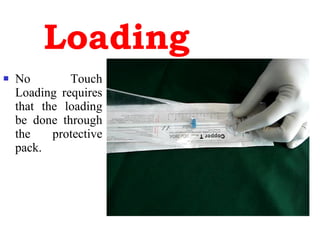
Insertion Technique No-touch technique Loading the IUD in the inserter while both parts are still in the sterile package  Cleaning the cervix with antiseptic before IUD insertion;  Not to touch the vaginal wall or speculum blades with the uterine sound or loaded IUD inserter  Passing both, uterine sound and IUD inserter only once through the cervical canal.
In women with   endometriosis  Use is associated  with decreased dysmenorrhoea and pelvic pain Beneficial in treating menorrhagia in women with heavy or prolonged bleeding Among women with   fibroids  No adverse health events have been reported There was a decrease in symptoms and size of  fibroids for some women Certain clarification related to medical eligibility
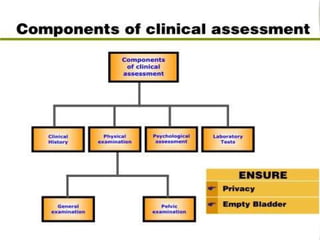
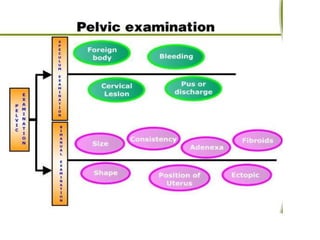
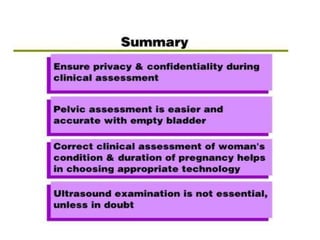
Examination of Client and Preparation before Insertion 1.  Client Counseling:  Explain the procedure to the client. This helps the client relax, making insertion easier and less painful. 2.  Infection prevention:  Use disinfected instruments, sterile hand gloves and clean the area with Betadine. This minimizes the chances of uterine infection. 3.  Speculum examination and bimanual pelvic examination :  The speculum examination is done to check for signs of genital tract infection. The bimanual examination determines the size, position, consistency, and mobility of the uterus and identifies any tenderness. A retroverted uterus requires special care during insertion. 4.  Sounding of the uterus:   Should be done slowly and gently to determine its depth and direction. This reduces the risk of perforating the uterus, which usually occurs because the sound is inserted too deeply or at the wrong angle.
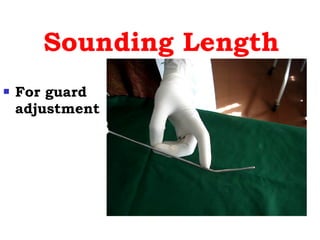
Sounding Length For guard adjustment
Preparing the IUD for insertion
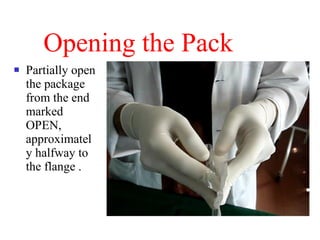
Opening the Pack Partially open the package from the end marked OPEN, approximately halfway to the flange .
Loading No Touch Loading requires that the loading be done through the protective pack.
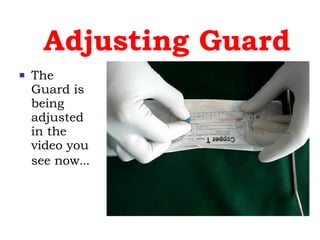
Adjusting Guard The Guard is being adjusted in the video you see now …
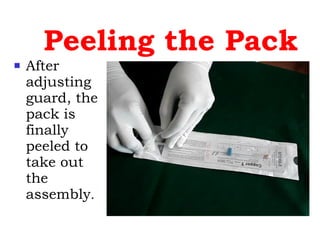
Peeling the Pack After adjusting guard, the pack is finally peeled to take out the assembly .
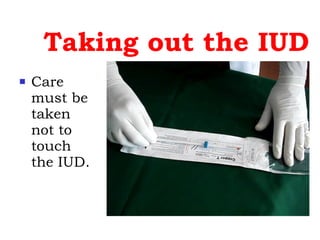
Taking out the IUD Care must be taken not to touch the IUD.
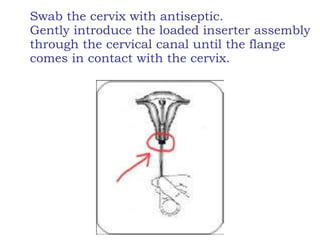
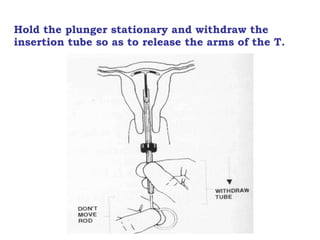
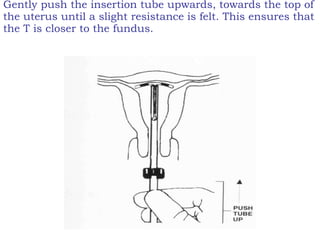
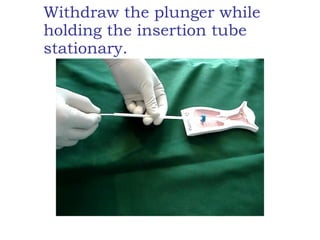
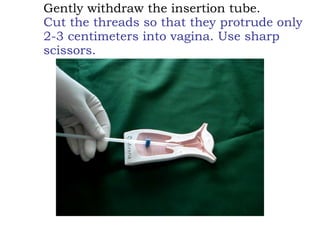
Recapitulation of Insertion 1.   Swab  the cervix with antiseptic.  Gently introduce the loaded inserter  assembly through the  cervical canal until the flange comes in contact with the cervix. 3.   Hold the plunger stationary  and  withdraw the insertion tube  slightly so as to release the arms of the T.  4.   Gently push the insertion tube upwards,  towards the top of the uterus until a slight resistance is felt. This ensures that the T is closer to the fundus.  5.   Withdraw the plunger  while holding the insertion tube stationary.  6.   Gently withdraw the insertion tube. 7.   Cut the threads  so that they protrude only 2-3 centimeters into vagina. Use sharp scissors.
Swab the cervix with antiseptic. Gently introduce the loaded inserter assembly through the cervical canal until the flange comes in contact with the cervix.
Hold the plunger stationary and withdraw the insertion tube so as to release the arms of the T.
Gently push the insertion tube upwards, towards the top of the uterus until a slight resistance is felt. This ensures that the T is closer to the fundus.
Withdraw the plunger while holding the insertion tube stationary.
Gently withdraw the insertion tube. Cut the threads so that they protrude only 2-3 centimeters into vagina. Use sharp scissors.
Caution The IUD should be loaded in to the inserter tube  not more than five minutes before  insertion.
Family Planning Permanent  Methods: Male & Female Sterilisation Dr. Kiran Ambwani, Deputy Commissioner, Family Planning Divison, MoHFW GOI
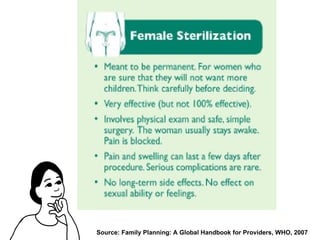
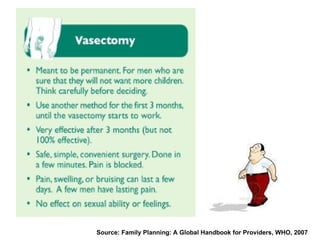
Source: Family Planning: A Global Handbook for Providers, WHO, 2007
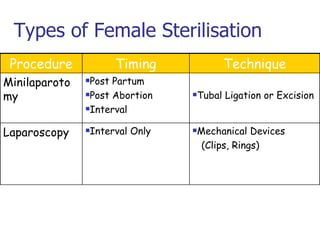
Types of Female Sterilisation Female Sterilization In: Landry E, ed. Contraceptive Sterilization: Global Issues and Trends. New York: Engender Health; 2002: 139-160 Procedure Timing Technique Minilaparotomy Post Partum Post Abortion Interval Tubal Ligation or Excision Laparoscopy Interval Only Mechanical Devices (Clips, Rings)
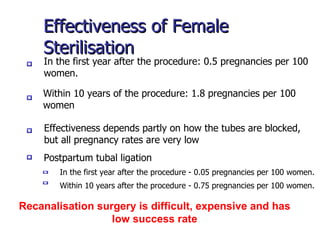
Effectiveness of Female Sterilisation Within 10 years of the procedure: 1.8 pregnancies per 100 women In the first year after the procedure: 0.5 pregnancies per 100 women. Effectiveness depends partly on how the tubes are blocked, but all pregnancy rates are very low Postpartum tubal ligation  In the first year after the procedure - 0.05 pregnancies per 100 women.  Within 10 years after the procedure - 0.75 pregnancies per 100 women. Recanalisation surgery is difficult, expensive and has low success rate
Who can avail Female Sterilisation? Safe for all women No requirement for Husband’s Permission After 21 years of age Who have just given birth (Within 7 days) Who are breast feeding Who are HIV Positive GOI Standards for female and male sterilisation The client should be screened using Medical Eligibility Criteria as enumerated in the “Standards for Female & Male Sterilisation”
Case Selection   (Self- declaration by the client will be the basis for this information) Clients should be ever-married. Female clients should be below the age of 49 years and above 22 years.  The couple should have at least one child whose age is above one year unless the sterilization is medically indicated. Clients or their spouses must not have undergone sterilization in the past (not applicable in the cases of failure of previous sterilization). Clients must be in a sound state of mind so as to understand the full implications of sterilization. Mentally ill clients must be certified by a psychiatrist and consent should be given by a legal guardian/spouse of sound state of mind.
DELAY female sterilization and treat as appropriate or refer in case of Pregnancy  Postpartum or second trimester abortion (7-42 days) Serious postpartum or post-abortion complications Unexplained vaginal bleeding Severe pre-eclampsia, eclampsia Pelvic inflammatory disease within past 3 months Current STI Pelvic cancers Malignant trophoblast disease …
REFER to a centre with experienced staff and equipment in case of Endometriosis Fixed uterus due to previous surgery or infection Hernia (umbilical or abdominal wall) Postpartum uterine rupture or perforation Post-abortion uterine perforation
Use CAUTION in case of Current breast cancer Past PID since last pregnancy Uterine fibroid Mild high blood pressure (140/90 – 155/99 mm) History of high blood pressure Past stroke or heart disease Valvular heart disease without complications.
Requirements of a safe procedure Client assessment Counseling Laboratory tests Informed consent Anesthesia Infection prevention Instructions to accompanying persons
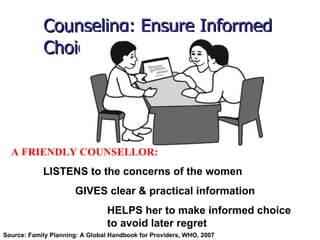
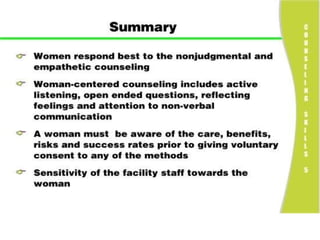
Counseling: Ensure Informed   Choice A FRIENDLY COUNSELLOR: LISTENS to the concerns of the women GIVES clear & practical information HELPS her to make informed choice  to avoid later regret Source: Family Planning: A Global Handbook for Providers, WHO, 2007
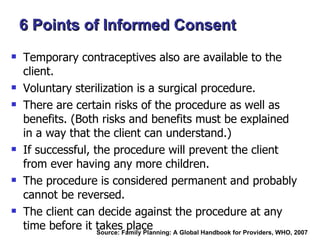
Temporary contraceptives also are available to the client. Voluntary sterilization is a surgical procedure. There are certain risks of the procedure as well as benefits. (Both risks and benefits must be explained in a way that the client can understand.) If successful, the procedure will prevent the client from ever having any more children. The procedure is considered permanent and probably cannot be reversed. The client can decide against the procedure at any time before it takes place 6 Points of Informed Consent Source: Family Planning: A Global Handbook for Providers, WHO, 2007
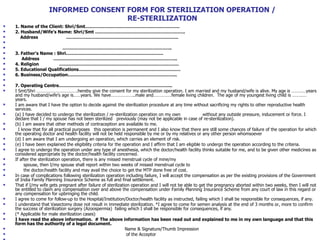
INFORMED CONSENT FORM FOR STERILIZATION OPERATION /  RE-STERILIZATION  1. Name of the Client: Shri/Smt………………………………………………………. 2. Husband/Wife’s Name: Shri/Smt ……………………………………………………. Address  …………………………………………………………………. ……………………………………………………………… .. 3. Father’s Name : Shri………………………………………………………… Address  ….…………………………………………………………………….. 4. Religion  ……………………………………………………………………… 5. Educational Qualifications…………………………………………………………… 6. Business/Occupation……………………………………………………………….. 7. Operating Centre………………………………………………………………….. I Smt/Shri …………………………….hereby give the consent for my sterilization operation. I am married and my husband/wife is alive. My age is …………years and my husband/wife’s age is……years. We have………………..male and……………female living children.  The age of my youngest living child is …………years.  I am aware that I have the option to decide against the sterilization procedure at any time without sacrificing my rights to other reproductive health services. (a) I have decided to undergo the sterilization / re-sterilization operation on my own  without any outside pressure, inducement or force. I declare that I / my spouse has not been sterilized  previously (may not be applicable in case of re-sterilization). (b) I am aware that other methods of contraception are available to me.  I know that for all practical purposes  this operation is permanent and I also know that there are still some chances of failure of the operation for which the operating doctor and health facility will not be held responsible by me or by my relatives or any other person whomsoever  (d) I am aware that I am undergoing an operation, which carries an element of risk. (e) I have been explained the eligibility criteria for the operation and I affirm that I am eligible to undergo the operation according to the criteria. I agree to undergo the operation under any type of anesthesia, which the doctor/health facility thinks suitable for me, and to be given other medicines as considered appropriate by the doctor/health facility concerned. If after the sterilization operation, there is any missed menstrual cycle of mine/my  spouse, then I/my spouse shall report within two weeks of missed menstrual cycle to  the doctor/health facility and may avail the choice to get the MTP done free of cost. In case of complications following sterilization operation including failure, I will accept the compensation as per the existing provisions of the Government of India Family Planning Insurance Scheme as full and final settlement.  That if I/my wife gets pregnant after failure of sterilization operation and I will not be able to get the pregnancy aborted within two weeks, then I will not be entitled to claim any compensation over and above the compensation under Family Planning Insurance Scheme from any court of law in this regard or any compensation for upbringing the child.  I agree to come for follow-up to the Hospital/Institution/Doctor/health facility as instructed, failing which I shall be responsible for consequences, if any.  I understand that Vasectomy dose not result in immediate sterilization. *I agree to come for semen analysis at the end of 3 months or, more to confirm the success of sterilization surgery (Azoospermia)  failing which I shall be responsible for consequences, if any. (* Applicable for male sterilization cases) I have read the above information.  # The above information has been read out and explained to me in my own language and that this form has the authority of a legal document.  Name & Signature/Thumb Impression  of the Acceptor …………………………………………
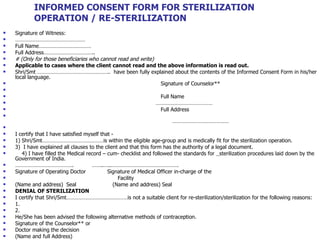
INFORMED CONSENT FORM FOR STERILIZATION OPERATION / RE-STERILIZATION Signature of Witness:  ………………………………………… Full Name……………………………… Full Address…………………………….. # (Only for those beneficiaries who cannot read and write)  Applicable to cases where the client cannot read and the above information is read out. Shri/Smt …………………………………………..  have been fully explained about the contents of the Informed Consent Form in his/her local language. Signature of Counselor** Full Name  ………………………………… Full Address ………………………………… I certify that I have satisfied myself that - 1) Shri/Smt……………………………………is within the eligible age-group and is medically fit for the sterilization operation.  3)  I have explained all clauses to the client and that this form has the authority of a legal document. 4) I have filled the Medical record – cum- checklist and followed the standards for  sterilization procedures laid down by the Government of India.  ………………………………… .  ……..…..………………………………………. Signature of Operating Doctor  Signature of Medical Officer in-charge of the  Facility  (Name and address)  Seal  (Name and address) Seal DENIAL OF STERILIZATION I certify that Shri/Smt……………………………………is not a suitable client for re-sterilization/sterilization for the following reasons: 1. 2. He/She has been advised the following alternative methods of contraception. Signature of the Counselor** or Doctor making the decision (Name and full Address)
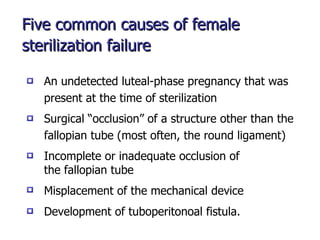
Five common causes of female sterilization failure   Surgical “occlusion” of a structure other than the  fallopian tube (most often, the round ligament) An undetected luteal-phase pregnancy that was  present at the time of sterilization Incomplete or inadequate occlusion of the fallopian tube Misplacement of the mechanical device Development of tuboperitonoal fistula.
Male Sterilisation OR Vasectomy A safe & Effective Method of Contraception
Source: Family Planning: A Global Handbook for Providers, WHO, 2007
Methods of Male Sterilisation Conventional Vasectomy No-Scalpel Vasectomy (NSV) Only three instruments used No incision and stitch Less pain and Bruising & Quick Recovery Fewer infections and hematoma No residual pain – perivasal anaesthesia
Case Selection   (Self- declaration by the client will be the basis for this information) Clients should be ever-married. Male clients should ideally be below the age of 60 years The couple should have at least one child whose age is above one year unless the sterilization is medically indicated. Clients or their spouses must not have undergone sterilization in the past (not applicable in the cases of failure of previous sterilization). Clients must be in a sound state of mind so as to understand the full implications of sterilization. Mentally ill clients must be certified by a psychiatrist and consent should be given by a legal guardian/spouse.
Medical Eligibility Most men who want vasectomy can have safe and effective procedures in routine settings.  Most men can have vasectomy This includes men of any age who are HIV positive or at high risk of HIV or other STIs  have sickle cell disease or hereditary anaemia;  have no children
Medical Eligibility Active sexually transmitted infection If he has the following, DELAY vasectomy and refer  for treatment  Scrotal skin infection or mass in the scrotum Acute systemic infection or significant gastroenteritis Inflamed (swollen and tender) tip of penis, ducts  or testicles
If he has any of the following, REFER him to a center with experienced staff and equipment that can handle potential problems: Hernia in the groin (can perform vasectomy at the  same time as repairing hernia. If this is not possible,  the hernia should be repaired first) Filariasis or elephantitis Undescended testicles - both sides Current-AIDS related illness Coagulation disorders
If he has any of the following, use CAUTION  Large varicocoel or hydrocoele (swollen veins or  membranes in the spermatic cord or testes, causing  swollen scrotum)   Previous scrotal surgery or injury   Undescended testicles – one side only (vasectomy is  performed on the normal side only. Then if any sperm remains in the semen after 3 months, the other side  must be done, too)  Diabetes
Having a vasectomy Counseling   Requirement of safe procedure: Informed consent   Infection prevention   Client assessment   Anaesthesia   Instructions to client
Counseling to ensure Informed   Choice & Informed Consent are similar to Female Sterilisation
GoI: Program, Guidelines and Standards in Sterilisation Services
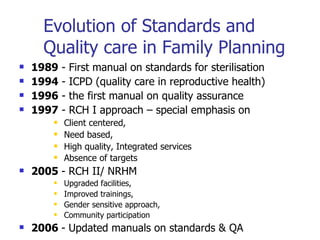
Evolution of Standards and Quality care in Family Planning  1989  - First manual on standards for sterilisation 1994  - ICPD (quality care in reproductive health) 1996  - the first manual on quality assurance 1997  - RCH I approach – special emphasis on  Client centered,  Need based,  High quality, Integrated services  Absence of targets   2005  - RCH II/ NRHM Upgraded facilities,  Improved trainings,  Gender sensitive approach,  Community participation   2006  - Updated manuals on standards & QA
Reasons for concern on quality Standards and guidelines: Not followed QACs: Non-functional PIL against GOI and States - on quality in sterilisation services in public sector Supreme court directives for stringently following standards laid down by GOI
Observations of the Supreme Court Lack of uniformity in sterilzation procedures No norms followed for ensuring GOI guidelines Poor documentation Forms & formats (consent form) varying Near absence of QACs
Supreme court directives on sterilisations GOI level Eligibility criteria for service providers Bring in an insurance scheme Ensure uniform standards for sterilization in the country as laid down by the GOI State level States to constitute QACs at state and district levels  Empanelment  of service providers as per laid down standards Check list to be filled by providers before surgery Consent to be taken before surgery Maintenance of records and publishing reports quarterly
What are Standards Established by authority/custom Measure for judging, comparing or serving  as an example Professionally agreed levels Broad descriptive statements
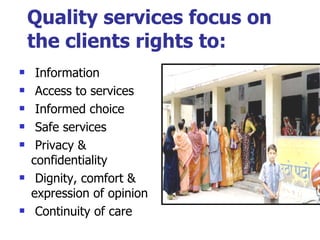
Quality services focus on the clients rights to: Information Access to services Informed choice Safe services Privacy & confidentiality Dignity, comfort & expression of opinion Continuity of care
Purposes of Standards Evaluate  quality  of care Compare and Improve existing practices Guidelines for practice & criteria for evaluation Assist employers to know expectation of  employees To improve documentation
Purposes of Standards (contd) Provide legal protection to healthcare practitioners. To inform society of the concern of healthcare professionals for improvement of patient care practices To assist public to understand the expectation from healthcare provider
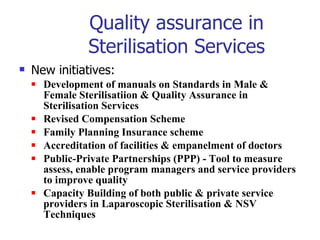
Quality assurance in Sterilisation Services New initiatives:  Development of manuals on Standards in Male & Female Sterilisatiion & Quality Assurance in Sterilisation Services Revised Compensation Scheme Family Planning Insurance scheme  Accreditation of facilities & empanelment of doctors Public-Private Partnerships (PPP) - Tool to measure assess, enable program managers and service providers to improve quality Capacity Building of both public & private service providers in Laparoscopic Sterilisation & NSV Techniques
 
Broad guidelines in Quality Assurance Manual (1996) Setting up Quality assurance committees at State and district levels Tools developed for assessing quality of care Tools for medical audits including death audits  for mishaps following sterilisation
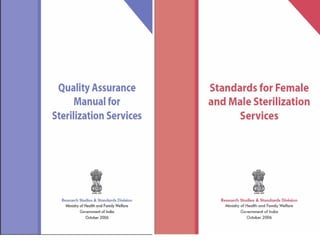
Standards for Female & Male Sterilization Contents Eligibility of service providers for performing sterilization procedure Providers Skill & Competency\ Physical Requirements Selection of Clients (elligibility criteria) IP set up
Eligibility of Providers for Performing Female Sterilization   MINILAP services -- MBBS medical officers Trained & Certified in MINILAP Laparoscopic Sterilisation  --DGO,  -- MD (OBGY)    -- MS (Surgery)  Trained & Certified in Laparoscopic Sterilisation
Eligibility of Providers   for Performing Male Sterilization Conventional Vasectomy  Trained & Certified MBBS doctor No Scalpel Vasectomy (NSV)  Trained & Certified MBBS doctor
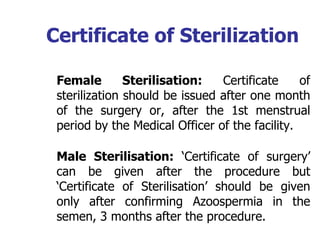
Certificate of Sterilization   Female Sterilisation:  Certificate of sterilization should be issued after one month of the surgery or, after the 1st menstrual period by the Medical Officer of the facility.  Male Sterilisation:  ‘Certificate of surgery’ can be given after the procedure but ‘Certificate of Sterilisation’ should be given only after confirming Azoospermia in the semen, 3 months after the procedure.
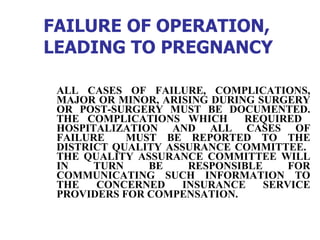
FAILURE OF OPERATION, LEADING TO PREGNANCY   ALL CASES OF FAILURE, COMPLICATIONS, MAJOR OR MINOR, ARISING DURING SURGERY OR POST-SURGERY MUST BE DOCUMENTED. THE COMPLICATIONS WHICH  REQUIRED  HOSPITALIZATION AND ALL CASES OF FAILURE  MUST BE REPORTED TO THE DISTRICT QUALITY ASSURANCE COMMITTEE.  THE QUALITY ASSURANCE COMMITTEE WILL IN TURN BE RESPONSIBLE FOR COMMUNICATING SUCH INFORMATION TO THE CONCERNED INSURANCE SERVICE PROVIDERS FOR COMPENSATION.
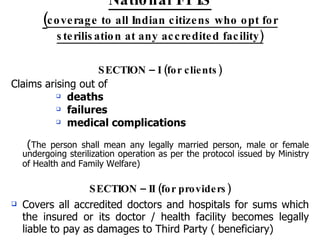
National FPIS ( coverage to all Indian citizens who opt for sterilisation at any accredited facility) SECTION – I (for clients) Claims arising out of  deaths failures medical complications ( The person shall mean any legally married person, male or female undergoing sterilization operation as per the protocol issued by Ministry of Health and Family Welfare)   SECTION – II (for providers) Covers all accredited doctors and hospitals for sums which the insured or its doctor / health facility becomes legally liable to pay as damages to Third Party ( beneficiary)
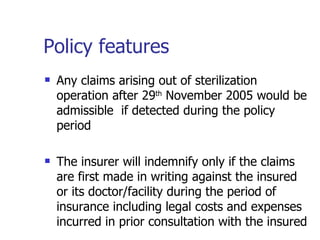
Policy features Any claims arising out of sterilization operation after 29 th  November 2005 would be admissible  if detected during the policy period The insurer will indemnify only if the claims are first made in writing against the insured or its doctor/facility during the period of insurance including legal costs and expenses incurred in prior consultation with the insured
CLAIM PROCEDURE Eligibility for Claim Section1 It would be mandatory that before going through Sterilization Operation, the person concerned (applicant) must fill and submit ‘Application for sterilization operation and consent form’.  This shall also facilitate nomination in case of unfortunate event of death  Section 2 All Govt. Institutions-central, state, local govt, public sectors, accredited private centres/doctors The doctors should have been empanelled by the state as per qualification requirement
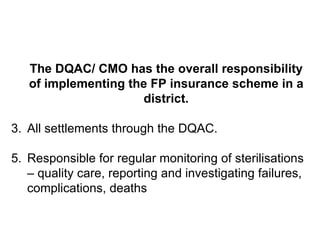
The DQAC/ CMO has the overall responsibility of implementing the FP insurance scheme in a district. All settlements through the DQAC. Responsible for regular monitoring of sterilisations – quality care, reporting and investigating failures, complications, deaths
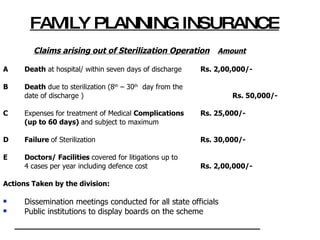
FAMILY PLANNING INSURANCE Claims arising out of Sterilization Operation   Amount A Death  at hospital/ within seven days of discharge    Rs. 2,00,000/- B Death  due to sterilization (8 th  – 30 th   day from the  date of discharge )    Rs. 50,000/- C Expenses for treatment of Medical  Complications   Rs. 25,000/- (up to 60 days)  and subject to maximum D Failure  of Sterilization    Rs. 30,000/- E Doctors/ Facilities  covered for litigations up to 4 cases per year including defence cost   Rs. 2,00,000/-  Actions Taken by the division: Dissemination meetings conducted for all state officials Public institutions to display boards on the scheme _________________________
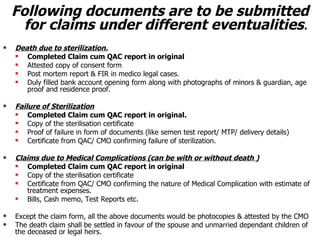
Following documents are to be submitted for claims under different eventualities . Death due to sterilization. Completed Claim cum QAC report in original Attested copy of consent form Post mortem report & FIR in medico legal cases. Duly filled bank account opening form along with photographs of minors & guardian, age proof and residence proof. Failure of Sterilization Completed Claim cum QAC report in original. Copy of the sterilisation certificate Proof of failure in form of documents (like semen test report/ MTP/ delivery details) Certificate from QAC/ CMO confirming failure of sterilization. Claims due to Medical Complications (can be with or without death ) Completed Claim cum QAC report in original Copy of the sterilisation certificate Certificate from QAC/ CMO confirming the nature of Medical Complication with estimate of treatment expenses. Bills, Cash memo, Test Reports etc. Except the claim form, all the above documents would be photocopies & attested by the CMO The death claim shall be settled in favour of the spouse and unmarried dependant children of the deceased or legal heirs.
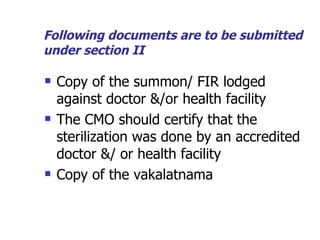
Following documents are to be submitted under section II Copy of the summon/ FIR lodged against doctor &/or health facility The CMO should certify that the sterilization was done by an accredited doctor &/ or health facility Copy of the vakalatnama
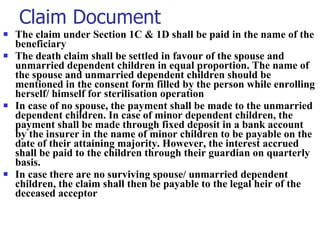
Claim Document The claim under Section 1C & 1D shall be paid in the name of the beneficiary The death claim shall be settled in favour of the spouse and unmarried dependent children in equal proportion. The name of the spouse and unmarried dependent children should be mentioned in the consent form filled by the person while enrolling herself/ himself for sterilisation operation In case of no spouse, the payment shall be made to the unmarried dependent children. In case of minor dependent children, the payment shall be made through fixed deposit in a bank account by the insurer in the name of minor children to be payable on the date of their attaining majority. However, the interest accrued shall be paid to the children through their guardian on quarterly basis. In case there are no surviving spouse/ unmarried dependent children, the claim shall then be payable to the legal heir of the deceased acceptor
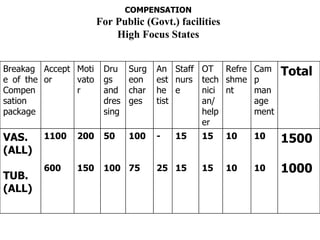
COMPENSATION For Public (Govt.) facilities High Focus States Breakage of the Compensation package Acceptor Motivator Drugs and dressing Surgeon charges Anesthetist Staff nurse OT technician/helper Refreshment Camp management Total VAS. (ALL) TUB. (ALL) 1100 600 200 150 50 100 100 75 - 25 15 15 15 15 10 10 10 10 1500 1000
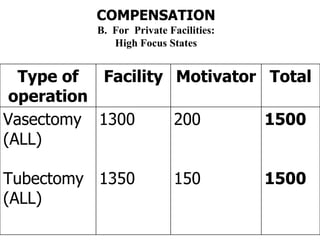
COMPENSATION B.  For  Private Facilities: High Focus States Type of operation Facility Motivator Total Vasectomy  (ALL) Tubectomy  (ALL) 1300 1350 200 150 1500 1500
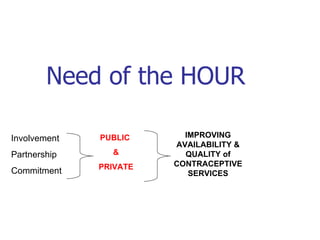
Need of the HOUR Involvement Partnership Commitment IMPROVING AVAILABILITY & QUALITY of CONTRACEPTIVE SERVICES PUBLIC  & PRIVATE
Orientation on safe abortion for private providers Dr. Dinesh Agarwal NPO(RH), UNFPA
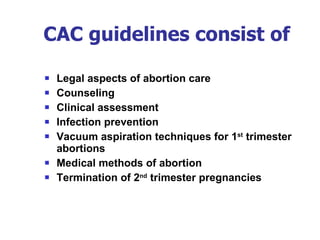
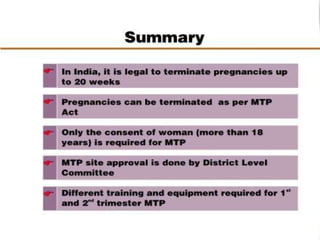
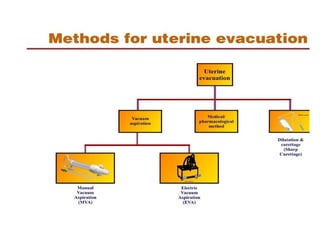
CAC guidelines consist of Legal aspects of abortion care Counseling Clinical assessment Infection prevention Vacuum aspiration techniques for 1 st  trimester abortions Medical methods of abortion Termination of 2 nd  trimester pregnancies
Legal Aspects of Abortion Care


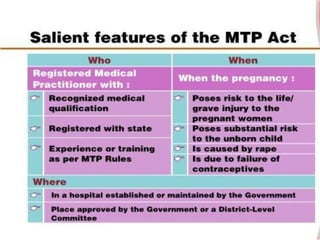
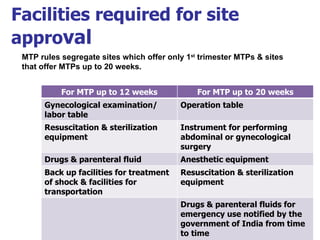
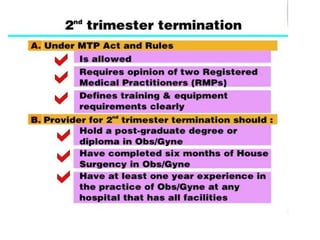
Facilities required for site appro val  MTP rules segregate sites which offer only 1 st  trimester MTPs & sites that offer MTPs up to 20 weeks.  For MTP up to 12 weeks For MTP up to 20 weeks Gynecological examination/ labor table Operation table Resuscitation & sterilization equipment Instrument for performing abdominal or gynecological surgery Drugs & parenteral fluid Anesthetic equipment Back up facilities for treatment of shock & facilities for transportation Resuscitation & sterilization equipment Drugs & parenteral fluids for emergency use notified by the government of India from time to time
 
 
Counselling


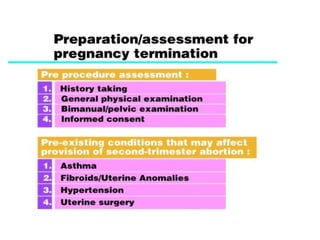
Clinical Assessment


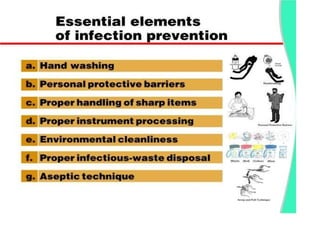
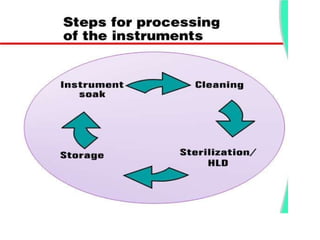
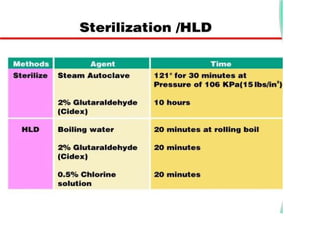
Infection Prevention


Vacuum Aspiration Techniques for 1 st  trimester MTP


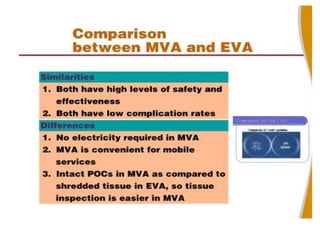
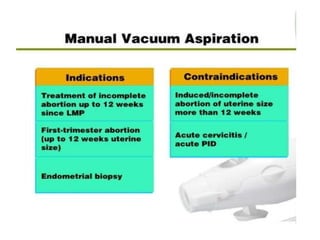
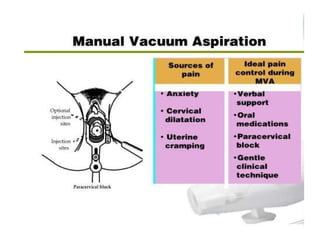
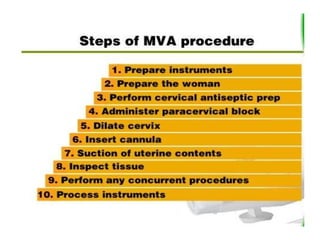
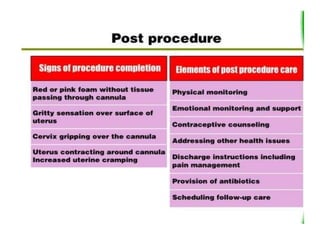
Manual Vacuum Aspiration


Medical Methods of Abortion (MMA)
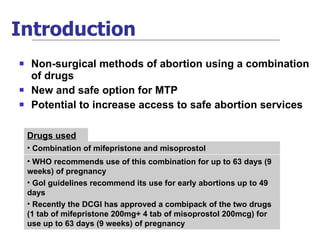
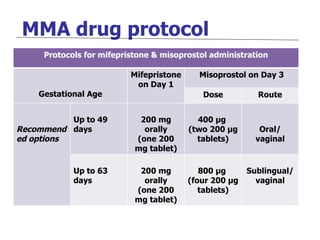
Introduction Non-surgical methods of abortion using a combination of drugs New and safe option for MTP Potential to increase access to safe abortion services Drugs used Combination of mifepristone and misoprostol WHO recommends use of this combination for up to 63 days (9 weeks) of pregnancy GoI guidelines recommend its use for early abortions up to 49 days  (7 weeks) Recently the DCGI has approved a combipack of the two drugs (1 tab of mifepristone 200mg+ 4 tab of misoprostol 200mcg) for use up to 63 days (9 weeks) of pregnancy
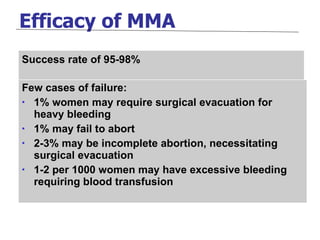
Efficacy of MMA Few cases of failure: 1% women may require surgical evacuation for heavy bleeding 1% may fail to abort 2-3% may be incomplete abortion, necessitating surgical evacuation 1-2 per 1000 women may have excessive bleeding requiring blood transfusion Success rate of 95-98%
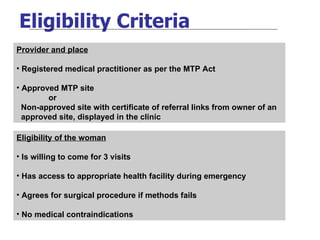
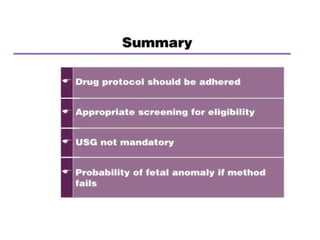
Eligibility Criteria Provider and place Registered medical practitioner as per the MTP Act Approved MTP site or Non-approved site with certificate of referral links from owner of an  approved site, displayed in the clinic  Eligibility of the woman Is willing to come for 3 visits Has access to appropriate health facility during emergency Agrees for surgical procedure if methods fails No medical contraindications
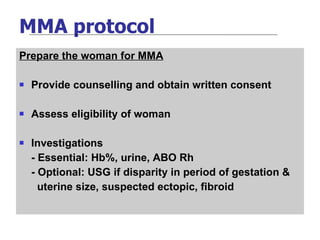
MMA protocol Prepare the woman for MMA Provide counselling and obtain written consent Assess eligibility of woman Investigations - Essential: Hb%, urine, ABO Rh - Optional: USG if disparity in period of gestation &  uterine size, suspected ectopic, fibroid
MMA drug protocol Protocols for mifepristone & misoprostol administration Gestational Age Mifepristone on Day 1 Misoprostol on Day 3 Dose Route Recommended options Up to 49 days 200 mg orally (one 200 mg tablet) 400  μ g  (two 200  μ g tablets) Oral/ vaginal Up to 63 days 200 mg orally (one 200 mg tablet) 800  μ g  (four 200  μ g tablets) Sublingual/ vaginal
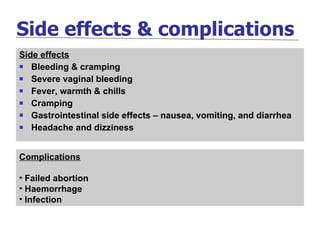
Side effects & complications Side effects Bleeding & cramping Severe vaginal bleeding Fever, warmth & chills Cramping Gastrointestinal side effects – nausea, vomiting, and diarrhea Headache and dizziness Complications Failed abortion Haemorrhage Infection
 
Methods of 2 nd  Trimester Abortion
 
 
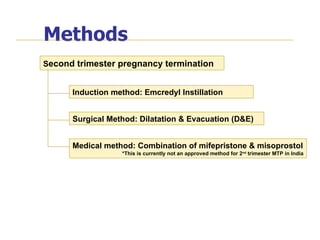
Methods  S econd trimester pregnancy termination Induction method: Emcredyl Instillation Surgical Method: Dilatation & Evacuation (D&E) Medical method: Combination of mifepristone & misoprostol *This is currently not an approved method for 2 nd  trimester MTP in India


CONTRACEPTION

  • 1.
    Family planning :CurrentContraceptive Scenario in India IMA DISTRICT LEVEL WORKSHOP ON CONTRACEPTIVE UPDATES & SAFE ABORTION TECHNIQUES
  • 2.
    Contraceptive Updates Seminar,October 2005 Source: NFHS-3 (2005-06) Percentage use of contraception by married Women (15-49) – Total urban rural N
  • 3.
    Knowledge among eligiblepopulation (%) Contraceptive method Ever use (%) Current use (%) Contraceptive Scenario in India Any method 99 55.1 48.2 For all modern methods 98.9 49.3 42.8 Combined Oral pills 79.5 8.4 2.1 IUDs 70.6 5.6 1.6 Condoms 71 7.9 3.1 Female sterilization 98.2 34.2 34.2 Male Sterilization 89.3 2 1.9 Natural methods 48.9 11.8 5
  • 4.
    Total Fertility RateThe total fertility rate (TFR, sometimes also called the fertility rate, period total fertility rate (PTFR) or total period fertility rate (TPFR)) of a population is the average number of children that would be born to a woman over her lifetime if (1) she were to experience the exact current age-specific fertility rates (ASFRs) through her lifetime, and (2) she were to survive from birth through the end of her reproductive life. It is obtained by summing the single-year age-specific rates at a given time. Contraceptive Updates Seminar, October 2005
  • 5.
    Trends in ContraceptiveUse by Method Percent of currently married women age 15-49
  • 6.
    Unmet need forFP Currently married women not using contraception but who Do not want any more children or Want to wait for two or more years before having another child are defined as having an unmet need for family planning
  • 7.
    Not using contraceptionPregnant or amenorrhoeic Not pregnant or amenorrhoeic Pregnancy intended Pregnancy mistimed Need for spacing Need for limiting Fecund In fecund Want later Want no more Want soon Need for spacing Need for limiting Total Unmet Need Pregnancy unwanted
  • 8.
    Knowledge gaps; fearof side effects Limited access to, and availability of, services Poor quality of services Barriers in meeting contraceptive needs
  • 9.
    Knowledge Gaps Counselling:Key element for ensuring informed choice, correct and consistent use and continuation of method; Understanding relative effectiveness of the method; Correct use of the method; how it works; Common side-effects; health risks and benefits of the method; signs and symptoms that would necessitate a return to the clinic; Information on return to fertility after discontinuing method use; and information on STI protection . Contraceptive Updates Seminar December 2004
  • 10.
    Access and Qualityof Services Skilled providers are key to increase access for contraceptives Providers Skilled in Clinical procedures as per the guidelines Counseling- General and method specific Follow up actions Management of side effects Ctd…….. Contraceptive Updates Seminar December 2004
  • 11.
    Access and Qualityof Services Physical infrastructure and supplies Site readiness as per prescribed norms Equipments Consistent and quality supplies Availability of educational materials for prospective and current users Contraceptive Updates Seminar December 2004
  • 12.
    Clients with specialneeds Adolescents Are eligible to use any method of contraception and must have access to a variety of contraceptive choices Many of the same issues regarding appropriate contraceptive use that apply to older clients apply to young people Social and behavioral issues important considerations in the choice and use of contraceptives. Expanding the method choices can lead to improved satisfaction, increased acceptance and increased prevalence of contraceptive use. Proper education and counseling both before and at the time of method selection Contraceptive Updates Seminar December 2004
  • 13.
    Clients with specialneeds Additional consideration for individuals with a physical disability, mental disability or with serious psychiatric disease The reproductive rights of the individual must be considered in any such decisions Clients with mental disabilities may have difficulty remembering to take pills daily. Clients with physical disabilities may have difficulty obtaining supplies or otherwise accessing the family planning services Contraceptive Updates Seminar December 2004
  • 14.
    Need for SpacingMethods WE NEED SPACING METHODS FOR SAVING LIVES AS WELL AS POPULATION STABILIZATION FOR A QUALITY LIFE. Birth interval is strongly associated with child mortality. A child born <1- ½ year after the previous sibling will have 3 TIMES THE CHANCE OF DYING than after a 3 years spacing interval
  • 15.
    Spacing Methods forContraception Barrier Contraceptives: Male Condoms Female Condoms Natural Contraceptives: LAM SDM Oral Contraceptives Injectable Contraceptives Intra Uterine Contraceptive Devices (IUCDs)
  • 16.
    Male condom BarrierContraceptive Condom is a sheath made of latex rubber to fit over a man’s erect penis. Condoms are available in different sizes, shapes, colors and textures. Some condoms are coated with a lubricant or with spermicide Barrier Contraceptive
  • 17.
    Condoms help inpreventing pregnancy as well as spread of sexually transmitted infections If used correctly, they prevent sperms and ST infections entering the vagina or organisms from vagina entering the penis. With typical use; 14 pregnancies per 100 women in the first year of use. With correct and consistent use every time; 3 pregnancies per 100 women in the first year of use. How do condoms work?
  • 18.
    Prevent pregnancy aswell as STIs including HIV. Enables a man to take responsibility of preventing pregnancy and disease. Can be used by men of any age Easily available . Safe, no hormonal side effects. Easy to keep at hand in case of unexpected sex. Can be stopped at any time. Can be used without seeing a healthcare provider first. Often help to prevent premature ejaculation (help man last longer during sex). Advantages
  • 19.
    Latex condoms maycause itching for a few people who are allergic to latex. Also, some people may be allergic to lubricant on some brands of condoms. May decrease sensation, making sex less enjoyable for either partner. Couple must take the time to put the condom on the erect penis before sex. Supply must be ready even if the man or woman is not expecting to have sex. Small possibility that condom might slip off or break during sexual intercourse. If not properly stored, the condoms can go weak and break or if used with oil-based lubricants. Disadvantages
  • 20.
    Only one conditionprevents use of condoms—severe allergy to latex rubber (severe redness, itching, swelling after condom use). If the client is at risk of STIs or HIV, she/he should continue to use condoms during sexual intercourse despite the allergy. In general, anyone can use condom safely and effectively if not allergic to latex. Medical Eligibility
  • 21.
    Do not usea condom more than once. Put the condom on erect penis before penis touches the vagina: Hold the pack at its edge and open by tearing from a ribbed edge. Hold the condom so that the rolled rim is facing up, away from penis. Place the condom on the tip of penis. Unroll the condom all the way to the base of the penis. The condom should unroll easily. If it does not, it is probably backwards. If more condoms are available, throw this one away and use a new condom . Give specific instructions
  • 22.
    Most of thecondoms are already lubricated; hence there is no need to apply any additional lubricant. This may damage the condom. Now they can have sexual intercourse. After the sexual intercourse (ejaculation), hold the rim of the condom to the base of the penis so it will not slip. The man should pull his penis out of the vagina before completely loosing his erection. Move away from vagina and take off the condom without soiling semen on the vaginal opening. Tie a knot at the rim of the condom. Dispose it off by burying or burning it. Do not leave it where children will find it. Do not use a condom more than once. Give specific instructions contd..
  • 23.
    Immediately insert aspermicidal into the vagina, if spermicidal is not available. If not, washing both, penis and vagina with soap and water should reduce the risk of STIs and pregnancy. Some clients may want to use emergency oral contraception to prevent pregnancy. If the condom breaks
  • 24.
    Urge clients toreturn to a health care provider, if they or their sex partners : Have symptoms of STIs such as sores on the genitals, pain when urinating or a discharge. Have an allergic reaction to condoms (itching, rash, irritation). Specific reason to see a health care provider
  • 25.
    The Female Condom(FC) is a viable option for women to protect themselves from pregnancy and STIs including HIV. FC is a thin, soft, loose-fitting polyurethane plastic pouch like device that lines the vagina. It has two flexible rings, an inner ring at the closed end, used to insert the device inside the vagina and hold it in place, and an outer ring which remains outside the vagina and covers the external genitalia. The device being made of polyurethane can be used with any type of lubricant without compromising its integrity. This is advantageous in countries where water-based lubricants are hard to find. FEMALE CONDOM
  • 26.
    Product Characteristics Polyurethane sheet measuring 17x7.8 cm Forms strong soft transparent sheath that lines the vagina to create a barrier against sperm and sexually transmitted infections Small ring at closed end is used for insertion and to help maintain the device at the upper end of the vagina Non biodegradable disposal device
  • 27.
    Female Condom inPlace Inner ring Outer ring Plastic sheath with ring at both ends How to grasp female condom for insertion
  • 28.
    Key lessons learntFC is not just a product, it needs to be an overall programme Integration into existing strategies and approaches Interaction between user and outreach worker and service provider critical for acceptance Interpersonal communication backed up with regular demonstration Leadership affects acceptability Not an issue of demand or use; but cost and access
  • 29.
    Effectiveness in pregnancyand disease prevention Contraceptive effectiveness and disease prevention rates seem comparable to those for male condoms 6 months failure rate 0.8% in Japan to 9.5% in Three Latin American sites Estimated annual accidental pregnancy rates for consistent and correct use Female condom 5%; Male Latex condom 3%; Diaphragm 6%; Spermicides 6% WHO Study to compare efficacy is under way Polyurethane is impermeable to small viruses e.g.., CMV, Herpes, Hepatitis B and HIV
  • 30.
    Acceptability The femalecondom has been found to have acceptability among both men and women. Studies in numerous countries and in many different settings show that on an average 50-70 % of male and female participants found the female condom to be acceptable. Source: The Female Condom. A Guide for Planning and Programming. WHO and UNAIDS. 2000
  • 31.
    Safety Female condomis both strong and durable. No special storage arrangements have to be made because the polyurethane is not affected by changes in temperature and humidity. Research confirms that the female condom does not have any serious side effects. It does not alter the vaginal flora or cause significant skin irritation, allergic reaction or vaginal trauma. Source: The Female Condom. A Guide for Planning and Programming. WHO and UNAIDS. 2000
  • 32.
    Advantages Female-controlled No medical condition appear to limit use. More comfortable to men, less decrease in sensation than male latex condoms. As a result, sensitivity of male partner may not be substantially reduced. It also offers ease of use by men with erectile dysfunction.
  • 33.
    Advantages Contd… Offer greater protection as it covers both internal and external genitalia. Stronger (polyurethane is 40% more stronger than latex) therefore less frequent breakage (1% compared to 4% for male condoms) Longer shelf-life even under unfavorable storage conditions. CSWs found that female condom allowed them to continue their job without interruption during menstruation (study fro Guatemala and Mexico
  • 34.
    Disadvantages Not aesthetically pleasing. The coverage of the female external genitalia had a decidedly negative impact on the device’s aesthetics and acceptance. Some women experience difficulties in insertion and removal Expensive than male condoms.
  • 35.
    How to use? Some time before the sex, the woman places the closed end of the female condom high in her vagina. The closed end contains a flexible, removable ring to help with insertion. A large flexible ring around the open end of the condom stays outside covering external genitalia.
  • 36.
    Effectiveness Pregnancies per100 women in the first year of the use- as commonly used 21. If used correctly and consistently-5.
  • 37.
    Lactational Amenorrhea Method(LAM) LAM is the use of breastfeeding as a spacing method. LAM provides natural protection against pregnancy and encourages using other method at the proper time. Stops ovulation (release of eggs from ovaries) as it changes the rate of release of natural hormones. Effective as commonly used: 2 pregnancies per 100 women in the first 6 months after childbirth. When used correctly and consistently: 0.5 pregnancies per 100 women in the first 6 months after childbirth.
  • 38.
    Correct and consistentuse means: Her baby is less than 6 months (she has given childbirth within last 6 months) After last childbirth her menstrual period has not returned She is fully breastfeeding—day and night, (at least 8-10 times a day, at least once in 4 hours) and at least once in night (night feeding regularly not more than 6 hours apart) and at least 85% of her baby’s feedings should be breastfeed.
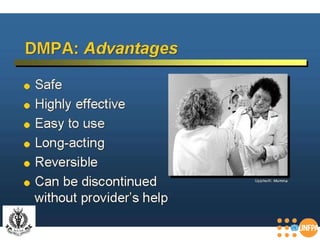
  • 39.
    Advantages of LAM Can be used immediately after childbirth Encourages the best breastfeeding patterns Effectively prevents pregnancy at least 6 months and may be longer if a woman keeps breastfeeding often, day and night. No direct cost .No supplies or procedure required to prevent pregnancy. No hormonal side effects. No need to do anything at the time of sexual inter course
  • 40.
    Advantages of LAMCounseling on LAM encourages starting a follow on method at the proper time. Breastfeeding practices required by LAM have other health benefits for mother and baby Provides the healthiest food for baby Protects the baby from life-threatening diarrhea. Helps protect the baby from diseases like measles and pneumonia by passing mother’s immunities to baby. Help develop close bondage between mother and baby .
  • 41.
    Disadvantages Effectivenessafter 6 months is not certain Frequent breastfeeding may be inconvenient or difficult for some women, especially working mothers No protection against STIs including HIV If the mother has HIV, there is a small chance that breast milk will pass HIV to the baby.
  • 42.
    Medical Eligibility Most women CAN use LAM safely and effectively A woman can use LAM after childbirth, if : Her baby is less than 6 months (she has given childbirth within last 6 months) After last childbirth her menstrual period has not returned She is fully breastfeeding—day and night, (at least 8-10 times a day, at least once in 4 hours) and at least once in night (night feeding regularly not more than 6 hours apart) and at least 85% of her baby’s feedings should be breastfeed.
  • 43.
    Explaining how touse Breastfeed often: An ideal pattern is at least 8-10 times a day including at least once at night. Breastfeed properly: Counsel her on breastfeeding technique and diet Start other foods when baby is 6 months old. Breastfeed before giving other food, if possible.
  • 44.
    Start another familyplanning method when: Her menstrual period return (bleeding in the first 56 days, or 8 weeks, after childbirth is not considered menstrual bleeding) OR She stops fully or nearly fully breastfeeding. OR Her baby is 6 months old (about the time when baby starts sitting up) OR She no longer wants to rely on LAM for family planning
  • 45.
    Standard Day MethodFertility Awareness Based Method
  • 46.
    Introduction The standarddays method (SDM) is a new natural family planning method for women with menstrual cycles ranging between 26 and 32 days. This method involves identifying the fertile days during each menstrual cycle.
  • 47.
    Introduction Women withmenstrual cycles ranging between 26 and 32 days can prevent pregnancy by avoiding unprotected sexual intercourse on days 8 through 19. Most women using the SDM use a device called Cycle Beads—a string of color-coded beads that help women identify the days of their cycles when they can become pregnant and the days when pregnancy is very unlikely.
  • 48.
  • 49.
  • 50.
  • 51.
  • 52.
  • 53.
  • 54.
  • 55.
    SDM instructions: Onthe day that your menstrual period starts, hold the Cycle Beads and move the rubber ring onto the first red bead. Each day, move the rubber ring onto the next bead, moving in the direction of the arrow. Avoid sexual intercourse or unprotected sexual intercourse on the days when the rubber ring is on any of the white beads.
  • 56.
    Return if,: Youare not happy with the method. You think you are pregnant. You want information about or want to start using another family planning method. You think there is any chance you may have been exposed to HIV infection or any other sexually transmitted infection (STI)
  • 57.
    Oral Contraceptives andEmergency Contraceptive Pills Contraceptive Updates Seminar, October 2005
  • 58.
    Types Contraceptive UpdatesSeminar, October 2005 Progesterone-Only oral contraceptive pills Combined oral contraceptives Monophasic: Standard dose, low dose and very low dose pills Multiphasic: Biphasic, Triphasic pills
  • 59.
    Combined Oral Contraceptivepills Contraceptive Updates Seminar, October 2005 Alteration of endometrium to make it unsuitable for implantation even if the ovum is fertilized. Mechanism of action: Changes in cervical mucous which make it hostile for sperms Inhibition of ovulation by suppressing FHS and LH
  • 60.
    Effectiveness Contraceptive UpdatesSeminar, October 2005 Failure rate is 0.3% as commonly used and only 0.1% on correct and consistent use. 99.97% to 99.99%.
  • 61.
    Health Benefits ContraceptiveUpdates Seminar, October 2005 Fertility related benefits Prevention of pregnancy Offers protection against ectopic pregnancy Menstrual benefits Menstrual cycle stabilization Reduced iron deficiency anaemia due to lighter menstrual cycles More regular menstrual cycles Less dysmenorrhea Less severe pre-menstrual symptoms
  • 62.
    Health Benefits ContraceptiveUpdates Seminar, October 2005 Protection from some cancers e.g. endometrial and ovarian cancer Protection against benign diseases e.g. benign breast diseases like fibrocystic and fibroadenomatosis disease decreased by 50-70% Other possible health benefits Protection against pelvic inflammatory diseases Reduces risk of follicular cyst by 50% and corpus luteal cyst by 80%. Past contraceptive use protects women after they reach menopause; reduced risk of low bone mineral density was documented Reduction in acne
  • 63.
    Side effects ContraceptiveUpdates Seminar, October 2005 Breakthrough bleeding-common with low dose progesterone pills due to low or absent estrogen. Nausea, vomiting, decreased appetite; usually pass off after 2-3 months of use Oligo and ammenorrhoea due to lack of proliferation of endometrium of cycle. Common among women who had menstrual problems before starting oral contraceptive pills.
  • 64.
    Side effects ContraceptiveUpdates Seminar, October 2005 Vaginal discharge due to congestion and hypertrophy of cervical epithelium. Breast changes- oedema, heaviness and tenderness. Chloasma Weight gain in some cases due to estrogen and progesterone . Acne and oily skin.
  • 65.
    ELIGIBILITY CRITERIA: (Forlow dose combined contraceptive pills) Contraceptive Updates Seminar, October 2005 Most women can use Combined Oral Contraceptives. Are of any age, including adolescents and over 40 (except women 35 years or older and who smoke) Smoke cigarettes but are under age 35 Have just had abortion or miscarriage
  • 66.
    ELIGIBILITY CRITERIA: (Forlow dose combined contraceptive pills) Contraceptive Updates Seminar, October 2005 Heavy, painful menstrual periods or iron deficiency anemia (condition may improve) Benign breast disease Diabetes without vascular, kidney, eye or nerve disease Irregular menstrual periods Mild headaches Malaria Varicose veins
  • 67.
    ELIGIBILITY CRITERIA: (Forlow dose combined contraceptive pills) Contraceptive Updates Seminar, October 2005 Thyroid disease Endometriosis Pelvic inflammatory disease Begin ovarian tumour Past ectopic pregnancy Uterine fibroids Tuberculosis (unless taking Rifampicin)
  • 68.
    Who cannot useCOCs? Contraceptive Updates Seminar, October 2005 Fully Breastfeeding within 6 month postpartum; If partially BF she can start after six weeks Are age 35+ and smoke more than 15 cigarettes per day Have multiple risk factors for arterial cardiovascular disease Have hypertension with systolic BP 140-159 and diastolic 90-99 and those having vascular disease. Have clear history of deep vein thrombosis (DVT), pulmonary thrombosis or current DVT or pulmonary thrombosis. Have known thrombogenic mutations. Have current history of ischemic heart disease or known hyperlipidaemias
  • 69.
    Who cannot useCOCs? Contraceptive Updates Seminar, October 2005 Women who have Migraine with aura Current breast cancer Diabetes with neuropathy, retinopathy, nephropathy and other vascular disease Acute hepatitis or severe cirrhosis of liver or benign or malignant liver tumours Complicated pulmonary hypertension, risk of atrial fibrillation, history of subacute bacterial endocarditis
  • 70.
    Important Contraceptive UpdatesSeminar, October 2005 Women having the above health conditions should be encouraged to use other more appropriate contraceptives than COCs.
  • 71.
    When can awoman start COCs? Contraceptive Updates Seminar, October 2005 During a menstrual cycle Amenorrhoea Between 2 menstrual cycles Breastfeeding Switching to another hormonal method Switching from non-hormonal method After miscarriage or abortion Switching from IUD (including hormonal)
  • 72.
    Key steps forproviding COCs Contraceptive Updates Seminar, October 2005 Give pills, 3 months supply if possible. Running out of pills is one of the major reasons for unintended pregnancy. Explain how to use If possible give condoms or spermicide to use: Until she can start taking the pills If she starts packet of pills late, misses pills in row or stops taking pills for any other reason If there is possibility of transmission of STIs/HIV Show her how to use condoms and spermicide. Invite the client to come back any time if she has any questions, problems or wants another method Plan for return visit
  • 73.
    Pills missed? ContraceptiveUpdates Seminar, October 2005 WHAT TO DO IF YOU MISS ONE OR MORE PILLS Every time you miss one or more active pills (days 1-21): In these special cases, ALSO follow these special rules If you miss nay of the 7 inactive pills (in a 28–pill pack only) 1. Take a pill as soon as you remember 1. Take the next pill at the usual time 3. Keep taking active pills as usual, one each day Source: Johns Hopkins University Bloomberg School of Health, Population information program Started pack 2 or more days late? Missed 2–4 pills of first 7 pills days 1–7 Missed 5 or more active pills in a row days 1–7 Missed 2–4 pills of last 7 active pills days 15–21 Avoid sex or another method for 7 days Finish all active pills in the pack. Do not take last 7 (inactive) pills in 28–pill pack. Do not wait 7 days to start next 21– pill pack. Start a new pack. 1. Throw away missed pills 2. Keep taking one pill each day 3. Start new pack as usual
  • 74.
    What to doat follow up visit Contraceptive Updates Seminar, October 2005 Ask if client has any questions or anything to discuss. Ask client about her experience with the method. Give her any information she needs and invite her to return any time for help. If she has problems that cannot be resolved, help her choose another method. Plan for next visit before she will need more pills.
  • 75.
    Emergency Contraceptive Pills(ECPs) Contraceptive Updates Seminar, October 2005 Emergency contraception: Is method of contraception used before missing a period to prevent pregnancy. It is also called “morning after” or post-coital contraception.
  • 76.
    Indications for usingemergency contraception Contraceptive Updates Seminar, October 2005 A woman who had unprotected sex, and wants to prevent pregnancy. For example: She did not expect to have sex and was not using any contraception Sex was forced Condom broke or slipped She ran out of contraceptives, or was irregular in taking pills and did not use condoms or spermicide. She is late for a contraceptive injection.
  • 77.
    What pills canbe used as ECPs? Contraceptive Updates Seminar, October 2005 Progestin-only dedicated products: Levonorgesterol pills are generally used GOI emergency contraceptive pills also available through public systems Several commercial preparations available in market
  • 78.
    Contraceptive Updates Seminar,October 2005 Levonorgesterol alone EC pills- A dedicated product 0.75 mg of tablets Levonorgestel available in India. The current recommendation: 1 pill of LNG 0.75 mg to be taken as soon as possible after unprotected coitus (within 72 hours) followed by another pill 12 hours later. Depending on the composition 1 pill of 1.5mg in a single dose can be taken.
  • 79.
    GOI Guidelines ContraceptiveUpdates Seminar, October 2005 The Government of India guidelines for Emergency Contraception recommend use of Levonorgestrel (progestogen only) LNG as a “dedicated product” for effective emergency contraception. The Drug Controller of India has approved only Levonorgestrel for use as ECP.
  • 80.
    How effective areECPs? Contraceptive Updates Seminar, October 2005 Pregnancy rate 8%, if women have sex once in the second or third week of the menstrual cycle without using contraception. Pregnancy rate 2% if women use combined oral contraceptives for emergency contraception Pregnancy rate 1% if women use progestin-only ECPs
  • 81.
    How do ECPswork? Contraceptive Updates Seminar, October 2005 Probable mechanisms are: Inhibition or delay of ovulation Thickening of cervical mucous Direct inhibition of fertilization Histological and biochemical alteration in endometrium leading to impaired endometrial receptivity to implantation of the fertilized egg Alteration in transport of egg, sperm and embryo Interference with corpus luteum function and luteolysis
  • 82.
    Medical eligibility criteriafor Emergency Oral Contraception Contraceptive Updates Seminar, October 2005 Any woman can use emergency oral contraception if she is not already pregnant within the stipulated time period.
  • 83.
    When should ECPsbe taken Contraceptive Updates Seminar, October 2005 ECPs should be taken as soon as possible after unprotected intercourse. The first dose should be taken within 72 hours after intercourse Question carefully to determine likelihood of pregnancy. If women is pregnant, do not provide Emergency Oral Contraceptives. Provide pills for Emergency Oral Contraception
  • 84.
    Advice on commonproblems Contraceptive Updates Seminar, October 2005 Nausea: Eat something soon after taking the pills to reduce nausea.Take anti-emetic half an hour before taking emergency contraceptive pills and every 4-6 hours thereafter. Vomiting: If the woman vomits within 2 hours of taking the pills, she may take another dose. Otherwise she should not take any extra pills. Extra pills will not make the method more effective, and they may increase nausea. Her next monthly period may start a few days earlier or later than expected. Reassure her that this is not a bad sign.
  • 85.
    Specific reasons toreturn to the healthcare provider Contraceptive Updates Seminar, October 2005 Advise her to return or see another health care provider if her next period is quite different from usual for her, especially if: There is unusually light bleeding (possibly pregnancy) Bleeding does not start within 4 weeks (Possible pregnancy) Unusually painful (possibly ectopic pregnancy). But emergency oral contraception does not cause ectopic pregnancy. If there are symptoms of sexually transmitted diseases.
  • 86.
    Some facts aboutECPs Contraceptive Updates Seminar, October 2005 Will not disrupt an established pregnancy Offer no protection against STIs. Do not provide continuing protection from pregnancy. No medical conditions rule out ECPs.
  • 87.
    Providing ECPs: Keysteps Contraceptive Updates Seminar, October 2005 Help the client feel at ease. Ask when unprotected sex took place. Give the woman pills. Explain how to take them. She can take first dose at once.
  • 88.
    Providing ECPs: Keysteps Contraceptive Updates Seminar, October 2005 Explain and discuss important points about ECPs. Discuss her ongoing need for contraception Tell her that if she vomits within 2 hours of taking pills, she may take another dose.
  • 89.
  • 90.
  • 91.
  • 92.
  • 93.
  • 94.
  • 95.
  • 96.
  • 97.
  • 98.
  • 99.
  • 100.
  • 101.
  • 102.
  • 103.
  • 104.
  • 105.
  • 106.
  • 107.
  • 108.
  • 109.
  • 110.
  • 111.
  • 112.
  • 113.
  • 114.
  • 115.
  • 116.
  • 117.
  • 118.
  • 119.
  • 120.
  • 121.
  • 122.
  • 123.
  • 124.
  • 125.
  • 126.
  • 127.
  • 128.
  • 129.
  • 130.
  • 131.
  • 132.
    In India DMPAcurrently approved and available in 106 countries and NET-EN in over 60 countries. Some social marketing organizations also provide ICs Approved by Drug Controller of India and commercially available.
  • 133.
    Continuation rates withDMPA at the end of one year 50-80%, but as low as 19% in one Indian study Discontinuation due to Continuation rate … Amennorrhoea: additional 11-12% for DMPA, 7-8% for NET-EN Bleeding abnormalities: 10-15% for both DMPA and NET-EN. For monthly injectables, continuation rates range from 66 to 82%. Discontinuation due to Amenorrhoea 2% Bleeding abnormalities 7%
  • 134.
    IUCD Worldwide IUCDUsage Country Any method IUCD Europe 73% 9% North America 75% 2% China 84% 36% Vietnam 79% 38% Cuba 73% 43% Egypt 60% 38% Jordan 56% 24% Korea 80% 13% India 54% 2%
  • 135.
    Types of IUCD1 st Generation : Unmedicated IUCDs 2 nd Generation: Copper- bearing IUDs 3 rd Generation :Hormone releasing IUDs
  • 136.
    Second generation IUDs Second generation IUDs Examples are :CuT-380A, Cu-T 220C, Nova T and Multiload 375 - Are much more effective have less side- effects than unmedicated IUDs - similar in terms of effectiveness, side effects, expulsion, and continuation rates. TCu-380A
  • 137.
    IUCD 380 A: An Excellent Spacing Method • C omparable to Female sterilisation 10 YRS EFFECTIVENESS “ REVERSIBLE STERILIZATION ” Completely reversible Very safe for most women, including postpartum, post abortion, or interval, breastfeeding, young Nulliparous Cochraine Review National F.P. Programme
  • 138.
    Re-emergence of theIUCD Recent research has led to important changes in WHO eligibility criteria Risk of upper genital infections is negligible Despite many misconceptions, IUCD users have higher satisfaction rates than users of many other methods (99% vs 91% for pill users)
  • 139.
    Reasons of Non Acceptance of IUCD Lack / Poor Counseling Poor motivation of Client Poor Selection of Cases Poor insertion technique Poor infection prevention strategies Poor post procedural counseling
  • 140.
    Medical Eligibility Criteriafor Contraception – WHO People specific need Specific medical conditions Expressed desire of women or couple Cafeteria approach Helping to make informed choice Reproductive right of woman Couple / individual specific Contraceptive Prescription
  • 141.
    MEC - WHO Category 1 Lactation amenorrhea (Pregnancy ruled out) Post menstrual, any time in cycle Postpartum > 6 wks Small uterine fibroid or benign ovarian cyst No medical disease Emergency contraception h/o Ectopic Pregnancy Can use IUCD with no Restriction Minimal vaginal discharge History of PID with a subsequent pregnancy Women who have breast disease, including cancer H/o Viral hepatitis, malaria Controlled diabetes, hypertension Women who smoke or obese
  • 142.
    Medical Eligibility criteriaWHO criteria 2 < 20 yrs of age 2 nd trimester abortion (spontaneous or induced) < 48 hours of post-partum Uterine anomaly but no uterine cavity distortion No genital infection but at risk for STIs Physiological Vaginal discharge + Past h/o PID HIV sero-positive but healthy, on ART Complicated heart disease Uterine Prolapse 1 o or 2 o or RVF Can use CuT but additional care needed
  • 143.
    Medical Eligibility criteriaWHO criteria 3 Heavy & prolonged menses Benign Trophoblastic disease At higher risk of STIs AIDS patient not on ART 3 rd degree UT prolapse or VVF Use of CuT not recommended
  • 144.
    Medical Eligibility criteriaWHO criteria 4 Pregnant women Post abortion or Puerperal sepsis Malignant trophoblastic disease Cervical or uterine cancer Gross uterine anomaly or big fibroids Current PID, Pelvic tuberculosis Unexplained vaginal bleeding Should not use IUCD
  • 145.
    WHO Eligibility CriteriaSource : WHO 2004. Category Description When clinical judgment is available When clinical judgment is limited 1 No restriction for use Use the method under any circumstances Use the method 2 Benefits generally outweigh risks Generally use the method 3 Risks generally outweigh benefits Use of method not usually recommended, unless other methods are not available/acceptable Do not use the method 4 Unacceptable health risk Method not to be used
  • 146.
    Counselling Giving need-basedcorrect and useful information. Facilitating the client to make informed decision. Going beyond the presenting condition and symptoms and identifying the non-visible factors.
  • 147.
    Counselor must facilitatethe client to: Choose and use a method. Solve any problems. Get accurate information. Assure the client about privacy and confidentiality.
  • 148.
    GOOD COUNSELOR G-goodtechnical knowledge O-obtains information O-objectively answers D-demonstrates professionalism
  • 149.
    REMEMBER! Counseling does not terminate when the client accepts a method or undergoes the procedure, its process completes when the acceptor returns to the service centre/provider for follow up and goes back home with satisfaction.
  • 150.
    Certain clarification relatedto medical eligibility Postpartum Evidence suggests that there was increase in expulsion rates with delayed postpartum insertion compared to immediate insertion and with immediate postpartum insertion compared to interval insertion. Post abortion insertion No difference in risk of complications for immediate versus delayed insertion of an IUD after abortion Expulsion was greater when an IUD was inserted following a second-trimester abortion
  • 151.
    Vulvular heart diseaseProphylactic antibiotics to prevent endocarditis PID and continuation of IUD To ensure continuation of IUD in cases of PID, Treatment of PID using appropriate antibiotics No need for removal of the IUD if the client wishes to continue to use. Clinical evidences suggest that among IUD users treated for PID, there was no difference in clinical course if the IUD was removed or left in place Certain clarification related to medical eligibility …….
  • 152.
    STI and IUDNo evidence to suggest the increased risk of PID with IUD insertion among women with STI HIV/AIDS • No increased infection risk • IUD use among HIV-infected women was not associated with increased risk of transmission to sexual partner Certain clarification related to medical eligibility ……… ..
  • 153.
    Managing problems PregnancyExclude ectopic pregnancy. Explain the risk of second trimester miscarriage, pre-term delivery and infection if the IUD is left in place.
  • 154.
    What is LNG-20 Consists of plain Nova T device with a silastic reservoir attached to the vertical arm The silastic reservoir is impregnated with levonorgestrel and is covered with a rate-limiting silastic membrane. The release rate of levonorgestrel is approximately 20 micrograms/24 hours for at least 5 years.
  • 155.
    Indications Particularly usefulfor 2 groups of women: Who have been pregnant and do not want to any more children in next few years Age group of 30-40yrs who have completed their families and want a reliable long term method of contraception
  • 156.
    Disadvantages Costlier than copper-bearing IUDs Can cause irregular bleeding or spotting in the first six months of use Not suitable for women who are at risk of sexually transmitted infections or ectopic pregnancy.
  • 157.
    Medical Eligibility Mostof the medical eligibility criteria for copper-bearing IUDs and LNG-20 IUDs are similar; however, due to hormonal nature certain precautions should be taken
  • 158.
    Insertion Technique No-touchtechnique Loading the IUD in the inserter while both parts are still in the sterile package Cleaning the cervix with antiseptic before IUD insertion; Not to touch the vaginal wall or speculum blades with the uterine sound or loaded IUD inserter Passing both, uterine sound and IUD inserter only once through the cervical canal.
  • 159.
    In women with endometriosis Use is associated with decreased dysmenorrhoea and pelvic pain Beneficial in treating menorrhagia in women with heavy or prolonged bleeding Among women with fibroids No adverse health events have been reported There was a decrease in symptoms and size of fibroids for some women Certain clarification related to medical eligibility
  • 160.
    Examination of Clientand Preparation before Insertion 1. Client Counseling: Explain the procedure to the client. This helps the client relax, making insertion easier and less painful. 2. Infection prevention: Use disinfected instruments, sterile hand gloves and clean the area with Betadine. This minimizes the chances of uterine infection. 3. Speculum examination and bimanual pelvic examination : The speculum examination is done to check for signs of genital tract infection. The bimanual examination determines the size, position, consistency, and mobility of the uterus and identifies any tenderness. A retroverted uterus requires special care during insertion. 4. Sounding of the uterus: Should be done slowly and gently to determine its depth and direction. This reduces the risk of perforating the uterus, which usually occurs because the sound is inserted too deeply or at the wrong angle.
  • 161.
    Sounding Length Forguard adjustment
  • 162.
    Preparing the IUDfor insertion
  • 163.
    Opening the PackPartially open the package from the end marked OPEN, approximately halfway to the flange .
  • 164.
    Loading No TouchLoading requires that the loading be done through the protective pack.
  • 165.
    Adjusting Guard TheGuard is being adjusted in the video you see now …
  • 166.
    Peeling the PackAfter adjusting guard, the pack is finally peeled to take out the assembly .
  • 167.
    Taking out theIUD Care must be taken not to touch the IUD.
  • 168.
    Recapitulation of Insertion1. Swab the cervix with antiseptic. Gently introduce the loaded inserter assembly through the cervical canal until the flange comes in contact with the cervix. 3. Hold the plunger stationary and withdraw the insertion tube slightly so as to release the arms of the T. 4. Gently push the insertion tube upwards, towards the top of the uterus until a slight resistance is felt. This ensures that the T is closer to the fundus. 5. Withdraw the plunger while holding the insertion tube stationary. 6. Gently withdraw the insertion tube. 7. Cut the threads so that they protrude only 2-3 centimeters into vagina. Use sharp scissors.
  • 169.
    Swab the cervixwith antiseptic. Gently introduce the loaded inserter assembly through the cervical canal until the flange comes in contact with the cervix.
  • 170.
    Hold the plungerstationary and withdraw the insertion tube so as to release the arms of the T.
  • 171.
    Gently push theinsertion tube upwards, towards the top of the uterus until a slight resistance is felt. This ensures that the T is closer to the fundus.
  • 172.
    Withdraw the plungerwhile holding the insertion tube stationary.
  • 173.
    Gently withdraw theinsertion tube. Cut the threads so that they protrude only 2-3 centimeters into vagina. Use sharp scissors.
  • 174.
    Caution The IUDshould be loaded in to the inserter tube not more than five minutes before insertion.
  • 175.
    Family Planning Permanent Methods: Male & Female Sterilisation Dr. Kiran Ambwani, Deputy Commissioner, Family Planning Divison, MoHFW GOI
  • 176.
    Source: Family Planning:A Global Handbook for Providers, WHO, 2007
  • 177.
    Types of FemaleSterilisation Female Sterilization In: Landry E, ed. Contraceptive Sterilization: Global Issues and Trends. New York: Engender Health; 2002: 139-160 Procedure Timing Technique Minilaparotomy Post Partum Post Abortion Interval Tubal Ligation or Excision Laparoscopy Interval Only Mechanical Devices (Clips, Rings)
  • 178.
    Effectiveness of FemaleSterilisation Within 10 years of the procedure: 1.8 pregnancies per 100 women In the first year after the procedure: 0.5 pregnancies per 100 women. Effectiveness depends partly on how the tubes are blocked, but all pregnancy rates are very low Postpartum tubal ligation In the first year after the procedure - 0.05 pregnancies per 100 women. Within 10 years after the procedure - 0.75 pregnancies per 100 women. Recanalisation surgery is difficult, expensive and has low success rate
  • 179.
    Who can availFemale Sterilisation? Safe for all women No requirement for Husband’s Permission After 21 years of age Who have just given birth (Within 7 days) Who are breast feeding Who are HIV Positive GOI Standards for female and male sterilisation The client should be screened using Medical Eligibility Criteria as enumerated in the “Standards for Female & Male Sterilisation”
  • 180.
    Case Selection (Self- declaration by the client will be the basis for this information) Clients should be ever-married. Female clients should be below the age of 49 years and above 22 years. The couple should have at least one child whose age is above one year unless the sterilization is medically indicated. Clients or their spouses must not have undergone sterilization in the past (not applicable in the cases of failure of previous sterilization). Clients must be in a sound state of mind so as to understand the full implications of sterilization. Mentally ill clients must be certified by a psychiatrist and consent should be given by a legal guardian/spouse of sound state of mind.
  • 181.
    DELAY female sterilizationand treat as appropriate or refer in case of Pregnancy Postpartum or second trimester abortion (7-42 days) Serious postpartum or post-abortion complications Unexplained vaginal bleeding Severe pre-eclampsia, eclampsia Pelvic inflammatory disease within past 3 months Current STI Pelvic cancers Malignant trophoblast disease …
  • 182.
    REFER to acentre with experienced staff and equipment in case of Endometriosis Fixed uterus due to previous surgery or infection Hernia (umbilical or abdominal wall) Postpartum uterine rupture or perforation Post-abortion uterine perforation
  • 183.
    Use CAUTION incase of Current breast cancer Past PID since last pregnancy Uterine fibroid Mild high blood pressure (140/90 – 155/99 mm) History of high blood pressure Past stroke or heart disease Valvular heart disease without complications.
  • 184.
    Requirements of asafe procedure Client assessment Counseling Laboratory tests Informed consent Anesthesia Infection prevention Instructions to accompanying persons
  • 185.
    Counseling: Ensure Informed Choice A FRIENDLY COUNSELLOR: LISTENS to the concerns of the women GIVES clear & practical information HELPS her to make informed choice to avoid later regret Source: Family Planning: A Global Handbook for Providers, WHO, 2007
  • 186.
    Temporary contraceptives alsoare available to the client. Voluntary sterilization is a surgical procedure. There are certain risks of the procedure as well as benefits. (Both risks and benefits must be explained in a way that the client can understand.) If successful, the procedure will prevent the client from ever having any more children. The procedure is considered permanent and probably cannot be reversed. The client can decide against the procedure at any time before it takes place 6 Points of Informed Consent Source: Family Planning: A Global Handbook for Providers, WHO, 2007
  • 187.
    INFORMED CONSENT FORMFOR STERILIZATION OPERATION / RE-STERILIZATION 1. Name of the Client: Shri/Smt………………………………………………………. 2. Husband/Wife’s Name: Shri/Smt ……………………………………………………. Address …………………………………………………………………. ……………………………………………………………… .. 3. Father’s Name : Shri………………………………………………………… Address ….…………………………………………………………………….. 4. Religion ……………………………………………………………………… 5. Educational Qualifications…………………………………………………………… 6. Business/Occupation……………………………………………………………….. 7. Operating Centre………………………………………………………………….. I Smt/Shri …………………………….hereby give the consent for my sterilization operation. I am married and my husband/wife is alive. My age is …………years and my husband/wife’s age is……years. We have………………..male and……………female living children. The age of my youngest living child is …………years. I am aware that I have the option to decide against the sterilization procedure at any time without sacrificing my rights to other reproductive health services. (a) I have decided to undergo the sterilization / re-sterilization operation on my own without any outside pressure, inducement or force. I declare that I / my spouse has not been sterilized previously (may not be applicable in case of re-sterilization). (b) I am aware that other methods of contraception are available to me. I know that for all practical purposes this operation is permanent and I also know that there are still some chances of failure of the operation for which the operating doctor and health facility will not be held responsible by me or by my relatives or any other person whomsoever (d) I am aware that I am undergoing an operation, which carries an element of risk. (e) I have been explained the eligibility criteria for the operation and I affirm that I am eligible to undergo the operation according to the criteria. I agree to undergo the operation under any type of anesthesia, which the doctor/health facility thinks suitable for me, and to be given other medicines as considered appropriate by the doctor/health facility concerned. If after the sterilization operation, there is any missed menstrual cycle of mine/my spouse, then I/my spouse shall report within two weeks of missed menstrual cycle to the doctor/health facility and may avail the choice to get the MTP done free of cost. In case of complications following sterilization operation including failure, I will accept the compensation as per the existing provisions of the Government of India Family Planning Insurance Scheme as full and final settlement. That if I/my wife gets pregnant after failure of sterilization operation and I will not be able to get the pregnancy aborted within two weeks, then I will not be entitled to claim any compensation over and above the compensation under Family Planning Insurance Scheme from any court of law in this regard or any compensation for upbringing the child. I agree to come for follow-up to the Hospital/Institution/Doctor/health facility as instructed, failing which I shall be responsible for consequences, if any. I understand that Vasectomy dose not result in immediate sterilization. *I agree to come for semen analysis at the end of 3 months or, more to confirm the success of sterilization surgery (Azoospermia) failing which I shall be responsible for consequences, if any. (* Applicable for male sterilization cases) I have read the above information. # The above information has been read out and explained to me in my own language and that this form has the authority of a legal document. Name & Signature/Thumb Impression of the Acceptor …………………………………………
  • 188.
    INFORMED CONSENT FORMFOR STERILIZATION OPERATION / RE-STERILIZATION Signature of Witness: ………………………………………… Full Name……………………………… Full Address…………………………….. # (Only for those beneficiaries who cannot read and write) Applicable to cases where the client cannot read and the above information is read out. Shri/Smt ………………………………………….. have been fully explained about the contents of the Informed Consent Form in his/her local language. Signature of Counselor** Full Name ………………………………… Full Address ………………………………… I certify that I have satisfied myself that - 1) Shri/Smt……………………………………is within the eligible age-group and is medically fit for the sterilization operation. 3) I have explained all clauses to the client and that this form has the authority of a legal document. 4) I have filled the Medical record – cum- checklist and followed the standards for sterilization procedures laid down by the Government of India. ………………………………… . ……..…..………………………………………. Signature of Operating Doctor Signature of Medical Officer in-charge of the Facility (Name and address) Seal (Name and address) Seal DENIAL OF STERILIZATION I certify that Shri/Smt……………………………………is not a suitable client for re-sterilization/sterilization for the following reasons: 1. 2. He/She has been advised the following alternative methods of contraception. Signature of the Counselor** or Doctor making the decision (Name and full Address)
  • 189.
    Five common causesof female sterilization failure Surgical “occlusion” of a structure other than the fallopian tube (most often, the round ligament) An undetected luteal-phase pregnancy that was present at the time of sterilization Incomplete or inadequate occlusion of the fallopian tube Misplacement of the mechanical device Development of tuboperitonoal fistula.
  • 190.
    Male Sterilisation ORVasectomy A safe & Effective Method of Contraception
  • 191.
    Source: Family Planning:A Global Handbook for Providers, WHO, 2007
  • 192.
    Methods of MaleSterilisation Conventional Vasectomy No-Scalpel Vasectomy (NSV) Only three instruments used No incision and stitch Less pain and Bruising & Quick Recovery Fewer infections and hematoma No residual pain – perivasal anaesthesia
  • 193.
    Case Selection (Self- declaration by the client will be the basis for this information) Clients should be ever-married. Male clients should ideally be below the age of 60 years The couple should have at least one child whose age is above one year unless the sterilization is medically indicated. Clients or their spouses must not have undergone sterilization in the past (not applicable in the cases of failure of previous sterilization). Clients must be in a sound state of mind so as to understand the full implications of sterilization. Mentally ill clients must be certified by a psychiatrist and consent should be given by a legal guardian/spouse.
  • 194.
    Medical Eligibility Mostmen who want vasectomy can have safe and effective procedures in routine settings. Most men can have vasectomy This includes men of any age who are HIV positive or at high risk of HIV or other STIs have sickle cell disease or hereditary anaemia; have no children
  • 195.
    Medical Eligibility Activesexually transmitted infection If he has the following, DELAY vasectomy and refer for treatment Scrotal skin infection or mass in the scrotum Acute systemic infection or significant gastroenteritis Inflamed (swollen and tender) tip of penis, ducts or testicles
  • 196.
    If he hasany of the following, REFER him to a center with experienced staff and equipment that can handle potential problems: Hernia in the groin (can perform vasectomy at the same time as repairing hernia. If this is not possible, the hernia should be repaired first) Filariasis or elephantitis Undescended testicles - both sides Current-AIDS related illness Coagulation disorders
  • 197.
    If he hasany of the following, use CAUTION Large varicocoel or hydrocoele (swollen veins or membranes in the spermatic cord or testes, causing swollen scrotum) Previous scrotal surgery or injury Undescended testicles – one side only (vasectomy is performed on the normal side only. Then if any sperm remains in the semen after 3 months, the other side must be done, too) Diabetes
  • 198.
    Having a vasectomyCounseling Requirement of safe procedure: Informed consent Infection prevention Client assessment Anaesthesia Instructions to client
  • 199.
    Counseling to ensureInformed Choice & Informed Consent are similar to Female Sterilisation
  • 200.
    GoI: Program, Guidelinesand Standards in Sterilisation Services
  • 201.
    Evolution of Standardsand Quality care in Family Planning 1989 - First manual on standards for sterilisation 1994 - ICPD (quality care in reproductive health) 1996 - the first manual on quality assurance 1997 - RCH I approach – special emphasis on Client centered, Need based, High quality, Integrated services Absence of targets 2005 - RCH II/ NRHM Upgraded facilities, Improved trainings, Gender sensitive approach, Community participation 2006 - Updated manuals on standards & QA
  • 202.
    Reasons for concernon quality Standards and guidelines: Not followed QACs: Non-functional PIL against GOI and States - on quality in sterilisation services in public sector Supreme court directives for stringently following standards laid down by GOI
  • 203.
    Observations of theSupreme Court Lack of uniformity in sterilzation procedures No norms followed for ensuring GOI guidelines Poor documentation Forms & formats (consent form) varying Near absence of QACs
  • 204.
    Supreme court directiveson sterilisations GOI level Eligibility criteria for service providers Bring in an insurance scheme Ensure uniform standards for sterilization in the country as laid down by the GOI State level States to constitute QACs at state and district levels Empanelment of service providers as per laid down standards Check list to be filled by providers before surgery Consent to be taken before surgery Maintenance of records and publishing reports quarterly
  • 205.
    What are StandardsEstablished by authority/custom Measure for judging, comparing or serving as an example Professionally agreed levels Broad descriptive statements
  • 206.
    Quality services focuson the clients rights to: Information Access to services Informed choice Safe services Privacy & confidentiality Dignity, comfort & expression of opinion Continuity of care
  • 207.
    Purposes of StandardsEvaluate quality of care Compare and Improve existing practices Guidelines for practice & criteria for evaluation Assist employers to know expectation of employees To improve documentation
  • 208.
    Purposes of Standards(contd) Provide legal protection to healthcare practitioners. To inform society of the concern of healthcare professionals for improvement of patient care practices To assist public to understand the expectation from healthcare provider
  • 209.
    Quality assurance inSterilisation Services New initiatives: Development of manuals on Standards in Male & Female Sterilisatiion & Quality Assurance in Sterilisation Services Revised Compensation Scheme Family Planning Insurance scheme Accreditation of facilities & empanelment of doctors Public-Private Partnerships (PPP) - Tool to measure assess, enable program managers and service providers to improve quality Capacity Building of both public & private service providers in Laparoscopic Sterilisation & NSV Techniques
  • 210.
  • 211.
    Broad guidelines inQuality Assurance Manual (1996) Setting up Quality assurance committees at State and district levels Tools developed for assessing quality of care Tools for medical audits including death audits for mishaps following sterilisation
  • 212.
    Standards for Female& Male Sterilization Contents Eligibility of service providers for performing sterilization procedure Providers Skill & Competency\ Physical Requirements Selection of Clients (elligibility criteria) IP set up
  • 213.
    Eligibility of Providersfor Performing Female Sterilization MINILAP services -- MBBS medical officers Trained & Certified in MINILAP Laparoscopic Sterilisation --DGO, -- MD (OBGY) -- MS (Surgery) Trained & Certified in Laparoscopic Sterilisation
  • 214.
    Eligibility of Providers for Performing Male Sterilization Conventional Vasectomy Trained & Certified MBBS doctor No Scalpel Vasectomy (NSV) Trained & Certified MBBS doctor
  • 215.
    Certificate of Sterilization Female Sterilisation: Certificate of sterilization should be issued after one month of the surgery or, after the 1st menstrual period by the Medical Officer of the facility. Male Sterilisation: ‘Certificate of surgery’ can be given after the procedure but ‘Certificate of Sterilisation’ should be given only after confirming Azoospermia in the semen, 3 months after the procedure.
  • 216.
    FAILURE OF OPERATION,LEADING TO PREGNANCY ALL CASES OF FAILURE, COMPLICATIONS, MAJOR OR MINOR, ARISING DURING SURGERY OR POST-SURGERY MUST BE DOCUMENTED. THE COMPLICATIONS WHICH REQUIRED HOSPITALIZATION AND ALL CASES OF FAILURE MUST BE REPORTED TO THE DISTRICT QUALITY ASSURANCE COMMITTEE. THE QUALITY ASSURANCE COMMITTEE WILL IN TURN BE RESPONSIBLE FOR COMMUNICATING SUCH INFORMATION TO THE CONCERNED INSURANCE SERVICE PROVIDERS FOR COMPENSATION.
  • 217.
    National FPIS (coverage to all Indian citizens who opt for sterilisation at any accredited facility) SECTION – I (for clients) Claims arising out of deaths failures medical complications ( The person shall mean any legally married person, male or female undergoing sterilization operation as per the protocol issued by Ministry of Health and Family Welfare) SECTION – II (for providers) Covers all accredited doctors and hospitals for sums which the insured or its doctor / health facility becomes legally liable to pay as damages to Third Party ( beneficiary)
  • 218.
    Policy features Anyclaims arising out of sterilization operation after 29 th November 2005 would be admissible if detected during the policy period The insurer will indemnify only if the claims are first made in writing against the insured or its doctor/facility during the period of insurance including legal costs and expenses incurred in prior consultation with the insured
  • 219.
    CLAIM PROCEDURE Eligibilityfor Claim Section1 It would be mandatory that before going through Sterilization Operation, the person concerned (applicant) must fill and submit ‘Application for sterilization operation and consent form’. This shall also facilitate nomination in case of unfortunate event of death Section 2 All Govt. Institutions-central, state, local govt, public sectors, accredited private centres/doctors The doctors should have been empanelled by the state as per qualification requirement
  • 220.
    The DQAC/ CMOhas the overall responsibility of implementing the FP insurance scheme in a district. All settlements through the DQAC. Responsible for regular monitoring of sterilisations – quality care, reporting and investigating failures, complications, deaths
  • 221.
    FAMILY PLANNING INSURANCEClaims arising out of Sterilization Operation Amount A Death at hospital/ within seven days of discharge Rs. 2,00,000/- B Death due to sterilization (8 th – 30 th day from the date of discharge ) Rs. 50,000/- C Expenses for treatment of Medical Complications Rs. 25,000/- (up to 60 days) and subject to maximum D Failure of Sterilization Rs. 30,000/- E Doctors/ Facilities covered for litigations up to 4 cases per year including defence cost Rs. 2,00,000/- Actions Taken by the division: Dissemination meetings conducted for all state officials Public institutions to display boards on the scheme _________________________
  • 222.
    Following documents areto be submitted for claims under different eventualities . Death due to sterilization. Completed Claim cum QAC report in original Attested copy of consent form Post mortem report & FIR in medico legal cases. Duly filled bank account opening form along with photographs of minors & guardian, age proof and residence proof. Failure of Sterilization Completed Claim cum QAC report in original. Copy of the sterilisation certificate Proof of failure in form of documents (like semen test report/ MTP/ delivery details) Certificate from QAC/ CMO confirming failure of sterilization. Claims due to Medical Complications (can be with or without death ) Completed Claim cum QAC report in original Copy of the sterilisation certificate Certificate from QAC/ CMO confirming the nature of Medical Complication with estimate of treatment expenses. Bills, Cash memo, Test Reports etc. Except the claim form, all the above documents would be photocopies & attested by the CMO The death claim shall be settled in favour of the spouse and unmarried dependant children of the deceased or legal heirs.
  • 223.
    Following documents areto be submitted under section II Copy of the summon/ FIR lodged against doctor &/or health facility The CMO should certify that the sterilization was done by an accredited doctor &/ or health facility Copy of the vakalatnama
  • 224.
    Claim Document Theclaim under Section 1C & 1D shall be paid in the name of the beneficiary The death claim shall be settled in favour of the spouse and unmarried dependent children in equal proportion. The name of the spouse and unmarried dependent children should be mentioned in the consent form filled by the person while enrolling herself/ himself for sterilisation operation In case of no spouse, the payment shall be made to the unmarried dependent children. In case of minor dependent children, the payment shall be made through fixed deposit in a bank account by the insurer in the name of minor children to be payable on the date of their attaining majority. However, the interest accrued shall be paid to the children through their guardian on quarterly basis. In case there are no surviving spouse/ unmarried dependent children, the claim shall then be payable to the legal heir of the deceased acceptor
  • 225.
    COMPENSATION For Public(Govt.) facilities High Focus States Breakage of the Compensation package Acceptor Motivator Drugs and dressing Surgeon charges Anesthetist Staff nurse OT technician/helper Refreshment Camp management Total VAS. (ALL) TUB. (ALL) 1100 600 200 150 50 100 100 75 - 25 15 15 15 15 10 10 10 10 1500 1000
  • 226.
    COMPENSATION B. For Private Facilities: High Focus States Type of operation Facility Motivator Total Vasectomy (ALL) Tubectomy (ALL) 1300 1350 200 150 1500 1500
  • 227.
    Need of theHOUR Involvement Partnership Commitment IMPROVING AVAILABILITY & QUALITY of CONTRACEPTIVE SERVICES PUBLIC & PRIVATE
  • 228.
    Orientation on safeabortion for private providers Dr. Dinesh Agarwal NPO(RH), UNFPA
  • 229.
    CAC guidelines consistof Legal aspects of abortion care Counseling Clinical assessment Infection prevention Vacuum aspiration techniques for 1 st trimester abortions Medical methods of abortion Termination of 2 nd trimester pregnancies
  • 230.
    Legal Aspects ofAbortion Care
  • 231.
  • 232.
  • 233.
  • 234.
    Facilities required forsite appro val MTP rules segregate sites which offer only 1 st trimester MTPs & sites that offer MTPs up to 20 weeks. For MTP up to 12 weeks For MTP up to 20 weeks Gynecological examination/ labor table Operation table Resuscitation & sterilization equipment Instrument for performing abdominal or gynecological surgery Drugs & parenteral fluid Anesthetic equipment Back up facilities for treatment of shock & facilities for transportation Resuscitation & sterilization equipment Drugs & parenteral fluids for emergency use notified by the government of India from time to time
  • 235.
  • 236.
  • 237.
  • 238.
  • 239.
  • 240.
  • 241.
  • 242.
  • 243.
  • 244.
  • 245.
  • 246.
  • 247.
  • 248.
  • 249.
  • 250.
    Vacuum Aspiration Techniquesfor 1 st trimester MTP
  • 251.
  • 252.
  • 253.
  • 254.
  • 255.
  • 256.
  • 257.
  • 258.
  • 259.
  • 260.
  • 261.
    Medical Methods ofAbortion (MMA)
  • 262.
    Introduction Non-surgical methodsof abortion using a combination of drugs New and safe option for MTP Potential to increase access to safe abortion services Drugs used Combination of mifepristone and misoprostol WHO recommends use of this combination for up to 63 days (9 weeks) of pregnancy GoI guidelines recommend its use for early abortions up to 49 days (7 weeks) Recently the DCGI has approved a combipack of the two drugs (1 tab of mifepristone 200mg+ 4 tab of misoprostol 200mcg) for use up to 63 days (9 weeks) of pregnancy
  • 263.
    Efficacy of MMAFew cases of failure: 1% women may require surgical evacuation for heavy bleeding 1% may fail to abort 2-3% may be incomplete abortion, necessitating surgical evacuation 1-2 per 1000 women may have excessive bleeding requiring blood transfusion Success rate of 95-98%
  • 264.
    Eligibility Criteria Providerand place Registered medical practitioner as per the MTP Act Approved MTP site or Non-approved site with certificate of referral links from owner of an approved site, displayed in the clinic Eligibility of the woman Is willing to come for 3 visits Has access to appropriate health facility during emergency Agrees for surgical procedure if methods fails No medical contraindications
  • 265.
    MMA protocol Preparethe woman for MMA Provide counselling and obtain written consent Assess eligibility of woman Investigations - Essential: Hb%, urine, ABO Rh - Optional: USG if disparity in period of gestation & uterine size, suspected ectopic, fibroid
  • 266.
    MMA drug protocolProtocols for mifepristone & misoprostol administration Gestational Age Mifepristone on Day 1 Misoprostol on Day 3 Dose Route Recommended options Up to 49 days 200 mg orally (one 200 mg tablet) 400 μ g (two 200 μ g tablets) Oral/ vaginal Up to 63 days 200 mg orally (one 200 mg tablet) 800 μ g (four 200 μ g tablets) Sublingual/ vaginal
  • 267.
    Side effects &complications Side effects Bleeding & cramping Severe vaginal bleeding Fever, warmth & chills Cramping Gastrointestinal side effects – nausea, vomiting, and diarrhea Headache and dizziness Complications Failed abortion Haemorrhage Infection
  • 268.
  • 269.
    Methods of 2nd Trimester Abortion
  • 270.
  • 271.
  • 272.
    Methods Second trimester pregnancy termination Induction method: Emcredyl Instillation Surgical Method: Dilatation & Evacuation (D&E) Medical method: Combination of mifepristone & misoprostol *This is currently not an approved method for 2 nd trimester MTP in India
  • 273.
  • 274.

Editor's Notes

  • #27 The female condom has been available in Europe since 1992 and in 1993 the US FDA approved the female condom for marketing and distribution. The female condom is a strong, soft transparent polyurethane sheath inserted in the vagina before sexual intercourse, providing protection against both pregnancy and STIs. It is stronger than latex, odourless, causes no allergic reactions and unlike latex can be used with both oil based and water based lubricants. There are no serious side effects associated with the female condom and less than 10 percent of users report mild irritations. Laboratory studies indicate that the female condom is impermeable to STIs and HIV
  • #138 These are some of the most important method-specific , i.e., intrinsic characteristics of the IUD, that make it an important method to be available for programs and service providers, and that make it a good potential choice for many women. Our challenge, of course, as change agents working for change agencies is to translate and transmit these method-specific facts and characteristics—and the important recent findings about their even greater safety than had previously been thought—into accurate perceptions and appropriate contraceptive behaviors in the programs and countries we assist. _______ First bullet: efficacy approaches FS, cheaper, easier to provide and reverse: In effect: “Reversible sterilization”—but in quotes because this is not ever how we’d promote it because of inevitable misconceptions and problems that would cause—but it certainly is “food for programmatic thought”
  • #179 In the first year after the procedure: 0.5 pregnancies per 100 women. Within 10 years of the procedure: 1.8 pregnancies per 100 women Effectiveness depends partly on how the tubes are blocked, but all pregnancy rates are very low. Postpatum tubal ligation In the first year after the procedure—0.05 pregnancies per 100 women. Within 10 years after the procedure—0.75 pregnancies per 100 women.
  • #180 Most women can have sterilization With proper counseling and informed consent, sterilization can be used in any circumstances by women who: Just gave birth (within 7 days) Are breastfeeding
  • #183 Fixed uterus due to previous surgery or infection Endometriosis Hernia (umbilical or abdominal wall) Postpartum uterine rupture or perforation or postabortion uterine perforation