LONG ACTINGREVERSIBLE
CONTRACEPTIVES
Alia Syarmila Binti Yusuf
Introduction
Definition
Types
Conclusion
• The LARCs available in Malaysia
– contraceptive implant (IMP)
– the copper intrauterine device (IUD)
– levonorgestrel intrauterine system (IUS).
• LARC usage in Malaysia recorded in 2004 averaged about
4.5% for IUD and 0.4% for the implant as compared to
14% for contraceptive pills.
Definition
LARC is defined as contraceptive methods
that require administration less than once
per cycle or month.
WHY LARC???
1. Are the most effective reversible methods
available
2. Have high rates of user satisfaction as
indicated by high continuation rates
3. Do not require daily adherence
4. Require fewer visits to health services than
many other methods
5. Are cheaper than using the pill over 12 months
6. Are easily reversible
7. Suitable for women of all ages
8. Do not affect fertility after removal
BARRIERS
1. A lack of familiarity with, or misperceptions about, the
methods
2. High upfront costs
3. Lack of access to insertion services
4. Health care providers’ concerns about the safety of IUD
use, especially in nulliparous ,younger women and
teenagers
5. Patient barriers, including a general lack of awareness
of LARC methods and information about their safety
and effectiveness
Types
Copper intrauterine devices
Progestogen-only intrauterine system
Progestogen-only injectable
contraceptives
Progestogen-only subdermal implants
Over 99 per cent effective.
Less than two women in 100 will get
pregnant over five years.
Older IUDs have less copper and are less
effective.
The modern banded
device has copper on the
stem and copper sleeves
on the arm
MODE OF ACTION
SIDE EFFECTS
• Irregular PV bleeding (IMB / spotting)
• Dysmenorrhea
• HMB
• Can introduce infection to the upper
genital tract (cervicitis) PID
• Perforation less than 1/1000
• Expulsion
PROGESTOGEN-ONLY INTRAUTERINE
SYSTEM
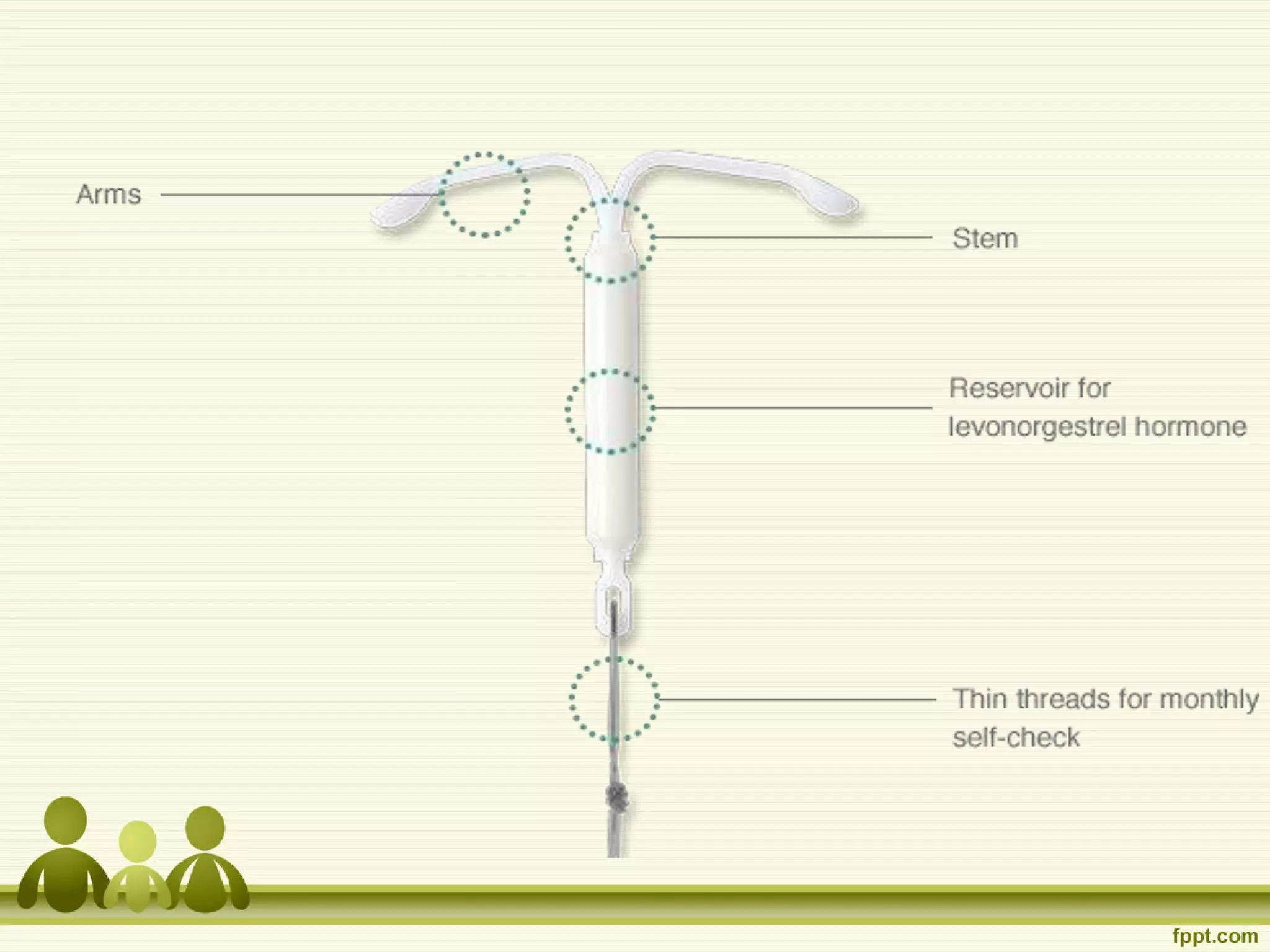
• Is a levonorgestrel-releasing intrauterine device
• T-shaped with reservoir on the vertical arm
• Releases progestin levonorgetsrel 20 ug daily
• Has 2 monofilament string attached to the
vertical arm.
• Life span is 5years
Risks
• 50% of pregnancy as a result of failure are ectopic preg.
• Irregular bleeding common in the initial 3-4 months of
use.
• About 25% of users become amenorrhoeic after the 2nd
year of use
Benefits
• Improvement in dysmenorrhoea.
• Used for treatment of HMB
• Reduced incidence of PID.
• Reduces risk of endometrial carcinoma
COPPER IUD HORMONAL IUD
Failure rate in 1 year of use 0.8% 0.1%
Mode of action Toxic effect on both sperm
& egg
endometrial gland atrophy
Thick cervical mucus
Suppress ovulation
Duration 10 y 5 y
Effect of menstrual cycle Menses more heavier and
painful
Irregular menses
Amenorrhea
Menstrual spotting More days of spotting
before and after menses
Erratic spotting
Hormonal side effect None Acne, greasier skin, breast
tenderness, mood swings
Therapeutic benefits None Help HMD & dysmenorrhea
Part of HRT
Average Malaysian cost RM 600 * RM 80 – 110 *
Average UK cost ₤10 ₤80
AbsoluteContraindication
i. Current STI or PID, including post-abortion &
following childbirth
ii. Malignant trophoblastic disease
iii. Unexplained PV bleed
iv. Endometrial & cervical Ca.
v. Known malformation of the uterus (fibroids)
vi. Copper allergy (use mirena)
1) Most people get cramps or feel a little bit of pain when
they're getting the IUD inserted, but many only have
mild discomfort. The pain can be worse for some, but
luckily it only lasts for a minute or two
2) You may have cramping and spotting after getting an
IUD, but this almost always goes away within 3-6
months. Hormonal IUDs eventually make periods lighter
and less crampy, and you might stop getting a period at
all. On the flip side, copper IUDs may make periods
heavier and cramps worse
PROGESTOGEN-ONLYINJECTABLE
CONTRACEPTIVES
Over 99 per cent
effective.
Less than four women in
1,000 will get pregnant
over two years.
Types: Progestin-Only
– Depo Medroxy Progesterone Acetate (DMPA)
150 mg
• Microcrystalline suspension
• 3 monthly
– Norethisterone Enanthate (Net-En) 200 mg
• In oil
• 2 monthly
Modeof action
• Inhibition of ovulation by suppressing
gonadotropinns.
• Thickening of cervical mucus.
• Thinning of the endometrium
• The risk of ectopic pregnancy is significantly lower
among users compared to women who do not use
contraception.
• The risk of endometrial cancer is reduced by as much
as 80%, an effect that is long term and increases with
duration of use.
• Studies have shown as much as a 70% reduction in the
frequency of sickle cell crises; the mechanism for this
effect is not known.
• Some women with endometriosis have improvement of
symptoms with use of DMPA.
BENEFIT
1. Decrease in bone mineral density, hence,
encourage calcium intake.
2. Irregular bleeding
3. HMB
4. Amenorrhoea in prolonged users
5. Mood swing & Depression.
6. Wt gain, about 2.2kg in 1 yr of use.
7. Delayed return to fertility when discontinued,
≥10 months.
Disadvantages
Over 99 per cent effective.
Less than one woman in 1,000 will get
pregnant over three years.
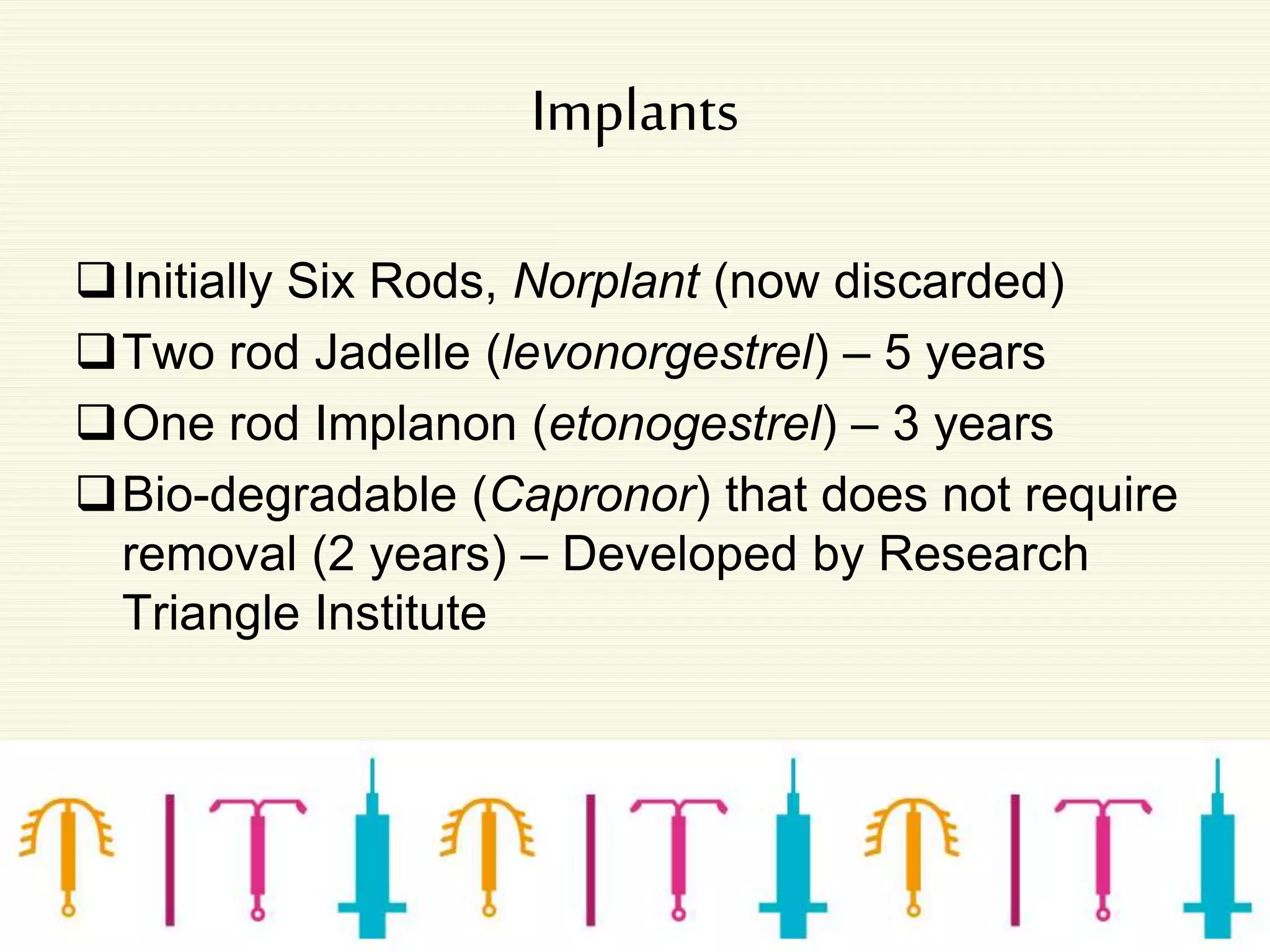
Initially Six Rods, Norplant (now discarded)
Two rod Jadelle (levonorgestrel) – 5 years
One rod Implanon (etonogestrel) – 3 years
Bio-degradable (Capronor) that does not require
removal (2 years) – Developed by Research
Triangle Institute
Implants
[Levonorgestrel Implant]
• 1st generation of implants
• Consists of 6 rods, each measuring 34mm
in length & 2.4mm in diameter
NORPLANT
Jadelle Implants (2 capsules)
• Non biodegradable
• Single rod
• Release the progestrogen etonogestrel
25-75 mg daily (dose with time)
• Duration of action is 3 years
Implanon
• Effective for women who have difficulty
remembering to take pill
• For long term contraception
• Rapid return of fertility after removal
• Implanon is associated with a higher frequency of
– amenorrhea
– oligomenorrhea,
• And a decrease in the prevalence of
– HMB
– weight gain
– Headache
– acne.
It's common to experience some degree of
bruising, pain, scarring or bleeding at the
insertion site.
Progestrogen only contraception
• Extremely safe
• Can be used if woman has cardivascular
risk factor
• Same mode of action
– Cervical mucus thickened
– Endometrial gland atrophy
– High concentration inhibit ovulation
SPOTTINGIN ISLAM
• The spotting that comes at times other than the regular
monthly period does not prevent one from praying and fasting,
because Umm ‘Atiyyah (may Allah be pleased with her) said:
• “We did not regard yellowish and brownish discharge after
tuhr (becoming pure) as being of any significance.”
– Narrated by al-Bukhaari (326) and Abu Dawood (307). Classed as saheeh by al-
Albaani in Saheeh Abi Dawood.
SPOTTINGIN ISLAM
• If a woman has become pure from her menses, what she sees
after that of spotting is not regarded as menses. And these
secretions are pure (taahir) so she does not have to wash them
from her clothes.
– This is the view of Abu Haneefah and Ahmad, and it is one of the two
views narrated from al-Shaafa’i, and it was classed as sound by al-
Nawawi.
Long acting reversible contraception

Long acting reversible contraception

  • 1.
  • 2.
  • 4.
    • The LARCsavailable in Malaysia – contraceptive implant (IMP) – the copper intrauterine device (IUD) – levonorgestrel intrauterine system (IUS). • LARC usage in Malaysia recorded in 2004 averaged about 4.5% for IUD and 0.4% for the implant as compared to 14% for contraceptive pills.
  • 5.
    Definition LARC is definedas contraceptive methods that require administration less than once per cycle or month.
  • 6.
  • 7.
    1. Are themost effective reversible methods available 2. Have high rates of user satisfaction as indicated by high continuation rates 3. Do not require daily adherence 4. Require fewer visits to health services than many other methods 5. Are cheaper than using the pill over 12 months 6. Are easily reversible 7. Suitable for women of all ages 8. Do not affect fertility after removal
  • 8.
    BARRIERS 1. A lackof familiarity with, or misperceptions about, the methods 2. High upfront costs 3. Lack of access to insertion services 4. Health care providers’ concerns about the safety of IUD use, especially in nulliparous ,younger women and teenagers 5. Patient barriers, including a general lack of awareness of LARC methods and information about their safety and effectiveness
  • 10.
    Types Copper intrauterine devices Progestogen-onlyintrauterine system Progestogen-only injectable contraceptives Progestogen-only subdermal implants
  • 12.
    Over 99 percent effective. Less than two women in 100 will get pregnant over five years. Older IUDs have less copper and are less effective.
  • 13.
    The modern banded devicehas copper on the stem and copper sleeves on the arm
  • 15.
  • 16.
    SIDE EFFECTS • IrregularPV bleeding (IMB / spotting) • Dysmenorrhea • HMB • Can introduce infection to the upper genital tract (cervicitis) PID • Perforation less than 1/1000 • Expulsion
  • 19.
    PROGESTOGEN-ONLY INTRAUTERINE SYSTEM • Isa levonorgestrel-releasing intrauterine device • T-shaped with reservoir on the vertical arm • Releases progestin levonorgetsrel 20 ug daily • Has 2 monofilament string attached to the vertical arm. • Life span is 5years
  • 22.
    Risks • 50% ofpregnancy as a result of failure are ectopic preg. • Irregular bleeding common in the initial 3-4 months of use. • About 25% of users become amenorrhoeic after the 2nd year of use Benefits • Improvement in dysmenorrhoea. • Used for treatment of HMB • Reduced incidence of PID. • Reduces risk of endometrial carcinoma
  • 23.
    COPPER IUD HORMONALIUD Failure rate in 1 year of use 0.8% 0.1% Mode of action Toxic effect on both sperm & egg endometrial gland atrophy Thick cervical mucus Suppress ovulation Duration 10 y 5 y Effect of menstrual cycle Menses more heavier and painful Irregular menses Amenorrhea Menstrual spotting More days of spotting before and after menses Erratic spotting Hormonal side effect None Acne, greasier skin, breast tenderness, mood swings Therapeutic benefits None Help HMD & dysmenorrhea Part of HRT Average Malaysian cost RM 600 * RM 80 – 110 * Average UK cost ₤10 ₤80
  • 25.
    AbsoluteContraindication i. Current STIor PID, including post-abortion & following childbirth ii. Malignant trophoblastic disease iii. Unexplained PV bleed iv. Endometrial & cervical Ca. v. Known malformation of the uterus (fibroids) vi. Copper allergy (use mirena)
  • 31.
    1) Most peopleget cramps or feel a little bit of pain when they're getting the IUD inserted, but many only have mild discomfort. The pain can be worse for some, but luckily it only lasts for a minute or two 2) You may have cramping and spotting after getting an IUD, but this almost always goes away within 3-6 months. Hormonal IUDs eventually make periods lighter and less crampy, and you might stop getting a period at all. On the flip side, copper IUDs may make periods heavier and cramps worse
  • 32.
  • 33.
    Over 99 percent effective. Less than four women in 1,000 will get pregnant over two years.
  • 34.
    Types: Progestin-Only – DepoMedroxy Progesterone Acetate (DMPA) 150 mg • Microcrystalline suspension • 3 monthly – Norethisterone Enanthate (Net-En) 200 mg • In oil • 2 monthly
  • 36.
    Modeof action • Inhibitionof ovulation by suppressing gonadotropinns. • Thickening of cervical mucus. • Thinning of the endometrium
  • 37.
    • The riskof ectopic pregnancy is significantly lower among users compared to women who do not use contraception. • The risk of endometrial cancer is reduced by as much as 80%, an effect that is long term and increases with duration of use. • Studies have shown as much as a 70% reduction in the frequency of sickle cell crises; the mechanism for this effect is not known. • Some women with endometriosis have improvement of symptoms with use of DMPA. BENEFIT
  • 38.
    1. Decrease inbone mineral density, hence, encourage calcium intake. 2. Irregular bleeding 3. HMB 4. Amenorrhoea in prolonged users 5. Mood swing & Depression. 6. Wt gain, about 2.2kg in 1 yr of use. 7. Delayed return to fertility when discontinued, ≥10 months. Disadvantages
  • 39.
    Over 99 percent effective. Less than one woman in 1,000 will get pregnant over three years.
  • 40.
    Initially Six Rods,Norplant (now discarded) Two rod Jadelle (levonorgestrel) – 5 years One rod Implanon (etonogestrel) – 3 years Bio-degradable (Capronor) that does not require removal (2 years) – Developed by Research Triangle Institute Implants
  • 41.
    [Levonorgestrel Implant] • 1stgeneration of implants • Consists of 6 rods, each measuring 34mm in length & 2.4mm in diameter NORPLANT
  • 42.
  • 43.
    • Non biodegradable •Single rod • Release the progestrogen etonogestrel 25-75 mg daily (dose with time) • Duration of action is 3 years Implanon
  • 44.
    • Effective forwomen who have difficulty remembering to take pill • For long term contraception • Rapid return of fertility after removal
  • 45.
    • Implanon isassociated with a higher frequency of – amenorrhea – oligomenorrhea, • And a decrease in the prevalence of – HMB – weight gain – Headache – acne.
  • 49.
    It's common toexperience some degree of bruising, pain, scarring or bleeding at the insertion site.
  • 50.
    Progestrogen only contraception •Extremely safe • Can be used if woman has cardivascular risk factor • Same mode of action – Cervical mucus thickened – Endometrial gland atrophy – High concentration inhibit ovulation
  • 51.
    SPOTTINGIN ISLAM • Thespotting that comes at times other than the regular monthly period does not prevent one from praying and fasting, because Umm ‘Atiyyah (may Allah be pleased with her) said: • “We did not regard yellowish and brownish discharge after tuhr (becoming pure) as being of any significance.” – Narrated by al-Bukhaari (326) and Abu Dawood (307). Classed as saheeh by al- Albaani in Saheeh Abi Dawood.
  • 52.
    SPOTTINGIN ISLAM • Ifa woman has become pure from her menses, what she sees after that of spotting is not regarded as menses. And these secretions are pure (taahir) so she does not have to wash them from her clothes. – This is the view of Abu Haneefah and Ahmad, and it is one of the two views narrated from al-Shaafa’i, and it was classed as sound by al- Nawawi.