ENDOMETRITIS
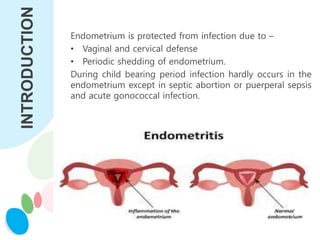
INTRODUCTION Endometrium is protected from infection due to –
• Vaginal and cervical defense
• Periodic shedding of endometrium.
During child bearing period infection hardly occurs in the
endometrium except in septic abortion or puerperal sepsis
and acute gonococcal infection.
ACUTE
ENDOMETRITIS
• Almost occurs after abortion
or childbirth.
• Anaerobic streptococcus
• Staphylococcus pyrogenes
• Non-haemolytic streptococcus
• E-coli
• Bacteroides group
• Malnutition, unhygienic
environment,
AETIO-
PATHOGENESIS
CHRONIC
ENDOMETRITIS
• The infection occurs when
there is persistent source of
infection in the uterine cavity.
• IUCD, infected polyp, retained
products, uterine malignancy
and endometrial burns due to
radium.
• Tubercular endometritis is
chronic from the beginning.
AETIO-
PATHOGENESIS
Purulent or sero-purulent vaginal discharge.
Low grade fever
Weakness, anemia
Infertility
Menstrual abnormality
Vulval or vaginal ulcers
ENDOMETRITIS
CLINICAL
FEATURES
ENDOMETRITIS
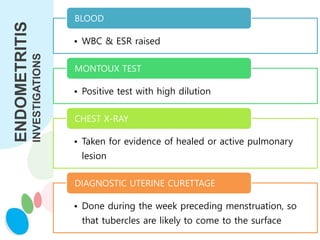
INVESTIGATIONS • WBC & ESR raised
BLOOD
• Positive test with high dilution
MONTOUX TEST
• Taken for evidence of healed or active pulmonary
lesion
CHEST X-RAY
• Done during the week preceding menstruation, so
that tubercles are likely to come to the surface
DIAGNOSTIC UTERINE CURETTAGE
ENDOMETRITIS
INVESTIGATIONS
• Cultured for tubercle bacillus
SPUTUM & URINE
• From lesion in cervix, vagina or vulva
BIOPSY
• In a proved case it is contraindicated, but it’s a routine
investigation of infertility
HYSTEROSALPINGOGRAPHY (HSG)
• Abdominal & pelvic ultrasound, CT or MRI
IMAGING
• For identification of tubercle or segmented nodular
appearance of the tubes
LAPROSCOPY
ENDOMETRITIS
DIAGNOSIS
&
TREATMENT
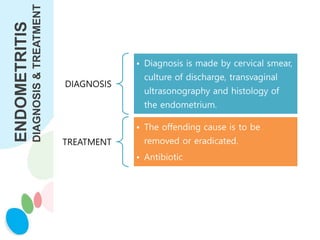
DIAGNOSIS
• Diagnosis is made by cervical smear,
culture of discharge, transvaginal
ultrasonography and histology of
the endometrium.
TREATMENT
• The offending cause is to be
removed or eradicated.
• Antibiotic
ATROPIC
ENDOMETRITIS
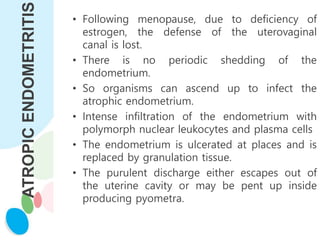
• Following menopause, due to deficiency of
estrogen, the defense of the uterovaginal
canal is lost.
• There is no periodic shedding of the
endometrium.
• So organisms can ascend up to infect the
atrophic endometrium.
• Intense infiltration of the endometrium with
polymorph nuclear leukocytes and plasma cells
• The endometrium is ulcerated at places and is
replaced by granulation tissue.
• The purulent discharge either escapes out of
the uterine cavity or may be pent up inside
producing pyometra.
ATROPIC
ENDOMETRITIS
CLINICAL
FEATURES
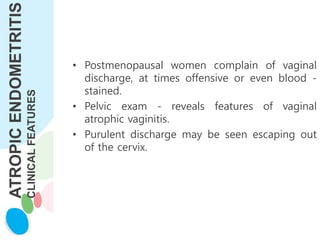
• Postmenopausal women complain of vaginal
discharge, at times offensive or even blood -
stained.
• Pelvic exam - reveals features of vaginal
atrophic vaginitis.
• Purulent discharge may be seen escaping out
of the cervix.
ATROPIC
ENDOMETRITIS
DIAGNOSIS • The diagnosis is confused with carcinoma of
endometrium which must be excluded prior to
treatment.
• USG
• Diagnostic curettage shout be done and the
endometrium subjected to histological
examination.
• If pyometra is present, drainage of pus by
simple dilatation should be done first,
• After 1-2 weeks, diagnostic curettage is to be
done under cover of antibodies.
ATROPIC
ENDOMETRITIS
TREATMENT
• In women with recurrent attacks,
hysterectomy should be done and the
specimen should be subjected to
histological examination.
THANK YOU

Endometritis

  • 1.
  • 2.
    INTRODUCTION Endometrium isprotected from infection due to – • Vaginal and cervical defense • Periodic shedding of endometrium. During child bearing period infection hardly occurs in the endometrium except in septic abortion or puerperal sepsis and acute gonococcal infection.
  • 3.
    ACUTE ENDOMETRITIS • Almost occursafter abortion or childbirth. • Anaerobic streptococcus • Staphylococcus pyrogenes • Non-haemolytic streptococcus • E-coli • Bacteroides group • Malnutition, unhygienic environment, AETIO- PATHOGENESIS
  • 4.
    CHRONIC ENDOMETRITIS • The infectionoccurs when there is persistent source of infection in the uterine cavity. • IUCD, infected polyp, retained products, uterine malignancy and endometrial burns due to radium. • Tubercular endometritis is chronic from the beginning. AETIO- PATHOGENESIS
  • 5.
    Purulent or sero-purulentvaginal discharge. Low grade fever Weakness, anemia Infertility Menstrual abnormality Vulval or vaginal ulcers ENDOMETRITIS CLINICAL FEATURES
  • 6.
    ENDOMETRITIS INVESTIGATIONS • WBC& ESR raised BLOOD • Positive test with high dilution MONTOUX TEST • Taken for evidence of healed or active pulmonary lesion CHEST X-RAY • Done during the week preceding menstruation, so that tubercles are likely to come to the surface DIAGNOSTIC UTERINE CURETTAGE
  • 7.
    ENDOMETRITIS INVESTIGATIONS • Cultured fortubercle bacillus SPUTUM & URINE • From lesion in cervix, vagina or vulva BIOPSY • In a proved case it is contraindicated, but it’s a routine investigation of infertility HYSTEROSALPINGOGRAPHY (HSG) • Abdominal & pelvic ultrasound, CT or MRI IMAGING • For identification of tubercle or segmented nodular appearance of the tubes LAPROSCOPY
  • 8.
    ENDOMETRITIS DIAGNOSIS & TREATMENT DIAGNOSIS • Diagnosis ismade by cervical smear, culture of discharge, transvaginal ultrasonography and histology of the endometrium. TREATMENT • The offending cause is to be removed or eradicated. • Antibiotic
  • 9.
    ATROPIC ENDOMETRITIS • Following menopause,due to deficiency of estrogen, the defense of the uterovaginal canal is lost. • There is no periodic shedding of the endometrium. • So organisms can ascend up to infect the atrophic endometrium. • Intense infiltration of the endometrium with polymorph nuclear leukocytes and plasma cells • The endometrium is ulcerated at places and is replaced by granulation tissue. • The purulent discharge either escapes out of the uterine cavity or may be pent up inside producing pyometra.
  • 10.
    ATROPIC ENDOMETRITIS CLINICAL FEATURES • Postmenopausal womencomplain of vaginal discharge, at times offensive or even blood - stained. • Pelvic exam - reveals features of vaginal atrophic vaginitis. • Purulent discharge may be seen escaping out of the cervix.
  • 11.
    ATROPIC ENDOMETRITIS DIAGNOSIS • Thediagnosis is confused with carcinoma of endometrium which must be excluded prior to treatment. • USG • Diagnostic curettage shout be done and the endometrium subjected to histological examination. • If pyometra is present, drainage of pus by simple dilatation should be done first, • After 1-2 weeks, diagnostic curettage is to be done under cover of antibodies.
  • 12.
    ATROPIC ENDOMETRITIS TREATMENT • In womenwith recurrent attacks, hysterectomy should be done and the specimen should be subjected to histological examination.
  • 13.