CSL-CONTRACEPTIVE METHODS
Dr NAJIMUDEEN
Year 5 R 3 October 2019/2020
24.06.2020
BARRIER METHODS
Male and female condoms
• The condom is the only form of contraception that protects against
most STIs as well as preventing pregnancy.
• This method of contraception can be used on demand, is hormone
free and can easily be carried with you.
• male and female varieties.
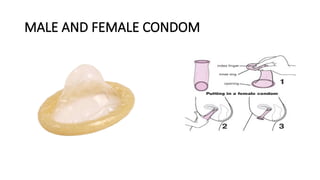
MALE AND FEMALE CONDOM
BARRIER METHODS
• Male condoms are rolled onto an erect penis and act as a physical
barrier, preventing sexual fluids from passing between people during
sex.
• The female condom is placed into the vagina right before sex.
• Based on typical use, the female condom is not quite as effective as
the male latex condom and it may take a little practice to get used to.
BARRIER METHODS
• Pros include:
It is the best protection against STI
can be used on demand
hormone free.
• Cons include:
It can tear or come off during sex if not used properly Partner
dependent
some people are allergic to latex condoms.
• More effective when spermicide is added
ORAL CONTRACEPTIVE PILL
• Combined oral contraceptive pills (COC) –Combination of oestrogen
and progesterone
• Oestrogen: Ethinyl oestradiol 30 microgram
• Progesterone: Varies
Desogestrel, Medroxy progesterone acetate Levonorgestrel,
Lynestrenol, Norethisterone or Norgestrel)
• Progesterone only pill
COMBINED ORAL CONTRACEPTIVE PILL
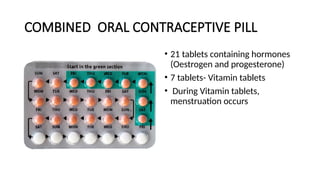
• 21 tablets containing hormones
(Oestrogen and progesterone)
• 7 tablets- Vitamin tablets
• During Vitamin tablets,
menstruation occurs
MECHANISM OF ACTION OF OCP
• Prevention of ovulation
(i)Progestogen negative feedback works at the hypothalamus to
decreases the pulse frequency of gonadotropin releasing hormone
(ii)Decrease the level of FSH and LH
(iii)LH surge in the midcycle is stopped
• Progesterone: Cervical mucous become thick- Ascend of sperm
difficult
• Progesterone: Endometrium become unsuitable for implantation
CONTRAINDICATION FOR COC
• Breast cancer
• Deep vein thrombosis
• Over 35 years and heavy smokers
• Obesity (BMI ≥40 kg/m2
)
• Hypertension (SBP ≥160 mmHg or DBP ≥100 mmHg)May have an
increased risk of stroke or MI
• Valvular and congenital heart disease (complicated by pulmonary
hypertension, atrial fibrillation, history of subacute bacterial
endocarditis)COC use may further increase the risk of arterial
thrombosis
CONTRAINDICATION FOR COC
• Within 6 weeks of postpartum if breast feeding
• Migraine headache with focal neurological symptoms and aura at any
age
• DM with retinopathy, nephropathy, neuropathy or
DM >20 years in duration
PROGESTIN-ONLY PILLS (POPS)
• Progestin-only Pills (POPs)
• Also known as “mini-pills”; contain low doses of progestins (eg
Desogestrel, Ethynodiol diacetate, Levonorgestrel, Lynestrenol,
Norethisterone or Norgestrel)
• May be considered in women in whom estrogen is contraindicated
PROGESTIN-ONLY PILLS (POPS)
• The chief mechanism of action is an increase in the viscosity of
cervical mucus which prevents sperm entry
• It causes thinning and atrophy of the endometrium
• Injectable progestins work primarily by inhibiting secretion of
gonadotropins and therefore, suppress ovulation
CONTRACEPTIVE INJECTION
Depo Provera (Depot Medroxy progesterone acetate) 150 mg
• Intramuscular injection
• Lasts for 3 months
• Acts by altering the endometrium
• Amenorrhoea
• Delay in return of fertility
• Weight gain
CONTRACEPTIVE INJECTION
• May be considered in women in whom estrogen is contraindicated
women who are breastfeeding (started 6 weeks after childbirth;
immediately if not breastfeeding)
women who smoke;
women who experience migraine headaches;
with endometriosis,
sickle cell disease; and
those taking anticonvulsants
DMPA NON-CONTRACEPTIVE BENEFITS
• Amenorrhea and subsequent decrease in dysmenorrhea and risk for
iron-deficiency anemia
• Reduced risk of endometrial cancer, ovarian cysts, ovarian cancer, PID,
sickle cell crises, and ectopic pregnancy
• Decrease in symptoms associated with endometriosis, PMS and
chronic pelvic pain
• Excellent method for women taking anticonvulsant drugs
• Lactation is not affected
• Sickle cell crises are reduced in patients with sickle cell anemia
DISADVANTAGES OF DEPO PROVERA
• Irregular menstruation during 1st several months
• Hypoestrogenism may occur, which can cause dyspareunia, hot
flashes and decreased libido
• May be associated with weight gain, acne and complexion changes
• Must return to the clinic every 11-13 weeks for injection
• Impossible to immediately discontinue
INTRAUTERINE CONTRACEPTIVE DEVICE (IUCD)
• Copper T
• LNG-IUS
COPPER IUCD
Mechanism of action
• creates a local inflammatory reaction that appears to prevent sperm
from reaching the fallopian tubes.
• Copper weakens the spermatozoa
• Tubal motility increased
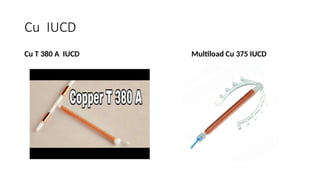
Cu IUCD
Cu T 380 A IUCD Multiload Cu 375 IUCD
Copper IUCD
• Effective for 8-10 years
• Can be used as emergency contraception – Should be inserted within
5 days of sexual exposure
Copper IUCD
• Side effects
Menorrhagia
Dysmenorrhoea
Expulsion
Spotting
Postcoital bleeding
Perforation
Infection
Copper IUCD- Contraindication
• Active pelvic infection
• Undiagnosed vaginal bleeding
• Carcinoma of uterus, cervix
• Pregnancy
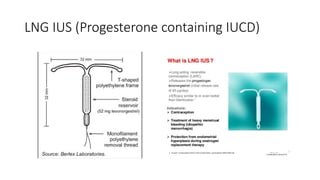
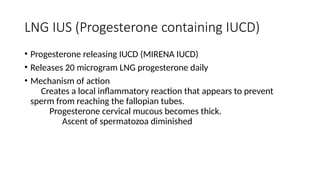
LNG IUS (Progesterone containing IUCD)
• Progesterone releasing IUCD (MIRENA IUCD)
• Releases 20 microgram LNG progesterone daily
• Mechanism of action
Creates a local inflammatory reaction that appears to prevent
sperm from reaching the fallopian tubes.
Progesterone cervical mucous becomes thick.
Ascent of spermatozoa diminished
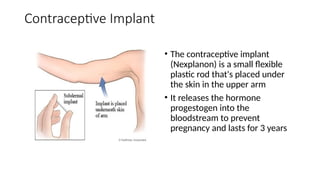
Contraceptive Implant
• The contraceptive implant
(Nexplanon) is a small flexible
plastic rod that's placed under
the skin in the upper arm
• It releases the hormone
progestogen into the
bloodstream to prevent
pregnancy and lasts for 3 years
Long-acting reversible contraception (LARC)
• Long-acting reversible contraception (LARC) is a contraceptive that
lasts for a long time.
• There are two types of LARC in Aotearoa New Zealand:
• the intra uterine device (IUD) that lasts for three, five or ten years
• the implant that lasts for five years.
• They are sometimes called “fit and forget” contraception because
once it is put in, you don’t need to remember it every day or every
month.
• LARCs are the most effective types of contraception. They are more
than 99% effective at preventing pregnancy.
Contraceptive Ring
• This method consists of a flexible plastic ring constantly releasing
hormones that is placed in the vagina by the woman. It stays in place for
three weeks, and then you remove it, take a week off then pop another
one in. The ring releases the hormones oestrogen and progestogen. These
are the same hormones used in the combined oral contraceptive pill, but at
a lower dose.
• Pros include: You can insert and remove a vaginal ring yourself; this
contraceptive method has few side effects, allows control of your periods
and allows your fertility to return quickly when the ring is removed.
• Cons include: It is not suitable for women who can't take oestrogen-
containing contraception; you need to remember to replace it at the right
time; does not protect against STIs
DIAPHRAGM
• Diaphragm
• A diaphragm is a small, soft silicon dome is placed inside the vagina to stop
sperm from entering the uterus. It forms a physical barrier between the
man's sperm and the woman's egg, like a condom.
• The diaphragm needs to stay in place for at least six hours after sex. After
six - but no longer than 24 hours after sex - it needs to be taken out and
cleaned.
• Some of the pros: You can use the same diaphragm more than once, and it
can last up to two years if you look after it.
• Some of the cons: Using a diaphragm can take practice and requires
keeping track of the hours inserted. The diaphragm works
fairly well if used correctly, but not as well as the pill, a contraceptive
implant or an IUD.
SURGICAL STERILIZATION
• Male- Vasectomy
• Female: Bilateral tubal ligation
EMERGENCY CONTRACEPTION
• Copper intrauterine device (IUCD) and
• Emergency contraceptive pills such as
levonorgestrel,
ulipristal acetate,
combined oral contraceptive pills (Yuzpe method),
EMERGENCY CONTRACEPTION
Mechanism of action of drugs
• delaying or inhibiting ovulation.
• alterations in hormone levels, changes in the endometrial
environment,
• and inhibition of fertilization
EMERGENCY CONTRACEPTION
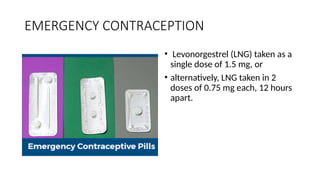
• Levonorgestrel (LNG) taken as a
single dose of 1.5 mg, or
• alternatively, LNG taken in 2
doses of 0.75 mg each, 12 hours
apart.
ULIPRISTAL ACETATE (UPA)
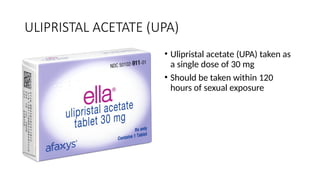
• Ulipristal acetate (UPA) taken as
a single dose of 30 mg
• Should be taken within 120
hours of sexual exposure
YUZPE METHOD
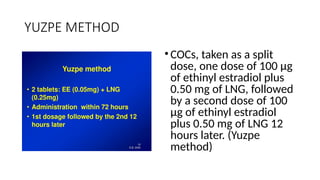
•COCs, taken as a split
dose, one dose of 100 μg
of ethinyl estradiol plus
0.50 mg of LNG, followed
by a second dose of 100
μg of ethinyl estradiol
plus 0.50 mg of LNG 12
hours later. (Yuzpe
method)

Contraceptive methods obstetric gynaecology

  • 1.
    CSL-CONTRACEPTIVE METHODS Dr NAJIMUDEEN Year5 R 3 October 2019/2020 24.06.2020
  • 2.
    BARRIER METHODS Male andfemale condoms • The condom is the only form of contraception that protects against most STIs as well as preventing pregnancy. • This method of contraception can be used on demand, is hormone free and can easily be carried with you. • male and female varieties.
  • 3.
  • 4.
    BARRIER METHODS • Malecondoms are rolled onto an erect penis and act as a physical barrier, preventing sexual fluids from passing between people during sex. • The female condom is placed into the vagina right before sex. • Based on typical use, the female condom is not quite as effective as the male latex condom and it may take a little practice to get used to.
  • 5.
    BARRIER METHODS • Prosinclude: It is the best protection against STI can be used on demand hormone free. • Cons include: It can tear or come off during sex if not used properly Partner dependent some people are allergic to latex condoms. • More effective when spermicide is added
  • 6.
    ORAL CONTRACEPTIVE PILL •Combined oral contraceptive pills (COC) –Combination of oestrogen and progesterone • Oestrogen: Ethinyl oestradiol 30 microgram • Progesterone: Varies Desogestrel, Medroxy progesterone acetate Levonorgestrel, Lynestrenol, Norethisterone or Norgestrel) • Progesterone only pill
  • 7.
    COMBINED ORAL CONTRACEPTIVEPILL • 21 tablets containing hormones (Oestrogen and progesterone) • 7 tablets- Vitamin tablets • During Vitamin tablets, menstruation occurs
  • 8.
    MECHANISM OF ACTIONOF OCP • Prevention of ovulation (i)Progestogen negative feedback works at the hypothalamus to decreases the pulse frequency of gonadotropin releasing hormone (ii)Decrease the level of FSH and LH (iii)LH surge in the midcycle is stopped • Progesterone: Cervical mucous become thick- Ascend of sperm difficult • Progesterone: Endometrium become unsuitable for implantation
  • 9.
    CONTRAINDICATION FOR COC •Breast cancer • Deep vein thrombosis • Over 35 years and heavy smokers • Obesity (BMI ≥40 kg/m2 ) • Hypertension (SBP ≥160 mmHg or DBP ≥100 mmHg)May have an increased risk of stroke or MI • Valvular and congenital heart disease (complicated by pulmonary hypertension, atrial fibrillation, history of subacute bacterial endocarditis)COC use may further increase the risk of arterial thrombosis
  • 10.
    CONTRAINDICATION FOR COC •Within 6 weeks of postpartum if breast feeding • Migraine headache with focal neurological symptoms and aura at any age • DM with retinopathy, nephropathy, neuropathy or DM >20 years in duration
  • 11.
    PROGESTIN-ONLY PILLS (POPS) •Progestin-only Pills (POPs) • Also known as “mini-pills”; contain low doses of progestins (eg Desogestrel, Ethynodiol diacetate, Levonorgestrel, Lynestrenol, Norethisterone or Norgestrel) • May be considered in women in whom estrogen is contraindicated
  • 12.
    PROGESTIN-ONLY PILLS (POPS) •The chief mechanism of action is an increase in the viscosity of cervical mucus which prevents sperm entry • It causes thinning and atrophy of the endometrium • Injectable progestins work primarily by inhibiting secretion of gonadotropins and therefore, suppress ovulation
  • 13.
    CONTRACEPTIVE INJECTION Depo Provera(Depot Medroxy progesterone acetate) 150 mg • Intramuscular injection • Lasts for 3 months • Acts by altering the endometrium • Amenorrhoea • Delay in return of fertility • Weight gain
  • 14.
    CONTRACEPTIVE INJECTION • Maybe considered in women in whom estrogen is contraindicated women who are breastfeeding (started 6 weeks after childbirth; immediately if not breastfeeding) women who smoke; women who experience migraine headaches; with endometriosis, sickle cell disease; and those taking anticonvulsants
  • 15.
    DMPA NON-CONTRACEPTIVE BENEFITS •Amenorrhea and subsequent decrease in dysmenorrhea and risk for iron-deficiency anemia • Reduced risk of endometrial cancer, ovarian cysts, ovarian cancer, PID, sickle cell crises, and ectopic pregnancy • Decrease in symptoms associated with endometriosis, PMS and chronic pelvic pain • Excellent method for women taking anticonvulsant drugs • Lactation is not affected • Sickle cell crises are reduced in patients with sickle cell anemia
  • 16.
    DISADVANTAGES OF DEPOPROVERA • Irregular menstruation during 1st several months • Hypoestrogenism may occur, which can cause dyspareunia, hot flashes and decreased libido • May be associated with weight gain, acne and complexion changes • Must return to the clinic every 11-13 weeks for injection • Impossible to immediately discontinue
  • 17.
    INTRAUTERINE CONTRACEPTIVE DEVICE(IUCD) • Copper T • LNG-IUS
  • 18.
    COPPER IUCD Mechanism ofaction • creates a local inflammatory reaction that appears to prevent sperm from reaching the fallopian tubes. • Copper weakens the spermatozoa • Tubal motility increased
  • 19.
    Cu IUCD Cu T380 A IUCD Multiload Cu 375 IUCD
  • 20.
    Copper IUCD • Effectivefor 8-10 years • Can be used as emergency contraception – Should be inserted within 5 days of sexual exposure
  • 21.
    Copper IUCD • Sideeffects Menorrhagia Dysmenorrhoea Expulsion Spotting Postcoital bleeding Perforation Infection
  • 22.
    Copper IUCD- Contraindication •Active pelvic infection • Undiagnosed vaginal bleeding • Carcinoma of uterus, cervix • Pregnancy
  • 23.
    LNG IUS (Progesteronecontaining IUCD)
  • 24.
    LNG IUS (Progesteronecontaining IUCD) • Progesterone releasing IUCD (MIRENA IUCD) • Releases 20 microgram LNG progesterone daily • Mechanism of action Creates a local inflammatory reaction that appears to prevent sperm from reaching the fallopian tubes. Progesterone cervical mucous becomes thick. Ascent of spermatozoa diminished
  • 25.
    Contraceptive Implant • Thecontraceptive implant (Nexplanon) is a small flexible plastic rod that's placed under the skin in the upper arm • It releases the hormone progestogen into the bloodstream to prevent pregnancy and lasts for 3 years
  • 26.
    Long-acting reversible contraception(LARC) • Long-acting reversible contraception (LARC) is a contraceptive that lasts for a long time. • There are two types of LARC in Aotearoa New Zealand: • the intra uterine device (IUD) that lasts for three, five or ten years • the implant that lasts for five years. • They are sometimes called “fit and forget” contraception because once it is put in, you don’t need to remember it every day or every month. • LARCs are the most effective types of contraception. They are more than 99% effective at preventing pregnancy.
  • 27.
    Contraceptive Ring • Thismethod consists of a flexible plastic ring constantly releasing hormones that is placed in the vagina by the woman. It stays in place for three weeks, and then you remove it, take a week off then pop another one in. The ring releases the hormones oestrogen and progestogen. These are the same hormones used in the combined oral contraceptive pill, but at a lower dose. • Pros include: You can insert and remove a vaginal ring yourself; this contraceptive method has few side effects, allows control of your periods and allows your fertility to return quickly when the ring is removed. • Cons include: It is not suitable for women who can't take oestrogen- containing contraception; you need to remember to replace it at the right time; does not protect against STIs
  • 28.
    DIAPHRAGM • Diaphragm • Adiaphragm is a small, soft silicon dome is placed inside the vagina to stop sperm from entering the uterus. It forms a physical barrier between the man's sperm and the woman's egg, like a condom. • The diaphragm needs to stay in place for at least six hours after sex. After six - but no longer than 24 hours after sex - it needs to be taken out and cleaned. • Some of the pros: You can use the same diaphragm more than once, and it can last up to two years if you look after it. • Some of the cons: Using a diaphragm can take practice and requires keeping track of the hours inserted. The diaphragm works fairly well if used correctly, but not as well as the pill, a contraceptive implant or an IUD.
  • 29.
    SURGICAL STERILIZATION • Male-Vasectomy • Female: Bilateral tubal ligation
  • 30.
    EMERGENCY CONTRACEPTION • Copperintrauterine device (IUCD) and • Emergency contraceptive pills such as levonorgestrel, ulipristal acetate, combined oral contraceptive pills (Yuzpe method),
  • 31.
    EMERGENCY CONTRACEPTION Mechanism ofaction of drugs • delaying or inhibiting ovulation. • alterations in hormone levels, changes in the endometrial environment, • and inhibition of fertilization
  • 32.
    EMERGENCY CONTRACEPTION • Levonorgestrel(LNG) taken as a single dose of 1.5 mg, or • alternatively, LNG taken in 2 doses of 0.75 mg each, 12 hours apart.
  • 33.
    ULIPRISTAL ACETATE (UPA) •Ulipristal acetate (UPA) taken as a single dose of 30 mg • Should be taken within 120 hours of sexual exposure
  • 34.
    YUZPE METHOD •COCs, takenas a split dose, one dose of 100 μg of ethinyl estradiol plus 0.50 mg of LNG, followed by a second dose of 100 μg of ethinyl estradiol plus 0.50 mg of LNG 12 hours later. (Yuzpe method)