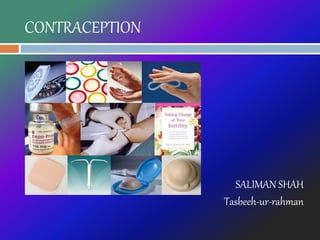
CONTRACEPTION
SALIMAN SHAH
Tasbeeh-ur-rahman
Definition of Contraception
Contraception = “Against Conception”
The intentional prevention of pregnancy
through the use of various devices, agents, drugs,
sexual practices or surgical procedures.
How do you choose?
Top five factors to consider when selecting a method of fertility control
 Cost
 Effectiveness of Protection From
STD
 Safety and Side Effects
 Comfort and Ease of Use
 Reversibility and Future Fertility
Types of birth control
SPACING METHODS
 Barrier Methods
 Hormonal Methods
 Intrauterine Devices
 Post conceptional Methods
 Natural Methods
TERMINAL METHODS
 Male Sterilization
 Female Sterilization
EFFECTIVENESS
EXTREMELY
EFFECTIVE
•IUDs
•DMPA
•Implants
•Sterilization
VERY
EFFECTIVE
• Oral Contraceptives
• Patch
• Ring
LESS
EFFECTIVE
•Male/Female Condom
•Cervical Cap
•Diaphragm
•Withdrawal
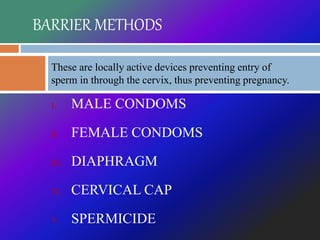
These are locally active devices preventing entry of
sperm in through the cervix, thus preventing pregnancy.
I. MALE CONDOMS
II. FEMALE CONDOMS
III. DIAPHRAGM
IV. CERVICAL CAP
V. SPERMICIDE
BARRIER METHODS
Male condom
What? A thin covering that one unroll over an erect
penis. Made of latex, polyurethane, or animal
membrane (don’t protect against STDs).
How? Put on before any genital contact. At
withdrawal, hold the rim in place at the base of the
penis so it doesn’t slip off.
Notes: May decrease the sensation for men. Lubrication
makes condom less likely to break.
Most commonly used barrier method.
Effectiveness: 82-98%
Female condom
What? A soft, loose pouch that is inserted in the
vagina. Flexible rings at each end hold it in place.
How? Insert the small ring in vagina, large ring stays
outside partially covering labia.
Notes: Can be used if you are allergic to latex (made of
nitrile). Men usually feel no reduction
in sensation. It is an effective barrier to
STDs.
Effectiveness: 79-95%
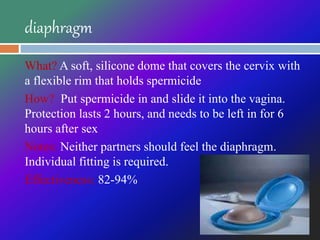
diaphragm
What? A soft, silicone dome that covers the cervix with
a flexible rim that holds spermicide
How? Put spermicide in and slide it into the vagina.
Protection lasts 2 hours, and needs to be left in for 6
hours after sex
Notes: Neither partners should feel the diaphragm.
Individual fitting is required.
Effectiveness: 82-94%
Cervical cap
What? A soft, silicone cup holding spermicide designed
to fit over the cervix
How? Put spermicide in cap and slide it into the
vagina. Protects for 42 hours, needs to stay in at least 6
hours after sex
Notes: Neither partners should feel the cap. Less
effective if one’ve given birth.
Effectiveness: 77%-90%
spermicide
 Cream
 Gel
 Foam
 Film
 Suppository
 Sponge
What? Chemicals that go in the vagina
before sex. Immobilize or kills sperm.
Most work for 1 hour, sponge for 24
hours
How? Put in vagina following
packaging directions. Most need to be
put in 10 minutes before intercourse.
Notes: Key ingredient is Nonoxynol9.
Neither partner should notice
spermicide.
Effectiveness: 72-91%
Chemicals similar to hormones stops the release of egg; weaken the
sperm; change cervical mucus and uterine lining; and reduce
implantation.
 The Pill
 The Patch
 Vaginal Ring
 The Shot
 Implant
Hormonal Methods
The pill
What? These are synthetic hormones in the form of
mini pills and combined pills.
How? A pill taken orally every day at about the same
time. Usually 28 days regime for mini pills and 21 days
or 28 days regimes for combined pills.
Notes: Women must have pap smear for birth control
pills. Do not prevent from STDs.
Period can occur monthly,
every 3 months, or not at all
Effectiveness: 91-99.7%
The patch
What? A bandage-like patch that sticks to skin.
How? Changed weekly, no patch on 4th week.
Hormones are absorbed through the skin.
Notes: Less effective if
you weigh over 198
pounds. May cause skin
irritation.
Effectiveness: 91-99.7%
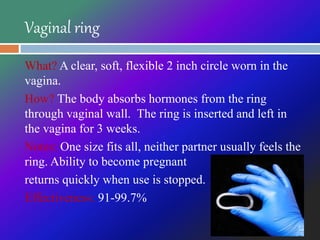
Vaginal ring
What? A clear, soft, flexible 2 inch circle worn in the
vagina.
How? The body absorbs hormones from the ring
through vaginal wall. The ring is inserted and left in
the vagina for 3 weeks.
Notes: One size fits all, neither partner usually feels the
ring. Ability to become pregnant
returns quickly when use is stopped.
Effectiveness: 91-99.7%
The shot/dmpa
What? A long acting hormone injection
How? Female is given a shot one time every 3 months.
Notes: Not reversible- once the injection occurs, the
hormones are in the woman for at least 3 months. It
may take a long time to get pregnant after the shot.
Breakthrough bleeding and
decreased bone mineral
density.
Effectiveness: 94-99.8%
implant(nexplanon)
What? A soft rod 1 ½ inches long placed under the skin
in the upper arm under local anesthesia.
How? Slowly releases etonogestrel into your system.
Notes: Prevents pregnancy for 3 years, but can be taken
out at any time. Irregular bleeding
usually occurs. Visible on X-ray.
Effectiveness: 99.5%.
Noncontraceptive benefits of ocp
 ↓ Acne
 ↓ Hair growth
 ↓Breast cysts
 ↓ Ovarian cysts
 ↓ Ovarian carcinoma
 ↓ Dysmenorrhea
 ↓ Endometrial carcinoma
 ↓ PID
 ↓ Risk of ectopic pregnancy
 ↓ Anemia
 ↓ Osteoporosis
adverse effects
 ↑ Risk of CV disease
 ↑ Risk of breast cancer
 ↑ Risk of cervical cancer
 ↑ Risk of thromboembolic episodes
 ↑ Risk of liver adenoma
 Lipid metabolism disorders
 Nausea
 Depression
 Post-pill amenorrhea
 Weight gain
 Breast tenderness
Contraindications
 Absolute: CV diseases, liver damage,
hormone-dependent tumors, hx of vascular
disease, SLE, migraine with aura.
 Relative: Depression, DM, chronic
hypertension and hyperlipidemia.
Long term reversible contraceptive method that involves
placement of a small T-shaped object inside the uterus.
 ↓ sperm transport
 ↑ tubal motility
 ↓ implantation
 Sperms and blastocyst destroyed
 Cervical mucus altered (levonorgestril)
iucd
Iucd options
MIRENA: LNG impregnated IUD
Gradually releases hormones for 5 years.
SKYLA: Similar to mirena.
Effective only for 3 years.
COPPER T-380A: (paraguard)
It gradually release hormones
for 10 years
complications
 Expulsion
 Ectopic pregnancy
 Septic abortion
 Uterine perforation
 PID
 Leiomyoma
SIDE EFFECTS: Menstrual Pain and Bleeding
Contraindications
ABSOLUTE:
 Confirmed or suspected pregnancy
 Pelvic malignancy
 Undiagnosed vaginal bleeding
 Suspected salpingitis
RELATIVE:
 Abnormal uterine size or shape
 History of ectopic pregnancy
 Steroid therapy
 Valvular Heart disease
How Often Do You Take It?
Method Frequency
Pills Every day
How Often Do You Take It?
Method Frequency
Pills Every day
Patch Once a week
How Often Do You Take It?
Method Frequency
Pills Every day
Patch Once a week
Ring Once a month
How Often Do You Take It?
Method Frequency
Pills Every day
Patch Once a week
Ring Once a month
Injection Every 3 months*
How Often Do You Take It?
Method Frequency
Pills Every day
Patch Once a week
Ring Once a month
Injection Every 3 months*
Implant Every 3 years*
How Often Do You Take It?
Method Frequency
Pills Every day
Patch Once a week
Ring Once a month
Injection Every 3 months*
Implant Every 3 years*
IUD Every 5 years*
What if….
…the condom broke or
slipped off...
…you forgot your
regular birth control...
…you were forced to
have sex...
Association of Reproductive Health Professionals
Emergency contraception
What? A pill or combination of pills you take after sex
to prevent pregnancy. IUCDs used if pills not taken.
How? It uses levonorgestrel tablets. Take 1 tab
immediately and 1 tab after 12 hrs.
Notes: Won’t stop an existing pregnancy.
Effectiveness: Approx. 95% if
taken within first 24 hours of
unprotected sex
METHODS BASED ON INFORMATION
Withdrawal
Fertility Awareness Method
 Cervical mucus method
 Basal body temperature methods
 Calendar Method
Abstinence
Withdrawal/coitus interruptus
What? The man takes his penis out of the vagina
before he ejaculates
How? Male needs to ejaculate away from vagina.
Notes: Depends on a male’s self knowledge and self
control. No protection against STDs.
Semen can enter vagina prior to
ejaculation. Oldest method.
Effectiveness: 78-96%
What? lowest temp of the
body at rest.
How? Ovulation raises
body temp ½ - 1 degree
F, and temp will drop if
fertilization does not
occur
What? Predicting fertility
based on menstrual
cycles.
How? Women chart
previous menstrual cycles
to predict the days they
are fertile and infertile
Basal Body Temp Calendar
abstinence
The only 100% effective way to prevent pregnancy,
STDs and HIV/AIDS.
Postpartum contraception
BREAST FEEDING:
Lactation is associated with temporary anovulation, so
contraceptive use may be differed for 6 months.
DIAPHRAGM:
Fitting for a vaginal diaphragm should be performed
usually at 6 weeks postpartum visit.
COMBINITION MODALITIES:
Combined estrogen progestin formulation should not be
used in breast feeding women. In non lactating women,
they should be started after 3 weeks postpartum.
cont.
IUCDs:
Decreased expulsion are seen if IUCD placement take
place at 6 weeks postpartum.
PROGESTIN ONLY CONTRACEPTION:
They do not diminish milk production. So can safely be
used during lactation. They can be begun immediately
after delivery.
Female: Tubal ligation
Male: Vasectomy
These procedures are permanent, and are usually
done by people of age 35+ years and those who have
completed their families.
Both procedures are done in doctor’s office.
Long-Term / Permanent
Vasectomy
A small incision is made to
access the vas deferens, the tube
the sperm travels from the testicle
to the penis, and is sealed, tied, or
cut
After a vasectomy, a male will
still ejaculate, but there won’t be
any sperm present.
Tubal Ligation
A small incision is made in the
abdomen to access the fallopian
tubes. Fallopian tubes are
blocked, burned, or clipped shut
to prevent the egg from
traveling through the tubes
Recovery usually takes 4-6
days
thank you
the end

Contraception

  • 1.
  • 2.
    Definition of Contraception Contraception= “Against Conception” The intentional prevention of pregnancy through the use of various devices, agents, drugs, sexual practices or surgical procedures.
  • 3.
    How do youchoose?
  • 4.
    Top five factorsto consider when selecting a method of fertility control  Cost  Effectiveness of Protection From STD  Safety and Side Effects  Comfort and Ease of Use  Reversibility and Future Fertility
  • 5.
    Types of birthcontrol SPACING METHODS  Barrier Methods  Hormonal Methods  Intrauterine Devices  Post conceptional Methods  Natural Methods TERMINAL METHODS  Male Sterilization  Female Sterilization
  • 6.
    EFFECTIVENESS EXTREMELY EFFECTIVE •IUDs •DMPA •Implants •Sterilization VERY EFFECTIVE • Oral Contraceptives •Patch • Ring LESS EFFECTIVE •Male/Female Condom •Cervical Cap •Diaphragm •Withdrawal
  • 7.
    These are locallyactive devices preventing entry of sperm in through the cervix, thus preventing pregnancy. I. MALE CONDOMS II. FEMALE CONDOMS III. DIAPHRAGM IV. CERVICAL CAP V. SPERMICIDE BARRIER METHODS
  • 8.
    Male condom What? Athin covering that one unroll over an erect penis. Made of latex, polyurethane, or animal membrane (don’t protect against STDs). How? Put on before any genital contact. At withdrawal, hold the rim in place at the base of the penis so it doesn’t slip off. Notes: May decrease the sensation for men. Lubrication makes condom less likely to break. Most commonly used barrier method. Effectiveness: 82-98%
  • 9.
    Female condom What? Asoft, loose pouch that is inserted in the vagina. Flexible rings at each end hold it in place. How? Insert the small ring in vagina, large ring stays outside partially covering labia. Notes: Can be used if you are allergic to latex (made of nitrile). Men usually feel no reduction in sensation. It is an effective barrier to STDs. Effectiveness: 79-95%
  • 10.
    diaphragm What? A soft,silicone dome that covers the cervix with a flexible rim that holds spermicide How? Put spermicide in and slide it into the vagina. Protection lasts 2 hours, and needs to be left in for 6 hours after sex Notes: Neither partners should feel the diaphragm. Individual fitting is required. Effectiveness: 82-94%
  • 11.
    Cervical cap What? Asoft, silicone cup holding spermicide designed to fit over the cervix How? Put spermicide in cap and slide it into the vagina. Protects for 42 hours, needs to stay in at least 6 hours after sex Notes: Neither partners should feel the cap. Less effective if one’ve given birth. Effectiveness: 77%-90%
  • 12.
    spermicide  Cream  Gel Foam  Film  Suppository  Sponge What? Chemicals that go in the vagina before sex. Immobilize or kills sperm. Most work for 1 hour, sponge for 24 hours How? Put in vagina following packaging directions. Most need to be put in 10 minutes before intercourse. Notes: Key ingredient is Nonoxynol9. Neither partner should notice spermicide. Effectiveness: 72-91%
  • 13.
    Chemicals similar tohormones stops the release of egg; weaken the sperm; change cervical mucus and uterine lining; and reduce implantation.  The Pill  The Patch  Vaginal Ring  The Shot  Implant Hormonal Methods
  • 14.
    The pill What? Theseare synthetic hormones in the form of mini pills and combined pills. How? A pill taken orally every day at about the same time. Usually 28 days regime for mini pills and 21 days or 28 days regimes for combined pills. Notes: Women must have pap smear for birth control pills. Do not prevent from STDs. Period can occur monthly, every 3 months, or not at all Effectiveness: 91-99.7%
  • 15.
    The patch What? Abandage-like patch that sticks to skin. How? Changed weekly, no patch on 4th week. Hormones are absorbed through the skin. Notes: Less effective if you weigh over 198 pounds. May cause skin irritation. Effectiveness: 91-99.7%
  • 16.
    Vaginal ring What? Aclear, soft, flexible 2 inch circle worn in the vagina. How? The body absorbs hormones from the ring through vaginal wall. The ring is inserted and left in the vagina for 3 weeks. Notes: One size fits all, neither partner usually feels the ring. Ability to become pregnant returns quickly when use is stopped. Effectiveness: 91-99.7%
  • 17.
    The shot/dmpa What? Along acting hormone injection How? Female is given a shot one time every 3 months. Notes: Not reversible- once the injection occurs, the hormones are in the woman for at least 3 months. It may take a long time to get pregnant after the shot. Breakthrough bleeding and decreased bone mineral density. Effectiveness: 94-99.8%
  • 18.
    implant(nexplanon) What? A softrod 1 ½ inches long placed under the skin in the upper arm under local anesthesia. How? Slowly releases etonogestrel into your system. Notes: Prevents pregnancy for 3 years, but can be taken out at any time. Irregular bleeding usually occurs. Visible on X-ray. Effectiveness: 99.5%.
  • 19.
    Noncontraceptive benefits ofocp  ↓ Acne  ↓ Hair growth  ↓Breast cysts  ↓ Ovarian cysts  ↓ Ovarian carcinoma  ↓ Dysmenorrhea  ↓ Endometrial carcinoma  ↓ PID  ↓ Risk of ectopic pregnancy  ↓ Anemia  ↓ Osteoporosis
  • 20.
    adverse effects  ↑Risk of CV disease  ↑ Risk of breast cancer  ↑ Risk of cervical cancer  ↑ Risk of thromboembolic episodes  ↑ Risk of liver adenoma  Lipid metabolism disorders  Nausea  Depression  Post-pill amenorrhea  Weight gain  Breast tenderness
  • 21.
    Contraindications  Absolute: CVdiseases, liver damage, hormone-dependent tumors, hx of vascular disease, SLE, migraine with aura.  Relative: Depression, DM, chronic hypertension and hyperlipidemia.
  • 22.
    Long term reversiblecontraceptive method that involves placement of a small T-shaped object inside the uterus.  ↓ sperm transport  ↑ tubal motility  ↓ implantation  Sperms and blastocyst destroyed  Cervical mucus altered (levonorgestril) iucd
  • 23.
    Iucd options MIRENA: LNGimpregnated IUD Gradually releases hormones for 5 years. SKYLA: Similar to mirena. Effective only for 3 years. COPPER T-380A: (paraguard) It gradually release hormones for 10 years
  • 24.
    complications  Expulsion  Ectopicpregnancy  Septic abortion  Uterine perforation  PID  Leiomyoma SIDE EFFECTS: Menstrual Pain and Bleeding
  • 25.
    Contraindications ABSOLUTE:  Confirmed orsuspected pregnancy  Pelvic malignancy  Undiagnosed vaginal bleeding  Suspected salpingitis RELATIVE:  Abnormal uterine size or shape  History of ectopic pregnancy  Steroid therapy  Valvular Heart disease
  • 26.
    How Often DoYou Take It? Method Frequency Pills Every day
  • 27.
    How Often DoYou Take It? Method Frequency Pills Every day Patch Once a week
  • 28.
    How Often DoYou Take It? Method Frequency Pills Every day Patch Once a week Ring Once a month
  • 29.
    How Often DoYou Take It? Method Frequency Pills Every day Patch Once a week Ring Once a month Injection Every 3 months*
  • 30.
    How Often DoYou Take It? Method Frequency Pills Every day Patch Once a week Ring Once a month Injection Every 3 months* Implant Every 3 years*
  • 31.
    How Often DoYou Take It? Method Frequency Pills Every day Patch Once a week Ring Once a month Injection Every 3 months* Implant Every 3 years* IUD Every 5 years*
  • 32.
    What if…. …the condombroke or slipped off... …you forgot your regular birth control... …you were forced to have sex... Association of Reproductive Health Professionals
  • 33.
    Emergency contraception What? Apill or combination of pills you take after sex to prevent pregnancy. IUCDs used if pills not taken. How? It uses levonorgestrel tablets. Take 1 tab immediately and 1 tab after 12 hrs. Notes: Won’t stop an existing pregnancy. Effectiveness: Approx. 95% if taken within first 24 hours of unprotected sex
  • 34.
    METHODS BASED ONINFORMATION Withdrawal Fertility Awareness Method  Cervical mucus method  Basal body temperature methods  Calendar Method Abstinence
  • 35.
    Withdrawal/coitus interruptus What? Theman takes his penis out of the vagina before he ejaculates How? Male needs to ejaculate away from vagina. Notes: Depends on a male’s self knowledge and self control. No protection against STDs. Semen can enter vagina prior to ejaculation. Oldest method. Effectiveness: 78-96%
  • 36.
    What? lowest tempof the body at rest. How? Ovulation raises body temp ½ - 1 degree F, and temp will drop if fertilization does not occur What? Predicting fertility based on menstrual cycles. How? Women chart previous menstrual cycles to predict the days they are fertile and infertile Basal Body Temp Calendar
  • 38.
    abstinence The only 100%effective way to prevent pregnancy, STDs and HIV/AIDS.
  • 39.
    Postpartum contraception BREAST FEEDING: Lactationis associated with temporary anovulation, so contraceptive use may be differed for 6 months. DIAPHRAGM: Fitting for a vaginal diaphragm should be performed usually at 6 weeks postpartum visit. COMBINITION MODALITIES: Combined estrogen progestin formulation should not be used in breast feeding women. In non lactating women, they should be started after 3 weeks postpartum.
  • 40.
    cont. IUCDs: Decreased expulsion areseen if IUCD placement take place at 6 weeks postpartum. PROGESTIN ONLY CONTRACEPTION: They do not diminish milk production. So can safely be used during lactation. They can be begun immediately after delivery.
  • 41.
    Female: Tubal ligation Male:Vasectomy These procedures are permanent, and are usually done by people of age 35+ years and those who have completed their families. Both procedures are done in doctor’s office. Long-Term / Permanent
  • 42.
    Vasectomy A small incisionis made to access the vas deferens, the tube the sperm travels from the testicle to the penis, and is sealed, tied, or cut After a vasectomy, a male will still ejaculate, but there won’t be any sperm present. Tubal Ligation A small incision is made in the abdomen to access the fallopian tubes. Fallopian tubes are blocked, burned, or clipped shut to prevent the egg from traveling through the tubes Recovery usually takes 4-6 days
  • 43.