Muhammad Redzwan Bin Abdullah
081303583 Batch 25 Group E2
References
 http://www.rcog.org.uk/files/rcog-corp/uploaded-

files/T51ManagementMonochorionicTwinPregnancy2008a.pdf
 http://emedicine.medscape.com/article/977234-overview
 Obstetric Today
 Hacker and Moore’s Essentials of Obstetrics and Gynecology
Definition
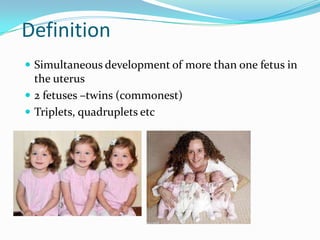
 Simultaneous development of more than one fetus in

the uterus
 2 fetuses –twins (commonest)
 Triplets, quadruplets etc
Incidence
 Hellin’s Law – Twin = 1:80

Triplets = 1:80²
Quadruplets = 1:80³
 Monozygotic = 3-5/1000 births
 Dizygotic = varies depending on
maternal age, race and geographical
distribution
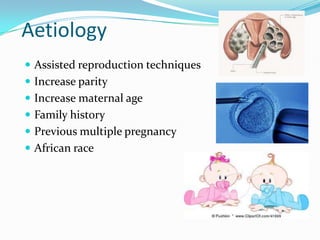
Aetiology
 Assisted reproduction techniques

 Increase parity
 Increase maternal age
 Family history
 Previous multiple pregnancy
 African race
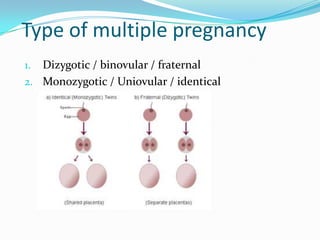
Type of multiple pregnancy
Dizygotic / binovular / fraternal
2. Monozygotic / Uniovular / identical
1.
Types of Monozygotic twins
1. Dichorionic Diamniotic :
i. Division occurs with in 72 hrs of fertilization
ii. May have 2 diff placentas/ single fused placenta
iii.Difficult to differentiate form dizygotic twins
iv.Both babies have same sex
2. Monochorionic Diamniotic:
I. Division occurs with in 4 – 8 days of fertilization
3. Monochorionic Monoamniotic:
I. Division occurs 9-12 days of fertilization
4. Conjoined twins:
I. Division occurs after 13th day
II. Incomplete division of embryonic disc
III. Types: -thoracopagus
- omphalophagus

-craniopagus
-pyopagus
-ischiopagus
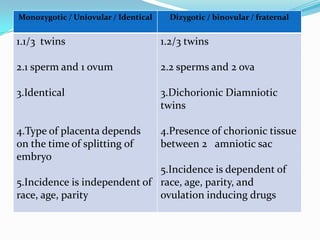
Monozygotic / Uniovular / Identical

Dizygotic / binovular / fraternal

1.1/3 twins

1.2/3 twins

2.1 sperm and 1 ovum

2.2 sperms and 2 ova

3.Identical

3.Dichorionic Diamniotic
twins

4.Type of placenta depends
on the time of splitting of
embryo

4.Presence of chorionic tissue
between 2 amniotic sac

5.Incidence is dependent of
5.Incidence is independent of race, age, parity, and
race, age, parity
ovulation inducing drugs
Clinical presentation
Symptoms :
• ↑ nausea, vomiting
• ↑ pressure symptoms:



•
•
•
•
•

constipation, pedal edema, varicosity of veins,
palpitations, precordial pain

Fatigue, indigestion, backache, sleeplessness
H/O overdistension
H/O premature labor
Excessive fetal movements
F/H, H/O ovulation inducing drugs
SIGNS :
• Anemia
• Edema
• Abnormal Weight Gain
• Uterine Height > POG
It may be normal size in case of binovular twins/ when 1 of
the babies die in utero
Palpation:
Feel 2 separate heads/ > 2 poles

Auscultation :
2 FHS with difference of at least 10 beats heard on 2 sides of
uterus by 2 people, at least 6 inches away
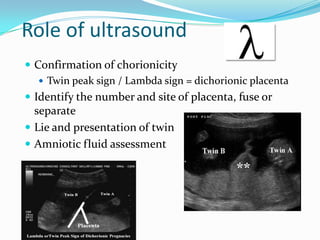
Role of ultrasound
 Confirmation of chorionicity
 Twin peak sign / Lambda sign = dichorionic placenta
 Identify the number and site of placenta, fuse or

separate
 Lie and presentation of twin
 Amniotic fluid assessment
Maternal Complication
Antenatal :
1. Hyperemesis gravidarum
2. ↑chances of abortion
3. hydramnios
4. PIH
5. Placenta previa, abruptio
6. Anemia
7. Exaggerated minor problems: pressure symptoms, etc
 Intrapartum :
1. Prolonged labor (uterine inertia)
2. Malpresentation
3. Cord prolapse
4. Abruptio placenta for 2nd twin
5. PPH
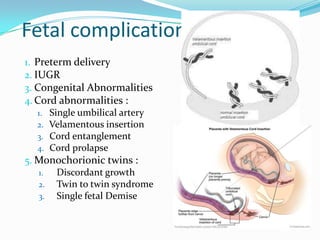
Fetal complications
1. Preterm delivery
2. IUGR
3. Congenital Abnormalities
4. Cord abnormalities :
1. Single umbilical artery
2. Velamentous insertion
3. Cord entanglement
4. Cord prolapse
5. Monochorionic twins :
1.
Discordant growth
2. Twin to twin syndrome
3. Single fetal Demise
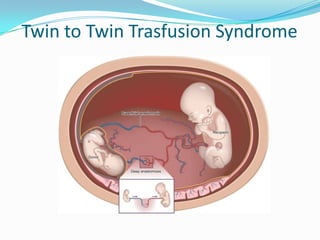
Twin to Twin Trasfusion Syndrome
Twin to Twin Transfusion
Syndrome
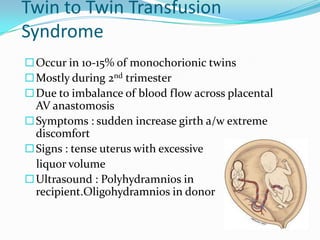
 Occur in 10-15% of monochorionic twins
 Mostly during 2nd trimester
 Due to imbalance of blood flow across placental

AV anastomosis
 Symptoms : sudden increase girth a/w extreme
discomfort
 Signs : tense uterus with excessive
liquor volume
 Ultrasound : Polyhydramnios in
recipient.Oligohydramnios in donor
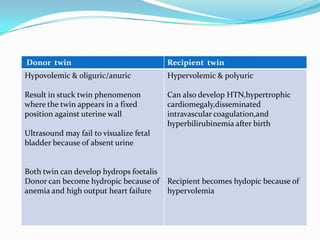
Donor twin

Recipient twin

Hypovolemic & oliguric/anuric

Hypervolemic & polyuric

Result in stuck twin phenomenon
where the twin appears in a fixed
position against uterine wall

Can also develop HTN,hypertrophic
cardiomegaly,disseminated
intravascular coagulation,and
hyperbilirubinemia after birth

Ultrasound may fail to visualize fetal
bladder because of absent urine

Both twin can develop hydrops foetalis
Donor can become hydropic because of
anemia and high output heart failure

Recipient becomes hydopic because of

hypervolemia
Single Fetal Demise
 > in Monochorionic twin

 If one twin dies after 14wk,there is high risk of


neurological damage to survivor twin : due to
thromboplastin release  thrombotic arterial
occlusion of ant & middle cerebral arteries
multicystic encephalomalacia
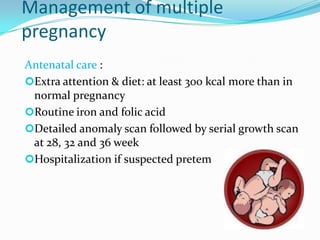
Management of multiple
pregnancy
Antenatal care :
Extra attention & diet: at least 300 kcal more than in
normal pregnancy
Routine iron and folic acid
Detailed anomaly scan followed by serial growth scan
at 28, 32 and 36 week
Hospitalization if suspected pretem
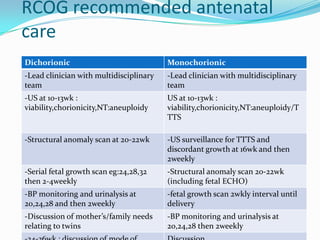
RCOG recommended antenatal
care
Dichorionic

Monochorionic

-Lead clinician with multidisciplinary
team

-Lead clinician with multidisciplinary
team

-US at 10-13wk :
viability,chorionicity,NT:aneuploidy

US at 10-13wk :
viability,chorionicity,NT:aneuploidy/T
TTS

-Structural anomaly scan at 20-22wk

-US surveillance for TTTS and
discordant growth at 16wk and then
2weekly

-Serial fetal growth scan eg:24,28,32
then 2-4weekly

-Structural anomaly scan 20-22wk
(including fetal ECHO)

-BP monitoring and urinalysis at
20,24,28 and then 2weekly

-fetal growth scan 2wkly interval until
delivery

-Discussion of mother’s/family needs
relating to twins

-BP monitoring and urinalysis at
20,24,28 then 2weekly
Timing of delivery
 Uncomplicated dichorionic – by

38 week
 Uncomplicated monochorionic –
by 37 week
 TTTS – depend on current
situation
 MCMA – 32 week, by LSCS
Mode of delivery
 Depend on presentation of 1st twin
 Both vertex / 1st twin vertex –

vaginal delivery
 Indication for Elective LSCS
-More than 2 fetuses
-1st twin malpresentation, CPD
-Scarred uterus
-MCMA
-Conjoint twin
-IUGR in dichorionic twin
-TTTS
 Emergency LSCS :

-Fetal distress
-cord prolapse in 1st baby
-Non progress of labor
-2nd twin is transverse, version failed after
delivery of 1st twin
Management during labour 1st
stage
1.

2.
3.
4.
5.
6.

Determine the presentation of 1st twin
Maintain partogram
Keep NBM and establish IV line
Blood grouping and cross matched
Continous intrapartum twin CTG monitoring
Analgesic
Management during labour 2nd
stage
1. Delivery of 1st twin

2. Clamp and cut the cord
3. Note lie of the 2nd twin (delivered within 20 min)
4. Longitudinal lie (abdominally & vaginally) :

Start 2 units of pitocin IV drip
Cephalic  Fix the head into pelvisARM &
deliver the fetus
Breech  Assisted breech delivery, Breech
extraction
If 2nd twin has transverse lie :
•
•
•
•

Assistant performs ECV.
Fix the head in lower pole of the uterus and accoucher
performs controlled ROM (rupture of membrane)
If this fails: do IPV (internal podalic version) followed
by breech extraction
Or proceed with emergency LSCS
Thank You
Copyrights not reserved.
x©x 2013-05-03
Multiple Pregnancy
Multiple Pregnancy
Multiple Pregnancy
Multiple Pregnancy
Multiple Pregnancy
Multiple Pregnancy
Multiple Pregnancy
Multiple Pregnancy
Multiple Pregnancy
Multiple Pregnancy
Multiple Pregnancy
Multiple Pregnancy
Multiple Pregnancy
Multiple Pregnancy
Multiple Pregnancy
Multiple Pregnancy
Multiple Pregnancy
Multiple Pregnancy
Multiple Pregnancy
Multiple Pregnancy
Multiple Pregnancy
Multiple Pregnancy
Multiple Pregnancy
Multiple Pregnancy
Multiple Pregnancy
Multiple Pregnancy
Multiple Pregnancy
Multiple Pregnancy
Multiple Pregnancy
Multiple Pregnancy
Multiple Pregnancy
Multiple Pregnancy
Multiple Pregnancy
Multiple Pregnancy
Multiple Pregnancy
Multiple Pregnancy
Multiple Pregnancy
Multiple Pregnancy

Multiple Pregnancy

  • 1.
    Muhammad Redzwan BinAbdullah 081303583 Batch 25 Group E2
  • 2.
  • 3.
    Definition  Simultaneous developmentof more than one fetus in the uterus  2 fetuses –twins (commonest)  Triplets, quadruplets etc
  • 4.
    Incidence  Hellin’s Law– Twin = 1:80 Triplets = 1:80² Quadruplets = 1:80³  Monozygotic = 3-5/1000 births  Dizygotic = varies depending on maternal age, race and geographical distribution
  • 5.
    Aetiology  Assisted reproductiontechniques  Increase parity  Increase maternal age  Family history  Previous multiple pregnancy  African race
  • 6.
    Type of multiplepregnancy Dizygotic / binovular / fraternal 2. Monozygotic / Uniovular / identical 1.
  • 7.
    Types of Monozygotictwins 1. Dichorionic Diamniotic : i. Division occurs with in 72 hrs of fertilization ii. May have 2 diff placentas/ single fused placenta iii.Difficult to differentiate form dizygotic twins iv.Both babies have same sex 2. Monochorionic Diamniotic: I. Division occurs with in 4 – 8 days of fertilization
  • 8.
    3. Monochorionic Monoamniotic: I.Division occurs 9-12 days of fertilization 4. Conjoined twins: I. Division occurs after 13th day II. Incomplete division of embryonic disc III. Types: -thoracopagus - omphalophagus -craniopagus -pyopagus -ischiopagus
  • 9.
    Monozygotic / Uniovular/ Identical Dizygotic / binovular / fraternal 1.1/3 twins 1.2/3 twins 2.1 sperm and 1 ovum 2.2 sperms and 2 ova 3.Identical 3.Dichorionic Diamniotic twins 4.Type of placenta depends on the time of splitting of embryo 4.Presence of chorionic tissue between 2 amniotic sac 5.Incidence is dependent of 5.Incidence is independent of race, age, parity, and race, age, parity ovulation inducing drugs
  • 10.
    Clinical presentation Symptoms : •↑ nausea, vomiting • ↑ pressure symptoms:   • • • • • constipation, pedal edema, varicosity of veins, palpitations, precordial pain Fatigue, indigestion, backache, sleeplessness H/O overdistension H/O premature labor Excessive fetal movements F/H, H/O ovulation inducing drugs
  • 11.
    SIGNS : • Anemia •Edema • Abnormal Weight Gain • Uterine Height > POG It may be normal size in case of binovular twins/ when 1 of the babies die in utero Palpation: Feel 2 separate heads/ > 2 poles Auscultation : 2 FHS with difference of at least 10 beats heard on 2 sides of uterus by 2 people, at least 6 inches away
  • 12.
    Role of ultrasound Confirmation of chorionicity  Twin peak sign / Lambda sign = dichorionic placenta  Identify the number and site of placenta, fuse or separate  Lie and presentation of twin  Amniotic fluid assessment
  • 13.
    Maternal Complication Antenatal : 1.Hyperemesis gravidarum 2. ↑chances of abortion 3. hydramnios 4. PIH 5. Placenta previa, abruptio 6. Anemia 7. Exaggerated minor problems: pressure symptoms, etc
  • 14.
     Intrapartum : 1.Prolonged labor (uterine inertia) 2. Malpresentation 3. Cord prolapse 4. Abruptio placenta for 2nd twin 5. PPH
  • 15.
    Fetal complications 1. Pretermdelivery 2. IUGR 3. Congenital Abnormalities 4. Cord abnormalities : 1. Single umbilical artery 2. Velamentous insertion 3. Cord entanglement 4. Cord prolapse 5. Monochorionic twins : 1. Discordant growth 2. Twin to twin syndrome 3. Single fetal Demise
  • 16.
    Twin to TwinTrasfusion Syndrome
  • 17.
    Twin to TwinTransfusion Syndrome  Occur in 10-15% of monochorionic twins  Mostly during 2nd trimester  Due to imbalance of blood flow across placental AV anastomosis  Symptoms : sudden increase girth a/w extreme discomfort  Signs : tense uterus with excessive liquor volume  Ultrasound : Polyhydramnios in recipient.Oligohydramnios in donor
  • 18.
    Donor twin Recipient twin Hypovolemic& oliguric/anuric Hypervolemic & polyuric Result in stuck twin phenomenon where the twin appears in a fixed position against uterine wall Can also develop HTN,hypertrophic cardiomegaly,disseminated intravascular coagulation,and hyperbilirubinemia after birth Ultrasound may fail to visualize fetal bladder because of absent urine Both twin can develop hydrops foetalis Donor can become hydropic because of anemia and high output heart failure Recipient becomes hydopic because of hypervolemia
  • 19.
    Single Fetal Demise > in Monochorionic twin  If one twin dies after 14wk,there is high risk of neurological damage to survivor twin : due to thromboplastin release  thrombotic arterial occlusion of ant & middle cerebral arteries multicystic encephalomalacia
  • 20.
    Management of multiple pregnancy Antenatalcare : Extra attention & diet: at least 300 kcal more than in normal pregnancy Routine iron and folic acid Detailed anomaly scan followed by serial growth scan at 28, 32 and 36 week Hospitalization if suspected pretem
  • 21.
    RCOG recommended antenatal care Dichorionic Monochorionic -Leadclinician with multidisciplinary team -Lead clinician with multidisciplinary team -US at 10-13wk : viability,chorionicity,NT:aneuploidy US at 10-13wk : viability,chorionicity,NT:aneuploidy/T TTS -Structural anomaly scan at 20-22wk -US surveillance for TTTS and discordant growth at 16wk and then 2weekly -Serial fetal growth scan eg:24,28,32 then 2-4weekly -Structural anomaly scan 20-22wk (including fetal ECHO) -BP monitoring and urinalysis at 20,24,28 and then 2weekly -fetal growth scan 2wkly interval until delivery -Discussion of mother’s/family needs relating to twins -BP monitoring and urinalysis at 20,24,28 then 2weekly
  • 22.
    Timing of delivery Uncomplicated dichorionic – by 38 week  Uncomplicated monochorionic – by 37 week  TTTS – depend on current situation  MCMA – 32 week, by LSCS
  • 23.
    Mode of delivery Depend on presentation of 1st twin  Both vertex / 1st twin vertex – vaginal delivery  Indication for Elective LSCS -More than 2 fetuses -1st twin malpresentation, CPD -Scarred uterus -MCMA -Conjoint twin -IUGR in dichorionic twin -TTTS
  • 24.
     Emergency LSCS: -Fetal distress -cord prolapse in 1st baby -Non progress of labor -2nd twin is transverse, version failed after delivery of 1st twin
  • 25.
    Management during labour1st stage 1. 2. 3. 4. 5. 6. Determine the presentation of 1st twin Maintain partogram Keep NBM and establish IV line Blood grouping and cross matched Continous intrapartum twin CTG monitoring Analgesic
  • 26.
    Management during labour2nd stage 1. Delivery of 1st twin 2. Clamp and cut the cord 3. Note lie of the 2nd twin (delivered within 20 min) 4. Longitudinal lie (abdominally & vaginally) : Start 2 units of pitocin IV drip Cephalic  Fix the head into pelvisARM & deliver the fetus Breech  Assisted breech delivery, Breech extraction
  • 27.
    If 2nd twinhas transverse lie : • • • • Assistant performs ECV. Fix the head in lower pole of the uterus and accoucher performs controlled ROM (rupture of membrane) If this fails: do IPV (internal podalic version) followed by breech extraction Or proceed with emergency LSCS
  • 28.
    Thank You Copyrights notreserved. x©x 2013-05-03