BIRTH CONTROL
www.plus100years.com
Introduction
 Birth control methods have been prevalent since thousands of
years.
 Earlier the methods were carried out on trial and error basis
and some of the traditional methods failed completely while
some provided restricted results.
 However, today, you have so many birth control methods that
are not only safe and highly effective but also very easy to use.
The process of birth control takes into account actions , sexual
practices, devices or medications that are followed for
preventing intentionally or reducing the chances of childbirth
or pregnancy.
There are three types of routes generally used for carrying out
birth control
 Contraception
 Contragestion
 Surgical or chemical process
Birth Control
• Contraception: In this method, the process of ovum
fertilization by the sperm cells is prevented.
• Contragestion: This is the pill after morning that prevents the
implantation of the fertilized egg.
• Surgical or chemical process: In this process, the developing
fetus or embryo is aborted surgically or by giving certain
medication.
Contraception
 During contraception different agents, devices, sexual
practices, drugs or surgical procedures are used to prevent
impregnation or conception.
 With the help of contraception, women can plan the exact time
when they want to conceive.
 At present condom is the only contraception that offers
protection to partners from sexually transmitted infections.
Reversible Birth Control Methods
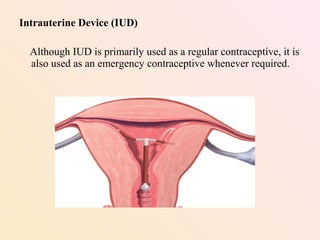
Intrauterine Device (IUD):
 Although is primarily used as a regular contraceptive, it is
also used as an emergency contraceptive whenever required.
 The intrauterine device is flexible, small and T-shaped and is
placed inside the uterus by the physician.
 It remains in the same place for the entire time you do not
desire to conceive.
• Depending upon the type of IUD you choose, it can be
effective from five to 10 years.
Hormonal Methods
 These methods include injections, implants, oral
contraceptives, the hormonally contraceptive ring and the
patch.
 All these hormonal methods have 91 to 99 percent
effectiveness
These include:
Contraceptive Pills
 These pills come with combination of two essential sexual
hormones-progestin and estrogen.
 These hormones together stop the ovulation process and also
makes the uterus lining thinner.
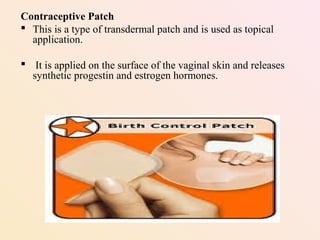
Contraceptive Patch
 This is a type of transdermal patch and is used as topical
application.
 It is applied on the surface of the vaginal skin and releases
synthetic progestin and estrogen hormones.
How to use:
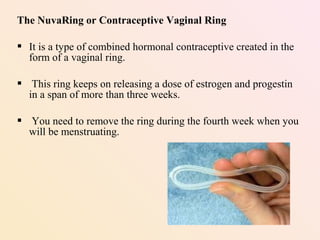
The NuvaRing or Contraceptive Vaginal Ring
 It is a type of combined hormonal contraceptive created in the
form of a vaginal ring.
 This ring keeps on releasing a dose of estrogen and progestin
in a span of more than three weeks.
 You need to remove the ring during the fourth week when you
will be menstruating.
How to insert
Contraceptive Shot or Injection
 This injection is injected in every three months to stop the
process of release of egg in women.
 It offers contraceptive results and is made up of a type of
progestin hormone-depot medroxyprogesterone acetate that
acts as a reversible birth control hormonal drug.
Implanon
 Implanon, a rod with progestin at its core is inserted beneath the
woman’s upper arm.
 The rod releases the progestin slowly and is very effective as a
birth control method for three years.
Barrier Methods
These are 79 to 98 percent effective in preventing
impregnation and can to some extent help to prevent STD’s.
These includes
Female Condom
 These too are made of polyurethane and come with a flexible
ring on both the ends.
 One ring is inserted into the vagina behind the pubic bone to
secure the condom in one place and the other is placed outside
the vagina
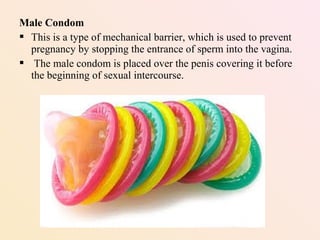
Male Condom
 This is a type of mechanical barrier, which is used to prevent
pregnancy by stopping the entrance of sperm into the vagina.
 The male condom is placed over the penis covering it before
the beginning of sexual intercourse.
Contraceptive sponge
 Women use this contraceptive inside the vagina.
 In this process, an applicator is used to place foam inside the
vagina.
 This foam contains spermicidal that is effective in destroying
male sperms.
How to use
Spermicides
 This chemical contraceptive is kept inside the vagina just
before the sexual intercourse to create a barrier.
 It is sometimes used along with a physical barrier such as the
contraceptive sponge.
Diaphragm
This is placed inside the vagina just behind the pubic bone of
the woman and comes with a flexible and firm ring due to
which it can be pressed easily against the walls of the vagina
and fixed in one place.
The Lea Contraceptive
 The Lea contraceptive is a cup-shaped soft and pliable bowl
with an attached loop.
 It is placed inside the vagina just before the sexual intercourse
to stop the sperms from entering inside the cervix
Cervical Cap
 This cap as the name suggests caps the cervix and prevents the
entrance of sperm inside the uterus via the external uterus
orifice also called os.
 The cap has a shape resembling a thimble and is a type of
rubber-latex barrier device.
Fertility Awareness
 This type of awareness includes understanding the pattern of
your fertility such as trying to find out the days of the month
when you are fertile and the days when you are infertile and
also the days in a month when you are less fertile but still
pregnancy can be possible.
 Knowing these fertility patterns help you to avoid intercourse
during the days when you are fertile or use the barrier methods
only during those days when you are fertile.
 This type of birth control method has been found to be 75 to
96 percent effective.
Permanent Birth Control Methods
Tubal ligation/ Female Sterilization
 In this process, the fallopian tubes are sealed after severing
them to prevent fertilization.
 This is the permanent way to sterilize a female.
 In this case, the eggs and sperms are prevented from coming in
contact
Transcervical Sterilization
 During this process, your doctor places a flexible, soft inserts
into your fallopian tubes through cervix and vagina.
 In the next three months, your body starts working with the
inserts to create a natural barrier and prevents the fertilization
process.
Male Sterilization
 The man is made sterile surgically through this process.
 The two tubes-the left and right vas deferens from which the
sperms come out and ejaculate are either blocked or cut.
Emergency Contraceptives
 This is also known as emergency postcoital contraception
and includes measures that are taken to prevent pregnancy
after the sexual intercourse.
 Emergency contraceptives are used when either primary
contraceptive fail or you forget to use any contraceptive before
the sexual intercourse.
Types of emergency contraceptives
Emergency Contraceptive Pills
 This is an emergency pill also known as morning-after-pill.
 It is a type of drug that prevents the occurrence of fertilization
or ovulation and also restricts the possible post-fertilization
implantation process of an embryo or blastocyst.
Intrauterine Device (IUD)
Although IUD is primarily used as a regular contraceptive, it is
also used as an emergency contraceptive whenever required.
Side effects of using Birth Control Pills
• Weight gain
• Nausea
• Small amounts of spotting or blood in between the periods
• Swollen or sore breasts
• Mood changes
• Lighter periods
ACHES
The ACHES include
• Chest pain
• Severe headaches
• Abdominal or stomach pain
• Blurred vision or eye problems
• Aching or swelling in the thighs and legs
What Health Issues Might Limit Your
Choices?
• Are pregnant or have chances of getting pregnant
• Smoke
• Have a serious health problem such as hypertension, heart
disease, diabetes, migraine or headache
• Are suffering from deep vein thrombosis or pulmonary
embolism
• Have one of the close family members suffering from blood
clots in lungs or legs
• Have been a patient of breast cancer before
• Are suffering from sexually transmitted infection or disease
Do Birth Control Methods Affect Fertility?
 It is but natural to worry about the effect of birth control
method on fertility as using birth control medications or pills
can have direct impact on your fertility level.
 Methods containing hormones have a tendency to alter some
part of your reproductive system as they prevent ovulation as
well as implantation of sperm.
 This is the reason why many caregivers advise caution while
using birth control methods.
 Although these methods do cause temporary loss of fertility,
no serious side effects on the fertility of a woman have been
witnessed until now.
Ovulation
 When a woman uses hormone birth control such as injection,
pills, intrauterine device or implant the hormones will stop
releasing the egg from the ovaries of a woman.
 The research by Mayo clinic suggests that ovulation begins
again two weeks after you have stopped taking the birth control
measures.
 Once the ovulation process has started, a woman can conceive
anytime.
 In case of some women though, there can be delay in the re-
start of ovulation but this is very rare.
Temporary Infertility
 A woman using estrogen and progestin birth control pills will
have two to three months of temporary infertility phase
 A woman using hormone birth control injection such as the
Depo-Provera will have to face six to 12 months of temporary
infertility phase
Miscarriage
 Earlier doctors thought that women who used birth control
measures had an increased chance of miscarriage immediately
after pregnancy.
 However, the recent researches suggest that this is not the
case and now women can become pregnant safely without any
cause to worry about miscarriage.
Medications That Interfere with Birth
Control Methods
 Antibiotics
 Migraine and Anti-Seizure Medications
 Anti-Fungal Medications
 Medications for Anxiety
 HIV Medicines
 Medications for Respiratory Problems
 Diabetic Medications
www.Plus100years.com
Live long Happily

Birthcontrol

  • 1.
  • 2.
    Introduction  Birth controlmethods have been prevalent since thousands of years.  Earlier the methods were carried out on trial and error basis and some of the traditional methods failed completely while some provided restricted results.  However, today, you have so many birth control methods that are not only safe and highly effective but also very easy to use.
  • 3.
    The process ofbirth control takes into account actions , sexual practices, devices or medications that are followed for preventing intentionally or reducing the chances of childbirth or pregnancy. There are three types of routes generally used for carrying out birth control  Contraception  Contragestion  Surgical or chemical process Birth Control
  • 4.
    • Contraception: Inthis method, the process of ovum fertilization by the sperm cells is prevented. • Contragestion: This is the pill after morning that prevents the implantation of the fertilized egg. • Surgical or chemical process: In this process, the developing fetus or embryo is aborted surgically or by giving certain medication.
  • 5.
    Contraception  During contraceptiondifferent agents, devices, sexual practices, drugs or surgical procedures are used to prevent impregnation or conception.  With the help of contraception, women can plan the exact time when they want to conceive.  At present condom is the only contraception that offers protection to partners from sexually transmitted infections.
  • 6.
    Reversible Birth ControlMethods Intrauterine Device (IUD):  Although is primarily used as a regular contraceptive, it is also used as an emergency contraceptive whenever required.  The intrauterine device is flexible, small and T-shaped and is placed inside the uterus by the physician.  It remains in the same place for the entire time you do not desire to conceive.
  • 7.
    • Depending uponthe type of IUD you choose, it can be effective from five to 10 years.
  • 8.
    Hormonal Methods  Thesemethods include injections, implants, oral contraceptives, the hormonally contraceptive ring and the patch.  All these hormonal methods have 91 to 99 percent effectiveness These include: Contraceptive Pills  These pills come with combination of two essential sexual hormones-progestin and estrogen.  These hormones together stop the ovulation process and also makes the uterus lining thinner.
  • 9.
    Contraceptive Patch  Thisis a type of transdermal patch and is used as topical application.  It is applied on the surface of the vaginal skin and releases synthetic progestin and estrogen hormones.
  • 10.
  • 11.
    The NuvaRing orContraceptive Vaginal Ring  It is a type of combined hormonal contraceptive created in the form of a vaginal ring.  This ring keeps on releasing a dose of estrogen and progestin in a span of more than three weeks.  You need to remove the ring during the fourth week when you will be menstruating.
  • 12.
  • 13.
    Contraceptive Shot orInjection  This injection is injected in every three months to stop the process of release of egg in women.  It offers contraceptive results and is made up of a type of progestin hormone-depot medroxyprogesterone acetate that acts as a reversible birth control hormonal drug.
  • 14.
    Implanon  Implanon, arod with progestin at its core is inserted beneath the woman’s upper arm.  The rod releases the progestin slowly and is very effective as a birth control method for three years.
  • 15.
    Barrier Methods These are79 to 98 percent effective in preventing impregnation and can to some extent help to prevent STD’s. These includes Female Condom  These too are made of polyurethane and come with a flexible ring on both the ends.
  • 16.
     One ringis inserted into the vagina behind the pubic bone to secure the condom in one place and the other is placed outside the vagina
  • 17.
    Male Condom  Thisis a type of mechanical barrier, which is used to prevent pregnancy by stopping the entrance of sperm into the vagina.  The male condom is placed over the penis covering it before the beginning of sexual intercourse.
  • 18.
    Contraceptive sponge  Womenuse this contraceptive inside the vagina.  In this process, an applicator is used to place foam inside the vagina.  This foam contains spermicidal that is effective in destroying male sperms.
  • 19.
  • 20.
    Spermicides  This chemicalcontraceptive is kept inside the vagina just before the sexual intercourse to create a barrier.  It is sometimes used along with a physical barrier such as the contraceptive sponge. Diaphragm This is placed inside the vagina just behind the pubic bone of the woman and comes with a flexible and firm ring due to which it can be pressed easily against the walls of the vagina and fixed in one place.
  • 21.
    The Lea Contraceptive The Lea contraceptive is a cup-shaped soft and pliable bowl with an attached loop.  It is placed inside the vagina just before the sexual intercourse to stop the sperms from entering inside the cervix
  • 22.
    Cervical Cap  Thiscap as the name suggests caps the cervix and prevents the entrance of sperm inside the uterus via the external uterus orifice also called os.  The cap has a shape resembling a thimble and is a type of rubber-latex barrier device.
  • 23.
    Fertility Awareness  Thistype of awareness includes understanding the pattern of your fertility such as trying to find out the days of the month when you are fertile and the days when you are infertile and also the days in a month when you are less fertile but still pregnancy can be possible.  Knowing these fertility patterns help you to avoid intercourse during the days when you are fertile or use the barrier methods only during those days when you are fertile.  This type of birth control method has been found to be 75 to 96 percent effective.
  • 24.
    Permanent Birth ControlMethods Tubal ligation/ Female Sterilization  In this process, the fallopian tubes are sealed after severing them to prevent fertilization.  This is the permanent way to sterilize a female.  In this case, the eggs and sperms are prevented from coming in contact
  • 25.
    Transcervical Sterilization  Duringthis process, your doctor places a flexible, soft inserts into your fallopian tubes through cervix and vagina.  In the next three months, your body starts working with the inserts to create a natural barrier and prevents the fertilization process. Male Sterilization  The man is made sterile surgically through this process.  The two tubes-the left and right vas deferens from which the sperms come out and ejaculate are either blocked or cut.
  • 26.
    Emergency Contraceptives  Thisis also known as emergency postcoital contraception and includes measures that are taken to prevent pregnancy after the sexual intercourse.  Emergency contraceptives are used when either primary contraceptive fail or you forget to use any contraceptive before the sexual intercourse.
  • 27.
    Types of emergencycontraceptives Emergency Contraceptive Pills  This is an emergency pill also known as morning-after-pill.  It is a type of drug that prevents the occurrence of fertilization or ovulation and also restricts the possible post-fertilization implantation process of an embryo or blastocyst.
  • 28.
    Intrauterine Device (IUD) AlthoughIUD is primarily used as a regular contraceptive, it is also used as an emergency contraceptive whenever required.
  • 29.
    Side effects ofusing Birth Control Pills • Weight gain • Nausea • Small amounts of spotting or blood in between the periods • Swollen or sore breasts • Mood changes • Lighter periods
  • 30.
    ACHES The ACHES include •Chest pain • Severe headaches • Abdominal or stomach pain • Blurred vision or eye problems • Aching or swelling in the thighs and legs
  • 31.
    What Health IssuesMight Limit Your Choices? • Are pregnant or have chances of getting pregnant • Smoke • Have a serious health problem such as hypertension, heart disease, diabetes, migraine or headache • Are suffering from deep vein thrombosis or pulmonary embolism • Have one of the close family members suffering from blood clots in lungs or legs • Have been a patient of breast cancer before • Are suffering from sexually transmitted infection or disease
  • 32.
    Do Birth ControlMethods Affect Fertility?  It is but natural to worry about the effect of birth control method on fertility as using birth control medications or pills can have direct impact on your fertility level.  Methods containing hormones have a tendency to alter some part of your reproductive system as they prevent ovulation as well as implantation of sperm.  This is the reason why many caregivers advise caution while using birth control methods.  Although these methods do cause temporary loss of fertility, no serious side effects on the fertility of a woman have been witnessed until now.
  • 33.
    Ovulation  When awoman uses hormone birth control such as injection, pills, intrauterine device or implant the hormones will stop releasing the egg from the ovaries of a woman.  The research by Mayo clinic suggests that ovulation begins again two weeks after you have stopped taking the birth control measures.  Once the ovulation process has started, a woman can conceive anytime.  In case of some women though, there can be delay in the re- start of ovulation but this is very rare.
  • 34.
    Temporary Infertility  Awoman using estrogen and progestin birth control pills will have two to three months of temporary infertility phase  A woman using hormone birth control injection such as the Depo-Provera will have to face six to 12 months of temporary infertility phase
  • 35.
    Miscarriage  Earlier doctorsthought that women who used birth control measures had an increased chance of miscarriage immediately after pregnancy.  However, the recent researches suggest that this is not the case and now women can become pregnant safely without any cause to worry about miscarriage.
  • 36.
    Medications That Interferewith Birth Control Methods  Antibiotics  Migraine and Anti-Seizure Medications  Anti-Fungal Medications  Medications for Anxiety  HIV Medicines  Medications for Respiratory Problems  Diabetic Medications
  • 37.