Breech
Presentatio
          n
     By,
       Ashrith K.C.
       Shimoga Institute Of
     Medical Sciences,
       Shimoga, K’taKa, India
Definition

        The presentation that the
fetus is in longitudinal lie and the
podalic pole presents at pelvic
brim.
Incidence


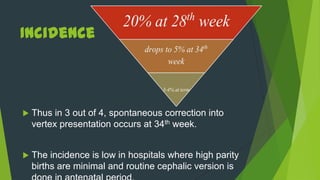
   Thus in 3 out of 4, spontaneous correction into
    vertex presentation occurs at 34th week.


   The incidence is low in hospitals where high parity
    births are minimal and routine cephalic version is
Types of breech
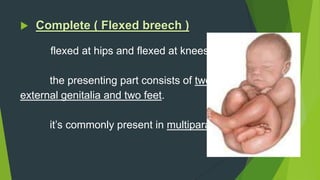
   Complete ( Flexed breech )

      flexed at hips and flexed at knees.

      the presenting part consists of two buttocks,
external genitalia and two feet.

      it’s commonly present in multiparae(10%).
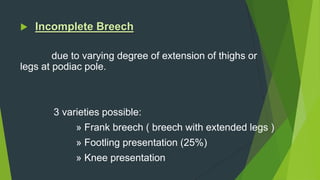
   Incomplete Breech

        due to varying degree of extension of thighs or
legs at podiac pole.


       3 varieties possible:
            » Frank breech ( breech with extended legs )
            » Footling presentation (25%)
            » Knee presentation
» Frank breech ( breech with
extended legs )
        the thighs are flexed on the trunk
and the legs are extended at the knee
joints.


        the presenting part consists of
two buttocks and external genitalia only.


       commonly present in
primigravidae (70%); due to tight
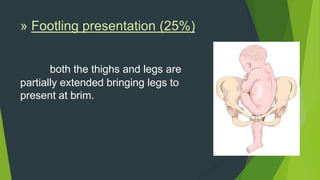
» Footling presentation (25%)


       both the thighs and legs are
partially extended bringing legs to
present at brim.
» Knee presentation


        thighs are extended but knees
are flexed, bringing the knees down to
present at the brim.
Clinical Varieties
 Uncomplicated        Breech
      defined as one where there is no other associated obstetric
complications apart from breech, prematurity being excluded.


 Complicated       Breech
       when presentation is associated with conditions which
adversely influence prognosis such as prematurity, twins, contracted
pelvis, placental praevia etc.


Extended legs, extended arms, cord prolapse or difficulty during
breech delivery should not be called complicated breech but are
called abnormal or complicated breech delivery.
Etiology
   Smaller size of foetus and comparatively larger volume of
    amniotic fluid allow the foetus to undergo spontaneous
    version by kicking movements until by 36th week when the
    position becomes stabilized.


   Known factors responsible for breech presentation:
        »Prematurity
        »Factors preventing spontaneous version
        »Favourable adaptation
        »Undue mobility of foetus
        »Foetal abnormality
» Prematurity: commonest cause of breech
presentation.

» Factors preventing spontaneous version:
      a) breech with extended legs
      b) Twins
      c) Oligohydramnios
       d) Congenital malformation of uterus like septate
or bicornuate uterus
      e) Short cord; relative or absolute
      f) Intrauterine death of foetus
» Favourable adaptation:
     a) Hydrocephalous; big head can be well
accommodated in wide fundus
      b) Placenta praevia
      c) Contracted pelvis
      d) Cornufundal attachment of placenta; minimizes
the space of fundus where smaller head can be placed
                      comfortably.
» Undue mobility of foetus:
      a) Hydramnios
      b) Multiparae with lax abdominal wall
» Foetal abnormality:
    a) trisomies 13, 18, 21
       b) anencephaly
       c) myotonic dystrophy due to alteration of foetal muscular
tone and

mobility.

Recurrent Breech:
      On occasion the breech presentation recurs in successive
pregnancies. When it recurs in 3 or more consecutive
pregnancies, it’s called Recurrent Breech.
Cause:
      » Congenital malformation of uterus; Septate or
bicornuate
Diagnosis


» Clinical:
    a) Per abdomen
    b) Per vaginam


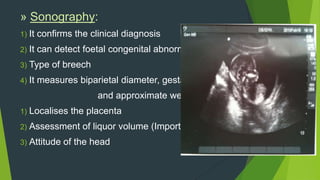
» Sonography:
» Clinical diagnosis:
» Sonography:
1)   It confirms the clinical diagnosis
2)   It can detect foetal congenital abnormality
3)   Type of breech
4)   It measures biparietal diameter, gestational age
                      and approximate weight of foetus
1)   Localises the placenta
2)   Assessment of liquor volume (Important for ECV)
3)   Attitude of the head
Positions:
 The sacrum is the denominator of the breech and there are 4
positions.
          In anterior positions, the sacrum is directed towards
iliopubic eminence.
           In posterior positions the sacrum is directed to sacro-
iliac joint.


  The positions are:
       (1.) 1st position – Left sacro-anterior (LSA) – being
comonest
         (2.) 2nd position – Right sacro-anterior (RSA)
Thank you

Breech presentation

  • 1.
    Breech Presentatio n By, Ashrith K.C. Shimoga Institute Of Medical Sciences, Shimoga, K’taKa, India
  • 2.
    Definition The presentation that the fetus is in longitudinal lie and the podalic pole presents at pelvic brim.
  • 3.
    Incidence  Thus in 3 out of 4, spontaneous correction into vertex presentation occurs at 34th week.  The incidence is low in hospitals where high parity births are minimal and routine cephalic version is
  • 4.
  • 5.
    Complete ( Flexed breech ) flexed at hips and flexed at knees. the presenting part consists of two buttocks, external genitalia and two feet. it’s commonly present in multiparae(10%).
  • 6.
    Incomplete Breech due to varying degree of extension of thighs or legs at podiac pole. 3 varieties possible: » Frank breech ( breech with extended legs ) » Footling presentation (25%) » Knee presentation
  • 7.
    » Frank breech( breech with extended legs ) the thighs are flexed on the trunk and the legs are extended at the knee joints. the presenting part consists of two buttocks and external genitalia only. commonly present in primigravidae (70%); due to tight
  • 8.
    » Footling presentation(25%) both the thighs and legs are partially extended bringing legs to present at brim.
  • 9.
    » Knee presentation thighs are extended but knees are flexed, bringing the knees down to present at the brim.
  • 10.
    Clinical Varieties  Uncomplicated Breech defined as one where there is no other associated obstetric complications apart from breech, prematurity being excluded.  Complicated Breech when presentation is associated with conditions which adversely influence prognosis such as prematurity, twins, contracted pelvis, placental praevia etc. Extended legs, extended arms, cord prolapse or difficulty during breech delivery should not be called complicated breech but are called abnormal or complicated breech delivery.
  • 11.
    Etiology  Smaller size of foetus and comparatively larger volume of amniotic fluid allow the foetus to undergo spontaneous version by kicking movements until by 36th week when the position becomes stabilized.  Known factors responsible for breech presentation: »Prematurity »Factors preventing spontaneous version »Favourable adaptation »Undue mobility of foetus »Foetal abnormality
  • 12.
    » Prematurity: commonestcause of breech presentation. » Factors preventing spontaneous version: a) breech with extended legs b) Twins c) Oligohydramnios d) Congenital malformation of uterus like septate or bicornuate uterus e) Short cord; relative or absolute f) Intrauterine death of foetus
  • 13.
    » Favourable adaptation: a) Hydrocephalous; big head can be well accommodated in wide fundus b) Placenta praevia c) Contracted pelvis d) Cornufundal attachment of placenta; minimizes the space of fundus where smaller head can be placed comfortably. » Undue mobility of foetus: a) Hydramnios b) Multiparae with lax abdominal wall
  • 14.
    » Foetal abnormality: a) trisomies 13, 18, 21 b) anencephaly c) myotonic dystrophy due to alteration of foetal muscular tone and mobility. Recurrent Breech: On occasion the breech presentation recurs in successive pregnancies. When it recurs in 3 or more consecutive pregnancies, it’s called Recurrent Breech. Cause: » Congenital malformation of uterus; Septate or bicornuate
  • 15.
    Diagnosis » Clinical: a) Per abdomen b) Per vaginam » Sonography:
  • 16.
  • 17.
    » Sonography: 1) It confirms the clinical diagnosis 2) It can detect foetal congenital abnormality 3) Type of breech 4) It measures biparietal diameter, gestational age and approximate weight of foetus 1) Localises the placenta 2) Assessment of liquor volume (Important for ECV) 3) Attitude of the head
  • 18.
    Positions: The sacrumis the denominator of the breech and there are 4 positions. In anterior positions, the sacrum is directed towards iliopubic eminence. In posterior positions the sacrum is directed to sacro- iliac joint. The positions are: (1.) 1st position – Left sacro-anterior (LSA) – being comonest (2.) 2nd position – Right sacro-anterior (RSA)
  • 19.