The Second
Principle
’
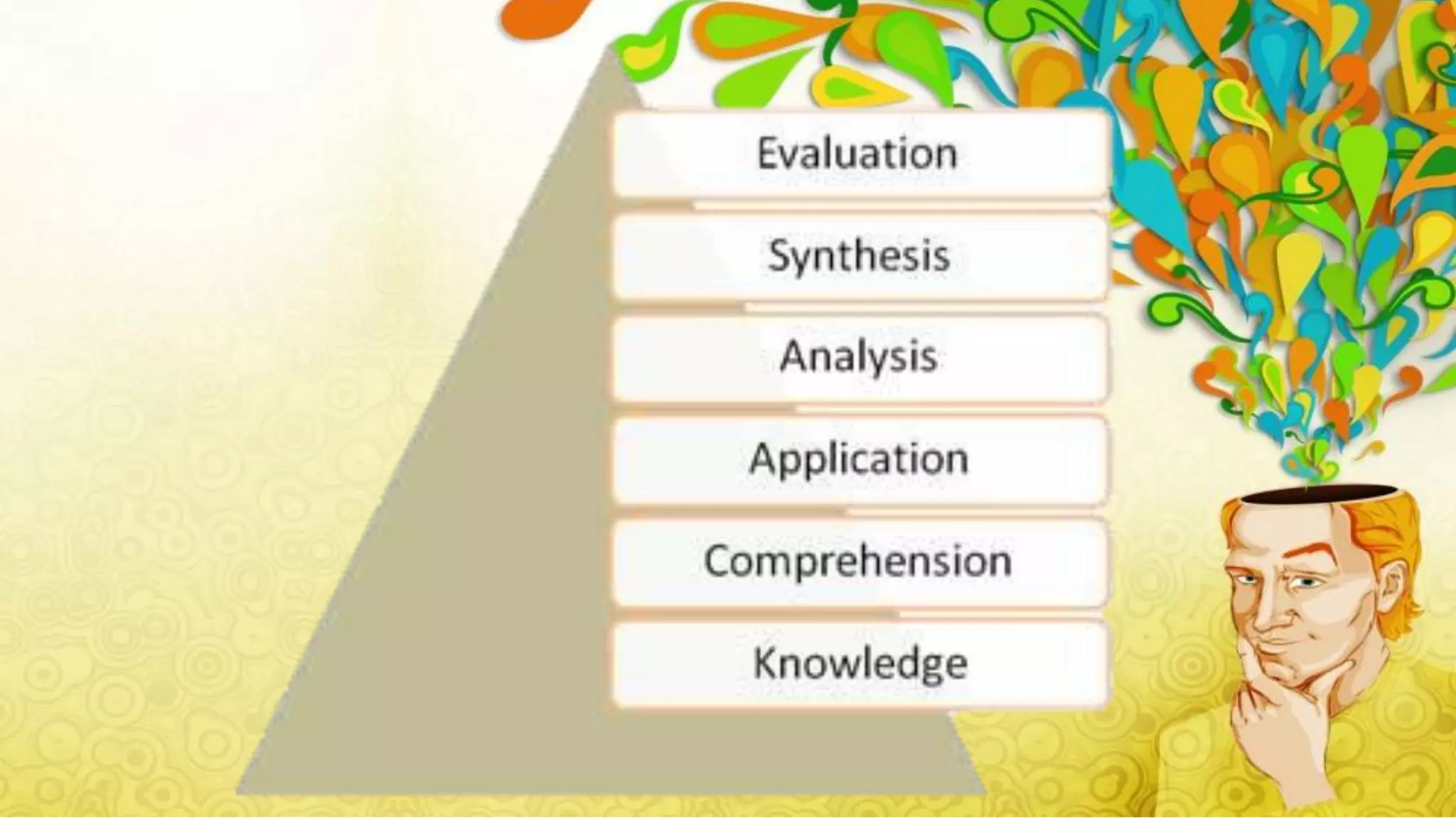
Bloom’s Taxonomy was created in 1956
under the leadership of educational
psychologist Dr. Benjamin Bloom in order to
promote higher forms of thinking education,
such as analyzing and evaluating , rather
than just remembering facts(rote learning).
With educational taxonomy, learning is classified into
three domains namely:
1. Cognitive Domain – domain of thought
process.
2. Affective Domain – domain of valuing, attitude
and appreciation.
3. Psychomotor Domain – domain of the use of
psychomotor attributes.
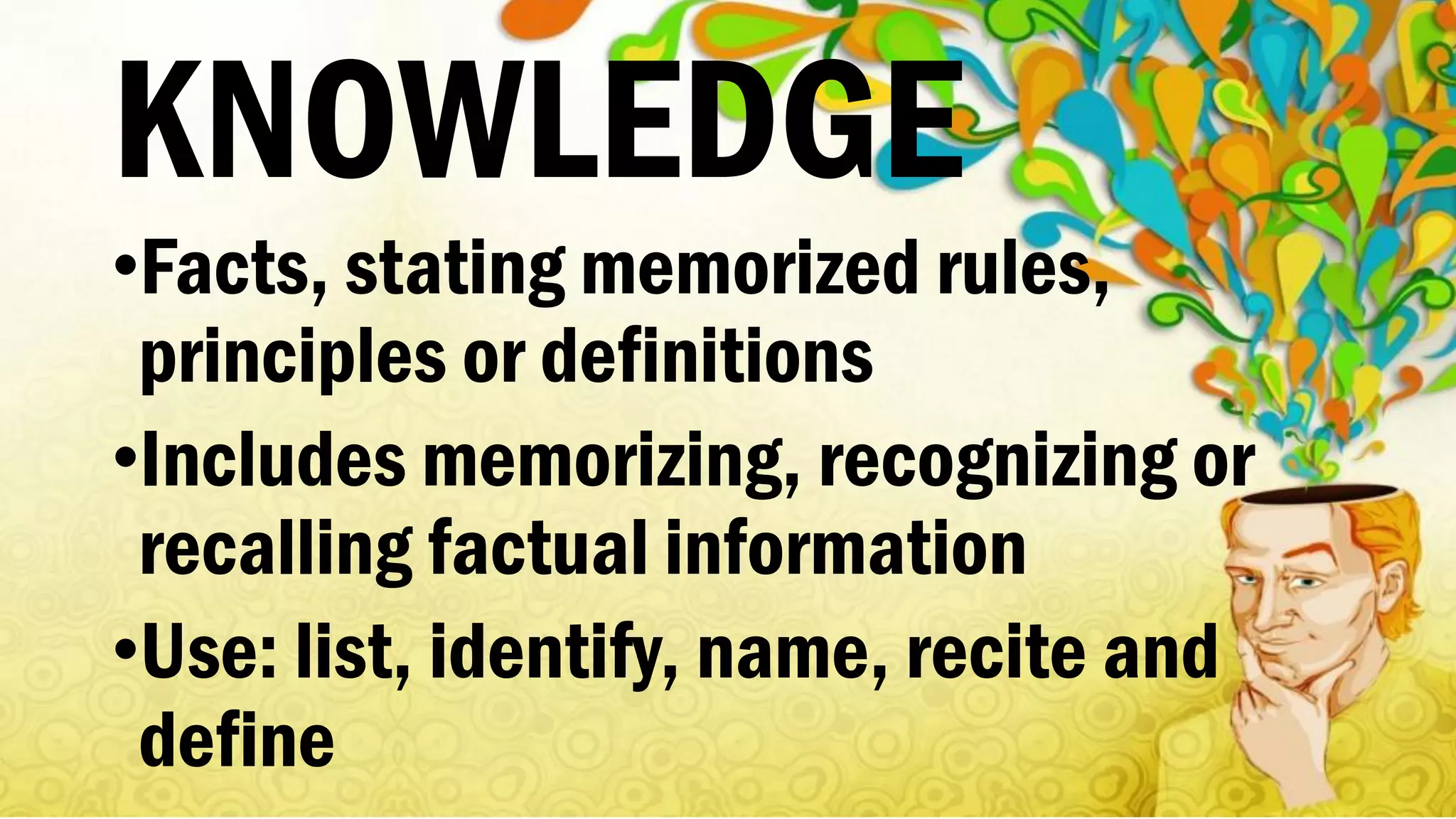
KNOWLEDGE
•Facts, stating memorized rules,
principles or definitions
•Includes memorizing, recognizing or
recalling factual information
•Use: list, identify, name, recite and
define
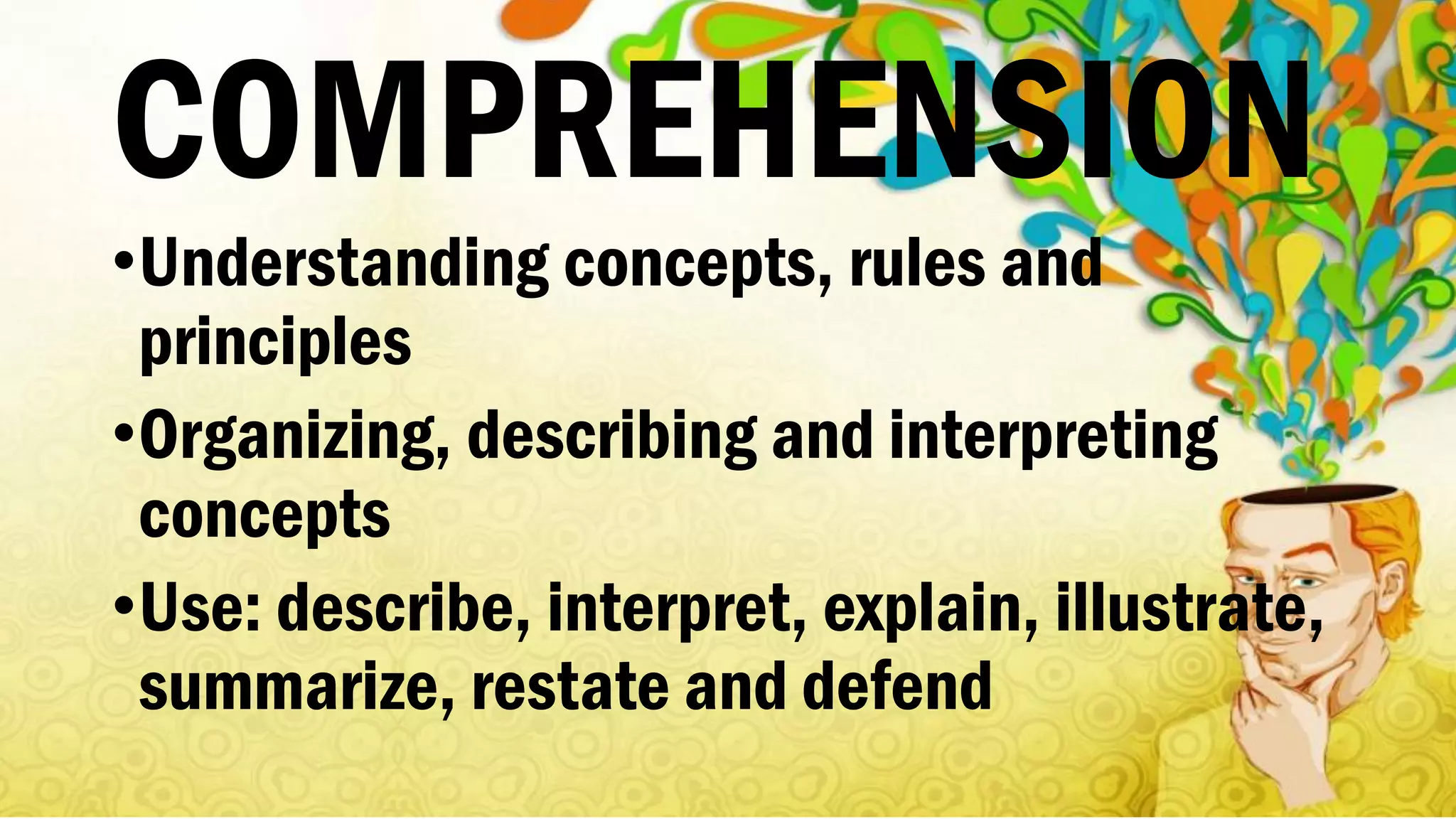
COMPREHENSION
•Understanding concepts, rules and
principles
•Organizing, describing and interpreting
concepts
•Use: describe, interpret, explain, illustrate,
summarize, restate and defend
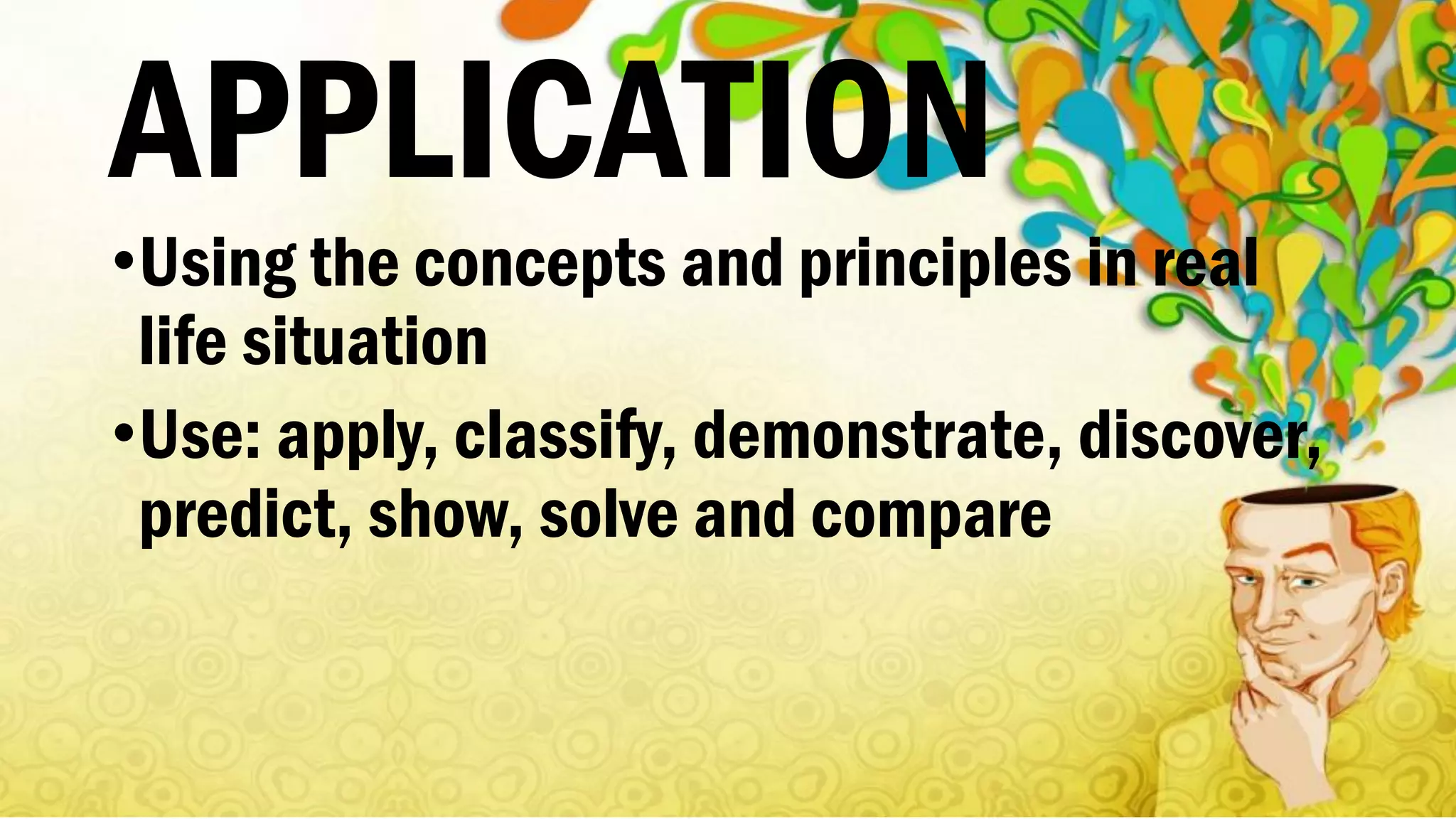
APPLICATION
•Using the concepts and principles in real
life situation
•Use: apply, classify, demonstrate, discover,
predict, show, solve and compare
ANALYSIS•Requires higher level thinking skills such as
finding underlying structures, separating the
whole into its components, identifying motives
and recognizing hidden meanings
•Use: analyze, ascertain, diagram,
differentiate, discriminate, examine,
determine, classify, investigate, construct and
contrast
SYNTHESIS
•Students put together elements of what
had been learned in a new way
•Use: combine, compile, create, design,
develop, expand, integrate, extend,
originate, synthesize and formulate
EVALUATION•Highest level of cognition and students can now
assess or judge, based on a set of standards, on
what they learned
•Expected to make thoughtful value decisions with
reference to knowledge, resolve differences and
controversies and develop personal opinions,
judgments and decisions
•Use: assess, critique, judge, appraise, contrast,
evaluate, weigh and recommend
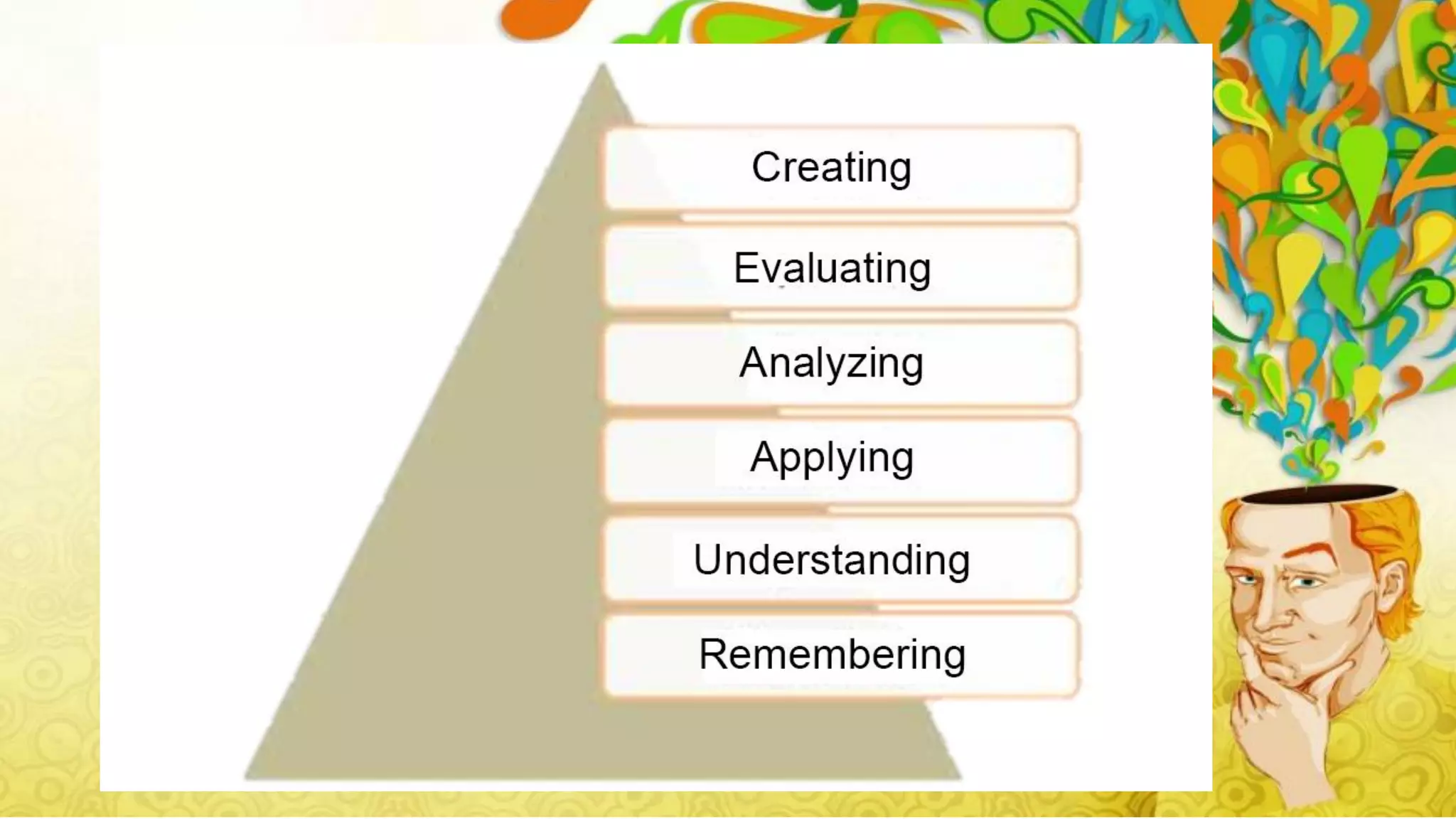
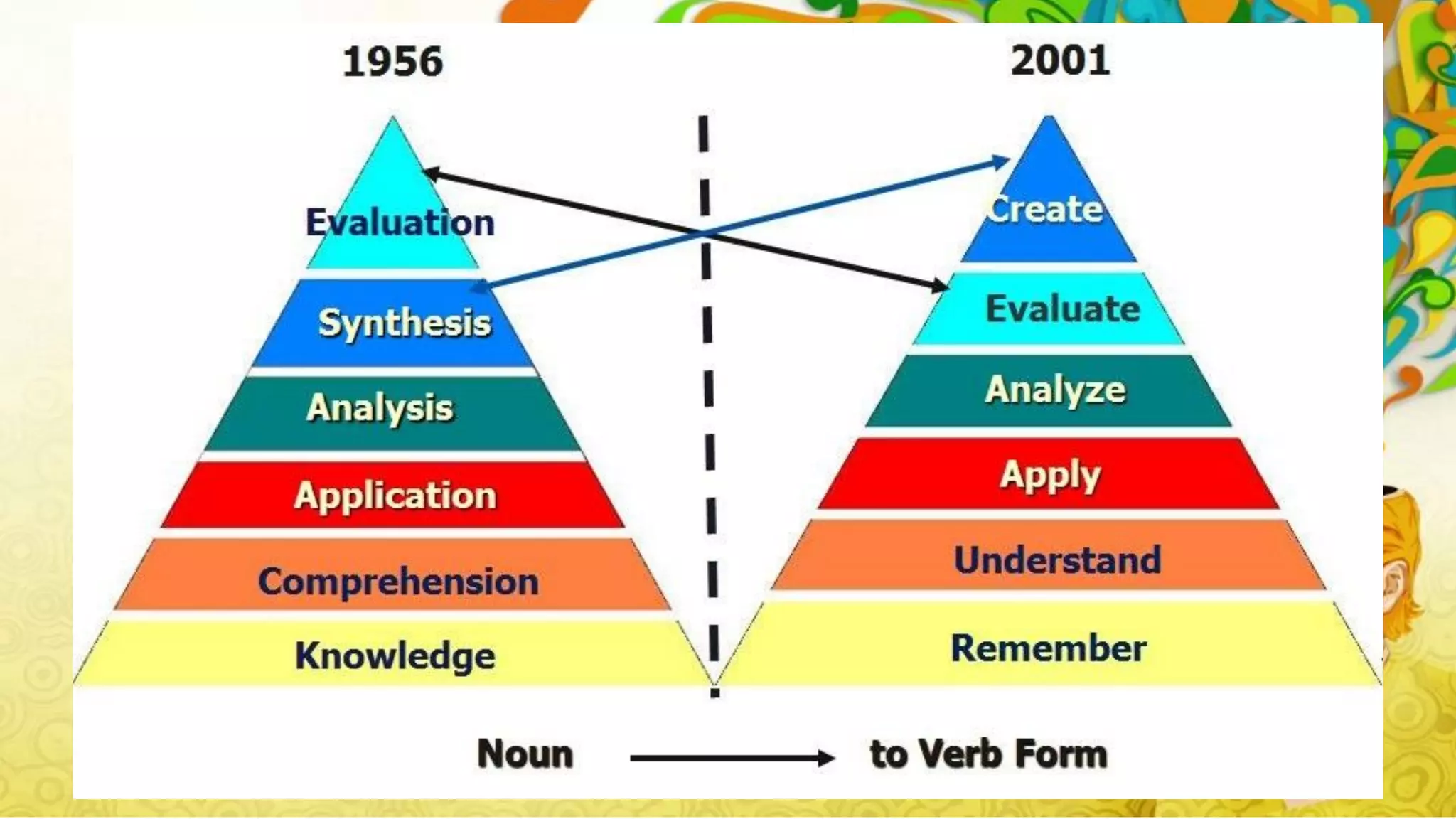
Lorin Anderson (a former student of Bloom), David
Krathwohl and a group of cognitive psychologist, updated
the taxonomy.
The new adaptation also took into consideration many of
Bloom’s own concerns and criticisms of his original
taxonomy.
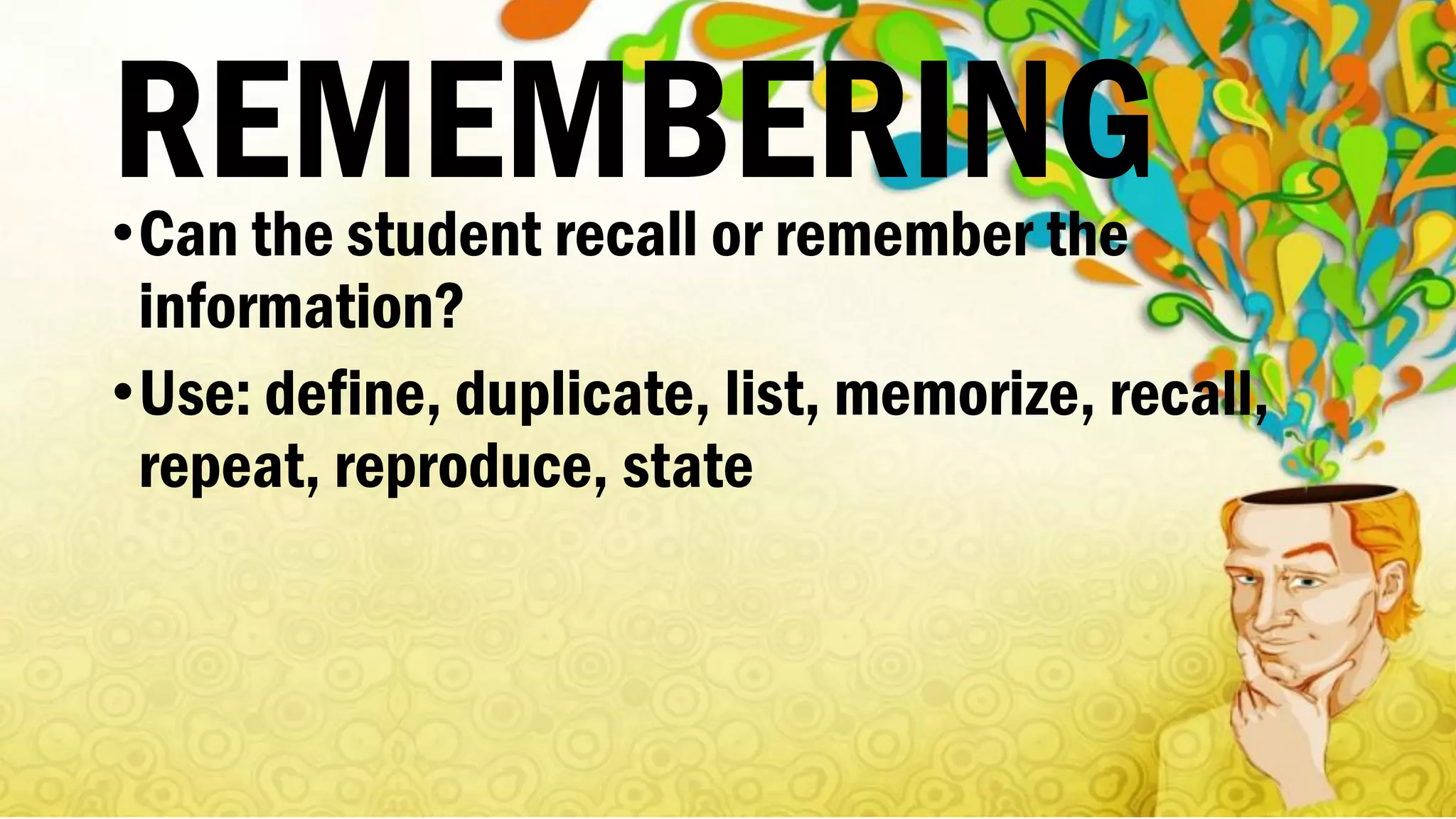
REMEMBERING•Can the student recall or remember the
information?
•Use: define, duplicate, list, memorize, recall,
repeat, reproduce, state
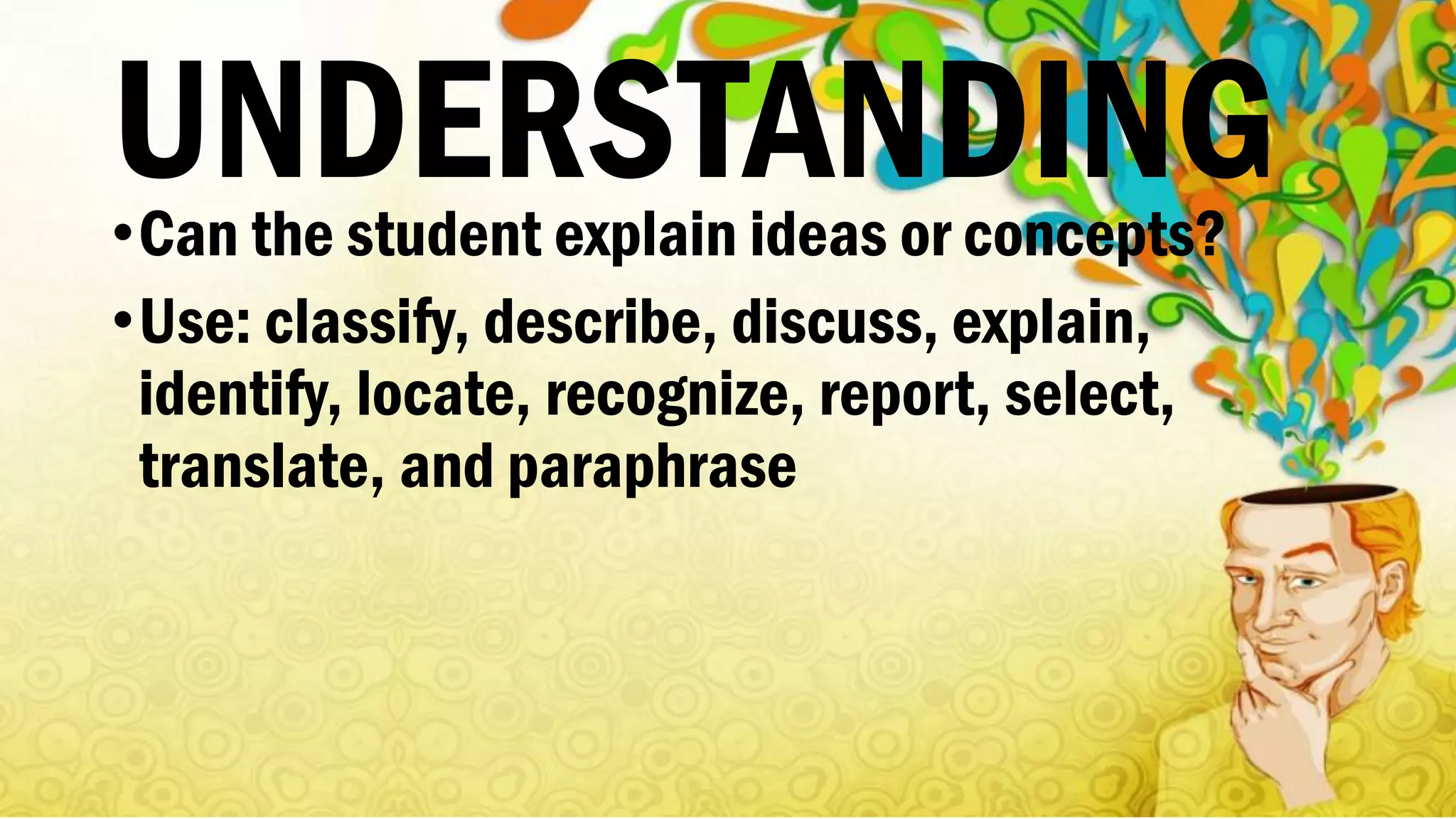
UNDERSTANDING•Can the student explain ideas or concepts?
•Use: classify, describe, discuss, explain,
identify, locate, recognize, report, select,
translate, and paraphrase
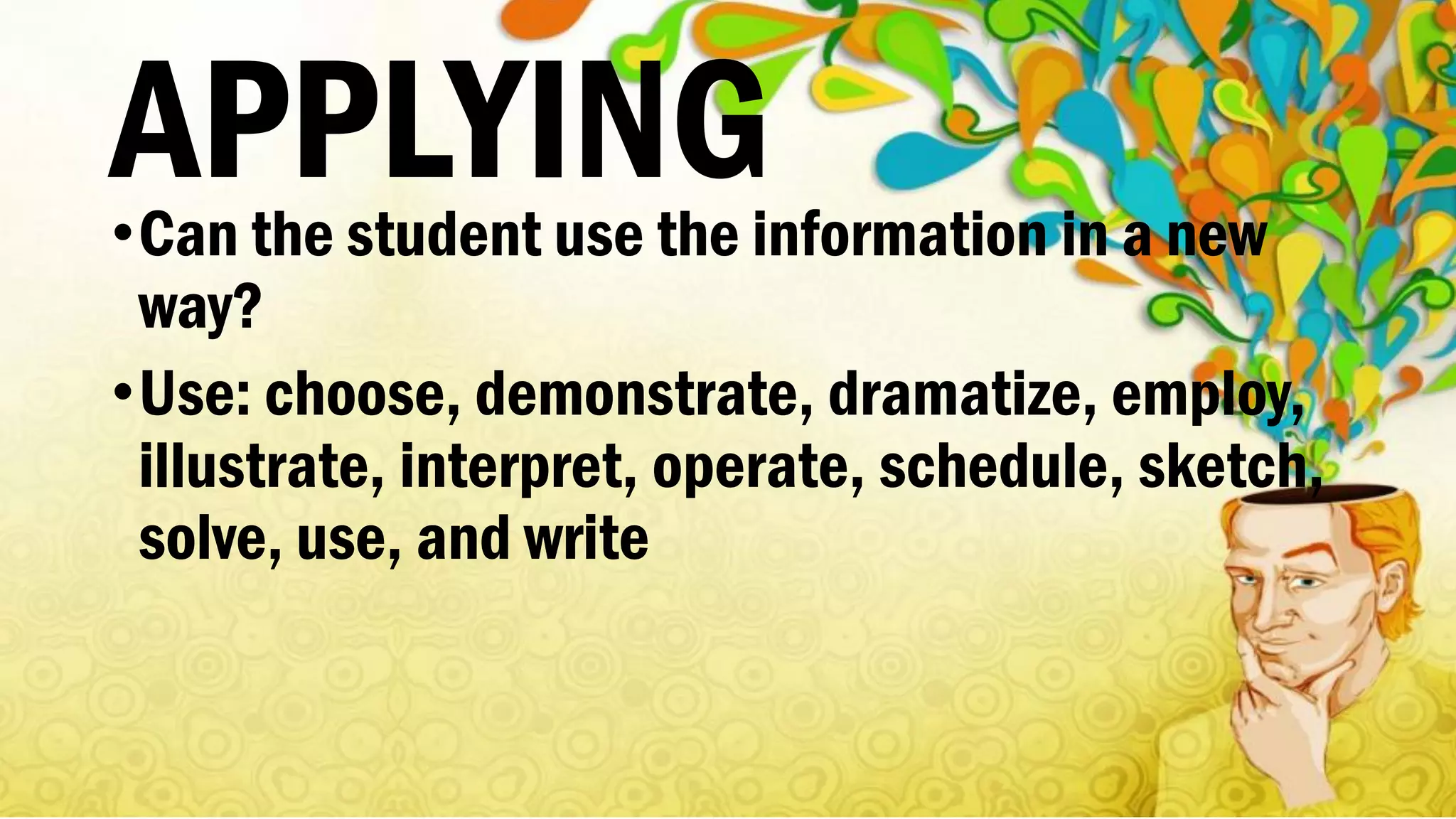
APPLYING•Can the student use the information in a new
way?
•Use: choose, demonstrate, dramatize, employ,
illustrate, interpret, operate, schedule, sketch,
solve, use, and write
ANALYZING•Can the student distinguish between the
different parts?
•Use: appraise, compare, contrast, criticize,
differentiate, discriminate, distinguish,
examine, experiment, question, and test
EVALUATING•Can the student justify a stand or decision?
•Use: appraise, argue, defend, judge, select,
support, value, and evaluate
CREATING•Can the student create a new product or point
of view?
•Use: construct, create, develop, formulate, and
write
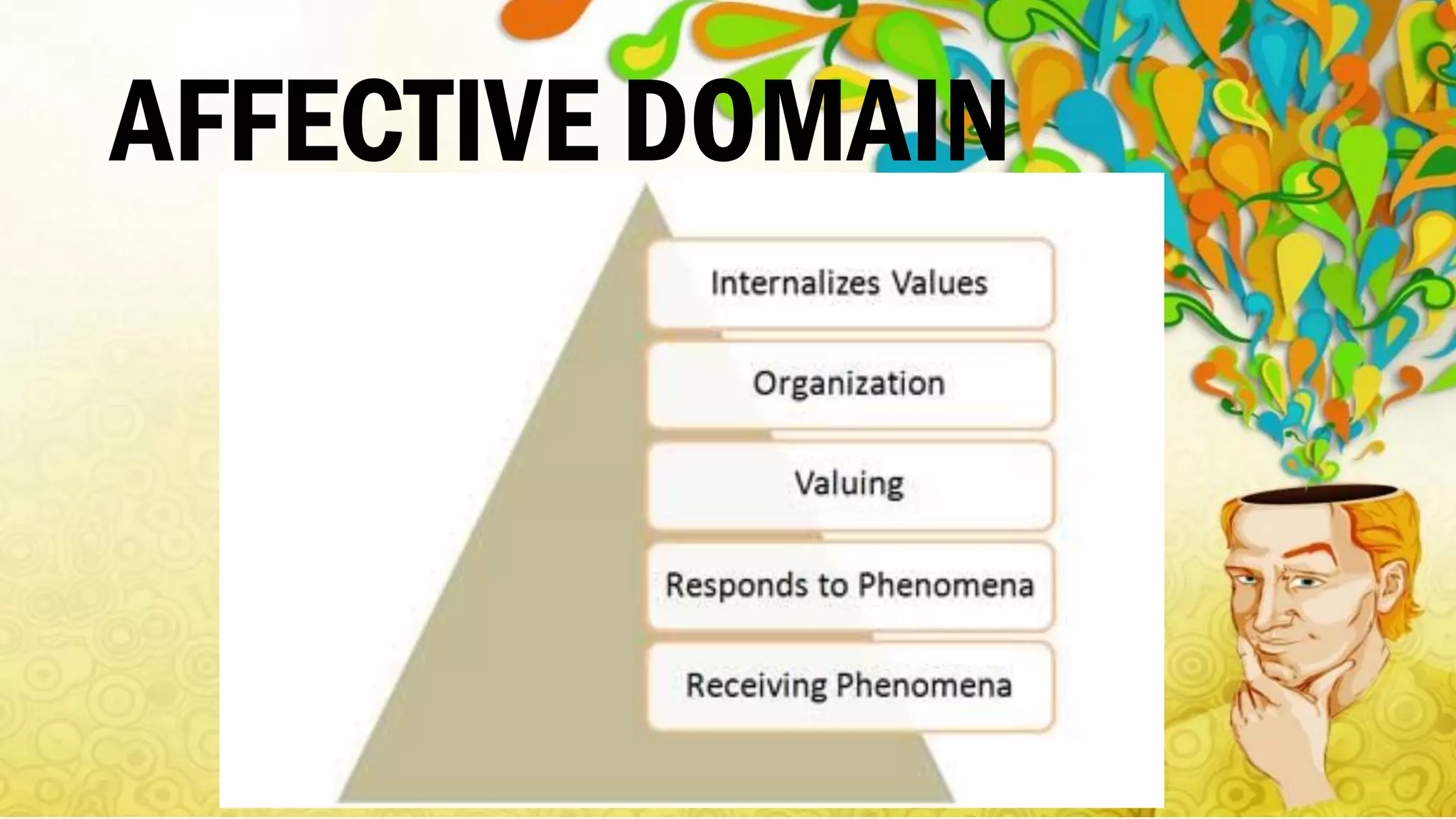
AFFECTIVE DOMAIN
Like cognitive objectives, affective objectives can also
be divided into a hierarchy (according to Krathwohl).
This area is concerned with feelings or emotions. The
taxonomy is arranged from simpler feelings to those
that are more complex.
This domain was first described in 1964 and as noted
before is attributed to David Krathwohl as the primary
author.
AFFECTIVE DOMAIN
RECEIVING
This refers to the learner’s sensitivity to the existence
of stimuli – awareness, willingness to receive, or
selected attention.
Feel, sense, capture, experience, pursue,
attend, perceive
RESPONDING
This refers to the learners’ active attention to stimuli
and his/her motivation to learn – acquiescence,
willing responses, or feelings of satisfaction.
Conform, allow, cooperate, contribute, enjoy,
satisfy
VALUING
This refers to the learner’s beliefs and attitudes of
worth – acceptance, preference, or commitment. An
acceptance, preference, or commitment to a value.
Believe, seek, justify, respect, search, persuade
ORGANIZATION
This refers to the learner’s internalization of values
and beliefs involving (1) the conceptualization of
values; and (2) the organization of a value system.
As values or beliefs become internalized, the leaner
organizes them according to priority.
Examine, clarify, systematize, create, integrate
CHARACTERIZATION
This refers to the learner’s highest of internalization
and relates to behavior that reflects (1) a generalized
set of values; and (2) a characterization or a
philosophy about life. At this level the learner is
capable of practicing and acting on their values or
beliefs.
Internalize, review, conclude, resolve, judge
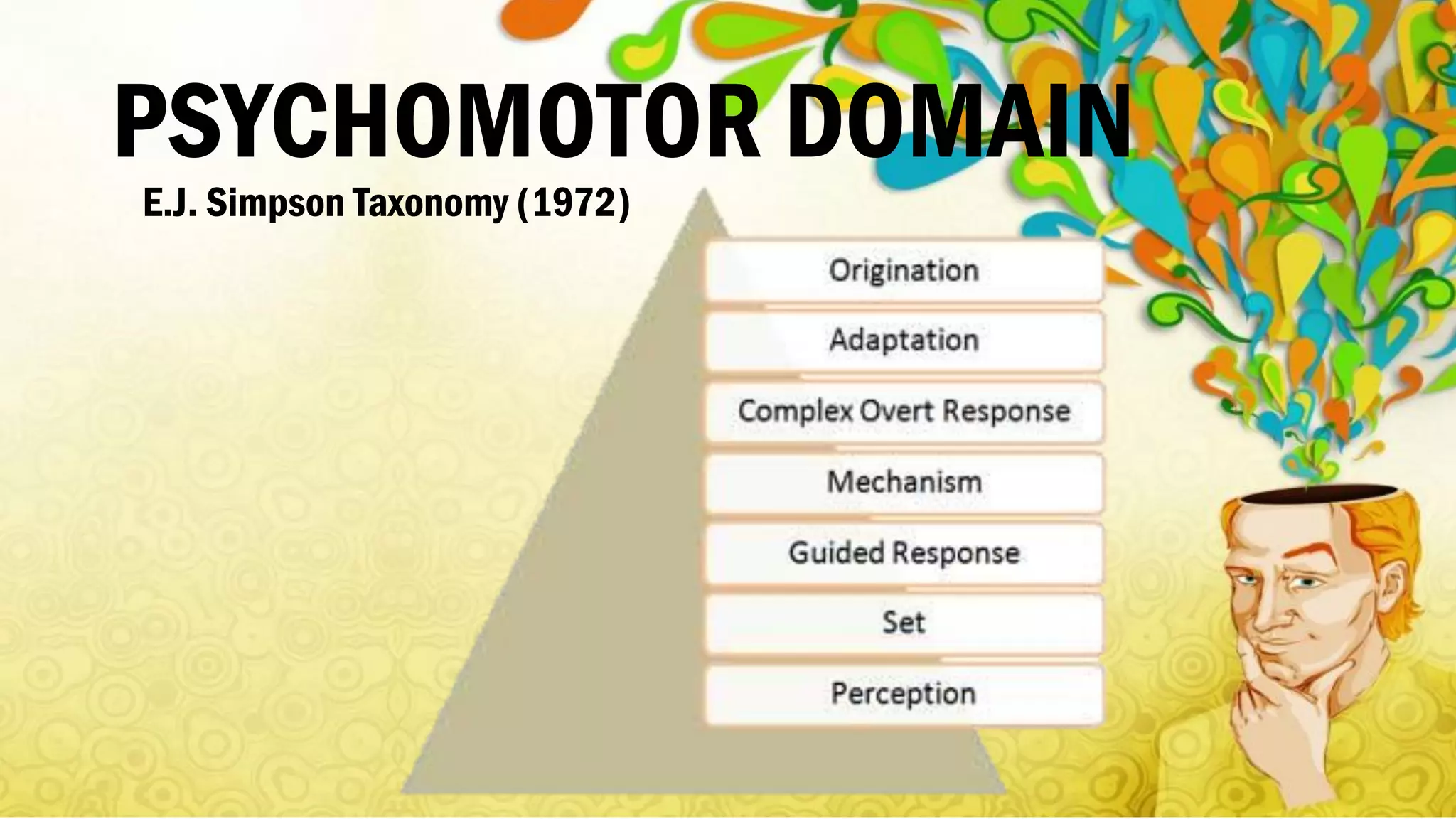
PSYCHOMOTOR DOMAIN
E.J. Simpson Taxonomy (1972)
PERCEPTION
•The ability to use sensory cues to guide motor
activity. This ranges from sensory stimulation,
through cue selection, to translation.
chooses, describes, detects,
differentiates, distinguishes,
identifies, isolates, relates, selects.
SET
Readiness to act. It includes mental, physical, and
emotional sets. These three sets are dispositions that
predetermine a person's response to different
situations (sometimes called mindsets).
begins, displays, explains, moves, proceeds,
reacts, shows, states, volunteers
GUIDED RESPONSE
The early stages in learning a complex skill that
includes imitation and trial and error. Adequacy of
performance is achieved by practicing.
copies, traces, follows, react, reproduce,
responds
MECHANISM
This is the intermediate stage in learning a complex
skill. Learned responses have become habitual and the
movements can be performed with some confidence and
proficiency.
assembles, calibrates, constructs, dismantles,
displays, fastens, fixes, grinds, heats,
manipulates, measures, mends, mixes,
organizes, sketches
COMPLEX OVERT RESPONSE
The skillful performance of motor acts that involve
complex movement patterns. Proficiency is indicated by a
quick, accurate, and highly coordinated performance,
requiring a minimum of energy.
assembles, builds, calibrates, constructs,
dismantles, displays, fastens, fixes, grinds, heats,
manipulates, measures, mends, mixes,
organizes, sketches.
ADAPTATION
Skills are well developed and the individual can
modify movement patterns to fit special
requirements.
adapts, alters, changes, rearranges,
reorganizes, revises, varies
ORIGINATION
Creating new movement patterns to fit a particular
situation or specific problem. Learning outcomes
emphasize creativity based upon highly developed
skills.
arranges, builds, combines, composes,
constructs, creates, designs, initiate, makes,
originates
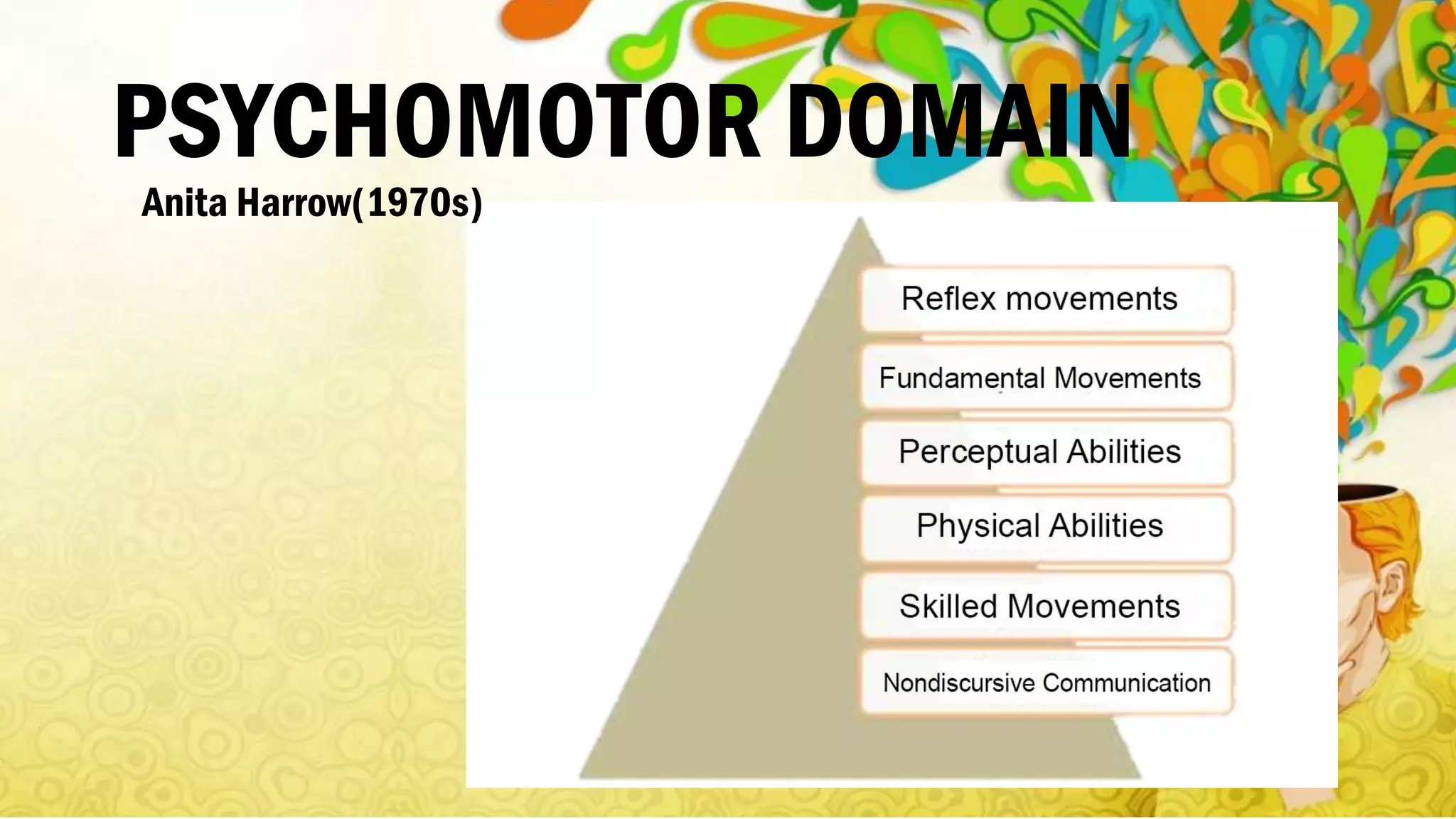
PSYCHOMOTOR DOMAIN
Anita Harrow(1970s)
REFLEX MOVEMENTS
Objectives at this level include reflexes that involve
one segmental or reflexes of the spine and
movements that may involve more than one
segmented portion of the spine as intersegmental
reflexes (e.g., involuntary muscle contraction). These
movements are involuntary being either present at
birth or emerging through maturation.
FUNDAMENTAL MOVEMENTS
Objectives in this area refer to skills or movements or
behaviors related to walking, running, jumping,
pushing, pulling and manipulating. They are often
components for more complex actions.
PERCEPTUAL ABILITIES
Objectives in this area should address skills related
to kinesthetic (bodily movements), visual, auditory,
tactile (touch), or coordination abilities as they are
related to the ability to take in information from the
environment and react.
PHYSICAL ABILITIES
Objectives in this area should be related to
endurance, flexibility, agility, strength, reaction-
response time or dexterity.
SKILLED MOVEMENTS
Objectives in this area refer to skills and movements
that must be learned for games, sports, dances,
performances, or for the arts.
NONDISCURSIVE COMMUNICATION
Objectives in this area refer to expressive movements
through posture, gestures, facial expressions, and/or
creative movements like those in mime or ballet.
These movements refer to interpretative movements
that communicate meaning without the aid of verbal
commands or help.
Complex Overt Response (Expert): The skillful
performance of motor acts that involve complex
movement patterns. Proficiency is indicated by a quick,
accurate, and highly coordinated performance,
requiring a minimum of energy. This category includes
performing without hesitation, and automatic
performance. For example, players are often utter
sounds of satisfaction or expletives as soon as they hit
a tennis ball or throw a football, because they can tell
by the feel of the act what the result will produce.
Examples: Maneuvers a car into a tight parallel
parking spot. Operates a computer quickly and
accurately. Displays competence while playing the
piano.
Key Words: assembles, builds, calibrates, constructs,
dismantles, displays, fastens, fixes, grinds, heats,
manipulates, measures, mends, mixes, organizes,
sketches.
NOTE: The Key Words are the same as Mechanism,
but will have adverbs or adjectives that indicate that the
performance is quicker, better, more accurate, etc.
Origination: Creating new movement patterns to fit a
particular situation or specific problem. Learning
outcomes emphasize creativity based upon highly
developed skills.
Examples: Constructs a new theory. Develops a new
and comprehensive training programming. Creates a
new gymnastic routine.
Key Words: arranges, builds, combines, composes,
constructs, creates, designs, initiate, makes, originates.
Adaptation: Skills are well developed and the
individual can modify movement patterns to fit special
requirements.
Examples: Responds effectively to unexpected
experiences. Modifies instruction to meet the needs of
the learners. Perform a task with a machine that it was
not originally intended to do (machine is not damaged
and there is no danger in performing the new task).
Key Words: adapts, alters, changes, rearranges,
reorganizes, revises, varies.
Bloom, B.S. and Krathwohl, D. R., et al.(1956) Taxonomy of Educational
Objectives: The Classification of Educational Goals, by a committee of
college and university examiners. Handbook I: Cognitive Domain. NY, NY:
Longmans, Green
Krathwohl, D.R., Bloom,B.S. and Masia, B. B. (1964).Taxonomy of
educational objectives, Book II. Affective domain. New York, NY. David
McKay Company, Inc.
Harrow, A. (1972) A Taxonomy of Psychomotor Domain: A Guide for
Developing Behavioral Objectives. New York: David McKay.
Simpson E.J. (1972). The Classification of Educational Objectives in the
Psychomotor Domain. Washington, DC: Gryphon House.

Revised Bloom's Taxonomy of Objectives by Anderson and Krathwol

  • 1.
  • 3.
    ’ Bloom’s Taxonomy wascreated in 1956 under the leadership of educational psychologist Dr. Benjamin Bloom in order to promote higher forms of thinking education, such as analyzing and evaluating , rather than just remembering facts(rote learning).
  • 4.
    With educational taxonomy,learning is classified into three domains namely: 1. Cognitive Domain – domain of thought process. 2. Affective Domain – domain of valuing, attitude and appreciation. 3. Psychomotor Domain – domain of the use of psychomotor attributes.
  • 6.
    KNOWLEDGE •Facts, stating memorizedrules, principles or definitions •Includes memorizing, recognizing or recalling factual information •Use: list, identify, name, recite and define
  • 7.
    COMPREHENSION •Understanding concepts, rulesand principles •Organizing, describing and interpreting concepts •Use: describe, interpret, explain, illustrate, summarize, restate and defend
  • 8.
    APPLICATION •Using the conceptsand principles in real life situation •Use: apply, classify, demonstrate, discover, predict, show, solve and compare
  • 9.
    ANALYSIS•Requires higher levelthinking skills such as finding underlying structures, separating the whole into its components, identifying motives and recognizing hidden meanings •Use: analyze, ascertain, diagram, differentiate, discriminate, examine, determine, classify, investigate, construct and contrast
  • 10.
    SYNTHESIS •Students put togetherelements of what had been learned in a new way •Use: combine, compile, create, design, develop, expand, integrate, extend, originate, synthesize and formulate
  • 11.
    EVALUATION•Highest level ofcognition and students can now assess or judge, based on a set of standards, on what they learned •Expected to make thoughtful value decisions with reference to knowledge, resolve differences and controversies and develop personal opinions, judgments and decisions •Use: assess, critique, judge, appraise, contrast, evaluate, weigh and recommend
  • 12.
    Lorin Anderson (aformer student of Bloom), David Krathwohl and a group of cognitive psychologist, updated the taxonomy. The new adaptation also took into consideration many of Bloom’s own concerns and criticisms of his original taxonomy.
  • 14.
    REMEMBERING•Can the studentrecall or remember the information? •Use: define, duplicate, list, memorize, recall, repeat, reproduce, state
  • 15.
    UNDERSTANDING•Can the studentexplain ideas or concepts? •Use: classify, describe, discuss, explain, identify, locate, recognize, report, select, translate, and paraphrase
  • 16.
    APPLYING•Can the studentuse the information in a new way? •Use: choose, demonstrate, dramatize, employ, illustrate, interpret, operate, schedule, sketch, solve, use, and write
  • 17.
    ANALYZING•Can the studentdistinguish between the different parts? •Use: appraise, compare, contrast, criticize, differentiate, discriminate, distinguish, examine, experiment, question, and test
  • 18.
    EVALUATING•Can the studentjustify a stand or decision? •Use: appraise, argue, defend, judge, select, support, value, and evaluate
  • 19.
    CREATING•Can the studentcreate a new product or point of view? •Use: construct, create, develop, formulate, and write
  • 21.
    AFFECTIVE DOMAIN Like cognitiveobjectives, affective objectives can also be divided into a hierarchy (according to Krathwohl). This area is concerned with feelings or emotions. The taxonomy is arranged from simpler feelings to those that are more complex. This domain was first described in 1964 and as noted before is attributed to David Krathwohl as the primary author.
  • 22.
  • 23.
    RECEIVING This refers tothe learner’s sensitivity to the existence of stimuli – awareness, willingness to receive, or selected attention. Feel, sense, capture, experience, pursue, attend, perceive
  • 24.
    RESPONDING This refers tothe learners’ active attention to stimuli and his/her motivation to learn – acquiescence, willing responses, or feelings of satisfaction. Conform, allow, cooperate, contribute, enjoy, satisfy
  • 25.
    VALUING This refers tothe learner’s beliefs and attitudes of worth – acceptance, preference, or commitment. An acceptance, preference, or commitment to a value. Believe, seek, justify, respect, search, persuade
  • 26.
    ORGANIZATION This refers tothe learner’s internalization of values and beliefs involving (1) the conceptualization of values; and (2) the organization of a value system. As values or beliefs become internalized, the leaner organizes them according to priority. Examine, clarify, systematize, create, integrate
  • 27.
    CHARACTERIZATION This refers tothe learner’s highest of internalization and relates to behavior that reflects (1) a generalized set of values; and (2) a characterization or a philosophy about life. At this level the learner is capable of practicing and acting on their values or beliefs. Internalize, review, conclude, resolve, judge
  • 28.
  • 29.
    PERCEPTION •The ability touse sensory cues to guide motor activity. This ranges from sensory stimulation, through cue selection, to translation. chooses, describes, detects, differentiates, distinguishes, identifies, isolates, relates, selects.
  • 30.
    SET Readiness to act.It includes mental, physical, and emotional sets. These three sets are dispositions that predetermine a person's response to different situations (sometimes called mindsets). begins, displays, explains, moves, proceeds, reacts, shows, states, volunteers
  • 31.
    GUIDED RESPONSE The earlystages in learning a complex skill that includes imitation and trial and error. Adequacy of performance is achieved by practicing. copies, traces, follows, react, reproduce, responds
  • 32.
    MECHANISM This is theintermediate stage in learning a complex skill. Learned responses have become habitual and the movements can be performed with some confidence and proficiency. assembles, calibrates, constructs, dismantles, displays, fastens, fixes, grinds, heats, manipulates, measures, mends, mixes, organizes, sketches
  • 33.
    COMPLEX OVERT RESPONSE Theskillful performance of motor acts that involve complex movement patterns. Proficiency is indicated by a quick, accurate, and highly coordinated performance, requiring a minimum of energy. assembles, builds, calibrates, constructs, dismantles, displays, fastens, fixes, grinds, heats, manipulates, measures, mends, mixes, organizes, sketches.
  • 34.
    ADAPTATION Skills are welldeveloped and the individual can modify movement patterns to fit special requirements. adapts, alters, changes, rearranges, reorganizes, revises, varies
  • 35.
    ORIGINATION Creating new movementpatterns to fit a particular situation or specific problem. Learning outcomes emphasize creativity based upon highly developed skills. arranges, builds, combines, composes, constructs, creates, designs, initiate, makes, originates
  • 36.
  • 37.
    REFLEX MOVEMENTS Objectives atthis level include reflexes that involve one segmental or reflexes of the spine and movements that may involve more than one segmented portion of the spine as intersegmental reflexes (e.g., involuntary muscle contraction). These movements are involuntary being either present at birth or emerging through maturation.
  • 38.
    FUNDAMENTAL MOVEMENTS Objectives inthis area refer to skills or movements or behaviors related to walking, running, jumping, pushing, pulling and manipulating. They are often components for more complex actions.
  • 39.
    PERCEPTUAL ABILITIES Objectives inthis area should address skills related to kinesthetic (bodily movements), visual, auditory, tactile (touch), or coordination abilities as they are related to the ability to take in information from the environment and react.
  • 40.
    PHYSICAL ABILITIES Objectives inthis area should be related to endurance, flexibility, agility, strength, reaction- response time or dexterity.
  • 41.
    SKILLED MOVEMENTS Objectives inthis area refer to skills and movements that must be learned for games, sports, dances, performances, or for the arts.
  • 42.
    NONDISCURSIVE COMMUNICATION Objectives inthis area refer to expressive movements through posture, gestures, facial expressions, and/or creative movements like those in mime or ballet. These movements refer to interpretative movements that communicate meaning without the aid of verbal commands or help.
  • 43.
    Complex Overt Response(Expert): The skillful performance of motor acts that involve complex movement patterns. Proficiency is indicated by a quick, accurate, and highly coordinated performance, requiring a minimum of energy. This category includes performing without hesitation, and automatic performance. For example, players are often utter sounds of satisfaction or expletives as soon as they hit a tennis ball or throw a football, because they can tell by the feel of the act what the result will produce. Examples: Maneuvers a car into a tight parallel parking spot. Operates a computer quickly and accurately. Displays competence while playing the piano. Key Words: assembles, builds, calibrates, constructs, dismantles, displays, fastens, fixes, grinds, heats, manipulates, measures, mends, mixes, organizes, sketches. NOTE: The Key Words are the same as Mechanism, but will have adverbs or adjectives that indicate that the performance is quicker, better, more accurate, etc.
  • 44.
    Origination: Creating newmovement patterns to fit a particular situation or specific problem. Learning outcomes emphasize creativity based upon highly developed skills. Examples: Constructs a new theory. Develops a new and comprehensive training programming. Creates a new gymnastic routine. Key Words: arranges, builds, combines, composes, constructs, creates, designs, initiate, makes, originates. Adaptation: Skills are well developed and the individual can modify movement patterns to fit special requirements. Examples: Responds effectively to unexpected experiences. Modifies instruction to meet the needs of the learners. Perform a task with a machine that it was not originally intended to do (machine is not damaged and there is no danger in performing the new task). Key Words: adapts, alters, changes, rearranges, reorganizes, revises, varies.
  • 47.
    Bloom, B.S. andKrathwohl, D. R., et al.(1956) Taxonomy of Educational Objectives: The Classification of Educational Goals, by a committee of college and university examiners. Handbook I: Cognitive Domain. NY, NY: Longmans, Green Krathwohl, D.R., Bloom,B.S. and Masia, B. B. (1964).Taxonomy of educational objectives, Book II. Affective domain. New York, NY. David McKay Company, Inc. Harrow, A. (1972) A Taxonomy of Psychomotor Domain: A Guide for Developing Behavioral Objectives. New York: David McKay. Simpson E.J. (1972). The Classification of Educational Objectives in the Psychomotor Domain. Washington, DC: Gryphon House.