What is Constructivism?
A view of learning based on the belief that
knowledge isn't a thing that can simply be
given by the teacher at the front of students
Students learn by fitting new information
together with what they already know
Learners are the builders and creators of
meaning and knowledge
Knowledge is constructed by learners through
an active, mental process of development
Our many thanks go out to…
Jean Piaget, 1896-1980
Piaget believed learning occurs by an active
construction of meaning, rather than by
receiving it passively.
He states," when we, as learners, encounter an
experience or situation that conflicts with our
current way of thinking, a state of imbalance is
created”
We must alter our thinking to restore
equilibrium or balance
 To do this, we must associate it with what
we already know
 The developing child must build
cognitive structures through the use of
…..
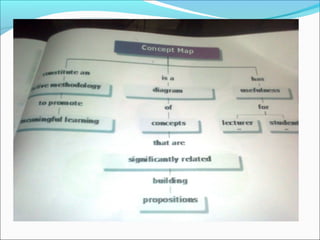
 Mental maps
 Concept maps
Flow chart ,Problem solving ,classification
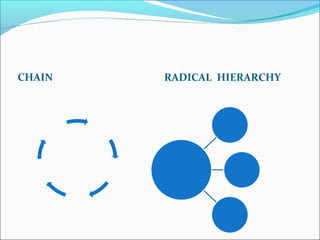
CHAIN RADICAL HIERARCHY
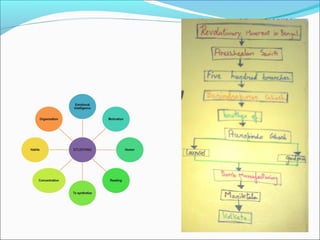
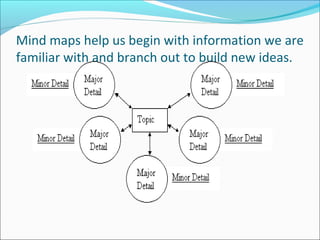
Mind maps help us begin with information we are
familiar with and branch out to build new ideas.
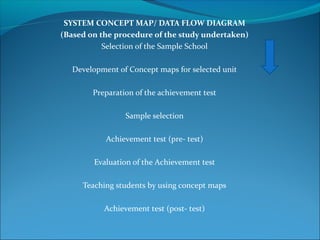
SYSTEM CONCEPT MAP/ DATA FLOW DIAGRAM
(Based on the procedure of the study undertaken)
Selection of the Sample School
Development of Concept maps for selected unit
Preparation of the achievement test
Sample selection
Achievement test (pre- test)
Evaluation of the Achievement test
Teaching students by using concept maps
Achievement test (post- test)
To further Piaget’s thinking....
We must alter our thinking to restore balance
or equilibrium
To do this, we must associate it with what we
already know
why constructivism is important?
Fosters critical thinking
Creates active and motivated learners
Students are able to learn through constructing
their own understandings
This approach frees teachers to make decisions
which enhance and enrich student’s
development.
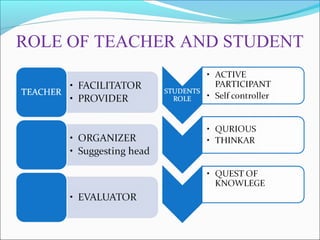
ROLE OF TEACHER AND STUDENT
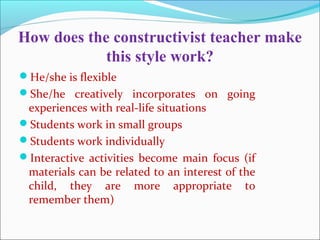
How does the constructivist teacher make
this style work?
He/she is flexible
She/he creatively incorporates on going
experiences with real-life situations
Students work in small groups
Students work individually
Interactive activities become main focus (if
materials can be related to an interest of the
child, they are more appropriate to
remember them)
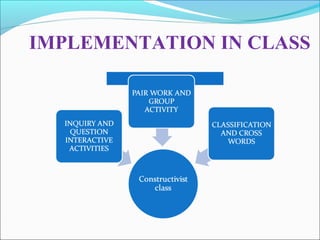
IMPLEMENTATION IN CLASS
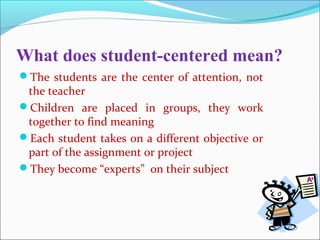
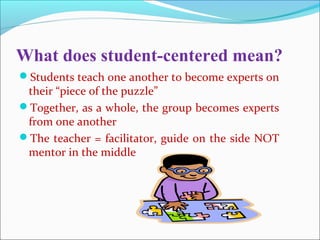
What does student-centered mean?
The students are the center of attention, not
the teacher
Children are placed in groups, they work
together to find meaning
Each student takes on a different objective or
part of the assignment or project
They become “experts” on their subject
What does student-centered mean?
Students teach one another to become experts on
their “piece of the puzzle”
Together, as a whole, the group becomes experts
from one another
The teacher = facilitator, guide on the side NOT
mentor in the middle
What about the constructivist classroom?
"Students should be presented with real life problems and then helped to discover
information required to solve them" John Dewey
 As we now know, the environment is a
student-centered one
Students are empowered by a teacher who
operates as a “guide on the side” vs. a “mentor
in the center” or “sage on the stage”
Classrooms are structured so that learners are
immersed in experiences with in which they
may engage in meaningful………
Inquiry
Action
Imagination
Invention
Interaction
Hypothesizing
Personal reflection
Important roles of the Teacher
Watching
Listening
Asking questions to learn about students
Having the ability to observe and listen to one’s
students and their experiences in the classroom
contributes to his other ability to use a
constructivist approach
A constructivist approach contributes to one’s
ability to observe and listen in the classroom.
In conclusion…
 I believe in teaching through constructivism
because…
1. Allows for students to become engaged with
one another
2. Cuts out the “talking head”
3. Children learn through own experiences based
on their lives
4. Remember information down the road of life
instead of memorization
Resources
 Piaget, J. (1977). The development of thought: Equilibration of cognitive
structures. (A. Rosin, Trans). New York: The Viking Press.
 Rosenblatt, L. (1978). The reader, the text, the poem: The transactional theory
of the literary work. Carbondale, !!: Southern Illinois University Press.
 Smith, K. (1993) Becoming the “guide” on the side. Educational Leadership, 51
(2), 35-37.
 Zemelman, S., Daniels, H., & Hyde, A. (1993). Best practice: New standards for
teaching and learning in America’s schools. Portsmouth, NH: Heinemann.
 Twomey Fosnot, C. (1989). Enquiring teachers, enquiring learners: A
constructivist approach for teaching. New York: Teachers College Press.
 McNeil, L. (1986). Contradictions of control: school structure and school
knowledge. New York: Routledge.
 Mezirow, J. and Associates. (1990). How critical reflection triggers
transformative learning. In J. Mezirow and Associates (1990), Fostering
critical reflection in adulthood: A guide to transformative and emancipatory
learning. San Francisco: Jossey-Bass Publishers

Ppt constructivism copy

  • 2.
    What is Constructivism? Aview of learning based on the belief that knowledge isn't a thing that can simply be given by the teacher at the front of students Students learn by fitting new information together with what they already know Learners are the builders and creators of meaning and knowledge Knowledge is constructed by learners through an active, mental process of development
  • 3.
    Our many thanksgo out to… Jean Piaget, 1896-1980
  • 4.
    Piaget believed learningoccurs by an active construction of meaning, rather than by receiving it passively. He states," when we, as learners, encounter an experience or situation that conflicts with our current way of thinking, a state of imbalance is created” We must alter our thinking to restore equilibrium or balance
  • 5.
     To dothis, we must associate it with what we already know  The developing child must build cognitive structures through the use of …..  Mental maps  Concept maps Flow chart ,Problem solving ,classification
  • 7.
  • 9.
    Mind maps helpus begin with information we are familiar with and branch out to build new ideas.
  • 11.
    SYSTEM CONCEPT MAP/DATA FLOW DIAGRAM (Based on the procedure of the study undertaken) Selection of the Sample School Development of Concept maps for selected unit Preparation of the achievement test Sample selection Achievement test (pre- test) Evaluation of the Achievement test Teaching students by using concept maps Achievement test (post- test)
  • 12.
    To further Piaget’sthinking.... We must alter our thinking to restore balance or equilibrium To do this, we must associate it with what we already know
  • 13.
    why constructivism isimportant? Fosters critical thinking Creates active and motivated learners Students are able to learn through constructing their own understandings This approach frees teachers to make decisions which enhance and enrich student’s development.
  • 14.
    ROLE OF TEACHERAND STUDENT
  • 15.
    How does theconstructivist teacher make this style work? He/she is flexible She/he creatively incorporates on going experiences with real-life situations Students work in small groups Students work individually Interactive activities become main focus (if materials can be related to an interest of the child, they are more appropriate to remember them)
  • 16.
  • 17.
    What does student-centeredmean? The students are the center of attention, not the teacher Children are placed in groups, they work together to find meaning Each student takes on a different objective or part of the assignment or project They become “experts” on their subject
  • 18.
    What does student-centeredmean? Students teach one another to become experts on their “piece of the puzzle” Together, as a whole, the group becomes experts from one another The teacher = facilitator, guide on the side NOT mentor in the middle
  • 19.
    What about theconstructivist classroom? "Students should be presented with real life problems and then helped to discover information required to solve them" John Dewey  As we now know, the environment is a student-centered one Students are empowered by a teacher who operates as a “guide on the side” vs. a “mentor in the center” or “sage on the stage” Classrooms are structured so that learners are immersed in experiences with in which they may engage in meaningful………
  • 20.
  • 21.
    Important roles ofthe Teacher Watching Listening Asking questions to learn about students Having the ability to observe and listen to one’s students and their experiences in the classroom contributes to his other ability to use a constructivist approach A constructivist approach contributes to one’s ability to observe and listen in the classroom.
  • 22.
    In conclusion…  Ibelieve in teaching through constructivism because… 1. Allows for students to become engaged with one another 2. Cuts out the “talking head” 3. Children learn through own experiences based on their lives 4. Remember information down the road of life instead of memorization
  • 23.
    Resources  Piaget, J.(1977). The development of thought: Equilibration of cognitive structures. (A. Rosin, Trans). New York: The Viking Press.  Rosenblatt, L. (1978). The reader, the text, the poem: The transactional theory of the literary work. Carbondale, !!: Southern Illinois University Press.  Smith, K. (1993) Becoming the “guide” on the side. Educational Leadership, 51 (2), 35-37.  Zemelman, S., Daniels, H., & Hyde, A. (1993). Best practice: New standards for teaching and learning in America’s schools. Portsmouth, NH: Heinemann.  Twomey Fosnot, C. (1989). Enquiring teachers, enquiring learners: A constructivist approach for teaching. New York: Teachers College Press.  McNeil, L. (1986). Contradictions of control: school structure and school knowledge. New York: Routledge.  Mezirow, J. and Associates. (1990). How critical reflection triggers transformative learning. In J. Mezirow and Associates (1990), Fostering critical reflection in adulthood: A guide to transformative and emancipatory learning. San Francisco: Jossey-Bass Publishers